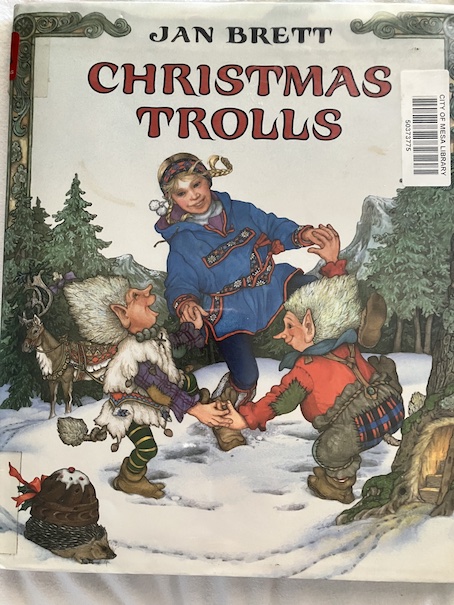
In this Scandinavian Christmas story, young Treva and her brother Sami are getting ready for Christmas when strange things start to happen.
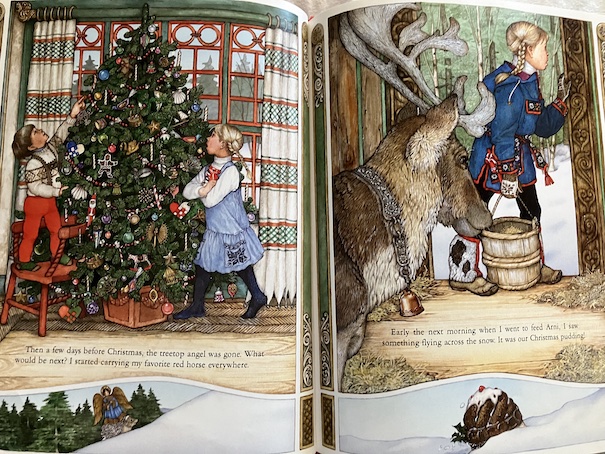
First, Treva feels like someone is watching them when they go to pick out a Christmas tree in the forest. Then, after they start decorating for Christmas, some of their decorations start to disappear. They had already wrapped Christmas presents and hidden them away, but they discover that those are gone, too!
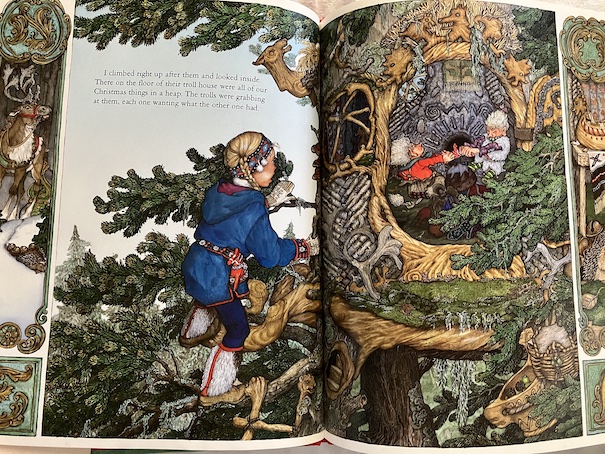
Treva begins to realize what is causing these disappearances when she spots their Christmas pudding, apparently moving quickly across the snow, stuck to the back of a hedgehog! Treva follows the hedgehog and pudding into the forest, where she finds two trolls, pulling the pudding up into their tree house.
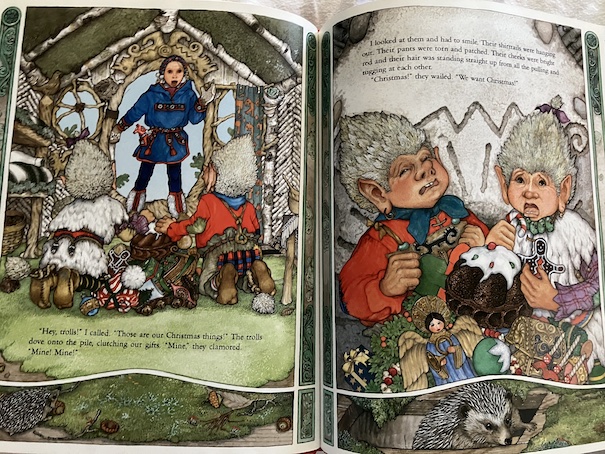
In the tree house, Treva finds the trolls arguing over all of the Christmas things they’ve taken from Treva’s family. Treva confronts them about stealing their Christmas things. The trolls say that they just want Christmas. They’re like small children who want something but don’t know how to get it or make it for themselves, so they just started trying to take it from other people.
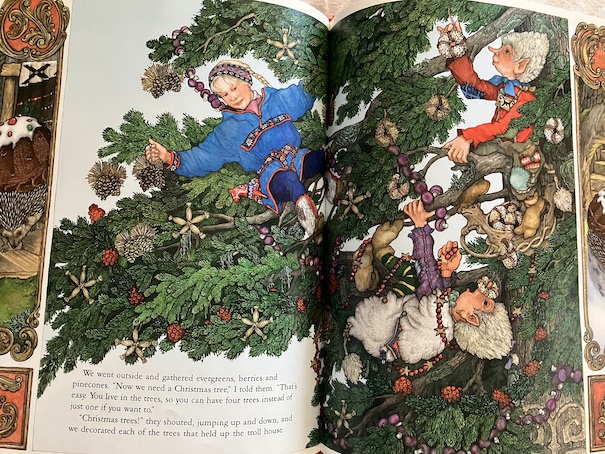
Treva tells them that she will show them what to do for Christmas. She helps them clean up their little house, make decorations, and decorate their tree for Christmas.
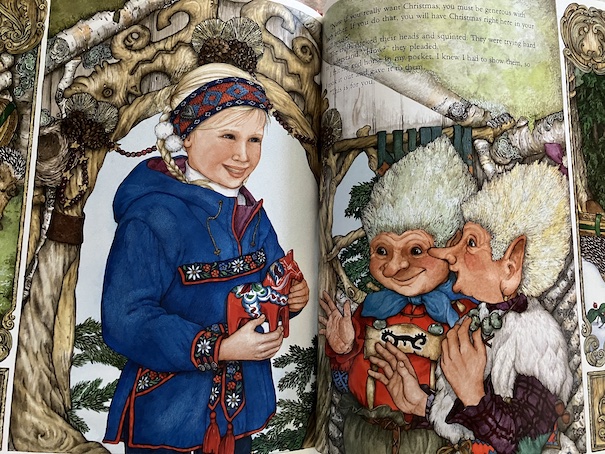
She also explains to them that arguing and being greedy isn’t the proper Christmas spirit, and it’s been ruining their mood. She tells them to try cooperating with each other and playing nicely together while they decorate. Finally, she teaches them that Christmas is about being generous and giving something to each other, not just taking things. To demonstrate what she means, she gives them their first Christmas present, her favorite Christmas decoration.
With the trolls now able to have Christmas on their own, Treva is able to reclaim the rest of her family’s Christmas presents and decorations. However, the trolls and their hedgehog friend have one more special Christmas present to give now that they understand what giving is.
The book is available to borrow and read for free online through Internet Archive (multiple copies).
My Reaction
This is a fun Christmas story with beautiful, colorful illustrations! I really loved the pictures in the book, with all the colorful Christmas decorations. The designs of the family’s Christmas decorations are traditional Scandinavian decorations. The side and bottom panels of the illustrations also explain some of what’s happening even before the main character understands.
I also loved the designs of the troll and their fun hedgehog friend. Around the time this story was published, troll dolls, which have existed since the late 1950s, were having a rise in popularity. The trolls in this story somewhat resemble troll dolls, with their fluffy hair rising to a point, although the troll dolls have more colorful hair options. I enjoy stories that use fantasy creatures, especially ones that aren’t especially common. The trolls in this story are troublesome, but in a little kid manner, not overly threatening. They’re more about mild magical mischief and lessons they have to learn.
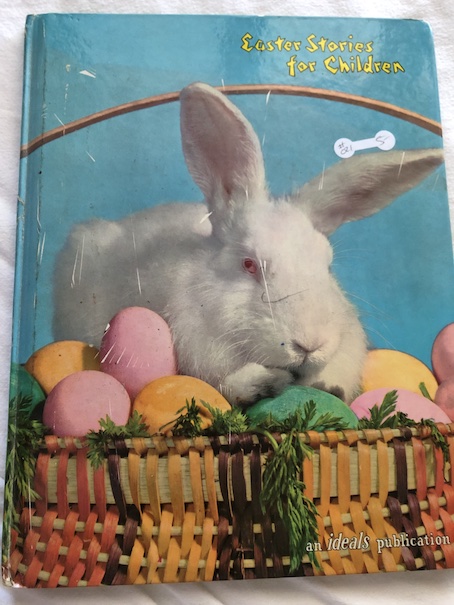
Easter Stories for Children edited by Van B. Hooper, 1962.
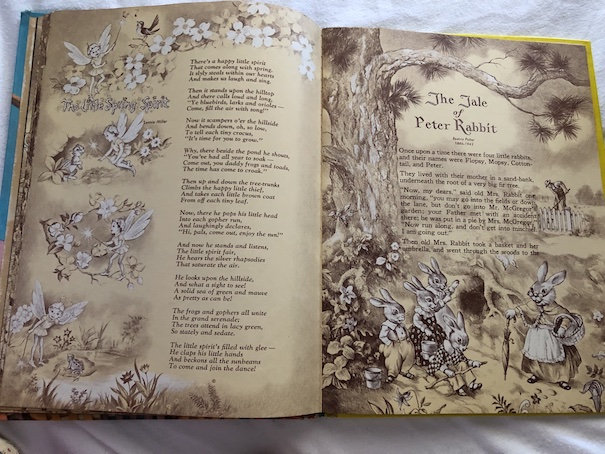
This book was published by Ideals, and if I remember right, is part of a series of holiday/seasonal books for children. (I don’t have a list of other books in the series, though.) It has short stories and poems about Easter. Largely, they’re not very religious in tone, tending to focus on fairies and the Easter bunny. I actually found all the references to fairies confusing because I never heard anybody talk about fairies being associated with Easter when I was a kid. On the religious side, there is one poem about prayer and a story about how the dogwood plant represents the crucifixion. There is also some information about how Easter is celebrated around the world.
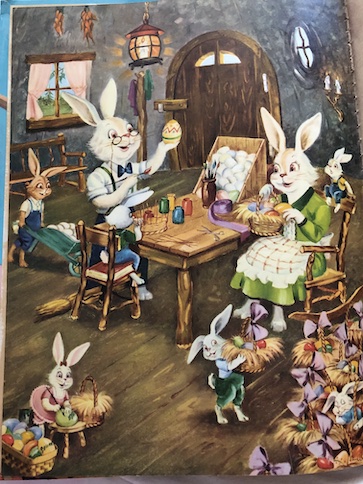
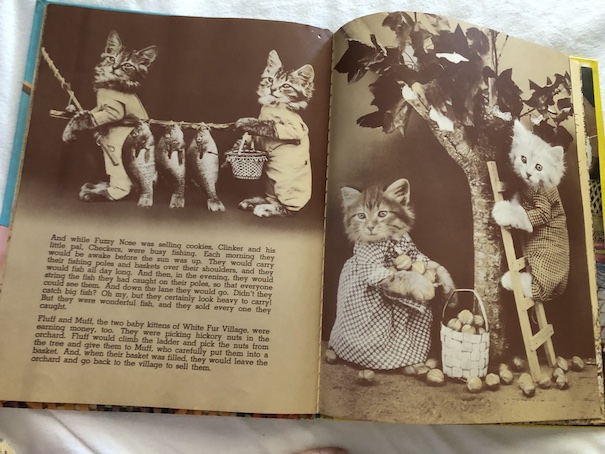
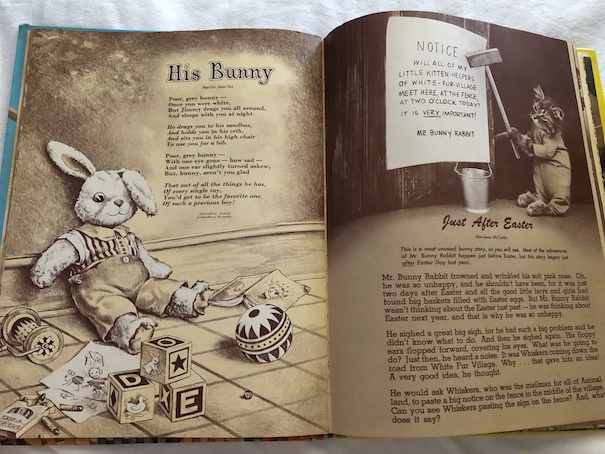
The pictures are in sepia tones. Mostly, they’re drawings, but there are also some photographs of cute bunnies and kittens wearing human clothes. The only full color pictures are on the inside of the front and back covers, and they’re scenes of rabbits painting Easter eggs. All in all, it’s a very cute book for Easter.
Stories:
How the Forest Fairies Get Ready for Spring – “Written especially for you by SPARKIE” – All of the forest fairies have special tasks for getting ready for spring.
The Tale of Peter Rabbit by Beatrix Potter (1886-1943) – A classic children’s story about a bunny who disobeys his mother.
Just After Easter by Maryjane McCarthy – Mr. Bunny Rabbit is worried about next Easter because the farmer is having trouble affording grain to feed his chickens. If he can’t keep the chickens, where will they get their Easter eggs? This is the story that has pictures of bunnies and kittens in costumes with props. The kittens try various ways to raise money for the chickens.
The Legend of the Dogwood – author unknown – The legend is that the cross of Jesus’s Crucifixion was made from dogwood, but the plant felt badly about it, so Jesus made the plant too small to be used for such a purpose again and gave it a cross-shaped flower.
Easter in Many Lands – About Easter customs in different countries, and the origins of the word “Easter” and how symbols like bunnies and eggs came to be associated with Easter. This is my favorite section in the book!
The Story of the Colored Easter Egg by “Maryjane” – A fairytale about a kind queen and the origins of Easter eggs.
Poems:
The Magic Pool by Dorothy Weiner – Bunnies color eggs in a magical pond fed by a rainbow.
Easter Bunny’s Secret by Mrs. Roy L. Peifer – The Easter bunny collects drops of paint that Jack Frost uses to paint leaves in autumn and saves them for Easter eggs, but when the paint gets spilled, he needs to get colors from other sources.
The Little Spring Spirit by Leonie Miller – The spirit of spring calls to plants and animals with the change of the season.
If Easter Eggs Would Hatch by Douglas Malloch – What would come out of an Easter egg? Brightly-colored chickens or maybe a little silver bunny?
In Cottontail Town by Marguerite Gode – A famly in Cottontail Town takes in an elderly rabbit and nurses him back to health. He starts a school there to teach the other rabbits how to paint Easter eggs.
The Gray Bunny’s Night – “As told by The big black Bumblebee” – A little gray bunny wants to be brightly colored for Easter, and his wish is granted by the queen of the fairies.
Hippety-Hop to the Barbershop by Claribel Ream – The Easter Bunny is going to the barbershop to deliver eggs and candy for the barber’s children.
Helping One Another by Mrs. Roy L. Peifer – The Little Red Hen helps the Easter Bunny to fill his basket for Easter.
His Bunny by Marilyn Jean Fais – About a little boy’s stuffed bunny. It can be hard on a toy to be a child’s favorite, worn and dragged everywhere, but it’s worth it!
Prayer by Ethel Romig Fuller – If we can hear songs from radio waves that travel through the air, God can also hear prayers.
Seed Thoughts by W. M. Walker – Good and kind thoughts produce good deeds, like plants sprouting from seeds, but selfish thoughts are like weeds that get in the way. Be careful what seed thoughts you grow in the garden of your mind!
Jack in the Pulpit by Mrs. Jessie S. Manifold – Spring plants and animals celebrate the Sabbath Day.
And He Hippety-Hopped Away by Rowena Bastin Bennett – The Easter Bunny delivers eggs and candy to children before sunrise.
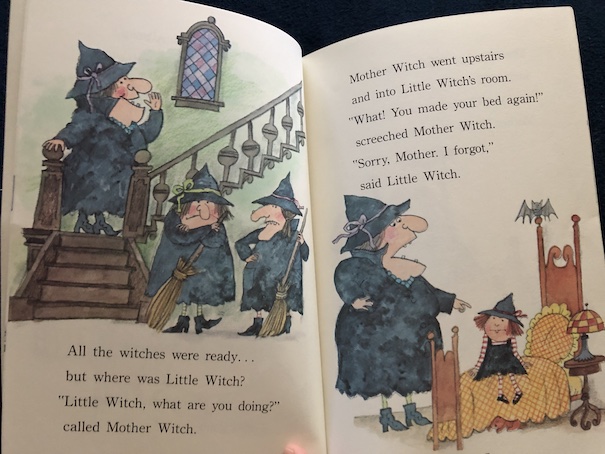
Little Witch’s Big Night by Deborah Hautzig, illustrated by Marc Brown, 1984.
On Halloween night, all the witches in Little Witch’s family are busy getting ready for their big broomstick ride. However, when Mother Witch sees that Little Witch has cleaned her room and made her bed, something too nice for a witch to do, she punishes her by telling her that she will have to stay home.
Because Little Witch is left at home, she is there to answer the door for three trick-or-treaters dressed as an astronaut, a devil, and a pirate. Since she doesn’t have any treats to offer them, she offers to give them rides on her broomstick.
The trick-or-treaters have a great time as Little Witch has her broom do tricks and she shows the pirate a real pirate ship.
The trick-or-treaters have so much fun that they promise to come back next year. Little Witch resolves to be good all year so that her mother will punish her again and make her stay home from the Halloween flight, so she will be there to meet her new friends when they come back.
However, when the other witches come back, Mother Witch says that she missed Little Witch on the flight and that she will get to come on the flight next year. Little Witch asks if she can bring some friends with her, and Mother Witch says that will be fine, as long as Little Witch isn’t too good.
This was one of my favorite Halloween books when I was a child, and so is one of the other books in the series, Happy Birthday, Little Witch. The first time I read these books, I read them out of order, but you really have to read the books in order to understand Happy Birthday, Little Witch because it turns out that Little Witch still doesn’t understand the idea of trick-or-treating or that human children wear costumes on Halloween. She really thinks that she met a small astronaut, pirate, and devil on Halloween, and that makes it difficult for her to find them when she wants to invite them to her birthday party. The Little Witch in this series isn’t the same as the Little Witch in theLittle Witch Craft Books.
The book is available to borrow for free online through Internet Archive.
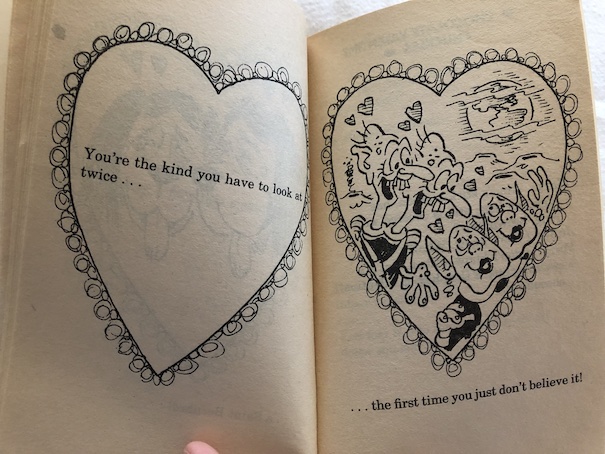
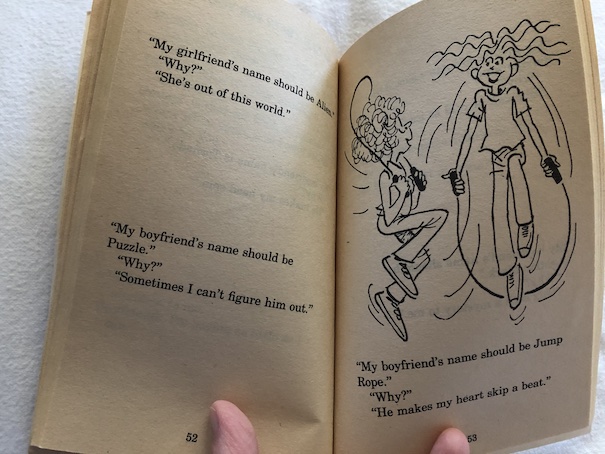
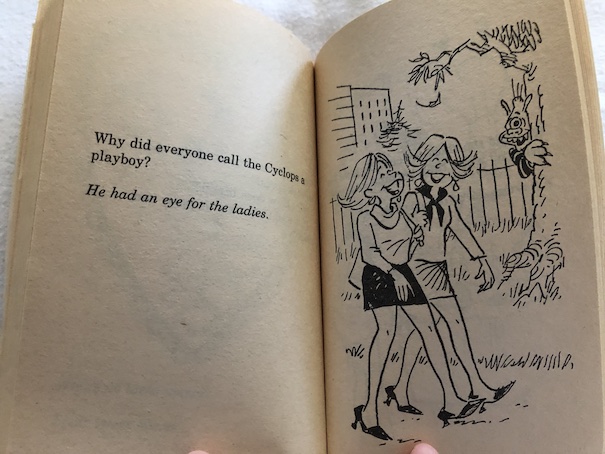
101 Valentine Jokes by Pat Brigandi, illustrated by Don Orehek, 1994.
This is one of those little themed joke books that I used to pick up at school book fairs and used book sales when I was a kid. Most of the jokes are really corny, but I remember finding them fun when I was a kid. Happy Valentine’s Day!
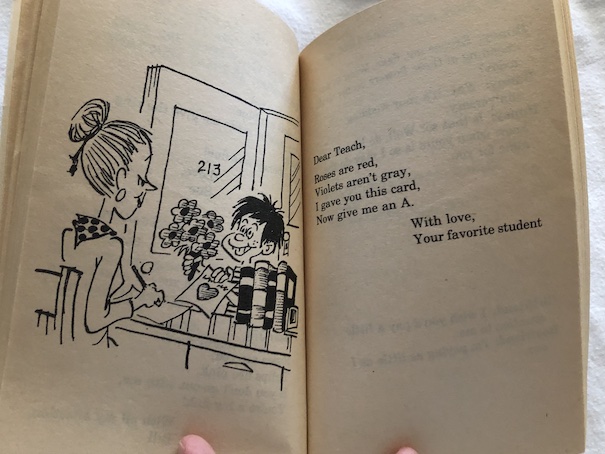
One of the things that surprised me about this book is that some of the jokes are weirdly insulting for a Valentine-themed book. It just struck me as odd that there were jokes with people basically insulting their boyfriends or girlfriends or sending insulting Valentines.
Actually, as I kid, I think I understood the point of the insulting joke Valentine cards because, when you’re a kid in school, there are rules that require you to give a Valentine to every person in class, whether you like them or get along with them or not, so nobody feels left out. Those rules make sense because teachers don’t want to create a situation a situation where somebody in class is being deliberately ignored by other students or the kids are playing one-upmanship about who is more popular than who. But at the same time, when someone else in class has been picking on you all year, that’s the last person you want to give a Valentine. You can’t really give people nasty Valentines like this (at least, not without getting into trouble), but there are times when it can be fun to imagine that you could so you can tell off some jerk who desperately needs it.
But, when it comes to people insulting their boyfriends or girlfriends, I’m just thinking, “If you feel that way about this person, why are you going out with them? Go find someone else!”
Fortunately, not all the jokes in this book are mean. It would have been depressing if all of them were negative in some way. There are the usual knock-knock jokes, jokes based on puns, and a few jokes that are told in story form or silly conversations.
There is one long joke that’s a form letter for “thanking” someone for a present. (Hint: It’s implied that the present wasn’t that great and the person isn’t thankful for it. It reminded me of one of the joke poems in The D- Minus Poems of Jeremy Bloom, and I think the poem was better.)
Overall, I think the best jokes were the kind that I think I kids really could use in class Valentines without getting in trouble. Because of all the insulting ones, though, I felt like there weren’t enough of this kind of joke.
What did the chewing gum say to the show? I’m stuck on you.
This book does have the classic:
Will you remember me tomorrow? Of course I will. Will you remember me next week? Of course I will. Will you remember me next month? Of course I will. Will you remember me next year? Of course I will. Knock, knock. Who’s there? See, you forgot me already!
The book is available to borrow and read for free online through Internet Archive.
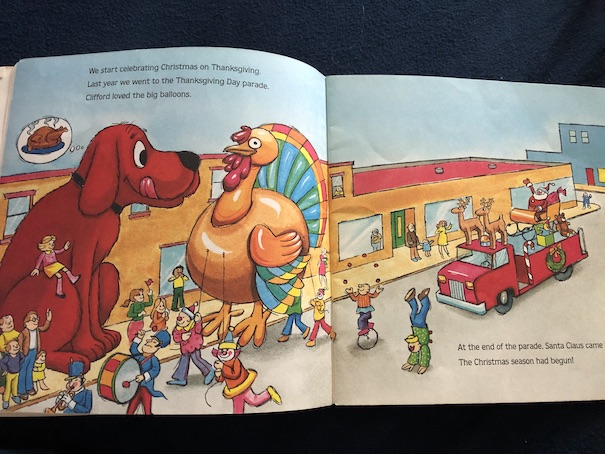
Christmas is coming, and Emily Elizabeth and Clifford are ready to celebrate! Emily Elizabeth talks about how the Christmas season begins with Thanksgiving. (That’s not how everyone regards it, but it is a common way to mark the season in the United States. The day after Thanksgiving, Black Friday, is considered the start of the Christmas shopping season, with people looking for bargains on Christmas presents.)
When it starts to snow, Emily Elizabeth, Clifford, and their friends have fun playing in the snow. They get a Christmas tree, prepare their stockings, and participate in other holiday activities leading up to Christmas. Clifford even gets a kiss under mistletoe!
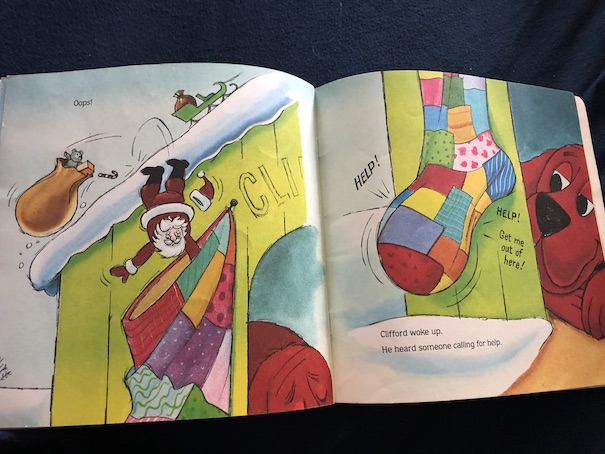
When Santa comes, he lands on the roof of Clifford’s dog house and accidentally falls into Clifford’s stocking, dropping his sack of toys. Clifford has to rescue him.
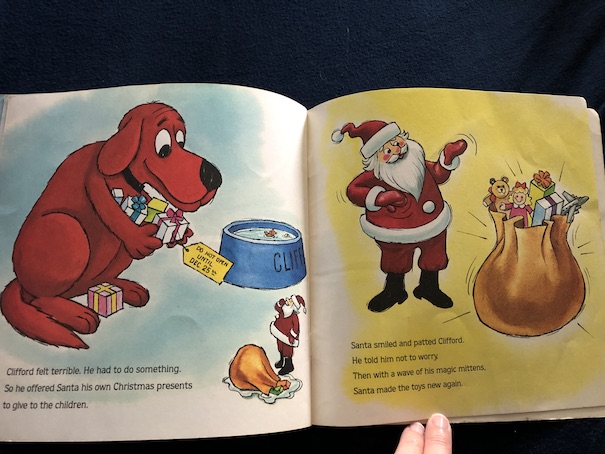
The toys fall into Clifford’s water bowl, but Santa fixes them with his magic. No harm done, and it’s a Merry Christmas after all!
This is just a cute Christmas story with a popular children’s books character. I loved the Clifford books when I was a kid, but I have to admit that they don’t look as good to be now as an adult. The entire plot of Clifford books revolves around Clifford’s enormous size, which is the very idea of the series. However, the plot of this is light, the problem is both caused and immediately solved by Clifford’s large size, and I think I’m just not interested in the usual trope of Famous Character Saves Christmas In Some Way anymore. I think that some Christmas stories with popular characters are still good, but for them to work, they usually have to have deeper, more clever, more interesting plots. This book isn’t bad, but I just didn’t think it was particularly great.
The book is available to borrow for free online through Internet Archive.
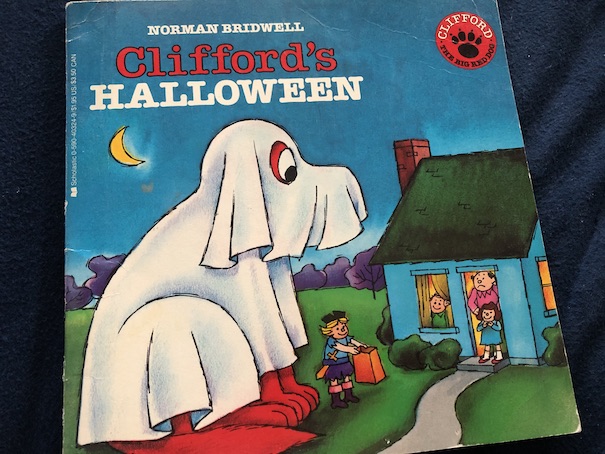
Halloween is Emily Elizabeth’s favorite holiday! Emily Elizabeth talks about the various holidays that she and Clifford enjoy, but Halloween is the one they enjoy the most.
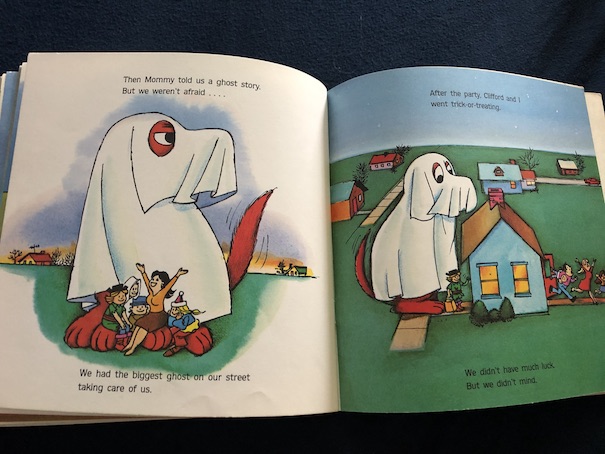
Last Halloween, she considered various costumes for Clifford, but Clifford decided that he wanted to be a ghost, covered with a giant sheet. (I love how they say that nobody could guess who the giant ghost is, like there could be someone else in the neighborhood that big.)
When you’ve got a giant dog, bobbing for apples doesn’t go the way you expect.
However, when you’ve got a giant dog, nothing else is very scary, either.
The book ends with Emily Elizabeth considering different costumes for Clifford for this Halloween, inviting the reader to think of other possible costumes.
I like the idea of letting kids consider which Halloween costumes they like the best from the ones that Emily Elizabeth considers. Kids like making choices, and trying to think of costumes that would work on a gigantic dog presents a creative challenge. When Emily considers dressing Clifford as a knight, they don’t consider where she’s going to get a suit of armor that size, but the books in this series don’t worry much about the logistics of caring for a dog the size of Clifford.
When I first read this book back in the 1980s (I was four years old when the book was new, although I can’t remember exactly how old I was when I first read it), I didn’t think too much about the Indian (Native American) costume with a pipe, although I wouldn’t think of suggesting that as a costume for anyone now. It’s partly because there’s something of a stigma against Native American costumes now. It’s not enough of a stigma to get people to stop wearing them and major costume retailers from selling them, but enough that some people raise eyebrows at them because of some of the connotations attached to them. If you read some of the reviews of Native American costumes on Amazon, like I did, it seems that more of them were purchased for school plays and projects or Thanksgiving plays than for Halloween. However, the part about this costume that particularly jumped out at me was the ceremonial pipe. Kids sometimes dressed as American Indians for Halloween when I was young, although the practice is discouraged now, but with all of the anti-smoking campaigns aimed at children when I was young, most of our parents wouldn’t have even considered giving us a peace pipe as part of a costume, even ignoring the social and cultural implications of that. I think that idea shows the age of the book’s creator. I grew up in the American Southwest, but I didn’t grow up on old western shows where peace pipes were a common feature. I didn’t see those shows until I was older, and by then, they looked pretty cheesy. I think that the book’s author was from the generation that was raised on those westerns and had nostalgic associations with them.
The book is available to borrow for free online through Internet Archive.
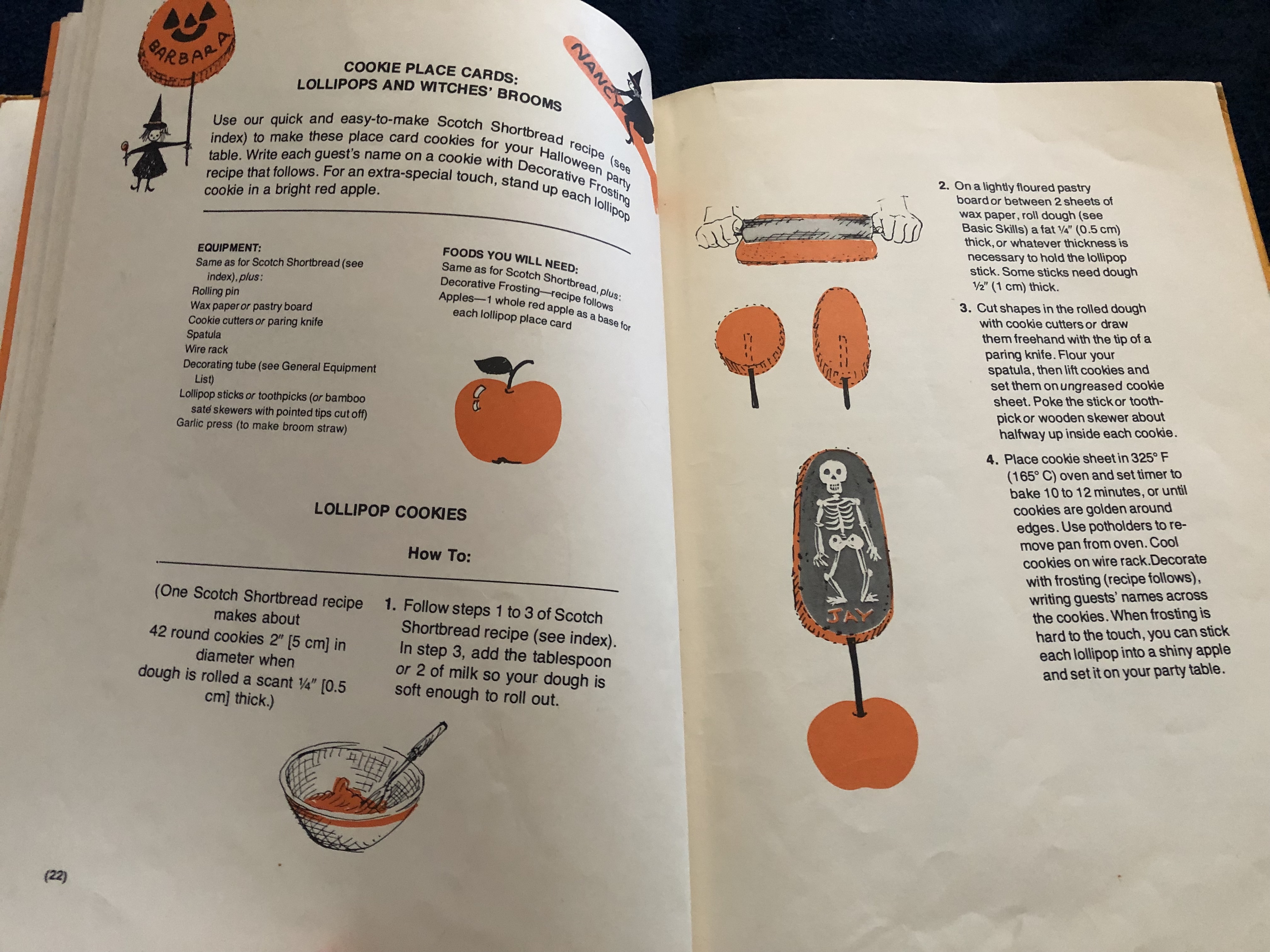
I remember getting this book from my school library when I was a kid. I never actually made anything from it because it was a little beyond my cooking skills. Still, I was fascinated by the recipes in the book, especially the stew inside the pumpkin.
Some recipes in the book use specifically Halloween shapes and colors, while others are more general fall and harvest-themed recipes. The recipes are organized by category with section for food that can also be used as Halloween decorations and other sections for brunch and lunch, vegetable dishes, meat dishes/main courses, and snacks and desserts.
Some of the recipes are old, traditional ones from around the world, such as the ones for Fried Pumpkin Blossoms (an Italian recipe) and the Indonesian Corn Fritters. A brief section at the beginning of each recipe explains a little about the recipe’s background.
In the beginning of the book, there are notes about converting between units of measurement, including converting between imperial and metric units. There is also a guide for converting between Celsius and Fahrenheit temperatures. There are other cooking tips for beginners, such as how to separate eggs (I’ve never done it with my hands, like in the book, but it’s useful to know) and how to chop onions and press garlic.
The American Boy’s Handy Book by Daniel Beard, 1882.
This is a Victorian activity book for boys, focusing particularly on outdoor seasonal activities. It was not the first book of its kind during the Victorian era, but the author explains in the preface that he wanted to create a book of sports, games, and activities that would be better than the ones that he knew from his own youth, with instructions that were well-written, complete, and easy to follow, particularly written for American boys, without some of the foreign phrases found in other books or tips that would be impossible for them to use, like recommendations for shops in London that sell equipment for the various activities and pastimes.
The book is now public domain and available to read for free online through Internet Archive.
Historical Background
Daniel Beard wasn’t just an author who had an interest in providing useful guides to fun activities for American boys; he was also a social reformer who was one of the founding members of the Boy Scouts of America. Before the Boy Scouts of America was founded in 1910, there were other, smaller scouting organizations throughout the United States, and Daniel Beard had founded one of these groups in 1905, which he called the Sons of Daniel Boone. This group later went through a couple of name changes before Beard joined the Boy Scouts of America and merged his group with theirs.
The Beard family in general believed in the benefits of exercise, appreciation of the natural world, and healthy outdoor activities for youth people, both male and female. Daniel’s sisters, Lina and Adelia, would later be founding members of the Camp Fire Girls, the first major scouting organization for girls in America, during the 1910s, a cause which Beard also supported. (Camp Fire Girls was founded before the founding of the Girl Scouts. It had the opportunity to merge with the Girl Scouts at one point but didn’t. Today, it is now a co-ed scouting organization simply called Camp Fire.) A few years after the publication of The American Boy’s Handy Book, Lina and Adelia published their own book of activities specifically for American girls called The American Girl’s Handy Book, which had somewhat of an outdoor focus but not as much as The American Boy’s Handy Book or some of the other books that they would later write. These were not the only books that the Beards published, and they would later go on to write more books about activities and wilderness skills for boys and girls.
Contents of the Book
The activities in this book are organized by season, which makes sense because of the largely outdoor focus of the activities. Within each section, there are more specialized sections, focusing on particular pastimes in each season. The American Girl’s Handy Book follows the same seasonal organization, but The American Boy’s Handy Book doesn’t mention holidays as much as The American Girl’s Handy Book. There is only one holiday section in this entire book, and the holiday is the Fourth of July. Later editions of the book also have some extra notes and projects in the back.
My copy of the book has a foreword written in modern times, part of which notes that some of the activities in the book are not really recommended for modern children because they are not suitable for kids living in urban or suburban environments and because some of them are outright dangerous and involve fire. At least, children should not attempt these activities without close supervision and help. Some 19th century people managed to play with fire and not hurt themselves, partly because more of them lived in the countryside, away from houses that could be set on fire, and like the author of this book, also lived in places in the Midwest and East Coast that see a lot of rain, keeping plants and fields from drying out and becoming more flammable, and could also be near lakes, ponds, and rivers. However, not everyone lives in those types of places these days. (If you want an indication of what could possibly go wrong with trying some of the more flammable activities in the book, consider what’s happened with some of the more flammable or explosive gender reveal parties in modern times. Consider your environment before deciding whether these activities are feasible.) Also, not everyone from the 19th century or 20th century pulled off these activities unscathed, and it’s the ones who did get hurt or caused serious damage that make the concern. The writer of the foreword describes how a 19th century boy lost a leg attempting the fire balloon activity with his friends years before this book was published. (The fire got out of control, and his leg was badly burned when he tried to put the fire out.) That being said, there are many interesting activities in this book that are perfectly harmless and fire-free and that kids from any era can try, even those who don’t live in the countryside.
Spring
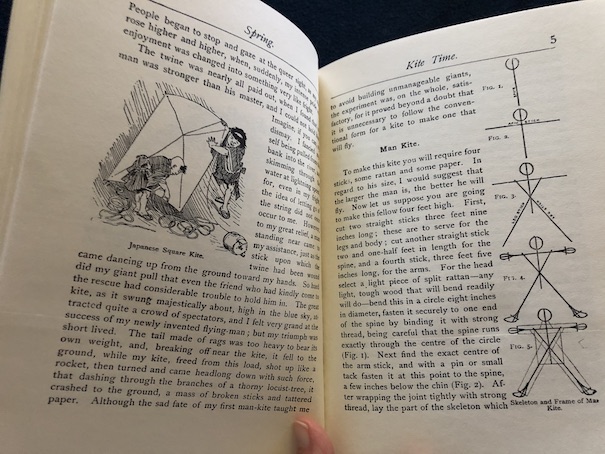
The spring section is mainly about making and flying kites and going fishing. The kites section explains how to make different types of kites in different shapes, like people, frogs, butterflies, fish, turtles, and dragons. One of these designs, called The Moving Star, involves attaching a lit lantern to the tail of a long kite. This kite is meant to be flown at night, so the light will bob in the air. It’s an interesting concept, although the instructions mention that certain types of lanterns are likely to just set fire to the kite. (I think I know how the author knows this.) The book provides instructions for making a custom lantern that will work better. This custom lantern featured a candle that is stuck between nails that are supposed to hold it in place, and it is supposed to be covered with red tissue paper (which is also sure to catch fire if that candle gets loose and falls over while it’s flying around). I’ll admit that the effect is probably neat, if you can pull it off without setting fire to something, but setting something on fire seems to be a likely outcome. This is one of the activities which wouldn’t work well for modern kids, especially if they live in places with highly flammable brush or dead grass and weeds or in the middle of areas with a lot of houses or apartments that would be set on fire if the flying lantern gets out of control (which is, apparently, a distinct possibility). Of course, thanks to modern technology, a battery-operated light could be an option.
There is also a section about war kites, which can be used for kite fighting.
The rest of the spring section is about different methods of fishing, how to make fishing tackle, and how to keep aquariums.
Summer
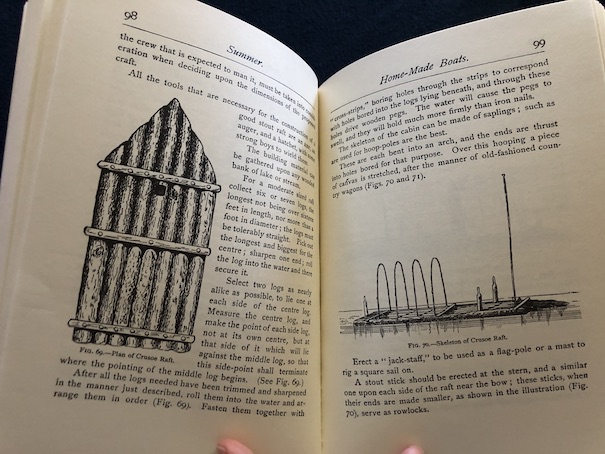
The summer section has more variety, although many of the activities are ones that modern boys can’t do if they live in an urban or suburban environment. There is more information about fishing in this section and how to make and sail different types of boats. I thought that the water telescope, which can be used to look at things under water, was really interesting. The book provides two sets of instructions for making a water telescope, one wooden and one metal.
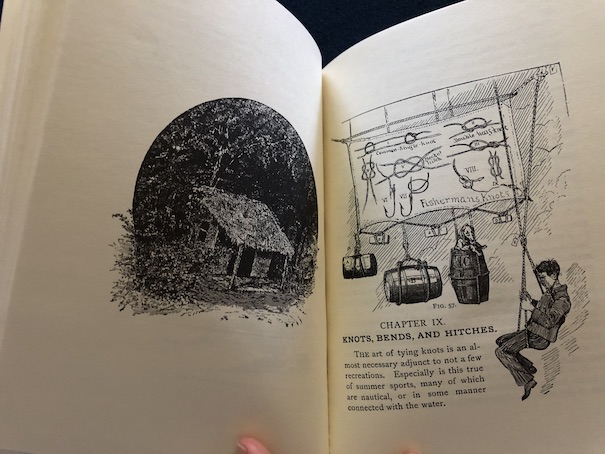
There is also information about different types of knots and how to tie them, blowing soap bubbles with a clay bubble pipe, and how to camp outside without a tent. The section about soap bubbles mentions “an aged negro down in Kentucky” whom the author knew as a child called “Old Uncle Cassius.” Uncle Cassius used to smoke a corn cob pipe, and he liked to amuse the children by blowing soap bubbles. The reason why the author brings up the subject of Uncle Cassius is that he had a particular trick where he would blow smoke-filled bubbles by filling his mouth from smoke from his own pipe before blowing some through the bubble pipe. The term “negro” is a bit archaic now, and I wouldn’t recommend smoking in general, but the author’s memories of Uncle Cassius seem to be fond ones, which is nice. The book doesn’t say whether or not Cassius was a slave, but the author was born in 1850, so my guess is that Cassius was either a slave or had been one earlier in life.
The section about soap bubbles also describes how children can use the gas from the gas lighting in their homes to blow bubbles, another activity that modern children can’t do.
As I mentioned before, fire is important to certain activities in this book. For Fourth of July, there are instructions for making a special kind of balloon that rises with heat produced by fire. They’re sort of like sky lanterns, made of paper. However, instead of having a place to set a small candle, these balloons have a “wick-ball”, which is a ball of rolled-up wick string, the kind used in an oil lamp, which is then soaked with alcohol and set on fire. The author notes that other people who make this type of balloon use small sponges instead, but he doesn’t think they’re as good because they don’t burn long, and as they burn out, the balloon comes back down, near where it started. He prefers to make a wick-ball so that it will continue burning and float out of sight. (I can’t help but notice that the sponge balloons, not burning for long and coming down nearby would also probably be easier to control and monitor for fire risk than the wick-ball balloons, which will float off to God-only-knows-where and get caught on who-knows-what before fully burning out.) The author says that he used to experiment with these as a child and has notes about which shapes are unsafe. Generally, it’s best to make them large and round, without a long neck at the opening. (As I said, the modern foreword in my copy notes that these types of balloons are actually dangerous and that kids have been injured trying to use them. This is why you don’t tend to see this type of activity suggested in modern children’s hobby books. Try it only at your own risk and remember that you’re responsible for any fires you start in the process. If you live in an urban setting or an area with a high risk of wildfires, don’t do it at all.)
There is quite a lot of information about activities involving real birds, like collecting bird nests and raising wild birds. (The modern view is that wild animals should be left wild and not kept as pets.)
There are also instructions for different types of hunting and how to make hunting weapons, including blow guns. In Meet Samantha from the Samantha, An American Girl series, she mentions that she read the instructions for how to make a boomerang in The American Boy’s Handy Book and that she wants to make and sell boomerangs to raise money to buy a new doll until her grandmother talks her out of it because that isn’t a proper activity for young girls. This is the part of the book where the boomerang instructions are, p. 190. Meet Samantha doesn’t say why Samantha was reading The American Boy’s Handy Book instead of The American Girl’s Handy Book in 1904, but that passage is mainly there to show the difference between what were considered acceptable activities for girls vs. acceptable activities for boys.
Autumn
The autumn section is much shorter than the previous two sections. It has information about trapping animals and practicing taxidermy. There is also a section about how to keep and train a pet dog. (Remember, that’s a commitment for life, not just for autumn.)
The part that I liked the best was the section about how to be a “decorative artist.” It teaches boys about photographic paper, how to make shadow pictures, and how to enlarge and reduce images.
Winter
The winter section has both indoor and outdoor activities, and the outdoor activities are designed for places with snow. (The author was born in the Midwest and lived on the East Coast of the United States, so these are the environments he considers for his outdoor activities.) He describes snowball fights, snow forts and houses, snow statuary, different types of sleds and sleighs, snow-shoes, and how to fish in winter.
For the indoor activities, there are instructions for making puppets and a script for a puppet show version of Puss-in-Boots. There are also tips for making costumes for people, so children could perform their own theatricals.
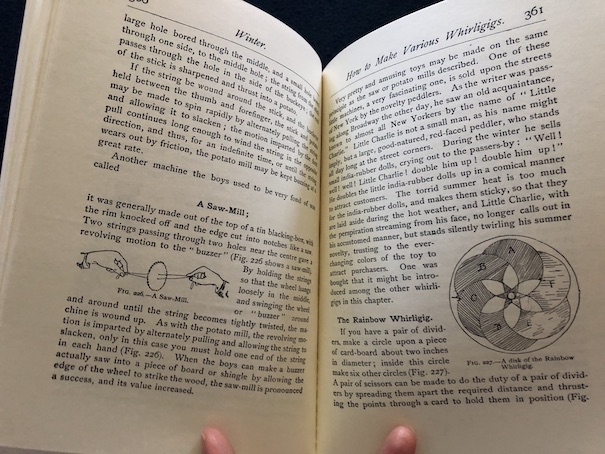
I particularly liked the sections about how to make and use magic lanterns and how to make different types of whirligig toys. The magic lantern was a kind of early slide projector. The whirligigs were homemade toys that would spin.
Patrick: Patron Saint of Ireland by Tomie dePaola, 1992.
This picture book is about the life and legends of St. Patrick, who is the patron saint of Ireland and the reason for St. Patrick’s Day, which is mainly celebrated in modern times by wearing the color green, and often, a shamrock or shamrock symbol. Some places also hold parades and other special celebrations.
The historical St. Patrick was born in Britain during the time when it was ruled by the Roman Empire. When he was young, he was abducted and sold into slavery in Ireland.
In Ireland, Patrick was forced to work as a shepherd for the man who bought him. Roman Britain was Christian, but Ireland was still pagan at this time. Patrick found it a strange and lonely place, and he prayed that he would be able to go back home.
Later, Patrick got his chance to return home aboard a ship that was carrying hunting hounds to be sold in France. Patrick tried to buy passage on the board, but the captain was reluctant to take him at first because he thought that Patrick was probably an escaping slave, and he didn’t want to get in trouble for taking him. However, the dogs on ship kept howling when Patrick was sent off, and the captain noticed that when Patrick was on the ship, the dogs were quiet, so he changed his mind.
When they reached France, the area where they landed was deserted because there had been a war. The men and dogs were hungry and couldn’t find anyone to help them. The captain said to Patrick that if his God was so powerful, why didn’t he pray and get God to help them? Patrick did, confident that God would help, and a herd of pigs appeared, providing them with food.
Patrick eventually returned home to Britain and rejoined his family, but he had dreams about Ireland in which a man called Victoricus appeared with letters from the Irish people, asking Patrick to return. Patrick felt that he was called to bring knowledge of God and Christianity to Ireland. He decided to become a missionary.
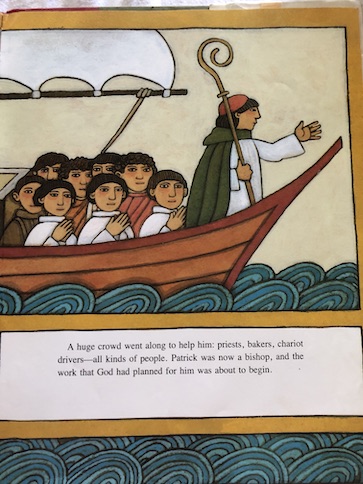
Patrick studied and worked his way up to become a bishop, and when he returned to Ireland, he brought others with him to help in his work. Upon his return to Ireland, he became friends with an Irish chieftain named Dichu, who also became a Christian. He gave Patrick a barn, which Patrick turned into the first church in Ireland.
Patrick and his followers suffered opposition in Ireland. At one point, a king tried to kill Patrick and ended up killing his chariot driver and friend, Odran, instead. In spite of that, Patrick persevered.
Patrick died on March 17, 461. After his death, he was declared a saint, the patron saint of Ireland, and the date of his death became his saint’s day. Many legends grew up around him, and the book explains the most popular stories.
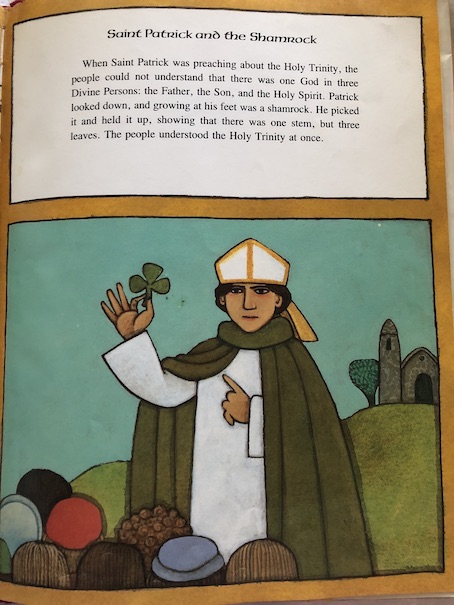
Among the most popular stories about St. Patrick are that he drove all of the snakes out of Ireland, frightening them away by beating on a drum. Another story says that he used the shamrock to explain the concept of the Holy Trinity, which is why the shamrock is an important symbol of Ireland and St. Patrick’s Day.
The book is available to borrow for free online through Internet Archive.
The Little Witch’s Valentine Book by Linda Glovach, 1984.
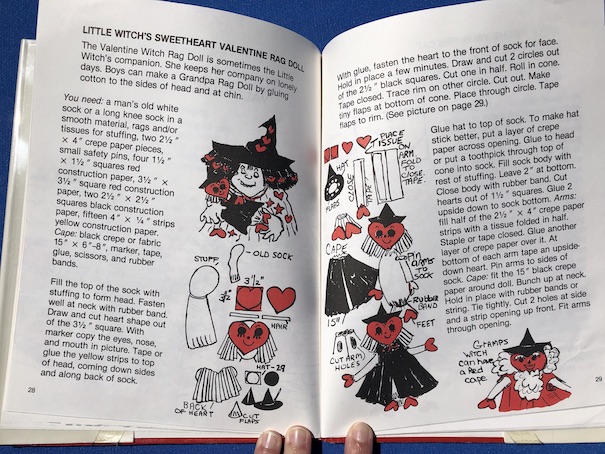
Like other Little Witch Craft Books, this one gives holiday-themed craft instructions, party tips, and recipes. The book starts out with a brief explanation about the purpose and origin of the Valentine’s Day holiday and then gives a section about Valentine-themed crafts. Some of them also relate back to the witch theme of our craft hostess, like Valentine-themed witch hats, which is a little odd, but fun.
There is a section of crafts that you can make as small gifts for people or prizes for some of the party games given later. The small crafts include finger puppets, a box decorated with an owl with a heart-shaped head, and a butterfly pin with heart wings. There are also instructions for a Valentine-themed rag doll with a witch’s hat, and the instructions recommend that boys make an old man version of the doll by adding a beard. The dolls have heart-shaped faces.
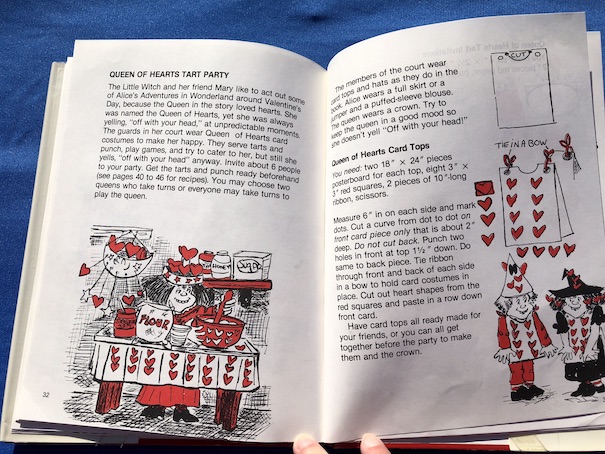
Under the party suggestions, the book recommends having a Queen of Hearts Tart Party for an Alice in Wonderland tie-in. It gives instructions for making playing card costumes that are kind of like sandwich board signs.
There are two party games described in the book, both based on the Queen of Hearts from Alice in Wonderland. One of the games is the “Off With Your Head Hunt” where players have to find missing heart halves with matching symbols on them that are hidden somewhere in the room. The name of the game comes from the person who will be playing the Queen of Hearts, who gives the players their instructions and shouts “Off With Your Head!” while the players hunt for the heart halves to appease the queen. (Yep, really.) The second game is the “Pass the Queen’s Red-Hot Heart Game.” It says that “The Heart is red-hot because it belongs to the queen.” It’s similar to the game Hot Potato. The players stand in a circle, passing a paper heart very quickly from one person to the next while someone plays music. When the music stops, the person who is holding the heart is out of the game. The game continues until only one person is left, and that person wins.
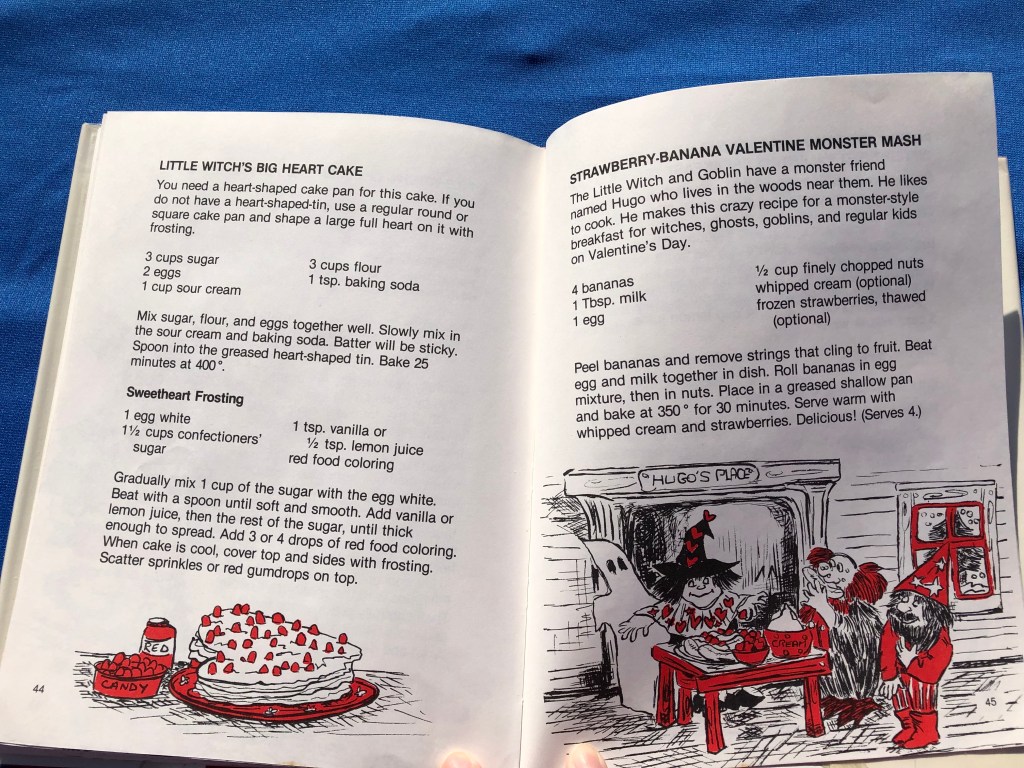
The recipes section offers treats that you can make for your Valentine’s Day party or just for fun, including Queen of Heart Tart Biscuits, Heart Cookies, Strawberry-Banana Valentine Monster Mash, and strawberry pancakes.
The book is currently available online through Internet Archive.






















 Jestress's Forgotten Books and Stories