Garbage Juice for Breakfast

Polka Dot Private Eye

This book follows an earlier book in the series, The Case of the Cool-Itch Kid, while Dawn is staying at her summer camp, Camp Wild-In-The-Woods. Her friend from school, Jill Simon, is at camp with her, and they’ve made friends with another character from the earlier book, Lizzie Lee, who started out as a rival/antagonist for Dawn. Both Dawn and Lizzie like mysteries and being private detectives, and they’ve bonded over that. There is still an element of rivalry between them, but it’s a friendlier rivalry than when they first met each other.
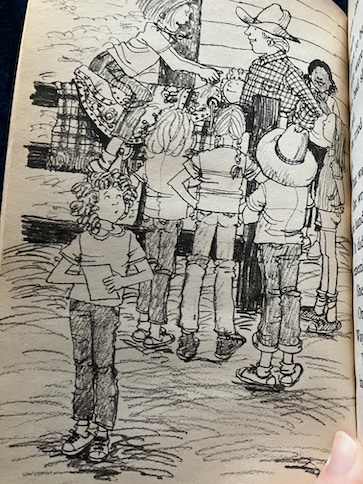
When their camp counselor announces that she has set up a treasure hunt for the campers to solve, Dawn is excited. As the Polka Dot Private Eye, she’s sure that she’ll be the first to solve the mystery! However, Lizzie is the Cool Cat Detective. (Each of them take their names from the detective kits that each of them own.) Dawn knows that Lizzie will be tough competition.

Because the kids in their cabin are from different schools and some were friends with each other before they came to camp, the campers in the cabin have favorites between the two girl detectives. Jill thinks that Dawn is the best detective and will solve the treasure hunt before Lizzie will, while Lizzie’s friends think that she’s going to be the one to solve the mystery. They decide to turn the treasure hunt into a contest to show which of the girls is the best detective.
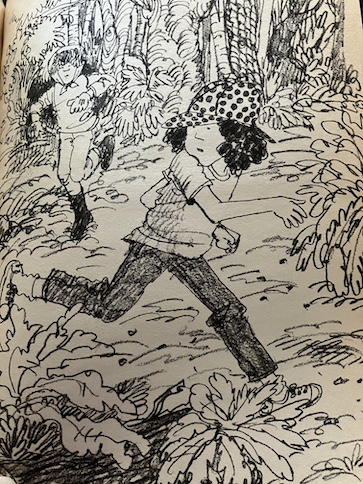
The first clue is in the form of a rhyme. It seems to have something to do with horses, and the girls are starting to learn horseback riding. There is also a hint about taking a particular trail. It’s tough for both Dawn and Lizzie to investigate the same mystery without getting in each other’s way, following one another or being suspicious that they’re following each other, or accidentally giving each other hints. Is the competition between them really a good idea, or is teamwork what they really need?

The book is available to borrow and read for free online through Internet Archive (multiple copies).

I remember reading this book when I was a kid, and I loved it because I always loved treasure hunt books! There are parts of the treasure hunt that readers can solve along with the characters in the story, although it’s not one of those stories that pauses to ask readers if they’ve solved parts before the characters have. It’s just that the information necessary to solve each part of the treasure hunt is given in the story and shown in the pictures, so readers have the opportunity to think what the next step should be along with the characters or before the characters announce what they’ve figured out. Some of the clues point to features of the camp itself, like the names of the trails around the camp, but the story does provide that information to the readers, so there’s nothing that the characters know that the readers don’t. Other clues use pop culture references, like Donald Duck, because their camp counselor is a Disney fan and has items with Disney characters on them.

Dawn and Lizzie do compete with each other to solve the treasure hunt, until they solve the final clue. All through the book, Dawn struggles with the horse lessons because she’s actually afraid of horses. When reaching the prize means going through an area with a lot bugs, Dawn suddenly feels sorry for Lizzie, who is following her but struggling because she’s afraid of bugs. Understanding what it’s like to struggle with something that scares her, she feels some empathy for Lizzie and realizes that she can’t use Lizzie’s fear to get ahead of her and reach the treasure first. She tells Lizzie that they can go together to reach the treasure, so they are able to share the glory. The experience helps the girls a little with their respective fears, and they share the final prize.

The name of this book comes from a kind of mixed fruit juice that the camp serves in the dining hall. None of the campers know exactly what’s in it, nobody really likes it, and the camp rumor is that it’s just strained out of the garbage. It doesn’t really have anything to do with the mystery in the story, but it’s there for background color, the kind of stories that kids tell about food at camps and schools that they don’t like.

Aside from the mystery, the story has some fun camp atmosphere for beginning chapter book readers: horses and barns, the camp dining hall, a picnic with books, and a cozy, rainy night in their cabin with cookies.

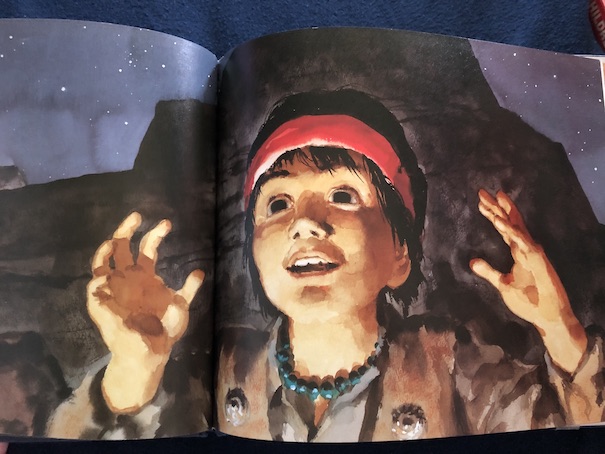
Knots on a Counting Rope

Knots on a Counting Rope by Bill Martin, Jr. and John Archambault, 1966, 1987.

The reason for the two copyright dates is that this book originally had somewhat different text and different illustrations.  I don’t have a copy of the original version, so I’m not sure how it compares to the 1987 version.

The story is told in the form of dialog between a young Navajo boy and his grandfather.  The story doesn’t explicitly say that they are Navajo, but they refer to hogans, which are a traditional type of Navajo house.  There are no words in the story other than what the characters say to each other, not even to indicate who is speaking, but you can tell who is speaking based on what they say.

The boy asks his grandfather to tell him the story of when he was born. The grandfather says that he already knows the story, but the boy persuades him to tell the story again.

The grandfather tells him that, on the night he was born, there was a storm, and it sounded like the wind was crying the word “boy.”  The boy’s mother knew that she was going to give birth to a son.  The grandfather quickly brought the boy’s grandmother to be there for the birth, and when the boy gave his first cry, the storm suddenly stopped.

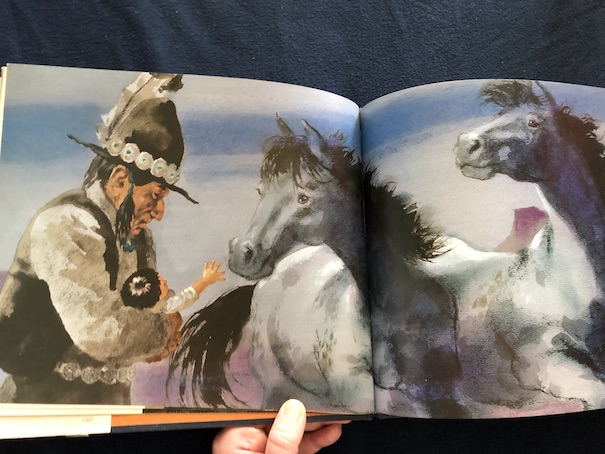
When the boy was born, he was very frail, and everyone was afraid that he would die.  Then, when morning came, the grandfather carried him outside, and although he did not open his eyes to the morning sun, he lived his arms up to two horses that had galloped by and stopped to look at him.  The grandfather took it as a sign that the boy was a brother to the horses and would live because he had the horses’ strength.  The boy did become stronger and was given the name of Boy-Strength-of-Blue-Horses.

However, the boy was born blind. It is a hardship that he will always have to deal with.  Even though the word “blue” in his name, the boy says that he doesn’t really know what “blue” is or what it’s like because he’s never seen it.  The grandfather describes it as being like morning because the sky in the morning is blue, and the boy says that he understands what mornings are like because they feel and sound different from night to him.

The boy has a horse of his own, and the two of them have a special bond.  The two of them perform well at races, and the horse acts as the boy’s eyes when he’s riding.  His grandfather says that it’s like the two of them are one.

As the grandfather tells the boy stories about himself, he ties knots on the counting rope.  He says that when the rope is full of knots, the boy will have heard the stories enough that he will be able to tell them himself.  The grandfather says that he will not always be there to tell the stories, and the boy is frightened, wondering what he will do without his grandfather. The grandfather says that he will be all right because his love will be with him.

The book is partly about the relationship between the boy and his grandfather and the grandfather preparing his grandson for the day when he will be gone, making sure that he knows the family stories about himself and the knowledge that he will need for the future. It’s also about the boy’s own struggles in life, which the grandfather refers to as the “dark mountains” that he must cross. Because of the boy’s blindness, he lives in a world of darkness, and there are things that are challenging to him that would be less challenging to a person with normal vision. Yet, the boy has innate skills which allow him to do things that some people with normal vision can’t do. Not everyone has the affinity for horses that the boy has. He shares a special bond with horses, and when he rides, he and his horse are a team. Because he has skills and a strong spirit, the grandfather knows that his grandson will be all right in his future, in spite of the challenges of his blindness.

The book was featured on Reading Rainbow, and it is currently available online through Internet Archive.

Linda Craig and the Clue on the Desert Trail

Linda Craig

Linda Craig and the Clue on the Desert Trail by Ann Sheldon, 1962.

Linda and her friend, Kathy, are exploring Olvera Street in Los Angeles before a horse show when Kathy notices a strange man watching them.  While the girls were shopping, Linda bought a small horse statue that reminded her of her own horse.  As the girls finish lunch, Linda notices an odd symbol on the statue that looks like an arrowhead, but before she can study it more, the man grabs the horse and runs off.  Linda tries to chase him down to get the horse back, but the man drops it and breaks it.  Linda picks up the horse’s head and decides to go back to the shop where she bought it to see if she can get another one.

The shop doesn’t have another horse like the one Linda bought.  It was unglazed, and the others are glazed.  Disappointed, Linda goes on to the horse show, where she is taking part, along with her brother Bob and his friend Larry.  At the show, they see the mysterious man again, and he apparently steals the broken head of the horse statue that Linda had kept.  Bob thinks that maybe the man is some kind of smuggler and that there was something hidden in the head that Linda hadn’t noticed.

Linda goes back to the shop to talk to the owner again, and he tells her that the horse was a special order from Mexico for a man named Rico.  Rico said that he was a traveling salesman and that he would collect the horse at the shop, but when he didn’t turn up to get it, the shop owner decided to sell it. Linda asks the shop owner to send her another horse statue like the broken one if one comes into his shop and reports all of this information to the police.  Then, when she returns to the horse show, she finds a threatening message, warning her to “Beware. Stay away from C. Sello.”  The note is signed with the symbol of an arrowhead, similar to the one on the horse statue.  Linda also reports this note to the police, but she can’t resist trying to figure out who C. Sello is and how this person fits into the mystery of the possible smugglers.

Soon after, the shop owner calls Linda to say that another horse statue did come into the shop and that he has sent it to her but now someone has broken into his shop and smashed every horse statue he has. Realizing that what they wanted was not in the shop, the bad guys are soon on Linda’s trail, even kidnapping one of her friends by mistake, thinking that it’s her. They even try to poison Linda’s horse!

At the end of a desert trail, the Mojave Trail, there is a ghost town with sinister characters and old cliff dwellings with Native American petroglyphs that may hold part of the secret to the mystery.

The story contains some anecdotes about California history, which is interesting. I have to admit, though, that I thought that the warning note for Linda was pretty silly. C. Sello turns out to not be a person but a clue about what the smugglers are smuggling, and they didn’t have to tell Linda what it was because she hadn’t heard about it at that point and wouldn’t have any reason to know what they were talking about. If they really wanted to get her to leave them alone, they could have left a more vague warning that didn’t include any clues like “Go home!” or “Go away!”

The Secret of Stonehouse

Stonehouse

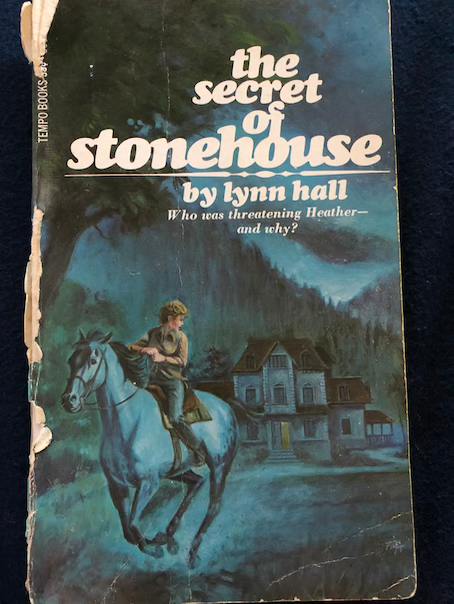
The Secret of Stonehouse by Lynn Hall, 1968.

Heather has lived her entire life (as far as she can remember) in Scotland with her grandmother and her uncle, Donald.  Donald has raised her since she was small.  He’s been like a father to her, and she loves him like a daughter.  However, he recently decided to move the two of them to the United States, taking them to a small town in Wisconsin.  Heather can’t understand the reason for the move, and for the first time in her life, it seems like Donald is keeping secrets from her.

Donald seems oddly concerned that Heather shouldn’t tell people that she is adopted, something that he’s never seemed concerned about before.  Heather has asked him about her parents before, but all he can tell her is that his wayward brother Ewen brought her to the family farm in Scotland, saying that she was his daughter and that her mother was dead.  Ewen simply left her with Donald, never trying to see her or talk to her again and never sending her any money. Heather also knows that, although says that he’s going out to search for a new job, he’s been hanging out in other places, spending time with the mysterious Mr. Worley.

Heather makes friends with a boy named Gus who lives nearby.  Gus lets her ride one of the horses that his family owns, Cloud, and invites her to go riding with him sometimes and participate in local riding events called “shodeos.”  Heather loves horses and enjoys their rides together.

On one of these rides, the two of them go near a large, old, stone mansion that gives Heather a strange feeling.  Gus’s family tells her the tragic story of the family who used to live there, the Selkirks.  They were wealthy, but young John Selkirk was killed in an accident the day that his beautiful young wife, Molly, gave birth to their only child, a little girl named Hebron.  John’s parents never recovered from the loss of their son and passed away soon after, leaving just Molly and the baby.  However, when Hebron was only three years old, she was apparently abducted for ransom and later murdered, and her mother died soon after.  The story makes Heather uneasy, and the house gives her a strange feeling, like she’s drawn to it.

However, other sinister things start happening.  Someone in a car that looks disturbingly like Donald’s tries to run her and Cloud off a bridge.  When Donald spends the night away from home “on business”, someone sneaks into the house.  Heather begins to realize that someone is out to get her, some mysterious person means her harm.  Memories, dangerous ones, are beginning to surface in Heather’s mind, and someone is determined to try to keep her from remembering.

Part of the mystery is pretty obvious (at least, I thought it was, and you might guess it from my plot description), but the part that I didn’t guess was who was behind it all.

Basil in the Wild West

BasilWestBasil in the Wild West by Eve Titus, 1990.

This book picks up right after the previous book in the Basil of Baker Street Series, Basil in Mexico.

After leaving Mexico, Basil and his best friend Dr. Dawson journey north into the western territories of the United States.  There, some friends of their ask them to investigate a smuggling operation.  Mice have been illegally bringing Mexican antiquities across the border.

Basil realizes that the smugglers have been smuggling the antiquities in the open, pretending that they are ordinary replicas, the kind that tourists often buy.  Because the border guards aren’t experts in antiquities, they haven’t been able to tell the difference between harmless souvenir replicas and the real thing.

When they catch one of these smugglers, they learn that the mastermind behind the scheme is a mouse called J.J. in a town called Moriarty in New Mexico (the name of the town irritates Basil).  They go to the town with the help of some friendly horses and confront J.J..  At first, they think it won’t be too difficult because, although J.J.’s house is well-guarded, he is confined to a wheel chair because of an accident.  However, the wheel chair is an act, and J.J. is no ordinary mouse.

BasilWestPic2Although J.J. escapes, Basil and Dr. Dawson decide that the smuggling ring has been defeated and it’s alright to continue their sight-seeing.  However, their adventures are not over!

Basil and Dawson want to see the Grand Canyon, but it turns out that the hotel where they are staying is being terrorized by a weird, glowing Thing.  Nobody knows what it is, but guests think it could be some kind of ghost or monster, and many of them are too afraid to stay.  The owners of the hotel ask Basil to discover what the Thing is and stop whoever may be behind it before their hotel is ruined!

This book is really two stories in one, and neither has any direct bearing on the other.  In that way, it’s kind of disjointed.

The book is currently available online through Internet Archive.

Something Queer in the Wild West

SQWest

Something Queer in the Wild West by Elizabeth Levy, illustrated by Mordicai Gerstein, 1997.

Gwen and Jill go to visit Gwen’s Uncle Dale, who owns a ranch in New Mexico. The girls enjoy learning to ride horses, but Fletcher seems to be interested in an old barn.  C. J., who works on the ranch, tells the girls that the barn is supposed to be haunted by the spirit of a wild horse and that they should stay away from it.  Uncle Dale confirms the old legend, but the girls think there’s more to the story.

They have hear strange sounds coming from the old barn.  Then, the girls notice that Fletcher seems to be sneaking out during the night.  One night, they see a white horse roaming around when Uncle Dale doesn’t own a white horse. Could it be the spirit of the wild horse, or could it have something to do with a recent horse theft?

Fletcher’s odd behavior is a clue, and there is more to the old barn than the ghost story, as the girls suspected.  The “theft” isn’t quite theft, and the thief is actually trying to do something noble.  In the end, the girls decide to help, but they need Fletcher’s help to do it.

This book is part of the Something Queer Mysteries.  It is currently available online through Internet Archive.

SQWestPic2