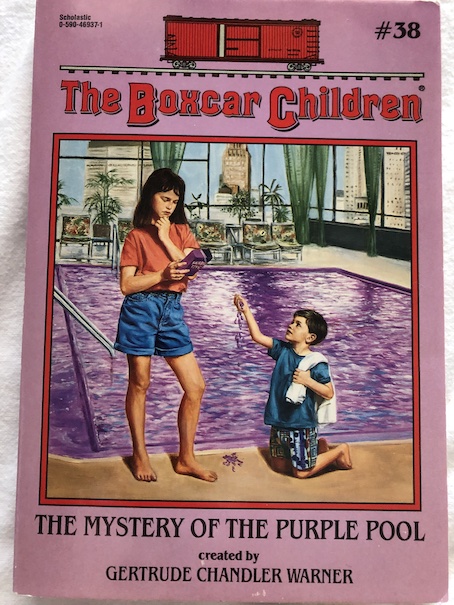
The Mystery of the Purple Pool by Gertrude Chandler Warner, 1994.
The Boxcar Children are all bored, especially Benny. Grandfather Alden tells them that he has to go to New York City on business, and the children can come with him and see the city. That sounds like just the kind of excitement the kids need! Their grandfather calls the hotel where he’ll be staying and reserves a suite of room for all of them. Then, he tells the children to look through some guidebooks for the city and decide what they want to see there. He says that, during the time when he’ll be working, the two oldest children, Henry and Jessie, will be in charge. The children start looking through the guidebooks and talking about things they want to see in New York.
When they arrive at the Plymouth Hotel in New York, the children’s grandfather notices right away that the service isn’t how it usually is at this hotel. For some reason, their reservation was canceled, although they are still able to get rooms. Then, there are no bellhops to be found to carry their bags, and even the hotel management doesn’t know where they are. As they go to their room, they hear another guest complaining that his room wasn’t cleaned, even though the maid said that she’d cleaned it.
All of these things could be mistakes or signs of bad hotel management, but it soon becomes apparent that someone is deliberately trying to sabotage the hotel. When the children try to swim in the hotel pool, they find out that someone dyed the pool purple! Then, someone switches the sugar and salt in the hotel restaurant, ruining everyone’s breakfast. When the kids come back from sight-seeing, they see a crowd of people in the lobby, all complaining about various things missing from their rooms, like pillows and shower curtains. Then, the children get stuck in the hotel elevator when someone turns it off and have to call for help.
The Alden children have another mystery on their hands! Who could be the mysterious saboteur, and what would they want to harm the hotel? There’s a mysterious man who seems to be lurking around when bad things happen. There’s also a maid who is angry about her brother being fired from the hotel. The hotel manager isn’t always on hand to deal with things when they go wrong. There’s also an unfriendly woman who doesn’t like kids (named Karen before that name started to be used as a slang word for a disagreeable, complaining woman) and is always scribbling in her notebook, never letting anybody see what she’s writing. Any of them could be the culprit, or it could be someone they haven’t even thought to suspect.
The book is available to borrow and read for free online through Internet Archive (multiple copies).
My Reaction
I remember reading this book and liking it when I was a kid. One of the hallmarks of The Boxcar Children series is that the children are always allowed their independence in their adventures. Their grandfather lets them explore the city completely on their own, even though the oldest child in the family is only 14 years old. Few people would let their children roam around New York City completely on their own these days, and they didn’t when I was a kid in the 1990s, either. Another guest at the hotel even lets his young son go sight-seeing with the Alden children when they haven’t known each other very long.
The kids have fun exploring the amenities at the hotel, too. The book draws attention to various aspects of staying at hotel, like suites with kitchenettes, hotel restaurants, pools and exercise rooms, and the snacks and toiletries you might find in your hotel room. I thought it was interesting how the book explains how you can call for help in an elevator if it gets stuck. Its a useful thing for kids to know.
One thing that occurred to me when I revisited this story was that it doesn’t mention the World Trade Center. They characters could have visited the original World Trade Center in the story because the book was published 7 years before it was destroyed in the September 11, 2001 terrorist attack, but the World Trade Center was not one of the sights that the children went to see. If it had been, it would have dated the story, but I can’t think of anything the children saw or did in the book that really dates it. The things they mention still exist in New York, and this story could still be set in the early 21st century.
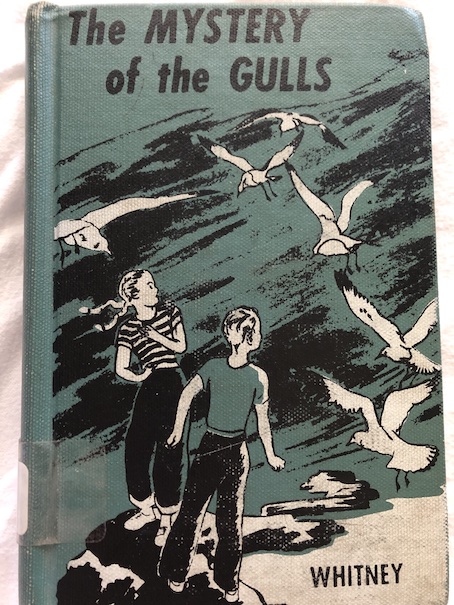
The Mystery of the Gulls by Phyllis Whitney, 1949.
Taffy Saunders and her mother are heading to Mackinac Island for the summer while Taffy’s father is in the hospital, recovering from a car accident. Taffy’s mother’s Aunt Martha has recently passed away, and she left the hotel she owned to Taffy’s mother. It’s a strange bequest because Aunt Martha hadn’t gotten along with her niece for years because she had disapproved of her marriage. There is also a condition on the inheritance. In order to retain ownership of the hotel, Taffy’s mother has to run it herself for a summer. Taffy thinks that it all sounds strange and mysterious, but her mother says that her aunt was an eccentric, and it was often difficult to understand why she did some of the things she did.
Taffy’s mother worries that something will go wrong over the summer that will prevent her from owning the hotel. It isn’t really that Taffy’s mother wants to be a hotel keeper, but since Taffy’s father’s accident, they’ve spent most of their money on medical bills. When he gets out of the hospital, he won’t be able to do his old job, which involved a lot of travel, so they’re going to have to settle down in a new city. Taffy is happy about living a more settled life than they used to live, but they’re going to need all the money they can get to buy a new home. Taffy’s mother is hoping to sell the hotel to pay their bills and buy a new home, but she can’t do that unless she can prove that she can manage the hotel first. Mrs. Saunders is hoping that her aunt’s long-time housekeeper, Mrs. Tuckerman, will help her make this summer a success, while Taffy is hoping that Mrs. Tuckerman’s daughter, Donna, will be a friend for her. Because their family has moved a lot, Taffy hasn’t had many opportunities to make and keep friends.
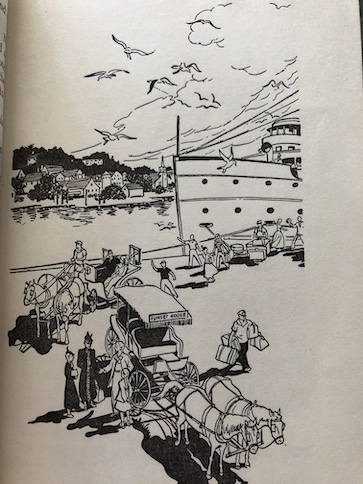
On the boat ride to Mackinac (which they point out is pronounced “Mackinaw” by locals), Taffy meets a boy about her age, David Marsh, who is going to Mackinac to visit his grandmother, and they talk about the sights to see on the island. There is an old fort on the island that is now a historic site for tourists, and David offers to show Taffy around. He tells her where his grandmother’s house is and says that she can come see him there, or he’ll come to the hotel, Sunset House, to see her.
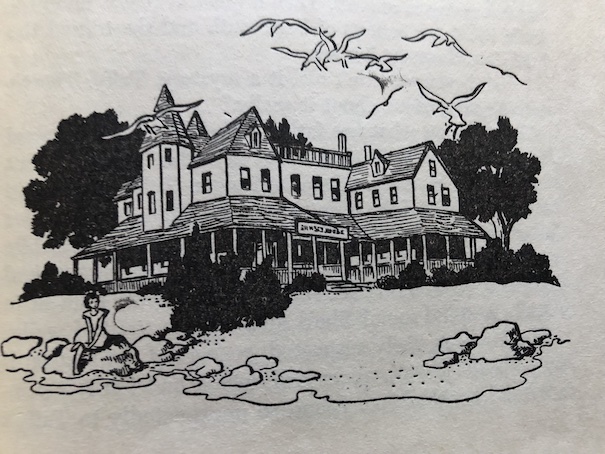
When Taffy sees Sunset House, she thinks it’s charming. The hotel is a large, old house with turrets, cupolas, and a widow’s walk. Mackinac Island in general seems charming. Cars are not allowed on the island, so people get around with horses, carriages, and bicycles. Taffy’s mother talks about wanting to “wake this place up”, but Taffy thinks that the calm, sleepy atmosphere is right for the house and doesn’t want to disturb it. Since Taffy has moved a great deal with her parents because of her dad’s job, she has lived in many hotels and apartments, and she finds the old-fashioned and comfortable furniture at Sunset House to be homey. Taffy thinks that the home-like atmosphere of Sunset House is a nice change and that she will like it there. The room she shares with her mother is beautiful, also filled with old-fashioned furniture and a charming alcove with a lovely view.
It seems like Aunt Martha’s usual guests prefer the place quiet, too. The first guests that they meet are the Twig sisters, a pair of elderly ladies who are at first concerned about a new child in the house. Until Taffy arrived, the only child at Sunset House was Donna, who is described as a quiet child. Aunt Martha only rented rooms to adults with no children. Taffy learns that Donna, who is about her age, is usually never even allowed to bring other children to visit her. Taffy feels sorry for Donna and hopes that she will want to be friends as much as she does.
Besides Mrs. Tuckerman, the housekeeper, there is also a cook named Celeste. When Taffy and her mother first arrive, they are told that Celeste hasn’t prepared lunch because she’s been seeing “omens.” Apparently, this is something that she does periodically, and Mrs. Tuckerman thinks that, this time, it’s just because she’s upset about Mrs. Saunders arriving. There are three other people who also work in the kitchen, but they all seem pretty useless without Celeste’s direction. Fortunately, Mrs. Saunders is a woman of action, so she immediately takes charge of making sandwiches for lunch. To speed things up, she even offers to let guests come to the kitchen to make their own sandwiches, any kind they want, if they wish to. Although Mrs. Tuckerman isn’t sure that will work, lunch turns out fine. However, Taffy has a strange encounter with Celeste in the garden.
In the garden, Celeste asks Taffy what word the gulls are saying. Taffy did have the feeling before that the gulls are saying a word, and it sounds like the word “help” to her. Celeste says that’s what she thought, and she says that’s a sign that a storm is coming. Her fear of the bad storm coming is why she feels like she can’t cook, and it bothers her that nobody else seems to understand, implying that there is impending doom. Taffy shows Celeste a map that David drew to his grandmother’s house, which she is having trouble understanding. Celeste explains to her how to get to the house, and she also mentions a shortcut, but she warns Taffy not to take the shortcut after dark because it goes through a “goblin wood.”
Taffy meets Donna for the first time at lunch. Donna is a shy girl, but she is glad that Taffy is there because she has spent much of her time alone since children are not usually allowed at Sunset House. Taffy asks Donna about Celeste and what she means about the “goblin wood.” Donna explains that Celeste and her family have lived on Mackinac for a long time because they are descended from fur traders (this is why Celeste has a French name, although the book doesn’t mention it directly) and Native Americans (the book uses the word “Indians”). Because of this heritage, Celeste has a lot of superstitions about the island and the spirits that supposedly inhabit it. Taffy doesn’t believe in spirits, but she can’t resist taking the shortcut to David’s grandmother’s house, just to see what it’s like. She has an odd encounter in the woods with a Native American boy (called an “Indian”) wearing overalls, who refuses to speak to her and seems hostile toward her.
When Taffy sees David, she tells him everything about Celeste and her encounter in the “goblin wood.” David says that he’s taken the shortcut through the woods many times without a problem, and he never had any reason to think that it might be haunted. Taffy is a little insulted at his comment that maybe girls get scared easier than boys, and David explains that the boy might not have been as unfriendly as she thought because her imagination might just have been fueled by Celeste’s stories, so she was primed for something scary or sinister to happen. They reconsider that theory when the two of them walk back through the “goblin wood” and find a note left on a tree, telling her that she’s not wanted on the island and that her presence makes the “manito” angry. David says that the “manito” is one of the Native American gods or spirits who supposedly inhabit the island. (This is a real concept in Native American lore, but I’ve seen it spelled “manitou.”) Whoever wrote the note was trying to scare Taffy, but why?
David is intrigued by what Taffy has told him about Celeste and her “omens” and the “goblin wood”, the note left for Taffy, and the unfriendly boy in the overalls (who Taffy sees again, talking to Donna, when she and David try out his grandfather’s binoculars), and he says he is willing to help her investigate further. The two of them work out a code, where Taffy can hang things of different colors in the window of her bedroom to send him messages.
The mystery deepens when Taffy’s mother tells her that there are two vacancies in the hotel after Taffy heard Mrs. Tuckerman turn away a man who wanted a room. There is also a locked room off of Aunt Martha’s old office that Donna says no one is supposed to enter. She says that they can’t even find the key, that no one has seen it since Aunt Martha died. When Taffy talks to her mother, she says that the locked room is a library and that the boy in overalls she’s been seeing is named Henry and that he does odd jobs for the hotel. Taffy tells her mother that it seems like people don’t want them on the island, including Henry, Celeste, and Mrs. Tuckerman. Even Donna has been acting strangely. Even though she said that she was glad Taffy was there, she’s been strangely unfriendly, and she’s been telling her mother that Taffy is the unfriendly one! Taffy thinks that’s really unfair, but her mother thinks that it’s just because everyone is adjusting to the changes since Aunt Martha died. Donna isn’t used to being with other children, and Celeste and Mrs. Tuckerman may be worried about their jobs since the ownership of the hotel depends on how well Mrs. Saunders manages it this summer and what she plans to do with it when she takes full ownership. Taffy and her mother don’t even know what will happen to the hotel if Mrs. Saunders can’t prove that she can manage it well enough. Aunt Martha’s will deliberately keeps the alternate heir secret until the end of the summer.
This is only the beginning of the mysteries and puzzles. Taffy learns that the man Mrs. Tuckerman turned away from the hotel was actually an old friend of Aunt Martha who has worked in hotels in Asia and says he would like to own a hotel of his own. The storm that Celeste predicted comes, and a baby seagull crashes into the window of the Twigs’ room. Celeste thinks that’s another bad omen and that Taffy and her mother should leave. Then, someone leaves a bat skeleton in Miss Twig’s bed. Donna says that Aunt Martha used to collect things like that and that maybe her spirit put the skeleton in the bed because she’s not happy. Of course, Taffy doesn’t believe that. Too many living humans seem unhappy that she and her mother are there. Donna admits that Aunt Martha was originally going to leave the hotel to her mother before the two of them had a quarrel, and Aunt Martha changed her will. Whether Mrs. Tuckerman might still be the alternate heir to the hotel is still unknown. Donna thinks the alternate heir might be some bird society because Aunt Martha was an amateur naturalist with a fondness for birds. Could there be another heir who is hoping to drive Taffy and her mother away so they can have the hotel? Could Donna and her mother still be hoping that the hotel will come to them? Could Celeste or Henry be trying to drive them away for their own purposes?
The book is available to borrow and read for free online through Internet Archive. Like other Phyllis Whitney books, this book is something of a collector’s item now, and copies are not cheap through Amazon.
My Reaction and Spoilers
I’ve been to Mackinac Island before, when I was in my teens, and I didn’t know about the pronunciation until I read this book. I had even forgotten about the horses and carriages since I’ve been there (which might seem odd, but I only spent one day there and I was obsessed with the fudge), but Mackinac Island is still car-free today. Reading this book revived some old memories for me, and it makes me want to go back and spend more time there! I didn’t stay overnight while I was there last time, but there are plenty of hotels there, including ones that resemble the one in the story, with turrets, cupolas, and widow’s walks.
Culture and Folklore
The book mentions that there are many Native Americans living on Mackinac Island, but it doesn’t mention a specific tribe. Even though some of the spooky and ominous things that happen in the story appear to have their roots in Native American folklore and superstition, I’m not completely sure how accurate the descriptions of the folklore aspects are. From what I’ve read, it seems that manitous (or manitos) really are a part of Native American folklore in that region, but there are a couple of aspects of it in the story that I haven’t been able to verify. As a slight spoiler, we eventually learn that Aunt Martha used to collect not only animal skeletons but dead birds, which she would turn into taxidermy. Celeste didn’t think that this was fully respectful to the spirits of the creatures, although she did seem to think that Aunt Martha had some kind of special connection to the spirits of birds because she was so good with them, living, injured, or dead. Because the author, Phyllis A. Whitney spent her youth in Asia because of her father’s job, she also has a habit of introducing Asian elements to most of the books she wrote at some point. In this one, although the main focus is on aspects of Native American folklore, there is also an Asia folklore story about a Chinese gong in the hotel, which seems to have a connection to birds or winged creatures, and that complicates the situation. The effect is that Taffy sometimes feels like she is dealing with forces that she doesn’t understand, which adds some suspense, although she is also sure that there’s a person behind it all because she doesn’t really believe in all the folkloric superstitions and physical objects are being used for the strange things that are happening.
One thing that I like about Phyllis A. Whitney’s juvenile mysteries is that they do frequently include history and folklore of different places and people around the world, and they do seem generally well-researched and presented with empathy. This book and other she wrote were published in the middle of the 20th century, around the same time that other books I’ve read were also published. Some mid-20th century books for kids lean into racial or cultural stereotypes, but Whitney’s book often subvert that or show characters rethinking some of their preconceived notions. The book does use the word “Indian” instead of Native American, which isn’t preferred, but apart from that, Taffy’s attitudes and ability to look at things from someone else’s point of view are good. Taffy is characterized as a very imaginative girl, and one of the ways she uses her imagination is to picture what other people think or how they would feel about different things. At one point, David says that Celeste is crazy for all of her superstitious talk, but Taffy defends her, saying that she’s not crazy. Taffy doesn’t believe in Celeste’s superstitions, but she recognizes that Celeste believes and acts the way she does because she has spent her whole life being steeped in stories of the history of spirits. These stories don’t make sense to Taffy and David, but Taffy recognizes that they make sense to Celeste. Celeste is wrong about the spirits being responsible for everything weird that’s happening, but being wrong about something isn’t the same as being crazy.
Later in the story, the kids form a club for exploring the island and giving hotel guests tours of some of the scenic spots. Taffy, David, and Donna ask Henry to be their “Indian guide” for the tours, and Henry sarcastically asks if they’re expecting him to wear feathers. The others quickly reassure him that they’re not asking him to be the guide because they want him to put on a kitschy show for the tourists or anything embarrassing like that. They just think he would make the best guide because he knows the island better than the rest of them and all the history and stories of the island. They want to call him an “Indian guide” to emphasize his Native American heritage and provide a credential for his knowledge for the sake of the tourists, but they say they would still want him to be part of the tours even without that, just because they want to be friends and include him. This explanation satisfies Henry, and he joins their tour club. For those who would like to learn more about the history of real Native American life on Mackinac, I recommend the Biddle House Native American Museum.
Time Period and Atmosphere
This book is set contemporary to when it was written, the in late 1940s. Readers will notice that Taffy periodically mentions whether or not women are wearing slacks instead of skirts, and that’s because that was a modern fashion trend in her time. Taffy’s mother is very much a modern woman, and she wears slacks from the beginning. However, Taffy can see that many women who stay at Sunset House (although not all) are older and more old-fashioned women, who wear skirts, like the Twig sisters. At first Taffy worries about whether her mother is dressing appropriately for her new job, managing the hotel, but it works out fine.
Taffy and her mother have different views on the hotel from the beginning. Taffy thinks that the old-fashioned hotel is charming and that the quiet atmosphere really suits the place. However, Taffy’s mother thinks that the place seems depressing and wants to “wake it up” a little. Taffy worries that her mother’s attempts to “wake it up” might ruin the quietness and quaintness that appeals to their customers. This is one of the reasons why people who work at Sunset House are concerned about what Taffy’s mother plans to do with the hotel. On the one hand, they didn’t always like the way Aunt Martha did things, but Taffy’s mother is a newcomer, who might not understand which parts of the hotel’s atmosphere should be preserved.
It’s true that people often visit places like this hotel specifically for their atmosphere, and the kind of people who choose to stay at Sunset House are looking for exactly that quiet and quaint atmosphere. When she was alive, Aunt Martha cultivated that time of atmosphere and a client base who likes that. With Aunt Martha’s death, Sunset House is at a transition point, where the new ownership will set the tone for its future. I think Taffy is right that the old-fashioned charm of the house should remain because even modern people like to visit quaint and charming places that are very different from the places where they live the rest of the time, but at the time time, Aunt Martha’s ways were unnecessarily strict, and there is some room for relaxing the atmosphere without ruining the quaintness. Allowing families with children wouldn’t be bad, and when Taffy’s mother learns that Donna’s passion in life is dancing (something that Aunt Martha disapproved of), she arranges for Donna to do an evening show for the guests, which Donna and the guests love. A little live music and dancing is a way of adding some life to the old house without ruining the charm because Donna’s ballet and tap dance are also charming and tasteful.
For some context between Taffy’s mother and her Aunt Martha, I’d like to point out that, because this book takes place in the late 1940s, Taffy’s mother’s youthful visits to her aunt’s Mackinac Island hotel took place before her marriage, which was probably in the mid-1930s, given Taffy’s age. That means that she was there as a kid during the 1920s or early 1930s. Culturally, the 1920s and 1930s, post-WWI, was the beginning of the modern era, with flappers pushing the boundaries of women’s dress and behavior, and women needing to take on greater roles in working and supporting their families during the Great Depression and WWII. Taffy’s mother would have been growing up, coming of age, and marrying and having a child of her own during all of these changes, and I think this helps explain her practical, modern outlook on life and personal habits. (Remember, she wears slacks. Other women don’t, especially the older and more traditional ones.) As a member of the previous generation, Aunt Martha would have been a product of the late 19th century and early 20th century, which I think helps explain the Victorian/Edwardian style of her home and her apparent attitude that children should be seen and not heard, an attitude which seems to be shared by the Twig sisters. Not all Victorian era adults felt this way, and many parents genuinely loved and indulged their children whenever they could, but it seems like Aunt Martha clung to the strict aspects of Victorian upbringing. In fact, her resistance to listening to the needs of the young people is a central part of the mystery. In fact, it is the reason for the mystery, and we learn that Aunt Martha’s behavior wasn’t solely a matter of her upbringing but her own mercurial personality and moods.
Aunt Martha (Spoilers)
Understanding Aunt Martha is key to understanding the entire mystery because she is literally the one who set everything up. Although she is dead before the story begins, we actually do get more explanations of her thinking in her own words than almost anyone else, except for Celeste, because she left behind journals that explain everything. I got angry with Aunt Martha when I realized that her manipulation of everyone was deliberate and planned. Aunt Martha wasn’t just strict; she was controlling and vindictive. She expected everyone to consult her about everything going on in their lives and to do everything she said, just based on her say-so. Whenever anybody resisted that control because their lives were their business and not hers, she would get angry, and that’s when she would withdraw affection and support and renege on promises she had made, seeking to punish them for their resistance. As Taffy later observes, Aunt Martha was not a nice person, and in her journals, she even said that she distrusted people who were too nice and too liked by other people because she never was herself. Her hotel was charming, but she wasn’t.
The terms of Aunt Martha’s will were not so much designed to benefit someone as to punish them all. She didn’t leave the hotel to Mrs. Tuckerman, as she had originally planned, to punish her for not following her orders on how to raise Donna, even though Mrs. Tuckerman had previously let her control things for both her and Donna. Leaving the hotel to her niece wasn’t meant as a nice gesture, either. She thought her niece was an idiot whose decision to marry a man she didn’t approve of was a sign of ingratitude for all that she had done for her (whatever that was – apart from letting her visit during summer, we don’t know of anything else she did), so she expected that she would fail at managing the hotel and would be publicly embarrassed by the failure. Aunt Martha purposely set up a situation where some people would have to ensure that others would lose in order to “win” something because she liked the thought of them fighting among each other and having problems because of her.
While understanding other people’s thinking is important, I also think that it’s important to recognize that understanding does not equal approval. We can understand that Celeste’s superstitions make sense to her without believing that everything has a supernatural cause, and we can also understand why and how Aunt Martha decided to use her will to get back at everyone for defying her in some way while recognizing that everything she did was toxic and done out of malice. What eventually stops it all is the revelation of Aunt Martha’s thinking and the understanding of the motives of the people doing all the strange things at the hotel. Taffy and one other person realize that, in spite of Aunt Martha’s manipulation, there is still a way for everything to work out well for everyone, with no “losers” in the situation. Once they figure that out, they are able to explain things to the others and get them to cooperate.
There is a theme in the story about good people who do bad things, but that applies more to the people Aunt Martha manipulated than Aunt Martha herself. Aunt Martha was good to birds and helped them heal when they were injured, but she wasn’t so kind to her fellow human beings. Some of the characters in the story think that they have no choice but to do what they’re doing because of the way Aunt Martha set things up, and it’s very hurtful to Taffy because she thought they liked her and she liked them, yet they were plotting against her and her mother the whole time. Taffy’s mother says that they did like them and feel badly about what they did, that they just felt trapped. I was bothered by some of the characters talking about how likeable these characters were because I don’t like people letting others off the hook for doing harmful things just because they can be pleasant and charming sometimes. There are serious abusers who too frequently get off the hook for those reasons. Heck, people let Aunt Martha get away with many of the things she did because she was nice to birds and could be charming and helpful sometimes, but her journals explain detail how little she thought of other people and how she schemed to manipulate and control them. Her last act was to do something she knew would hurt and embarrass the people close to her and cause them problems with each other.
Fortunately, even though the offenders are otherwise nice and likable, the book doesn’t let them off the hook for their behavior. I was gratified that Taffy’s mother and other characters say that people need to take responsibility for their choices, even if they’re “all mixed up inside”, and that doing things that harm others can’t be excused. Even the miscreants just saying that they understand now that they were wrong about what they were thinking and doing doesn’t get them completely off the hook. Instead, the characters make the offenders each pick a way to punish themselves and make amends for the trouble they’ve caused, to show everyone that they’re genuinely sorry and really mean to make things right. I like it because, as Taffy points out, their behavior makes her wonder about their entire relationship. How much of their previous likeability was just an act while they were scheming against them behind their backs, and what is their relationship going to be now? Can they still be friends, or is that all over because they were plotting harm the entire time? The punishments they give themselves are a gesture to show that they really do regret what they did and that they are going to follow through on that regret and change for the better. Nobody gets away with causing problems just because they put on an outward show and come across as likeable. In the end, they’re not trying to insist on everyone letting them go because that’s what they want, and they’re not acting as though they’re entitled to anything or deserving of being treated as special exceptions. It’s just them, taking responsibility for themselves and owning their feelings and motivations, as Aunt Martha never fully did outside of her journals. As Mrs. Saunders says, “like anyone who does wrong, they’ll have to take their punishment.” Their willingness to do that and to admit that they were wrong and make amends is what paves the way to repairing their relationships with the others.
I was disappointed, though, that we don’t really get to see the miscreants explain themselves. The Taffy’s mother and others talk to them without Taffy being present, saying that they want to handle the matter privately, even though Taffy is the main character and the one who was investigating the mystery all along. It’s sort of weird that the main character was shut out of the final discussion. Because she’s not there, readers don’t get to “see” exactly what happened or hear the miscreants’ explanations in their own words. Taffy’s mother just tells her about it afterward, and that feels like a cheat. “Show” is generally better than “tell.”
A Touch of Cottagecore
I think this mystery story about a summer spent in an enchanting place, with an old-fashioned hotel and an island with horse-drawn carriages, might appeal to fans of the Cottagecore aesthetic. The kids in the story have some independence in where they go and what they do. Taffy is allowed to spend some time exploring the island with David, seeing the sights and enjoying the beauty of the island. The garden around the hotel has pretty flowers, and Taffy starts learning some of their names. She never had the opportunity before to learn much about flowers because she’s been living in hotels and apartments. She thinks that, when her family finally has their own house, she also wants her own garden with flowers.
Some characters in books make up their own special words which are only used in their story, and the word for this book is “exasper-maddening”, which Taffy and her father use to describe her mother’s behavior at times. The mother is a woman of action, which can be good when someone needs to take charge of the situation. However, she is also impulsive and stubborn, given to doing things as soon as she gets the notion to do them and sweeping everyone else along with her, and she also has a tendency to focus on whatever seizes her attention in the moment instead of what’s concerning someone else.
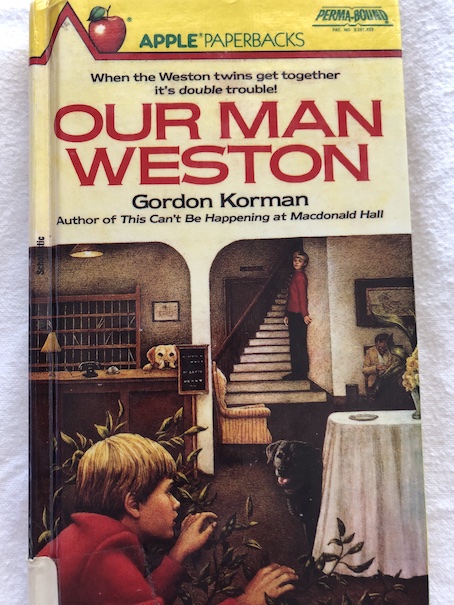
Tom and Sidney Weston, a pair of identical twins, are excited about their first big summer jobs as service boys at a fancy resort hotel. Tom is thinking that the work is going to be easy and that they’ll have plenty of time to have fun, but then, he starts worrying about what kind of fun Sidney is going to try to have. Sidney mentions that they might see some interesting people at the hotel, and Tom remembers that Sidney thinks of himself as a detective and is always on the lookout for spies and criminals. It’s a real problem because Sidney is perpetually wrong in his suspicions about everything and everyone he tries to investigate. He’s gotten into trouble before for making false accusations, and because the two boys look alike, Tom sometimes gets blamed for things that Sidney does. Tom is really looking forward to this summer, and he’s determined that Sidney isn’t going to ruin their summer jobs.
Right from the first, Sidney is in detective mode. As the boys are picking up room service dishes, Sidney tries to study the dishes to make deductions about the people in each room. Tom tries to get Sidney to stop because their manager, Walter Parson, is a serious man with little patience, and he’s already annoyed that he has trouble telling the two boys apart. Sidney is excited when a hotel guest complains that her purse is missing, thinking that he’s found a case to investigate, but while he interviews her for details and pressing for details about a primary suspect, Tom just notices that the lady’s purse is still in her room. It wasn’t stolen, just misplaced. Tom uses this incident to emphasize to Sidney that he needs to give up this detective game because it only causes problems.
However, unbeknownst to the boys, there are real spies at the hotel, and they’re interested in the nearby air base, just like Sidney speculated might happen. The readers learn who the spies are right in the beginning, before the boys even know that there are spies. It’s a little like a Columbo mystery, where the identities of the villains aren’t a secret, and part of the suspense of the story is how the heroes will figure it out and prove it. Even though we know right away who the main villains are, Sidney is clueless.
Sidney continues investigating various guests as though they’re all spies or criminals, although he doesn’t seem at all suspicious of our real villains. He becomes convinced that Lawrence Waghorn is a spy when he’s actually a television writer who’s working on a script for a show about spies. He convinces the guest who temporarily lost her purse, Miss Fuller, that another guest, Mr. Kitzel, is a suspicious character, and she starts following him around and spying on him. In turn, Mr. Kitzel gets the idea that Miss Fuller either has an awkward crush on him or that she’s investigating him because he cheated on his taxes. He’s very nervous because she keeps following him around and tries his best to avoid her. Sidney steals his boss’s dog because he’s under the false impression that the dog is being trained to help the spies carry out their mission, and he seriously wants to inform the Prime Minister of Canada (where they live) and the President of the United States. Tom keeps trying to thwart his brothers’ various schemes and confiscate the spy equipment that he’s hidden around their hotel room. Confusion abounds, although some of its helps to inspire Waghorn, who has been suffering from a case of writer’s block.
Meanwhile, the real spy, Richard Knight (a pseudonym, county of origin unspecified), is trying to get his hands on a new airplane being tested at the nearby air base. He’s brought along a pilot named Bert Cobber. Cobber actually has military training and trained alongside the pilot testing the plane, “Wings” Weinberg. Weinberg has nerves of steel … except about anything related to his cadet days, having been partnered with Cobber, who is a skilled but reckless flier and nearly got him killed on many occasions while flying drunk, forgetting to put sufficient fuel in the plane, and repeatedly crashing. Weinberg hasn’t seen Cobber for years, but he practically has a nervous breakdown every time he relives those memories. A friend of Weinberg’s assures him that, if Cobber is really as reckless as Weinberg remembers, he probably got himself killed long ago, but Weinberg has the uneasy feeling that Cobber is still around somewhere.
Although many characters have the overall situation wrong, I appreciated those moments when some people got certain things exactly right. When Miss Fuller overhears Mr. Parson yet again mistaking Tom for Sidney and also quizzing him about why he’s getting mail from different government agencies, she steps up to tell him to stop his bullying, reminding him that mail is private and that the boy doesn’t owe him any explanation about his personal mail just because he works for him. She also tells him that he’s talking to Tom, not Sidney, and that he’s a fool for getting that wrong.
I also love it that the different government agencies that Sidney has been writing to already know who he is because Sidney has submitted many other inquiries to these various agencies. They’re all familiar with Sidney’s false accusations, and in their response letters to Sidney, they express both amusement for Sidney’s wild escapades and sympathy for whatever poor sap Sidney is suspicious of today. Sidney is never discouraged by their criticism of his wild theories or their requests for him to stop writing. It’s getting to the point where some law enforcement agencies are so fed up with Sidney that they wish they could find something to arrest him for.
Meanwhile, Richard Knight has noticed Sidney’s investigations, although he is unimpressed because he knows that Sidney is way off base. However, he hasn’t fully reckoned with the lengths Sidney is prepared to go to “save the western world”, and Sidney’s schemes interfere with Knight’s in completely unexpected ways.
My Reaction
I remember reading this book when I was in middle school, and I loved it. I remember thinking that it was really funny, although I’d forgotten a lot of the details since then. As an adult, I find Sidney more frustrating than I remember, and I feel sorry for poor, long-suffering Tom. As with the MacDonald Hall books by the same author but with different characters, Sidney’s crazy schemes end up working out for the best, and he ultimately saves the day, even though it’s largely by accident.
There are a couple of changes that I wish I could make to the story. First, I liked it that, while Mr. Kitzel isn’t a spy or a major criminal, he does have one guilty secret: he cheated on his taxes by claiming his dog as a dependent daughter. He becomes convinced that Miss Fuller is onto him for that. However, I’d like to create even more semi-guilty secrets for various guests at the hotel so that Sidney can be almost correct about some things while still missing the most suspicious person of all. As it is, Sidney is seriously way off base because he’s paranoid and delusional, although in a comedic sort of way. I don’t like characters that are intentionally stupid, so I’d like more secrets and petty crimes among the more innocent guests so Sidney can be almost right about them.
I’d also like to see Sidney develop some self-awareness during the course of the story. He is completely oblivious to his own failings and false conclusions and also to the way other people react to him, even when they tell him, in writing, that they don’t want to be bothered with his wild goose chases anymore. That’s part of the comedy of the story, but I find it a bit frustrating. Sidney does almost come to realize how other people look at him when he tries to persuade Miss Fuller that he was wrong about Mr. Kitzel being a spy, but she’s as impervious to correction as he is, so he ends up just letting her continue barking up the wrong tree. I think it would have shown more character development and maybe even have been more funny if Sidney comes to realize how Tom feels, trying to reign him in, if he had to try to control someone even more overly paranoid and determined than he is. The book ends well, but I think it would have been even better if, at the end, Sidney apologizes to Tom for everything he’s put him through, saying that, while everything worked out for the best, he realizes that he’s done a lot of things wrong and that he still has a lot to learn. Then, just when Tom thinks that things are going to calm down, he can see Sidney seriously reading a book about espionage or interrogation techniques and making notes or signing up for a summer correspondence course in criminal investigation, hinting that Sidney’s adventures aren’t over yet and leaving it open about whether he’s going to really learn something practical or just graduate to the next level of crazy.
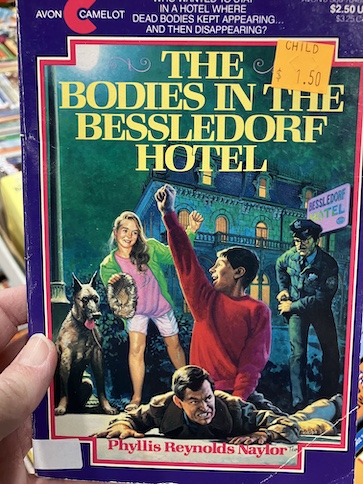
The Bodies in the Bessledorf Hotel by Phyllis Reynolds Naylor, 1986.
Officer Feeney is the first person who suggests that, someday, there might be a dead body at the Bessledorf Hotel. The hotel is coincidentally located next to the local funeral parlor, which is why the subject of dead bodies comes up, and Officer Feeney has a way of suggesting frightening things that scare Bernie Magruder, son of the hotel’s manager. Officer Feeney’s reasoning is that most people die in bed, so it only makes sense that some of them would be hotel beds. The hotel has 30 rooms, and with people coming and going, it’s surely just a matter of time before a guest dies there. It’s a morbid thought, although Bernie reasons that Officer Feeney is overestimating the number of people who pass through the hotel because it isn’t always full and some of the guests are long-term residents.
Still, Bernie gets a shock after he returns to the hotel, and the cleaning lady, Hildegarde bursts in on him and his parents, hysterical about finding a body in a bathtub of Room 107 with all his clothes on. Bernie’s father tells his wife to call Officer Feeney to write a report of the death and considers whether they can remove the body secretly, perhaps in a laundry cart, to avoid bad publicity for the hotel. Unfortunately, some of their guests already heard Hildegarde screaming about a dead body, so word is out. They want to know if it’s a case of murder or suicide and how it’s being investigated, and one of the long-term guests, who is a poet, has already written a short poem for the occasion.
However, by the time they all get to the room where Hildegarde saw the body, it’s gone. There is nothing in the bathtub, not even water. Officer Feeney shows up and demands to know what’s going on, and Hildegarde insists that she really saw something. The Magruders believe her, but they have no explanation for where the body could have gone. The guests speculate about body-snatchers and ghosts.
All they know about the man who occupied that room is that he gave his name as Phillip A. Gusset, he checked in the evening before, and he said that he would be leaving the next morning. Officer Feeney asks them if there was anything odd about him, like if he seemed nervous or unwell. Nobody remembers anything like that. They remember that he had a mustache and a hat with a red feather and just a single bag with him. He did kind of make Bernie’s parents uneasy, and he seemed to have a strange scent about him, although they find it difficult to describe what it actually smelled like. Officer Feeney says that, without a body or any evidence that something has happened, there doesn’t seem like anything to investigate. Bernie’s father is relieved that there won’t be any report of a murder or death occurring at the hotel because, otherwise, the owner might fire him. Bernie remembers that the man’s slippers were still in the room and goes to get them in case they’re evidence. When he gets there, he discovers that the slippers have mysteriously disappeared.
Bernie’s friends, Weasel and Georgene, think that people will probably never want to rent that hotel room ever again, and Bernie’s father renumbers the rooms so there will be no Room 107. Weasel convinces Bernie and Georgene to help him search the area for the body, thinking that whoever took it would most likely want to dispose of it quickly. They search down by the river, but they only find a bag of garbage that Bernie’s younger brother, Lester, left there to trick them.
Even though there’s no evidence that anything happened and the police aren’t investigating the situation, the incident of the disappearing guest appears in a newspaper in Indianapolis, where the hotel owner, Mr. Fairchild, lives. Mr. Fairchild calls the hotel to demand to know what’s going on. Mr. Fairchild says that he want the hotel to put on live entertainment in the evening on weekends to draw attention away from the incident and bring people in. However, he expects Bernie’s father to hire the entertainment out of his own money since Mr. Fairchild thinks this situation is his fault, and most entertainment is out of the Magruders’ price range. Fortunately, Bernie’s father has joined a barbershop quartet, so his group can do their singing at the hotel.
The singing goes well, but a strange woman with orange hair checks into the hotel and keeps making comments about dead bodies there. Then, one of the waiters finds this woman dead in her room, Room 321. Just like the first body, this body also vanishes. By this time, Bernie’s father suspects that the woman faked her “death” just to scare the waiter and ran away as soon as he was gone. As Bernie’s parents investigate the room, they notice an odd smell that reminds them of the first guest who disappeared. The smell really unnerves his father, but strangely, not his mother. It’s a faint smell that’s difficult to identify, but it conjures different images for both of them. Bernie’s father says it reminds him of sweaty clothes, cigars, and pastrami, while his mother says it makes her think of flowers and a porch swing in the evening.
The Magruders aren’t sure why someone wants to fake deaths at the hotel, but this latest faker didn’t pay for either her room or dinner, and somehow, the newspaper has heard about it and reported it again. Mr. Fairchild is angry, and Bernie knows that they need to figure out who the prankster is before they do it again!
The book is part of the Bessledorf mystery series, also known as the Bernie Magruder series. It is available to borrow and read for free online through Internet Archive (multiple copies).
My Reaction
Attempts to investigate the mystery alternate with the Magruders’ attempts at cheap hotel entertainment. The barbershop quartet works until one of the members gets laryngitis. Some of the guests start a food fight when the entertainment is bad. Then, Joseph gets some of his friends from the veterinary college who play instruments to come. Personally, I like the part where Lester suggests that they hold a haunted house at the hotel and take people on tours of the rooms where “dead” bodies have been found. They reject that idea, but there are hotels and bed-and-breakfasts that give haunted tours, and people come to investigate ghosts. That actually can be a successful gimmick. I once intentionally stayed in a supposedly haunted hospital that had been turned into a hotel in an old western mining town. A possible murder once occurred there, but I enjoyed the visit.
When a new guest shows up at the hotel with that same, strange scent, Bernie knows that it’s their culprit, back again in another disguise. Now that he knows who to watch, he starts planning how they’re going to trap the person.
I had a couple of ideas in beginning about who was doing all of this and why, but there are some surprising twists in the story. Bernie’s first attempt to catch the villain is weirdly thwarted by the discovery of a dead body that is actually a real, dead person. It’s not a guest; it’s a body stolen from the funeral parlor next door. The bad guy decided to change his tactics.
One of the clues to the person’s identity is that mysterious smell and the way it has an opposite effect on Bernie’s parents. It irritates Bernie’s father but makes his mother feel strangely nostalgic. The truth is that they’re both remembering the same thing or the same person, but although they can’t remember right away exactly what they’re remembering, they have very different feelings about it.
Surprisingly, although Mr. Fairchild threatens to replace Mr. Magruder with another manager, he actually shows up at the hotel himself and discovers that he likes playing detective and figuring out what’s going on. He’s also impressed with the way Mr. Magruder stayed to finish managing things even after he told him that he was planning to hire someone to replace him, and that secures the family’s position.
#13 Who’s Haunting the Eighth Grade? by Kate Kenyon, 1988.
A group of eighth graders are going on a field trip to see a Shakespeare play in another town, but right from the start, everything seems to be going wrong. The teachers who are accompanying them on their trip are in a foul mood and spend a good part of the trip arguing with each other, which bothers the kids because they know that the teachers have recently become engaged to each other. Then, the bus breaks down in a small town before they can reach their destination. The entire class is going to have to spend the night somewhere in the small town.
At first, things look like they’re going to improve when the group decides to spend the night at a local bed and breakfast in a big, beautiful, old house. However, their spirits are almost immediately dampened again when they are told that the house is haunted and that anyone who tries to stay there is scared away by the ghost. Still, they proceed with their plan to stay there in order to avoid staying at the dumpy local motel, the only other choice of accommodation.
Needless to say, before the night is over, the ghost puts in an appearance, and strange things start to happen. By then, the students have come to feel sorry for the owner of the bed and breakfast, a nice older lady who grew up in the house but can’t really afford to keep it unless she can make her inn a success. Can the eighth graders catch the ghost, stop the hauntings, save the bed and breakfast from having to close, patch up the relationship between their feuding teachers, and still make it in time to see the play?
The book takes place in the 1980s, and the kids in the story are 14 years old. They mention the decade somewhere during the course of the story, and the descriptions of the clothes and some pop culture references make the time period fairly obvious. It also has some of the stock characters that books for pre-teens and early teens in the 80s have (ex. a boy-crazy space cadet, a level-headed health nut, a class clown, and a couple of young punks). Still, even though there are some things about the book that are a bit dated, it is still pretty enjoyable. The author has a sense of humor, and she plays with the characters’ stereotypes a bit. The class clown is secretly quite sensitive and even a bit perceptive. There are also a couple of fun scenes when the girl who is only interested in boys is shocked to discover that the boys are more interested in the mystery than in her.
The Ghost in the Tokaido Inn by Dorothy and Thomas Hoobler, 1999.
In feudal Japan, more specifically in 1735, the family you were born into determined what you were meant to be in life. Samurai were born into families of samurai, and merchants were born into merchant families.
This is a terrible disappointment to Seikei, the fourteen-year-old son of a tea merchant, who would love nothing more than to be able to become a samurai. He has studied the samurais and their ideals and greatly admires their bravery. He even loves to write poetry, as the samurais do.
One day, Seikei accompanies his father on a business trip from their home in Osaka to Edo (the old name for Tokyo). On their way, they stay overnight at an inn. There, Seikei makes friends with the daughter of a paper merchant, and she entertains him with a ghost story. During the night, Seikei sees a strange figure that attempts to enter his room, which he fears might be an evil spirit (like the one in the ghost story), but he is unable to get a good look at it before it disappears.
The next morning, Lord Hakuseki, a daimyo (lord, nobleman) also staying at the inn, says that a jewel was stolen from him during the night. The famous Judge Ooka comes to the inn to investigate the crime. The paper merchant and his daughter are accused of the theft because the jewel is found among their belongings. Seikei recognizes the jewel as one that Lord Hakuseki showed to both him and the girl the night before when they each went to show him their fathers’ wares, and he also realizes that he saw the “evil spirit” holding it.
When Seikei tells Judge Ooka all of this, his father is angry, saying that Seikei must have imagined the whole thing. However, Judge Ooka believes him. He points out that the silent figure was no doubt the thief, who merely looked like an evil spirit to the boy who had just been startled awake, with a ghost story still on his mind. Judge Ooka is also impressed with Seikei’s bravery when Seikei describes how he got up to try to get a better look at the figure, even though he believed that it was an evil spirit at the time.
Judge Ooka recruits Seikei to help him further investigate the crime, and they realize that the theft is only part of a much larger and more serious plot of revenge. Judge Ooka, himself of the samurai class, also understands Seikei’s feelings better than his father does. In the end, he offers Seikei a way of living the kind of life that he’s always dreamed.
This book is the first in a series. Judge Ooka was a real, historical figure, although Seikei, his adopted son, is fictional. Because the story contains violence and some religious oppression, I recommend it for middle school level readers. The book is currently available online through Internet Archive.
Laura and Bill are visiting their Uncle Joe, who is the caretaker of a large hotel in New Hampshire. The hotel is closed for the winter because it is too old and poorly-insulated to heat. The children think that the big, old hotel is fascinating, especially when they begin hearing stories about the ghost of a princess who is said to haunt the hotel and put people under her spell to do her bidding. It’s just the sort of thing that Laura reads about in her favorite series of mystery books, and she’d love the chance to investigate something like the heroine, Gwen Gilderstar.
Bill rolls his eyes at Laura’s melodramatic mystery obsession, but then the children begin noticing that their uncle is behaving strangely, and they start to wonder if he is under the princess’s spell. When they first arrived, their uncle told them that his sister, their Aunt Gigi, had gone away to visit a sick friend. Then, Laura overhears him talking to Gigi on the phone, saying that she and her brother and parents went out to dinner, so she can’t talk to them. Later, Laura gets the chance to talk to Aunt Gigi and finds out that she only went to visit her friend because Joe insisted and that her friend isn’t sick. What is going on? Why would her uncle lie? Is he under the princess’s spell?
Laura and Bill see mysterious lights and a shadowy figure in the windows of the closed hotel. Could that be the ghost of the princess? Even though their parents have forbidden them to go inside the old hotel, the kids go there to investigate. They hear organ music and a woman laughing, and they find a red rose on the floor, just like the roses in the portrait of the princess. Then, Bill catches a glimpse of the princess in the elevator, carrying a silver axe! Laura is determined to solve the mystery, just like Gwen Gilderstar. She’s afraid, but she knows that she has to do something for her uncle’s sake.
My Reaction
I loved this book when I was a kid because it’s a fun mystery. Laura is a girl after my own heart, who loves mystery stories in the classic girl detective style. “Gwen Gilderstar” seems to be a character similar to Nancy Drew, Trixie Belden, or other girl detective characters. Because of her taste in books, Laura looks at everything that happens through the lens of a spooky mystery story, initially not seeing the more practical explanations for the things happening around her. Although the setting of the book, a seemingly haunted hotel that’s closed for the winter season, reminds me of The Shining, the actual plot reminds me more of Northanger Abbey, the classic book by Jane Austen about a girl with an active imagination and a taste for frightening stories.
Miranda is living with her grandmother in Oregon while her scientist parents are away studying algae in Antarctica. Her grandmother owns a bed and breakfast called The Jumping Frog, which has a Mark Twain theme. At first, all Miranda is concerned about is finding some friends and fitting in at her new school, but soon strange things start to happen at the bed and breakfast.
First, someone attacks their housekeeper, hitting her over the head with a bust of Mark Twain. Then, some letters that were written to an ancestor of Miranda’s by Mark Twain himself are stolen.
Although Miranda’s grandmother likes to think the best of everyone, Miranda is convinced that the villain is someone living in the bed and breakfast. With her new friends (the main characters from A Little Magic, another book by the same author) Miranda begins her investigation, determined to find the letters for her grandmother, although it may mean solving a double mystery. There is more that one person in the bed and breakfast with something to hide.
One of the fun things about this story is the riddles that Miranda and her grandmother like to tell each other. Even her friends enjoy riddles, and they help provide Miranda with the inspiration to solve the mystery.
This book is currently available online through Internet Archive.






 The Ghost in the Tokaido Inn by Dorothy and Thomas Hoobler, 1999.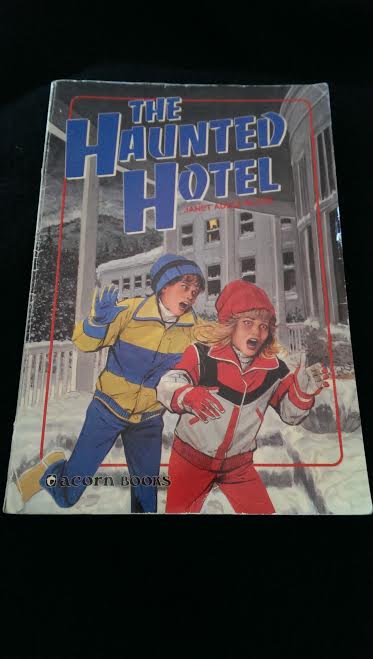

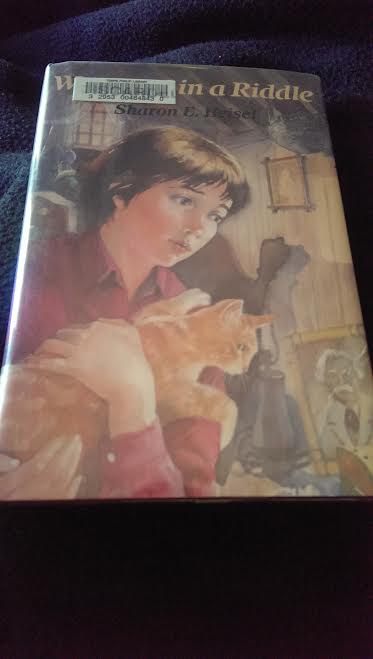 Wrapped in a Riddle by Sharon E. Heisel, 1993.
 Jestress's Forgotten Books and Stories