William’s House

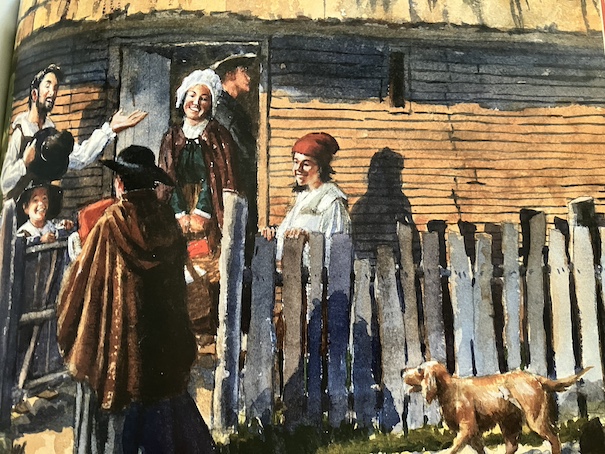
It’s 1637 in Colonial New England, and a man named William is building a house for himself and his family. He wants a house that’s like his father’s house in England. The story describes all the steps he and his family go through to build the new house.

The descriptions include interesting historical details about homes from the Colonial era. When the family wants to put a window in their house, they don’t have any glass, so William uses a very thin piece of animal horn instead. It lets in light, but the window opening is still covered. William also uses stones and clay from a nearby creek when he builds a fireplace for the house.

William and his family also need furniture for the house. William uses boards from a wooden packing crate to make a table, and he stuffs bags with corn husks to make beds. When the house is finished, and the family is living in it, the book describes aspects of their daily lives. It describes how the family eats together.

The family has to change some of their habits and make additions to their house and the area around it because conditions are different in New England. The weather is hotter than they’re accustomed to from their lives in England, and their food spoils faster, so William digs a cellar for storing food. Before ice boxes and refrigeration, people would store their food underground in root cellars because it was cooler underground. When the thatch on their roof dries out and becomes a fire risk, William replaces the thatch with singles.

Then, when winter comes and it snows, they realize that the snow is too heavy for the roof, so William replaces the whole roof with one that has a steeper slope, so the snow will slide off. Then, he has to make the fireplace bigger because the house is so cold.

When spring comes, William’s cousin Samuel arrives from England with his wife, and he asks William about the design of his house. Originally, William wanted a house like the one he grew up in, but because he’s living in a different place and under different conditions, he’s had to make many changes to the house. Still, it’s his family’s new house, and it’s exactly what they need it to be.

The book is available to borrow and read for free online through Internet Archive.

I love stories about life in the past, and I liked all of the little details of daily life in this story. The main focus of the story is about the building of a new home, and at first, William wants a house like the one where he grew up in England. However, when the family experiences what life is like in New England, they realize that they have to make some changes to their home and the way they live. I like the way the book points out that the style of a person’s home depends on where they live and the circumstances of their life. The family doesn’t fully understand at first what their new lives will be like and what they really need, but they learn to adjust, and they make changes to their new house along the way.

When William’s cousin arrives, he doesn’t understand the design of their house at first. He hasn’t been living in New England yet, but readers know that he’s about to find out some of the reasons why people’s houses in New England are different from those in England at the same time period. At the end of the book, the characters are building a new house near William’s house, so it seems that his cousin and his wife will be living there, and they will benefit from what William has learned about building a house suitable for that environment.

The Diamond in the Window

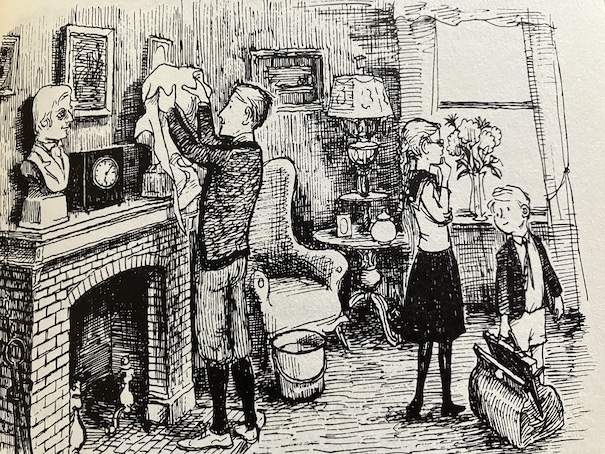
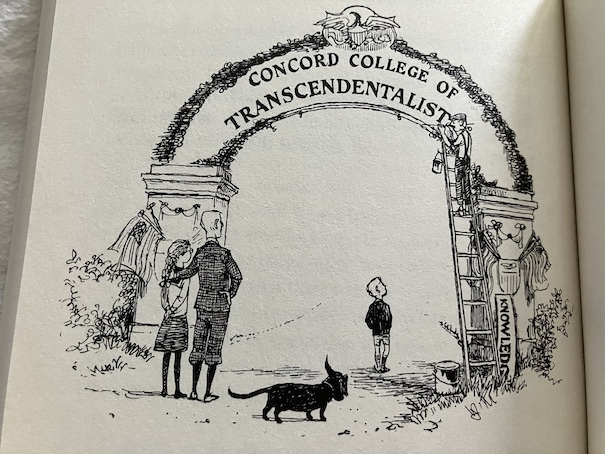
Eleanor and Edward Hall are orphans who live with their Aunt Lily and Uncle Frederick in their family’s big but somewhat shabby old house in Concord, Massachusetts. The family has lived there for generations, and they are intellectuals with a particular interest in the literary history of Concord. Uncle Freddy is obsessed with Ralph Waldo Emerson and Henry Thoreau, although he doesn’t share Eleanor’s love of Louisa May Alcott. When a couple of the town leaders threaten to take the family’s house because of unpaid back taxes and to destroy it because they think it’s an eyesore, the children come to learn that their house holds more secrets and history than anyone knows.

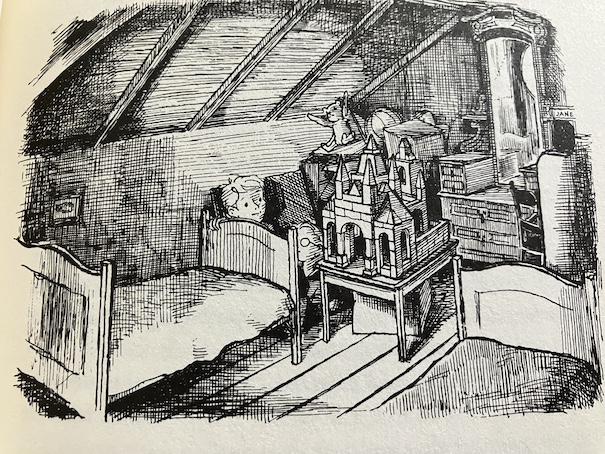
As Eleanor and Edward look at the house from the outside, they suddenly realize that there’s an window at the top of the house that’s shaped like a key and made of colored glass. They’ve never seen that window from the inside of the house, so there must be a secret room! The children search the attic and find a trap door that they never realized was there before. When they look into the hidden room, they find a pair of children’s beds and toys.

The children ask Aunt Lily about the room, and she sadly admits that she hadn’t wanted to tell them about it. Then, she begins to explain more about the family’s history and the aunt and uncle the children never knew. Aunt Lily is their father’s sister, and Uncle Freddy is their brother, but there were once two more children in the family, called Ned and Nora. Eleanor and Edward were named after them, but Ned and Nora mysteriously disappeared years ago. Aunt Lily still believes and hopes that, somehow, they will return someday, so she has always kept their room ready for them.

When she shows the children pictures of Ned and Nora in the family’s album, they also see a picture of a young man in a turban and ask about him. Aunt Lily says that the man is Prince Krishna, son of the Maharajah of Mandracore. Their Uncle Freddy has written books about Emerson and Thoreau and was once considered an expert on the Transcendentalists. People who were interested in Transcendentalism, like Prince Krishna, used to come and study with him. Aunt Lily wasn’t really interested in Transcendentalism, but she explains, “I think he said that the Transcendentalists believed that men’s minds were very wonderful, and that they could know all kinds of important things without being taught about them through their eyes and ears –because they were part of something called an Over-Soul.” Eddy approves of this concept because it sounds like it’s about learning without school, and he approves of anything that involves no school.

Everyone was fond of Prince Krishna while he lived and studied with the family, and Aunt Lily said that he used to make up fun games for Ned and Nora, like treasure hunts with real jewels as prizes because the prince was very rich. The children get the sense that Aunt Lily was in love with Prince Krishna, but he also vanished shortly after Ned and Nora did. When they discovered that Ned and Nora were missing from their beds one morning, Prince Krishna dashed around, looking for them, but suddenly, he was also gone, and no one knew where or how.

Eleanor and Eddy return to Ned and Nora’s room upstairs to have another look at it, and they find a mysterious poem called “Transcendentalist Treasure.” From the handwriting, which matches a note that Prince Krishna wrote to Ned and Nora with a present he gave them, Eleanor and Eddy realize that Prince Krishna also wrote the poem. Since the poem seems to be some kind of treasure hunt, the children think that it was probably part of the treasure hunts that Prince Krishna used to make for Ned and Nora. They try to figure out what the clues in the poem mean and what it might lead to, hoping that it might be the jewels that Aunt Lily told them about and which haven’t been seen in the house since Ned, Nora, and Prince Krishna vanished. If they could find those jewels, they could pay the back taxes and save their house!

However, they don’t really begin to grasp the full importance of the poem until they ask Aunt Lily if they can spend the night in Ned and Nora’s room. During the night, they have a bizarre dream, in which they’re climbing an elm tree with Ned and Nora and find a harp, which is something that was mentioned in the poem. A dangerous wind blows them out of the tree, and they wake up. They could have believed that it was only a dream except that they realize that they both dreamed the same thing, Eleanor has bruises and a scratch on her leg that she got from falling out of the dream tree, and Eddy has located the harp in Ned and Nora’s bedroom.

They show the harp to Aunt Lily, and she says that Prince Krishna had given it to Ned and Nora years ago, hanging it in a tree so that they would hear the wind blowing across it. The poem and the dreams that Eleanor and Eddy have seem to be hinting at the treasure hunts that Prince Krishna had with Ned and Nora. Eleanor and Eddy begin to think that solving the riddles in the poem may not only lead them to the jewels but to the truth about what happened to Ned, Nora, and Prince Krishna.

The book is available to borrow and read for free online through Internet Archive.

The book introduces the concept of Transcendentalism. I remember my English and history teachers discussing the Transcendentalists when I was in high school, but for some reason, they didn’t appeal to me back then, even though I went through a kind of phase where I was interested in metaphysical topics. I think my teachers put a lot of emphasize on their interest in nature, and I wasn’t an outdoorsy person. The background information in this story revived old memories of my high school classes and actually clarified a couple of points for me. The kids visit real places in Concord, Massachusetts, including the house where Louisa May Alcott once lived, and the book is full of discussions of literary figures and their lives and quotations from their works.

The children’s surrealist dreams connect to real objects in their lives and in the history of the family and their house. The dreams follow the poem that Prince Krishna left behind, and in each of their dreams, they see Ned and Nora up ahead of them, so the Eleanor and Edward realize that they’re following their path. The poem and the dream reference pieces of Transcendental literature and thought, and the children’s uncle explains the references throughout the story.

Many of the dreams also show the children’s personal and mental growth. In one dream, the children examine different images of their future selves, seeing how different choices they make can lead their lives in different directions, and they make up their minds which version of themselves they want to aim to be. In another dream, the children are trapped in a nautilus shell, and they discover that they have to think their way out of it. The thoughts they have help them work their way through each chamber of the nautilus, but they have to use thoughts with increasing depth and complexity to make progress. At first, remembering nursery rhymes is enough to help them move forward, but as they go further, they have to concentrate on more complex poems and higher-level moral and philosophical thoughts.

Although the dreams the children have are very surreal, and readers have no idea where they might be leading, the children do find Prince Krishna and their missing aunt and uncle. When the three of them return, Prince Krishna does explain where they were the entire time they were missing. He doesn’t offer a detailed explanation because they were trapped in a sort of magical/metaphysical prison, but he does explain who trapped them and why. There is a villain in the story, but it takes a while to grasp who and what the villain is because readers don’t really see it/him in his true form and don’t understand who he is and what his motives are until Prince Krishna explains. Eleanor and Eddy end up understanding more than Aunt Lily and Uncle Freddy do in the end, but finding Ned and Nora, Prince Krishna, and Prince Krishna’s treasure changes everyone’s lives for the better. Throughout the book, Uncle Freddy is mentally unbalanced, eccentric at the best of times and outright crazy at others. Local people want to see him committed to an asylum, but his mind was unbalanced by Ned and Nora’s disappearance. Once they’re back, he regains his senses.

The author wanted to write realistic children as her protagonists to appeal to real children. Eleanor and Eddy have their own insecurities and dreams which play into their characters all through the book and appear in the visions of the futures and choices they have to make in their dreams.

Mr. Pine’s Purple House

Mr. Pine lives in a little white house. All of the houses on Vine Street are white, and they look completely identical. Mr. Pine thinks that he’d like to do something that will make his house different from all the other little white houses.

His first idea is to plant a pine tree in his front yard. Since his name is Pine, everyone seeing it will think of him, and his house will be different from everyone else’s. The problem is that all of his neighbors like his pine tree and decide to plant their own trees. Soon, all of the houses look alike again with pine trees in the yards.

To make his house look different, Mr. Pine tries to plant a bush next to his tree, but everybody likes that idea, too. Soon, everybody has both a bush and a pine tree in their yard, and the houses look identical again.

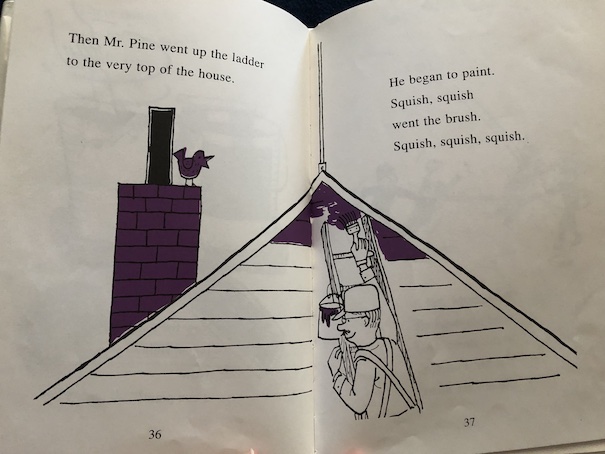
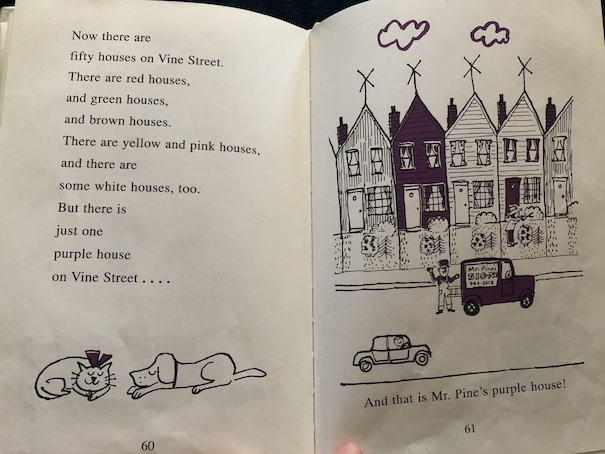
Mr. Pine tries to think of something that he can do with his house that his neighbors won’t imitate. He gets the idea of painting his house, but he can’t pick any obvious color that all of his neighbors will want, too. He decides to paint his house purple. Is this finally the idea that will make Mr. Pine’s house different from the rest?

This book is actually the second book in a series of picture books about Mr. Pine.

I often think of this book and The Big Orange Splot together because they’re both about people in a neighborhood of identical houses who make changes to distinguish themselves and their houses and end up changing the way their neighbors view their own homes. The difference between the books is that, in The Big Orange Splot, the neighbors were completely opposed to changes that made anyone’s house different until they began to see the opportunities for living out their own dreams through their homes. In this book, the neighbors immediately seize on everything that Mr. Pine does that’s different and start copying him. They think all of his changes are great and frustrate his efforts to be different by doing everything he does until they decide to all paint their houses different colors. Of course, Mr. Pine’s changes are all less outlandish than the ones from The Big Orange Splot, so they would be easier to accept.

I liked it that Mr. Pine’s neighbors all have colors for names: Mrs. Gray, Mr. Gold, Mrs. Green, Mrs. Brown, and Mrs. White, and all the colors they eventually pick for their houses are different from the colors in their names. Even though this book mentions a lot of colors, the only colors shown in the pictures are black, white, and purple. In the end, when the houses are all different, the differences in color are shown with lines providing shading rather than with actual colors. It still works to show that the houses are now different from each other.

Mirror of Danger

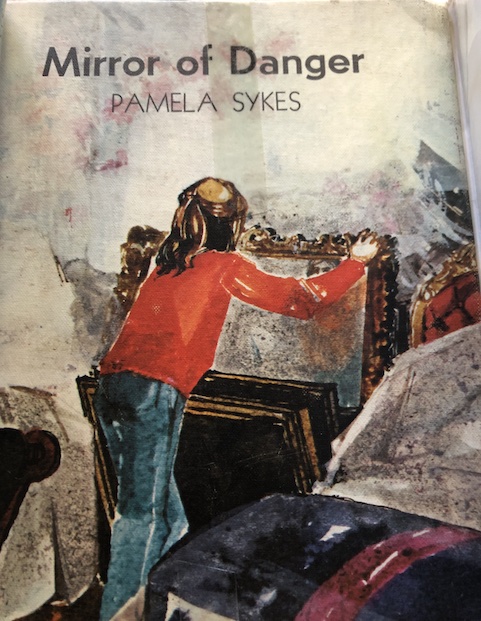
Mirror of Danger by Pamela Sykes, 1973, 1974.

In the beginning, Lucy is an orphan who lives in the countryside with her elderly Aunt Olive. The two of them are very fond of each other. Then, Aunt Olive dies, and Lucy has to go live in London with her distant cousins. Even though Lucy inherited her aunt’s house, there were bills to settle, and the trustees in charge of Lucy’s legacy had to sell the house to pay them and provide money to help support Lucy. Lucy’s cousins have agreed to take her for Christmas, but Lucy isn’t sure whether or not she will be living with them permanently. It depends on how well Lucy gets along with the children of the family. People keep telling her “we’ll see” and reminding her to be brave and sensible and that changes are natural after someone dies. Her trustees and her aunt’s old friends want to do what’s best for Lucy, although they’re secretly a little concerned about whether their plans are what’s best for her. If she doesn’t get along with her relatives, they might have to send her to a boarding school, although they know that type of environment isn’t really suited to Lucy’s personality.

Since Lucy was raised and home-schooled by an elderly and old-fashioned woman, she is not accustomed to living in a big family or with other children and not even accustomed to any type of school environment. The adults who know her understand that Lucy is a quiet, reserved child who acts older than her age. Before she goes to stay with her relatives for Christmas, one of her trustees, Mr. Thomas, talks to Lucy about her life with her aunt and the need to give her other relatives a chance to be friendly. He says that Aunt Olive was an old woman who had a tendency to look back to the past, but Lucy is young and still has her future ahead of her. Mr. Thomas advises her to look forward. However, Lucy can only think of how much she already misses her life with her aunt and how she can’t imagine being happy with these relatives she’s never even met. She escapes thinking about these things by imagining herself other places, immersing herself in past memories.

Lucy feels out of place in her new home and worries if these relatives really want her. The father of the family, called Uncle Peter, is an architect, and the mother, called Aunt Gwen, is an artist who used to design theatrical costumes. Their three children are pretty close in age to Lucy. Patrick is the oldest, Rachel is closest to Lucy’s age, and Bill is the youngest. Their house is an old Victorian house, which pleases Lucy, but she doesn’t like it when she finds out that Uncle Peter is modernizing it. Home renovations are part of what he does as an architect, but Lucy prefers old-fashioned styles to the modern ones, which feel too stark and have garish colors. The children of the family are noisy, and Lucy has to share a room with Rachel, when she’s used to having a room of her own in a quiet, old-fashioned house. Rachel points out that they haven’t been in this house very long themselves, and there are rooms in this house that haven’t been renovated yet. When the renovations are done, Lucy could have one of those rooms for herself, but again, Lucy feels like the renovations are destroying the old-fashioned charm of the place. She doesn’t see why everything has to be new and modern. While she has no idea where else she could go, Lucy just can’t imagine herself living in this house with these people.

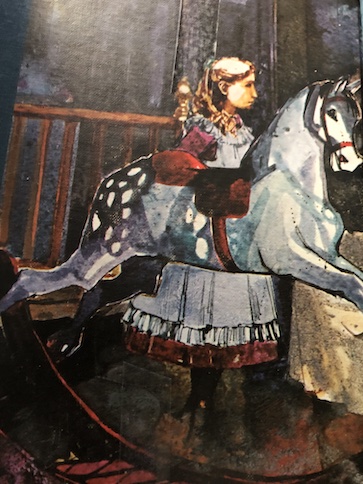
Then, Lucy makes an unusual new friend. Alice is a girl about Lucy’s age, and she used to live in the aunt and uncle’s house 100 years before. Now, she haunts it as a ghost. Lucy first sees Alice in a mirror in the attic, where there are many antiques that have been stored away from Alice’s time. Alice brings Lucy back in time to visit her in the Victorian era because Alice is lonely in the past. She has six older siblings, but four of them have already left home to marry or start careers, and two are at boarding school. Her parents are away much of the time, so most of the time, she is alone with her tutor, whom she calls Mademoiselle. Alice says that she really wants someone to play with.

Alice shows Lucy her toys and games, which are all familiar to Lucy, looking like the ones she always played with at Aunt Olive’s house. However, Alice is spoiled and cheats at games to win. The two of them argue about it, and then Alice sends Lucy to the attic because her tutor is coming, and Alice doesn’t want her to see Lucy. Lucy finds herself in the attic in her aunt and uncle’s house in modern times, unsure of what just happened.

Over the next few days, Lucy spends part of her time with her relatives, preparing for Christmas, and part of her time in the Victorian era with Alice, which is also around Christmastime. Things are still awkward between Lucy and her cousins. On the one hand, she has some fun with them, doing things that Aunt Olive would never have allowed her to do, like going to the movies without adults and eating take-out fish and chips. On the other hand, Lucy is still overwhelmed when her cousins get boisterous, and she is repulsed by their ultra-modern Christmas decorations. Although Alice intimidates and even frightens Lucy, whenever things get overwhelming for her in modern life, Lucy retreats into the past with Alice … only for Alice to get intimidating and frightening again as she tries to keep Lucy in the past with her.

In some ways, Lucy feels more comfortable in the past than she does in her aunt and uncle’s modern home. She likes the homey feel of the house as it was in the Victorian era. The old-fashioned Christmas decorations and Alice’s party are far more charming to her than the modern ones, and she likes the old-fashioned party games better than dancing to modern music. However, Lucy becomes increasingly afraid of Alice. Alice tries to trap Lucy in the past and make her forget all about the present. When Lucy resists and tries to remember things about her family or modern times, Alice gets angry and threatens her. She says that she’ll make something bad happen if Lucy tells anybody about her. Alice has sinister intentions for Lucy. Alice is a lonely and selfish child who isn’t above lies, cheating, and manipulation to get what she wants. She exists only in the Victorian era, and what she wants more than anything is a playmate to join her for all eternity. She says that she always gets what she wants. She wants Lucy.

The book is available to borrow and read for free online through Internet Archive (multiple copies). The original British title of this book was Come Back, Lucy, which was also the title of the tv mini-series from 1978 based on the book. You can sometimes see trailers, clips, or episodes from this series online on YouTube. This fan page has more information about the tv mini-series and the book and its author.

My Reaction and Spoilers

The heart of the story is about looking back and living in the past instead of looking forward and living in the present. Aunt Olive, as an elderly woman, had a tendency to live in the past, bringing up Lucy as if she were a Victorian girl instead of a modern one. Because that was the only life Lucy knew from a young age, she clung to it after Aunt Olive’s death. It was what was familiar and comfortable to her when her life was changing, and she needed comfort. Her London relatives know that this is the case, but they’re not sure how to connect with her at first and to help her see that modern times and a new home can also become comfortable.

There’s a difference between just liking old-fashioned, vintage things and styles and the type of living in the past that Lucy does at first. There are people in modern times who still like the Cottagecore aesthetic and who try to live a slower pace of life and enjoy old-fashioned things and simple pleasures, something that came out of the coronavirus pandemic. But, just having a few vintage things and learning to slow down and appreciate the small things in life isn’t quite what Lucy does. It is the sort of thing she misses from the old-fashioned house in the country, where she used to live, but the problem is that she uses her memories of that time, Aunt Olive, and the stories that Aunt Olive used to tell her about life in the past to take her mind off the things and people in the present too much. Whenever things get stressful or upsetting to her, she retreats into past memories, so she doesn’t have to think about how her life has changed or learn to appreciate the things around her or get along with other people. Her relatives can tell that she’s shutting them out, and while they’re sympathetic to her struggling through her grief, it’s also hurtful that she’s rejecting them. She’s not just using her past memories or love of old-fashioned things for comfort but to avoid dealing with things in the present and forming new relationships.

At the same time, Lucy feels like her relatives don’t really care about her or the life she had before she came to them because they never express sympathy about Aunt Olive’s death or ask her any questions about what she was like. However, that’s due to a misunderstanding and miscommunication rather than her relatives trying to ignore Lucy or Aunt Olive’s death. If Lucy had bothered to read Aunt Gwen’s letter to her all the way through before she arrived at their house, she would have known that Aunt Gwen had told her children not to bring up the subject of Aunt Olive until Lucy did because she didn’t want them upsetting Lucy by forcing her to talk about her death if she wasn’t ready. Her relatives planned to wait for Lucy to feel ready to talk to them and for her to raise the subject herself. Because she was too upset to read the letter, Lucy didn’t understand that and has been waiting for them to talk to her first. At the end of the story, Lucy does read the letter, and she and her relatives have an honest talk about everything, including Alice. This is exactly what Lucy needs to free herself from Alice.

Alice is a similar sort of malevolent child ghost to Helen in Wait Till Helen Comes or Emily in Jane-Emily. She is selfish, and she has no concern for Lucy and Lucy’s life and future. Alice is dead, and she lives only in the past because that’s the only place where she can live. She has no future left. The one thing that past Alice is waiting for is a message from her parents, who are looking for a house in the country to buy. When the message finally arrives for her on December 21, 1873, Lucy has her final encounter with Alice on the 100th anniversary of the event. Alice is happy because she wants to move to the new house and live there with her parents, but she’s also decided that she’s going to bring Lucy with her by drowning her in an icy pond. In a frightening scene, she tricks Lucy into walking out on thin ice, but fortunately, Lucy is saved by her cousin Patrick.

After this incident and her brush with death, Lucy is finally able to release all of her bottled-up feelings about Aunt Olive and the changes in her life and explain everything to her relatives about Alice and how Alice has been influencing her to do and say things that upset them. Aunt Gwen had suspected that Lucy had seen a ghost or at least thought that she had, but she had thought that maybe Lucy had seen someone who made her think that she was seeing Aunt Olive’s ghost. Then, Aunt Gwen saw a door in the house open and close by itself, making her think that maybe the ghost was real. Rachel knew that Lucy was upset about someone named Alice because Lucy was talking in her sleep, but she didn’t know who Alice was. By the time Lucy reveals everything, all of her relatives have had encounters with Alice or things Alice caused to happen. Lucy isn’t sure when she explains things whether or not they all believe her that Alice is a real ghost. Aunt Gwen is convinced, and so is Bill because he met Alice face-to-face at one point and can describe her. Uncle Peter does consider the idea that Alice is a ghost in Lucy’s mind, inspired by all of Aunt Olive’s stories about her Victorian youth and the old house they now live in, but then, he looks through more of the things in the attic and finds Alice’s old scrapbook with her final note about moving to the countryside and starting a new life on December 21st. In the context of the story, Alice is a real ghost who posed a real threat to Lucy, and not just the imagining of a distraught child.

There are a couple of factors that end Alice’s threat to Lucy. The first one is getting past the 100th anniversary of Alice leaving the house, which seems to hold great significance to the ghost, like it was her last opportunity to connect with the house in the present. We never find out Alice’s full history or why she haunts the house as a child in the time shortly before she was supposed to move to the country. She simply disappears after her attempt to kill Lucy so she can remain in the past forever and go to her new home with her. Alice is a ghost who is conscious that she is a ghost, and she knows that Lucy lives in a different time period with people who inhabit her house in the future or present time. Because Alice is a child and seems forever stuck as a lonely child, it seems that she died young somehow and is aware of it, but we never find out exactly how that happened. I have a theory that she was killed in an accident on the way to her new home, but we are never told that. It feels like a let-down that we don’t get the rest of the story about Alice, especially because Lucy says that she would like to learn more about the historical Alice so she can think of her more as a person and less as a ghost.

There is a sequel to this book called Lucy Beware, so perhaps more of that information is revealed in the sequel. The sequel is much more rare than the original, book, though. It only rarely comes up for sale, even online. I’ve checked Amazon, eBay, Etsy, Alibris, and Abe Books, and currently, none of them have a copy. It’s not even on Internet Archive. (At least, not yet, as of this writing.) You can try to get the sequel through an interlibrary loan, but not all libraries will loan out books that are considered “rare.”

The most important factor that breaks Alice’s connection to Lucy is Lucy’s changing feelings. Lucy has some control over when she goes back in time and when she returns to the present, although it takes her a while to see it. There are times when she deliberately seeks out Alice in the past, even when Alice disturbs her, because she just finds the present time and her relatives so overwhelming. While she doesn’t really want to stay with Alice in the past forever, especially at the expense of her own life, Alice gives her someone to talk to about things that she can’t bring herself to talk about with her relatives and a place to retreat to so she doesn’t have to think about the present or her future. At one point, Lucy and Rachel are talking about the importance of making plans for the future. Rachel says that everyone needs to think of the future, and she is exhilarated by all of the possibilities that modern life has to offer for young women. However, because of her life with Aunt Olive, who lived mainly in the past, Lucy is unaccustomed to thinking about the future and finds the prospect frightening. To a woman like Aunt Olive, girls should simply receive a basic education and then get married. Beyond that, Lucy doesn’t know what she wants out of life. She has never considered having a career or learning to support herself because Aunt Olive never discussed things like that with her and never prepared her to make decisions like that. At the beginning of the story, Lucy finds it difficult to look much beyond the immediate future anyway because it seems uncertain where she will live since Aunt Olive is gone. However, once she and her relatives open up to each other and it becomes clear that they do want her to stay with them, her doubts and fears about her immediate future are resolved. She has people who love her, care about her feelings, and want her to talk to them about things, so she no longer feels so overwhelmed about her situation and in need of a retreat. Aunt Gwen says that Alice no longer has influence over her because, whether or not Alice still wants Lucy, Lucy no longer wants or needs Alice. Lucy can now face her present and future without feeling the need or temptation to escape into Alice’s past.

It’s true for people who are victims of living narcissists, too. Abusive people count on their victims being unable to leave them, and they even try to gaslight victims into thinking that they really need them in their lives, for some reason. As soon as their victims realize that they can escape and manage without them, their abusers lose their hold on them. Lucy has no more desire to return to her abuser/attempted murderer because she has dealt with the insecurities that made her vulnerable to Alice and kept her tied to the past, and she has forged new bonds with other people.

One other thing that I really liked about this story was the description of the antique games and game pieces that Lucy kept from Aunt Olive’s house. If you’ve never heard the term before, Spillikins is an old name for Pick-up Sticks. One of the more unique gaming pieces was the set of fish-shaped game counters. There were real fish-shaped game counters (link repaired 12-11-23) like that that were used in the 1800s for playing card games.

Clocks and More Clocks

Clocks and More Clocks by Pat Hutchins, 1970.

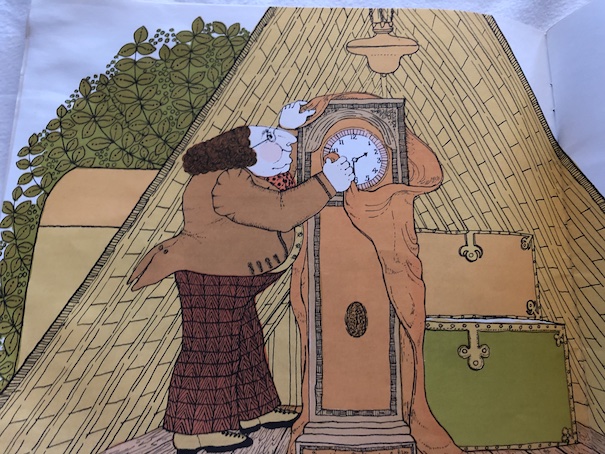
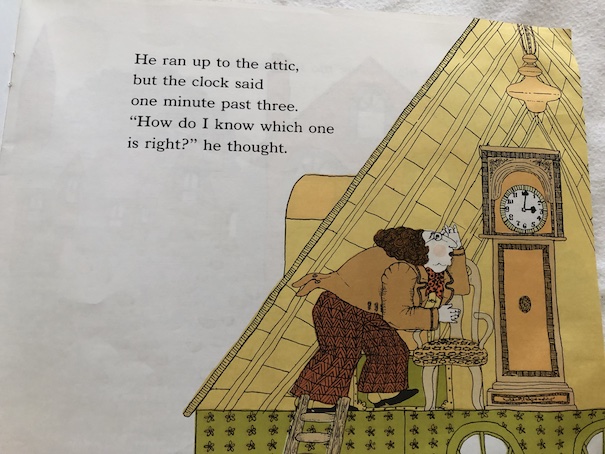
One day, Mr. Higgins finds an old grandfather clock in his attic. He likes the grandfather clock, but he wonders if it really keeps accurate time.

To figure out how accurate the grandfather clock is, he decides to buy another clock. He puts the second clock in his bedroom.

The problem is that when Mr. Higgins goes from his bedroom up to the attic, the clock in the attic reads one minute later than the one in the bedroom. Mr. Higgins isn’t sure which one is right.

Confused, Mr. Higgins decides to buy a third clock to compare to the other two. He puts this one in his kitchen. However, the same thing happens! Each time Mr. Higgins leaves one clock and walks to the next, they’re always a little different!

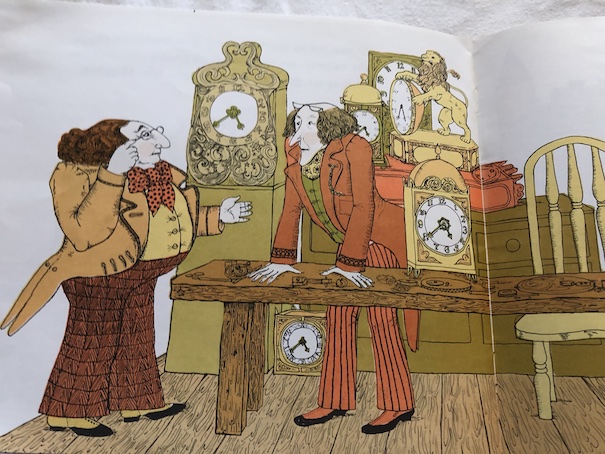
After purchasing a fourth clock gives him the same results, Mr. Higgins asks the Clockmaker what the problem is and he should do. The Clockmaker comes to Mr. Higgins’s house to take a look at his clocks.

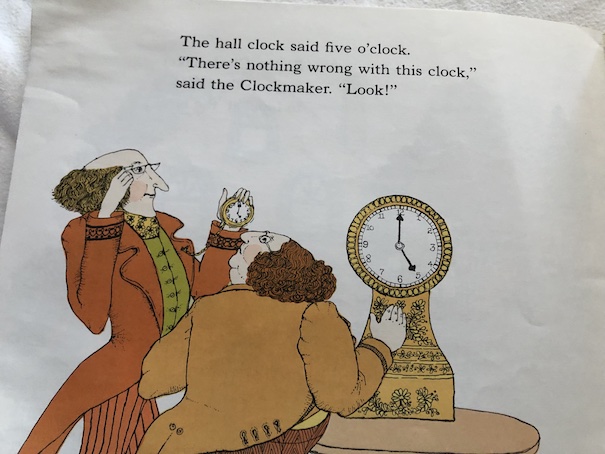
When the Clockmaker compares the time on his watch to the time on each of the clocks, each of the clocks is correct. All of Mr. Higgins’s clocks are working just fine. Suddenly, Mr. Higgins knows what he must do!

Mr. Higgins goes out and buys a watch like the one the Clockmaker owns. Since he bought his watch, all of his clocks have been reading correctly, and Mr. Higgins is happy.

The book is available to borrow and read for free online through Internet Archive (multiple copies).

My Reaction

This is a fun picture book, partly because even kids will begin to figure out what’s going on with Mr. Higgins’s clocks before he does. He never figures out that it takes him one minute to get from one floor of his house to the next. It doesn’t occur to him that the clocks he left behind in each room have been advancing since he walked to the next one. Even at the end, he still doesn’t seem to fully understand it. He just knows than, when he compares any of his clocks to his new watch, they’re always right! The reason why this happens is never explicitly explained. It’s just left for readers to notice and chuckle at.

House of Many Ways

House of Many Ways cover

House of Many Ways by Diana Wynne Jones, 2008.

This is the third book in the Howl Trilogy. The Howl books are a loose series. Although the wizard Howl, his wife Sophie, and the fire demon Calcifer are the main characters in the first book and appear in all of the other stories, they are not the main characters in the other stories.

When her Great Uncle William, who is a wizard, has to go away for treatment for a health condition with the elves, Charmaine’s Aunt Sempronia volunteer her to house-sit for him. When Aunt Sempronia goes to tell Great Uncle William that Charmaine will be looking after his house, he asks whether Charmaine knows anything about magic. The aunt says that she doesn’t think so. Charmaine spends all of her time reading and doesn’t usually help much with the housework at home. Her aunt thinks this responsibility would do her good. Great Uncle William is a little concerned because his house is not an ordinary house, and he says that he had better take some precautions.

Although Charnaine could be annoyed at being volunteered for this chore without her permission, she is actually grateful for this opportunity to get away from her parents. Her parents are overprotective of her, and they never allow her to do anything that is remotely daring or doesn’t seem completely respectable. She feels stifled, and she wants the chance for a little independence. One of her first acts of independence is to write to the king, telling him that, more than anything, she would like to help catalog his library. She knows that the king is cataloging it himself with the help of his daughter, Princess Hilda (which was established in the previous book in the series), but Charmaine loves books more than anything and she has always dreamed of being an assistant librarian in the royal library. Her parents would think that she was being too cheeky by asking for this position.

In the meantime, Charmaine can prove herself capable and enjoy further independence in Great Uncle William’s house. When she arrives there, Aunt Sempronia tells her that living in a wizard’s house is serious business. Charmaine doesn’t know much about magic because her parents would never let her study it. They didn’t think magic was very respectable.

When Great Uncle William meets her, he seems pleased by her and starts to tell her that he has taken precautions for her stay in the house. Charmaine is about to tell him that she doesn’t know any magic, but they are interrupted by the elves, who come to take Great Uncle William away for his treatment. Charmaine asks the elves how long Great Uncle William will be gone, but they just say “as long as it takes.” Although Charmaine finds herself alone in the house, she hears Great Uncle William’s voice telling her that she will have to tidy the kitchen and apologizing for leaving so much laundry. His voice also says that there are more detailed instructions in the suitcase he left behind.

Before looking at the detailed instructions, Charmaine decides to take a look around the house and get herself unpacked. The kitchen is a horrible mess, and there are enormous bags of laundry. To her astonishment, there are no water taps in the kitchen sink, but there is a water pump outside. This is going to make her job harder. She is tempted to put her nose in a book and forget all her troubles and chores in the house, but she left the job of packing her own bag to her mother, and her mother didn’t include the books she had sitting out. Charmaine realizes that she should have packed her bag herself. This house-sitting job is going to be an education in responsibility as well as independence for Charmaine.

Charmaine also discovers that there’s a dog in the house that nobody told her about. Great Uncle William’s voice tells her that the dog is called Waif, that he used to be a stray, and that he’s afraid of everything. Charmaine was always afraid of dogs because of her mother’s worries about them, but Waif is so timid that she doesn’t worry about him and shares her food with him.

Charmaine realizes that she has led a very sheltered life, partly because of all of the things she was never required to do and also because of the things her parents wouldn’t let her do. It helps that anytime she asks a question out loud, Great Uncle William’s voice gives her the answer.

As Charmaine starts learning her away around the house, she discovers both that she has her work cut out for her and that it’s incredibly easy to get lost in the house. She also discovers that Great Uncle William’s study has many books in it. A note that her uncle left for her in the study says that he could be gone for about two weeks to a month and explaining more about the spoken instructions he left for her as well as the instructions in the suitcase. The note says that she can use the books in the study, but it warns her to be careful of the difficult spells. Charmaine is very appreciative for the books, although she finds them difficult to understand because they are all about magic. There are also many letters in the study written to her uncle by other wizards, including one from the wizard Howl. Many of the letters are from people asking Great Uncle William to take them on as apprentices. Charmaine thinks that her letter to the king probably sounded as pathetic as some of those letters to her great uncle.

Because Charmaine has never been allowed to try any magic before, she can’t resist trying one of the spells from one of her uncle’s books. She chooses one that looks pretty easy, but because the book’s pages turn every time she leaves to get more ingredients, she ends up putting bits and pieces of different spells together. Her spells does what she intends it to do, but the full results take some time.

Things get complicated when Charmaine has a terrifying encounter with a creature called a Lubbock while picking flowers in the mountains near the house. The Lubbock claims that it owns all the land around and everyone in it … including Charmaine. She has a narrow escape, getting away from the creature!

After she returns to the house, she meets a new arrival: Peter, Great Uncle William’s new apprentice. This unexpected guest gives Charmaine an extra responsibility. Peter is still pretty inexperienced with magic and often gets left and right mixed up, but even though he’s almost as inexperienced with everything as Charmaine, he is still company for her in this strange house. He recognizes that the reason why the house is so confusing and rooms seem to move around is that Great Uncle William has cast a spell on the house to bend space and include extra rooms in the house.

When Charmaine tells Peter about her encounter with the Lubbock, he is alarmed. The two of them research Lubbocks in Great Uncle William’s books, and what they learn is horrifying. Lubbocks need human hosts to reproduce, and those hosts die. The Lubbock offspring are also evil. While a full Lubbock looks like a purple insect, a human and Lubbock hybrid will have purple eyes. Charmaine and Peter reassure themselves that neither of them shows any sign of being part Lubbock. However, even with her aunt and mother coming to check on her, Charmaine isn’t prepared to let her fear of the Lubbock ruin her first experience with independence.

To her surprise, the king also accepts her application to work in the royal library! The cataloging work in the library isn’t quite as much fun as she had imagined it would be because much of it is routine documents, but Charmaine learns that the king and his daughter are searching for some very important documents. Before he went away, Great Uncle William was also helping them. Now, the princess has called in an old friend of hers, Sophie Pendragon, wife of the Royal Wizard Howl of Ingary. There is a plot against the royal family which has kept them poor. Not all of the royal family is what they seem to be, and some of the secrets of the past are hidden in Great Uncle William’s unusual house.

The book is available to borrow and read for free online through Internet Archive (multiple copies).

My Reaction

Some of the characters in this book other than Sophie, Howl, and Calcifer were introduced in the previous book in the series. The elderly princess was one of the princesses kidnapped by the djinn, which is how she met Sophie. The king’s cook, Jamal, and his dog were also introduced in Castle in the Air. However, Charmaine is definitely the main character of the story, along with Peter as her sidekick and main helper. The other characters are there for support. Howl and Sophie help Charmaine by providing her with information that she wouldn’t have had otherwise, and Calcifer destroys some of the threats because only a fire demon is powerful enough to do it. Howl is in the castle in disguise because, as one of the royal wizards of another country, it wouldn’t be right for him to seem to be working for the royal family of another country. Unlike in Castle in the Air, though, readers know right away what Howl’s disguise is, and it’s played for comedy. The villains of the story aren’t too difficult to spot once they appear. What is more mysterious is what the king is searching before and what happened to it.

Charmaine’s self-discovery is a major part of the story. Charmaine knows from the beginning that she has lived a very sheltered life because of her mother’s standards for what is “respectable” and proper for a young girl like her. She has already decided that she doesn’t agree with all of her mother’s ideas and that she wants some independence. To her credit, although she does resent some of the routine chores she has to do while taking care of Great Uncle William’s house, she is determined to learn what what she has to learn to achieve some independence and do some of the things she really wants to do. Peter knows more about some things than Charmaine does, like how to do dishes and laundry, so he is some help to her, but he has only recently left home to take up his apprenticeship, so there are things that he doesn’t know, either. Neither one of them knows how to cook, so they turn to Charmaine’s father for advice and recipes. Charmaine’s father is more broad-minded than her mother, so he is willing to help. Charmaine also gradually learns to get along with Peter, and they learn how to consider each other’s feelings and allow each other their own learning opportunities. At one point, Peter tidies up Charmaine’s room as a favor to her, but she is annoyed and tells him not to do that anymore because she wants to take care of her own things for herself.

From her own experimentation and from what her father tells her, Charmaine discovers that she has a natural talent for magic. She inherited her magical talent from her father, who admits to her that he has secretly been using his talent for making things in his bakery. He never tells his wife about his magic because she wouldn’t approve.

The House in Hiding

The House in Hiding by Elinor Lyon, 1950.

This is the first book in the Ian and Sovra series, which takes place in Scotland.

Ian and Sovra Kennedy are brother and sister, and they live by the sea in western Scotland. Their father is the doctor in their small town. One day, after Ian and Sovra have been asking their dad to rent a boat for them so they can explore some of the islands just off the coast where they live, their father tells them that he has bought a boat for them. It’s just a small boat for rowing, but it’s theirs, and it gives them the freedom to explore that they want. There is one island in particular that they want to explore, the one they call Castle Island. Its real name is Eilean Glas, which means “Gray Island”, but they like to call it Castle Island because there’s a square-shaped rock in the middle of the island that looks somewhat like a castle. However, their visit to this particular island has to wait for the end of the book because other events intervene to distract them.

When the children come back from trying out their boat for the first time, they hear their parents arguing about how to accommodate some house guests. Their father’s fishing friend wants to come for a visit. He was going to rent rooms in town for himself, his wife, and their daughter, but the innkeeper has had a stroke and can’t handle guests right now. So, Dr. Kennedy has offered to host the family, but the Kennedy house isn’t very big. If the guests use the children’s rooms, Ian and Sovra will have to camp out in the bothy, which is an old hut in back of the house. Ian and Sovra sometimes camp there anyway for fun, but it does get damp when it rains. Mrs. Kennedy doesn’t like the idea of the children sleeping there if the weather gets bad, but the children think that it sounds like fun and tell their mother that they’ll be fine and that they want to do it.

Dr. Kennedy’s friend is named Tom Paget. Dr. Kennedy doesn’t like Mrs. Paget, although it isn’t completely clear why. All he says about her is that she likes to wear a cloak and paint with water colors, which doesn’t sound very objectionable by itself. (I was actually a little irritated at Dr. Kennedy because he makes repeated comments about how much he doesn’t like Mrs. Paget without offering any more information than that. If she’s just a little eccentric in her style of dress and likes art, so what? I found the parts in the book where they get nitpicky and really down on her irritating.) Their daughter Ann is about the same age as Ian, and because Dr. Kennedy hasn’t yet met her, he’s not sure what she’s like until the family arrives, although he makes a point of saying, to his children, directly, that he hopes Ann isn’t like her mother. (Nope, no further information about why, and Dr. Kennedy sounds rather rude.) Dr. Kennedy’s comments about Ann and her mother leave Ian and Sovra feeling unenthusiastic about their guests, so they plan to spend most of their visit staying out of their way and possibly avoiding Ann, too, if she turns out to be like whatever her mother is like. (Way to go, Dr. Kennedy. Let’s start this whole experience off on a bad foot with everyone primed to hate your house guests, shall we?) Ian thinks that their whole camping outside the house experience would be even more fun if they were further from the house, so they won’t have to deal with the guests poking their noses into the bothy to see where they’re staying or worrying about whether Ann will want to join them because that would be bad for vague reasons.

Ian and Sovra start camping out in the bothy before the guests actually arrive to get things in order. However, they accidentally set fire to the bothy during an accident with their camp fire. With the bothy burned, where are Ian and Sovra going to camp out while the guests use their rooms? Their parents won’t let them have a tent because it won’t be dry enough if it rains. Fortunately, an important discovery that Ian and Sovra make turn this misfortune into an adventure.

While their parents worry about finding them another place to stay during their guests’ visit, the kids go exploring further in their boat. Their boat gets caught in a whirlpool and is drawn around the back of a waterfall, where they find a hidden cave. More importantly, someone else discovered this cave a long time ago. There are stone steps carved into the rock and a metal ring set into the wall for tying up boats, showing the children that this is an intentional landing spot. When they go up the stone steps, they discover an old, abandoned cottage hidden in a green hollow. (They call it a shieling.) The old cottage is in remarkably good condition for being abandoned for a long time, and Ian thinks that if they clean it up, it would be the perfect place for the two of them to stay during the guests’ visit. Sovra thinks that their parents aren’t likely to agree because the cottage is too far from their own house and rather isolated, and the landing place behind the waterfall is too dangerous. However, Ian is sure that there’s a better landing place somewhere else, if they approach from another side. Upon further exploration, the kids find a collection of cottages that were once a tiny village, older than the shieling they found and abandoned for a long time. The little abandoned village does have a landing place, and they decide that was probably how the people who once lived in the shieling got to where they built their home. They have to be careful, though, because the area is surrounded by a bog that might contain quicksand, and they’re not sure how to get across or around the bog. In the end, they decide that the waterfall entrance is actually the best way to reach the shieling, and they learn to navigate the currents around the waterfall safely.

The children’s father finally gives them permission to camp out in the old shieling, although their mother still has misgivings because the parents aren’t completely clear on exactly where the children will be camping and haven’t seen it yet themselves. The children describe the shieling to their father and tell him that it’s over near Lochhead, another town nearby. Dr. Kennedy is satisfied from their description that the house will be safe to camp in and says that they can communicate with them daily by sending them a message by the postal van from Lochhead, and if they need anything, the parents will send it to them by the same van the next day. Their mother is still uneasy, but since their father is convinced that it will be fine, she finally agrees to let them go. Ian and Sovra are thrilled at having this secret house all to themselves, but Ian says that they will need to keep it a secret and be careful not to leave signs that they’re there, just in case someone still owns the old house and doesn’t want them there, even if they’re not using the house themselves right now.

The children’s discovery and use the shieling is not only the beginning of this story but also the rest of the series. The children’s secret hiding place not only provides them with a secret place of their own but also leads them to some important discoveries about their own family and other people. This book in particular focuses on the missing chieftain of the Gunn clan, who has been presumed dead, but it takes awhile for that mystery to enter the story.

While Ian and Sovra are enjoying their freedom in their secret house, the Pagets arrive with their daughter, Ann. Mrs. Paget turns out to be a somewhat eccentric woman, sometimes overly enthusiastic about little things, raving about them with some cutesy talk. She often elaborates her daughter’s name from Ann (which is what it really is) to the longer Annabel or Annabella (neither of which is her actual name) and referring to the absent Ian and Sovra as the “dear little children.” (Yeah, it’s kind of an annoying cutesiness, but I still think that Dr. Kennedy shouldn’t have been maligning her before she arrived.) Mrs. Paget isn’t just a hobby painter; she has actual shows of her work and has been successful at selling her paintings. When she arrives, she tells the Kennedys that she wants to find the best places in the area to paint, and she’s particularly interested in things like old castles, old bridges, and waterfalls. (I think you can see where this is going.) The Kennedys mention that there are abandoned villages in the area.

Mrs. Paget thinks that sounds exciting and asks about the history of these villages. The Kennedys say that they don’t know the full story behind them, but Donald, the old man they bought the boat from, might know. They think that the people who used to live there probably moved to the bigger cities to find work or something. (This is something that actually did happen to small villages in Scotland in real life. If you’d like to know more about the circumstances and see pictures, I suggest looking at Hirta Island. Although it looks like a pretty spot, living conditions there were harsh, and after a young woman died there who might have been saved if she had lived near a city with a hospital, the people decided that it was too isolated, and they didn’t have the population levels and support they needed to stay there.)

Poor Ann is bored and disappointed by the absence of Ian and Sovra. (Yeah, thanks again, Dr. Kennedy, for all the negative talk that made them not want to even meet poor Ann and be friends with her. In his first message to the children after the guests arrive, Dr. Kennedy makes fun of Mrs. Paget’s sandals, which he says are “made of pink string” and says he doesn’t know why Mrs. Paget wants them to meet Ann. Oh, I don’t know Dr. Kennedy. Let’s all think hard about this. Could it possibly be because Ann is lonely, there are no other kids in the area, and she could use a friend? Why is Dr. Kennedy so mean and weird about this? He’s an adult, for crying out loud! Ian and Sovra think that it would be “frightfulness” if they have to meet Ann and actually “be nice to” her if she’s like her mother. Keep in mind that they still don’t even know what Mrs. Paget is really like because they haven’t met her, and oh, noes, how awful to be nice to somebody who’s a little strange or eccentric during a temporary visit. What a family!) Ann often finds family holidays boring because she’s an only child. When her mother is busy painting and her father is busy fishing, Ann has very little to do and nobody to talk to. Ian and Sovra know that the Pagets have arrived, but they try to avoid meeting them, both because they think that they won’t like the Pagets, not even Ann, and because they want to keep the house where they’re staying a secret.

The very first time Ian sees Ann, he tries to run away from her and ends up falling and getting hurt. Ann tries to help him, although he resists at first, partly because he is afraid that if his mother finds out that he’s hurt, she’ll put an end to the camping trip. Ian messes up Ann’s name, calling her “Animosity,” and I’m not sure if he did it on purpose or because he actually has a head injury from his fall. (Actually, it was probably on purpose because he does it repeatedly from this point on in the story. No, Ian, “animosity” is what your family cultivates for other people and what I’ve been feeling each time your dad criticizes Mrs. Paget behind her back.) Ann messes up Sovra’s name, asking if Ian is saying “Sofa”, but I cut her more slack because Sovra is a more unusual name, and she’s not doing it deliberately. She’s just asking if she heard that right. Ian does explain that although Sovra mostly spells her name “Sovra” for school, her name is really supposed to be the Gaelic word “Sobhrach”, which means “Primrose.” Same name and pronunciation, but different spelling. Ann likes the name for being unusual. Ann goes to get some water for Ian, and while she’s gone, Sovra finds Ian and helps him into their boat. By the time Ann gets back, they’re gone.

Sovra worries about whether Ian has given away their secret to Ann. Ian says he doesn’t think so, but he has been rambling and not thinking straight since he hit his head, so he can’t be sure. He’s dizzy and disoriented and definitely showing signs of having a concussion. He should be checked out by a doctor, who happens to be his dad in this area. However, Sovra takes Ian back to the shieling. Ann worries about where Ian disappeared to, but she realizes that he couldn’t have gone anywhere by himself in his condition, so someone else must have come and helped him. She doesn’t mention what happened when she returns to where her mother is painting by the abandoned village because she doesn’t know where Ian is and can only assume that someone took him somewhere to get help. Both she and her mother spot smoke rising from the hollow where the shieling is, and Ann wonders if that could be Ian and Sovra’s campsite, although she isn’t sure. When Ian and Sovra get another note from their parents, it says nothing about Ian’s injury, so they realize that Ann didn’t tell the adults about it, and they begin to think more highly of her for keeping their secret. (Yeah, as if that was the smartest or most caring thing she could have done. But, these are kid priorities. You’d think with a father who’s a doctor that they’d know better than to be too cavalier about head injuries, though.)

However, soon, there are other things on the kids’ minds. When Ian went to go see Donald about a bung for their boat, he noticed that Donald has a special two-handled cup called a quaich, and his quaich has a symbol on it that’s the same as a symbol that was carved into the hearth of the shieling. Ian and Sovra wonder if that means that Donald actually owns the shieling. When they ask him about it, he tells them that the symbol is a juniper sprig and it’s the badge of the Gunn clan. Donald questions them about why they want to know, and they carefully say that they’ve seen the symbol carved somewhere else. Donald realizes what they’re talking about, and he tells them that he once helped to build the little house where they’re staying. Years ago, his cousins lived in the little abandoned village, and he found that secret cave behind the waterfall himself when he was young. He’s the one who created the secret landing place and stone steps. The Gunns once owned the village and the land around it, but the head of the family, Colonel Gunn, died without children. Since then, Kindrachill House, the bigger house where Colonel Gunn lived, has been empty. Colonel Gunn did have a nephew named Alastair, but everyone believes that he died somewhere in the Far East. Alastair used to live in the shieling where Ian and Sovra have been staying. Donald gives the kids permission to continue staying there, since it seems that the original owner isn’t coming back. He also tells them that there’s a superstition in the Gunn family that, when Kindrachill House is empty, the heir to the estate will not arrive until someone lights a fire in the hearth. Ian wonders if they really have to light a fire only in the hearth at Kindrachill to make the legend come true or if it would count that they’ve been lighting fires in the hearth at the shieling, where Alastair used to live and where he carved his family’s crest in the hearth. Sovra says that it doesn’t really matter since Alastair’s dead and can’t come back … but is that really true?

When things in the shieling are moved around when Ian and Sovra aren’t there, they assume that Ann has found their hideout. They know that she’s been looking for it. Later, she admits to them that she has been there, having figured out a way to get there that Ian and Sovra don’t even know about, but she didn’t move all of the things that have been moved. Someone else who knows about the shieling has been there. They know it’s not Donald because he has trouble walking and can’t make the trip to the shieling by himself. So, who else could it be?

The book is available to borrow and read for free online through Internet Archive (multiple copies).

My Reaction and Spoilers

The location of the story gives it an almost timeless quality. The children spend much of their time in nature, with few references to modern technology, so the story could take place in many time periods. However, the book is set contemporary to the time when it was written, in the mid-20th century, after WWII. That time period is especially important in the third book in the series. This first book in the series could take place during many possible decades, but the third book can only be set during the 1950s because WWII is important to that story.

There is a slight element of mystery to the story, but the kids aren’t actively trying to solve the mystery element. Mostly, it’s a kind of adventure story with elements of slice-of-life about how these kids spend their summer in an exciting location with a somewhat mysterious history. Little pieces of the situation are gradually revealed to the characters during their adventures. Kids like stories about other kids who have adventures without adult supervision, and parts of the story are about the fun things they do, setting up house in the old cottage and enjoying themselves in and around the secret hideaway.

The Kennedys’ Attitude Problems

I have to say that I didn’t like the attitudes of any of the Kennedys. I actually read the third book before this one, and I liked the characters better in that book. In this book, both the parents and the kids seem to be some kind of snobs. They’re negative and mean about Mrs. Paget and her daughter for little reason. Granted, I don’t like cutesiness much, but Mrs. Paget just seems to be a mildly eccentric artist who dresses a little oddly and acts overly enthusiastic about some things. I didn’t think there was any call for a medical man like Dr. Kennedy, who should be at least somewhat understanding about human nature because of his profession, to be so mean about the way Mrs. Paget dresses or try to discourage his children from being nice to Ann. There’s almost a mean girl exclusiveness quality to the Kennedys’ behavior. Most of the men I know have little knowledge about women’s clothes, but Dr. Kennedy sounds like a middle school mean girl, nitpicking the way the poor woman dresses. He even writes about it in the notes that he sends to his kids during their camping trip. The pink rope sandals bother him so much that he wants to put that in writing to his kids who aren’t even there and who should be polite to this guest when they actually meet. Dude, you live a “simple” life in a cottage near a small town on the coast of Scotland. You’re not exactly in a high society fashion district, and there are few people around to see or care what anybody dresses like. So what if she likes to wear cloaks with sandals? It’s an odd clothing choice because it seems to indicate that she’s dressing for two different types of weather at once, but it’s harmless. Calling the landscape “delicious” and the children “dear little children” (“dear” seems overly generous to me, but Mrs. Paget doesn’t know any better) might seems a little sappy, but again, so what if she’s somewhat sappy and romantic in her speech? Calling her daughter Ann by much longer names which she could have just named her in the beginning, like Annabel or Annabella, is also a little odd, but if Ann doesn’t seem to care, why should anybody else? Families do sometimes have odd nicknames for kids, and it’s not the worst I’ve ever heard. Going from a shorter name to a longer one is the opposite of what most nicknames do, but again, it’s just harmless eccentricity. None of the things Mrs. Paget does seem really that bad. Mrs. Paget doesn’t do anything rude or mean, and she seems like a pretty unobtrusive guest. Mostly, she just wants to find pretty spots where she can sit most of the day and work on her paintings while her husband fishes, so if they don’t like her cute, sappy talk, they don’t have to hear it much. She only seems to return to the Kennedy house to eat and sleep, and that’s literally the least a host can provide a house guest.

The Kennedys are fine in the scenes when they’re just by themselves, but when their guests are around, they’re barely holding back inner meanness and rudeness for the guests that seems completely undeserved. That was a constant source of tension for me while reading the book. When Mrs. Paget is asking about beautiful spots in the area with enthusiasm and interest in their history, Dr. Kennedy is thinking about the best way to answer her questions quickly so he can just talk to her husband (about fishing, I guess), like he just wants her to shut up. The men are going to go off fishing together, during which they’ll have hours to talk about anything they want, and Dr. Kennedy thinks it’s such an imposition to talk to Mrs. Paget for a few minutes when they first arrive about the area where he lives and its history, for which Mrs. Paget has only expressed admiration and interest. Mrs. Kennedy also seems oddly defensive to Mrs. Paget about the “simple” life they lead, which she seems to think is too simple for Mrs. Paget, but Mrs. Paget reassures her that isn’t the case, that she thinks the area is charming and the children’s camping trip sounds like fun. Mrs. Paget seems overly enthusiastic about how great it all is. Whether she’s really that enthusiastic on the inside, I couldn’t say, but at least she speaks positively and makes an effort to show interest. She is definitely interested in the artistic possibilities of the area and sincerely curious about its history. She follows up her curiosity by asking Donald about what he knows, which shows effort.

Meanwhile, the Kennedys are trying to hide their negativity, which seems to spring from ideas they have about Mrs. Paget that aren’t born out in real life. There’s little indication of how the Kennedys got these ideas except their own inner negativity and insecurity. When I was a kid, my mother would tell me to be nice to other people and to make visitors feel welcome, and even if I wasn’t having fun with particular visitors, to remember that their visit was only temporary and make the best of it until it’s over. You can feel any way you want, but you still have to behave yourself. Being nice to a temporary guest is not a terrible imposition, and putting up with a less-than-ideal guest is completely bearable and encourages return hospitality. The Kennedys don’t impart these lessons to their children, and the father seems to particularly discourage this thinking. This is the type of family that breeds little bullies, people who think that generally being nice to people is a terrible burden to endure. It really struck me as pretty rotten for Dr. Kennedy, a grown man in a position of trust and responsibility for the welfare of people in their community, to try to discourage his children from meeting and being nice to Ann, a lonely child who never did anything to Dr. Kennedy and doesn’t deserve this bad treatment from him, smearing her reputation and making it difficult for her to make friends. Why is Dr. Kennedy trying to get his kids to be mean to Ann instead of telling them to be kind to a guest and make friends?

Of course, I really know why the Kennedys have to be this way. It’s a plot device. Their reasons for not liking Ann and her mother don’t have to be fair or make complete sense because it’s the results that matter. It’s all to set up part of the conflict of the story. If Dr. Kennedy was nicer about Mrs. Paget and encouraged his kids to be nice to Ann, they wouldn’t be so worried about having Ann around or joining them on their camping trip. Ian wouldn’t have been so worried about Ann seeing him that he tried to run from her, fell, and got that concussion. If the kids were friendlier with each other, Ann wouldn’t have needed to get a ride from a stranger or might have told them about the man she met who gave her a ride and who turns out to be important. Quite a lot of the problems the kids encounter would have been different or simplified if characters were nice with each other and worked together more. It’s a theme that appears often in literature, and actually, quite a lot in real life, too. It doesn’t make it any less annoying for me.

Character Development

The parts where I thought Ian and Sovra were at their best were when they were completely by themselves. They seem to have a good brother-and-sister relationship and know how to function as a team. Even when one of them messes something up and they criticize each other, they still have each other’s back and work together to clean up their messes. However, I never really got to like Ian and Sovra as people during this book because of their meanness and snobbishness, which is ironic because they later say that they don’t like Ann because she thinks that she’s better than they are. This seems to be a retroactive decision by the author because she doesn’t show that trait right away. It seems to surface later in the story, long after Ian and Sovra have decided that they don’t like Ann and need to avoid her and think it would be frightful to be nice to her.

My favorite characters in the story are thoughtful Ann and kind Alastair. Yes, Alastair does appear in the story. He’s not dead. Ann is the first to meet Alastair on his arrival back in the area, and he helps her when Ian and Sovra have been mean to her, stealing her shoes so she can’t follow them back to their secret house from the beach and leaving her to limp back to the Kennedy house over rocks with a hurt foot. Ann vents to Alastair about her troubles with the Kennedys without knowing who he really is, and he tells her that he’s sorry that she’s having such a bad time and that the Kennedys have been unpleasant to her. Finally, a voice of reason and compassion in the story! Ann doesn’t mention this encounter with Alastair to anybody at first because she doesn’t know who he is, that they all think he’s dead, or that his return has any special meaning.

Little by little, Ian and Sovra do start to feel guilty about the way they’ve treated Ann and start looking at her differently, noticing the things she does well and acknowledging some of the skills and knowledge she has. Eventually, Sovra does apologize to Ann for stealing her shoes. When Ann is seasick the first time they take her out in their boat, she admits that she’s not as used to sailing as they are, which makes her seem less superior than Ian and Sovra thought she was. Ann even apologizes for talking like she knows everything when she doesn’t, but I still thought it was weird because that wasn’t the impression that I was getting from her until after Sovra and Ian started saying that’s what she was doing. The apologies they each give each other and their mutual acknowledgement of each other’s faults and strengths help them come to a better understanding of each other and resolve their conflicts.

Ann also proves to Ian and Sovra that she does know things that even they don’t know about the shieling and the area around it because of the questions her mother asked Donald about the history of the area. Donald told Mrs. Paget that there was once a pathway between the abandoned village and the shieling that was lost years ago, apparently swallowed up by the bog, and nobody knows quite where it is now. However, this summer has been drier than normal in the area, and Ann realizes that the path might have been exposed again by the lower water levels in the bog. She carefully observes the area from a high vantage point when they go hiking in the mountains until she spots where the path goes and marks it on her map. Then, the next time her mother goes to the village to paint, she scouts for the beginning of the path from the ground, finding a series of stepping stones through the bog.

When Ian and Sovra ask her later how she got to the shieling when she didn’t know about the waterfall entrance, she explains to them what she did, and they ask her to show them where the path is. I liked this part because Ian and Sovra were smug earlier about Ann’s map, saying that they didn’t need any local maps like that because everyone knows where everything around here is anyway, and their big source of pride with Ann was that they know more about the area than she does. (They thought that her explanations of what’s on her map when they asked her to show it to them earlier was just her trying to be “superior” to them.) They do know a lot from living there for their whole lives, but the problem is that they count too much on that sometimes and don’t think to ask the questions Ann and her mother do because Ann and her mother are aware of what they don’t know and are actively trying to learn.

I also liked it that when Ian and Sovra finally let Ann join them camping at the shieling, they also let her take over the cooking. Earlier, they took exception to her father saying that she’s an excellent cook because they saw it as bragging and acting superior, but Ann really is good at cooking and likes doing it, and Sovra admits that she isn’t terribly good at it and doesn’t really like it herself. I was relieved when the characters stopped worrying about who was superior to who and who was acting superior when they shouldn’t and just let people do what they’re good at and interested in doing, acknowledging when someone does something well without adding a kind of put-down onto it, like Ian and Sovra did earlier.

Alistair

Getting back to Alastair’s return, he eventually shows up at the shieling and talks to the children, explaining what happened to him. He says that he tried to talk to them before, but they weren’t at the shieling the last time he stopped by. His plane was wrecked in the Pacific (They don’t say that it happened during the war, so it might not have been. I thought they might have been implying that he was a pilot in the war, but that would play with the timing of later books in the series.), as they heard, and he spent some time living with a native group on an island. The natives were friendly enough and helped him, but it took him awhile to learn enough of their language to really communicate with them and figure out how to get to a place where he could arrange passage home. That was when he first learned that he’d been declared dead. Since then, he’s been reestablishing his identity and checking on the estate that he’s inherited. By the time that Alastair finally shows up at the shieling and introduces himself to the children, they’ve heard that Kindrachill House is supposed to be sold to pay the mortgage. When they ask Alastair about it, he confirms that he doesn’t have the money he needs to pay the mortgage. He almost didn’t come back to the area at all because he didn’t think there was anything there for him. However, it turns out that he’s an art lover, and when he went to a showing of Mrs. Paget’s paintings in Glasgow, he saw the painting she did of the old village and how she included the smoke rising from the shieling where Ian and Sovra were staying. That made him want to return to his old cottage and see who was there. So, the legend about a fire in the hearth bringing the Gunn heir home comes true.

There is an argument among the four of them whether Ian and Sovra should get the credit for Alastair’s return because they lit the fire in the hearth at the shieling or whether Mrs. Paget should get the credit because her painting is what drew it to Alastair’s attention, but it’s a good-natured debate. There is still the problem of the mortgage that needs to be paid, but Ian, Sovra, and Alastair find the solution to the problem when they finally go take a look at Castle Island, and Ann rescues them when they accidentally maroon themselves there. Since Ian was the first to spot the solution to their problem, Alastair thanks him by giving him the shieling so he and his sister can use it whenever they want. Alastair is able to save Kindrachill House and takes up his role as chieftain of the Gunn clan, which sets up the other stories that follow in this series.

My Favorite Parts

The best parts of the book for me were its timeless quality and the location. A secret house, forgotten by everyone, accessed by going behind a waterfall and climbing a hidden stone stairway is just the sort of place I would have loved as a kid. Even as an adult, I love the idea of a secret hideaway in a picturesque spot. The location and atmosphere are what I recommend to other readers the most. The imagery of the setting is wonderful, and it’s a great place to escape to mentally, if you can’t get to such a spot physically.

I also like books that bring up interesting facts and bits of folklore for discussion. At one point in the book, Ian explains singing sand to Sovra, which is dry sand that makes a sound when people walk on it under the right conditions. (This YouTube video demonstrates what singing sand can sound like on Prince Edward Island.) A less pleasant but still informative part is when Sovra breaks the necks of the fish they catch to kill them quickly. I’m not sure if I’ve heard of other people doing that when they fish or not. It makes sense when they explain it, but I know very little about fishing. I’ve never lived near bodies of water and haven’t gone fishing, and I get squeamish about things, so I’ve never asked.

On a day of heavy mists, Ian and Sovra are also fascinated with how muffled and mysterious the land looks and talk about how it probably inspired stories they’ve heard about ghosts and “second sight” and doppelgangers (although they say it as “doublegangers”). Ian explains how doppelgangers are like “the wraith of someone who’s still alive, so there are two of them.” This piece of folklore is why we refer to people who bear a strong resemblance to each other without being actual twins as doppelgangers. (Some people also call them “twin strangers.”)

Susannah and the Blue House Mystery

Susannah and the Blue House Mystery by Patricia Elmore, 1980.

Susannah Higgins and her friend, Lucy, live in Northern California. Susannah loves mysteries and she’s asked Lucy to be her partner as a detective. Susannah loves mysteries and is always looking for a mystery to solve, but so far, the girls haven’t found anything worth investigating. Susannah finally finds the mystery she’s been looking for when another friend’s grandfather fails to meet her at the bus stop. Shy Juliet Travis, who is largely shy because people at school have made fun of the burn scar on her face, meets her grandfather at the bus stop every day, and then, they walk home together. When he fails to show up one day, Juliet is sure that something is wrong. Susannah and Lucy, finding Juliet upset, try to reassure her, saying it’s probably nothing and that her grandfather probably forgot the time or his clock stopped. They offer to walk Juliet home to see if her grandfather is there.

Juliet and her mother live in a small apartment house next door to the old, once-grand Blue House. Her “grandfather” is the last of the old Withers family. (Juliet and her mother aren’t actually related to Juliet’s “grandfather” at all. He’s just a family friend who likes to treat Juliet and her mother like family because none of them really have any close relatives. Mrs. Travis got divorced when Juliet was a baby, and Juliet hasn’t seen her father since. Mr. Withers’s only relative is a niece named Ivy.) The Withers family was once one of the richest families in the area, but they haven’t been really wealthy for some time. Ivy Withers has some money and is a social climber, but the Blue House mansion where Mr. Withers lives has fallen into severe disrepair. Ivy pays Mrs. Travis to be her uncle’s cleaning woman, and that’s about all of the attention either the house or Mr. Withers receives.
Juliet’s mother, Mrs. Travis, cleans houses and is also an artist. When she first meets Susannah and Lucy, she comments that she’d like to do a sketch of Susannah because her face would be good for an African princess. (Susannah is African American, and this is the first mention of it in the book.) Juliet asks her mother about her grandfather, and her mother says that she thinks he went to see his friend Joe. Juliet feels a little better, thinking that her grandfather just lost track of time with his friend, but by the next morning, Mr. Withers still hasn’t come home. Susannah and Lucy go to visit Juliet again, but she and her mother don’t know much about Mr. Withers’s friend, Joe. They don’t know his full name or where he lives to see if he’s really seen Mr. Withers. Susannah says that they should take another look around the Blue House, even though Mrs. Travis has already looked there.

In the Blue House, they discover that Mr. Withers took his good coat instead of his old one and left his wallet with his identification behind. Mrs. Travis also remembers that he was carrying an umbrella, even though it wasn’t supposed to rain that day. From this information, Susannah deduces that he went to another city, where there was a chance of rain, but it couldn’t have been too far away because he didn’t take luggage or his wallet with him, and he was planning to be back to meet Juliet that afternoon. Also, since Mr. Withers doesn’t have a lot of money, he probably went by bus. After making a call to bus station to check the bus schedule for buses leaving around the time he left, they decide that the most likely place he would have gone was Sacramento. Then, the customer service agent tells them that the bus returning from Sacramento arrived late because an old man had a heart attack. Realizing that the old man could have been Mr. Withers, who couldn’t be identified because he left his wallet at home, they begin phoning hospitals to learn where he could have gone. Sadly, they learn that Mr. Withers was the man who had the heart attack and that he died in the hospital.

That would be the end of the mystery of the disappearing grandfather, but it turns out to be the beginning of a greater mystery. Susannah is disappointed that the mystery seems to be over just when she wanted to investigate some odd points of the situation more deeply. Lucy thinks that sounds heartless to be thinking of Mr. Withers’s disappearance and death as just an exciting adventure like that, but Susannah explains that there are still some aspects of the situation that seem strange. They still don’t know why he went to Sacramento. Apparently, it was something important because he felt the need to dress up in his nicer coat. (It couldn’t be to see a doctor because his Medicare card was one of the cards he left behind in his wallet.) They also don’t know who “Joe” is because this friend didn’t turn up at the funeral. Nobody else seems to know who “Joe” is, either.

Susannah also begins to suspect that Mr. Withers may have made a second will, leaving something to Juliet. Mr. Withers didn’t have much to leave, and it’s publicly known that he promised his house to Ivy because she helped him pay the taxes on it for years. Mr. Withers lost most of his money years ago due to a bad investment, and thieves also stole many of the valuable antiques that he used to own. However, on the morning of the day he died, he told Juliet that he was going to leave her a “treasure.” Juliet says that this “treasure” was supposed to be a book of some kind, and he emphasized to her that she should “see a good man.” What is that supposed to mean, and did Mr. Withers really have a treasure to leave to Juliet? Someone else must think that Mr. Withers had something of value because someone has been sneaking around the Blue House at night.

The book is available to borrow and read for free online through Internet Archive (multiple copies).

My Reaction

I read this book years ago, when I was in elementary school, but for a long time, I’d forgotten the name of it and much of the plot, which made it difficult to find it again. As with so many other things, I found it again by accident while looking for something else on Internet Archive.

The part that stuck with me the most from when I read it as a kid was the scene where Susannah and Lucy meet Juliet’s mother, who is an artist. Mrs. Travis likes to do sketches of people she’s just met so she can use their faces in paintings later. When she first sees Susannah, she takes her by the chin and studies her face. She compliments Susannah’s bone structure and says that her face would be great for an African princess, which is a rather odd thing to do and say to somebody on first acquaintance. I liked the quirkiness of Mrs. Travis, and I kind of wished somebody would tell me that I looked like a princess. (I don’t, and I never really did. I look more like somebody’s teacher or librarian. I’m not either of those, but I just look like somebody who would be.)

The scene with Mrs. Travis is also the first mention in the book that Susannah is black. She is shown as black on the covers of the books in this series, but Mrs. Travis’s description of her as having the look of an “African princess” is the first indication of it in the text. The reason why I like that is that, before we get to that point, Susannah is described by her friend Lucy as an aspiring detective, an “amateur herpetologist” who dreams of buying the snake called Beelzebub in the pet store, and one of the few people who can draw out shy Juliet and get her to talk before we are given any indication of her race or appearance. I like it that readers are drawn into Susannah’s own quirky and distinctive personality before she is described physically, so she isn’t typed by race or appearance.

Further on in the book, Lucy describes more of Susannah’s appearance, saying that she has glasses and wears her hair in two clumps on her neck. They didn’t always get along because they’re in the same academic group at school, and of the two, Susannah is really the better student. She got on Lucy’s nerves by constantly nagging her to do her homework and improve her grades so their group could get the school’s Top Scholar Award. Susannah complained that Lucy actually could do better at school if she just tried and called her a “clown” and a “dumb blonde” (the first indication of what Lucy looks like) for not even trying to do better. Lucy retaliated against this criticism by drawing unflattering cartoons of Susannah. They started to resolve their differences when they got into an argument over something Lucy said to another classmate about Susannah. Lucy said that Susannah “prevaricates”, which means to lie, but what she really meant was “pontificates.” At first, Susannah was mad at Lucy for calling her a liar, then she laughed when she realized that Lucy mixed up words that were vocabulary words for their class, and then, she realized that there was some justification to Lucy’s criticism of her, that she does sometimes act like a know-it-all. Realizing that someone else had a justifiable criticism of her caused Susannah to soften her own criticism of Lucy, and their relationship improved.

I liked the description of how Lucy and Susannah came to be friends, and it also fits in with how the girls become better friends with Juliet. Appearances are important to Juliet because the burn scar on her face has made it difficult for her to make friends with people. They never explain how she got the scar, but she is very self-conscious of it because of the teasing she got about it early in life. She is very shy and has a habit of turning her head to the side as she talks to people because she doesn’t want them to look at the scar. Lucy thinks to herself that the scar isn’t really so bad. As she spends more time with Juliet, she realizes that she hardly notices it anymore, just like most of the time, she hardly notices anymore that Susannah wears glasses. It’s common for people to have various types of imperfections, and Lucy herself has crooked front teeth. The only reason why Juliet’s scar really matters is that it matters to her because it makes her feel bad about herself. What Juliet wants most of all is an operation to remove the scar tissue so the scar will be less noticeable, but her mother can’t afford it. By the end of the book, she can afford the operation, and she goes ahead with it, although part of me wanted to see her rethink it because she sees that she can make friends anyway, whether she has a scar or not.

Deceptive appearances are a large part of the mystery because things in the Blue House, Mr. Withers’s treasure, and even Mr. Withers himself weren’t quite what they seemed to be. Mr. Withers was unfortunate for losing his money and most of the beautiful antiques that he loved, but he didn’t lose everything. Ivy thinks that he was a lonely, bitter hermit who rejected all of his old friends because he was too proud to see them after he lost his money, but Lucy realizes that the truth is that Mr. Withers just made new friends who wouldn’t judge him because he was now poor. Mr. Withers wasn’t lonely, and he was even happy with the new people in his life and the secret he was keeping. Even the mysterious “Joe” and the “good man” were not what everyone assumed they were at first. As I read through the book, I remembered what Mr. Withers’s trick was, but it took me some time be sure of the villain. I thought I knew who it would turn out to be, but the author does a good job of making multiple people look guilty.

One other thing I’d like to add is that apparently none of the children in this book live in a two-parent household. Books featuring children of divorced families were becoming increasingly common in the 1980s and into the following decades, and there are three children in this book who live in single-parent households. Juliet’s mother is divorced. Lucy lives with just her father, and to her horror, she eventually discovers that he’s starting to date the divorced mother of the most annoying boy in her class (who actually proves to be very helpful in their investigation). Susannah also appears to live with her grandparents. This book doesn’t explain why, but she always talks about her grandparents and not her parents.

Mystery of the Melted Diamonds

Mystery of the Melted Diamonds by Carol Farley, 1986.

This is the last book in the Kipper and Larry mystery series.

This time, Larry has come to visit Kipper and his family on their farm in Kansas while his father attends a police convention in Florida and will be spending Christmas with them. At first, Kipper thinks that Larry probably regrets this visit because Kansas isn’t very exciting, and it’s snowing while Larry’s father is in sunny Florida.

The situation gets worse when Kipper gets into a fight with his friend Scooter when Larry and Kipper were supposed to be spending the night at Scooter’s house. Scooter apparently cheated at a game, and Kipper got so mad that he said that he and Larry would just go home. The problem is that the boys have to walk a couple of miles to reach the farm where Kipper’s family lives, and the snow has turned into a blizzard.

The boys start to get scared that they might freeze to death when Larry spots a light from a house nearby and heads toward it. Kipper thinks that it’s a dangerous mistake because the house with the light is the old Morgansterne house, and it’s been empty for years. However, when the boys reach the house, there are oil lanterns burning in the windows and a fire in a wood-burning stove. Out of desperation, the boys let themselves into the house to warm up, but then they start to wonder who lit the fire and the lanterns. They search the house to see if there’s anyone there, but they don’t find anyone. The only thing they find upstairs is an old box of Christmas ornaments.

The boys spend the rest of the night in the house without seeing anyone and continue to the farm in the morning. When they explain to Kipper’s mother what happened and where they spent the night, she’s concerned, both because the boys were out in the snowstorm and because nobody should be in the old Morgansterne house. Old Miss Morgansterne, who owns the house, has been living in a retirement home, and no one else is supposed to be there. Kipper’s mother decides to call the sheriff and have him look into it.

The sheriff comes and questions the boys about what they saw in the house, and they ask him about a robbery at a jewelry store in town that the family heard about on the radio while waiting for him to arrive. Larry wonders if there’s a connection between the robbery and the supposedly empty house that seemed to be occupied by someone before they arrived. The sheriff doesn’t see why there would be a connection between the two events, but Kipper’s younger brothers think that maybe the robbers were in the house the whole time, hiding in some kind of secret passageway, like in books and movies. The sheriff thinks that the boys have overactive imaginations.

However, there is more to the theory that the house and the robbery are connected than the sheriff thinks. Soon, the sheriff is alerted that the car that is believed to belong to the robbers has crashed into a pond near a dangerous curve in the road and the two men inside the car are dead. When they search the car, they find some of the jewelry from the robbery, the less expensive costume jewelry, so it seems that they were correct that these men were the robbers, but strangely, the most expensive jewels from the robbery, diamonds, are still missing. The sheriff says that it’s almost like they melted away, like the diamond-like snow that Larry commented on earlier.

It makes sense to the boys that the robbers were in the Morgansterne house before they were. They remember seeing a car like the robbers’ car along that road before the snow storm got bad, and it would explain why the house was empty all that night. The robbers accidentally saved the boys’ lives by lighting the stove in the house for them, but they never returned to their hideout in the empty house because they had their car accident. But, somewhere along the way, the diamonds they stole seem to have vanished. Can the boys figure out how?

The book is available to borrow and read for free online through Internet Archive.

My Reaction

Overall, I liked the story. I had more than one theory about where the diamonds were, and one of them turned out to be correct, but there was enough doubt in my mind to keep the story interesting until the end.

The Mystery at Skeleton Point

The Boxcar Children

Boxcar Children Mystery at Skeleton Point cover

#91 The Mystery at Skeleton Point by Gertrude Chandler Warner, 2002.

Boxcar Children Mystery at Skeleton Point bone collection

Mr. Alden’s cousin Charlotte has recently bought a house and some land at Skeleton Point that is a local landmark.  The doctor who owned the old house collected skeletons.  He was a bone expert and taught aspiring doctors and veterinarians.  It’s a creepy place with a lot of local legends about a skeleton called the Walking Skeleton that came back to life and is trying to turn itself back into a person by stealing pieces from the statuary around the house.  The statues are damaged and missing pieces, although no one really knows why.

Boxcar Children Mystery at Skeleton Point neighbors

The locals have mixed feelings about Charlotte’s desire to donate all the skeletons to a medical school and to clean up the house and renovate it.  Some people don’t like the idea of a local landmark changing.  Greenie, a man who lives nearby, is also an expert on bones who studied with the doctor, and he is upset that the doctor didn’t leave Skeleton Point to him when he died, as he had promised that he would. 

The people Charlotte had hired to carry out the renovations argue with each other about how things should be done and are not happy that Charlotte has asked the Alden children to help out with the cleaning and documenting the statuary around house.  It seems like they’re trying to distract the Aldens and keep them away from the house.

Then, some of the statues around the house disappear.  Who is taking them and why?

The book is available to borrow and read for free online through Internet Archive.

My Reaction

The best part of the story for me was the setting. A house filled with skeletons is a bizarre and creepy idea. But, much of the mystery concerns the statues around the house instead of the skeletons, and honestly, although I had a strong feeling about who was taking the statues, there were times when I suspected other people and different motives for the thefts. The story did a good job of making multiple people look guilty.