Mystery Back of the Mountain

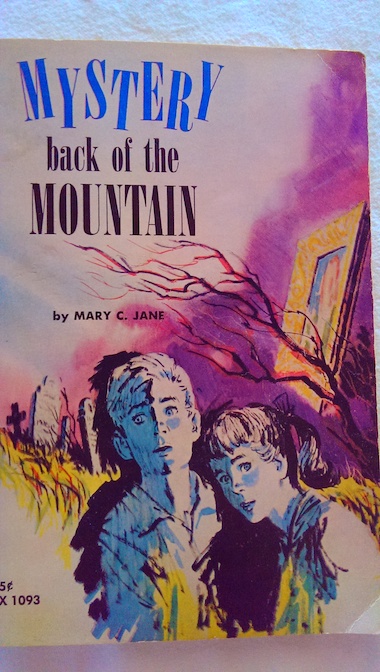
MysteryBackMountainMystery Back of the Mountain by Mary C. Jane, 1960.

Anne and Stevie Ward are thrilled when they discover that their father has inherited a house in the country from a distant relative who has recently died. Neither of the children had met their father’s “Uncle” James (really a distant cousin of their great-grandfather), and even their father hadn’t seen him for years. Probably, the only reason Uncle James left him the old farm where he used to live was because he had no children of his own and the two of them shared the same name.

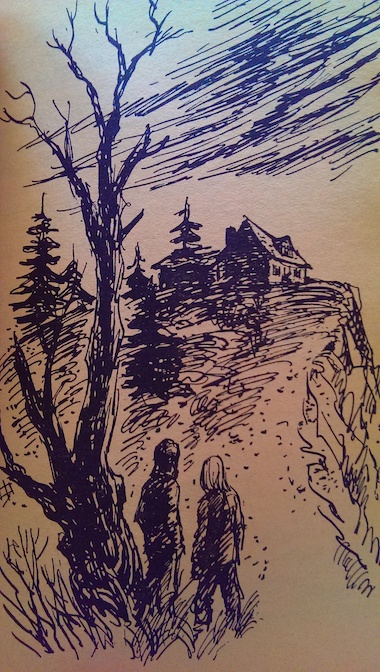
The children think that a country house would be a great place to spend the summer, and even their mother thinks that perhaps they should keep the house as a vacation home, but their father has some reservations about it. For starters, the old farm house, located outside of a small town in Maine, is kind of shabby and has no running water or electricity. It’s so isolated that people named the area Back of the Mountain. Then, there’s Uncle James’s reputation. Uncle James was the black sheep of the family, having apparently made his money in some unethical business dealings and then became involved in some kind of inappropriate romance that ended tragically. The children’s father isn’t completely sure of the details because he only heard whispered rumors about Uncle James when he was young, but he knows that the people of his town weren’t very fond of him, and he suspects that they might feel the same way about his relatives. He thinks that it might be better just to sell the house and forget about it. Nevertheless, he agrees with his wife that the family should go there and take a look at the house and decide what they’re going to do with it.

MysteryBackMountainMissingPictureWhen they get to Maine, they meet Uncle James’s lawyer, Mr. Palmer, to collect the key to the house.  Mr. Palmer tells them that the house has a few items in it that could be considered valuable antiques, including a portrait of the woman that Uncle James had wanted to marry, Drusilla Randall.  The children’s father asks Mr. Palmer more about Drusilla Randall, and he says that all he knows is that she had an argument with Uncle James and then disappeared.  He thinks that she just left town, although he says that there are rumors that Uncle James may have murdered her.  Mr. Palmer thinks that the rumors are ridiculous and doesn’t take them seriously, but Stevie and Anne are disturbed at the idea that their relative may have been a murderer, or that people thought he was.  Mr. Palmer also mentions that Drusilla’s sister, Marion, has decided to return to her family’s old house for the summer as well, so she’ll be living close to their farm.

MysteryBackMountainRunningThe house is certainly an isolated place, and their closest neighbors, the Hodges have an old grudge against Uncle James.  The unethical business deal that Uncle James did years ago involved buying some of the Hodges’s family’s best land.  Bert Hodges, who was young at the time, says that the deal ruined his father’s life, and it’s making his miserable, too, because he really needs that land to make his farm profitable.  Anne hears this from Bert’s young niece, Oleva, an orphan who has come to live with her aunt and uncle.  Although Uncle Bert is strict with her and somewhat bitter about the past and the family’s circumstances, Oleva likes her aunt and uncle and wishes they would adopt her, giving her the stable home she’s longed for since her parents died and she began being traded around among her relatives.  However, Bert doesn’t have much faith in other people, and even though he likes his young niece, is afraid to commit to adopting her.

MysteryBackMountainBridgeAnne feels badly that Uncle James’s land deal seems to have ruined people’s lives.  Oleva also tells her something disturbing about Drusilla, the girl that Uncle James loved.  They were supposed to be married when Drusilla turned twenty, but she disappeared before that happened, and most people think that she drowned in the natural pool on Uncle James’s property.  It’s deeper than it appears at first, and some things belonging to her were found nearby, so everyone thinks that she probably drowned and that her body is still somewhere at the bottom of the pool.  Whether her death was an accident, suicide, or murder is still unknown.

Mysterious things are happening around Uncle James’s property.  The portrait of Drusilla that Mr. Palmer said would be in the house is missing.  The family hears eerie howls in the night.  Oleva is sneaking around, doing something that she says her uncle would disapprove of, but which she insists that she can’t stop.  Then, Anne finds a poem engraved on a stone in an old graveyard, apparently written by Uncle James in Drusilla’s memory that points to the secret of their quarrel and her death.  The things that Uncle James did in his life still cast their shadow, and the only person who can tell them the full story of what really happened all those years ago and set things right . . . is Drusilla.

Uncle James’s problem, as the children eventually learn, was the nature of his ambitions.  He wanted to be a big man more than a good one.  It wasn’t that he was completely awful.  Drusilla herself (once the children learn where she really is and who she is) tells them that he could be charming, and she knows he never really meant to do anything wrong.  The problem was that he wanted to be important and admired by others to the point where “getting ahead” of others was all that really mattered to him.  There was a point when he could have used what he had to help his neighbors when they were in trouble, but instead, he used their troubling situation to his own advantage to take what they had for himself.  When he discovered something valuable on the land he’d acquired from Hodges family, something that would have saved them from their problems if they had known about it before the sale of the land, he could have turned it over to them to help make things right, but he refused to do it, which was the basis of his quarrel with Drusilla.  As far as Uncle James was concerned, he was entitled to what he found because he had bought the land legally, but Drusilla argued against keeping it on moral grounds, out of compassion for the Hodges.  In the end, Uncle James was admired by no one because of his selfishness, and Drusilla realized that wasn’t a quality that she wanted in the man she was going to marry.  Uncle James’s attempts to make people admire him for being wealthy and important ended up costing him friendships, relationships with relatives, and ultimately, the woman he wanted to marry.  Like others, Uncle James believed that Drusilla was dead, that she had drowned herself over their quarrel.

Uncle James’s drive to make people like him causes Anne to reconsider something that was bothering her as well.  She isn’t as good at making friends as her brother because her brother is more outgoing and good at sports.  The other kids always want Stevie to play for their team.  Anne often wishes that she could be more athletic, “to come in first,” so that other kids will like her better and want her to play with them more, instead of picking her last for every game.  However, she comes to realize that being “first” in things isn’t what really wins friends in the end.  Caring about others and being there for them when they need you wins real friends.  As Anne explores the old graveyard, she thinks about how just being alive and enjoying life is a great feeling by itself, whether you’re “first” or not, and sometimes, good things come to those who take their time instead of just rushing to be “first.”

Mystery on Nine-Mile Marsh

Nine Mile MarshMystery on Nine-Mile Marsh by Mary C. Jane, 1967.
Lucille Pierce has been feeling lonely because her other friends joined a club with some other girls that meets over the weekend, and Lucille hasn’t been invited to join. The only people who are available to hang out with now are her brother Brent and his friend Kevin, and they don’t always want a girl hanging out with them.

When Brent and Kevin have an argument because Kevin laughed at Brent’s horrible spelling during a spelling bee (Brent is horrible at spelling because he never stops to think about what he’s doing, and he gets into fights fast because he also has a quick temper), Kevin invites Lucille to join him as he goes out to have a look at the old house on Moody Island before the new owners take over. The old farmhouse stands on an island in the marsh. Sometimes, people hear odd sounds coming from the house, and some people believe that it’s haunted by the ghost of John Moody, who was lost at sea years ago. Old Mrs. Moody, John’s widow, was a hermit in her final years, and now, the only living member of the Moody family is Clyde Moody, John’s nephew. Everyone had expected that Clyde would inherit the old Moody house, but instead, Mrs. Moody left it to a man named Arnold Lindsay, an apparent stranger. Miss Rand, who owns the diner not far from the Moody house thinks that Mrs. Moody should have left it to Clyde. Clyde has had problems with alcohol and hasn’t been able to hold any job for very long, and Miss Rand thinks that having the house to care for might have been good for him, providing him with some stability. No one even has a clue who Arnold Lindsay is.

Nine Mile Marsh HouseLucille and Brent take a bike ride out to the island, but a noise in the barn frightens them away. It isn’t that they really think there’s a ghost, but they’re concerned that someone may be trespassing on the property. They decide to keep an eye on the house to see if they can see anyone sneaking around, but they don’t.
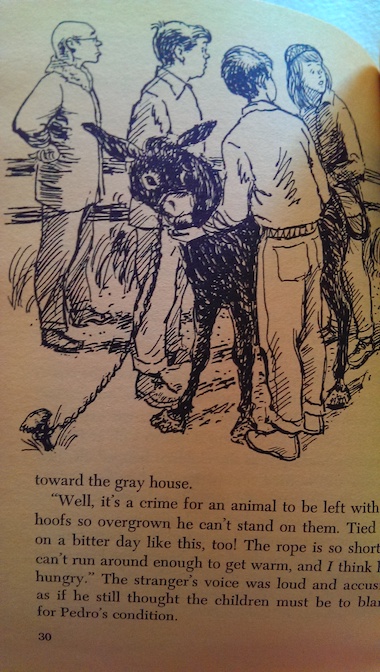
A short time later, Lucille, Brent, and Kevin meet Arnold Lindsay, who turns out to be a nice man. Like the children, he becomes concerned about the condition of Pedro, the donkey that the Turner family owns and leaves neglected in one of their fields. To give the donkey a better life, Mr. Lindsay buys Pedro, telling the kids that they can come out to the Moody house and visit him.

Mr. Lindsay doesn’t have any idea why Mrs. Moody left him the house, either. He’s a writer, but not a famous one. He just writes newspaper columns. All he or the children can think of is that Mrs. Moody must have been a fan of his columns. She didn’t get out, but she did read newspapers.

Nine Mile Marsh PedroMr. Linsday has also heard strange noises around the Moody house, and he asks the children what they know about it. They tell him the ghost stories about the Moody place, but they say that they don’t really believe that there’s a ghost. Mr. Lindsay is fascinated by the stories. He says that his impression was that the noises he heard came from the cellar, but he didn’t see anything when he investigated. He invites the children to help him investigate further sometime.
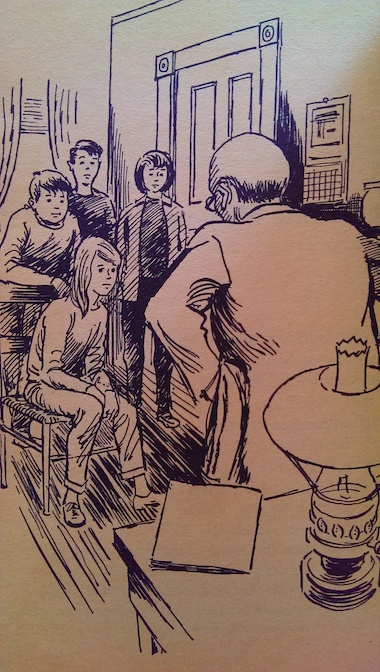
Meanwhile, Lucille tries to make friends with a new girl at school, Barbara Rosen. At first, Barbara doesn’t want to be friends because she thinks that Lucille is part of the Saturday Club with the other stuck-up girls, but she becomes friendlier when Lucille tells her that she’s not with them. Barbara had worried that the snobby girls didn’t like her because they thought something was wrong with her, but she really likes Lucille and thought for sure that she would have been asked to join the club, too, having been involved in a lot of other activities at school. Both girls find it reassuring that the fact that they weren’t asked to join the club doesn’t mean that that there’s anything wrong with them, but maybe with the girls running the club and their priorities in choosing friends. Having each other for friends makes them both feel less lonely, so they can stop worrying about the club and its members so much.

Nine Mile Marsh MeetingBarbara’s father owns a clothing store in town, and she says that some of his customers have been saying bad things about Mr. Lindsay. Some of them have even said that he might be a spy. Lucille thinks that’s ridiculous and that they’re only saying things because they wanted to buy the property or see it go to Clyde. Lucille has to admit that she doesn’t know much about Mr. Lindsay, so she can’t swear that the rumors aren’t true, but she still thinks that he’s probably just a nice guy, and she wants to see him keep the house so that Pedro will have a safe place to live.

With Clyde Moody and others sneaking around the property, seeming to look for something, and Clyde’s new accusations that Mrs. Moody was never legally married to his uncle and therefore had no right to will the property to anyone, Lucille, her brother, and their friends try to help prove that Mrs. Moody was really Mrs. Moody and that the house does rightfully belong to Mr. Lindsay.

Part of the theme of this story is about loyalty.  Lucille feels hurt that the girls she had previously thought were her friends abandoned her to join the Saturday Club.  She thinks that people who are real friends should stand by each other, no matter what other friends come into their lives.  However, looking back on her friendship with these other girls, she comes to realize that she was mostly friends with them because they were the girls who lived nearby, and neither of them really had other options.  In the end, they didn’t really have much in common, and she realizes that she doesn’t think very highly of them, so she is as free to move on and make new friends as they are.

Similarly, that is how some of the people in town feel about Clyde Moody.  It isn’t so much that they like him as he’s always been there.  He’s familiar to them, and it would have made sense for Mrs. Moody to will the Moody house to him.  It doesn’t make sense to them that she would leave her house to someone she’s never met, so they get upset about it and assume that there must be something wrong with the situation or with Mr. Lindsay himself.  However, nothing is wrong with Mr. Lindsay, and Clyde isn’t really worth their loyalty.  He’s a known troublemaker who associates with other troublemakers, like the Turners. Mr. Lindsay really is a better person.

In part of the story, the children catch Miss Rand sneaking around the property.  At first, they think that she was there to help Clyde or get Mr. Lindsay in trouble, but she tells Mr. Lindsay that she was actually there for very different reasons.  There was something on the property that she wanted to protect.  She wasn’t sure that she could trust Mr. Lindsay, and she knew that she couldn’t trust Clyde, so she was taking it on herself to look after it.

General Butterfingers

GeneralButterfingersGeneral Butterfingers by John Reynolds Gardiner, 1986.

Years ago, the Spitzers, an elite rescue force in the armed services, saved the life of General Britt.  To thank them, he invited the surviving members of the team to live with him in his house, taking care of them until his own death, along with his housekeeper Mrs. Wilson and her son Walter.  Walter is a bit of a klutz, so the old men kid him about being a “Butterfingers.”  But, Walter likes the old men and admires them.

After the General’s death, the General’s nephew, Ralph, claims his estate as his only living relative.  Unlike his uncle, Ralph is mean and selfish and sees the old men as nothing but leeches, using his uncle’s house and money.  He fires Mrs. Wilson and tells the old men that they only have a few days to get out of the house.  The old men have no other place to go except for the Veterans’ Hospital, and no one likes it there.  The men who are currently in the hospital keep hoping that the Spitzers will somehow figure out a way to rescue them.

GeneralButterfingersChessMrs. Wilson and Walter talk to a lawyer, but he says that, since the General apparently didn’t leave a will, the estate has to go to his nearest relative, which is Ralph.  As far as he’s concerned, there’s nothing they can do about, even though the General made a verbal promise to the men that they could stay in his house for the rest of their lives.
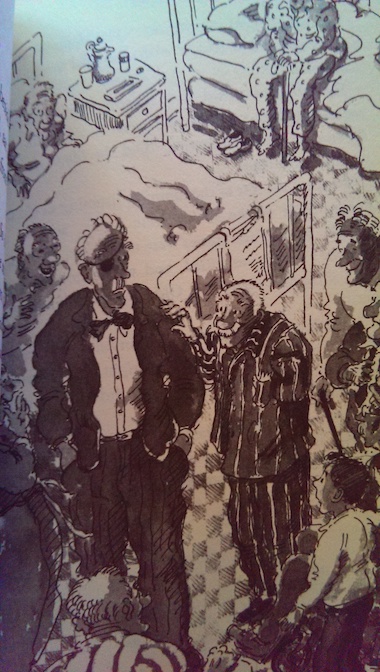
Walter tries to talk to Ralph and appeal to his better nature, but that doesn’t work, either.  Ralph has always been a selfish person, disliked even by his own family, and now, he’s bitter about it.  He sees Walter’s attempts at kindness just as a ploy to get the house and money and sends him away.

The more he thinks about it, the more Walter’s convinced that the General must have left a will somewhere.  When he and the men try to visit the General’s safe deposit box at the bank, they discover that someone using the General’s name visited the box on the day that the General died.  Walter realizes that it must have been Ralph.  He is convinced that Ralph knew that the General had left a will, but he stole it so that he could claim the General’s estate himself.  The question is, how are he and the men going to prove it?

GeneralButterfingersHospitalIn some ways, you could feel sorry for Ralph, who is a very unhappy person.  Because of his meanness and selfishness, his father spent years giving him pretty much anything that he wanted on the condition that he not come around to see him.  Ralph is hurt at his family’s avoidance and disdain for him, which is why Walter, at one point, invites him to come for dinner and be their friend.  However, Ralph’s motives are always selfish, and that causes him to suspect that the same is true of everyone, so he refuses their kindness.  It gives the impression that he’s probably done the same for many others over the years, for the same reasons.
Ralph wanted everyone’s approval, especially his family’s, but because of his self-centered nature, he never had any idea of how to go about earning it.  He didn’t know what would matter to others and earn their respect because he was only ever concerned with what mattered to him and what he wanted.  At one point, he angrily tells Walter that his uncle was impossible to impress.   He once tried proving to him that could fight, thinking that would impress an old soldier.  When he further elaborates that his “fight” involved beating up a girl solely to impress his uncle, it leaves little question of why his uncle was unimpressed.  So, Ralph was never able to relate to other people and what mattered to them, which is the root of his problems, but still entirely his own fault.

Ralph has stolen his uncle’s will as a last act of revenge, getting the better of his uncle and acquiring all of his uncle’s things because his uncle would never give him his respect.  In the end, however, his uncle did outsmart him.  Because he didn’t trust his nephew, he left a second will, which is discovered when Walter and the Spitzers stage a last battle against Ralph for their house.  But, the General left them more than just the house.  It turns out that Ralph, who says that he doesn’t believe in charity, has been living on his uncle’s charity for years.  The General’s final legacy allows the Spitzers not only to save themselves but all the other veterans in the hospital as well.

Zathura

Zathura

Zathura by Chris Van Allsburg, 2002.

This book begins where Jumanji ends. It’s not completely a sequel because it has a different set of children and a new game, but it’s connected because the two children from Jumanji left the board game in the park again after they finished it, and they saw two boys that they know pick it up and take it home.

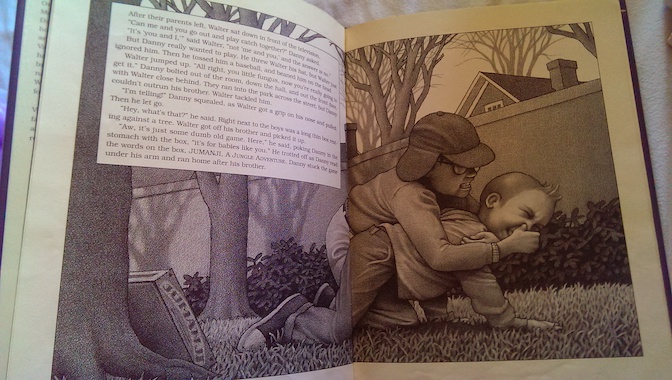
ZathuraBrothersWrestling

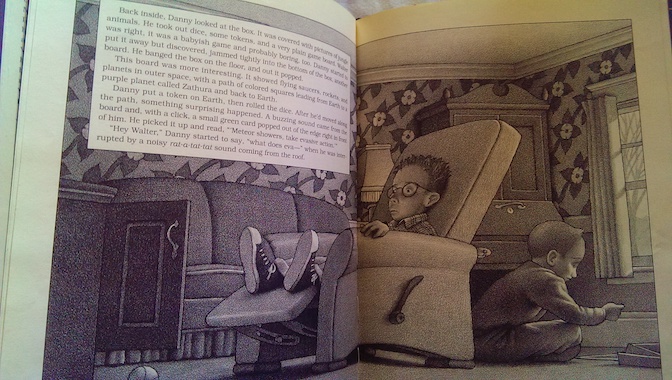
However, the two boys, Danny and Walter, don’t end up playing the same jungle board game, Jumanji, that was in the previous book. They find a second board game in the Jumanji box called Zathura and decide to try it instead. Zathura is a space-themed game where players travel a path from Earth to the planet Zathura. Like in Jumanji, elements from the board game come to life as the boys play, and someone must reach the end in order to end the game.

ZathuraStartingGame

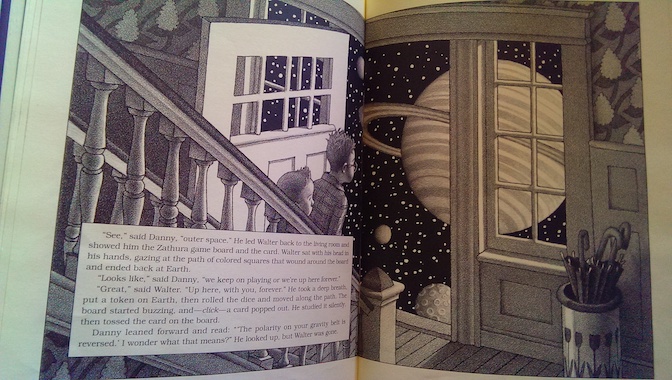
Danny and Walter, a pair of brothers, fight a lot. Walter hates doing things with Danny. However, when Danny starts playing the game, sending their house into outer space, Walter must join in and play with his brother in order to bring the game to an end so they can go home. The two of them learn teamwork as they help each other face the dangers of the game while trying to reach Zathura.

ZathuraOuterSpace

There is a movie version of this book, but there are major differences between the original book and the movie. The conflicts between the two boys are similar in the book and the movie, but the movie added a subplot about the boys’ parents being divorced (they weren’t in the original book), an older sister for the boys (it was just the two of them originally), and a kind of alternate reality where the older boy was trapped in the game by himself for years because he wished his brother away before finishing the game until his alternate self realized that he cared about his brother and wanted to cooperate with him.  In the original book, nobody was trapped in the game.

ZathuraAlienRobot

Chris Van Allsburg illustrations are always good, although I have to admit that I preferred the illustrations in Jumanji to the ones in Zathura.  It just seems to me that the pictures in Jumanji were more detailed and realistic.

The book is currently available online through Internet Archive.

ZathuraGoingHome

Magic Elizabeth

MagicElizabeth

Magic Elizabeth by Norma Kassirer, 1966.

Young Sally’s parents are away on a business trip, so she’s been staying with Mrs. Chipley, but now Mrs. Chipley has a family emergency to tend to. Mrs. Chipley’s daughter is ill, and Mrs. Chipley needs to go and help her with her children. While Mrs. Chipley is gone, there is only one other person for Sally to stay with: her Aunt Sarah, an elderly woman who Sally doesn’t really know. Aunt Sarah moved to California when Sally was just a baby, and the only reason why she has returned is that she has decided to sell her old house.

MagicElizabethArrival

Sally is a rather shy girl. She’s uneasy around Aunt Sarah, who is obviously unaccustomed to spending time with children, and Aunt Sarah’s creepy cat, Shadow. The house is old, chilly, and filled with strange things. However, Sally is enchanted with the bedroom that Aunt Sarah gives her and the portrait of a girl and her doll that hangs on the wall. The girl looks very much like Sally herself, and Aunt Sarah tells her that the girl was also called Sally and lived in that bedroom as a child, many years ago.

MagicElizabethKitchen

Fascinated by this earlier Sally and her beautiful doll, modern Sally decides to try to find the doll. Although her aunt tells her that she shouldn’t go poking around in the attic, Sally can’t help herself. She finds a trunk with Sally’s name on it full of girls’ clothes, just the right size for modern Sally to wear. There is a doll in the trunk also, but it’s not the same doll as the one in the portrait. When Sally reads the diary in the old trunk she learns the reason why. The doll in the picture, Elizabeth, was lost many years ago, when the earlier Sally was still young. As modern Sally plays dress up with the earlier Sally’s old clothes and studies herself in the mirror, she finds herself taken back in time, seeing the house through earlier Sally’s eyes. In the past, it was a busy and happy household with parents, an elderly aunt, earlier Sally, Sally’s little brother, and Sally’s pet cats.

A short time later, Aunt Sarah wakes modern Sally on the floor of the attic, and they assume that it was all a dream, but this look into the past changes Sally’s feelings about the house and her aunt’s cat, who suddenly seems friendlier and reminds her of the mother cat she saw in the past. Aunt Sarah also seems a little less stern as they discuss earlier Sally and her lost doll. Aunt Sarah says that no one ever saw the doll again after it disappeared on Christmas Eve all those years ago.  Earlier Sally had put the doll on top of the Christmas tree, like an angel, and after the family finished singing Christmas carols, the doll was gone.  They could never figure out what happened to her.  Modern Sally thinks that sounds very sad and wants to investigate the mystery of the missing doll, although Aunt Sarah isn’t very enthusiastic. She says that if the doll could be found, it would have been found long ago, and the earlier Sally has long since grown up and no longer needs it. Although, oddly, Aunt Sarah remarks that the earlier Sally had always thought that Elizabeth was “a little bit magic.”

Modern Sally continues to look for the doll anyway and also continues having moments when she sees the past as the earlier Sally did many years ago, especially when she looks into the mirror in the attic. One day, she invites a neighbor girl named Emily over, and while the two of them are looking around the attic, Emily finds Elizabeth’s old doll bonnet. The girls are excited because they now know for certain that Elizabeth is still in the house, waiting to be found. The girls are running out of time to find her. If Aunt Sarah agrees to sell the house, it will be torn down to build apartments. But, Sally falls ill with the flu, and it isn’t until Shadow gives her an important clue that Sally realizes where Elizabeth must be.

This book is currently out of print, but it’s one that I’d dearly love to see in print once more!  It is available to borrow and read for free online through Internet Archive.

My Reaction and Spoilers

Adults reading this story will probably realize before the children do (spoiler) that Aunt Sarah herself was the earlier Sally, the one who lost her favorite doll many years ago. “Sally” is a nickname for Sarah, like “Molly” can be for Mary and “Peggy” can be for Margaret, although any of those names can also be used by itself.  (In the Middle Ages, it was common for popular names to get different variations of nicknames by changing one sound in the original name and then changing one more sound in the first nickname to get another one, and sometimes even moving on to change one more sound to get yet another nickname that was very changed from the first. Those nicknames that look significantly different from their original names are a holdover from that practice, having lasted even into modern times.  John/Jack works on the same principle.  Fun fact!)  When Aunt Sarah grew up, she stopped using her childhood nickname, but the name was passed on to modern Sally.

At first, modern Sally sees her stern aunt as being witch-like, all dressed in black and fussy, but gradually, the memories of the past, her new relationship with young Sally, and the finding of her slightly-magical doll soften her. There are hints of Aunt Sarah’s youth in the attic, although Sally at first dismisses thoughts that some of the lovely things there could have belonged to her cranky old aunt because she has trouble thinking of her aunt as once having been young, pretty, and sweet. However, part of the theme of the story is that everyone was young once. Aunt Sarah is is bent and achy from arthritis, giving her the witch-like appearance and making her short-tempered at times. She also hasn’t been around children much for years, and part of her fussiness comes from forgetting what it was like to be young herself. Modern Sally, with her resemblance to her elderly aunt, and Elizabeth the doll both work their magic on her, reminding her what it was like to be a young girl and helping to revive a more youthful spirit in her.

I was happy that (further spoiler) Aunt Sarah decides not to sell the house after all, not just because she and Sally will get to spend more time together, but because old houses like that are rare these days. I like the idea that the old family heirlooms in the house will now be preserved, like the sleigh out in the old barn and the melodeon, a type of small organ.  I liked the way the book described the melodeon making musical sounds as people walk past it because of the way the floor boards move.  I also loved the description of the gas plant that Sally sees in earlier Sally’s memories.  If you’d like to see what a gas plant looks like when it’s lit, have a look at this video on YouTube.MagicElizabethMelodeon

What’s a Ghost Going to Do?

WhatGhostDo

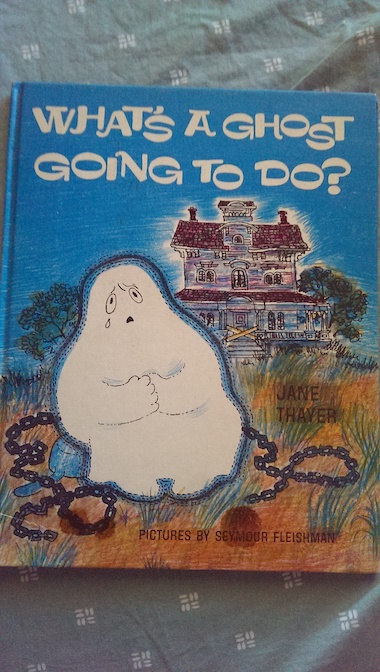
What’s a Ghost Going to Do? by Jane Thayer, 1966.

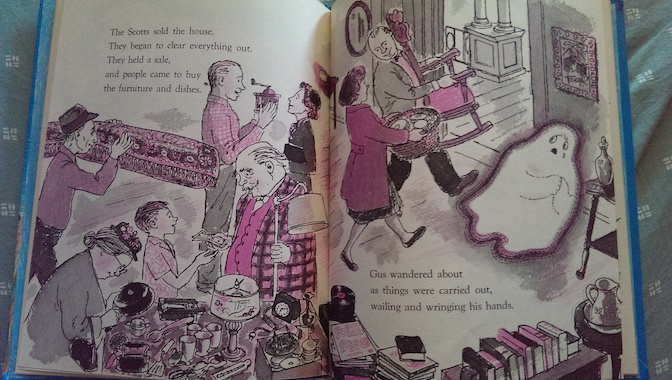
Gus is a friendly ghost who lives a quiet life alone in his old house, which is run-down and shabby, with winter visits from his mouse friend.  However, Gus discovers one day that the property is being sold.  The government wants the land to turn into a park, and if that happens, Gus’s house will be torn down!  If they decide to tear the house down, where will he go?

WhatGhostDoSale

For a time, Gus tries living with another ghost in another old house nearby, but that arrangement doesn’t work because the other ghost doesn’t like Gus rattling chains.  Then, Gus tries living in a hole with his mouse friend, but it’s really too small for him.  The only place that seems right for Gus is his old house, which is in danger of being destroyed!

WhatGhostDoHints

In desperation, Gus whispers in the ears of the man in charge of preparing the park for the government, Mr. McGovern, trying to get him to notice the virtues of his house.  Fortunately, Mr. McGovern accepts Gus’s vision of the house as a beautiful piece of the past and finds a way to restore it to its former glory so that Gus can keep his home and others can appreciate it, too.

WhatGhostDoRepairs

Gus’s house becomes a museum in the park, and Mr. McGovern also officially acknowledges Gus as the resident ghost.

The book is available to borrow and read for free online through Internet Archive. It’s part of a series.

WhatGhostDoMuseum

My Reaction

I’ve had this book since I was a little kid. I always felt sorry for poor Gus throughout the book, but the story has a nice ending, with Gus and Mr. McGovern finding a creative way to restore the house and put it to good use, filling it with antique furniture for both Gus and the public to enjoy. I haven’t read any of the others in the series yet because this is the only one I’ve ever had.

Old Black Witch

OldBlackWitch

Old Black Witch by Wende and Harry Devlin, 1963.

OldWitchChimneyA boy called Nicky and his mother are looking for a new place to live somewhere in New England.  The mother wants to buy an old cottage with the idea of turning it into a tea room.  At first, they have trouble finding a place, but finally they buy an old house that badly needs fixing up, not knowing that there is an old witch living there.
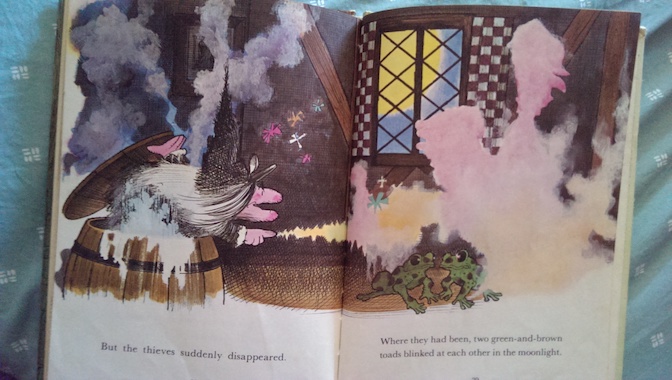
The witch (whom they call Old Black Witch, since she’s dressed all in black and sooty and doesn’t seem to have any other name) has been sleeping in the chimney of the house for about a hundred years, and they wake her the first time they try to start a fire in the fireplace.

The witch is furious to discover that the house has new owners and worried about where she’s going to live because she needs an old house to haunt.  Nicky and his mother invite her to stay and live in the attic, which has enough dust and cobwebs to satisfy her tastes, while they clean up the lower part of the house for the tearoom.

The locals have heard stories about the house being haunted, but the nice tearoom soon becomes popular with ladies in the area, especially after Old Black Witch decides to help out Nicky’s mother in the kitchen.  Old Black Witch’s blueberry pancakes are wonderful and win many fans for the tearoom.

Then, one night, a couple of burglars break in.  Since Old Black Witch is kind of evil herself, she can’t really fault them for wanting to rob the place . . . until she suddenly realizes that they’re stealing from her, too, and uses her magic to fix the burglars for good and give herself the pet toads that she’s been wanting.

This book is available to borrow and read for free online through Internet Archive.

OldWitchToads

My Reaction

One of the things that I like about this story, which was a favorite of mine when I was a kid, is that Old Black Witch isn’t particularly evil although she isn’t too nice, either.  She’s as bad and disagreeable as a cranky old witch who’s lived in a chimney for over 100 years ought to be, but not so bad that she can’t make some new friends and help them out once in a while.  Friendly enough for the kids, but not too sweet to be a real witch.  It’s part of a short series, although I haven’t managed to find any of the other books yet.  Some of the pictures are in full color and some are in black and white.  Don’t ask me why she has a spoon in her hat because I’ve never been completely sure, either.  Somehow, on her, it looks good.

The back cover of the book has the recipe for the blueberry pancakes.

OldWitchPancakeRecipe

There was a short film version of this story from 1969 called Winter of the Witch.  It follows the book fairly well, but with some variations (there were no burglars).  In the film, the pancakes have the power to make people happy, and that’s what gives Nicky’s mother the inspiration to open a pancake parlor in their house.  The witch finds a new sense of purpose, although she still plans on going back to her old, wicked ways once the world is happy enough to need a good, old-fashioned scare.  I don’t think that it was ever released on dvd, but it is possible to see it on YouTube and Internet Archive.