The Big Orange Splot

The Big Orange Splot by Daniel Manus Pinkwater, 1977.

Mr. Plumbean lives in a neighborhood where all the houses look alike. He and his neighbors all think of the uniformity as making their street “neat” and tidy, and they appreciate it. Then, something happens that makes them reconsider.
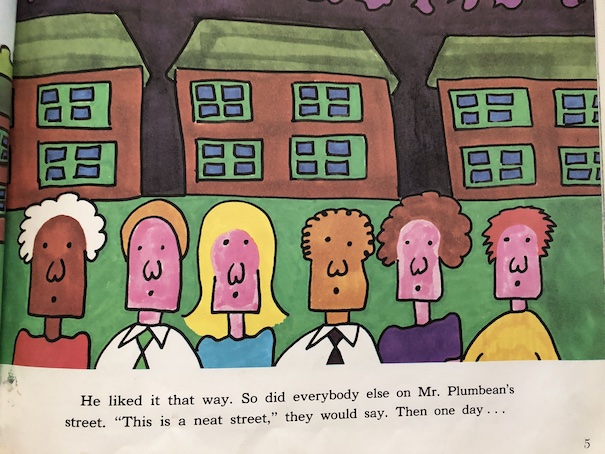
For reasons that nobody ever understands, a seagull carrying a can of orange paint happens to fly over Mr. Plumbean’s house and drops the can, leaving a big orange splot on Mr. Plumbean’s roof. Mr. Plumbean realizes that the big orange splot means that he’ll have to repaint his house, but the painting project makes him think.

Instead of painting his house to look like everyone else’s, the way it was before, he gets a bunch of wild colors and turns the exterior of his house into a rainbow explosion, working around the big, orange splot on his roof! He adds paintings of animals and other things he likes and colorful patterns. It’s such a wild and crazy design that his neighbors think he went mad. Before long, he adds a clock tower onto his house and an alligator and some trees with a hammock in the front yard.
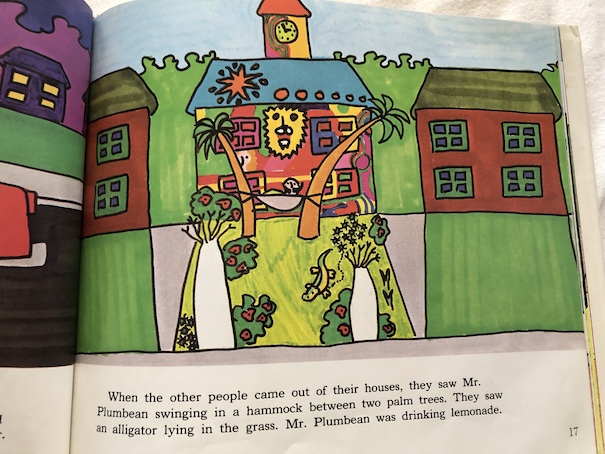
The neighbors think he’s gone too far, but Mr. Plumbean says, “My house is me and I am it. My house is where I like to be and it looks like all my dreams.”

One of Mr. Plumbean’s neighbors tries to talk some sense into him, but instead, Mr. Plumbean talks to him about his dreams. The next day, the man goes out to buy some building supplies. It turns out that he always loved ships, so he turns his house into the ship of his dreams!
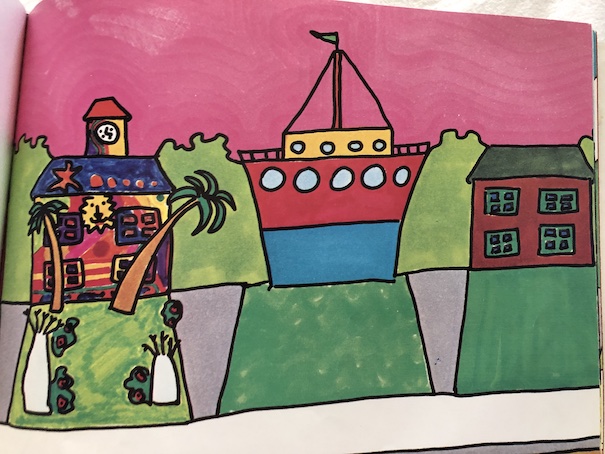
With Mr. Plumbean’s encouragement, other neighbors also start to change their homes to reflect their dreams, changing their quiet, “neat” street into a magical wonderland of imagination!

The book is available to borrow and read for free online through Internet Archive (multiple copies).

My Reaction

I remember this book from when I was a kid, and I always liked the pictures! It’s fun to imagine all the creative themes a house could have and what you might choose if you had the opportunity to live in a house that could look like anything you wanted. The houses shown in the pictures of the neighborhood end up looking nothing like their original shapes, except for Mr. Plumbean’s house, oddly. The others are vastly different from their original shapes, and the windows aren’t even in the same places, making them look like they’ve been completely rebuilt. This level of renovation would be difficult and costly in real life, but this story is meant to be fun and to celebrate imagination and the capacity people have to add a touch of color to their lives. If you read this book with a child, you can invite them to decide which of the house was their favorite at the end (mine was the one that looked like a castle) or what they would do if they could make their house look like anything they want.

In real life, I’ve never particularly liked those neighborhoods where all the houses look alike. I’m not the only one because tract homes and uniform suburbs were controversial from their beginnings in the mid-20th century. In the early 1960s, a song called Little Boxes (listen to it on YouTube) poked fun at the uniformity of suburban houses and the lives of the people in them (although the houses in that song were still different colors – just saying). The connection between the uniformity of homes and the conformity of the people living in them is a topic that resurfaces periodically in popular culture and other songs, like “Subdivisions” by Rush (listen to it on YouTube).

The themes of non-conformity and self-expression are pretty profound, but the story is lots of fun and isn’t too deep for kids. If you read the back section about the author, it explains that the inspiration for this story came from a time when he spilled orange ink on his own pair of new yellow boots.

This picture book is a fun story about non-conformity and self-expression. In the beginning, Mr. Plumbean is as content as anyone with his neat, uniform neighborhood until a strange, inexplicable accident creates a situation where Mr. Plumbean has to paint his house. Once he’s confronted with the task of repainting his house, Mr. Plumbean begins to consider the creative opportunities this chore provides, and he enjoys exploring the possibilities and changing his house to be more of a reflection of the wild and wacky person he really is or dreams of being. Once his creative side is unleashed, it begins to get his neighbors thinking along similar lines. True, they liked it when their street was neat and uniform because they could see the appeal of having things orderly, but it turns out that each of them also has an inner creative side that’s been waiting for a chance to get out. The non-uniformity and non-conformity of their street becomes more comfortable for each of them as they each embrace those sides to their personalities that they don’t normally show. When they come to accept and embrace their own dreams and each other’s, it doesn’t matter to them anymore that they’re not all alike. They’re comfortable with the wacky and whimsical parts of their personalities, and they’re not afraid to show them anymore. They’re happy with themselves, their homes, and their different visions.

I really liked the art style of the illustrations in the book. It’s very simple but colorful, and you can tell that the artist used markers because you can see the marker lines, especially in the backgrounds of the drawings. It makes it different from more modern books that use digital art. I like seeing signs of the physical materials used, and it gives the story a funky, organic feel that goes well with the theme.

As I said earlier, I did notice that many of the new home designs in the pictures don’t take into account where the houses’ windows used to be, but that’s just part of the whimsy of the story. We don’t need to worry about how these people accomplished these drastic changes so quickly and easily. It’s just fun to think about how you can personalize your space to reflect what’s important to you.

How Did They Live? Greece

How Did They Live? Greece edited by Raymond Fawcett, 1951, 1953.

This is a non-fiction book, part of a series about life in the past, but it’s told in the form of a story where the readers are visiting a man living in ancient Athens named Simonides. The story is told from the point of view of “we” as “we” visit Simonides, and he shows us around Athens.

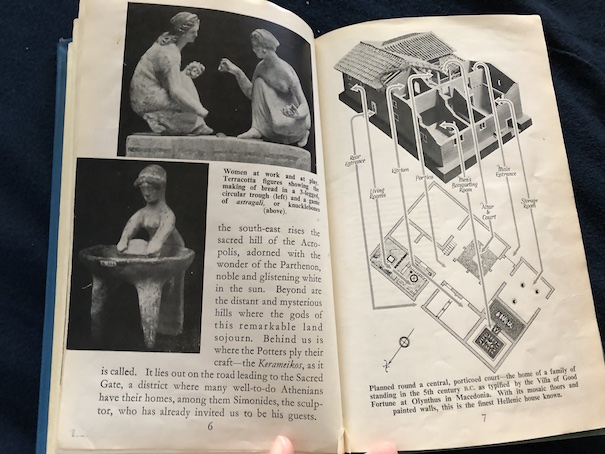
At the beginning of the story, Simonides meets us at the Temple of Hephaestus. The book provides a map and a description of the city so we know our way around. Simonides is a sculptor, and he lives in a nice house in an area of the city with well-to-do people. The book provides a map of the interior of Simonides’s home. His house is bigger and nicer than those of poorer people, and he also owns slaves. (The women playing a game on this page are playing Knucklebones, a precursor to modern Jacks but played with animal bones.)

Athens, like other cities in Greece at this time, is actually a city-state, an independent state with its own government, separate from other Greek city-states. Simonides explains that he served in Athens’s army when he was younger. Now, as a sculptor, he works with an artist producing public art in Athens. During a war with Sparta, many homes and buildings were badly damaged, so they’ve been rebuilding what was ruined and creating new public monuments.

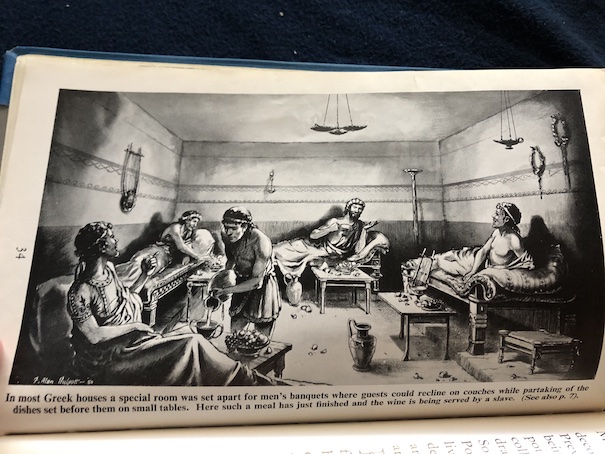
Simonides takes his guests into a special dining room, where we can relax. Guests are only allowed into areas of the men’s quarters of the house. The women’s quarters are strictly private, and we are told that the women in Athens spend most of their time at home, tending to household tasks. Usually, they only go out for special occasions, like festivals or plays. The Athenian women do not have the rights to property and having a say in public life that the men do. However, women from wealthy families lead comfortable lives and authority with in their houses. The book puts it, “Besides running the household she has her little vanities and the universal feminine interest in dress and adornment to help her and, in spite of her seclusion, she contrives to keep herself pretty well informed about what is going on in the city.” The part about the “little vanities” seemed a little insulting to me because I personally don’t like vain and shallow women who can’t think outside of the clothes closet, and I know plenty of women who aren’t in clothes and fashion. It seems like one of those cases where interest in these things might not really be “universal” but it’s something that women do because there just isn’t that much else for them to do. If they had more options of other activities, some of them might have found other things to do. The book goes on to describe various styles of women’s dress, hair, and makeup.

As the guests, we are invited to spend the night at Simonides’s house, and the next day, slaves bring us water to wash in and a breakfast of pieces of bread in wine. Then, we visit the agora (marketplace) with Simonides. There are people hanging around, socializing with friends, and the book describes the tunics and mantles they wear. After Simonides makes his purchases, he has his slaves carry them home. As we wander through the public meeting places, Simonides explains about the local philosophical groups that meet there, like the Stoics. We even meet Socrates as a young man.

After the shopping and visiting the public meeting places, we return to Simonides’s house for the midday meal of fish, vegetables, fruit, and bread. After the meal, Simonides’s wife, Hestia, explains more about the lives of women and children in Athens. As explained before, women have fewer rights than men, and female children do not receive as much education and training as boys do. Children younger than seven are all raised in the women’s quarters of the house. They play with toys like rattles, dolls, balls, spinning tops. Girls like to play on swings and see-saws and learn to dance, while boys play with kites, hoops, and hobby-horses. They all listen to stories like Aesop’s Fables to learn moral lessons. At the age of eight, boys begin to go to school, and at the age of eighteen, they join the army. Meanwhile, girls are taught to handle domestic tasks.

After that, we make a visit to the Acropolis to see the Parthenon, which is the Temple of Athena. The carved figures in the pediments of the building tell stories from the life of Athena. That evening, Simonides invites some friends to the house for a dinner party in his banquet room, where people eat while reclining on couches.

The next day, we learn about pottery and how it is made. The book describes the types of pictures and designs painted on pottery and says that the style with red figures painted on a black background is a newer style. Before, black figures were painted on a red background.

Toward the end of the book, we attend the Panathenaic Festival, which is meant to honor Athena. The festival includes athletic competitions and music and literature contests. There is a procession of important public officials and animals to be sacrificed to Athena. We (the guests) ask Simonides to explain more about the religion and gods of Ancient Greece, and he does. Religion is an important part of public life in Athens, but the book includes a suggestion that Simonides might not actually believe in the gods and goddesses of Ancient Greece: “We do not ask Simonides if he himself believes in these gods. But we have an idea that, like many other Grees, he may not do so, for he suggests that a knowledge of the gods has been handed down from the poets of old and the sculptors have clothed the ancient myths in beautiful forms.” That’s not much of an explanation, although I suppose it’s reasonable that people would believe in the religion of Ancient Greece to varying degrees, and there would have been at least some disbelievers. That’s found in pretty much every religion. There are also people around the world in modern times who engage in religious traditions less out of personal belief than out of civic or cultural participation (like this description of Shinto in modern Japan), which is the implication about the people in this story.

The book ends with a visit to Olympia to see the ancient Olympic Games.

My Reaction

I love books that explain daily life in different time periods, and I thought this one was pretty well done. It covers a few days in the life of Ancient Athens and also does a good job of explaining the wider society of Athens. Most of the perspective is on a fairly wealthy family and their slaves. I found parts about the descriptions of the lives of women and slaves distasteful, but the descriptions and attitudes of the people seem pretty accurate for the time and place. My feelings were more about not liking the lifestyle and circumstances than about disagreeing with the author. There are more details about the raising and schooling of children and about food and clothing than I’ve included in this description.

I particularly liked the maps of the city and the interior of the house. I also liked the way they included Greek words and explained their meanings, like kerameikos (pottery, note the resemblance to the word “ceramics“). Even though I took a philosophy class in college and learned about the Stoics, I didn’t remember the professor explaining that the origin of the word “Stoics” was the stoa, the public gathering place like a covered porch where they would meet.

I was confused for a moment when the book explained that Simonides doesn’t bow when he meets people “as we would do.” As an American, I wondered, “Who’s ‘we’?” Americans aren’t in the habit of bowing to random people we meet on the street, either. I checked, and the book was printed in England. British spellings in the book (“honour” vs. “honor”) also confirm that this is a British book. I didn’t think that people in England in the 1950s bowed to people either, except maybe during important events with royalty and nobility. The most I would ordinarily expect would be a nod or bow of the head to acknowledge other people, and people in the US do that, too.