
The King’s Equal by Katherine Paterson, 1992.
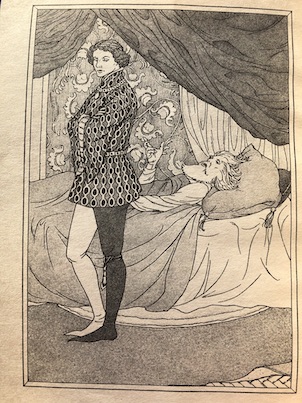
Everyone dreads the day that Prince Raphael will rule the kingdom instead of his father. Prince Raphael is good-looking and highly educated, but he’s also selfish and greedy. His one outstanding characteristic is that he’s arrogant. He assumes that no one knows as much as he does about anything and no one is as deserving as he is . . . of anything. Knowing that, as the old king lies dying, he makes his final decree that the prince will not wear his crown until he is married to a woman who is his equal.
When the prince hears that, he immediately becomes angry, saying (as his father guessed he would) that there could not possibly be any woman in the world who is his equal, who is as rich, intelligent, or beautiful as he is. After his father dies, the prince immediately begins looting the kingdom for his own gain and generally abusing his subjects (as they had also guessed he would). Still, he doesn’t have the one thing he really wants: his father’s crown.

The prince orders his councilors to find him an appropriate bride but (as the councilors feared), the task proves impossible. No matter what options they place before the prince, the prince finds something about them to nit-pick. Princesses of fabulous wealth are not beautiful or intelligent enough for him. Princesses who have amazing beauty either aren’t beautiful enough or don’t know enough. Princesses with amazing knowledge are still lacking in some area of knowledge or are just plain ugly in the prince’s eyes. One by one, he dismisses them all.

Meanwhile, a farmer in the prince’s kingdom, has sent his daughter, Rosamund, to live in the mountains with their goats to avoid having the prince confiscate their only livestock, which he has done with everyone else. During the winter, Rosamund and the goats almost starve, but they are saved by a magical Wolf.
The Wolf assures Rosamund that her father is alive and well, and Rosamund says that she is worried about what is happening in the kingdom. The Wolf tells Rosamund that the kingdom would be saved if the prince finds the princess that he is looking for and that she should go to the capital and present herself as that princess. Rosamund doesn’t see how she can do that because she is definitely not as wealthy as the prince, and she doesn’t think of herself as particularly beautiful or clever. However, the Wolf tells her that her mother, who died when she was born, had blessed her, that she would be a king’s equal. To fulfill her dead mother’s wish, Rosamund does as the Wolf tells her.
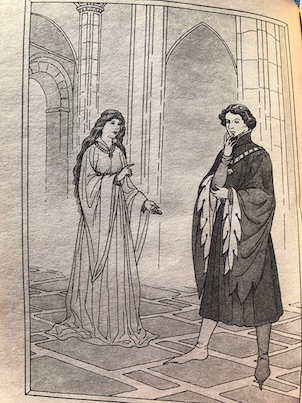
To Rosamund’s surprise, the prince falls in love with her beauty at first sight. She also impresses him with her intelligence when she tells him that she knows what no one else does, that he is actually very lonely. (Which is natural, since he thinks that no one can be his equal or true companion.) Although she cannot demonstrate that she possesses great wealth, she can demonstrate that there is nothing in particular that she wants while the prince still feels like he is lacking things he needs (like his father’s crown). The prince is satisfied that Rosamund has passed all the necessary tests to be his equal, but Rosamund turns the tables on the prince by pointing out that his description of her has made her more than his equal, challenging him to prove to her that he is worthy of marrying her.

It is in meeting Rosamund’s challenge, taking care of her goats in the mountains for a year, Raphael learns humility from the Wolf. While he’s away from the palace, Rosamund tends to the kingdom, ruling more compassionately than Raphael had. When Raphael returns, he is humble enough that he doesn’t think that he is worthy of marrying Rosamund, but his humility is precisely what makes him worthy, and they do marry.
My Reaction
Overall, I liked the story, although I wish that we could see a little more of the conversation between Rosamund and Raphael when she explains to him who she really is. They still get married, so whatever Rosamund told Raphael must have persuaded him, but it’s left to the imagination how she explains it. How I picture it is partly based on the fact that, during the last year, Rosamund has lived as a princess, even though she was originally a goatherd, and Raphael has lived as a goatherd, even though he is really a prince. By the time the year is over, they have each lived in the other’s place, and that is what really makes them each other’s equal. Raphael was callous and arrogant because he never thought about how other people lived until he tried it himself.
I don’t know if Rosamund really learned anything from her experiences as a princess, which bothers me a little because I think that she really should have because it was so far outside of her experience. We don’t really hear about that because the focus is on Raphael’s changing character. Personally, I’d like to think that part of what Rosamund may have learned is that running a country is a big, difficult job, and that, while her rule was better than Raphael’s for being more compassionate, it’s not a job that she would like to do alone, emphasizing that she and Raphael would be better ruling as a team than either of them would be by themselves. If Rosamund and Raphael really both need each other, it would be fitting for a story about equals.



 Jestress's Forgotten Books and Stories