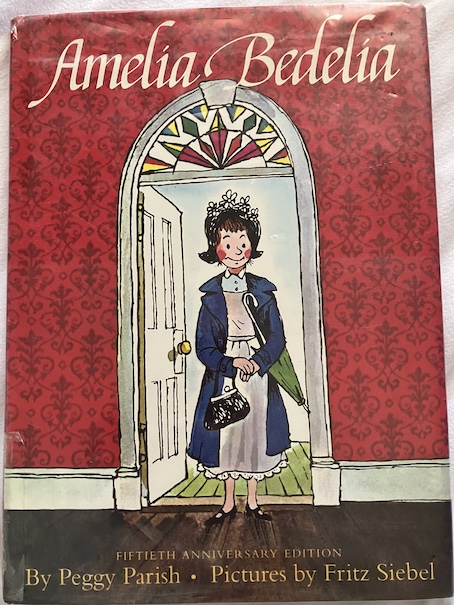
Amelia Bedelia is just starting her new job as a maid with Mr. and Mrs. Rogers! Mr. and Mrs. Rogers can’t be there to supervise her on her first day, but Mrs. Rogers leaves her a list of things to do and tells her to do exactly what the list says. Little does Mrs. Rogers know just how literal Amelia Bedelia can be!
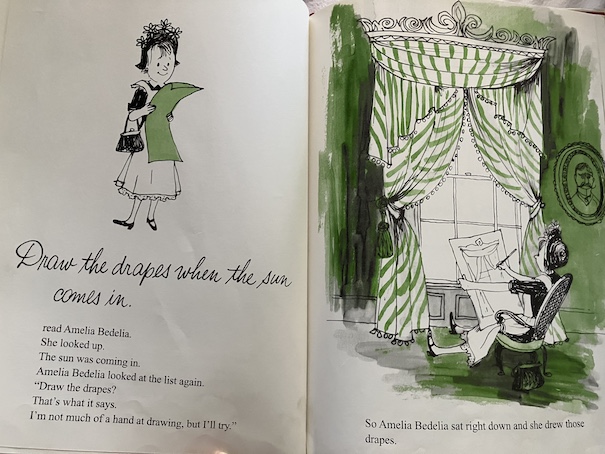
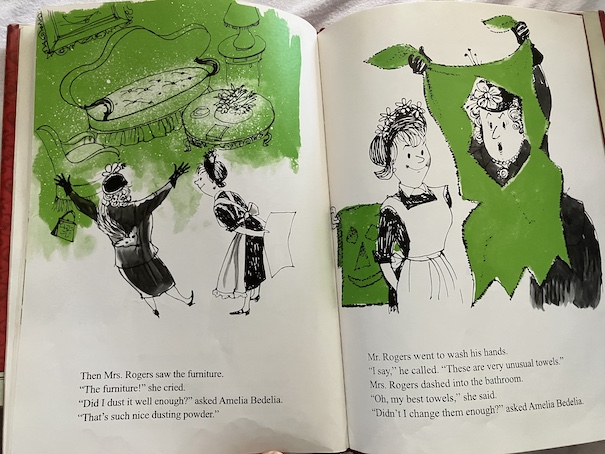
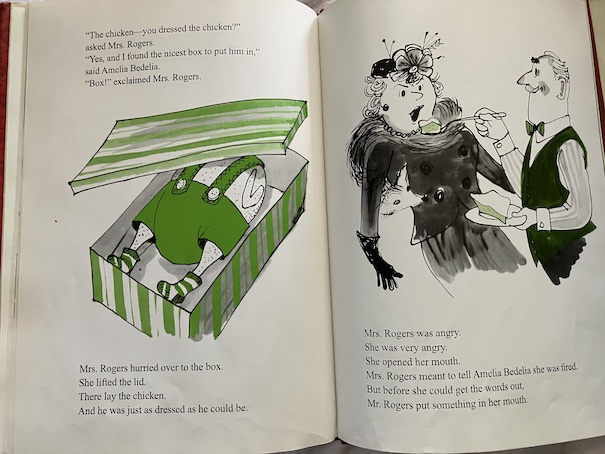
When Amelia Bedelia reads that she’s suppose to “change the towels”, she thinks that she’s supposed to change the way they look instead of replacing them with new ones. To Amelia Bedelia “dust the furniture” means to add dust to the furniture instead of removing it. The instruction to “draw the drapes” sounds like she should draw a picture of them instead of closing them.
When Mr. and Mrs. Rogers return to see how Amelia Bedelia is doing, they are shocked at what she’s done!
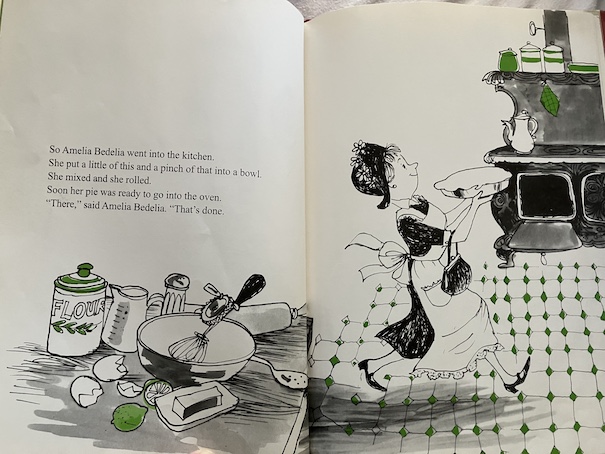
There is only one thing that can save Amelia Bedelia’s job: her ability to make an amazing lemon meringue pie!
The book is available to borrow and read for free online through Internet Archive.
My Reaction
This is the very first book in the Amelia Bedelia series, and I remember reading it when I was a kid. The point of the Amelia Bedelia books is to introduce kids to expressions and words that have multiple meanings. They’re pretty funny to read, although even as a kid, I had trouble believing some of the phrases that Amelia Bedelia takes literally. For example, when she “dusts” the furniture, she thinks that Mrs. Rogers should have told her to “undust” the furniture instead. I see what the author is saying, that it’s funny that we say “dust” the furniture when we’re actually removing dust instead of adding it, but I’ve never heard anybody in real life use the term “undust” the furniture. Amelia Bedelia is funny, but sometimes, it seems like it’s reaching a little to find terms she can credibly misinterpret.
I also don’t think I fully understood the parts about trimming the fat on the steak and dressing the chicken as a kid because I wasn’t used to cooking. I think I got the concept that she was supposed to cut the fat off the steak rather than decorate it as one might trim a Christmas tree (a concept that Amelia Bedelia interprets the opposite way in her Christmas story). What she was supposed to do with the chicken she ended up “dressing” in clothes was a little more confusing. When I was a kid, I knew that people make stuffing or dressing to put in poultry, like chicken or turkey, when they cook it, or they can rub herbs and spices under the skin for flavoring, and I think that’s what Amelia Bedelia was supposed to do here. Even so, there are different types of stuffing or dressing to make and different mixtures of herbs and spices to use, and Mrs. Rogers doesn’t say what kind she wants. Of course, if she was more specific, Amelia Bedelia couldn’t have gotten so confused, and that’s really the point of the story.
I don’t know whether any teachers still use Amelia Bedelia books as examples of words and phrases with multiple meanings, but they are fun in that fashion. A good accompanying activity for these books is a project that I had when I was in school and that I’ve heard students still do – explain how to make a peanut butter sandwich (or any other kind of sandwich) to someone from another planet, who has no idea what a sandwich is or how to make one. Students doing this activity need to be as careful and detailed as they can because some phrases are easy to misinterpret if you assume that the person you’re talking to has no idea how anything works. I remember my old teacher would act out our instructions literally, almost like Amelia Bedelia. For example, if you said, “Put peanut butter on bread” without saying that you need to open the jar first and remove the peanut butter from the jar with a knife, the teacher would set the whole jar of peanut butter on top of the bread and just stare at it. If you explain the peanut butter sandwich instructions well enough that there’s no room for misinterpretation, you may have a future in technical writing!
The pattern established in this first book continues through other books in the series. In many other Amelia Bedelia stories, Amelia Bedelia misinterprets instructions she’s given by taking things too literally or misunderstanding words with multiple meanings, but she always manages to keep her job because she’s really good at baking and makes cakes, pies, and other treats that Mr. and Mrs. Rogers love.
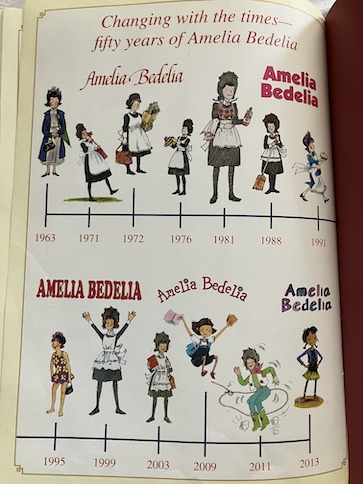
If you read the 50th Anniversary edition of the book, there’s a section in the back about the Amelia Bedelia series and how it’s changed over the years!
The Scandalous Sisterhood of Prickwillow Place by Julie Berry, 2014.
The story is set in England in 1890. There are seven girls at the proper Victorian boarding school known as Saint Ethelreda’s School for Young Ladies on Prickwillow Road in Ely. As the beginning sections of the book explain when they introduce the girls and members of their families and acquaintances, they were all sent to Saint Ethelreda’s because their families want them to become proper Victorian young ladies, ready to make suitable and socially-acceptably marriages. Some of the girls have defects in their characters or personal interests that are considered entirely unsuitable, and their families are hoping that the school’s discipline and propriety will cure them.
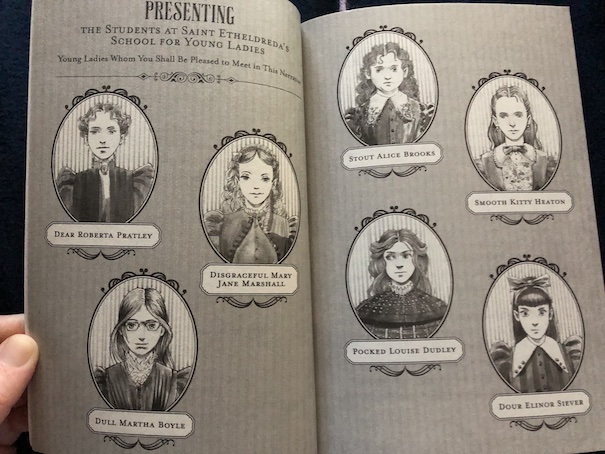
The seven girls are:
“Dear” Roberta Pratley – Her mother died while she was still young, and her father remarried. It was her stepmother’s idea to send her to boarding school, thinking her too soft, clumsy, awkward, and overindulged by her late mother. Her stepmother hopes that boarding school will strengthen her and turn her into a more graceful young lady. Roberta is known for being gentle and kind. She’s good at sewing.
“Disgraceful” Mary Jane Marshall – She was sent to boarding school by her mother, who has noticed that Mary Jane, while still rather young, is very pretty and precociously flirtatious, with a tendency to attract disreputable and penniless young men. Worse still, Mary Jane enjoys the company of these disreputable young men and regularly slips away from her mother to see them on the sly. Fearful that Mary Jane’s recklessness with young men will lead her into a disastrous marriage too early in life, her mother enrolled her in an all-female boarding school to keep her away from boys and, hopefully, give her a chance to mature and improve herself. So far, it’s not working. The only non-disreputable young man who interests her is the young local police constable.
“Dull” Martha Boyle – Martha has four brothers at home who make her life miserable with their pranks and teasing. Boarding school gives her an escape from them. She isn’t considered very bright, but she has a talent for music. She has a crush on a nearby farmer’s son.
“Stout” Alice Brooks – Poor Alice has a tendency to put on weight and is often compared unfavorably to her cousin Isabelle, who seems to be able to eat anything she wants without putting on an ounce. Alice doesn’t really hate Isabelle for this, but she’s tired of her grandmother’s criticism over it. She has a crush on a young law clerk.
“Smooth” Kitty Heaton – Kitty’s mother died when she was only four years old, and Kitty has no other siblings, which is a disappointment to her father, who hoped for a son to take over his business enterprises one day. Kitty’s father largely ignores her, and he has not yet noticed that Kitty is developing some shrewd business skills herself.
“Pocked” Louise Dudley – Louise’s face is scarred because she contracted smallpox at a young age. She survived this potentially-deadly illness because her devoted uncle, a talented doctor, nursed her through it. Ever since, she has revered her uncle and looks up to him as a mentor. Her uncle enjoys sharing his scientific and medical knowledge with her, he encourages her studies, and he thinks that she has the potential to a be doctor herself. Unfortunately, Louise’s parents don’t think that this is a proper profession for a young lady, so they sent her to boarding school to learn the kind of skills young ladies need to know to be wives and mothers. However, Louise has not given up her scientific interests.
“Dour” Elinor Siever – Elinor has a macabre side to her personality. Actually, her macabre side is most of her personality. When she was younger, she started sneaking out at night to explore, and she watched with fascination as the old grave digger in her town exhumed bodies to rob them or sell them for medical experiments. When the old grave digger spotted her watching him, she gave him a fright, and when her parents found out what she’d been doing, they packed her off to boarding school to put an end to this morbid interest and encourage her to be a sweeter, more cheerful, and more normal girl. None of that is working, but her morbid interests are about to come in handy when death comes to the little school.
One evening, while the headmistress of the girls’ school is dining with her visiting brother, both the headmistress and her brother are poisoned. The girls are saved because they were not eating the same food. Realizing that the headmistress and her brother are dead and quickly concluding that they were murdered, the girls debate about what to do. They consider calling a doctor, but it’s obviously too late for that. They could get the police, but before they do, the girls stop to consider what this will mean for themselves.
They have no idea who poisoned the headmistress and her brother. The girls prepared the food they were eating, so the poisoner could have even been one of them, or at least, they could be potential suspects. At the very least, the death of the headmistress means the end of the school, and the girls will all be sent home to their families. The truth is that the girls don’t want to go home. Each of them has some sort of tension at home or a reason why they were sent away, and they’ve all become like sisters to each other. More than anything, they want to be able to stay together and have some freedom from their tensions at home.
With their headmistress gone and no adults around to tell them what to do, what not to do, or how to be, the girls realize that they have unprecedented freedom to do as they like and be themselves, but that’s not going to last if they’re suspected of murder. Kitty is the first to suggest that they not tell anyone that the headmistress and her brother are dead, but she’s also the first to realize that, if they don’t find out who killed them, there will be a scandal, and each of the girls will be under suspicion for the rest of their lives. While Kitty relishes the idea of taking charge of the other girls and having them organize their own lessons and self-study from now on, according to the subjects that interest each of them the most, they also need to investigate and solve the murders. There is little hope for any of their future prospects if they have to go through life as murder suspects.
Their first problem arises when some friends of the headmistress and her brother show up unexpectedly as part of a surprise party for the brother’s birthday. Acting quickly, the girls hide the bodies and convince the guests that the brother has gone to India suddenly to tend to a sick relative and their headmistress has gone to bed because she was feeling unwell. However, one of the girls accidentally injures the ankle of the choir teacher, who has to spend the night at the school, causing them further complications. Desperately, the girls try to cover up the fact that their headmistress is dead and buy themselves time to investigate.
Although none of the girls is what their families consider a proper Victorian young lady, they each have skills that are useful to their deception and investigation. Kitty is good at organizing and managing people, and Mary Jane knows how to charm them. Elinor isn’t afraid of handling the dead, and Louise has scientific knowledge. Alice is the right size to pose for their headmistress in her clothes, and she has some acting ability.
Can the girls find the real murderer before someone figures out that two murders have taken place and blame the girls for them? What will the girls do if it turns out that the murderer is one of them? And, if it’s not one of them, what’s to stop the murderer from trying to kill again if he believes the girls’ ruse that their headmistress is still alive?
The book is available to borrow and read for free online through Internet Archive (multiple copies).
My Reaction
This is a humorous mystery with delightful characters! Although none of the girls is quite what their families or society wishes they were, readers will see that some of their supposed defects are actually strengths and skills. The humor in the story is dark, and the girls are unsentimental about the deaths of their annoying headmistress and her odious brother. They explain the reasons for their lack of sentimentality through their explanations of the victims’ characters. Neither of them was ever very nice to the girls, and they both had dark sides to their personalities.
Because some of the girls have morbid tendencies or possibly scandalous sides to their personalities that they need to cover up, it is plausible from the beginning that one of them could have had a reason to kill the headmistress, leaving readers more in suspense about the identity of the murderer. Although the girls love each other like sisters, there are moments when even they question whether they can really trust each other. However, the introduction of the headmistress’s friends and associates add other possible suspects to consider.
The first half of the book is largely about the girls getting themselves organized and covering up the deaths of the headmistress and her brother. They get more into solving the murders about halfway through the book, although they begin developing suspicions before that. I was pretty sure from the beginning that none of the girls did it, although the book does a good job of making it plausible that they could have. However, the girls soon learn that there were sides to their headmistress and her brother that they didn’t know about.
Early on, I had a theory that there could be more than one murderer involved. The headmistress and her brother didn’t seem to have exactly the same symptoms when they died, so I thought that it was possible that they were poisoned by different people coincidentally at the same meal. That’s not quite the right answer, although the parts of the story that made me think so are actual clues to what really happened. There are multiple villains in the story, some working together and some not. Some of what I suspected turned out to be true, but not all of it, and I didn’t figure out the whole situation before the characters explained it.
During the course of their adventures, the girls remain friends, and they also come to realize some things about themselves. Some of the girls develop budding romantic interests. Whether or not those fully develop, we don’t know, but it appears that there’s someone out there for everyone. Even Elinor finds someone to bond with over her morbid fascination for death. Some of the girls also come to realize talents they didn’t fully consider before and begin developing ambitions for their future. Kitty comes to reckon with her father’s lack of interest and emotional connection with her, and she also comes to realize that she shares some traits with him, even some of the less desirable ones. She realizes that she doesn’t want to be like her father, cold and commanding. While she felt little for her old headmistress, she was primarily motivated by her warm feelings for her best friends and fellow students, whom she regards as sisters. Because of her father’s detachment, she desperately guards the only warm connections she has in her life. Fortunately, the book has a happy ending. Circumstances allow the girls to continue with their education together in a way that supports all of their interests and under the guidance of someone who truly cares for them and understands them.
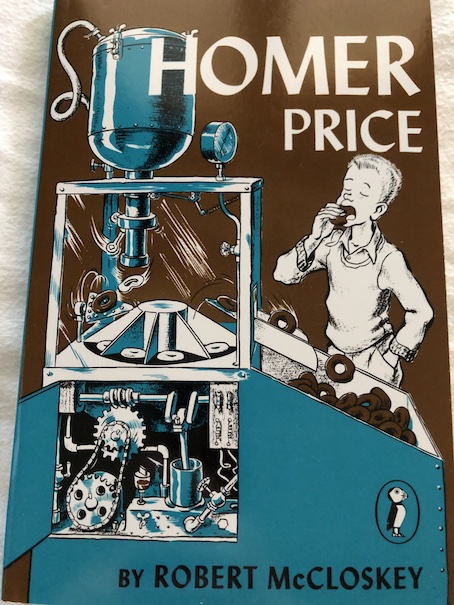
Homer Price is a collection of short, humorous stories about a boy who lives in a Midwestern town called Centerburg. His parents own a tourist camp with cabins and a filling station, and Homer helps out there with odd jobs. In his spare time, he has a hobby, building radios.
Many people remember this book specifically for the episode of the doughnut machine that goes out of control. Stories in the collection have been made into tv episodes or short films three times, and two of those are based on the doughnut machine story. (Sometimes, they appear on YouTube.) There is also a sequel to this book called Centerburg Tales: More Adventures of Homer Price.
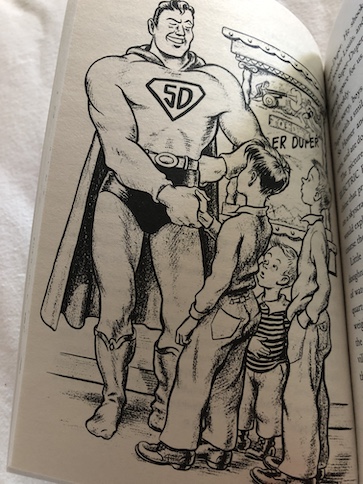
It didn’t occur to me until I started reviewing the book for this site, but it was first written and published during WWII. The war doesn’t play any part in any of the stories in the book, but it occurred to me as a fun collection of stories that its first audience of 1940s children might have enjoyed as a break from the chaos of the world around them. Various aspects of 1940s society and culture appear in the stories in humorous ways, like the comic book superhero who resembles Superman (a character introduced in comic books in 1938), lunchrooms (small diner-style restaurants), and the concepts of advertising, mass production, and suburbs with prefabricated houses.
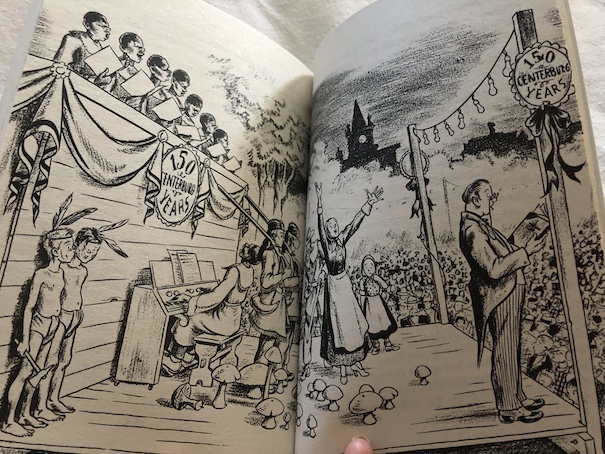
There is one incident that readers should be aware of that concerns descriptions of Native Americans. When the town holds its 150th anniversary celebration, Homer and his friends have roles in skits about the history of the town, playing Native Americans, and part of their costume involves dyeing their skin, which would be considered tasteless and racist in the 21st century. Their skit also includes a “scalping scene” (not really described, except saying that it “had to be modified somewhat”), which would also definitely not pass modern standards in any public performance. Because this is a collection of intentionally humorous stories, I’m not sure whether the author included this stereotypical depiction of kids playing Native Americans in a tasteless way to poke fun at such depictions or not, but I though it was worth mentioning for the benefit of people sharing these stories with children, so you know that part is there.
I didn’t notice anything particularly concerning about the depiction of black people in the book. Black people are included in the stories as members of the community without too much attention to the fact that they’re black. They’re simply part of the town, and nobody makes a big deal about them being there or refers to them by any derogatory names. One black boy finds a wealthy lady’s bracelet inside a doughnut in the doughnut machine story, and the local African Baptist Church choir performs at the town celebration.
Stories in the Book:
The Case of the Sensational Scent
One evening, Homer gets his usual bedtime snack of milk and cookies and leaves some milk out for his pet cat. However, a skunk wanders in and finds the milk. Homer decides to try keeping the skunk as a pet, naming it Aroma. Aroma helps to thwart a gang of robbers.
Case of the Cosmic Comet
Homer and a couple of friends are reading comics and marveling over a superhero called Super Duper (who is sort of like Superman). Later, Homer’s friend Freddy says that there’s going to be a Super Duper movie playing in town and that Super Duper himself will be there. Homer isn’t quite as enthralled with Super Duper as Freddy is because he knows it’s just fiction, and he thinks the stories are kind of formulaic, but he agrees to come to the movie. When the Super Duper’s car crashes as he leaves, they see that the Super Duper is actually an ordinary human who doesn’t really have super strength and can get hurt. Fortunately, he isn’t hurt badly, and the boys take their disillusionment well, profiting from the help they give him.
The Doughnuts
Homer’s aunt and uncle own a lunchroom, and his uncle is a gadgeteer with a weakness for buying labor-saving devices. One of these devices is an automatic doughnut-making machine. One day, Homer’s uncle is trying to fix the doughnut-making machine, and he asks Homer if he can finish fixing it and make some doughnuts for him while he runs an errand (really, he’s going to play pinochle at the nearby barber shop) because Homer is good with mechanical devices. When Homer gets some help from a patron, mixing up masses of doughnut dough from her family’s old recipe and runs the machine, Homer has trouble turning off the machine. It just keeps making more and more doughnuts! What are they going to do with all these doughnuts, and will they ever get the machine to stop?
Mystery Yarn
Miss Terwilliger is locally known as a great knitter. She’s taught most of the local women how to knit, and everybody also loves her fried chicken. She has two admirers who would like to marry her, the local sheriff and Homer’s Uncle Telly, but she just can’t make up her mind which she would like to marry. When the Sheriff and Homer’s Uncle Telly compete to see which of them has the largest collection of string, the Sheriff arranges for the two of them to unroll their giant balls of string at the local fair to prove which of them has more string. They also decide that whichever of them win the contest will also win Miss Terwilliger … until they discover that Miss Terwilliger also collects string and is determined to enter the contest … and she just might be beat them both. All’s fair in love and string collecting, and to the winner go the spoils!
Nothing New Under The Sun
A strange man comes to town. He seems a little odd and kind of shy. The sheriff is a little concerned about who he might be. The stranger himself just makes an odd comment about having been away from people for a long time. The stranger might be a shy eccentric, but the sheriff is concerned that he might be some kind of fugitive. The sheriff talks to various people around town, and they all offer their advice about how to judge a person’s character and what they think about the stranger. Various people say that he reminds them of someone from a story, and the town librarian identifies the character they’re thinking of as Rip Van Winkle. Could this stranger really be an old man who fell asleep for 30 years in the mountains, like in the story? If so, what’s with the bizarre vehicle the stranger has? When Homer finally persuades the man to show him his car and tell him who he is, the story turns out to be stranger than fiction: he’s a man determined to literally “build a better mousetrap” and turns out to be a kind of modern-day Pied Piper.
Wheels of Progress
Centerburg is celebrating its 150th anniversary with a public celebration and the creation of a new suburb with mass-produced, prefab tract houses (the kind made fun of in the song Little Boxes by Malvina Reynolds, which “all look just the same”). The identical nature of the houses turns into a nightmare when the street signs aren’t ready in time for the grand opening celebration, confusing the townspeople.
Fun fact: The original name of the town is revealed to have been “Edible Fungus” after the edible fungus that kept the original settlers who founded the town alive. The choir in the story sings a song about it.
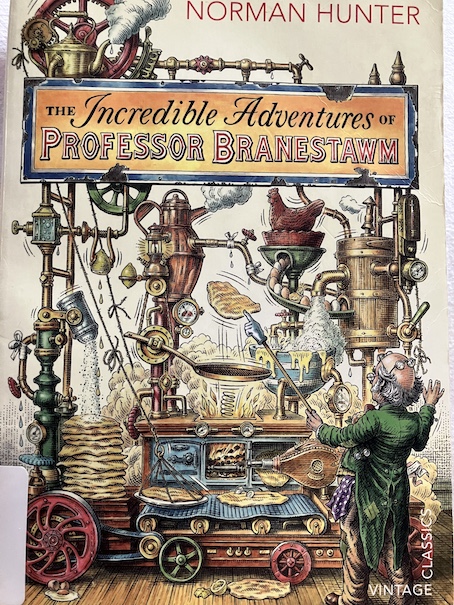
The Incredible Adventures of Professor Branestawm by Norman Hunter, 1933.
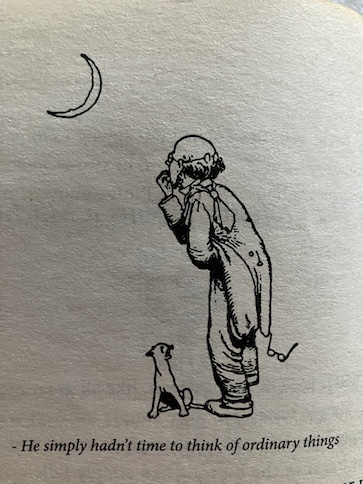
Professor Branestawm is a classic absent-minded professor. He’s is a balding man who wears several pairs of glasses, one of which is for finding the other pairs of glasses when he inevitably loses them. He’s a very clever man, but everyone knows that his inventions are likely to cause chaos. He’s not an easy person to talk to, so he doesn’t have many friends. His best friend is Colonel Dedshott, who is a very brave man.
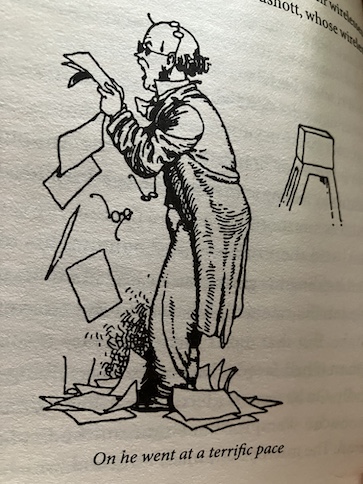
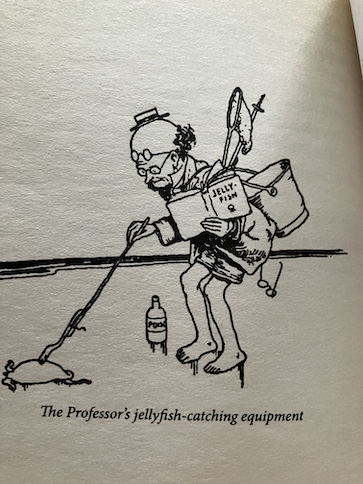
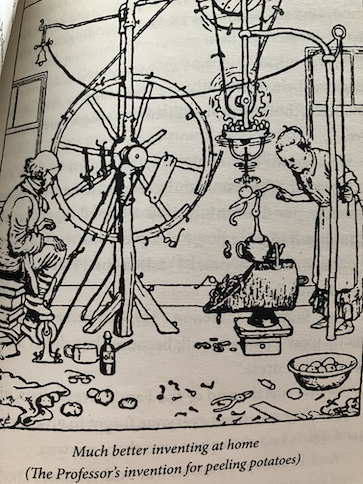
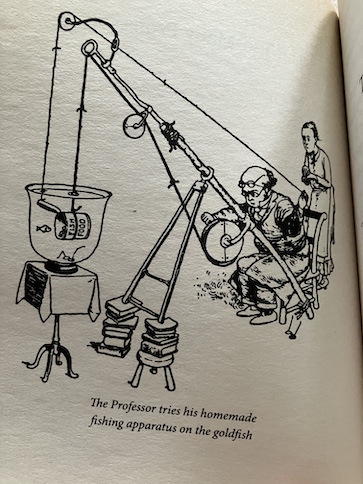
Every chapter in this book is about another of the Professor’s inventions and the adventures that the Professor, the Colonel, and the Professor’s housekeeper, Mrs. Flittersnoop, have with them and with various situations that the Professor creates with his absent-mindedness. The stories are accompanied by pen-and-ink drawings. I love the way almost every picture of the professor shows him shedding one or more of his many pairs of glasses and that the Colonel’s weapon of choice is a slingshot!
Chapter 1: The Professor Invents a Machine
One day, Professor Branestawm invites the Colonel to his house to see his latest invention, which he says will revolutionize travel. When the Colonel arrives, Professor Branestawm explains his idea. First, he points out that, if you’re traveling somewhere, you’ll arrive in half the amount of time you ordinarily would if you travel there twice as fast. The Colonel says that makes sense. Then, Professor Branestawm says that, the faster and faster you travel, the sooner you arrive at your destination. That also makes sense. Further, Professor Branestawm says, you eventually start traveling so fast that you arrive before you even start, and if you go fast enough, you can arrive years before you start. The Colonel doesn’t really understand this, but he takes the Professor’s word for it. The Professor has built a machine that will allow them to travel that fast, and the Colonel is eager to try it. He suggests that they try going back in time to a party he attended three years earlier. The Professor insists that they take some powerful bombs with them, just in case of emergencies (don’t try to make sense of it, there isn’t any), and the Colonel has his trusty catapult (slingshot) and bullets with him.
It turns out that, rather than going to the party three years earlier, they arrive at the scene of a battle that took place in another country two year earlier. Although they already know how the battle turned out, the Professor and Colonel can’t resist joining in with their bombs and catapult, and they end up wiping out an entire army and changing the result of the battle in favor of the revolutionaries. The revolutionaries are so grateful to them for their help that they take them to the palace of their former king, put the two men on the enormous throne there, and make them the new presidents of the country. Professor Branestawm realizes that they’ve made a terrible mistake and changed history because the king’s army was the one that was originally supposed to win the battle. The Colonel, however, doesn’t care because he thinks it sounds like fun to be a president and can’t wait to do some ruling.
Of course, the ruling of the two presidents doesn’t go well. Neither one of them really knows anything about running a country. Since they blew up all the country’s troops, there are no troops left for the Colonel to review, and he ends up playing with toy soldiers. Meanwhile, the Professor really just wants to get back to his inventing. Eventually, the revolutionaries get tired of this and tell them that they’ve decided that they don’t want any presidents, so they’re giving them a week’s notice before they’re out of a job. The Professor and the Colonel try not to take any notice (ha, ha) of the revolutionaries’ attempts to dethrone them. This just leads to the revolutionaries trying to imprison them in the dungeon, so the Professor and the Colonel are forced to escape in the Professor’s machine, which takes them back to the exact time and location where they started. They arrive just as the Professor’s housekeeper brings them some tea, so they have their tea, go about their usual business, and leave it to the historians to deal with the complications of the two of them changing history.
Chapter 2: The Wild Waste-Paper
When Professor Branestawm’s housekeeper puts a bottle of cough syrup with no stopper into the waste-paper basket, it accidentally creates a waste-paper monster! It turns out that it wasn’t really cough syrup in the bottle. It was a special life-giving formula that the professor invented. He only keeps it in a cough syrup bottle because cough syrup is the only thing that neutralizes the life-giving formula and stops it from bringing everything it touches to life, including the bottle holding it. Now that they’ve accidentally created a waste-paper monster, what can they do to stop it, especially since it seems to have the ability to use tools and is currently trying to saw down the tree where the Professor and his housekeeper are trying hide?
Chapter 3: The PRofessor Borrows a Book
Professor Branestawm accidentally loses a library book about lobsters, so he goes to another library to get the same book. By the time that he needs to return the library book, he has found the first one and lost the second one. For a while, he manages to avoid library fines by continually returning and checking out the same book from both libraries because the libraries don’t notice which library the book is from. Of course, he eventually loses the first book, too. He tries to fix the situation by getting the same book from a third library and then one from a fourth library, when he loses the third book. Where will it all end? How many libraries will have to share this one book, and where on earth are all these books about lobsters going?
Chapter 4: Burglars!
Professor Branestawm and his housekeeper go to the movies to see a documentary about brussels sprouts. (The housekeeper doesn’t care about brussels sprouts, but there’s a Mickey Mouse cartoon included with the feature, and she wants to see that.) When they get back, they discover that the house has been robbed! Professor Branestawm decides that he’s going to invent a burglar catcher, but the only burglar he catches is himself.
Chapter 5: The Screaming Clocks
Professor Branestawm’s clock stops, so he takes it to a clock repair shop. It turns out that the clock has only wound down because the Professor has forgotten to wind it. The Professor decides that he’s going to invent a clock that will go forever and never need winding. (This story is set before clocks that don’t need winding became common.) The Professor does invent a clock that will never stop and never need winding, but he makes a critical mistake: the chimes never reset after they strike twelve. They just continue counting up and up, endlessly, with no way to stop them! Just how many times will they endlessly strike before something terrible happens?
Chapter 6: The Fair at Pagwell Green
The Professor visits a local fair and invites the Colonel to join him. The Colonel ends up winning most of the prizes for the various games, and the Professor accidentally gets left behind in the waxworks exhibit, being mistaken for a wax statue of himself. When the Professor decides that it’s finally time to get up and go home, the people who work in the waxworks think that a wax statue has come to life!
Chapter 7: The Professor Sends an Invitation
Professor Branestawm writes a letter to the Colonel, inviting him to tea, but because he is distracted, thinking about potatoes, he accidentally writes a muddled letter and then mails the paper he used to blot the letter instead of the letter itself. The message that arrives at the Colonel’s house is a backward, muddled mess, and he has no idea who sent it to him. Since it looks like it’s written in some strange language he doesn’t know, the Colonel decides to take it to the Professor to see if he can decipher it. The Professor fails to recognize the letter as what he sent and has forgotten that he sent it. Will the two of them figure out what the letter is about, or will they eventually just give up and have some tea?
Chapter 8: The Professor Studies Spring Cleaning
Professor Branestawm’s housekeeper’s spring cleaning creates some chaos in the professor’s house, and the Colonel suggests that Professor Branetawm invent a spring cleaning machine. Predictably, the spring cleaning machine creates an even bigger mess and far more chaos.
Chapter 9: The T00-Many Professors
Professor Branestawm invents a very smelly liquid that brings things from pictures to life. The things from the pictures go back to being pictures when the liquid dries. Of course, there are some things that cause big problems when they’re brought to life. Possibly the most chaotic pictures that come to life are pictures of the Professor and the Colonel and the professor’s housekeeper. Who is who and which is which?
Chapter 10: The Professor Does a Broadcast
Professor Branestawm is invited to give a talk on the radio, and the Colonel helps him to rehearse. However, because he gets mixed up, he almost misses his own talk, and when he finally gives it, he speaks too fast and discovers that the time slot for his talk is much longer than he thought it was. Listeners are confused, but everything is more or less all right when the Children’s Hour comes on.
Chapter 11: Colonel Branestawm and Professor Dedshott
The Professor and the Colonel are going to a costume ball. Since the Professor doesn’t know what to do for a costume, the Colonel suggests that the two of them dress as each other. This causes some confusion, and neither of them likes each other’s clothes. The Professor’s social skills aren’t even great at the best of times, and the truth is that he’d rather be inventing things at home in his “inventory” (pronounced “invEnt – ory” as in a laboratory where you invent things, ha, ha). Then, the Countess at the ball raises the alarm that her pearls are missing! Everyone is confused when they try to get “the Colonel” to find the thief, and he doesn’t seem to know what he’s doing. It takes a while for things to get sorted out, but at least the Professor and the Colonel develop a new appreciation for being themselves instead of being each other.
Chapter 12: The Professor Moves House
Professor Branestawm’s house has gotten so full of his inventions that it’s become difficult to live there, so he’s decided to move to a new house. Moving to the new house is an escapade, and when Professor Branestawm and his housekeeper get there, they discover that the water and gas haven’t been connected up yet. Professor Branestawm’s attempts to remedy the situation render the new house unlivable, so he is forced to move back to his older house.
Chapter 13: Pancake Day at Great Pagwell
Professor Branestawm invites his friends and various members of the community to his house for a party, where there will be tea and pancakes. Everyone is happy to go because of the promise of pancakes, but when they’re all there, Professor Branestawm reveals that the party is to unveil is newest invention: a pancake-making machine! As the library man predicts, the pancake-making machine goes wrong (just like the Professor’s other inventions), but it’s all right because the town council comes up with a new purpose for it.
Chapter 14: Professor Branestawm’s Holiday
Professor Branestawm takes a trip to the seaside. He asks the Colonel to join him and bring his book about jellyfish, but unfortunately, he neglects to tell the Colonel where he’s staying (partly because he forgot where he was supposed to stay and is actually staying somewhere else). When the Colonel tries to find the Professor, he accidentally mistakes an entertainer dressed as a professor for Professor Branestawm. When the entertainer isn’t acting like himself (so the Colonel thinks), the Colonel becomes worried and decides medical intervention is necessary.
The book is available to borrow and read for free online through Internet Archive (multiple copies). It’s the first book in a series about Professor Branestawm, and it was also adapted for television multiple times.
My Reaction
Kids won’t learn anything about real science from Professor Branestawm, but the stories in the book are funny and not meant to be taken seriously at all. Most of the stories are about some pretty silly things that don’t really mean much in the end, but when you think about it, the Professor’s antics do lead to some pretty serious consequences, from wiping out an entire army just for the fun of it (pretty horrific in real life) and changing the course of history to accidentally blowing up someone’s house with his perpetually-chiming clock. No matter what the Professor does, though, there never seem to be any lasting consequences.
Even when people around him brace themselves for when the Professor’s latest project inevitably goes wrong, everybody still thinks that the Professor is pretty clever. The Colonel always thinks the Professor is clever, and even when he knows that the Professor is bound to do something that’s going to cause chaos, he enjoys the excitement. The housekeeper sometimes goes to stay with her sister, Aggie, when the chaos and excitement get too much for her.
The stories are just meant to be enjoyed for their zaniness, and there’s no point in analyzing them much. You don’t have to worry about whether anything the Professor does makes sense or exactly how he got any of his inventions to work. You can just enjoy seeing how everything develops and watch the craziness unfold! It sort of reminds me of Phineas and Ferb’s summer projects, which cause some chaos but are ultimately funny and always disappear at the end of the day. Enjoying these stories is what they used to say in the theme song for the tv show Mystery Science Theater 3000:
“If you’re wondering how he eats and breathes And other science facts, Just repeat to yourself “It’s just a show, I should really just relax …”
I can promise you that, no matter what happens in any of the stories, the Professor and his friends will ultimately be fine and will probably have a cup of tea (or “a cup of something”) afterward. This book was originally published in Britain the early 1930s, and it was read by children during the Great Depression. I can imagine that it might have given children then a good laugh and some escapism during troubled times.
Strangely, at least one of the Professor’s inventions, the clock that never needs winding, is a real invention that we have every day because time has moved on (ha, ha) since this book was originally written and published. In fact, it’s very unusual to find clocks that need to be wound these days. Of course, the part about the clock perpetually chiming more and more and blowing up when it gets to be too much is just part of the craziness of Professor Branestawm.
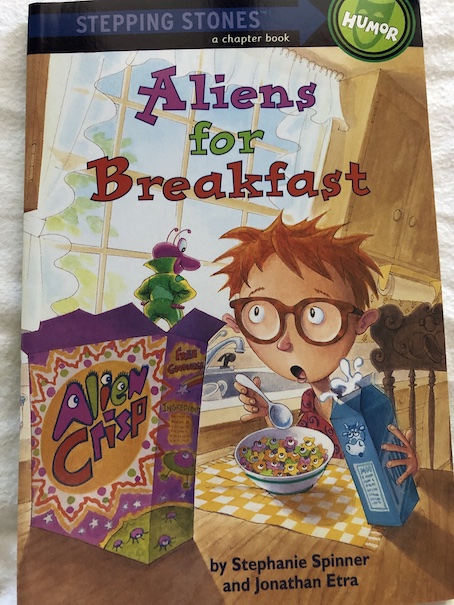
Aliens for Breakfast by Stephanie Spinner and Jonathan Etra, 1988.
This is the first book in the Aliens for Breakfast Trilogy, a short, easy chapter book series for elementary school children.
There’s a new student in Richard Bickerstaff’s class at school called Dorf. In spite of his strange name, Dorf is a good-looking blond boy with an irresistible smile. Everyone in class admires him and imitates him. Even Richard finds himself admiring Dorf’s clothes and wishing that he could wear the same thing, even his stupid bowling shirt. Then, when Richard sits down to breakfast one morning before school, he learns something startling about Dorf that changes everything.
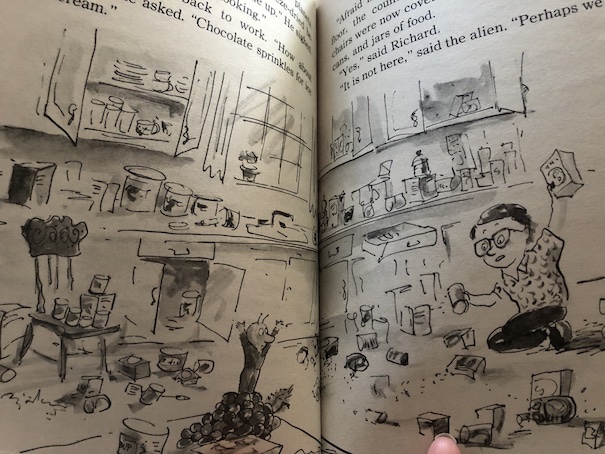
Richard’s mother gives him a sample of Alien Crisp that came in the mail. She thinks that Richard will love it because of his love of science fiction, but right away, he can tell that this is no ordinary cereal. When he pours milk on the cereal, it comes to life! Actually, he has revived a small alien called Aric, who was sent to Earth from another planet in freeze-dried form in the cereal. Aric is a Commander of the Interspace Brigade, and he’s here to stop an alien invasion on Earth. His target is Dorf.
Dorf is no ordinary boy. He’s an alien in disguise and a dangerous one. His type of alien multiplies, and if that happens, Earth is doomed! There’s only one thing that can stop Dorf … and Aric has forgotten what it is. Being freeze-dried for the trip to Earth has scrambled his memory, but he knows that the weapon they need is an ordinary type of food from Earth.
While Aric struggles to remember what that secret weapon is, Dorf’s hold over Richard’s friends and teachers becomes stronger. Everyone is charmed by Dorft, and everyone wants to do whatever Dorf does. Only Richard resists, and that identifies him to Dorf as an enemy.
Dorf uses his powers to make Richard start dissolving. If Aric doesn’t remember that secret weapon soon, both Richard and Earth are history!
My Reaction
I remember reading this when I was in elementary school, although I forgot most of the story. I remembered the alien arriving in the cereal box, like those little toys we used to get in cereal as kids. I also remembered that he was under threat somehow and that Aric told him that he hoped he didn’t have big plans for the weekend, with the implication that, if they don’t do something, he won’t make it to the weekend.
There’s a lot of humor in the story. I was alarmed at how Richard’s fingertips start bleeding when the dissolving begins. That part sounds a little scary. He bleeds rather than starting to fade out, and I had forgotten about that part in the story. However, there is humor in the story that helps to soften it, and the solution is a simple one that works right away.
The story has some references to real life science fiction, like Yoda from Star Wars and the starship Enterprise from Star Trek.
Henry Green absolutely loves chocolate, and he eats it all the time, at every meal! Although this doesn’t sound healthy, Henry’s parents let him eat as much chocolate as he wants because it never seems to affect his health. Henry doesn’t gain weight, have stomach aches, get cavities in his teeth, or suffer skin problems from eating all that chocolate, so his parents assume that it must be okay and let him eat whatever he wants. However, Henry is about to suffer some consequences from his chocolate obsession.
One morning, Henry starts feeling a little funny, and then, he notices that he’s breaking out in brown spots. His teacher takes him to the school nurse, and they notice that Henry’s rash smells oddly like chocolate. More little brown spots start popping out as they look at Henry.
They take Henry to the hospital, where the doctor who sees him is mystified. He says it’s like Henry is turning into a candy bar, and he starts talking about making medical history. In a panic, Henry runs away from the hospital. However, he ends up lost, and everywhere he goes, people notice his spots and the smell of chocolate.
Henry is afraid that he’s going to spend the rest of his life as some kind of chocolate freak, but a kind truck driver helps him and a candy shop owner who’s experienced this problem before provides a solution to his Chocolate Fever.
The book is available to borrow and read for free online through Internet Archive (multiple copies).
My Reaction and Spoilers
I remember hearing about this book when I was a kid, but I didn’t read it until I was an adult. I liked it, and I enjoyed the character of Mac, the truck driver who helps Henry. At first, Henry is reluctant to explain his situation to Mac, but Mac can clearly see (and smell) Henry’s condition, and he just waits for Henry to explain himself without pressing him for answers. When Henry explains that he’s afraid of being a freak for the rest of his life, Mac tells him that he’s “unique” and “sort of special”, not really a “freak.” Henry is afraid of everyone staring at him at all the time, but Mac says that he’s already had experience with that. Mac is a black man in a mostly white society, and he says that being different from other people is bound to attract some attention, but he’s proud of what makes him different because “black is beautiful.” Henry says that’s not the same as his situation because being covered with spots is ugly. It’s true that people with different colors of skin look the way they do because it’s natural for them to look that way, like people with different hair colors and eye colors. That’s not quite the same as someone suddenly breaking out in a weird rash.
Henry just wants to run away from him problems, but Mac convinces him that he has to deal with the situation instead of just running away. He has parents who care about him, and he at least needs to let them know where he is and what’s happening, and they can work out another way to deal with the problem that doesn’t involve returning to the hospital with the doctor he doesn’t like. Mac points out that it’s also possible that this problem of his is a temporary one that will clear up on its own.
Mac’s plan to call Henry’s parents is interrupted by a couple of robbers who hijack the truck, but when Mac finally delivers the cargo he’s carrying – a shipment of chocolate bars – to a local candy shop, the owner of the candy shop provides the solution that Henry’s been looking for. The candy shop owner once had a problem like Henry’s, and he teaches him that it’s possible to have too much of a good thing and that he needs to learn moderation. Cutting back on chocolate also means that Henry gets to experience and appreciate other flavors that he’s been ignoring. The story ends with the potential for Henry to get hooked on some of these flavors as well, and we’re left with the question of whether or not Henry has completely learned his lesson yet.
It’s a fun story about learning not to overdo things. One thing that surprised me was that Mac smoked a cigar because children’s books cut back on portrayals of smoking during the late 20th century to discourage children from taking up the habit. There were still some books that had people smoking, but it just struck me as interesting in this particular story because the story is about out-of-control habits.
The Abraham Lincoln Joke Book by Beatrice Schenk de Regniers, 1965.
I love joke books on oddly specific topics! This one is a little bittersweet because it was published 100 years after Abraham Lincoln’s death, but the book isn’t about that. Instead, it’s a fun celebration of some funny stories about Lincoln and some of his favorite jokes.
The jokes are mostly in story form, and many of them are stories about incidents from Lincoln’s own life. Some of them are stories about his youth, like the time he helped a classmate secretly during a spelling bee and the time he played a prank on his stepmother by holding some younger boys upside down so they could walk across the ceiling of the house, leaving muddy footprints.
Not all of the stories in the book are true tales about Lincoln. The book admits that some of them are “tall tales” that other people told about him. Many of them were jokes that people told about Lincoln’s height because that was one of the first things that people noticed about him. It was all the more notable when he was standing next to his wife because he was especially tall and she was especially short.
The end of the book discusses how Lincoln would often use jokes and stories to make a point in a conversation or soften the blow of criticism. As President, he liked to read joke books or humorous stories to cheer himself up during stressful times. He is quoted as saying, “I laugh because I must not cry.” The book ends with a timeline of events in Lincoln’s life.
The book is available to borrow and read for free online through Internet Archive (multiple copies).
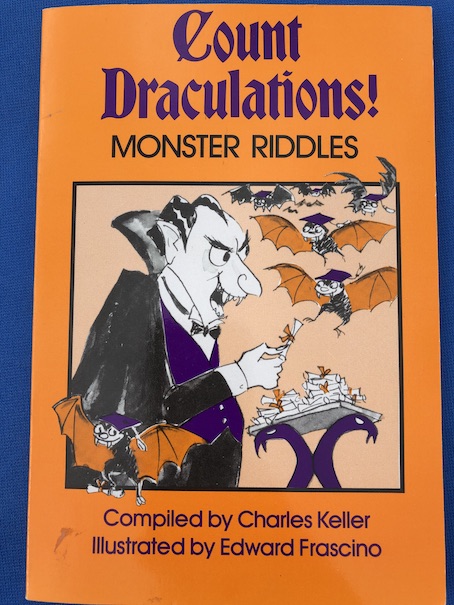
Count Draculations!: Monster Riddles compiled by Charles Keller, 1986.
This is
one of those themed joke books for kids that has monster and Halloween-themed
jokes. The jokes are the basic kid-friendly
question-and-response type with lots of puns.
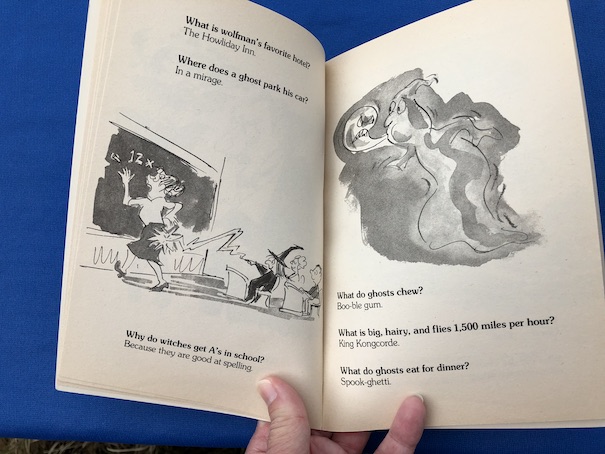
There are also some cute black-and-white illustrations.
Some of my favorite jokes:
Why do
witches get A’s in school?
Because
they are good at spelling.
How do
you get into a locked cemetery?
With a
skeleton key.
Why did
Frankenstein’s monster go to the psychiatrist?
While Murray’s parents are on vacation, his older sister, Blanche, is in charge of the house. One day, he calls Blanche to get a ride home from the dentist and hears what he thinks is Blanche shooting their housekeeper.
Earlier that morning, he had heard Blanche talking on the phone to someone about a gun. Then, when he calls home, a friend of Blanche’s, Harold, answers, and Murray hears a gun going off in the background and Blanche apologizing to the housekeeper and talking about blood on the carpet. When Murray gets home, his mother’s Persian rug is missing and sees what appears to be a head in a bucket under the sink in the kitchen, further proof that the housekeeper is dead and that her blood stained the carpet.
Murray doesn’t know what to do because he is sure that his sister would never shoot anyone on purpose, and he doesn’t want to see her go to jail. He consults a private detective, Mat Cloak, who he met in a doughnut shop, for help.
The detective agrees to look into the case, and along the way, he realizes that it has connections to a case that he is already investigating. What really happened to the housekeeper? Is Blanche really guilty of murder? Moreover, who is the strange man who is following Murray around?
It’s a very funny story with some twists that readers won’t be able to guess right away. Part of the mystery is pretty obvious because Blanche is a theater student, but the real mystery is one that Murray isn’t even trying to solve and the real villain is someone who Murray thinks is a victim.
The book is available to borrow and read for free online through Internet Archive.
Herculeah’s friend, Meat, decides to take a comedy class at a local comedy club called Funny Bonz. While he’s at the club for his class, he finds a dead body in the men’s restroom. He quickly runs to get help, but when the club’s owner (who is also the teacher of the class), Mike Howard, goes to check, the body is gone. It happens to be April 1st, so everyone assumes that it was just an April Fool’s Day prank. However, Meat is sure that what he saw was a real dead body.
He
tells Herculeah what happened, and he also remembers that he has proof of what
he saw: a blue wallet that he picked from the floor near the body. The ID in the wallet says is for a woman
named Marcie Mullet. Meat never got a
clear look at the identity of the body because it was lying face down, but he
remembers that it had a ponytail, so they assume that it was Marcie. Marcie was supposed to be a student in the
class, too, but she never showed up.
Meat and Herculeah assume that the body must have been Marcie.
However,
Herculeah is somewhat preoccupied by something else. She’s been getting strange vibes from a
camera that she bought at a secondhand shop.
The camera was cheap, only a dollar, and there’s still a
partially-exposed roll of film inside.
The camera was a great deal, but Herculeah’s hair is frizzling, and she
senses danger approaching.
When
she develops the film left in the camera, she realizes that the camera had once
belonged to Meat’s mother, and the pictures show Meat’s father. Meat has very little memory of his father
because his parents separated when he was very young, and his mother has
refused to talk about him for years.
Herculeah knows that Meat badly wants more information about his father,
but she hesitates to show him the pictures because she doesn’t think that he’ll
like what he sees. He’s imagined that
his father could have all kinds of cool professions, and she doesn’t know how
he’ll react to his real one.
Self-perception
is also very important to the solution to the murder. Meat is the first to learn the killer’s true
identity and is able to get the killer to confess and confide in him. The killer was tired of the victim’s mean-spirited
jokes, all of which were about the killer, who is fat. The murder was unintended; the person just
snapped when the victim gloated about using the mean-spirited comedy routine to
become famous. Meat understands how the
killer feels because he hasn’t had a very good perception of himself and knows
what it’s like to be fat. There is a
series of fat jokes in this part of the book, the meanest of which (the killer
quoting the victim) are about a fat woman’s bra size.
When his father’s true identity is revealed, Meat is actually glad, which surprises Herculeah. Meat’s father is very different from what he had imagined, but oddly, finding out that his father is a professional wrestler gives Meat something new to aim for. Meat is sometimes self-conscious of his large size, but seeing his father makes him realize that he can change his fat to muscle and be really impressive. The two of them meet, and Meat’s father apologizes for leaving so suddenly when Meat was young. He explains that, much like his own father, he has trouble living anywhere for very long. His own father had similarly abandoned his family when he was young. Both of them just reached a point when they had an irresistible urge to pick up and move on. However, Meat’s father makes it clear that he really does love him and is proud of him and says that he will continue to see him. It’s a strange explanation, but Meat accepts it and forgives his father.
This book is available to borrow for free online through Internet Archive.

















 Jestress's Forgotten Books and Stories