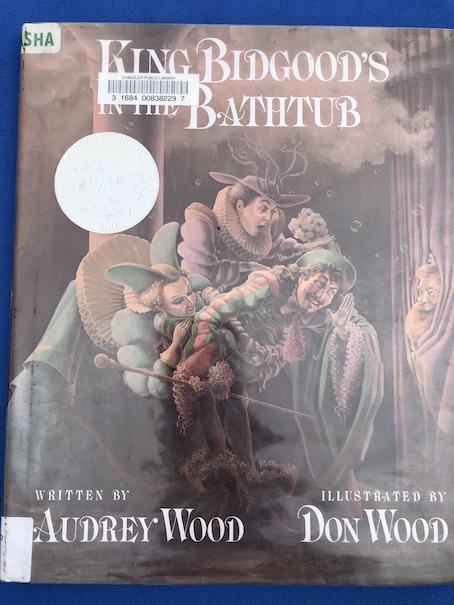
King Bidgood’s in the Bathtub

King Bidgood’s in the Bathtub by Audrey Wood, 1985.

King Bidgood loves being in his bath, but one day, he just doesn’t want to get out!  When the young page realizes that the king is refusing to leave the bath, he calls out to the courtiers, asking what to do about it.

One by one, they try to interest the king in other activities, but each time, he keeps inviting them to join him (fully clothed, although he apparently isn’t, just mostly hidden by bubbles) in order to prove that absolutely everything can be done in the bath.

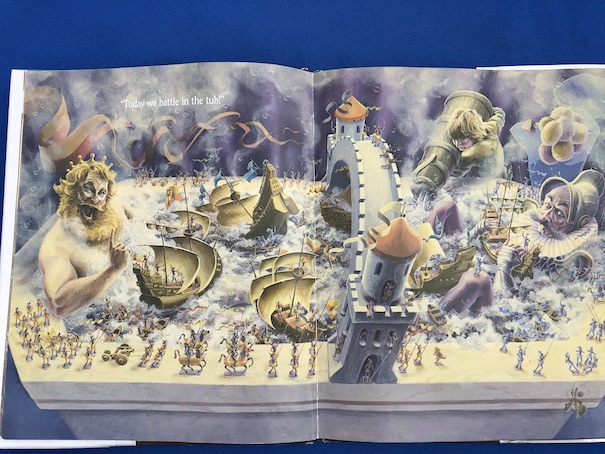
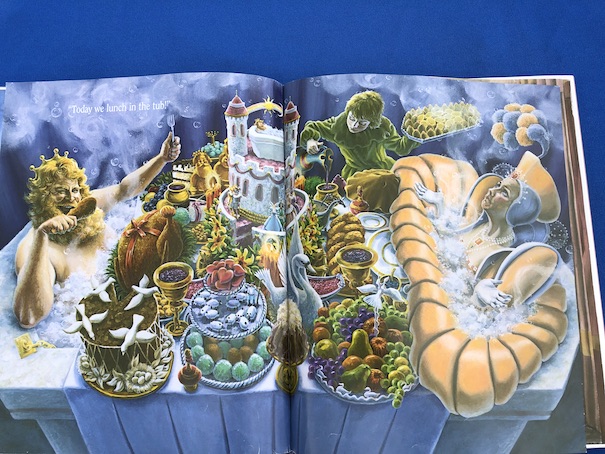
When the knight says it’s time for battle, they end up having a battle with toy ships in the tub.  When the queen tells him that it’s time to eat, they have a fancy feast right there in the tub.  The king’s activities eventually include a fishing trip and a dance.

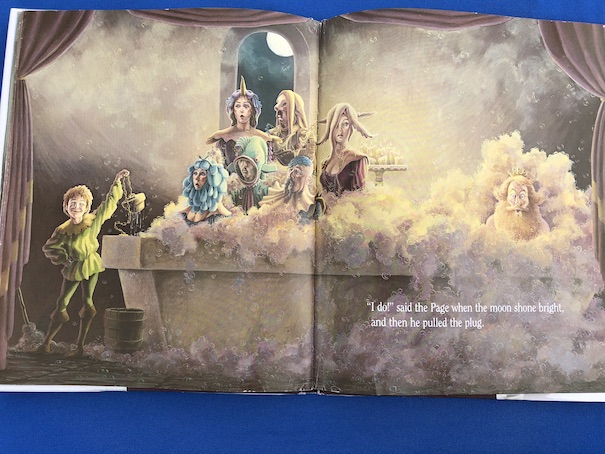
In the end, the page is the one who figures out how to put an end to this never-ending bath.

I love the pictures in this book, and the repetition as each person steps forward with a suggestion should appeal to young children.  This book is a Caldecott Honor Book. It is currently available online through Internet Archive.

Talking to Dragons

Talking to Dragons by Patricia C. Wrede, 1985.

This is both the fourth book in the Enchanted Forest Chronicles and the first book in the series that was written.  The author wrote this story before the others and then wrote the other three to explain how the characters got to this point.  The first three books in the series focus on Princess Cimorene and her adventures, but this book focuses on her son, Prince Daystar.

Partly because this series is kind of backwards, with the last book being the first written, I’m going to start with a spoiler.  When the book begins, Daystar is unaware that he is a prince and that his father is the king of the Enchanted Forest.  He grew up in an ordinary cottage on the edge of the forest, so he is accustomed to the presence of all kinds of fantasy creatures and fairy tale characters.  He thinks of himself and his mother as ordinary poor folk.  However, his mother has taught him not only reading and writing but other skills that are more unusual for peasants, like music, fighting, and even a little magic.

When Daystar is 16 years old, a wizard named Antorell comes to their house.  Daystar’s mother, Cimorene, seemed to know him, and he knows her.  Antorell demands “the sword” and the boy, and Cimorene casts a spell to melt him.  (“’No! Not again!’ he screamed.”  If you’ve read the other books, you already know why.  But, again, this book was written first.)

The next day, Cimorene gives Daystar a sword that he’s never seen before but which seems to draw him to it, and she starts giving him instructions.  The instructions are vague, but Cimorene insists that Daystar is to go into the Enchanted Forest and not to come back until he can explain why he had to go in there in the first place.  Also, he is not allowed to draw the sword from its scabbard unless he really needs to use it.  Cimorene says that she can’t explain more because it might “ruin everything.”  Not knowing what else to do, Daystar starts into the Enchanted Forest.  When he glances back, Cimorene and the cottage have suddenly disappeared.  Daystar has no idea why, but he has no choice but to keep going.

In the forest, Daystar meets a talking lizard called Suz, who claims to know everything about the Enchanted Forest and what goes on there (a tall claim, considering everything that goes on there).  When Daystar asked him if he knows anything about the mysterious, magical sword that his mother gave him, Suz tells him that it’s the Sword of the Sleeping King and that everyone has been looking for it.  Daystar knows nothing about it, which surprises Suz.  To Daystar’s surprise, both the sword and Daystar’s lack of knowledge agitate Suz, who says that he must get Kazul, who will know what to do.  Before he then runs off, leaving Daystar wondering who Kazul is, Suz tells him that he’s going to have to learn about the sword by himself because there are certain rules associated with magic, but that he should follow the sword to find out.

The next person Daystar meets is a red-haired girl who is stuck in a hedge.  She is surprised by how easily Daystar can get into the magical hedge, and at first, she thinks that he is a wizard.  She is relieved when she finds out that he’s not.  The girl, Shiara, tells Daystar that wizards have been chasing her because she burned the Head Wizard’s staff.  Most people could never accomplish that because wizards’ staffs are extremely powerful and have protective spells on them, but Shiara is a fire-witch.

As the two of them talk, Daystar learns that, while fire-witches are extremely rare and powerful come by their powers naturally, Shiara’s abilities are more unpredictable than most.  She has trouble casting spells on purpose, but when she gets mad, she can do some extremely powerful ones without really trying.  Fire-witches tend to have tempers, and Shiara is no exception.  Because of that, she doesn’t have many friends.  Most people are afraid to be around her because they never know when she’ll lose her temper and accidentally set things on fire.  Even worse, for Shiara, is knowing that most fire-witches are able to do very impressive spells and are almost invulnerable, but yet, she can’t even burn her way through a hedge when she tries it.  The wizards are very interested in her because most fire-witches are immune to their spells.  When they learned that she was a fire-witch who couldn’t cast her own spells, they tried to kidnap her in order to study her magic, which she how she ended up setting the Head Wizard’s staff on fire.

Daystar and Shiara finally get out of the magical hedge when Daystar suggests that Shiara try being polite to it instead of losing her temper.  Creatures and objects in the Enchanted Forest tend to respond well to politeness.  When they’re out of the hedge, a wizard shows up and tries to kidnap Shiara again, but Daystar defends her with his sword.  However, Daystar’s hand is injured when he tries to pick up the pieces of the wizard’s staff, and it explodes.

Daystar and Shiara seek help from Morwen, a witch who lives nearby.  It is from Morwen that Daystar begins to get a sense of what his sword is capable of doing.  He also meets up with Suz again, who tells him that he should go to the castle and that Kazul will meet him there.  Daystar still doesn’t know what he’s walking into, but missions in the Enchanted Forest can’t be ignored, and he has a mission to complete that everyone has been waiting for since before he was born.

By the end of the story, Daystar has learned what he needs to do to rescue his father, and Cimorene and Mendanbar are reunited.  Shiara ends up getting what she wants, partially, because she gains the ability to use her powers, but is forced to be polite in order to do so, which really irritates her.  She becomes Kazul’s new princess, where she will learn both the personal skills and magical skills she needs to control both herself and her ability.  Cimorene believes that Shiara will end up marrying Daystar eventually and becoming the next queen of the Enchanted Forest.  However, the series ends here, and the future is left to the imagination.  Morwen also decides to marry Telemain, a character from the previous books.

Like other books in this series, this book contains a lot of humor and parodies on popular fairy tales and fairy-tale creatures. Personally, I like the first two books in the series the best, but this one is also fun. There is a mild touch of romance to it, which is also nice.

The book is currently available online through Internet Archive.

There is one more story after this series, a short story in the collection Book of Enchantments that features Daystar and both of his parents but does not have Shiara.

Magician’s Ward

Magician’s Ward by Patricia C. Wrede, 1998.

This is the sequel to Mairelon the Magician.  When the book begins, it has been about a year since Kim and Mairelon’s previous adventures.  Kim has been living with Mairelon as his apprentice, and he has been teaching her both reading and magic.  (In the previous book, Kim was living on the streets of early 19th century London.  She did not know how to read, and at the end of the previous book, she learned that she had the ability to become a wizard, prompting Mairelon to take her on for training.)  Although Kim enjoys spending time with Mairelon and appreciates what he’s teaching her, other aspects of life with Mairelon’s wealthy family are less appealing.  Kim gets bored reading by herself while Mairelon continues his work with the Royal College of Wizards, and Mairelon’s aunt, Mrs. Lowe, is trying to turn Kim into a proper young lady.  The pressures of the social niceties and obligations wear on Kim, and even more worryingly, Mrs. Lowe has been considering Kim’s marriage prospects.

In order to be socially-acceptable, Mrs. Lowe thinks that Kim should be considering a socially-acceptable marriage for her future.  For most of her life, marriage was about the last thing on Kim’s mind.  She spent most of her youth pretending to be a boy in order to be safer on the streets.  Since she became Mairelon’s apprentice, the challenges of reading and magic have occupied most of her time.  When Mrs. Lowe brings up the subject of marriage, the idea seems ridiculous to Kim.  With her poor background, she can’t imagine what kind of “respectable” man would want to marry her, and she can’t imagine anyone among the upper-class people of London she would want to marry.  However, she sees Mrs. Lowe’s point that she won’t be able to stay Mairelon’s apprentice and ward forever.  At some point, she will need to decide what to do once her training with Mairelon is complete.  It’s a little worrying to her that Mairelon (known to most people by his real name, Richard Merrill) hasn’t discussed the future with her and doesn’t seem to be making any plans.

Then, one night, Kim overhears someone breaking into the library in their house.  At first, Kim can’t imagine what someone would want in the library.  She interrupts the thief, and he manages to escape.  After colliding with her in the hallway, the thief leaves behind one of his buttons and a small piece of wood that seems to be magic.  When Mairelon examines the wood, he says that it appears that someone stored a spell inside it temporarily, to be used by someone else.  Also, whoever put the spell together didn’t do a very good job and probably didn’t really know what they were doing.

As for what the thief was looking for in the library, Mairelon discovers that he was particularly looking through a collection of books that his father purchased years ago from a French wizard who had come to England after fleeing the French Revolution.  In particular, the thief seems to be trying to obtain the memory book that belonged to the wizard’s wife.  A memory book is exactly what it sounds like – a book that that keeper would carry around with him or her and use to record certain things that he or she would particular want to remember, a little like a journal but often containing bits of important instructions, like notes about favorite recipes or cold remedies (not necessarily the entire recipe, just general reminder notes) or, in the case of a wizard, notes about important spells.

As they investigate further, they learn that the wizard and his wife were part of a larger society of wizards in France before the Revolution and that someone has been trying acquire all of their old books and notes to learn the secret of one of their spells, specifically a spell for sharing magical power.  The person who wants this knowledge has a nefarious purpose for it, and when Mairelon tries to interfere with his plans, he uses the knowledge he has acquired to block Mairelon’s own magic!  This spell and its power-hungry master has already harmed other magicians, and now, Mairelon is in danger, too.

Meanwhile, Mairelon and his family have decided that, in order for Kim to truly be accepted in society, she must have a coming out party.  The mystery and intrigue of the story mix with Kim’s new lesson in dancing, fashion, and social etiquette and the unexpected attention that she receives from young men as she begins truly mingling with the upper classes of society.  Part of the mystery actually does involve the tensions between social classes, social mobility, and the extent to which birth and natural ability influence both.  As Kim discovers that she is more acceptable in society and desirable to at least some of the upper-class young men, she also finds herself becoming jealous of the attention that Mairelon receives from young women in search of a good husband.

Like the first Mairelon book, this one is a nice mixture of mystery, fantasy, history, and comedy of manners.  Both of the Mairelon books are a fun mixture of intrigue and humor, and this one also has a nice romantic element as Kim realizes that the only man she could ever see herself marrying is Mairelon.  He’s eccentric and sometimes aggravating, but she loves him, and he has loved her all along, from the time when she was just a thief in the marketplace to her beginnings as a wizard and her transformation into a young lady. The book ends with Kim and Mairelon engaged to be married, and I’m sorry to say that there are no more books in the series after that. I really wish that there were because I think that there’s a lot more room for character development.

The villain’s plot in this book hinges on the earlier established principle that wizards are born, not made.  Only certain people have the ability to use magic.  For some people, like Kim, the ability to use magic can lift them to higher positions in life, and it can be a source of real power.  For a person who is unable to use magic, there aren’t as many options.  The villain in this book thinks that he’s found a way around the problem, but as Mairelon guessed from the first, he doesn’t really know what he’s doing.

Even though this book has been a favorite of mine for years, I noticed something this time that hadn’t really occurred to me before.  Mairelon’s aunt and mother in the book look at fashion and social obligations in a similar manner to people in high society and the business and legal professions (categories that overlap) in modern society, whereas Mairelon, who is considered pretty eccentric for a man of his family’s social standing, and other wizards seem to look at fashion and social obligations more like modern day academics, engineers, computer programmers, and other tech experts (at least, the ones I know because those are the kind of circles I tend to move in).  Within each of these categories, some of these characters are more knowledgeable about fashion or more socially adroit or intuitive, but I noticed that there are two basic schools of thought going on here.  For the high society types, fashion is essential and social activities are their main focus in life because that is how they build their connections, make the best possible marriage matches, gain support from others, and generally move up the social scale, always aiming to do a little better that they did before or set the stage for their children to move up.  For the wizards and academic types, fashion and social obligations are of secondary importance because what makes the biggest difference in their lives is knowledge and skill.  They even say that wizards are always considered socially acceptable because of their abilities and professional standing.  Because of that, they’re socially allowed some eccentricities in personal habits and dress, and many of them take those liberties as much as possible because most of them are kind of socially introverted and prefer either the privacy of their own studies or the company of others who share their professions and interests. 

At first, Mairelon doesn’t do much about Kim’s social education because it is not a subject that’s important to him and he knows that she can go pretty far in the field of magic by putting most of her efforts into building her magical skills.  However, what Mairelon’s mother and aunt try to impress upon both Mairelon and Kim is that they both need some social skills in order to function in wider society.  This is kind of like how tech experts may have some great ideas for creating new software or a new form of online business, but in order to get their ideas off the ground, they have to have some business knowledge or connections.  Wizards may be allowed to be a little less social or more eccentric than other people, and it’s generally understood and expected, but they do much better if they learn to balance their preferences with society’s expectations.  Because the people who normally occupy high society love the latest fashions and attending prestigious social events, they can’t understand why other people don’t. As the story says, they would leap to the assumption that a wizard, who is always acceptable in society, would naturally want to participate in society, and if the wizard didn’t, it must be that they are either not really a wizard or at least not a good one.  In other words, they would assume that something was wrong with the person or their skills, not recognizing that their choices are simply a matter of personal taste.  In order for Kim and Mairelon to truly rise in their professions, they also have to learn to manage their social obligations.

In the book, Renee is an example of a character who has learned this type of social, professional, and personal balance.  She is a wizard, and as a single female, is regarded as something of an eccentric, but she understands that social skills are important.  She is a longtime friend of Mairelon’s, and she lectures him somewhat on his social obligations and acts as something of a big sister/fashion mentor to Kim, along with Mairelon’s female relatives.

The book is currently available online through Internet Archive.
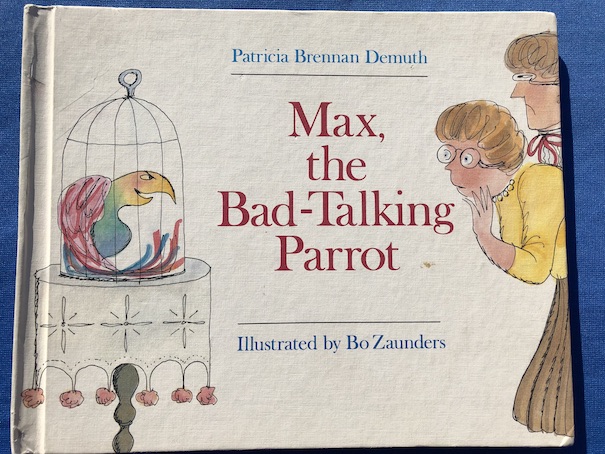
Max, the Bad-Talking Parrot

Max, the Bad-Talking Parrot by Patricia Brennan Demuth, illustrated by Bo Zaunders, 1986.

Don’t worry, Max’s “bad” talk isn’t really that bad.

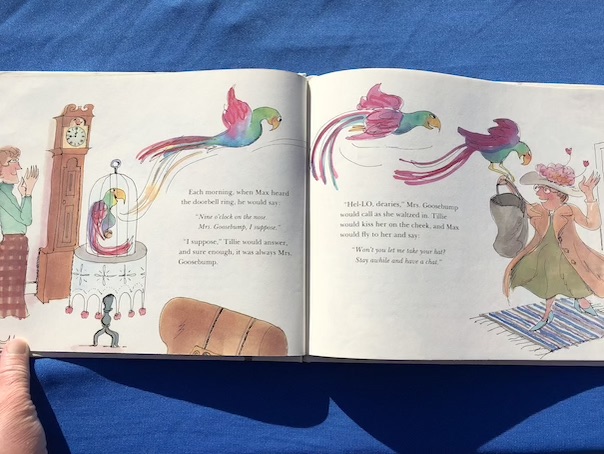
Max is a parrot who belongs to a woman named Tillie.  They live in a house that has been made into two apartments.  The woman who lives in the apartment above them is Mrs. Goosebump.  Mrs. Goosebump is Tillie’s friend, and Max likes her, too.

Because Mrs. Goosebump works the night shift in a toll booth, she always comes to see Tillie and Max in the morning, when her shift is over.  Max always greets her with one of his rhymes.  Everything Max says is a rhyme.

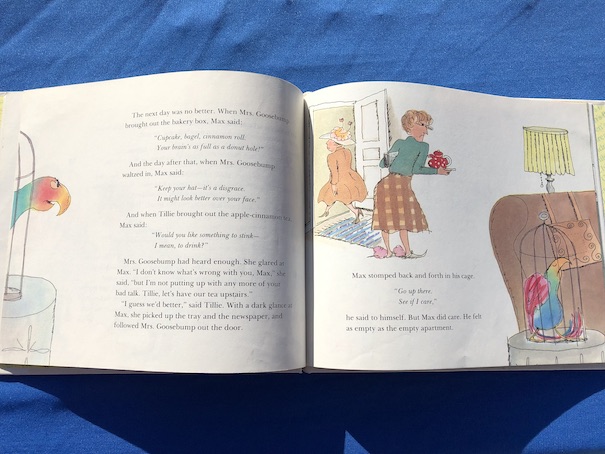
However, one day, as Max is dozing on Mrs. Goosebump’s shoulder during one of her visits, he thinks that he hears her calling him an ugly bird.  Max gets upset and returns to his cage, not ever saying goodbye to Mrs. Goosebump when she leaves.  He feels badly about the insult, and when Mrs. Goosebump visits later, he only gives her insulting rhymes, like, “Cupcake, bagel, cinnamon roll, Your brain’s as full as a donut hole!”

Mrs. Goosebump and Tillie have no idea why he’s so angry. The only thing that they can think to do is ignore him.

Later that night, a burglar breaks into Tillie’s apartment and starts stealing some of her things, including Max!  Max is scared, but by coincidence, the burglar stops to pay at Mrs. Goosebump’s tollbooth.  When Max recites some of his rhymes for her, she recognizes one of his usual rhymes and calls the police.

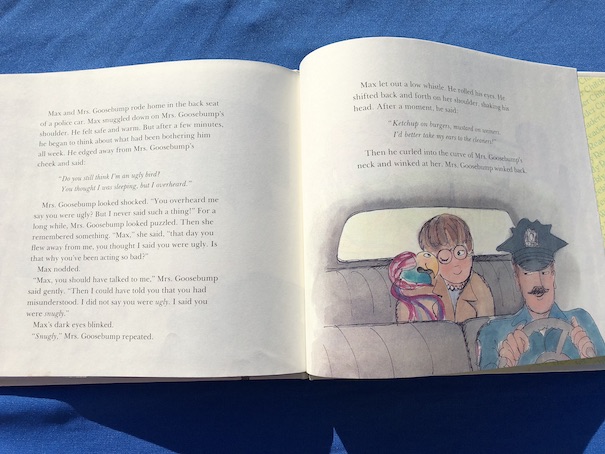
After Max is rescued, he finally tells Mrs. Goosebump why he was so angry, and Mrs. Goosebump explains that she actually said that he was “snugly”, not ugly.  With the misunderstanding cleared up, the two of them become friends again.  Max is also considered a hero for alerting Mrs. Goosebump about the robber.

When I was a kid, I thought that Max’s rhymes were funny, and the scene with the robber at the tollbooth is funny because Max tricks Mrs. Goosebump into believing that the burglar is insulting her before he says the rhyme that Mrs. Goosebump recognizes.  The book is also a good lesson about the importance of talking to people about what you’re feeling in order to clear up misunderstandings.

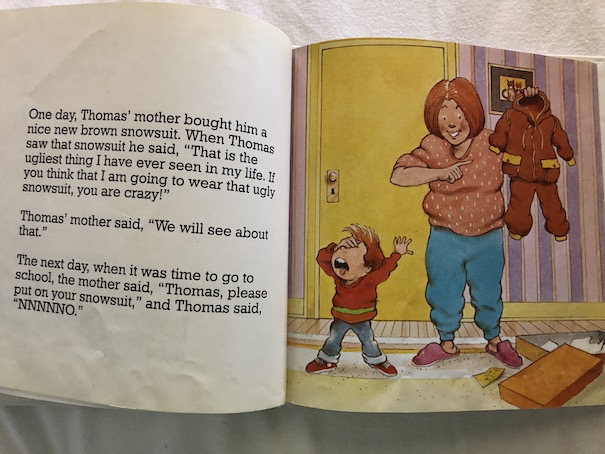
Thomas’ Snowsuit

ThomasSnowsuit

Thomas’ Snowsuit by Robert Munsch, 1985.

Thomas absolutely hates the new snowsuit that his mother bought him.  He thinks it’s ugly.  When it’s time for him to go to school, his mother has to wrestle him into it because he refuses to put it on himself.

ThomasSnowsuitNew

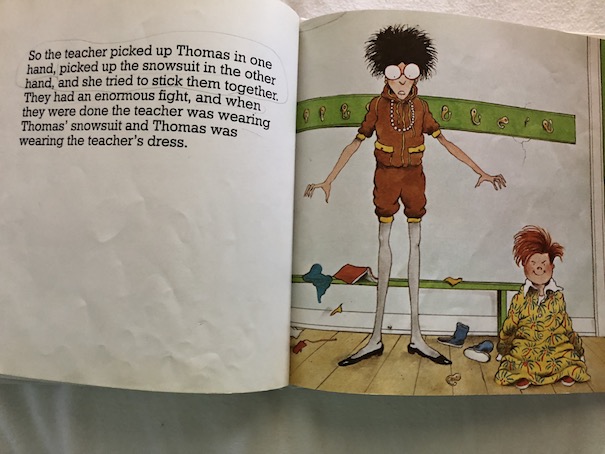
That’s fine until it’s time for Thomas to once again put on his snowsuit so he can go outside for recess.  His teacher insists that he has to wear it, but he refuses.  When the teacher tries to wrestle Thomas into his snowsuit, the results are hilarious!

ThomasSnowsuitTeacherSwitch

Thomas and his teacher end up getting their clothes all mixed up.  When the school’s principal tries to help, it only makes things worse.

ThomasSnowsuitTeacherPrincipalSwitch

Finally, Thomas is persuaded to put on his snowsuit when a friend of his wants him to come out and play.

ThomasSnowsuitFixed

Thomas eventually helps set the teacher and principal right again after recess, and the principal decides that it’s time to retire to Arizona, so he won’t have to deal with snowsuits again.

ThomasSnowsuitArizona

Like all Munsch books, the storyline is bizarre and hilarious, and half the fun is watching it unfold in the pictures!

The book is currently available online through Internet Archive.

Murmel, Murmel, Murmel

Murmel

Murmel, Murmel, Murmel by Robert Munsch, 1982.

Robin is playing in her backyard sandbox when she hears a “Murmel, Murmel, Murmel” sound from a hole that she has never seen before. In the hole, Robin finds a baby. Since Robin herself is only five years old, she decides that she needs to find someone older to take care of the baby.

Robin asks various people, but they all have reasons why they can’t take the baby. Then, Robin encounters a truck driver who is enchanted with the baby’s “Murmel, Murmel, Murmel” and says that he wants him.

The story never explains where the baby came from, how he ended up in Robin’s sandbox, or if his parents are looking for him, but apparently, he’s happy with the truck driver. As for the truck driver’s truck, he says that Robin can keep it because he already has seventeen others. Robert Munsch books are like this. That’s basically the explanation.

The book is currently available online through Internet Archive.
MurmelTruck

Something Good

SomethingGood

Something Good by Robert Munsch, 1990.

Tyya begs her father to buy “something good” at the grocery store. Tyya would much rather have him get something like ice cream and cookies instead of boring things like bread and eggs, which is what he usually gets.

However, when she tries to get whole cartloads of ice cream and candy bars, her father makes her put it all back. Tired of her messing around, Tyya’s frazzled father tells her to just stand in one place and not move. Unfortunately, he tells her that near a display of large dolls. Because she doesn’t move, a store employee mistakes Tyya for a doll and puts her on the shelf with the others, giving her a price tag of $29.95.

Some people try to buy Tyya, but she yells at them, scaring them away. Tyya’s father comes to get her, but he has trouble taking her out of the store because she still has a price tag on her, and the man at the register insists that her father has to pay for her.

In real life, no grocery store would try to sell a child, and it would be a crime if they did. However, because this is a Robert Munsch story (where all kinds of crazy things happen), Tyya’s father finally pays the $29.95 because she’s worth it, and Tyya says that her father finally bought something good at the grocery store.  Sort of touching, in an odd kind of way, I guess.

One of the benefits of this story is that it has a lot of potential for reading aloud because the reader can really play up the parts where the characters yell.

The book is currently available online through Internet Archive.
Moira’s Birthday

MoirasBirthday

Moira’s Birthday by Robert Munsch, 1987.

Moira wants to have a birthday party and to invite every kid in her school, from kindergarten to sixth grade. Her parents say that she can have only six party guests total, not six grades’ worth. However, so many kids at school want to come to her party that she ends up inviting the whole school anyway.

When every kid in school shows up on the day of the party, Moira’s parents are bowled over. There are so many kids that they hardly fit in the house. Moira calls up a pizza place, asking for an enormous amount of pizza, and a bakery, asking for an enormous amount of birthday cakes. The kids also help out by supplying their own food from home.

Naturally, Moira’s house is a mess, and her parents are upset, but Moira, seeing the enormous pile of birthday presents that everyone brought, promises a present to everyone who helps to clean up.

But, just when everything seems to have worked out all right, the trucks from the bakery and pizza place show up with the rest of Moira’s order.

The book is currently available online through Internet Archive.

The Dreadful Future of Blossom Culp

DreadfulFutureBlossomCulpThe Dreadful Future of Blossom Culp by Richard Peck, 1983.

This book is part of the Blossom Culp Series.

It’s 1914, and Blossom Culp is just starting high school. Although the principal of her old school tells her that this is a chance for her to make a fresh start, it looks like Blossom’s future is going to be very much a continuation of her immediate past.  In high school, she’s still a social outcast, looked down on by girls from better-off families, like Letty, the class president.  Also, despite her principal’s assertion that Blossom’s previous forays into the occult were imaginary, the product of the mental confusion that accompanies puberty, and that she is bound to grow out of them, Blossom knows that her psychic abilities are a natural gift and will not be ignored.

Blossom begins high school friendless because Alexander Armsworth has been ignoring her lately because of his important new position as class vice-president, his infatuation with Letty, and his friendship with a couple of local hooligans, Bub and Champ. Alexander is looking forward to his role in planning the school’s Halloween Festival, telling Blossom that he’s over their earlier, childish occult escapades and the Halloween pranks he used to pull.  Meanwhile, all of the other girls in school are infatuated with their handsome history teacher, Mr. Lacy, and so is the girls’ gym teacher, much to Blossom’s disgust.  Blossom thinks that Mr. Lacy is full of himself and denies that she has any such silly crush on Alexander.

Blossom makes an unexpected friend in a girl called Daisy-Rae, a girl from the country who has brought her younger brother into town to attend school and hoped to get an education herself but has been too afraid of the big town to actually attend classes.  Daisy-Rae hides in the school during the day and lives alone with her brother at night in the old chicken coop at the abandoned Leverette house.  It is through Daisy-Rae that she learns that Alexander and his friends aren’t so above childish pranks as they claim to be.  Blossom also discovers that Mr. Lacy has been romancing her old principal.  Mr. Lacy isn’t quite what he appears to be and has some unsavory secrets in his past.

Matters come to a head when Alexander (at Letty’s urging) tries to persuade Blossom to dress up and become the fortune teller for the haunted house that the freshmen class is doing for the Halloween Festival.  The haunted house is also a fundraiser, and Letty figures that they can get extra money from people if they’re willing to pay to have their fortunes told, and who would be better for the job than Blossom?  However, Blossom isn’t one to go out of her way to please others, especially Letty, and it turns out that they’re holding the haunted house in the Old Leverette place.  For some reason, that old house makes Blossom’s mother uneasy.  She seems to think that it’s haunted, but in an unusual way.  Blossom tells Alexander that she will not agree to be their fortune teller until he agrees to check out the house with her before Halloween and find out what’s wrong with it.  She figures that, since both of them are psychic, they can learn what’s so unusual.

As Blossom learns, her abilities don’t confine themselves to the past and people who have died but extend to the future and the people who haven’t yet been born.  Inside the Old Leverette house, Blossom suddenly finds herself entering the distant future, the 1980s.  In the 1980s, the Leverette house is once again lived in, and Blossom meets a boy named Jeremy who is a lonely social outcast, like herself.  Jeremy is a computer nerd, living with his divorced mother.  He takes Blossom on a tour of their town as it is in Blossom’s future, much larger than it used to be and with many familiar landmarks missing.  However, what Blossom sees in the future gives her the inspiration she needs to solve her problems in the past and hope that things will improve.  In return, she also proves to Jeremy that he is far from alone and has had a friend for longer than he ever imagined.

The time travel to the 1980s comes off as being a little corny (or so it seemed to me), but the writing quality of the book is excellent.  The author has an entertaining turn of phrase, and the book, like others in the series, is humorous and a lot of fun to read.

Besides being a kind of fantasy story, there are some interesting tidbits of history in the book, showing how people lived in the 1910s.  Blossom explains about the things she and her classmates did at school, like wearing beanies on their heads to show which year they were (freshmen, future graduating class of 1918).  At one point in the story, Blossom takes Daisy-Rae and her brother to their first movie, a silent film with an episode of The Perils of Pauline serial.  While Blossom worries about the future, readers can get a glimpse of the past!

As for what Blossom learns about her own future, she avoids finding out too much because she’d rather not know the details.  However, there are implications that she and Alexander may eventually marry and live in his family’s old house.

The book is currently available online through Internet Archive.
Tales of a Fourth Grade Nothing

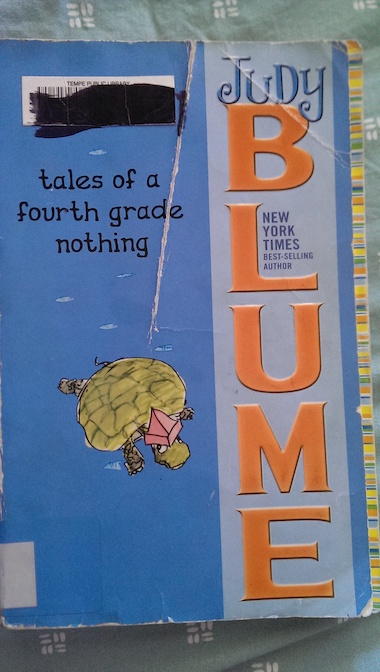
FourthGradeNothingTales of a Fourth Grade Nothing by Judy Blume, 1972.

Fourth-grader Peter Hatcher is being driven crazy by his younger brother, Farley, who everyone calls Fudge because he hates his name.  People think that two-year-old Fudge (he turns three during the book) is cute, and his mother sometimes spoils him or gives in to his tantrums.  To Peter, Fudge is a little terror, and he feels like his parents don’t care as much about him as they do about Fudge.

Most of the book is kind of like a series of short stories about Fudge’s antics which take place over the course of several months.

When Fudge goes through a phase of refusing to eat unless he gets to eat on the floor under the table, like a dog, their mother allows Fudge to get away with it, even patting him like a dog.  Peter thinks that his mother would be better to let Fudge not eat until he gets hungry, and Fudge’s doctor gives her the same advice, but his mother lets Fudge’s behavior continue until their father gets tired of it and dumps a bowl of cereal on Fudge’s head, declaring, “Eat it or wear it!”

Fudge sometimes gets Peter into trouble, too.  Peter’s mother takes them to the park along with Peter’s friend Jimmy and Sheila, a girl they know from school who also lives in the same apartment building as Peter.  Their mother has to run back to the apartment for a moment, so Sheila volunteers to baby-sit Fudge.  Mrs. Hatcher only allows it on the condition that Peter help her.  Of course, Sheila, who is a pest, decides to chase Peter and tease him about having cooties, so no one is watching Fudge until he falls off the playground equipment and knocks out a couple of teeth.  Peter can’t help but notice that he gets more of the blame for that from his mother than Sheila does, even though she was supposed to be the main baby-sitter.

Fudge’s third birthday party is a disaster, with other little kids as messy and troublesome as Fudge himself.  He gets into Peter’s room and messes things up, including a project Peter was working on for school.  For many of Fudge’s antics, Peter is able to laugh about them in the end, but there is frequently frustration at his mother’s inability to stop Fudge from doing some of the things he does or her willingness to put up with them and her seeming favoritism at times for the cute younger sibling.

Then, Fudge does the worst thing he could possibly do and eats Peter’s pet turtle, Dribble, the one he won at his friend Jimmy’s birthday party.  Peter loved Dribble, talking to him throughout the book when he didn’t want to talk to his parents, and while everyone else is concerned for Fudge’s health and giving him presents for getting better, Peter is angry that his pet is now dead and no one seems to care about him . . . or about Peter himself.  Or so Peter thinks.

There is one more present from Peter’s parents and grandmother: a pet that Fudge would never be able to eat, and it’s for Peter alone.

Peter’s parents do care about him, even though they can get so caught up in Fudge’s antics and rescuing Fudge from them that it can be difficult to show it.  Most of the time, Peter is able to laugh with his parents at Fudge’s antics, which are pretty funny, but once in awhile, he also needs them to understand how the things that Fudge does affect him, too.

Reading it again as an adult, I sometimes find myself getting a little annoyed with the mother in the story.  Being a mother of a young child isn’t easy, but Mrs. Hatcher does take out her frustrations on Peter (something she even admits to at one point when he confronts her about blaming him for Fudge’s playground accident and she apologizes), and I take issue with some of her priorities and assumptions about Fudge’s behavior.  Sometimes, it seems like she doesn’t know her own child as well as his brother does and she doesn’t take take pragmatic steps in dealing with him and preventing problems before they start.  At times, I found myself thinking, “She’s making a mistake here.  Does she really not see this coming?”  Admittedly, I’ve read the book before, so I have an advantage, but putting a three-year-old into a suit he hates for his birthday party with other three-year-olds?  Seriously?  Suits are things adults are interested in, not three-year-olds, and many adults try to avoid wearing formal wear whenever they can.  She was trying to dress him up like a doll, not a real small child, and it was more for her sake than for his.  Sometimes, Mrs. Hatcher is reluctant to punish Fudge (admittedly, he is pretty young for most punishments), although she does spank him once when he ruins Peter’s school project, showing that she can stand up to him when it’s important.

Possibly, Peter was a different, calmer child when he was young, and Mrs. Hatcher sometimes expects Fudge to be the same way when he isn’t.  That might also explain the episode when Mr. Hatcher invites a business associate to stay with them for awhile, not considering that not everyone is used to putting up with a young child and some of the chaos that goes with it.

The age difference between Peter and Fudge is also important to the story.  Fudge looks up to Peter and wants to do a lot of the things he can do and have things like the stuff Peter has.  Having two kids with very different ages also makes family life a little harder because the children are in different phases of life and have different needs and interests.