The Day Jimmy’s Boa Ate the Wash

JimmysBoa

The Day Jimmy’s Boa Ate the Wash by Trinka Hakes Noble, pictures by Steven Kellogg, 1980.

The fun thing about this story is the backward way that the girl begins telling it, somewhat resembling The House that Jack Built, or better yet, the old No News Joke. The joke is really closer to the format of the story, with someone explaining the least eventful thing that happened as though it were the most important when it was just the end result of everything else.

A young girl (unnamed) arrives home, and her mother asks her how she liked her class trip to a farm that day. She says that it was boring until the cow started crying. When the mother asks her why the cow was crying, she says that the farmer wasn’t paying attention to where he was driving his tractor and knocked a haystack over on the cow.

As the mother continues to ask her daughter questions about what happened, backtracking through events, the real story begins to reveal itself:

The girl’s friend, Jimmy, had a pet boa constrictor, and he brought it along on the field trip so it could meet all the farm animals.
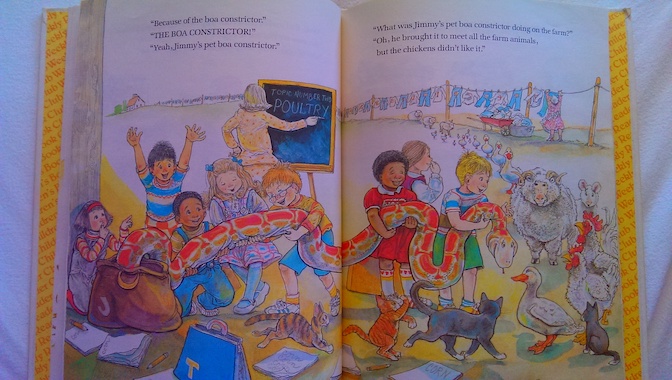
JimmysBoaFieldTrip

However, the chickens became frightened, and one of them laid an egg on one of their classmates. She thought that someone else threw it at her, so she threw another egg at him, which hit yet another student.
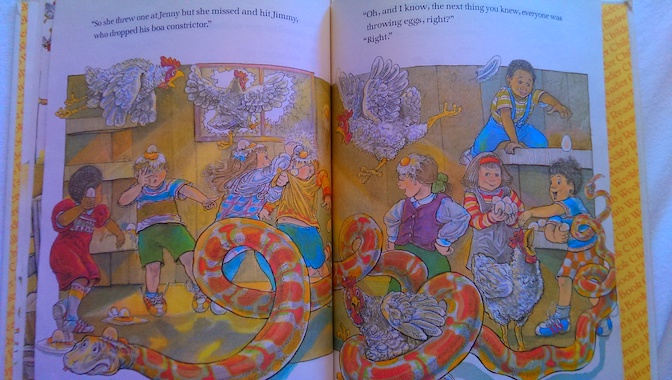
JimmysBoaEggs

From there, it turned into one big food fight, with students throwing eggs at each other, and when they ran out of eggs, they threw corn at each other. The corn was for the pigs to eat, so the pigs wandered onto the school bus and started eating the children’s lunches. From there, chaos ensued until the farmer’s wife suddenly screamed, and the children’s teacher hustled the children onto the school bus to go home.
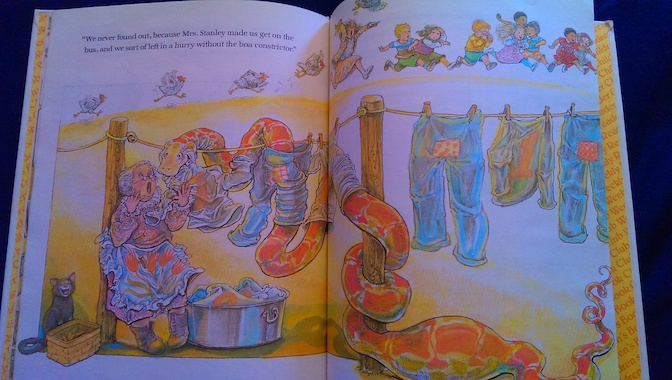
JimmyBoaLeaving

The children never knew exactly why the farmer’s wife screamed (although the reason is actually in the title to the book), but two things quickly became evident: Jimmy accidentally left his boa constrictor behind on the farm, but he has acquired a pet pig because there was still one left on the bus.

This summary doesn’t quite do the story justice because the backwards way the story starts out is part of the fun. The pictures in the book are hilarious, and the boa constrictor is shown at the end to have become a beloved pet of the farmer and his wife, even making friends with the chickens.

This is a Reading Rainbow Book.  It is currently available online through Internet Archive.

Imogene’s Antlers

ImogenesAntlers

Imogene’s Antlers by David Small, 1985.

One day, a young girl named Imogene wakes up to find that she has sprouted antlers during the night. It comes as a shock to the rest of her family, and she finds that it’s very difficult to do things with large antlers sticking out of her head.

No one seems to know why Imogene has sprouted antlers or what to do about them. Imogene’s mother faints just about every time she looks at her daughter, and her attempt to help Imogene hide them with a specially-designed hat is pure disaster. Imogene’s brother, Norman, thinks that Imogene might be a rare kind of elk now.

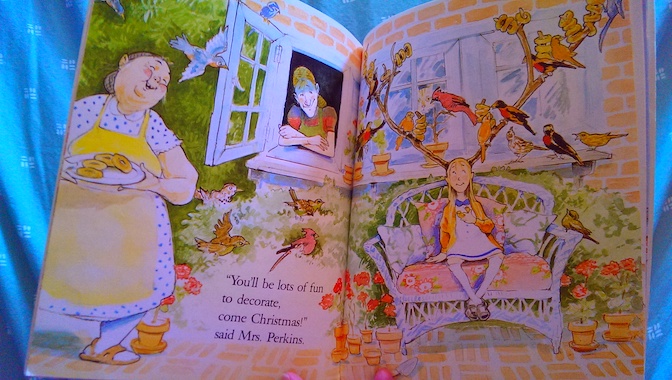
However, Imogene still has a lovely day as the family maid uses her as a rack to dry towels and the cook decks out her antlers with donuts to feed the birds.  She even puts candles on her antlers as an elaborate candelabra while she practices her piano lesson.

ImogenesAntlersDonuts

Still, it’s a most bizarre day, and her family is relieved when the antlers are gone the following morning.  But, Imogene’s adventures may only be just beginning.

The book never offers an explanation for why Imogene grew antlers or why she now has a peacock tail, but it doesn’t really matter. This is just one of those books that’s fun to read because it’s silly. While Imogene’s mother panics over her daughter’s condition and tries to hide it under a ridiculously big hat at one point, readers don’t have to worry about the long-term implications of Imogene’s antlers (or any other animal transformations) because she just enjoys them for what they are. The peacock feathers may not have as many practical uses as the antlers did, but one can imagine that Imogene will make the most of them while she has them.  I loved this book when I was a kid!

This book was featured on Reading Rainbow.  It is currently available online through Internet Archive.

The Pizza Monster

Olivia Sharp, Agent for Secrets

OSPizzaMonster

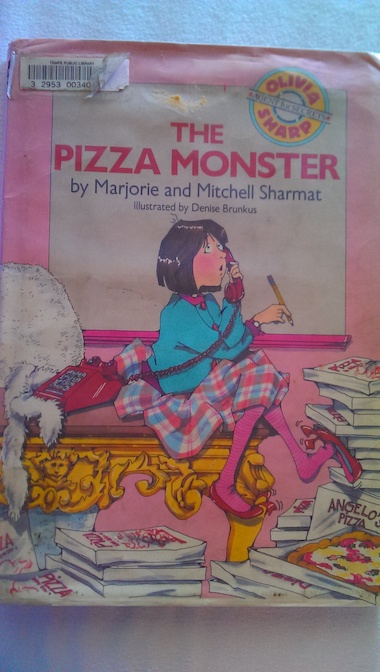
The Pizza Monster by Marjorie Weinman Sharmat and Mitchell Sharmat, 1989.

Olivia lives in a penthouse in San Francisco with her chauffer, Willie, and her housekeeper, Mrs. Fridgeflake. Her wealthy parents live there, too, but they are often traveling and are rarely home. When her best friend, Taffy, moves away, Olivia is lonely. She buys herself a pet owl named Hoot, but that still doesn’t completely help.  She needs something to help keep herself busy. Olivia realizes that she is good at keeping secrets and at helping people with their problems, so she decides to busy herself running a service to help people with their secret problems. She has a bunch of flyers made and hangs them up around town saying that she is an agent for secrets and will help people.

A boy named Duncan, who Olivia knows from school, asks her to help him with his friend, Desiree. He says that they were together at the pizza parlor when she suddenly got angry and walked out.  He doesn’t know what made her angry, but he asks Olivia to help him find out and fix their relationship.

Olivia’s attempts to help are a matter of trial and error. At first, Olivia thinks that Desiree was merely offended that Duncan gave her the smallest slice of pizza. She suggests that Duncan buy her another whole pizza, but that doesn’t work. Even Olivia’s idea to buy her a lot of different kinds of pizza doesn’t work. Eventually, Olivia talks to Desiree herself and learns that there is another reason why she is angry with Duncan.

It turns out that the problem doesn’t have anything to do with pizza but with Duncan himself.  He’s always full of doom and gloom and criticism for everything.  What Duncan needs is an attitude adjustment.  He doesn’t realize that his pessimism and negativity makes it difficult for others to be around him.  Olivia encourages him to be more positive and to develop his sense of humor.  Once his attitude improves, so does his relationship with Desiree.

The Plant That Ate Dirty Socks

PlantDirtySocksThe Plant That Ate Dirty Socks by Nancy McArthur, 1988.

Michael and his younger brother, Norman, share a room, but it’s not a peaceful arrangement.  Norman is a neat freak, and Michael likes things messy.  Michael’s always saving random things that might turn out to be useful later, although how useful they are is questionable because it’s hard to even find anything in his pile of junk.  Michael also likes sending away for random things in the mail, like toys that require him to save a certain number of box tops.  Often, by the time these things arrive, he’s forgotten what he sent away for.

One day, Michael gets a couple of seeds in the mail that he doesn’t remember sending away for.  He plants one himself and gives one to his brother to plant.  The seeds come with a set of instructions, but Michael soon loses them, and the boys are left to care for their plants themselves.  Norman is very regular in his habits, watering his plant daily with his squirt gun and giving it the proper amount of plant food.  Michael is more experimental, dumping plant food on his plant haphazardly and even giving it bits of human food from time to time.  The boys have fun with their plants, treating them like pets, but soon, it becomes obvious that these aren’t normal plants.

It starts when socks start disappearing from Michael’s half of the room.  With Michael’s messiness, he often has to dig out his dirty socks from the rest of his stuff, but even after Michael cleans up his room, he still can’t find all of his socks.  The boys suspect that someone is stealing them, so they try to sit up at night (disguised as a robot and a gorilla, as if that would help) to find out who the thief is.  That’s how Michael discovers that his plant is actually eating his socks.  They try an experiment and discover that Norman’s plant also eats socks, except that Norman’s plant prefers clean socks, and Michael’s plant only eats the dirty ones.

When the boys demonstrate to their parents that the plants are eating socks, their mother wants them to get rid of the plants immediately, but the boys plead for their pet plants (which they name Fluffy and Stanley).  Michael promises to keep his half of the room neat from now on to keep his plant from eating anything it shouldn’t and proves that keeping plants for pets, even ones that eat socks, would be less expensive than keeping a dog or a cat, especially if they only buy cheap socks.  Reluctantly, their mother agrees to let them keep the plants, but their father forbids them to tell anyone about them because everyone will think they’re crazy.

However, with people at the store wondering why they’re buying so many socks, Michael’s friend Jason spending the night, and the upcoming science fair, for which Michael still needs a project, can Michael keep their weird plants a secret?  Does he even want to?

One of the things that I remembered from reading this book as a kid was the part where they invent Fudge Ripple Pancakes.  It starts because they were making up code words to use when talking about their plants, and someone overhears them saying “Fudge Ripple Pancakes,” so they have to make up a recipe to go with it.  The recipe isn’t exactly included in the book, but basically, it involves adding chocolate syrup to regular pancake mix.  The boys try it themselves and decide they like them.  Norman has a large squirt gun, kind of like a Super Soaker (but called by a different name), and he uses it to both water his plants and squirt syrup on his pancakes.

This is the first book in a series.

Mrs. Armitage, Queen of the Road

ArmitageRoad

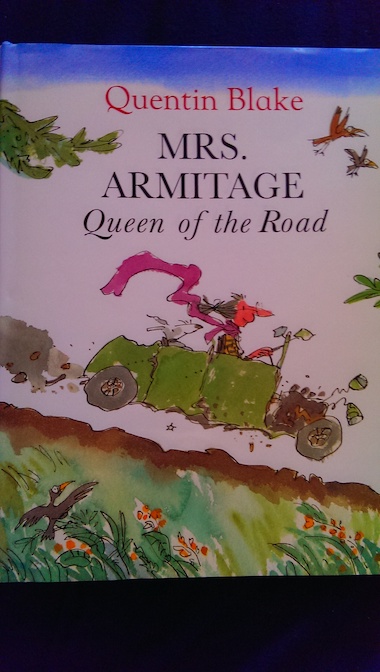
Mrs. Armitage, Queen of the Road by Quentin Blake, 2003.

When Mrs. Armitage‘s Uncle Cosmo decides to get a new motorcycle, he lets her have his old car.  However, it isn’t in very good condition.

ArmitageRoadCar

Mrs. Armitage and Breakspear decide to try it out, but as they drive along, pieces of the car fall off.  Some of it is because the car is in bad repair, and some is due to accidents Mrs. Armitage has.  First, the hubcabs, then the fenders fall off.  Mrs. Armitage shrugs it off , saying, “Who needs them?”

ArmitageRoadHubcaps

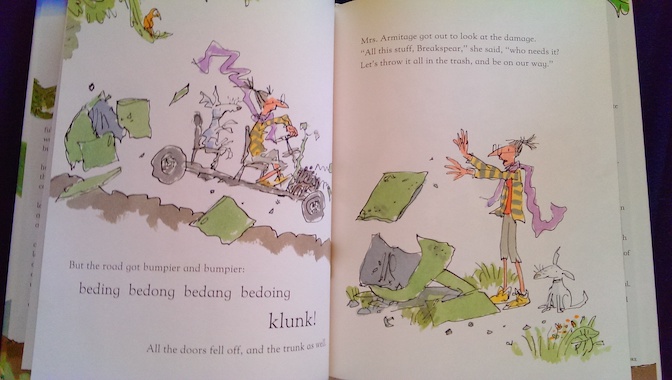
Eventually, the car goes almost entirely to pieces, but who needs it all?

ArmitageRoadWreck

When Uncle Cosmo shows up with his friends and their motorcycles, they help her fix up what’s left of the car into one amazing machine!

The book is available to borrow and read for free online through Internet Archive (multiple copies, including one in Spanish).

ArmitageRoadMachine

Mrs. Armitage and the Big Wave

ArmitageWave

Mrs. Armitage and the Big Wave by Quentin Blake, 1997.

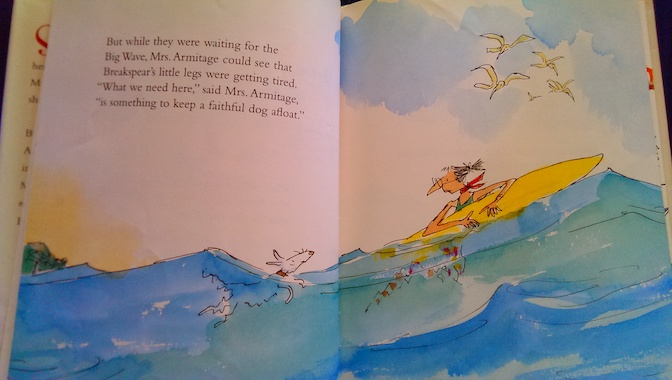
Mrs. Armitage goes the beach with Breakspear in order to go surfing.  She explains to Breakspear that they have to swim out and wait for the “Big Wave.”  But, waiting takes longer that Mrs. Armitage expected, and soon Breakspear is tired, and they’re both hot.

ArmitageWaveDogTired

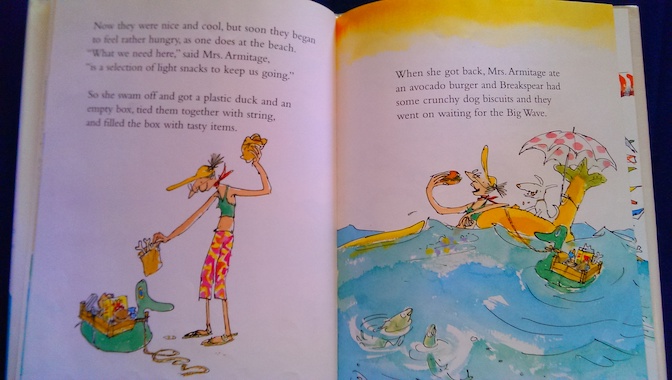
Of course, Mrs. Armitage finds a solution for everything.  With an inflatable toy for Breakspear to ride on and some protective gear, they wait some more.  Needless to say, Mrs. Armitage doesn’t stop there.  As they wait for the perfect wave, there are plenty of other things that they need to keep themselves busy and make themselves more comfortable.

ArmitageWaveFloaties

When the Big Wave finally comes, Mrs. Armitage not only makes an incredible show, but she also has what she needs to save a little girl who swam out too far and needed to be rescued.

The book is available to borrow and read for free online through Internet Archive (multiple copies, including one in Spanish).

ArmitageWaveRescue

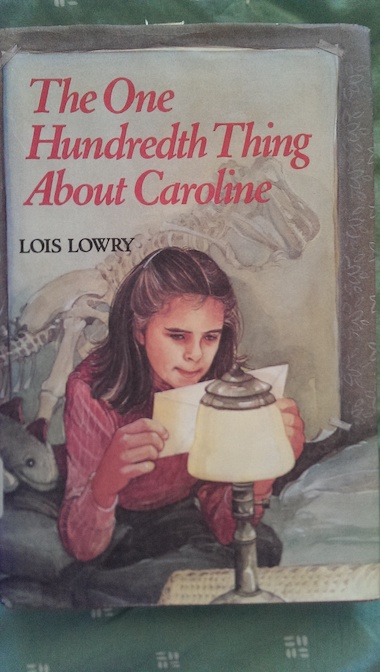
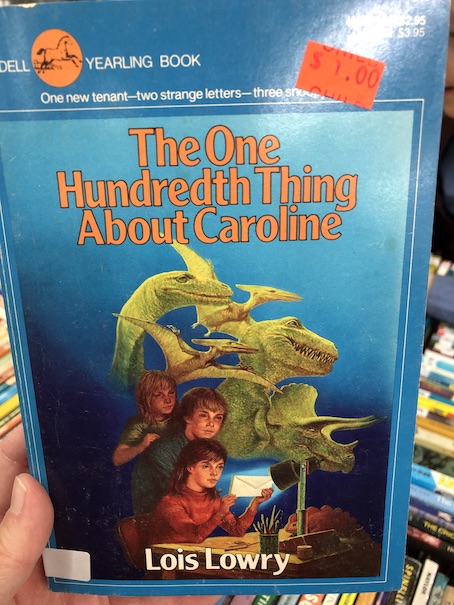
The One Hundredth Thing About Caroline

The One Hundredth Thing About Caroline

The One Hundredth Thing About Caroline by Lois Lowry, 1983.

Eleven-year-old Caroline Tate knows that she wants to be a paleontologist when she grows up, but she is also fascinated with her friend Stacy’s dream of becoming a great investigative reporter. For fun, the two girls begin investigating the people who live in their respective apartment buildings.

Caroline’s investigation focuses on the mysterious Frederick Fiske, who lives on the fifth floor of her building. In a wastebasket, she finds a letter written to him by a man she’s never heard of telling him to “eliminate the kids.” Also in the wastebasket, there is an overdue notice for Fiske from the library, and the book is about poisons. From this evidence, Caroline comes to believe that the strange Mr. Fiske is planning to murder some children.

The situation becomes worse when Mr. Fiske begins dating her divorced mother, and Caroline fears that the children Mr. Fiske is planning to murder are her and her brother, J.P.. Can Caroline, J.P., and Stacy prove that Mr. Fiske is a cold-blooded murderer before his relationship with the Caroline’s mother can go any further and before he succeeds in poisoning them?

The book is available to borrow and read for free online through Internet Archive.

My Reaction and Spoilers:

It’s a bit of a spoiler, but this is one of those stories where the mystery is largely based on a series of misunderstandings. The book is a comedy mystery.  Mr. Fiske isn’t really a murderer, although he has done some things which make the children suspicious.  It’s a humorous story, and the kids’ antics as they try to further their investigation and collect “evidence” against Mr. Fiske are hilarious.  Along the way, the kids end up helping Mr. Fiske with a problem he’s been having, and the kids realize that they’ve made a mistake about him and his intentions.  Whether Mr. Fiske learns of their suspicions about him or not is left to the imagination, although something at the very end of the story may bring everything out into the open.

The title of the book comes from a joke between Caroline and her mother.  Caroline’s mother is always talking about the things she loves about Caroline, giving them different numbers.

Good Work, Amelia Bedelia

Good Work Amelia Bedelia

Good Work, Amelia Bedelia by Peggy Parish, 1976.

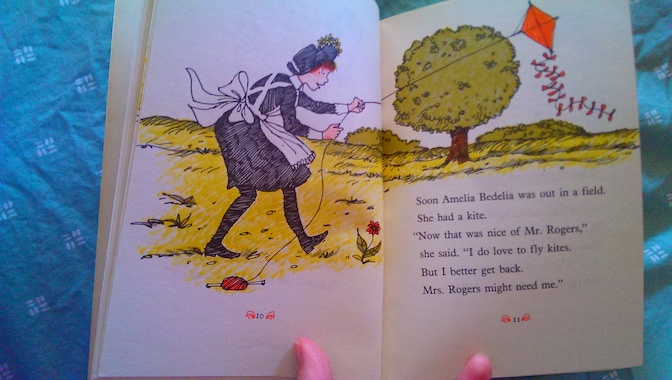
Amelia Bedelia works as a maid/housekeeper for Mr. and Mrs. Rogers. They like her, but they have to be extremely careful about the orders and instructions that they give her because Amelia Bedelia takes everything literally. For example, when Mr. Rogers asks her for toast and an egg for breakfast, she gives him a raw egg straight out of the refrigerator because he never told her to cook it. Telling her to “go fly a kite” is also pointless because she’ll simply go to the park and do it.

Good Work Amelia Bedelia Fly a Kite

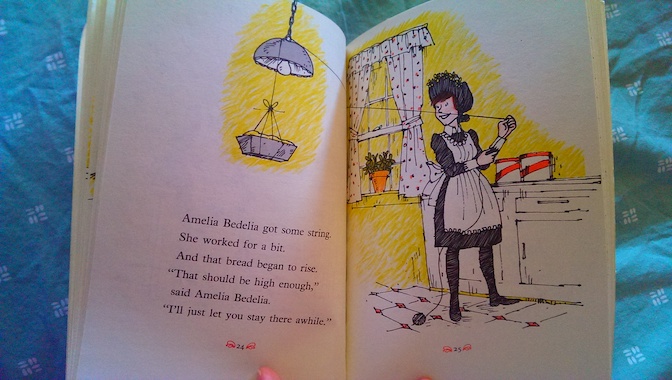
Possibly the most dangerous thing Mr. and Mrs. Rogers can do is leave Amelia Bedelia alone in the house with a “to do” list. Unsupervised, she reads each item on the list and does her best to obey all of the instructions to the letter. From putting plants in pots from the kitchen to making sure that the bread rises by hanging it from a string to making a “sponge cake” that includes actual sponge, Amelia Bedelia muddles her way through, getting everything wrong while still being technically correct.

Good Work Amelia Bedelia Bread Rises

Good Work Amelia Bedelia Sponge Cake

So, why do Mr. and Mrs. Rogers put up with her? Well, for one thing, she makes a terrific butterscotch cake.

The book is currently available online through Internet Archive.

Good Work Amelia Bedelia Butterscotch Cake.jpg

The Secret Life of the Underwear Champ

UnderwearChampThe Secret Life of the Underwear Champ by Betty Miles, 1981.

Ten-year-old Larry lives in Connecticut, but one day, while he and his mother are visiting his dentist in New York City, he gets spotted by the Zigmunds.  The Zigmunds own a modeling agency, and they think that Larry will be perfect for a series of tv ads.  At first, Larry is kind of excited about the idea of being on tv and earning extra money (maybe enough to get a new ten-speed bike!) until he realizes what he’s going to be advertising: underwear.

The Zigmunds like Larry because he’s a clean-cut, athletic kid who likes to play baseball, and the advertisements are supposed to feature a family playing sports together . . . in their underwear.  Larry also happens to have red hair, just like the girl already picked to play his sister in the commercials, Suzanne.  Suzanne has been in advertisements many times before, and the idea of advertising underwear doesn’t bother her at all.  The underwear kind of looks like athletic clothes and isn’t really revealing, but it’s still underwear.  Larry goes from feeling proud of his new tv advertising career to hoping that no one at school ever finds out about it.  But, how can Larry even hope for that when his underwear-clad form is going to be displayed on everyone’s tv set?

UnderwearChampPic1Now, Larry is wondering what he’s gotten himself into.  He worries about his filming schedule conflicting with baseball practice and makes up excuses about needing to visit the dentist when he has to film a commercial.  Money or no money, Larry just wishes that his life would return to normal!

After the filming is over, Larry starts to feel better about what he’s accomplished.  He and Suzanne have become friends (and she may possibly be his first girlfriend), and learning about the world of advertising was kind of fun.  But when the commercial actually makes it to tv, and Larry tells his best friend Robert about it, the dreaded teasing starts.

In some ways, Larry’s fears about teasing don’t turn out to be as bad as he fears, although it seems like it at first.  Robert laughs at him when he sees the first commercial and realizes why Larry’s been sneaking around and making excuses, but Larry tells him off for being mean and challenges him to think how he feels about it all.  Robert feels a little bad about laughing but says that he can’t help it and that other kids at school will react the same way.  He’s partly right, but he does help to put a stop to it, and the other kids do calm down.  Larry even enjoys some minor fame because he’s the only one of the kids to have been on tv at all.

There’s a lot of humor in the story, but it’s also surprisingly thoughtful as Larry considers why people find the idea of seeing someone in their underwear so funny.  After all, everyone wears underwear of some kind, even the President of the United States.  It’s a normal part of everyone’s wardrobe and a common part of everyday life.  The other people in the ad don’t act self-conscious while they’re being filmed in their underwear because it’s just part of their job, another part of daily life.  The book doesn’t mention sex, although the “mother” of the family in the ads gets a few whistles when she’s in her underwear, and Larry acknowledges that he and Robert sometimes giggle over advertisements with girls in their underwear.  Larry’s main conclusion is that people laugh about underwear because that’s just not how people normally see each other, so it seems weird.  After everyone has seen the commercial with Larry many times, people get used to the idea and it doesn’t seem so weird, so they get over the “funny” part and stop laughing.  Eventually, the other kids at school stop thinking so much about the underwear and just think it’s kind of cool that Larry was in a commercial.

The book is currently available online through Internet Archive.

The Best School Year Ever

BestSchoolYearThe Best School Year Every by Barbara Robinson, 1994.

This year at school, Beth’s teacher has assigned everyone a year-long project to think about good points about their classmates, but it’s difficult when one of your classmates is Imogene Herdman.  The Herdmans are generally awful.  They lie, steal, set things on fire, bully other kids, and have been kicked out of almost every building in town for one reason or another.

Mr. Herdman deserted the family years ago, and Mrs. Herdman works long hours at the shoe factory, so the six awful Herman kids are left to do pretty much anything they want most of the time, even if what they want to do is to walk off with Louella’s baby brother Howard and draw pictures on his bald little head and charge other kids a quarter to see the amazing “tattooed baby” like some kind of sideshow freak.  It’s difficult for the adults in town to tell them off because they never listen or punish them because no punishment ever seems to stick.  Mostly, when the Herdmans are around, the adults seem to focus on damage control.

So, Beth struggles to find anything good to say about awful Imogene, the oldest girl in an awful family, but throughout the school year, Beth does begin to notice that Imogene does have other sides to her personality.  The book is more of a collection of short stories about the Herdmans’ various antics and escapades and Imogene’s role in them than one single story as Beth thinks about the things Imogene does.  Imogene can’t really be called “nice,” and she definitely causes her share of chaos, but she does have occasional moments when she’s helpful or does something in the name of justice, like giving her old blanket to Louella’s little brother to replace the one he lost so he wouldn’t be sad.

Some of Beth’s compliments to Imogene at the end are somewhat generic because Beth struggles to get around some of Imogene’s genuinely awful behavior, but when she considers what Imogene’s best trait is, she finds something that really captures Imogene’s spirit, a quality that Imogene genuinely admires and may lead her on to better things in her life.

This is the second book in The Herdmans Series.  The books are funny because of the chaos that the Herdmans cause wherever they go, although you can’t help but feel a little sorry for them at times, too.  It’s part of that awful dilemma when you think that someone deserves a good spanking for what they’ve done but, at the same time, you see that it wasn’t entirely their fault.  While the Herdmans are responsible for the things they do, they’re also victims of neglect.  Their parents aren’t really raising them, and the other adults have mostly given up on them.  They do what they do because they can and because no one is there to make sure that they’re doing the right thing.  No one even really expects them to do the right thing, so if they do something right, it’s completely up to them.

Beth’s observations about Imogene show that there is hope for her.  Imogene has some good traits as well as bad ones, and occasionally, she does do good deeds as well as bad.  Beth realizes that Imogene could do some great things in her life because of her resourcefulness (a quality that Imogene likes when Beth points out that she has it), but she realizes that what Imogene eventually turns out to be is still in her hands, whether she uses her abilities to rob banks or run for President.  Adults will know that Imogene’s reality is likely to be something in the middle, but the point is that Imogene has more good points than it appears at first and more possibilities in her life than just being a trouble-making Herdman.

As in the first book in the series, there is also something of a contrast between Imogene and Beth’s friend Alice.  Alice is the perfect child (at least in her mother’s eyes, and her mother lets everyone know it), but she is also often shallow, bragging up her looks, talents, and perfect behavior to get attention and feel important (which is what Beth thinks is really the best compliment to give Alice because it’s the one she would most value).  When Alice is nice, it’s not so much because she is a nice person as she likes the praise she gets for doing it.  Really, neither Alice nor Imogene are especially nice; they’re just not nice in different ways and for different reasons (although both have good points, too, which is the point of the story).  When Alice gets a compliment, she sees it as merely her due for her perfection, but for Imogene, compliments come as a surprise because she doesn’t hear them much and she knows that she is far from perfect.

The book is currently available online through Internet Archive (multiple copies, actually).