The Codebreaker Kids

CodebreakerKidsThe Codebreaker Kids by George Edward Stanley, 1987.

Dinky Lakewood likes living in Washington, D.C. because it’s such an interesting place, and he loves the stories about spies and government intrigue that appear in the local newspaper.  His father, who deals in plumbing supplies, thinks that all this sneaking and spying is awful and threatens to move his family somewhere else when he hears about another spy being caught, but Dinky decides that he’s going to get in on the action because he has a special skill that the spies really need.

The newspapers say that the reason why the latest spy was caught was because he and his associates were so bad at cryptology — they either picked codes that were way too hard or way too easy to decode.  Although Dinky’s parents don’t like spies, they did give him a book about secret codes for his birthday: The Complete and Total Book of All the Secret Codes That Have Ever Been Devised and That Ever Will Be Devised.  Dinky has worked his way through all of the codes in the book, so he feels qualified to open his own Secret Code Service, helping spies to encode and decode their secret messages.

Dinky recruits his best friend Wong and a girl he knows from school named Lulu to be part of his organization.  Lulu is a little strange, but Dinky knows that she’s always wanted to be a spy, so he figures that she would be good for dealing with real spies.  Wong is more interested in the money because he wants to get a new bike.

Their first clients are a little strange.  One of them is an elderly lady, Emma, who wants to stop her younger sister from snooping in her diary.  She turns out to be a repeat visitor because her sister turns out to have a talent for breaking codes.  The next client is Boris, the world’s worst Bulgarian spy.  He admits that he’s horrible with codes because he cheated at spy school, copying off of a cute female spy.  Dinky and his friends help him, although they start to question whether they’re doing the right thing since he is obviously spying on their country and they might be guilty of treason.

They decide that Boris is protected under their pledge of confidentiality, but soon, Dinky is approached by someone from the State Department, who turns out to be tracking Boris the Bulgarian.  Can Dinky and his friends continue their service, helping both sides at the same time?  Also, will they ever figure out a code that Emma’s sister can’t break?

The premise of the story is a little corny, with spies and government agencies going to a kid’s backyard clubhouse for help with some pretty simple codes, but the book is a lot of fun and doesn’t take itself seriously.  It’s a good introduction to cryptology for children, starting out with very simple Caesar ciphers (basic substitution codes) and gradually moving on to more difficult ones, like Trithemius’s Square Table.  There are points in the story where readers are given the chance to decode messages before Dinky does, and in the back, there are some additional secret messages to decode using the codes presented in the book.

The book is currently available online through Internet Archive.  There is a sequel to this book, but unfortunately, I don’t have it and never read it.

Fudge-A-Mania

FudgeAManiaFudge-A-Mania by Judy Blume, 1990.

Peter is horrified when he finds out that his family is going to spend their vacation in the same place as bossy know-it-all Sheila Tubman and her family.  Even worse, the two families are going to be staying to be staying right next to each other.  Really right next to each other.  They’re staying in the same house, which has been split into two halves.  As far as Peter is concerned, the only thing that might save his summer is that his friend Jimmy will be coming up to stay with them part of the time.

The arrangement turns out to be a little better than Peter thought it would be at first.  Sheila finds a way to make some extra money by baby-sitting Peter’s five-year-old brother Fudge.  Fudge says at first that he wants to marry Sheila, although it turns out to be mostly because he’s afraid of monsters in his room at night, and he thinks that if he gets married and shares a room with Sheila, it will keep the monsters away.  Then, he decides that marriage may be unnecessary when he makes friends with a little girl named Mitzi, who is staying with her grandparents nearby.  Mitzi’s grandmother makes a special monster spray for her to keep monsters away, so Fudge decides that he might not have to marry Sheila after all.

Peter is happy when he discovers that Mitzi’s grandfather is Big Apfel, his baseball hero, and that he holds baseball games that are open to the public, so he and Jimmy can also play with him.  He also gets a crush on Isobel (“Izzy”), a girl who works at the local library, although Isobel is a few years older than he is.  The baseball game goes well enough, but the crush, not so much.

Then, comes the most shocking news of the summer: Peter’s grandmother and Sheila’s grandfather decide to get married!  If that happens, Peter and Sheila realize that they’ll be related by marriage!

Big Apfel and his granddaughter Mitzi are fictional characters, but the book that Mitzi claims is about her, Tell Me a Mitzi, is a real book.

This book is part of the Fudge Series.  It is available to borrow and read for free online through Internet Archive.

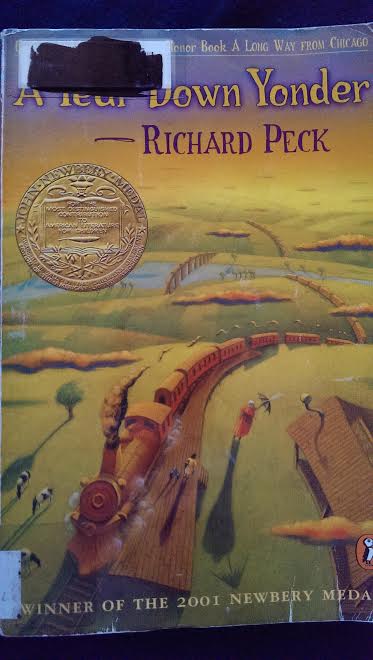
A Year Down Yonder

YearDownYonderA Year Down Yonder by Richard Peck, 2000.
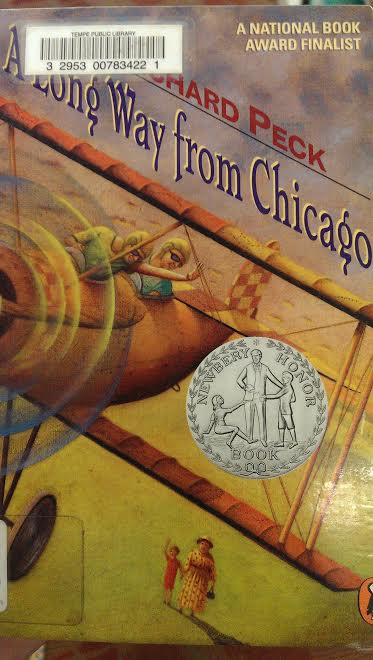
This is the sequel to A Long Way from Chicago. The story takes place shortly after the Great Depression, in 1937.

Times are still hard, and a recession has left a lot of people out of work again. Mary Alice’s father is out of work, and her brother Joey is out west working for the Civilian Conservation Corps. Because her family has to move to a smaller apartment, fifteen-year-old Mary Alice leaves Chicago to stay with her Grandma in the country for the year. Times are hard in Grandma’s small town as well, but Mary Alice’s Grandma is as wily and eccentric as ever.

Like the first book, this book is really a series of short stories about Mary Alice’s adventures with her Grandma during their year together. The stories generally have a hilarious turn as Grandma gets the better of everyone, often in the name justice or a good cause.  (Although, Grandma’s sense of justice is debatable since it involves “borrowing” pumpkins from the neighbors in the dead of night and other questionable activities.)

These stories present a detailed picture of rural life during the 1930s, from pranks played on Halloween to how Armistice Day was celebrated in the years following World War I, when people were still alive who had strong memories of that war. The stories also capture some of the personalities and politics of life in a small town, from a disreputable family of outcasts to the local elite, who have more money than the others and brag about having ancestors who fought in the Revolutionary War (which may or may not be so).

Rich Chicago Girl: Mary Alice arrives in Grandma’s small town and is enrolled in the local school.  She meets the class bully, and Grandma helps her to deal with her.

Vittles and Vengeance: At Halloween, Grandma gets revenge against a group of pranksters and raids her neighbors for ingredients to make the school Halloween party better.

A Minute in the Morning: Armistice Day, November 11, has more meaning for people who have actual memories of The Great War (World War I).  Grandma makes sure that those who can afford it pay what they owe to the veterans of that war and shows Mary Alice the price that some soldiers paid for supporting their country.

Away in a Manger: Mary Alice is picked to play Mary in the school’s Christmas Nativity play.  The baby Jesus turns out to be a surprise for the whole town, and Grandma arranges a special surprise for Mary Alice.

Hearts and Flour: The head of the local branch of the DAR pushes Grandma to make cherry tarts for their annual tea in honor of George Washington’s birthday.  Since she will neither allow Grandma to join the DAR (because Grandma doesn’t have the proper lineage) nor pay Grandma for her work (she thinks Grandma should ‘volunteer’ her services as part of her patriotic duty), Grandma insists that if she bakes, she must host the tea as well . . . with a couple of special surprise guests.  Meanwhile, a handsome new boy named Royce joins Mary Alice’s class at school.

A Dangerous Man: An artist working for the WPA rents a room from Grandma, treating Mary Alice and Royce to a scandalous but hilarious sight when his subject matter gets out of hand.

Gone with the Wind: A tornado sweeps through the town, and Grandma and Mary Alice go to check on residents who live alone.  Mary Alice also prepares to return home to her parents in Chicago.

Ever After: The final story in the book is about Mary Alice’s wedding, years later, toward the end of World War II.

This book is a Newbery Award winner.  There are multiple copies currently available online through Internet Archive.

A Long Way from Chicago

LongWayChicagoA Long Way from Chicago by Richard Peck, 1998.

Joey and Mary Alice live in Chicago during the Great Depression, but every summer, they go to stay with their grandmother in a small town in Illinois. At first, the kids think that staying with their grandmother will be boring, but they soon find out that Grandma is anything but. She’s an eccentric woman who doesn’t let anyone boss her around and doesn’t have much respect for any rules but her own. Although she’s pretty tough, Joe and Mary Alice learn that, deep down, Grandma really does care about other people and tries to help them, even though she often gets into a lot of trouble in the process. Each chapter is a short story from each of the summers that the kids spend with their grandmother, from 1929 to 1935:

Shotgun Cheatham’s Last Night Above Ground (1929): When a reporter comes looking for information about a recently deceased local character, Grandma volunteers to hold a wake for him in order to teach everyone a lesson about truth and gossip.

The Mouse in the Milk (1930): When a group of local pranksters needs to be punished, Grandma decides to play a little trick of her own to get even.

A One-Woman Crime Wave (1931): Grandma turns to trespassing and illegal fishing in her quest to feed the hungry.

The Day of Judgment (1932): Grandma enters a baking contest at the county fair for the glory of her home town and a chance to ride in an airplane.

The Phantom Brakeman (1933): Mary Alice tries to help a young woman escape from her abusive mother, and Grandma brings a ghost story to life for the sake of young love.

Things with Wings (1934): Effie Wilcox, a neighbor of Grandma’s, loses her house to the bank, but Grandma comes to the rescue by demonstrating the power of rumors.

Centennial Summer (1935): As Grandma’s town celebrates its centennial, Grandma decides that uppity Mrs. Weidenbach, the banker’s wife, needs to be taught a lesson.

The Troop Train (1942): Joe, now much older, has enlisted in the Army Air Corps during World War II. As the train taking him to his basic training passes Grandma’s town, she’s there to wave to him.

During the course of the stories, the author includes details about how Prohibition and the Great Depression affected people and other details about life in the early 1930s. This book is a Newbery Honor Book.  There are multiple copies available online through Internet Archive.

Soup

soupSoup by Robert Newton Peck, 1974.

This is the first book in a series about the author’s childhood best friend.  His friend’s real name was Luther Wesley Vison, but he always hated that name.  Because Luther refused to come home whenever his mother called his name for dinner, his mother took to just yelling, “Soup’s on!” when she wanted him to come home to eat.  After that, everyone else just started calling him “Soup”, which he liked a lot better than “Luther.”

Together, Soup and Robert had a reputation for getting into scrapes in their small town in Vermont.  The book is a series of short stories about the funny things they did as kids, like how they got revenge on the school nurse for asking embarrassing questions, how Soup got punished for breaking a window other than the one he’d actually broken, how Soup talked Rob into rolling down a hill in a barrel, and how Robert’s aunt let him tie her to a tree right before a lightning storm.

souppicSome of the stories are laugh-out-loud funny, and some of them have kind of a moral lesson to them, like the time when Rob realized that he didn’t have the heart to lie to his mother even if it would allow him to escape punishment for talking back to the school nurse, the time when Soup and Rob tried to cheat Mr. Diskin out of some money so they would have enough to go to the movies but ended up feeling guilty, and how the boys made themselves sick by attempting to smoke cornsilk.  Others are just stories of childhood events and friendship, like the story of how Rob and Soup played football and how Soup loaned Rob his new shoes when his were ruined.  Even though Soup often got Rob into trouble, he really was a good friend and went out of his way to make Rob feel better when he needed it the most.
Although it is a short chapter book that is easy to read, a couple of the stories might require some further explanations for young children reading them, like the one where the boys smoke cornsilk using homemade pipes and the one where Soup says that someone told him it was all right to cheat Mr. Diskin because he’s a Jew (a belief that they come to rethink when they feel guilty for cheating someone who was always fair with them and was kind to them even when he discovered the deception).  They deal with older practices and prejudices and can be the start of discussions about the lessons people learn by making mistakes. Other than that, these stories present a fascinating look at what it was like to grow up in the country during the 1920s.

The book is available to borrow and read for free online through Internet Archive.

The Best Christmas Pageant Ever

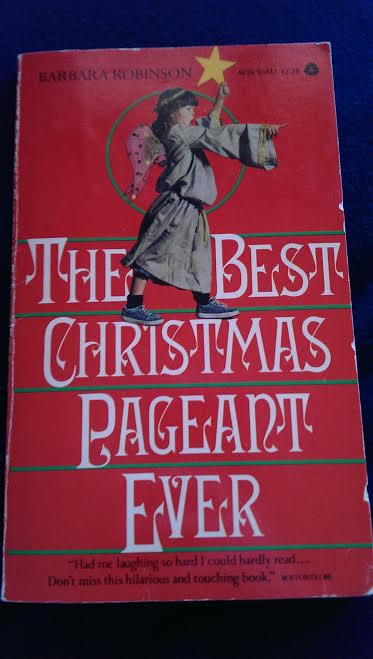
christmaspageantThe Best Christmas Pageant Ever by Barbara Robinson, 1972.
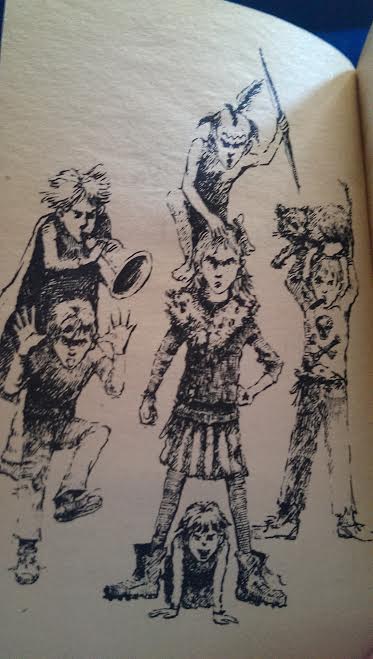
The Herdmans are the meanest, toughest kids in town.  They lie, cheat, steal, and when the mood strikes them, set things on fire.  Their father deserted the family, and their mother works all the time, so the six Herdman kids are pretty much left to their own devices, giving them plenty of opportunity to cause trouble.  Certainly, no one ever made the Herdman kids go to Sunday school.

But, to everyone’s surprise, the Herdmans suddenly show up at Sunday school in time to get cast for the annual Christmas pageant.  It wasn’t because the Herdmans suddenly found religion.  They were mostly there because they heard that there would be snacks.  Charlie told them so when they stole the dessert from his lunch at school.  In reality, Charlie exaggerated the snacks just to get back at the Herdmans.

christmaspageantpic1Although the Herdmans don’t get the cake Charlie mentioned and have little interest in Jesus, they begin to be fascinated by the description of the pageant and decide to stick around.  The Herdmans love movies, and the idea of being in any kind of play strikes them as fun.  Although the Christmas pageant basically goes the same way every year, typically using the same kids for the same parts, once the Herdmans make up their minds that they want the starring roles, they manage to push and bully their way right into the center of everything.
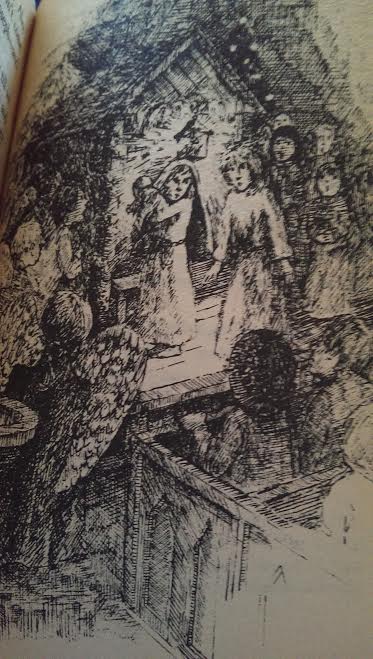
All of the other kids in Sunday school already know the story of Christmas and how the pageant usually goes, and they’re usually bored with the whole thing, but this year, the Herdmans make the pageant so unpredictable that even the kids the Herdmans tend to pick on find it fascinating.  The Herdmans are only hearing the story of Christmas for the first time as they assume their new roles of Mary, Joseph, the three wise men, and the angel.  Because they aren’t as familiar with the story and the routine of the pageant, they end up adding their own little twists to their performance.

christmaspageantpic2At first, the more conservative adults in the church are horrified at the prospect of what the wild Herdmans might do on Christmas itself, but the minister and the lady overseeing the pageant decide to give the Herdmans a chance.  As the title says, it ends up being The Best Christmas Pageant Ever as the Herdmans unexpectedly bring out parts of the Christmas story that the other people who had taken the story for granted hadn’t really thought about much: the simple human reactions of a poor young couple who were strangers in a new town, the fear and expectation that accompany doing something great but unfamiliar and confusing, and the sense of wonder and surprise that are at the heart of the Christmas season.

Parts of the book are laugh-out-loud funny, and parts are actually touching.  While the awful Herdman kids stumble their way through the Christmas pageant, changing things, is it possible that the play is also changing them?

This is the first book in a short series about the Herdmans.  It is available to borrow and read for free online through Internet Archive (multiple copies).  There is also a movie version of the book.  Sometimes, you can find it on YouTube.

Something Fishy at MacDonald Hall

somethingfishySomething Fishy at MacDonald Hall by Gordon Korman, 1995.

Time moves on, and Boots’s little brother, Edward, is just starting school at MacDonald Hall. He’s made it clear that he thinks his older brother and his friends are “over the hill” and uncool.  Mr. Sturgeon is also feeling “over the hill” and thinking about retiring.  Being the headmaster just doesn’t seem that exciting to him anymore.

But, MacDonald Hall just wouldn’t be MacDonald Hall without strange things happening, and some mysterious person has been playing a series of bizarre pranks that rival anything Bruno and Boots have ever done.

Naturally, Mr. Sturgeon suspects them of being the pranksters, but for once, Bruno and Boots aren’t guilty.  On the one hand, they’re a little envious of the prankster’s ingenuity, but on the other, they don’t want to take the rap for something they haven’t done.

Who could the mysterious prankster be?  It is Edward, trying to prove that he’s more clever than Bruno and Boots?  Could it be Cathy and Diane, the girls at Miss Scrimmage’s Finishing School for Young Ladies?  They’ve been somewhat distant this year, for some reason.  Maybe it was Mark, who runs the MacDonald Hall school newspaper, drumming up interest in the paper by creating the phantom joker so he can write stories about it.  Elmer Drimsdale, the school genius, has been acting pretty odd since he developed a crush on a girl at the summer science fair, a girl who also happens to attend Miss Scrimmage’s.

There are plenty of suspects to choose from, and time is running out.  Bruno and Boots may be facing expulsion if they can’t figure out who is behind all the pranks!

This book is part of the MacDonald Hall Series (or Bruno and Boots series).

MacDonald Hall Goes Hollywood

macdonaldhallhollywoodMacDonald Hall Goes Hollywood by Gordon Korman, 1991.

MacDonald Hall has been picked as a location for filming a movie about a boarding school, and people are going crazy (or crazier than normal)!  Bruno hopes that he’ll be discovered and become a movie star. His attempts to insinuate himself (not very subtly) into various scenes keep getting him into trouble.

The girls at Miss Scrimmage’s Finishing School for Young Ladies all have a crush on the teen star of the movie, Jordie Jones, further annoying Bruno.  Cathy and Diane, Bruno and Boots’s friends at Scrimmage’s, are especially getting on his nerves with their wild schemes to meet Jordie in person.

Meanwhile, poor Jordie wishes that he could live life out of the limelight for awhile.  His manager worries about him excessively and never lets him do anything fun.  In spite of his many admirers, Jordie is lonely because he spends all of his time with the movie people and doesn’t have many friends his own age.  Nobody has even remembered his birthday!

Bruno and Boots discover Jordie’s woes when Bruno tries to play a mean trick on Jordie, due to his jealousy of all the attention Jordie gets.  After Jordie opens up to the guys about his problems, Bruno feels more sympathetic toward him and decides to help.  The boys invite Jordie to play poker with them (after lights out and against school rules), take him to a dance at Miss Scrimmage’s (in disguise as a prince from a made-up country), and even get him to help with a hockey game as goalie (which earns Jordie a black eye).

Jordie has been having the time of his life, but the boys still have to conceal his activities as much as possible and deal with his over-protective manager, his rabid fans at Miss Scrimmage’s, and as always, The Fish.  Mr. Sturgeon (aka The Fish), is sympathetic to Jordie because he knows that activities like these are important to his growth as a person, but the movie people crack down on Jordie’s activities because the black eye interferes with his filming.

Although Jordie is supposed to keep quiet and let his eye heal, he runs away to join Bruno and Boots and several other boys on the school’s traditional wilderness survival trip (known to the students as “Die-in-the-Woods”).  It isn’t long before Jordie is discovered among them, but before the trip is over, the others are going to be glad that he’s there.

This book is part of the MacDonald Hall Series (or Bruno and Boots series).  It is currently available online through Internet Archive.

The Zucchini Warriors

zucchiniwarriorsThe Zucchini Warriors by Gordon Korman, 1988.
One of MacDonald Hall’s former students, Hank “the Tank” Carson, has made it big with his zucchini stick snack company.  As a former football player, he also wants to create a winning football team for his old school, funded by his zucchini fortune.

Mr. Sturgeon isn’t happy to see Hank again.  He was in Mr. Sturgeon’s math class, before Mr. Sturgeon became the school’s headmaster.  Hank was always a loud, obnoxious student, and against his morals, Mr. Sturgeon gave him a passing grade even though Hank actually failed the class.  He only did it because he couldn’t stand another year with Hank as his student, although he’s felt guilty about it ever since.

The boys aren’t thrilled about the new football stadium and team, either.  What they really wanted was a new rec hall.  But, when Bruno gets up the nerve to tell Hank about it, Hank makes the kids a deal: if they get a football team together and make a decent showing with it, he’ll fund a rec hall for them, too.  Bruno, as the one who wanted the rec hall the most, becomes the driving force behind the new football team, talking the other guys into playing and even eating Hank’s zucchini sticks even though everyone at school actually hates them.

The biggest stumbling block that the MacDonald Hall Zucchini Warriors faces is that they know nothing about the game.  In fact, the only one around who’s really into football is Cathy, one of the girls across the street at Miss Scrimmage’s Finishing School for Young Ladies.  But, football is a man’s game . . . right?

This book is part of the MacDonald Hall Series (or Bruno and Boots series). It is currently available online through Internet Archive.

The War with Mr. Wizzle

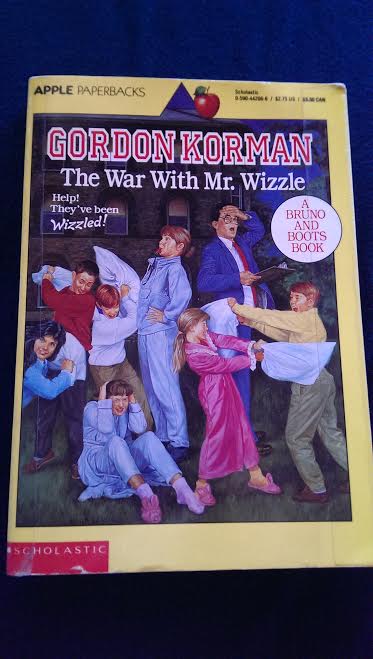
warwizzleThe War with Mr. Wizzle by Gordon Korman, 1982.

MacDonald Hall hasn’t been the same since Mr. Wizzle came.  He’s obsessed with computers and analyzing and categorizing everyone and everything.  He uses his computers to analyze the boys’ personalities, making changes to their schedules and activities based on the results.  But, no computer could ever understand the wacky and complex personalities of the students at MacDonald Hall.

Mr. Wizzle thinks he can understand everything with his computer, but he doesn’t understand the boys at all.  The boys soon get sick of being tested and analyzed and ordered around and told that they should consider changing their last names because the length is too inconvenient for the computer.  Even Mr. Sturgeon and the other faculty members are getting fed up with Mr. Wizzle, but they can’t do anything about it because the school’s board of directors are still hoping that Mr. Wizzle will modernize the school.

Meanwhile, the boys’ friends across the street at Miss Scrimmage’s Finishing School for Young Ladies are having personnel problems of their own.  Miss Scrimmage’s new athletics teacher, Miss Peabody, used to be a U.S. Marine, and she’s trying to train the girls like they’ve signed up for boot camp.  Like the boys, they would do just about anything to get rid of this new nuisance!

What ensues is a series of hi-jinks in the usual spirit of McDonald Hall as the students at each school attempt to drive out the new faculty, but along the way, the kids are forced to acknowledge that they don’t really want anything bad to happen to these new people.  It’s not that they’re bad people, they’re just not right for the types of schools and the students they’re trying to teach.  Then, a thought occurs to them: Is it possible that Mr. Wizzle and Miss Peabody might be right for . . . each other?

This book is part of the MacDonald Hall Series (or Bruno and Boots series). It is currently available online through Internet Archive.