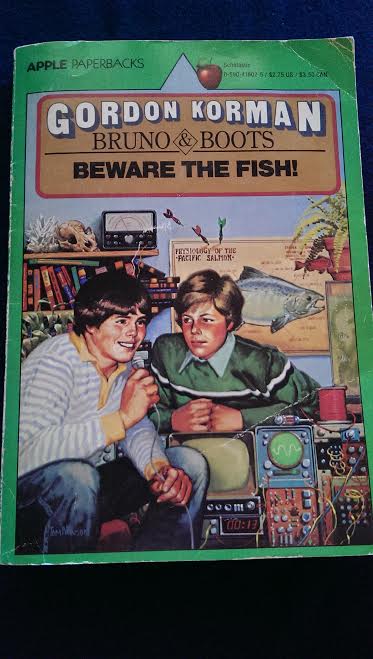
Beware the Fish!

bewarefishBeware the Fish! by Gordon Korman, 1980.

In spite of MacDonald Hall’s prestigious reputation, it is continually plagued by money problems.  The students can’t help but notice all the budget cutbacks, and now, there are rumors that the school might even have to close permanently.  The last thing anyone wants is to leave MacDonald Hall.  Bruno, the school’s resident idea man and master prankster, decides to spearhead a movement to raise money and publicity for MacDonald Hall so they can save the school!

Bruno, his best friend Boots, and their other fellow students try everything they can think of to spread the word about what a great place MacDonald Hall is so that enrollment will go up and the school can earn enough money to stay open.  They enlist the help of the girls at the nearby finishing school to help them break a world record.  The school’s science whiz, Elmer, shows the boys some of his inventions in the hope that one of them will make the school famous.

Unfortunately, as usual, nothing turns out as planned.  World records are extremely difficult to break, and Elmer’s inventions backfire.  One of his inventions backfires in such a way that it comes to the attention of the local police, and even the government becomes convinced that a gang of terrorists may be operating somewhere in the vicinity of MacDonald Hall.

The boys try to keep their activities secret from their headmaster, Mr. Sturgeon (or, as the boys nickname him, “The Fish”), while government agents snoop around, looking for the head of the organization that’s been issuing cryptic messages over television signals, a shadowy figure known only as “The Fish.”

This book is part of the MacDonald Hall Series (or Bruno and Boots series).  It is currently available online through Internet Archive.
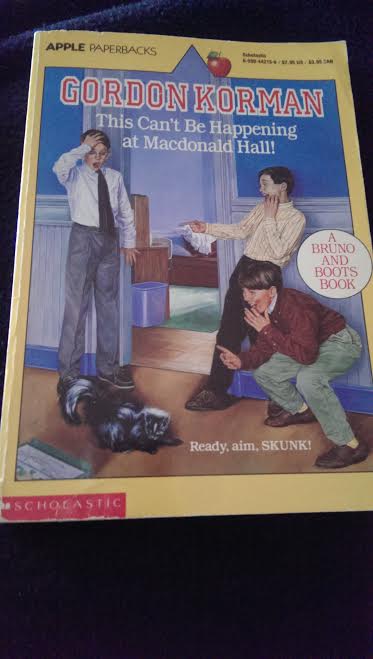
This Can’t Be Happening At MacDonald Hall

macdonaldhallThis Can’t Be Happening at MacDonald Hall by Gordon Korman, 1978.
Bruno and Melvin (called Boots) have been roommates ever since they began attending boarding school at MacDonald Hall.  The two of them are best friends, and they do everything together.  Quite a lot of what they do involves practical jokes.  But, they’ve really been pushing the limit with their antics, and when they go a little too far during a hockey game, the headmaster gives them the ultimate punishment: they can no longer share a room.  Mr. Sturgeon thinks that they’re a bad influence on each other.  Each of them is assigned to a new roommate, and they won’t even be able to hang out together.

The prospect of losing each other as best friends is too much for Bruno and Boots. Besides, neither of them likes their new roommates.  Boots has to share a room with George, who comes from a wealthy family and is only interested in money.  George is also a germophobe who hates it that Boots sneezes every morning when he wakes up.  Bruno’s new roommate is Elmer, the school’s supreme science nerd.  Elmer isn’t happy about Bruno’s presence, either, because Bruno and his belongings take up valuable space that Elmer requires for his many projects.  Obviously, the situation is completely intolerable for everyone.

Bruno, the idea man of the duo, declares that he will find a way for him and Boots to become roommates again.  They meet secretly at night to discuss their plans.  The boys try every tactic they can think of.  They try making themselves completely obnoxious to their new roommates so that Mr. Sturgeon will have pity on them and give them their old room assignments.  They try framing George and Elmer for some outrageous pranks of their own so Mr. Sturgeon will think that they’re a bad influence on Bruno and Boots.  Bruno and Boots even try (as an extreme measure) behaving themselves!  What will finally work?

This is the first book in the MacDonald Hall Series (or Bruno and Boots) series.  It is currently available online through Internet Archive.

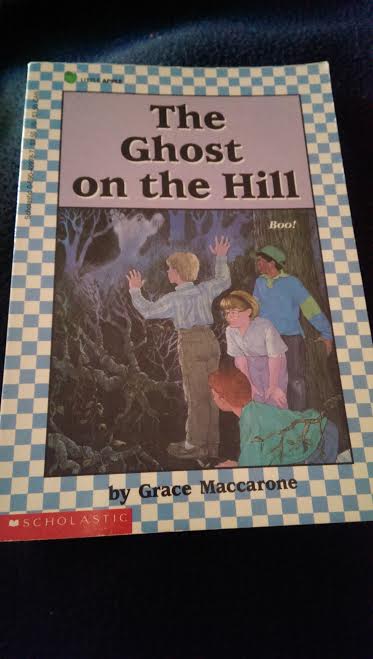
The Ghost on the Hill

ghosthillThe Ghost on the Hill by Grace Maccarone, 1990.
This is the last book in the Third Grade Ghosthunters series.

The kids take another field trip, this time to a state park. Native Americans used to live on that land, but most of the tribe died from disease many years ago. There are stories about spirits that live in the hills and the forest. Young boys from the tribe used to perform a ritual where they would dance with the Great Spirit in order to become men.

The third graders have been studying Native American history and customs to prepare for the field trip.  Norma wrote a report about Native American names, which tended to describe some significant characteristic of the person.  Their teacher tells the students that they should think of names for themselves which describe something significant about themselves.  Most of the kids think it sounds like a fun idea, but Joey doesn’t.  He’s just one kid in a family with a dozen other kids, and he’s never felt like there was anything particularly special about him.  That’s why he makes up tall tales about himself that all the other kids find weird and annoying.

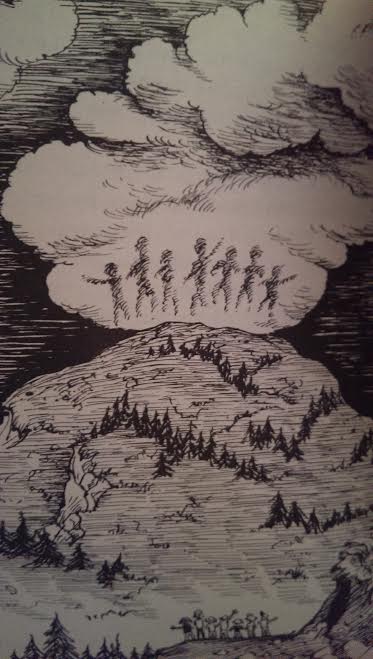
ghosthillpicWhen they reach the state park, Dennis Ten Foot Bridge, who is the last of his tribe, tells the students about his tribe, teaches them wilderness skills, and leads them in group activities.  One evening, Joey goes out to practice some rowing on the lake by himself, and he sees what looks like a large ghost at the top of a hill  However, everyone knows that Joey lies about a lot of things, so at first, no one believes him.  At least, no one except Adam.

Adam agrees to help Joey investigate the mysterious spirit. Eventually, all of the members of the ghosthunting group decide to go up on the hill together to see the ghost for themselves.  There, Joey finds the courage to face the spirit directly, and everyone sees the truth. Together, Joey and his friends end up repeating the ancient coming-of-age ritual that the tribe that used to live there would perform.

The solution to the mystery is a little strange, but the book is great for the characters alone. This final book in the Third Grade Ghosthunters series is a coming-of-age story. The other books in the series addressed personal issues and personality quirks in the characters as side-plots, such worrying about not being as smart others, worries about making and keeping friends, and the trouble with teasing. This one focuses on Joey and his sense of identity. He’s always felt that there is nothing special about him compared to his brothers and sisters. In this story, he develops his own character more and gains new confidence. In the process, he ends up becoming more comfortable with his role as a kid in a family with many children as well as appreciating his own uniqueness.  He also finds a name for himself that expresses his new sense of identity.

Return of the Third-Grade Ghosthunters

return3gghostThe Return of the Third-Grade Ghosthunters by Grace Maccarone, 1989.
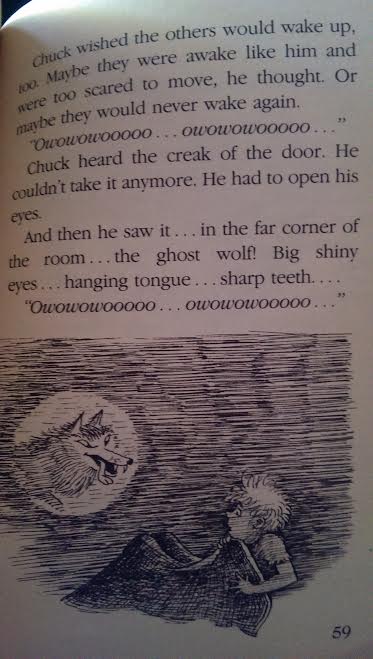
This is part of the Third Grade Ghosthunters series.

The same kids who were assigned to figure out the mysterious happenings at their school are now going on a field trip to a farm with their class. They’ll be spending a couple of days on the farm, sleeping over.  Adam has been looking forward to the trip, and he brings his ghost hunting gear with him, just in case.  He hasn’t lost his taste for ghost stories since their last adventure.

At first, things are pretty normal.  Then, during the night, the boys hear howling and see apparitions of a ghostly wolf in their bunk house. Could the farm be haunted?  Or is this some kind of mean joke?  Perhaps it’s the work of the class bully, Jeff? The ghost hunting committee assembles again to solve the mystery.

return3gghostpic2They try to use scientific methods to study the haunting.  They measure the placement of the furniture to see if anything moves while they’re out and sprinkle flour on the floor to get footprints.  But, even though they watch carefully and don’t see anyone enter the bunk house, when they go inside, everything is a mess, and the flour doesn’t appear disturbed.  Everyone else is about ready to admit that this one is a real ghost, but Adam has another theory.

The solution has an interesting twist to it. It’s a good mystery for kids beginning chapter books who like a little creepiness in their reading.

The book is currently available online through Internet Archive.

The Haunting of Grade Three

HauntingG3The Haunting of Grade Three by Grace Maccarone, 1984.
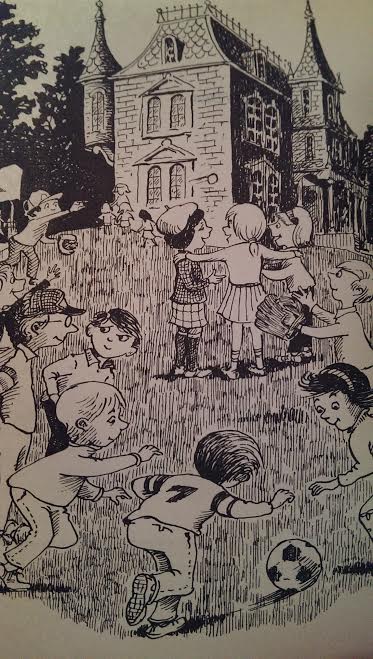
Elwood Elementary has become overcrowded, so the third-graders have been moved to an old mansion, Blackwell House, which has been empty for years. The house looks kind of spooky, and there are a lot of local ghost stories about it. Fortunately, Adam Johnson likes scary stories, so he thinks that it’s wonderful to go to school there.

Soon after the students move into the house, strange things begin happening. Objects fall off desks and shelves, and door slam for no reason.  Some of the kids discover a grave marker on the property for a boy about their age who died during the Civil War.  The kids start getting nervous, and so does their teacher, Mr. Jenkins. Then, Mr. Jenkins decides to give the kids group assignments. Each committee gets to go to a different place in town and learn about it. Adam’s committee is assigned to study Blackwell House and decide if it’s really haunted. The kids think their assignment is pretty strange, but Adam is excited.  He wants to be a ghost hunter like on Ghostbusters!

HauntingGradeThreeMost of the group members are misfits in one way or another. Norma Hamburger is a shy girl, frequently teased about her last name. Debbie Clark is a talkative girl who’s really into science. Chuck Webber, Adam’s best friend, is the class clown, always telling stupid jokes (and one of the main people who teases Norma about her name). Danny Biddicker is strong and good at sports, but he worries that he’s not as smart as the others. Joey Baker feels overshadowed by his large family, so he tells tall tales to get attention. The other kids don’t understand and get annoyed with his lies. By working together, they not only learn the secret of Blackwell House, but they learn more about each other and become a real team and friends.
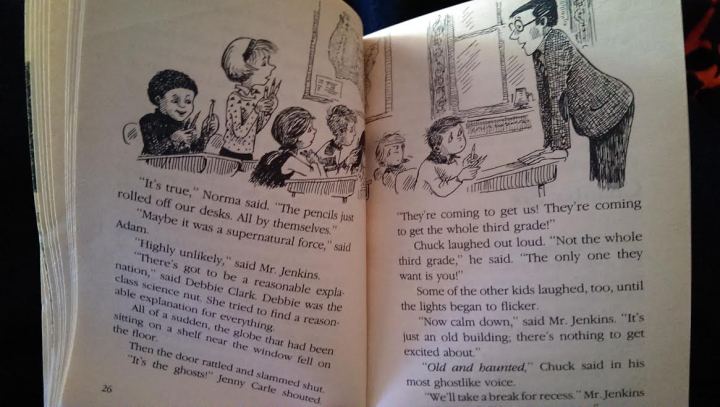
In the end, there is a reasonable explanation for the haunting of Blackwell House.  The kids take a methodical approach to the mystery, gathering their facts and ruling out various possibilities along the way.  Joey gets a chance to be a real hero, Danny proves to himself and everyone else that he’s smart and has good ideas, and Adam gets a new life ambition.

HauntingG3Pic

One other thing that I thought was interesting is that Adam, the main character in the story, is African American, but it’s never mentioned in the text of the story.  You only know because it’s shown in the pictures.  It’s just a little detail and not important to the story, but I thought it was interesting in a story that encourages kids to notice details.  I also liked it that Adam isn’t defined by race or appearance as so many characters in kids’ books are.  He stands by himself as an interesting character with his own ideas, courage, and leadership abilities.

This is the first book in the Third Grade Ghosthunters series.  It is currently available online through Internet Archive.

The D- Poems of Jeremy Bloom

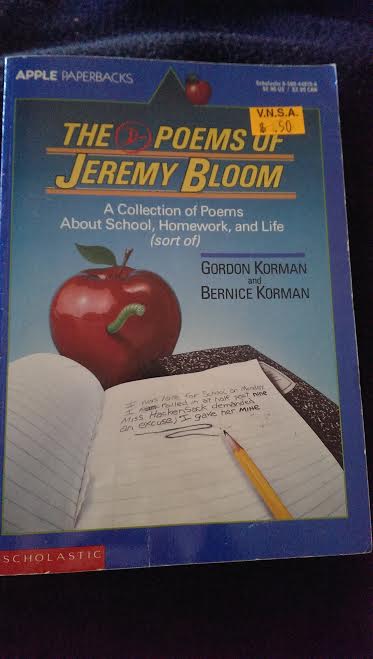
jeremybloomThe D- Poems of Jeremy Bloom by Gordon Korman and Bernice Korman, 1992.

This book is mostly a collection of funny poems, but there is an overarching story to them.  Jeremy Bloom, a typical middle school slacker, wanted to sign up for the easiest elective course he possibly could.  But, by accident, he overslept on the first day of school, and by the time he got there, sign-ups had already started and the easiest and most popular electives were full.  Desperately trying to find something easy and with as little work possible under the remaining electives, Jeremy decided to sign up for Pottery. (“It was no Snooze Patrol, but how hard could it be to make ashtrays?”)  Only, he made another mistake and accidentally signed up for Poetry, and once he was enrolled, there was no way out of it.  He was committed to spending a year writing poetry.

jeremybloompoemJeremy tries to make the best of things, but somehow (partly through his own fault and partly by accident), he continually manages to do things to annoy his poetry teacher, Ms. Terranova (or, as the kids call her, Ms. Pterodactyl, thanks to a mistake Jeremy made when he said her name on the first day of class).  Every single poem Jeremy writes during the year receives the same grade: D-.  The book is divided into different periods of Jeremy’s work, along with an explanation about what Jeremy did during each period to tick off his teacher.  At the end, the reader can be the judge: Are Jeremy’s D- grades because he’s a terrible poet or because his teacher is mad at Jeremy for everything else he does during the year?  (The answer is pretty obvious.)
My favorite poems are the longer ones like “Why I Was Late,” “The Wheeler-Dealer,” and “No Boring Parts Allowed.”  Just to give you an idea of what the poems are like (although they are written in a variety of styles), here’s another one of my favorites, “Honesty Is Not Always the Best Policy.”

The book is currently available online through Internet Archive.

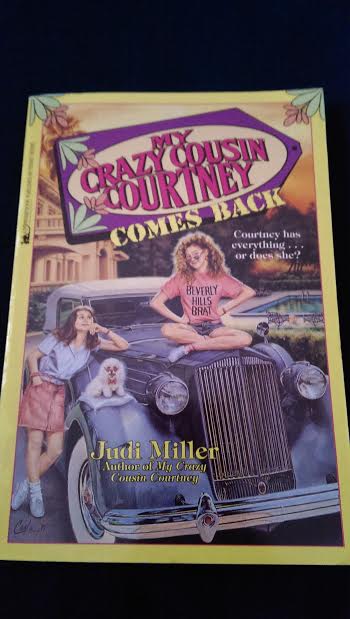
My Crazy Cousin Courtney Comes Back

CousinCourtneyBackMy Crazy Cousin Courtney Comes Back by Judi Miller, 1994.

The title is a little deceptive because Courtney hasn’t come back to New York to visit Cathy.  This time, Cathy has flown to Beverly Hills to spend Christmas with Courtney.  Courtney’s parents are now divorced, and Courtney’s adjusting to it, but she’s still as wild and unpredictable as she ever was.

Almost as soon as Cathy arrives, Courtney wakes her in the middle of the night to tell her that she needs her help to rescue an old man who’s being held against his will and maybe bring him cans of soup and sauerkraut.  Courtney’s heart is always in the right place, but as usual, she has the wrong idea.  In the best Courtney tradition, things work out amazingly well in the end.

In between spotting movie stars and getting into trouble, the girls manage to find time to get their nails done and visit with their friend Frank, who they met last summer in New York.  Cathy had fallen in love with Frank until she realized that he was more interested in being Courtney’s boyfriend.  Seeing him again over Christmas has brought back Cathy’s awkward feelings.  She still likes Frank, but the last thing she wants to do is to take a guy away from her lovable, if crazy, cousin.  But, if there’s one thing that Courtney specializes in, it’s happy endings.

This book isn’t as introspective as the first one in the series was, although Courtney and Cathy still help each other with their opposite personalities.  Cathy’s common sense and restraint can’t stop Courtney in her wild escapades, but she does inspire Courtney to be more thoughtful.  Courtney also helps Cathy to get out of shell, speak up for herself, have a little excitement, and see the possibilities that life has to offer.

My Crazy Cousin Courtney

CousinCourtneyMy Crazy Cousin Courtney by Judi Miller, 1993.

Cathy Bushwick usually spends the summer at camp, but this summer, her mother is having her stay in the city because her cousin Courtney is coming to visit them in New York.  Cathy and Courtney are actually second cousins because their mothers are first cousins.  They’re the same age (thirteen) and met once when they were five, but neither of them remembers it.  All that Cathy really knows about Courtney before she arrives is that she’s somewhat neurotic (Courtney is troubled by anxiety and panic attacks) and that the reason she’s coming to visit is that her parents are thinking of getting a divorce and need time alone to discuss it.

Cathy understands what it’s like to live with a single parent.  Her parents are divorced, and her father went to California years ago to become an actor.  She hasn’t heard from him since.  Her mother used to be an actress, but with Cathy to take care of, she became a theatrical agent for animals instead (she finds animals for people to use in commercials).  So, when Cathy hears that Courtney will be visiting from Beverly Hills, she’s very excited.  At first, she hopes that she and Courtney will be like sisters and that Courtney might have even heard of her father in California.

Cathy’s illusions are shattered almost immediately.  Courtney not only hasn’t heard of her father but she’s nothing like Cathy imagined.  When she and her mother go to meet her at the airport, she’s wearing heart-shaped sunglasses and a hot pink shirt that says, “KISS ME QUICK,” and she has a pile of luggage.  She’s used to having money and getting the best of everything, and she’s immediately disappointed with the modest apartment where Cathy and her mother live.  When she learns that they don’t even have a pool, she gets upset and wants to go home.  But, it’s no use.  She’s stuck there for the summer.  And, they’re stuck with her.

But, things don’t turn out to be as bad as Cathy fears they’re going to be.  In some ways, they’re worse.  Once Courtney reconciles herself to spending the summer in New York, she has some very specific ideas about things that she’d like to do, and a lot of them end up getting the girls in trouble.  Shy, sensible Cathy finds herself getting locked in Tiffany’s after closing time because Courtney thought she saw a spy stealing their designs, rescuing Courtney from the dolphin pool at the aquarium, and lots of other things that she never thought she’d find herself doing.  Then, one day, the girls think they’ve witnessed a murder.  What are they going to do?  Is Cathy going to survive the summer with her crazy cousin Courtney?

This book is the first in a series about Cathy and Courtney.  Courtney may be a bit wild, but she’s not as crazy as Cathy thinks.  Over the course of the summer, the two become friends, and they learn quite a few things about each other and about themselves.  By the time Courtney has to go home, a little of each of them has rubbed off on the other, and neither will be quite the same again.

The book is available online through Internet Archive.

The Adventures of the Red Tape Gang

RedTapeGangThe Adventures of the Red Tape Gang by Joan Lowery Nixon, 1974.
Hardcover editions of this book are called The Mysterious Red Tape Gang.

Mike’s father loves to read the newspaper every morning and rant about the stories that make him angry.  It annoys him how little gets accomplished because there’s so much “red tape” involved.  Take the case of their neighbor, Mr. Hartwell.  He has a large bush that’s dangerously close to the corner of their street and has caused several accidents. The city wants him to cut it, but he refuses to do so out of meanness and stubbornness.  Now, the city has to go through all kinds of red tape to make it happen.

His father’s rants give Mike an idea.  Why not put the new clubhouse he and his friends are working on to good use and form a club to right the wrongs of their neighborhood and make all of that red tape unnecessary?  Besides, cutting the Hartwells’ bush in the middle of the night would be a great joke on Mr. Hartwell’s nosy daughter, Linda Jean, who’s always hanging around, getting in the way of Mike and his friends.

Mike’s friends love the idea of being secret neighborhood heroes, but of course, it turns out to be harder than they expected.  After trimming the Hartwells’ bush as best they can, they decide that instead of just cutting the bush, it would be better to move it to a completely different spot so there will be no need to cut it again when it grows out.  But, Mr. Hartwell almost catches them in their midnight landscaping, and when Linda Jean finds Mike’s shears, they’re forced to let her into their club.

Their next project, boarding up the doors and windows of an abandoned house so that curious children won’t wander in and get hurt, also comes with complications.  It seems that the house wasn’t quite as abandoned as everyone thought.  Still, the Red Tape Gang accomplishes something even greater than just keeping kids out of the house and successfully keeps their identities secret.  But while they’re congratulating themselves on the wonderful job they’ve been doing, they discover that their neighborhood contains far more serious problems than they originally thought. Their activities are also starting to come to the attention of the wrong people.  And, for one member of the group, these problems hit dangerously close to home.

This was one of my favorite books when I was a kid.  The descriptions of the kids’ midnight excursions are hilarious and make you want to cheer them on!

This book is currently available online through Internet Archive.

Sideways Arithmetic from Wayside School

SidewaysArithmetic

Sideways Arithmetic from Wayside School by Louis Sachar, 1989.

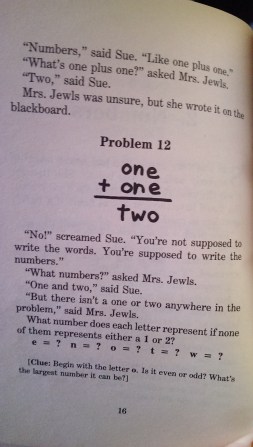
This is a companion book to the Wayside School Series.  Unlike the other books in the series, it doesn’t contain stories.  It talks about the things that kids at Wayside School study, partly from the point of view of Sue, a new student who is stunned to learn that kids at Wayside School do arithmetic with words, not numbers.

SidewaysArithmeticPicBasically, it’s a puzzle book.  In the Arithmetic section, the letters in the words stand for numbers.  The book gives an example to demonstrate how to figure out which numbers the letters stand for.  The problems get harder through the sections labeled Numbers, Pronouns, and Paragraphs.

From the Recess section on, there are logic puzzles.  In Recess, you have to use the information provided to figure out what games the children play at recess.  In Science, Geography, Etc. (that’s one chapter), you have to figure out who got the right answers to the tests from the information provided. You see the answers five of them got and know that only one of them got all the answers right and no two of them had the same score. When you look in the back to see if you solved the problem right, you get to see what the test was actually about, and that’s the funniest part.  The Lunch section combines logic puzzles with math.  The True or False section gives you true/false questions to answer based on a series of statements about which of them are true or false.  Finally, in the After School section, Joy and Sue give up and go home (as well they should).

I like the book because I like puzzles, and there are funny little stories around the problems and answers.  All of the puzzles are answerable (except for one or two where the correct answer is that they’re impossible, which is why Joy should definitely get up and go home, but you’ll figure that out way before she does).  If you like puzzles and the Wayside School series, you’d like this book.  If you don’t like puzzles, you can skip this and just stick to the regular books in the series (as regular as Wayside School gets).  If you like puzzles but don’t know about the Wayside School series, you could still find it interesting but you wouldn’t really appreciate the funny parts.  If you don’t like the Wayside School series or puzzles, you probably aren’t reading this right now, so don’t worry about it.

This book is currently available online through Internet Archive.