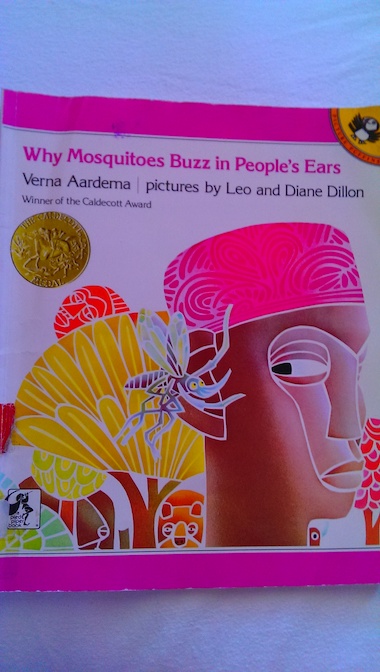
Why Mosquitoes Buzz in People’s Ears retold by Verna Aardema, pictures by Leo and Diane Dillon, 1975.
The story comes from a West African folktale, and all the characters are animals.
In the beginning, a grumpy iguana gets tired of hearing a mosquito telling tall tales. He sticks a couple of sticks in his ears so that he won’t have to listen anymore, and this decision leads to a series of unfortunate events that leads to the accidental death of a baby owl.
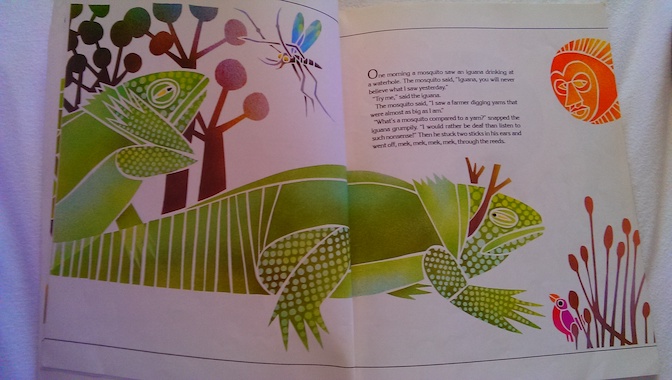
It starts with a snake trying to talk to the iguana, who does not hear him. The snake, thinking that perhaps the iguana is angry with him, goes to hide from him in a rabbit hole, startling the rabbit out. The chain reaction of events continues, with different animals startling each other, until a frightened monkey crashes through a tree branch, which breaks, killing the baby owl.

The Mother Owl is so distraught at the death of her baby that she doesn’t wake the sun so that dawn can come, as she usually does. When the other animals realize that dawn isn’t coming, King Lion calls a meeting to determine the reason why. Together, they trace the events backward to the iguana. The iguana is not at the meeting because he still has sticks in his ears and hasn’t heard a thing about it.
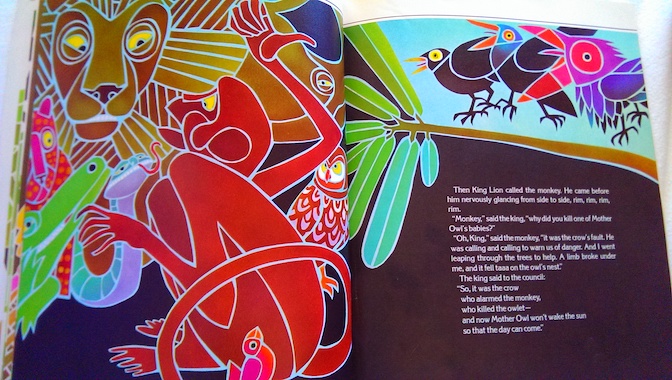
When the other animals track down the iguana and take the sticks out of his ears, they demand to know why he wouldn’t talk to the snake. When he tells them that he had sticks in his ears because he couldn’t stand listening to the mosquito’s stories anymore, the mosquito ends up taking the blame for everything. The Mother Owl is satisfied with the explanation and hoots to wake up the sun, although the mosquito escapes punishment by hiding. So, ever since, the mosquito whispers in people’s ears to find out if everyone is still angry.
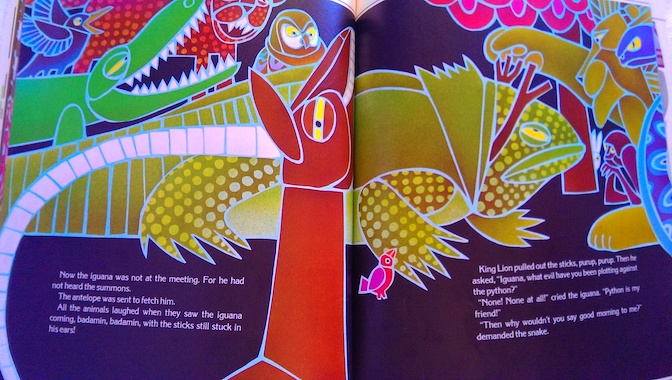
The art style in the book is a little unusual. When I looked at the pictures the first time, I thought of them as looking stenciled. However, there is a note in the beginning of the book, near the copyright information, that says that the pictures are a combination of watercolors and india ink. The artists used an airbrush and pastels, and they created the “cut-out effect” with frisket masks and pieces cut out of vellum.
This book is a Caldecott Award winner. It is currently available online through Internet Archive.
 Jestress's Forgotten Books and Stories