
The Bell Tolls at Mousehaven Manor by Mary Deball Kwitz, 1991.
This book is the sequel to Shadow Over Mousehaven Manor.

Since the characters’ adventures in the previous book, Minabell Mouse has come to live with her Aunt Pitty Pat in their ancestral home, Mousehaven Manor. Just as Aunt Pitty Pat and Minabell have finished their spring cleaning, Minabell’s cousin Violet Mae arrives for a visit … apparently a long one, based on the amount of luggage that she brought with her.
Also, the prairie hawk who brought Violet Mae to Mousehaven Manor brings a package for Minabell, although there’s nothing to say who the package is from. Minabell finds the package disturbing and is afraid to open it. Instead, she stashes it in the music room. Still, the package leaves her feeling weak and unwell, as if it were somehow cursed.

That evening, their friend Percy the bat comes to dinner, and they are also joined by a mysterious stranger bat who calls himself Count Von Flittermouse. Count Von Flittermouse is a traveler, but he has no luggage except for a large box, which he declines to bring inside. They invite him to join them for dinner, but he says he’s already eaten, so he will just join them in conversation. Aunt Pitty Pat asks the Count if he’d like to spend the night at Mousehaven Manor, but the Count says that he’s a nocturnal creature, so he’s active at night. He asks for directions to Springfield because he says he wants to camp in the Oak Ridge Cemetery and visit Lincoln’s tomb. After dinner, the Count leaves, and they see he’s carrying a long box on his back. He’d mentioned that he brought his bed with him, so they figure that’s what it is. Percy seems a little uneasy about the Count, and Minabell notices that the Count left some odd kind of dust on the chair where he was sitting.
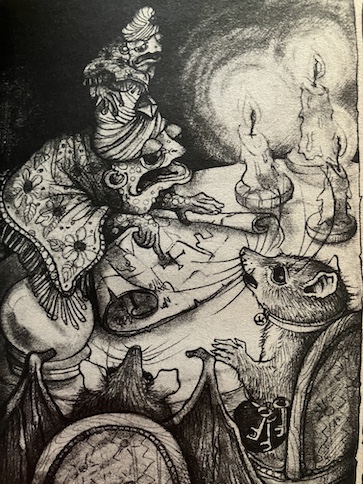
Minabell is in charge of security at Mousehaven Manor, but that evening, she accidentally leaves the music room window open. At night, Minabell hears someone moving around the manor, but she never sees the mysterious intruder, and in the morning, nothing is missing, so her aunt thinks it might have been her imagination.
Meanwhile, a country singer mouse called the Rhinestone Rodent arrives in town. (A joke on the Rhinestone Cowboy song.) Minabell is shopping when she stops to watch the singer perform. Then, an alarm goes up among the mice in town because Mousehaven Manor is on fire! Minabell rushes home, and Percy rings the bell at Mousehaven Manor to summon help. Others come to form a bucket brigade, and they successfully put the fire out. Aunt Pitty Pat is fine, but it takes them awhile to find Violet Mae. Violet Mae casually strolls downstairs and tells them that she was upstairs, having a nap and missing the whole thing.
Part of the mansion is damaged from the fire, and they have to clean everything up. Violet Mae meets the Rhinestone Rodent and develops a crush on him. While Violet Mae and Aunt Pitty Pat go to see the Rhinestone Rodent perform, Minabell and Percy inspect the site of the fire. They determine that the fire was set deliberately, but it was never intended to burn down the whole mansion. It seems like whoever set the fire was using it to cause a distraction while they did something else, but they’re not sure what.

The mysterious package that Minabell hid in the music room is still there, and Minabell finally opens it in front of Percy. It turns out that it’s from Wendell Weasel, a member of the local law enforcement agency, the Illinois State Ski Patrol. The mysterious package contains an equally mysterious ancient box, and Wendell’s letter explains that this box has been passed down in the Mouse family for generations, always held by the head of the family. Until recently, it was in the possession of Colonel Mouse, who was Violet Mae’s guardian but has recently passed away (something that Violet Mae has completely failed to mention to anyone, which is weird). Wendell says that Violet Mae doesn’t know anything about the box, but Colonel Mouse wanted Minabell to look after both the box and Violet Mae. Wendell says that there is a document in the box itself that will explain the purpose of the box, but each caretaker of the box is bound to use its contents to help others and not just for personal gain. Also, there are evil people who may try to steal the box, so Minabell is going to have to be careful.
In the mysterious antique box, Minabell finds a pile of sand surrounding a bottle holding something intensely cold and an old map written in Spanish. It seems like this is what their mysterious intruder was looking for, but what does it mean, and who wants it?
The book is available to borrow and read for free online through Internet Archive (multiple copies).
My Reaction and Spoilers
This story is more supernatural than the previous book in the series, which was an adventure story. I thought that the villain in the story was pretty obvious, although I did have a couple other suspects in mind for a more devious twist. It turned out to be the obvious choice, though.

Count von Flittermouse is not what he seems, in more ways than once. Percy figures out pretty quickly that the Count is a vampire bat, but what that seems to mean in this version of the animal world is not only different from what vampire bats actually are, but it’s also kind of confusing. I expected that he’d turn out to be like a human vampire, only with a bat as his main form – drinking blood, being immortal, etc. But, that’s not it. Count von Flittermouse is a shapeshifter. He can change into different scary animals, like wolf and spider. That’s his main super power. So, he’s not exactly what I think of as a “vampire”, he’s more like a werewolf, or werebat, or werewolf bat or something. We never see him drink blood or try to drink blood, although there are some bones in his lair that suggest that he might eat other animals. They don’t really go deep into the lore of it or outline the rules for vampire bats in their version of Illinois. You just have to take their word for it that vampire bats are shapeshifters, and that’s it. That’s their thing. Also, their vampire bats aren’t immortal vampires. That’s really the problem that Count von Flittermouse has. He’s actually a very old vampire bat and not likely to live much longer unless he can get his little winged paws on the package that Minabell received.

The bottle in the mysterious package turns out to contain water from the Fountain of Youth. Generations back, one of Minabell’s ancestors accompanied Spanish conquistadors on their search for the Fountain of Youth, and they not only found it but saved some water from it. Count von Flittermouse wants it to restore his youth and make him immortal. It wouldn’t be so bad if he wasn’t also evil and a werewolf bat.
Of course, our heroes are victorious. They find a way to use the special water so that it benefits everyone, except for the evil bat, and everything ends happily. I actually think that this book might make a fun Disney cartoon, something like a more supernatural version of The Great Mouse Detective. Even though I thought that the book’s version of what a vampire bat is and what it does is a little confusing, a movie version could clarify some of the rules regarding what vampire bats are supposed to be and what they do. The lore about human vampires varies depending on the source, although they usually do have the ability to shapeshift into bats, an ability which is kind of pointless if the vampire happens to already be a bat. It’s understandable that the story has to tweak the traditional vampire lore to fit into this animal society. I kind of picture that the vampire bat would only be able to change into things whose blood it sucked earlier, but that’s just my theory; the book doesn’t clarify that point. Still, it’s a fun story, and I think a movie version would also be fun.

 In 1944, everyone is concerned with finding ways to help the war effort. In Molly’s third grade class at school, her teacher announces that their class is invited to participate in the Lend-a-Hand contest. The class will be divided in half, and each half will compete against the other to find the best way to help the war effort. The class decides to make the contest boys against girls, and Molly immediately starts trying to figure out a spectacular idea that will impress everyone. Unfortunately, one of the other girls says that the girls in class should knit socks for soldiers, and the teacher accepts that as the goal for the girls’ team, before Molly can say anything.
 Molly is appalled at the idea of knitting socks. It’s partly that she had wanted to be the one to come up with the best idea, and it’s also partly because she has tried knitting before, and she knows that socks are difficult, time-consuming projects, especially for beginning knitters. Molly is sure that the other girls are going to find it too difficult and that, in the end, they’ll have nothing to show for their project. Her friend Susan doesn’t think that the project sounds so bad, but Linda also dreads the idea of knitting because she’s not very good at it. Talking it over in their secret hideout in the storage area of Molly’s garage, the three girls decide that they’ll work on a secret project by themselves, something that will save the day when the other girls’ project falls through.
 The other girls are certainly a lot more comfortable, knitting inside. However, as Molly predicted, they are finding their project harder than they thought it would be. None of them has completed an entire sock yet; all they really have are the square shapes at the top of the sock, and they’re getting discouraged. That’s when Molly gets a better idea: why not take the squares they’ve made and turn them into a blanket? Simple squares are much easier to make than socks, they can make a lot of them quickly with everyone helping, and the girls who can’t knit well can sew the squares together. A blanket is still a good war effort project because Molly’s father has told her that the hospital where he works is always in need of blankets for the wounded soldiers. With this new idea, the other girls become much more excited, and they make more progress.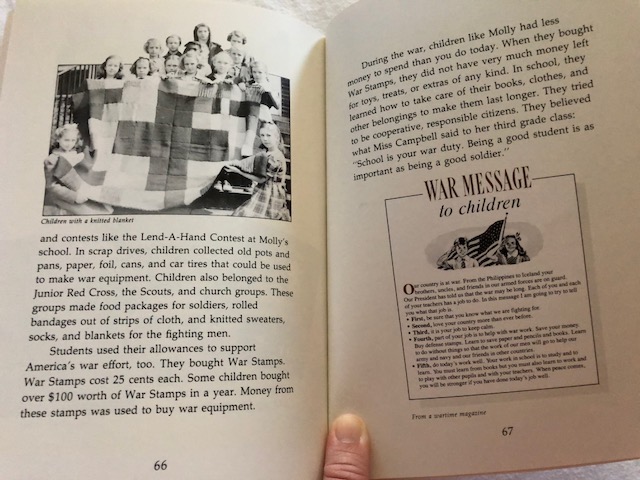
 A Long Way from Chicago by Richard Peck, 1998.
 Jestress's Forgotten Books and Stories