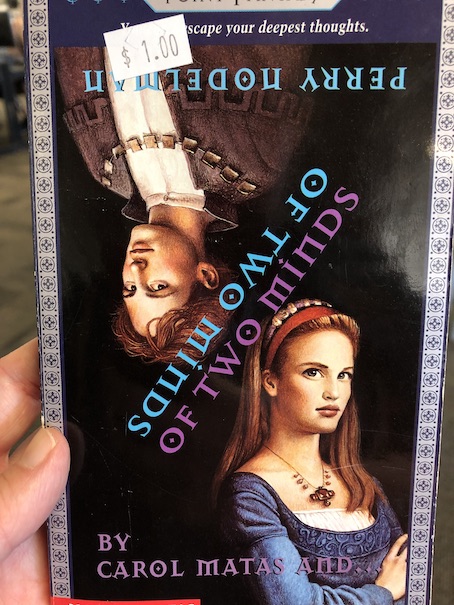
A Meeting of Minds by Carol Matas and Perry Nodelman, 1999.
This is the final book in the Minds series. Each book in the series begins shortly after the previous book ends, and this one starts only three weeks after the last book.
Princess Lenora and Prince Coren are still in Andilla for their impending wedding when, while simply walking down a hallway of the castle, they suddenly find themselves transported to a land of snow. The world in which they now find themselves is our world (which, I guess would be distant past of their world, the late 20th century). Disoriented and cold, Lenora and Coren go inside a shopping mall to get warm. At first, Coren thinks that Lenora has caused their present predicament (because, usually, she does, either consciously or unconsciously), but Lenora denies having anything to do with it.
At the time they’d been walking down the hallway, they’d been discussing the exhibition at the castle in honor of their upcoming wedding and Lenora’s desire for a better world. The exhibition was called “A Meeting of Minds” and designed to showcase the ways that different groups of people in their world live and what they envision as a perfect world. The entries in the exhibit were chosen as entries in a contest, and a panel of judges from different countries would choose winners from among them. The winning entries would be adopted as real laws in the hope of fulfilling Lenora’s wish of making the world a better place for everyone. What could go wrong? (Seriously, things in this world always go wrong when people try to enforce some vision of perfection, so what’s it going to be this time?) Could the exhibition have something to do with their present predicament?
Lenora and Coren briefly consider different possibilities, including the possibility that some unknown enemy has sent them to this strange place, but nothing really makes sense. Lenora has the uncomfortable feeling that something she’s done may have cause this problem after all, although she can’t think what it is. Either way, they are stuck in a strange land.
They stop a passing girl and ask them where they are, and she tells them that they’re in a mall called Portage Place. That doesn’t really explain much to Lenora and Coren, so the girl tells them to buy a map. Lenora and Coren don’t understand the concept of “buying” (in the last book, they didn’t know the word “economy”). When they try to ask her the name of her “world”, it turns out that the girl is an alien conspiracy theorist, wearing a shirt with a picture of an alien on it and the words “The Truth is Out There” (the slogan from the X-Files tv show). The girl is very excited, thinking that Lenora and Coren are space aliens. She tells them that they’re in Winnipeg on Earth and asks them where they’re from. Coren recognizes the name “Earth” as the old name for their world. This confirms that, although there are fantasy elements in these stories, Lenora and Coren are actually from the distant future of the Earth, although the three of them work out that they might actually be from a parallel universe of our Earth. However, her helpfulness ends when she suddenly seems to suspect them of being “Mindies” and making fun of her. Lenora and Coren don’t know what she’s talking about.
The two of them explore the mall, getting into trouble when they try to stop two girls from taking another child’s toy and end up having security called on them and not having money to pay for food in the mall food court. Fortunately, a couple of other young people in line offer to pay for their food. These young people, Barb and Thomas, seem to recognize them as Princess Lenora and Prince Coren, but strangely, Lenora and Coren learn that they think that they’re in costume and only pretending to be themselves. It slowly comes out that the authors of the book series live in Winnipeg and that there’s a fan convention in town for the books in which Lenora and Coren are fictional characters. (I’ve never actually heard of a convention specifically for this series of books, but I don’t live in Canada, so I can’t swear that it never happened. However, the characters later meet someone dressed as Spock at the convention, so it’s possible that this is supposed to be part of some larger book or sci-fi/fantasy-themed convention.)
Lenora and Coren don’t fully understand the concept of the fan convention, but Lenora sees it as a possible lead to what’s happening, so she insists on going to the convention center. At the convention center, Lenora and Coren encounter other people who are apparently trying to dress like they do and pretend to be them. Some of them even criticize what Lenora and Coren are wearing because their real outfits don’t agree with the fans’ interpretations of the characters. (Fandoms are like this in real life. The more someone likes something and spends time with it, the more they consider themselves an authority on it. They kind of are, but sometimes, fans get wrapped up in their own vision of what they’d like characters to be like that they kind of depart from the original story or get out of sync with the vision of the original authors. It’s almost like they mentally create an alternate reality of a world that was already fictional, which fits very well with the themes of this entire series.) Lenora and Coren think that they’re all very rude for criticizing the way they dress, telling them how they should talk to be in character, and thinking that Coren is a wimp or geek or that Lenora is annoying or arrogant, which some of them say right in front of them.
At this point, someone comments that Lenora sounds just like she does in the books, and the people at the convention start talking about all of the books in this series, which I’ve already reviewed. Finally, Lenora and Coren understand that these people know about them and are imitating them because they have read books about them. Coren is embarrassed when these fans start talking about some of his more embarrassing moments like they’re common knowledge. Lenora gets angry and decides that they need to talk to the authors. (Which seems to have been the goal of this book.)
Coren and Lenora get in line to talk to the authors of the books, but when they meet them, the authors also just think they’re fans of the books who are putting on a little skit for them. There’s some banter with the authors (including some inside jokes that Carol and Perry seem to have with each other, like how bad Perry’s handwriting apparently is), and the authors remark how much Lenora and Coren sound like their characters, although they don’t think they really look like them (which is interesting, as if they have a completely different vision of them in their minds). Lenora gets angry with them and accuses them of stealing from their lives to write their books, so she grabs some of the books the authors and signing and runs away with them.
As Lenora and Coren hide from security with their stolen books, they start reading about themselves. They find that the books do describe their previous adventures together, and they seem to capture some of what they were thinking and feeling at the time, but not everything is correct. In a twist that makes this book a little more interesting than it started out, not everything in the books they read is like the real-life Minds books. Lenora and Coren start noticing that Sayley plays a very prominent role and is described in glowing terms and that her favorite word, “scrumptious” appears frequently. Then, Lenora and Coren discover that one of the events at the convention is a worship service for the “Divine Sayley.” One of the other convention attendees tells them that the Sayley in the books was named after the Divine Sayley, who is a real figure in their world, an angelic-looking girl with divine powers, who seems to be a glowing version of their Sayley.
It seems that Lenora and Coren have discovered the source of this strange world and everything that has been happening to them, but how and why did Sayley do it? Or, did she really do it at all? And how can Lenora and Coren get home when their powers no longer work?
The book is available to borrow and read for free online through Internet Archive.
My Reaction and Spoilers:
First, I’d like to talk about why the authors wrote this book. It’s somewhat of a departure in theme and tone from the rest of the series, and because of that, it annoyed me. At first, I guessed that this book was just the authors’ excuse to have their own characters meet them in the story, to show off a few inside jokes for their own amusement, and to kind of toot their own horns. That sort of story annoys me. I don’t like it when authors do that. When I read a series that I like, I want to do it for the sake of the characters and the stories, not for the sake of the fandom, and any inside jokes the co-authors have with each other are not jokes I am personally in on, so I’m just not going to get the same charge out of them. (There’s an in-joke in this book about Perry Nodelman having some kind of special underwear. I don’t know what it is because it isn’t described, but I’ve seen lots of funny undershorts in those catalogs that come around Christmas, and I don’t really care which pair he owns. Younger readers would probably get more of a kick out of that bit of trivia than I do.)
However, I looked it up, and I found this explanation, written by one of the co-authors, Carol Matas:
Why We Wrote A Meeting of Minds
In thinking about the imaginative powers of the people of Gepeth, it suddenly struck us that they could have imagined us. After all, the Gepethians have the power to make whatever they imagine real, so why not this entire world of ours, including the city of Winnipeg and everyone who lives there–including us? Lenora and Coren are figments of our imaginations–but we might also be figments of theirs. In A Meeting of Minds, that is exactly what happens. Lenora and Coren and the authors Carol M and Perry N come face to face, as Lenora and Coren find themselves stuck without their powers in the city of Winnipeg and unable to get out. Who created whom? And will Lenora and Coren ever manage to escape this frightening city, worse than their worst nightmares? You’ll have to read the book to find out!
That explanation did make me feel a little better about the book, that more thought went into it than just a bunch of inside jokes for fans. The Minds books all focus on the power of the mind and the imagination and the nature of reality. A meta plot, like trying to decide if the authors created the characters or the characters created the author does fit with the theme of the theme of the series, almost like the end of Through the Looking Glass, where the reader is left to decide whether Alice dreamed the Red King or if Alice was just part of the Red King’s dream. However, by the end of this book, the question is resolved, as far as people in Lenora’s world is concerned. According to the story, Sayley really did create Winnipeg and everything in it, including the authors of this book and their books and fandom. There is something a little unsettled about the end of the book, but that’s not what it is.
I can’t talk about my full opinion of this story without some spoilers, though, so get ready: The current problem is actually a plot by Leni and Cori, the annoying doubles of Lenora and Coren created two books ago in the series, although it also turns out that their plot is part of the machinations of someone else.
It’s important to remember that Leni and Cori are basically Lenora and Coren themselves, sharing all of their memories up to the point in time when Lenora created them as separate people, but with twists to their personalities. She created Leni on purpose as a double of herself so she could go off and do what she wanted and people wouldn’t know she was missing, but she made Leni a distinct personality, who would like all of the boring things she didn’t like about managing a household and planning a wedding, so Leni would be happy to stay home and do those things while Lenora herself went adventuring. Cori was an accidental creation, when Lenora’s powers where acting erratically. She was in trouble and wished that Coren was there to help her, but she also wished that Coren was a braver, more action-oriented person, so Cori appeared as a kind of white knight figure to rescue her. Once Lenora created Leni and Cori, she didn’t have the heart to un-imagine them into non-existence because they are now distinct people and personalities by themselves.
Unfortunately, while Leni and Cori are pretty well-suited to each other, they both come with their annoying defects. Leni is frivolous and vapid, getting too wrapped up in petty details, like hair, clothes, and makeup, to care about larger issues. Cori is brave but reckless. He doesn’t have the real Coren’s thoughtfulness and rushes right into danger because his only solution to anything is fighting. Lenora and Coren come to appreciate each other more after seeing what their doubles are like and experiencing their annoying sides. Coren realizes that he doesn’t want Lenora to be like Leni, and Lenora stops complaining that Coren thinks too much. They don’t like their doubles, but the feeling is actually mutual. Because Leni and Cori have personalities that are almost opposite to Lenora and Coren, they find Lenora and Coren as annoying as Lenora and Coren find them, just for different reasons. Cori thinks that Coren is a wimp, and Leni thinks that Lenora is irresponsible and tasteless.
Part of the problem is that, while everyone knows that Leni and Cori are recently-created doubles instead of the real Lenora and Coren, Leni and Cori are still real people with all of the memories of Lenora and Coren. So, while the public and their royal parents acknowledge Lenora and Coren as their real children and the real princess and prince, Leni and Cori are angry and dissatisfied because they are no less “real” and have all the memories of being princess and prince. They are not treated as equals to Lenora and Coren, and their own parents don’t really consider them their children. Leni resents being treated like she’s secondary to Lenora, especially since Lenora made her to be the embodiment of all of the qualities that her parents wished she had. Leni is (for the most part) quiet and obedient, focused on spending all of her time looking the part of a princess, and rarely uses her powers in order maintain the Balance. While all of the preparations are going on for Lenora and Coren’s grand wedding, preparations that Lenora and Coren themselves don’t even find particularly interesting because they just don’t like all of the fuss and pageantry, Leni and Cori are also engaged to be married and actually want the pageantry of a grand wedding instead of the quieter ceremony being planned for them. With Lenora and Coren put out of the way, they can take over the wedding themselves, and Leni thinks that, once people get used to her instead of Lenora, they will think of her as an improvement and forget about Lenora.
Sayley did create the little world of Winnipeg that Lenora and Coren are trapped in as a display, her entry in the A Meeting of Minds contest, but Leni is the one who trapped Lenora and Coren in that world. In another twist, it turns out that Sayley created Winnipeg not as her example of the best world possible but as her example of the worst world possible, which she created for contrast. (Sorry, real world Winnipeg. It turns out that Sayley thinks snow is dreadful, but on the bright side, none of you will ever have to worship the Divine Sayley, which by itself makes real world Winnipeg immediately a better place for everyone.) When Sayley discovers what Leni and Cori have done, she wants to tell Coren’s parents, but Cori reads her mind and Leni banishes Sayley to her own exhibit along with Lenora and Coren.
By Sayley’s logic, what really makes her version of Winnipeg so bad is that nobody there believes in the power of the imagination. Everyone there likes to imagine things and they enjoy hearing about the power of imagination, which is why they are fans of Lenora and Coren, but none of them believe that imagination is real or that they can actually create the things they imagine. Their lack of belief in the powers of the mind is what prevents Lenora and Coren’s powers from working. Even though they worship Sayley as “divine”, Sayley says that they don’t really believe in her, they just consider her to be a symbol. Because of that, nobody there respects the real Sayley or listens to her. Sayley is unable to get the authors, Carol and Perry, to listen to them even though she tries to prove to them that she actually made them because she knows all about the embarrassing pair of underwear that Perry owns. Carol and Perry are still unconvinced and think that Sayley needs “help.”
Fortunately, there is one person in this world who Sayley allowed to have the power of imagination, Michael, and he believes that Sayley, Lenora, and Coren are all who they say they are. Michael figures out how to help them all to escape from the exhibit, but when they do, they still have to face down Leni and Cori and the evil force that is controlling them – Lenora’s old alter-ego and nemesis, Hevak.
The evil way that Leni behaves in this book is a clue that she isn’t quite herself. Normally, being well-behaved is a part of her personality, and her scruples would prevent her from doing any of the things she did, even though she secretly wanted to in the back of her mind. Hevak explains that, because Leni is another version of Lenora, he a part of her as well as Lenora. When Leni was feeling jealous and resentful about the wedding, it awakened him in her mind, and he used his influence to force her to overcome her normal inhibitions and do what she was thinking of doing. At first, I was thinking that having Hevak come back seemed like a bit of a cop-out and seemed a little like those cliched scenes in anime where the villain changes into their “final form” and reveals their “true power”, but that explanation actually does make sense for the way this world functions.
Just as Hevak and Lenora are poised for their ultimate battle, however, it all just kind of comes to an end. Defeating Hevak proves easier than it seems like it should because Hevak himself has changed, even though it doesn’t really seem like it from the rest of the book. What Hevak decides is that he’s been through just about everything – he tried to create perfection and failed, people have called him evil (because he does evil things), he tried to be perfectly good, and for a long period, he was stuck in a state of nothingness. Now, he wonders what it’s all for. He hasn’t really accomplished much, and he doesn’t really see the point in continuing on this way. He’s thought about it so much that he’d really rather return to nothingness and not have to think about anything. It’s a little anti-climactic for how much of a nemesis Hevak is.
However, Lenora can’t bring herself to imagine him as not existing permanently because he was always an extension of herself, so instead, she takes Michael’s suggestion and sends him to Winnipeg, which gives the authors a chance to make a few more jokes about life in Winnipeg. Michael says that there are many unimaginative people there who spend time not doing much or thinking much, so without his powers, Hevak will fit in nicely and feel comfortable. Sayley promises to make Winnipeg a little nicer than it is now without changing its character completely, giving it other seasons besides winter and making it part of a much larger world, so people in Winnipeg won’t feel trapped there if they don’t like the climate and can experience some variety. Unfortunately, she also says that, since Winnipeg was supposed to be her worst world, she’s going to give the other seasons a downside, too, which is why she decides to invent mosquitos for Winnipeg’s summer. (So, now we all know who to blame.) Michael isn’t worried because he says that people in Winnipeg are tough. I kind of liked Hevak’s banishment to Winnipeg for the humor value, even though it felt like a rather easy wrap-up to the story.
This is the final book in the Minds series, and from the way it ends, I think there could be room for another one after it, even though one was never written. The book ends with Lenora and Coren’s actual wedding, stopping just as the ceremony ends. It appears that they are going to live happily ever after with the form of perfection they’ve selected taking effect as the ceremony ends, but exactly what that means is never clarified, probably because perfection is a difficult thing to imagine and maybe complete perfection is impossible to achieve. Lenora and Coren are both happy, although Coren does have some slight misgivings about whether the perfection is going to be too perfect in some way. (Remember, this series is all about Balance.) However, he brushes his worries aside to complete the ceremony. Then, we don’t know what happens after that. Is their new perfect world everything they’ve ever wanted and keep everyone happy forever, or will there be new, unforeseen complications after their marriage? Would new, unforeseen complications actually make Lenora happier than a completely settled world because she actually likes excitement and new problems to solve? Could that actually be her version of perfection? Is there a chance that Hevak will return from Winnipeg or has he finally found his true niche there, shoveling snow? There are no answers to these questions because the series is over, so we’ll never know, but I’ll leave you with a final thought – this world is all about imagination and the power of the imagination to create, so if you imagine something after this, that’s what you’ve created.






 Jestress's Forgotten Books and Stories