My Sister the Witch

My Sister the Witch by Ellen Conford, 1995.

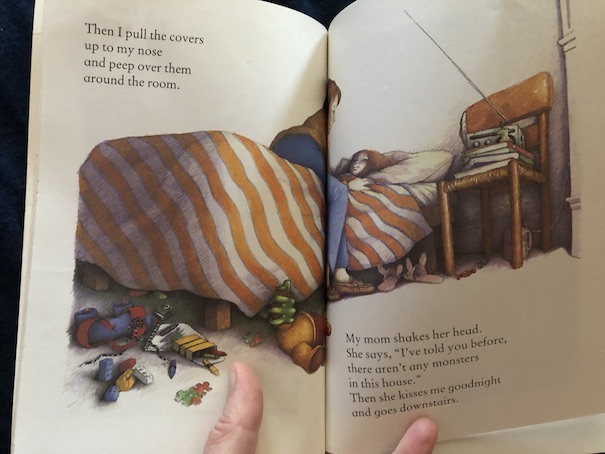
Norman Newman is convinced that his sister, Elaine, is a witch. When he goes to her room one evening to call her to dinner, he catches her all dressed in black and chanting strange words.

Norman likes to read horror and mystery books, and he uses some of the techniques that he has learned from reading his favorite mystery stories to investigate his sister. Some of these techniques don’t work as well for Norman as they do for the characters in his books, partly because he doesn’t really know how they work (like which end of a glass you’re supposed to put against a door when you’re trying to listen in on someone) and partly because the characters and situations in books are fictional and some of the things they do don’t work that well in real life.

Early in the story, Norman uses one of his scary stories for a book report for school, and his teacher tells him that she wants him to start to read other types of books. She makes him write an extra book report, telling him that he has a week to read something outside of his usual genre and report on it. That incident and some other pieces of bad luck cause Norman to think that maybe Elaine really is a witch and that she put a curse on him, just like a witch in the book he just read.

Norman’s friend, Milo, thinks that Norman’s imagination is just running away with him. It’s happened before because of the scary stories he reads. Once, he thought that their teacher might be an alien.

When Norman has a brief streak of good luck, he starts to think that whatever curse Elaine put on him may be over, but then, he gets sick to his stomach. He goes to the library to get a book for his new book report, and he also gets a non-fiction book about witches. Then, he overhears Elaine talking to her friend, Deirdre, about something being powerful and scaring Deirdre’s sister. The two of them begin chanting together. Norman decides that he was right about Elaine being a witch and that Deirdre must be a witch, too.

After some research, Norman and Milo learn that, to get rid of the effects of a magic spell, they need to learn the words to the spell and say it backwards. Norman doesn’t remember the whole spell from when he heard Elaine say it, so Milo says that he’ll just have to look for a copy of the spell in her room. The book they consult also says that a spell can be neutralized if the person it was cast on duplicates it, which means gathering all the materials used in the spell, but Norman doesn’t know where he would find things like newts’ eyes and frogs’ toes. Either way, it looks like Norman’s going to need a copy of Elaine’s spell. However, even when he gets it and tries to break the curse, things still go wrong. What can Norman do to get rid of this bad luck spell?

I particularly liked the character of Milo in the story. Milo uses a wheelchair because he was hit by a car when he was young and can’t walk. Norman notes that, although Milo can’t use his legs, he gets around very well in his wheelchair and that he has very strong arms. Milo is also more level-headed than Norman, pointing out to him how he has allowed his imagination to run away with him in the past.

The book is available to borrow and read for free online through Internet Archive.

Spoilers and Other Thoughts

I thought that the secret behind Elaine’s spell was pretty obvious from the beginning because the book repeatedly says that Elaine wants to be an actress. It reminded me of other stories I’ve seen where someone’s playacting was mistaken for some real life danger. Overall, I enjoyed the book, even though I figured out what was going on pretty quickly. Kids might be in suspense for longer.

By the end, Norman still hasn’t learned his lesson because the next scary story he reads leaves him looking at his dog suspiciously. There is at least one sequel to this story called Norman Newman and the Werewolf of Walnut Street.

The Vanishing Scarecrow

The Vanishing Scarecrow by Phyllis A. Whitney, 1971.

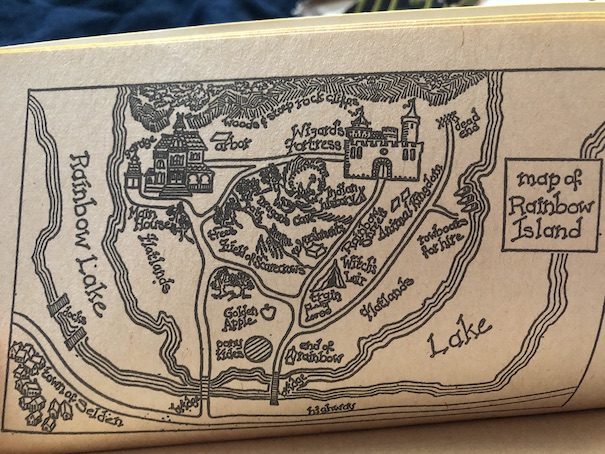
Joan Lang and her mother are moving from their town in Connecticut to Rainbow Island, where Joan’s Great Uncle Agate Benson owned his own amusement park. However, the move is sad because Great Uncle Agate’s death in a skiing accident has so closely followed Joan’s father’s death from a long illness. Joan and her mother knew that they were going to have to move to a smaller house because they could no longer afford their bigger one, and Uncle Agate’s sudden death means that they will inherit his house on Rainbow Island and the amusement park that goes with it. Joan and Uncle Agate had been writing letters to each other since her father’s death, and he made her feel less lonely, so Joan knows that she will miss him, but she is looking forward to seeing the amusement park that he had described to her.

However, the terms of Uncle Agate’s will are unusual, and his lawyer is vague on some aspects of them. What they know is that they must live at Rainbow Island and manage the amusement park for three years in order to gain full ownership. If they decide to leave before that time, Uncle Agate has another plan for the amusement park, but the lawyer refuses to tell them what it is immediately.

When they arrive at Rainbow Island, they meet Mrs. Fuller, who works at the amusement park’s gift shop and lives there with her two sons, Peter and Kent. Mrs. Fuller hopes that Kent and Joan will be friends because they’re close in age. Kent doesn’t seem particularly friendly at first, and when Joan confronts him about that, he says that he’s just trying to figure out what she and her mother are going to be like. Kent, like other people who live and work at Rainbow Island, was very attached to Uncle Agate. He appreciated his vision and imagination, and he misses him now that he’s gone. He has trouble believing that things will ever be like they were with Uncle Agate.

Mrs. Fuller and Kent both mention strange things that have been happening at the amusement park recently, including a scarecrow that frightened Mrs. Riddell, the wife of Wilson Riddell, who manages the park, but she says that she’d better let Mr. Riddell explain the situation. When Joan and her mother go to Uncle Agate’s old house to begin unpacking their things, Mr. Riddell comes to talk to them. He doesn’t seem particularly welcoming, either. Joan’s mother tries to ask him about the scarecrow incident, and he explains that someone, possibly a teenage prankster, has been pulling tricks around the park lately. Earlier that day, someone ran right through the Riddell house, terrifying Mrs. Riddell. Mrs. Riddell is described as being a very nervous person who is somewhat unwell, so Mr. Riddell seems uncertain whether his wife actually saw a person dressed as a scarecrow, as she described, or if that was her imagination. Earlier, she also claimed to see a witch. The idea of someone in a scarecrow costume is plausible because the amusement park includes a field of scarecrows, and they do have a spare scarecrow costume that they’ve used in the past to make it look like one of the scarecrows has come to life, to give guests a bit of a thrill. However, the employee who normally wears the costume hasn’t worn it for some time, and it seems like the recent scarecrow sightings are the work of a prankster.

As Kent shows Joan around the amusement park, they meet up with Peter in the Wizard’s Fortress, where he points out that someone has been messing around with the dioramas of historical scenes, moving some of the little figures around to scenes where they don’t belong. In the dungeon of the fortress, Joan meets up with Mr. Riddell’s daughter, Sheri, who is also about her age. Sheri has found the costume the scarecrow was wearing under some straw. Joan isn’t sure that she trusts Sheri because of the strange way she acts and how she seems to be sneaking around, keeping secrets, and playing weird pranks and tricks.

Could Sheri have something to do with the mysterious scarecrow, or could it be Emery Holt, the man who did odd jobs for Uncle Agate and sometimes wore the scarecrow costume as an act in the park? Another suspect could be Jud Millikin, an escaped convict who used to live in the area and who still has family living nearby. Joan and her mother hear people whispering about him, wondering if he might have come back to see his sick daughter, although people say it isn’t likely that he’d show his face in town since the police are looking for him. But why would he want to sabotage the Rainbow Island amusement park? Joan considers that there might be an answer closer to home when she learns that the Riddells and the Fullers don’t really get along, and there seems to be a silent power struggle between them for control of the park. Either of the families might want the other to leave, plus Joan and her mother, so they can be in charge.

Joan finds a message and an audio recording left behind by Uncle Agate for her, in which he seems to have had a premonition of his impending death and saying that the reason why he wants Joan and her mother to manage the park with Mr. Riddell is that the park needs someone with a fresh imagination to keep creating new exhibits and keep the park interesting for new generations of children. Joan wants to find out who is sabotaging the park and to keep Uncle Agate’s vision for the park alive, but her mother isn’t so sure that the situation is going to work for them.

Joan does have a fantastic imagination. She loves writing and making up stories, and she finds the atmosphere of the amusement park inspiring. However, Joan’s mother worries sometimes that Joan lives too much in her stories and doesn’t face up to reality enough. When Joan accuses her of not liking her stories, her mother says it’s not that, it’s just that writers also need a grounding in real life and the real world, and that it’s not good to use fantasies as a way of ignoring real life. She says that Uncle Agate was like that. Uncle Agate and his sister were orphaned from a young age, and while his sister was adopted by a family, Uncle Agate remained in the orphanage for the rest of his youth. When he grew up, he became successful in the toy industry, which was how he gained enough money and expertise to start his amusement park. However, Joan’s mother believes that much of what he did with the park was trying to live out childhood fantasies from his deprived youth and forget the hard realities of it. Joan’s mother says that she finds the real world outside of the amusement park more compelling, and she doesn’t want Joan to live too much in fantasy.

Joan is attracted to fantasy, but she’s realistic enough to know that there won’t be any hope for the park until she learns the true identity of the mysterious scarecrow that is trying to sabotage it. In the recorded message he left for Joan, Uncle Agate refers to a “right place” where Joan will find instructions that will tell her what to do. As Joan explores the the amusement park, familiarizing herself with the attractions and exhibits, she searches for the place that Uncle Agate referred to. Along the way, she has frightening encounters with someone dressed as a witch and the dangerous scarecrow among the regular figures in the exhibits.

My Reaction and Spoilers

The atmosphere of the story is great, and the author does a good job of making everyone Joan meets look like a potential villain or accomplice. All through the book, I kept changing my mind about who the real scarecrow was, and there are red herrings in the form of other people dressing up in costumes. Joan is never sure who to trust. There is a major twist toward the end of the book that turns the entire situation on its head. The rest of the ending after the scarecrow’s identity was revealed seemed a little abrupt to me, but the story has a good overall message.

At the beginning of the story, Joan does actually look at the amusement park on Rainbow Island as a kind of fantastic sanctuary from her problems, where she can escape from the sad loss of her father and uncle and the problems she’s been having at school. However, she learns that the amusement park isn’t really a sanctuary because it has problems of its own and the people associated with it also have their problems. However, these are problems that Joan is more motivated to solve because they are more exciting than her problems back home, and the stakes are high.

Joan and her mother have a frank discussion about facing up to life’s problems, and Joan points out that her mother’s impulse to run away from the park isn’t that different from her reluctance to face up to her problems with her schoolwork. Joan’s mother doesn’t find the park as interesting as Joan does, so she’s not as interested in trying to save it as Joan is. It’s similar to the way that Joan was unmotivated to work harder at school because it bored her, it was less imaginative than the creative writing she likes to do, and she was preoccupied with other major changes in her life. Joan’s mother acknowledges the truth of that, that it’s easier to try to solve a problem when you’re more motivated to work on it, and the two of them agree that, whatever else they do with their lives, they can’t just abandon the park without trying to catch the saboteur.

All of the characters in the story get new perspectives on their lives from this adventure, seeing how the park and their problems fit into a much bigger picture of life. Joan comes to understand that there are some problems that she’ll still have to face up to, like her school problems, no matter what else happens, and she sees that understanding the real problems that real people have is what will give her characters and stories greater depth.

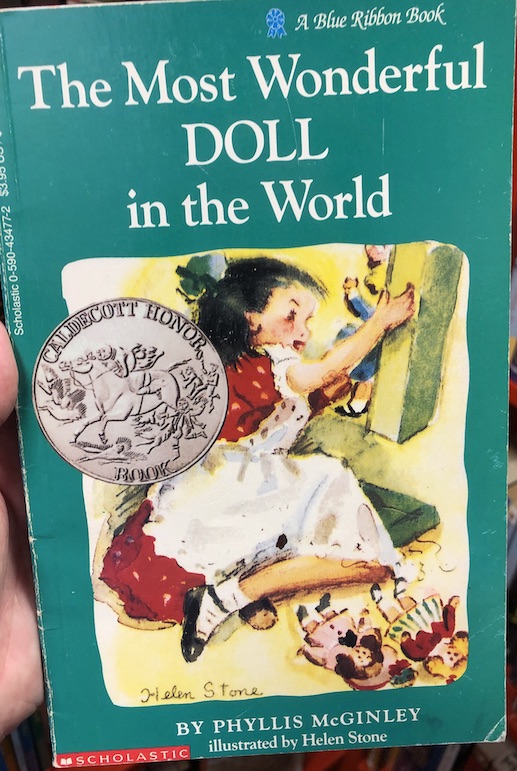
The Most Wonderful Doll in the World

The Most Wonderful Doll in the World by Phyllis McGinley, 1950.

Dulcy is a little girl who is rarely satisfied by anything. She has a big imagination, and is always wishing for something better than what she has. Dulcy has an impressive collection of dolls, but even though she loves all of her dolls, she can’t help but think sometimes that some of them would look better with a different hair color or with different clothes or with some other small detail changed. No matter how good something is, it’s never completely perfect.

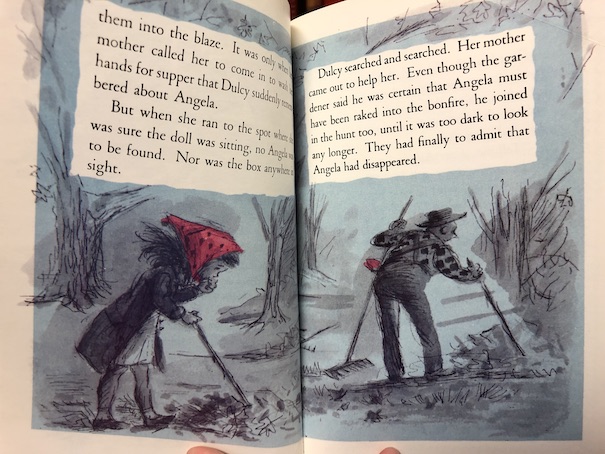
Then, one day, an elderly friend, Mrs. Primrose, gives Dulcy a doll named Angela. Dulcy likes Angela, although her immediate thought is that Angela would be even better if she had dark hair instead of blonde, finding a tiny fault as she always does. But, by accident, Dulcy loses Angela on the way home. She sets Angela’s box down when goes to help rake leaves into a bonfire, and when she goes to retrieve her, she can’t find her.

Once Angela is gone, Dulcy’s attitude changes. Dulcy is upset about the loss of Angela, realizing that Angela really was a precious and special doll. Her mother offers to get a replacement doll that looks like Angela, but Dulcy can’t imagine that any doll would be as special as Angela. As Dulcy describes the doll to her mother, she says that Angela was blonde with a blue dress and pinafore and eyes that could open and close. Those aren’t terribly unusual qualities for a doll, but Dulcy also adds that Angela had shoes with heels and could say “Mama” and “Papa” and sing Rockabye Baby. Those are more unusual, and Dulcy’s mother agrees that she probably won’t be able to find a doll that does all that.

However, readers soon begin to notice that Angela becomes increasingly wonderful each time that Dulcy describes her. When her father offers to buy her another doll, Dulcy adds that Angela could also walk and wave her hand. Dulcy tells her teacher about Angela’s little purse and gloves. She tells her friend Margery about Angela’s raincoat and umbrella.

The more Dulcy thinks about and talks about her wonderful doll, the less satisfied she is with her other dolls. None of them can compare to the amazing Angela! When her Aunt Tabitha gives her a skating doll, suddenly the missing Angela acquires the ability to skate as well. No doll that Dulcy has or ever could have could compare to the missing Angela!

Other children at school are fascinated by Dulcy’s descriptions of Angela and all of the marvelous things Angela had and Angela could do, which get more and more wonderful every time Dulcy tells the story. Then, people start getting tired of hearing about Angela. Dulcy’s friends don’t like hearing that their dolls aren’t as good as Angela, and people stop giving Dulcy dolls as presents because she always says that they’re not as good as Angela.

Then, one day, when Dulcy is playing with a new girl in the neighborhood, they find the box with the missing Angela. When Dulcy sees how the real Angela compares to the one that she dreamed about and imagined when she was lost, Dulcy comes to a greater understanding of the power of her imagination and the need to appreciate things being just the way they are.

Dulcy doesn’t completely give up imagining things and dreaming of perfection, but she does learn that part of growing up is remembering the difference between what she imagines and what is real. She realizes that when she was moping about the doll she didn’t have, she kept herself from having fun with the dolls she did have and discouraged people from giving her other nice dolls. Dulcy saves all the of the amazing qualities that she dreamed of for Angela and gives them to an imaginary doll called Veronica. Dulcy keeps Veronica as her perfect doll in her imagination, and she knows that Veronica is imaginary. As long as she can have her imaginary doll to be as amazing and perfect as she wants, she can be happy with her other dolls being just the way they are, and they make her happy, too.

The book is a Caldecott Medal winner. It is available to borrow for free online through Internet Archive.

Harold and the Purple Crayon

Harold and the Purple Crayon by Crockett Johnson, 1955.

Harold loves drawing things with his purple crayon. In fact, everything in the story is a creation of Harold’s, drawn with his purple crayon.

First, Harold decides that he wants to go for a walk in the moonlight. He draws a moon and a path that he can follow.

Along the way, he decides to draw a forest with an apple tree. However, he makes the mistake of drawing a dragon to guard the tree, and it frightens him.

Harold’s hand shakes, and he accidentally draws water and falls in. Fortunately, he also draws a boat and sails to a beach where he can have a picnic lunch.

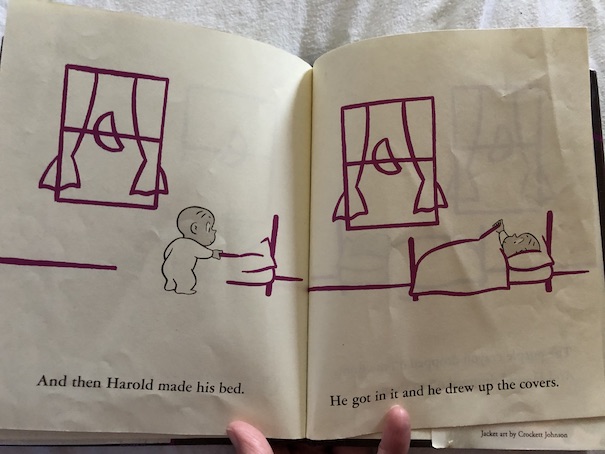
After a series of adventures, Harold decides that he wants to go home, but he has trouble finding his home. He looks for his bedroom window, and then realizes that his window should look out on the moon, which is still in the sky.

After drawing his window and bed, Harold goes to sleep.

The story is rather surreal. We never see Harold’s real home or any other people who are not drawn by Harold. All we see in the story is Harold and the things he draws with his purple crayon. This is a story about the power of imagination, and at the end, we can only imagine Harold’s real life because we never see him return to it.

The book is available to borrow for free online through Internet Archive (multiple copies).

Where the Wild Things Are

Where the Wild Things Are by Maurice Sendak, 1963.

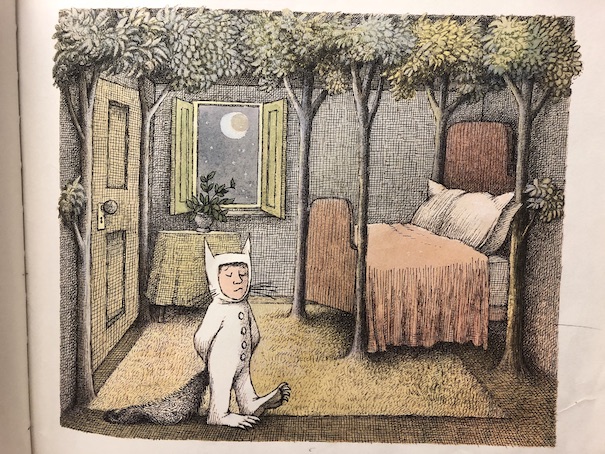
One evening, Max puts on his wolf costume and starts causing trouble all over the house. His mother calls him a “wild thing” and sends him to bed early without supper.

As Max mopes in his room, a forest grows around him, and Max climbs into a boat and sails away.

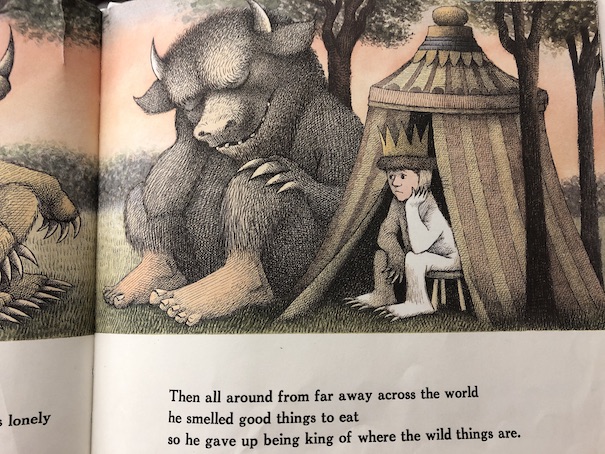
Max eventually arrives at “the place where the wild things are.” There are all kinds of wild beasts and monsters there, and they make Max their king because he’s the wildest of them all.

After they all go parading about and swinging from trees, Max sends all the wild things to bed and is lonely because he wants to be with someone who loves him.

So, Max sails home again to have his supper, which is waiting for him, still hot.

Max’s magical journey is in his own head. Angry and hurt at being told off for his behavior, he imagined himself far away from where he was being punished, in a place where he could act any way he wanted and tell other people what to do. But, that wasn’t satisfying because what he really wants is to be loved and cared for. Wild monsters don’t get the kind of nurturing that small human boys get from their mothers, so there are benefits to being a civilized human. This is a classic children’s book about the power of a child’s imagination and how love and human feeling wins out over anger.

The book is a Caldecott Medal Winner. It’s available online through Internet Archive.

Things to Do During Coronavirus

People are cooped up in their homes as communities around the world quarantine in an effort to slow the progress of the virus, both to prevent hospitals from becoming overrun with too many victims at once (although that’s happening already in some places) and in the hopes of a vaccine to prevent further illnesses (vaccines are being developed and tested in multiple locations, but from what I’ve heard, they aren’t likely to be widely available until sometime next year).

Personally, I’m been in something of an odd situation from the very beginning. Not odd in the sense that my life has changed weirdly. I mean odd in the sense that it hasn’t changed much at all. I take online classes, I work on personal websites and blogs, I volunteer for a local organization that helps teachers, but all of those activities involve my computer. Even my volunteer work is often done remotely. Basically, I’m accustomed to spending a lot of time in front of my computer or reading books. Now, I’m still sitting in front of my computer and reading books. Although my direct contact with the outside world (beyond the internet and my communications with friends in other places) is minimal, basically only what I need to do in order to get supplies and walk my dog, I still worry that I could end up getting the virus in spite of my precautions, but that’s the risk we all take, and others are in far more danger than I am right now. I learned a long time ago that it just isn’t possible to control everything that happens in your life, and I’ve arranged everything I can control as best I can, which is about as much as anybody can do right now.

I like to consider wider events in terms of terms of the books I’ve been reading. I talked about the coronavirus a bit in my reviews of Charlotte Sometimes (which takes place partly during the 1918 influenza pandemic, and I did that review before I knew that we were headed into a new pandemic) and Will It Be Okay? (which I couldn’t get pictures for because the local libraries are closed, but you can still read it online). So, I’ll be starting to cover some children’s activity books and adding some resources for helping people to carrying out the activities in the books. However, after some thought, I’ve decided to go further and create a list of resources, including websites and videos, not just books and sources of reading material, to help people keep busy while they’re sheltering at home during the pandemic.

I don’t really mind spending extended periods of time at home because I actually have many interests and hobbies, not to mention all the books I still want to read, and I never get enough time to do everything I want to do. I’m also a definite introvert, so a lot of what’s important to me happens in my head, and I appreciate relatively uninterrupted periods when I can develop ideas that I’ve been toying with in odd moments. Of course, this also often leads to more projects and hobby concepts than I will ever actually do. The more I read and think about stuff, the more things I think of that I want to try. It’s a vicious cycle. I don’t get bored very often; I get boggled, trying to decide what to work on next. So, for the benefit of those who don’t go through this process, I’m going to present a bunch of random ideas for things you can do at home that don’t require any usual materials or any particular skill. In fact, I’ve decided to start a new blog with some of my ideas.

In the meantime, here are a few things to help you stave off the boredom. I’ve grouped them by subject, and I’ve made notes about books that relate to some of them. Most of these activities are child-friendly, but not exclusively so. These are things that adults can do as well.

Places to Read Books for Free Online

All or most public libraries offer books online these days (provided that you have a card for that library), and Amazon offers some free public domain books for Kindle. However, there are other places where you can find books that you can simply read in your browser, some of which also have audio. I have a list of places where you can read books for free online on my Resources page. I’ll reprint the list here for easy reference:

Internet Archive

“A non-profit library of millions of free books, movies, software, music, websites, and more.”  It’s free to use, but it requires you to sign up for an account.  It has more than just public domain books.  Various organizations, such as libraries and book-selling companies, have donated scanned copies of many books and also various audio recordings, some software (such as old computer games), and other materials.  There is even help for users with print disabilities.  Patrons may borrow up to 5 items at a time, and books can be borrowed for up to 14 days, with the option to renew. When your time is up, the book simply disappears from your list of loans, so there are no late fees. You can also turn in books early if you’re done with them and want to get something else.  Patrons can also place holds on books which are currently being loaned.

Project Gutenberg

Provides free e-books of books that are in the public domain.  Some of the older vintage series described on my site are here. There is no need to sign up for an account. E-books are available in multiple formats.

Internet Sacred Text Archive

This is a collection of public domain works, especially those about religion and folklore. Most of it isn’t for children, but some of the folktales and fairy tales overlap with children’s literature. For example, they have a complete collection of the Lang Fairy Books (also known as the Color Fairy Books because of the titles). There is no need to sign up for an account, you can simply read the texts in the page.

Lit2Go

An online collection of public domain works by the University of South Florida. The description on the main page states:

“Lit2Go is a free online collection of stories and poems in Mp3 (audiobook) format. An abstract, citation, playing time, and word count are given for each of the passages. Many of the passages also have a related reading strategy identified. Each reading passage can also be downloaded as a PDF and printed for use as a read-along or as supplemental reading material for your classroom. “

The collection contains more than children’s literature and is free for the public to use. You can listen to the audio version of a book while reading the text version of a book in your browser at the same time. You can search for books by author, title, genre (broad categories such as mystery, adventure, fantasy, and horror), collection (shows specific topics such as African-American Literature, The Princess Collection for stories about princesses, or specific series such as the Oz books or the Lang Fairy Books), or reading difficulty according to the Flesch-Kincaid grade level system.

Writing for Fun

Writing can be a lot of fun, and writing really well requires practice and skill. However, you don’t have to be Shakespeare or Dickens to have fun with writing. Don’t worry about being a great writer, especially if you’re new to it. If you write at all, you’re a writer. The best way to learn is just to keep doing it and see what works and what doesn’t. Think of your craziest ideas and just get them out there! Put them on paper or on your computer

When you’ve written something that you want to share with other people, you could get a free online blog, possibly through WordPress (like my blog) or Blogger (through Gmail). There are also special sites to submit your writing online where it can be read by the public, reviewed, or sometimes, entered in contests.

Fanfiction.net – Exclusively for fan fiction. This means that people write their own stories based on characters and worlds that already exist in books, movies, tv series, and video games. Free to use, but requires you to set up an account.

Fictionpress.net – This is for original fiction, using original characters. Free to use, but requires you to set up an account.

Inkitt – Accepts a wide range of fiction, holds contests, and offers publishing deals for stories that get a lot of positive attention.

Writing When You Don’t Know What to Write About

Don’t worry about coming with a great idea, just start writing about something, anything, and see where it takes you. Good writing is creative and shows a strong voice, so you can start with a very basic topic and just allow your personality or your characters’ personalities to carry it from there.

Fan Fiction

If you don’t want to take the time to build characters or worlds for them right now, you could start by writing some fan fiction, which involves taking characters and situations from already-existing fiction and putting your own twists on them. For example, you could make up a new situation to happen on the Enterprise from Star Trek or a fictional planet for characters from Star Wars to visit. You could write a story that could happen to the characters from Harry Potter that occurs between their established adventures in the books, or you could play “what if” and write about how things could have gone differently if something from the original stories changed. For example, suppose that Harry’s father survived, even though his mother died protecting him? Or vice versa?

Imaginary Vacation

Travel for fun isn’t a particularly good idea right now because of the coronavirus, but I remember reading an article a long time ago about how planning a vacation can be very stress relieving, even if you don’t actually go. (I’d put the link there, but it was so long ago that I can’t remember where it was.) It’s a kind of mental vacation. In a way, I think mental vacations can be even better than actual vacations because you don’t have to worry about staying within your own personal budget, making your travel connections on time, or the availability of tickets and hotel reservation.

Just pick a destination and look up local sites and hotels. Plan an itinerary for yourself, and look up YouTube videos of sites in the area to get an idea of what they actually look like in person. Look up the history of the area for local flavor. You can even plan meals at the best restaurants in the area, whether you could normally afford to eat there or not.

You can expand on your dream vacation by turning it into a story, writing in romance or intrigue, or just file it all away as a vacation you’ll take some day, when you can.

Writing When You’re Just Really Bad at Writing

Don’t let that stop you. When you can’t write well, writing badly, and have fun doing it! As I said, you don’t have to be a great writer, you just need to keep on doing it, and that’s how you get better. Besides, if you think you’re just really awful at writing, have I got a writing contest for you! I just have one question: Can you be really bad at writing on purpose?

The Bulwer-Lytton Fiction Contest appeals to me not just because I like writing but because the aim of this contest is to write badly.  Specifically, you have to pretend that you are writing the first sentence to a very badly-written book, and the winner is the worst one.  There are quite a lot of contenders, which is how they have been able to publish books full of past entries. I covered one of these books on my other book blog.  The namesake of the contest is Edward George Bulwer-Lytton, who has sometimes been credited with originating the hackneyed opening line “It was a dark and stormy night …” (although that expression had actually been around before Bulwer-Lytton used it).  This line was the inspiration for the contest and is part of the title of each compilation of past entries. Anybody can enter the contest, and you can submit as many horrible opening lines as you want. The only requirement is that your entries have to be one single sentence, but it can be a very long run-on sentence. I entered this contest myself about six times last year but didn’t win, which means that I’m either not bad enough at writing to win or not good enough to make myself sound really horrible on purpose. It’s a toss-up.

For inspiration, you can read past winning entries online. They’re pretty entertaining, and it’s fun to imagine what the rest of those stories would be like.

If All Else Fails

Write about your experiences during the coronavirus, even if it’s just a rant about your worries and the inconveniences of getting groceries and household supplies or staying at home with family members who drive you crazy. You’re living through a major historical event that is affecting the entire world right now. What you have to say about it will be of interest to people later, and if nothing else, getting your thoughts out will do you some good. If you need someone to rant to, go ahead and comment below. I rant regularly when I feel the need, and I don’t mind airing a few rants from others.

I Can Fly

I Can Fly by Ruth Krauss, 1950.

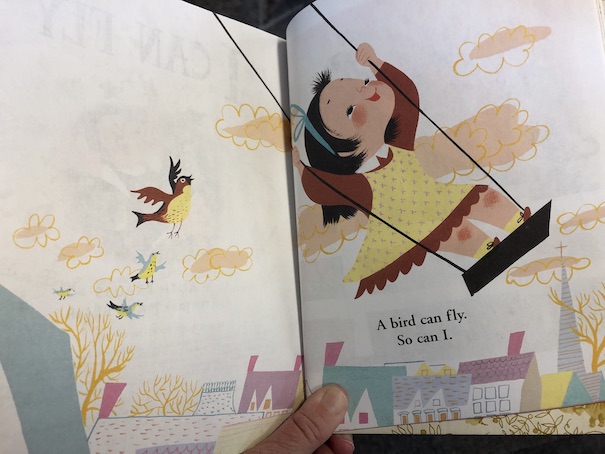
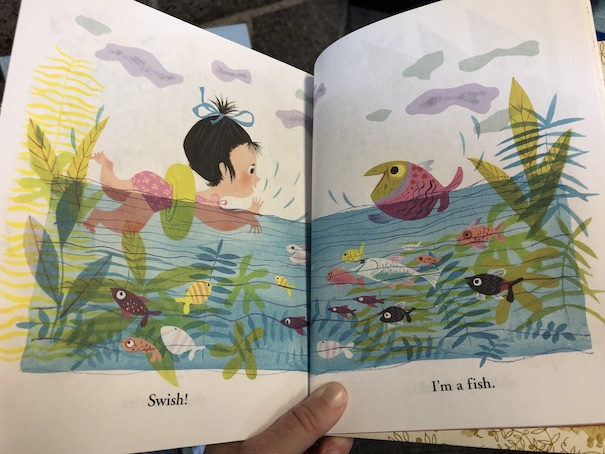
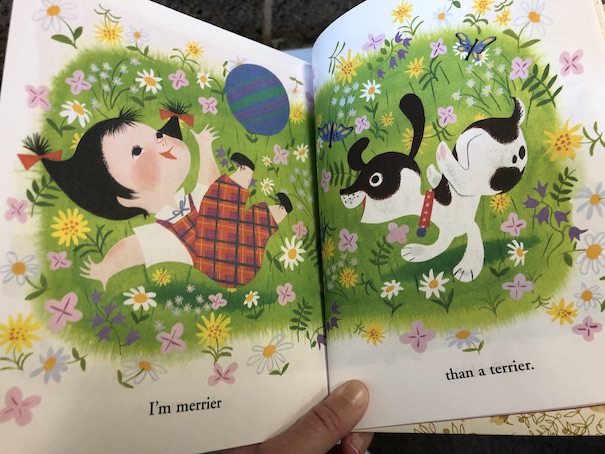
This is a cute Little Golden Book about a little girl playing.

As she plays, she compares herself to various animals. When she’s on her swing, she feels like she’s flying like a bird, and when she swims, she feels like a fish.

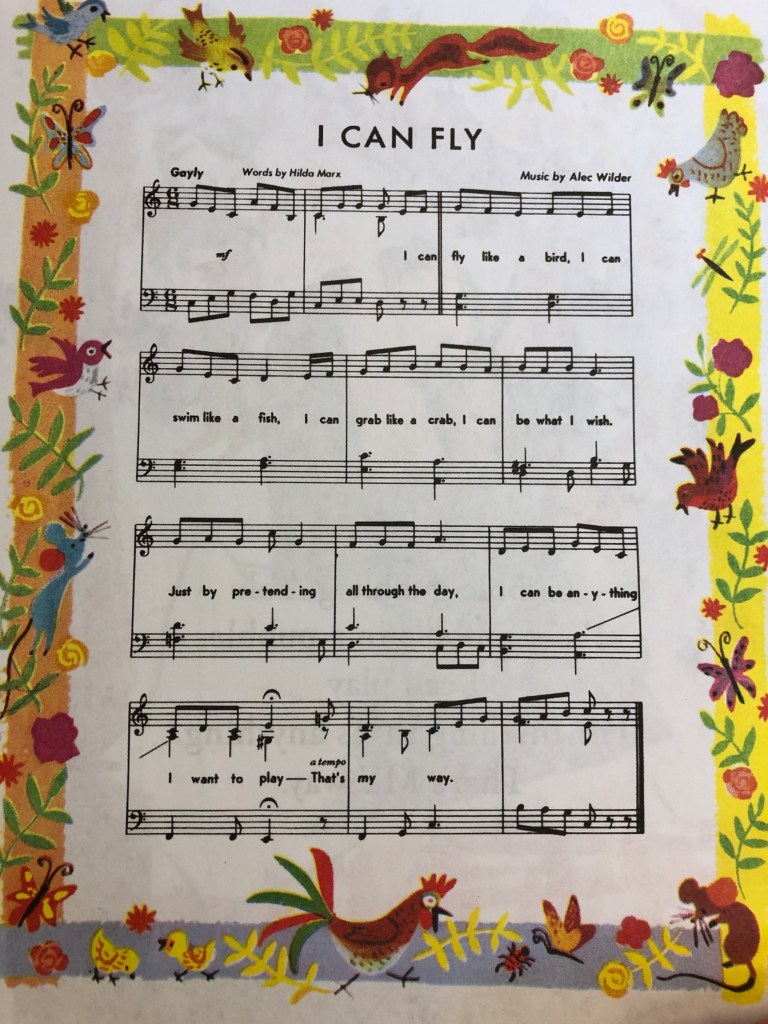
The story is told in rhyme, and in the back of the book, there is actually music so you can sing the rhyme as a song.

There are different printings of this book, some with different illustrations. The different versions also have different words, and it looks like the newer one includes both a boy and a girl and doesn’t have the music for the song. One of the newer versions is available to borrow for free online through Internet Archive.

Mystery in the Apple Orchard

Mystery in the Apple Orchard cover

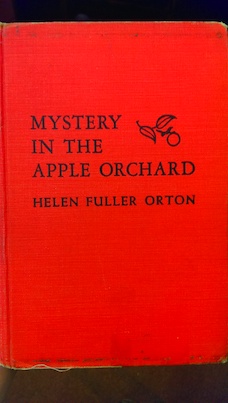
Mystery in the Apple Orchard by Helen Fuller Orton, 1954.

Mystery in the Apple Orchard swing

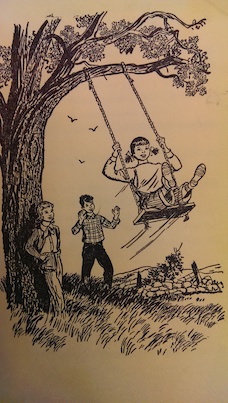
Dee Waters (age nine), her brother Ronnie (age eleven), and the other neighborhood children enjoy playing in the nearby apple orchard. The orchard was planted by Dee and Ronnie’s grandfather, and the trees are all different types of apple. Sometimes, the children take a lunch with them and spend hours climbing trees and playing. They like to watch the animals there, like the squirrels and crows, running around and hiding things in the trees. There is also a swing hung in one of the trees.

The Waters’ housekeeper, Mrs. Brown, lives in the city and commutes to her job in the country. She also has a son, Timmy, and she’s been concerned about him. Timmy is recovering from a broken leg. The bullies in his neighborhood dared him to climb a tall pole, and he fell. Although Timmy’s been out of the hospital, he hasn’t been getting enough fresh air and time outdoors in the city because they don’t live near a park. Dee and Ronnie don’t know Timmy, but hearing that he’s been unwell, they suggest that Mrs. Brown bring him along the next time she comes so that they can show Timmy the apple orchard. The children’s mother thinks that’s a good idea and also urges Mrs. Brown to bring Timmy for a visit.

Timmy is a little younger than Dee and Ronnie, and he can’t play many games with the children yet because he still walks with a crutch and can’t run. Still, he is fascinated by the animals in the orchard and enjoys watching them. He doesn’t see many wild animals in the city.

Most of the other children in the area are nice to Timmy, but Gloria is a little bit of a snob. Ronnie finds Gloria annoying because she is so prissy and extra careful about her clothes, and on Timmy’s first day in the orchard, Gloria shows up with a ring that she says has a real diamond and a family. The other children don’t believe her at first because it would be silly to wear an old, valuable ring to an apple orchard, especially when it looks so loose on her finger. Ronnie warns her that it could get lost, but Gloria tells him to mind his own business. She also tries to cheat when they play hide-and-seek, asking Timmy to tell her where everyone is because he can’t play the game anyway. Timmy refuses to help her cheat, and Gloria leaves in a huff. Because this is a mystery story, you can see where this is probably leading.

Mystery in the Apple Orchard play ticket desk

When Timmy comes the next time, the children decide to pretend that they’re going on trips by airplanes, with the trees in the orchard representing the planes. Timmy is sad that he can’t climb with the others, so they make him the ticket agent in the airport. Gloria shows up again, still with her diamond ring, and the other children again warn her that she could lose it in the orchard. Gloria says that’s impossible because she tied it to her finger, and she shows the the string. (What was it they said about the Titanic being unsinkable?)

Naturally, the ring gets in the way while Gloria is playing with the others, catching on a twig in a tree. They have to untie the string to get her loose. The other children tell Gloria to put the ring somewhere safe while she plays, suggesting that Timmy the ticket agent could watch it. However, Gloria decides to put the ring on a stone near the old well that has been filled in. (Considering that there are small animals in the orchard that happen to like shiny things, this was not the best decision.)

Mystery in the Apple Orchard digging

Sure enough, by the time Gloria comes down from her tree and her imaginary flight to Paris, her ring is gone. Naturally, Gloria is upset and admits that she was wearing the ring without her mother’s permission. (Gloria likes to show off.) She accuses one of the other children of taking the ring. Timmy seems like the most logical suspect, since he was on the ground while the others were in the trees, but he denies it, saying that he closed his eyes so he could imagine a flight, like the others were doing. Dee suggests that an animal could have taken the ring. Earlier, a chipmunk carried off the piece of string. On the other hand, crows also like shiny things. Could the crow have swooped down and carried it away?

Gloria still insists that Timmy took the ring, and she threatens to tell her mother that he stole it. Can the others find the ring before Timmy is labeled as a thief?

It take awhile for the other children to find Gloria’s ring, and because they failed to find it with the animals right away, some readers might wonder whether a human was responsible for taking. However, the mystery itself is very simple and wouldn’t really surprise anyone but young children. In the end, though, the important point is that Timmy is so motivated to find the ring and clear his name that he finds the courage to climb a tree again. He has healed from his broken leg more than even he thought he had. Before coming to the country, the doctor had told him that he could stop using his crutch, but he hesitated to do that because he was so afraid of re-injuring himself. Once he gets the courage to try not using his crutch, he discovers that he can also do many other things, although he does freeze up when trying to come back down the tree and needs the help of a couple of telephone linesmen to get back down. The linesmen tell him that it’s okay and that God has smiled on him for helping him to improve and do what he needed to do. Timmy is reassured by the discovery that he can do more than he thought he could, and his mother and Mrs. Waters decide that the Browns should move to the country permanently so that Mrs. Brown won’t have to commute to work and Timmy can have more fresh air, playing with the other children in the apple orchard.

This book is available to borrow for free online through Internet Archive.

More Perfect Than the Moon

More Perfect Than the Moon by Patricia MacLachlan, 2004.

This is the first book in the Sarah, Plain and Tall Series that is narrated by Cassie, the younger daughter in the family. 

By this time, Cassie is about eight years old, and her grandfather, who rejoined the family in the previous book, has been living with them for a few years.  Caleb has also found a girlfriend (Violet, Maggie and Matthew’s daughter).  When Cassie writes entries in the family’s journal (started by Anna in the first book), they are partly fantasy, like when she thinks that Caleb and his girlfriend will someday marry and go to live in Borneo, where they will eat wild fruit.  When Caleb tells her that the things she’s writing aren’t the truth, she says, “It is my truth.”  (Oh, criminy!  I hate it when people say that.  Well, she doesn’t really mean it in the sense that I’m sick of hearing it.  I like games of pretend, but only those where the people playing them realize that it’s both a game and pretend.)  Fortunately, it’s just that Cassie is an imaginative child, and most of what she imagines is wishful thinking about things she would like to see happen.  With Cassie, the journal becomes not just a documentary of family events but of her feelings about them and what she imagines.

As Cassie grows more observant because of her writing, she notices that her mother’s behavior is changing.  Sarah is sleeping a little more, and she doesn’t always want to eat. Cassie worries that she’s sick.  Then, one day, Sarah faints.  Jacob takes Sarah to the doctor, and in the journal, Cassie writes about how her mother is well and will bring home a perfect present for her, “More Perfect than the moon,” in the hopes that it will come true.

When Sarah comes home and Cassie tells her what she wrote, Sarah says that it is true because she is pregnant.  Her perfect present will be a new baby.  Cassie doesn’t think that a baby sounds like a perfect gift.  She doesn’t want the baby because she doesn’t want things to change.  She is determined not to love the new baby.  Anna (who is now engaged to her boyfriend, Justin) tells Cassie that she didn’t love her at first, either, but she came to love her.  When Cassie asks Anna what made her love her as a baby, she says that she couldn’t help it and that she’ll understand when the new baby arrives.  All the same, Cassie can’t help but wish her mother would give birth to a cute little lamb instead.

Then, Cassie hears Sarah telling her friend, Maggie, that she thinks she’s too old to have a baby.  Cassie knows that Anna and Caleb’s mother died giving birth to Caleb, and she worries that the same thing could happen to her mother.  She thinks that the “terrible baby” is putting her mother’s life in danger.  Sarah tells her that’s not really the case, that she just thinks that it will be difficult to run after a young child again.  Still, Cassie worries and tries to keep an eye on her mother.  Sarah tells her that it isn’t necessary and that she will let her know when she needs her, like when the baby is going to be born.

As everyone guessed, Cassie’s feelings about the baby change once he arrives and she sees him for the first time.  At one point, Cassie admits to Sarah that some of the things she writes in her journal are nasty, but Sarah understands and says that one of the reasons to keep a journal is “To put down feelings. That way they don’t clutter up your head.”  Sarah knows that Cassie has a lot of worries about the new baby and the changes that will come in their family, and she knows that the journal is a way for Cassie to sort out her feelings. Once Cassie gets her worries and bad feelings out of the way, she is better able to move on to better things. Journals can be therapeutic.

The book is available to borrow and read for free online through Internet Archive (multiple copies).

The Bear That Was Chicken

The Land of Pleasant Dreams

The Bear That Was Chicken by Ane Weber, Ron Krueger, Tony Salerno, 1986.

In her dream, Mary meets Threads the Bear.  When she meets him, he’s trying to sleep under a tree.  He’s sad and tells Mary that he thinks he’s a chicken and that all of his friends say so.  (It’s not a nice thing for friends to say, and I wish the story had said so.  There’s a song about it on the tape that accompanies the book with the words given in the book, but it bothers me because calling people “chicken” is something that I associate with people who are trying to goad people into doing things that they really shouldn’t do. I don’t think that it’s good to teach children to react to being called “chicken” or any other insulting names.)

Mary thinks that Threads’ imagination is getting the better of him and that’s why he’s so afraid of so many things.  However, Threads tells Mary something that isn’t imaginary: there are some strange eggs in his cave that appeared there suddenly and mysteriously.  That’s why he’s sleeping in the forest, because he doesn’t know where the eggs came from or what they are.  Mary bravely offers to go with him to have a look at the eggs.

When they go to look at the eggs, Mary thinks that they look pretty harmless.  They’re kind of cute and colored like Easter eggs.  Threads is still worried about them and what they might hatch into.  Mary says again that Threads is imagining the worst and volunteers to sit with Threads while he takes his nap and keep an eye on the eggs to see what happens.

The eggs do hatch, and it turns out that they contain tiny teddy bears, very much like Threads.  When Threads sees the little bears, he loves them and thinks that they’re adorable.  The little bears seem worried when Threads wants to take them outside to play, but Threads encourages them, telling them that there’s nothing to be afraid of.

Moral: Your Greatest Fears Are Often Those You Imagine.

The main message of the story is that it’s better to face your fears than imagine the worst. However, I found some of this story a little confusing as a kid, and some of the implications are a little alarming when you begin to analyze it.  Where did those little bear eggs come from?  Did Threads lay them himself in his sleep? Are those little bears his children?  Did Threads lay eggs because he was a “chicken”?  But, Threads is a boy bear!  Then again, this is supposed to be a dream, so I guess it doesn’t really have to make sense.

I still don’t like that the story uses “chicken” as an insult and in a way that implies that people who are called “chicken” should try to prove that they’re not. This just seems like a recipe for disaster, encouraging children to accept dares.

The book is available to borrow and read for free online through Internet Archive. This book is currently available online through Internet Archive. It was made into an episode for the tv show version of this series with puppets.