Shadow in Hawthorn Bay

Shadow in Hawthorn Bay by Janet Lunn, 1986.

Mary (or “Mairi,” they spell it both ways) Urquhart and her cousin Duncan had always loved each other.  They were always close as children, feeling more like two parts of one person than separate people, and they always imagined that they would spend the rest of their lives together.  Then, Duncan’s parents, Mary’s Uncle Davie and Aunt Jean, decided that they wanted to travel to Canada, while Mary and her parents stayed at home in the Scottish Highlands.  Duncan hadn’t really wanted to go.  He was only eleven, and he promised Mary that when he was older, he would work hard to earn enough money to come back.  However, Duncan never came.  He only sent Mary a brief letter about the dark forest where he now lives.  Mary feels like the Duncan she knew is gone forever.

Four years later, in 1815, when Mary is fifteen, she has a strange feeling, like Duncan is calling to her from across the ocean.  All of her life, Mary has had a strange gift for seeing into the future or reading others’ minds.  The “gift of two sights,” people call it, but Mary doesn’t feel like it’s a gift.  It makes her uneasy, and she can’t control it.  She hears Duncan’s calls to her through her “gift,” but she is afraid because she doesn’t want to leave Scotland.  She wants Duncan to come to her.

However, she is unable to resist Duncan’s calls.  She asks her parents for help with money for her passage to Canada, but they tell her that she is wasting her time and that, even if they sold their family’s most precious heirloom to give her the money, there would not be enough for the return journey.  A family friend gives her the money instead, and although Mary doesn’t really want to accept it and doesn’t really want to go, she can’t help herself.

The journey to Canada is miserable, and when she finally arrives at the place where her aunt and uncle live, alone and without money, she learns something which she thought she had sensed during the journey: Duncan is dead.  Duncan committed suicide while Mary was still on the ship to Canada.  Mary has arrived too late.  To make matters worse, one of the family’s neighbors, Luke Anderson, tells her that her aunt and uncle gave up the idea of farming in Canada and have already begun the journey back to Scotland.  Mary has no money to follow them, and they have no idea that she’s now in Canada, alone.

Luke takes Mary to Mrs. Colliver, who tells Mary a little about her family and their life in Canada and why they decided to leave.  Mary is devastated by the loss of Duncan and tries to tell Mrs. Colliver about how she felt that Duncan had been calling out to her, but Mrs. Colliver tells her that she doesn’t believe in ghosts or things like that.  Although Mary knows that her “gift” is real and so are spirits, she learns that others in the community share Mrs. Colliver’s no-nonsense, disbelieving attitude toward such things.  Mary, in her despair, wants to rush straight back to Scotland, but Mrs. Colliver, with her practicality, points out that Mary can’t possibly get there without money.  She tells Mary that she can stay with her family, that she will give her room and board in exchange for help with chores and that she can earn extra money for weaving and spinning.  Mary is clumsy at household chores because she was always better with animals at home, but when Mrs. Colliver sees Mary’s skills with animals, she is appreciative.

Life is hard in the small farming community.  Mrs. Anderson, Luke’s mother, explains to Mary that most of the people who live there are refugees.  When they were young, their families moved there from the Thirteen Colonies that now make up the United States because they were Loyalists.  When the Revolution came, they couldn’t stay, and so had gone north to Canada, where they struggled to establish a new community for themselves with their small homesteads. During her time there, Mary witnesses the death of a baby and the hardships of this strange place, seeing why Duncan didn’t like it there.  They tell her that Duncan was a strange boy who would seem bright and happy one day, but black with depression the next, something Mary remembers in him even before he went to Canada. 

The people are kind and welcoming to Mary, although they find her a bit strange.  As Mary struggles to make a life for herself, hoping to earn enough money to return home, she slowly comes to appreciate Luke’s kindness and help.  She learns healing arts and the use of herbs from another woman in the community, developing new skills.  In helping others, she earns their appreciation and a place in their community.  Luke Anderson becomes very fond of Mary, but she still mourns for her lost Duncan.  In spite of his kindness, she doesn’t see how she can make this strange, hard, dark forest of Canada her home, where it doesn’t even seem like the spirits she believed in and that seemed to protect her when she lived in Scotland exist.

Mary is melancholy and feels like she doesn’t belong in Canada.  It distresses her that she can no longer feel Duncan’s presence . . . although she can oddly hear him calling to her sometimes.  Mary also unnerves people when she makes predictions that come true and speaks about ghosts and spirits.  When she almost gives in to her homesickness and depression and kills herself, lured to the spot where Duncan drowned himself by his ghostly calls to her, she finally sees Duncan’s death for what it really was and finds the courage to refuse to follow him down the dark path that he chose for himself and to fight for the life she has been building, the one she really wants to live.

The book is available to borrow and read for free online through Internet Archive.

My Reaction

This book is part of a loose trilogy, involving ancestors and descendants of the Anderson and Morrisay families.  All of the books take place in or near Hawthorn Bay in Canada, but at different time periods.  Some of the characters are psychic, like Mary, or have the ability to travel through time, like Susan in The Root Cellar, who is apparently Mary’s granddaughter.  The connection between Mary and Susan is never stated explicitly, but it’s implied by their last name, shared psychic abilities, and comments that a friend makes about Susan’s grandmother in The Root Cellar.  In this series, the characters from each of the books generally don’t appear in any of the others (except, perhaps, for Phoebe, who appears briefly in this book and is the main character in the third story).  Most of the time, you only know about the family connections by reading the books and taking note of the last names.  The books go backward in time as the series progresses, and the connection between the Anderson and Morrisay families is only obvious in The Root Cellar.

With the deaths that occur in the book, discussions of suicide, and the influence of Duncan’s selfish, malevolent spirit, this is not a book for young kids. I’d say that readers should be middle school level or older. There is also some implied sex and pregnancy out of wedlock when one of Luke’s brothers gets one of Mary’s friends pregnant. Her friend doesn’t give the details of what happened, but from what she says, it’s implied that Luke’s disreputable brother forced himself on the girl and that she went along with it because she didn’t know what else to do. The description of that incident is minimal, but older readers will understand what happened. There is a scandal in the community because of it, and the disreputable brother leaves rather than face the consequences of his actions.

Themes and Spoilers

I enjoyed the book for its references to Scottish folklore, which Mary believes in and seems to be in touch with through her “gift” and for Mary’s growing confidence in her abilities and more mature understanding of what her cousin was really like and what her relationship with him really was.  In some ways, I do feel sorry for Duncan because he seems to have been suffering from some kind of mental illness, possibly bipolar disorder or manic depression, which would explain how his moods could shift so abruptly and dramatically.  However, Duncan was also a selfish and controlling person.  Although Duncan’s death was sad, Mary realizes that his end was of his own making, and it’s not the future she wants for herself.  There are some disturbing scenes in the story.  Mary witnesses the deaths of others, including a baby, because it is a harsh environment, where people sometimes succumb to sickness or bad weather, although these deaths are not described in too much detail. 

There are also some frightening moments, like when Duncan’s ghost almost convinces Mary to kill herself and when he similarly lures a young boy, Luke’s younger brother, to the spot where he drowned and almost kills the boy because Mary finds the little boy comforting and Duncan doesn’t want her to be comfortable and happy.  In the beginning, readers see Duncan through Mary’s fondness for him, so the true darkness of his personality isn’t immediately apparent, although I had some misgivings about him from Mary’s first description of how they played together as children.  I didn’t like the way she described how he would tease her until she became angry or hurt and then he would sulk until she comforted him.  She says that wasn’t really fair, but to me, it was disturbing because I have seen that kind of selfish personality before, and it’s never a good sign.  It shows right from the first that Duncan doesn’t really care about Mary’s feelings.  He cares only about his own feelings, and he has no interest in changing his behavior out of consideration for her.  In fact, the very idea that he should consider her feelings seems somehow insulting to him, even though he supposedly loves her.  He just thinks that she needs to reassure him that everything he does is fine whether it is or not.  In his view, Mary is obviously wrong to feel hurt even when he tries to hurt her because he has more right to his feelings than she has to hers and he should be able to behave any way he wants with no consequences.  That’s what Mary’s first description of Duncan said to me.  As soon as I saw that, even though some might consider it just the actions of an immature child, I had some suspicions about him.

My suspicions were somewhat confirmed before Mary left home. Her mother told her that she didn’t think Duncan was worth chasing after, calling him sulky and thoughtless, but the full truth of that doesn’t strike Mary until she confronts his spirit where he died. Because people in Canada don’t like to talk about Duncan much, when Mary first hears about his death, it isn’t immediately clear that he killed himself or how.  At first, it’s just somewhat implied, but when Mary is almost lured to her death, she sees the full truth about Duncan. 

Mary comes to realize that, although everyone, including Duncan and herself, felt like the two of them were two parts of the same person, they really weren’t.  Mary sees that not only can she live without Duncan, she has been living without him for years.  She lived without him for a time in Scotland, and she’s been living without him in Canada, and she can continue to live without him wherever she chooses to live the rest of her life.  When she was younger, she had thought of Duncan as being the stronger of the two of them because he was not plagued by the same “gift” she was, but she realizes that she is actually the stronger of the two of them.  Duncan’s “love” for her had also always been a selfish one.  He couldn’t bring himself to work hard and return to Scotland for her sake, but he expected her to give up everything, even her own life, to join him in Canada and in death.

When Mary realizes all of this, Duncan’s spirit loses its hold over her, and she comes to see that the darkness in him was darker than the forests that had seemed so frightening to her before.  Free from the shadow of Duncan’s death and his selfish spirit, Mary is able to see the beauty of Canada and to be more open to the good people around her, forging a new future with a better man.

Molly’s Pilgrim

MollysPilgrim

Molly’s Pilgrim by Barbara Cohen, 1983.

Molly has been unhappy since her family moved to the smaller town of Winter Hill, New Jersey so that her father could get a better job. In New York City, there were other Jewish girls like her, and she didn’t feel so strange and out-of-place. The Winter Hollow girls don’t understand her at all and don’t like her. Molly’s family fled Russia to escape persecution, and they’ve only been living in America for about a year.  Molly still has a Yiddish accent and doesn’t quite speak proper English yet.  Molly is constantly teased about the way she talks and her unfamiliarity with American habits.

MollysPilgrimSchool

One girl in particular, Elizabeth, makes up rhymes to make fun of Molly, even following her home from school like a creepy stalker, to continue singing them at her. The other girls follow Elizabeth’s lead because they kind of admire her and because she is always giving them candy.

MollysPilgrimBullies

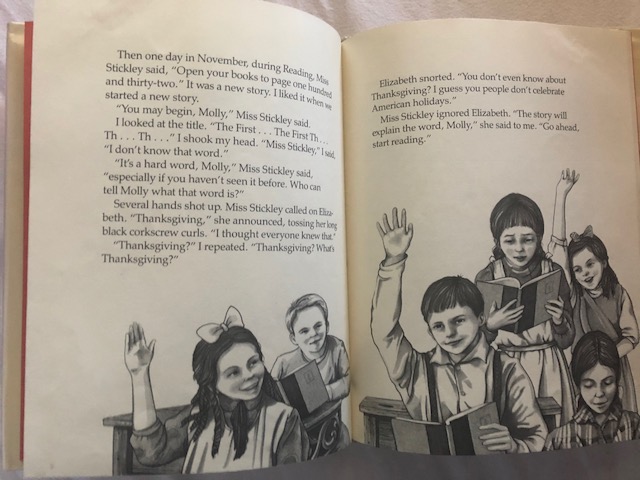
Then, one day, the girls’ teacher begins teaching them about Thanksgiving. Of course, Elizabeth makes a big deal about the fact that Molly has never heard about Thanksgiving before. But, Molly finds the story about the pilgrims interesting. The teacher says that for their Thanksgiving activity, instead of making paper turkeys like they usually do, the children are going to make clothespin dolls to look like American Indians and pilgrims, so they can create a scene like the first Thanksgiving.

MollysPilgrimClass

When Molly gets home and explains the assignment to her mother, she has to tell her mother what a “pilgrim” is. She explains it by saying that they were people who came from across the ocean in search of religious freedom. Her mother understands that and offers to help Molly with the doll.

However, when Molly sees what her mother has done with the doll, she is worried. The doll is beautiful, but her mother has dressed the doll in the clothes of a Russian refugee, like Molly’s family, not in the traditional Puritan garb of the pilgrims. At first, Molly is sure that she’ll be teased more than ever at school when she shows up with a doll wearing the wrong clothes and that people will think that she’s stupid for not understanding how pilgrims dressed.

MollysPilgrimDoll

But, Molly’s mother is correct in pointing out that their family are modern pilgrims, coming to America for the same reasons that the original pilgrims did. Molly does get some teasing from Elizabeth (that’s not a surprise, since it’s Elizabeth, after all), but when the teacher asks Molly about the meaning of her doll, it leads everyone to a better understanding, both of the holiday and where Molly and her family fit in with their new country and its history.

Molly’s teacher points out that the holiday of Thanksgiving wasn’t entirely an original idea that the pilgrims invented all by themselves but that they took their inspiration from a much older Jewish tradition from the Old Testament.  Human beings do not exist in a vacuum, and we all regularly take ideas that we’re exposed to and build on them in our own lives.  Although Puritans were generally known for their belief in religious “purity” (hence, their name) and noted for their intolerance to different religions and beliefs, they also strongly believed in education, which frequently involves taking past ideas and knowledge and applying them toward new situations.  Their Thanksgiving celebration was just an example of that, an older idea that they used for their own purpose, adapted to the lives of the people who adopted the tradition.  It was their celebration, but not their sole intellectual property.

The book is currently available online through Internet Archive (multiple copies).

There is also a sequel to this book called Make a Wish, Molly, in which Molly learns about birthday parties in the United States.

My Reaction and Additional Information

The book doesn’t mention it, but the word “pilgrim” itself is also much older than the early Puritan colonists in America.  Before the development of the America colonies, it referred to any religious traveler on their way to a holy place, and many people still use it in that sense.  A person on a pilgrimage could be just about anyone from anywhere going to anywhere else as long as the journey has spiritual significance.  The Puritan colonists used that term for themselves to emphasize the reasons why they were seeking new homes in a new land.  For them, it was a kind of pilgrimage to a place where they could start again.  Molly’s family came to America in search of religious freedom, just as the Puritans did.  Their journeys weren’t quite the same, but they shared a common purpose and ended up in the same place (more or less).

By showing the links between Molly and her family and the pilgrims, Molly’s mother and her teacher help the other students to understand that Molly really does fit in, that her being there makes sense, and that she has a place in their class and in their celebration of Thanksgiving.

This story was also made into a short film. I remember seeing it in school when I was a kid in the early 1990s.  I checked on YouTube, and there are trailers posted for this film.  One thing that I hadn’t remembered from when I was a kid was that the time period of the book was earlier than the film.  In the film, the characters are shown to be contemporary with the time the film was made, but the style of dress of the girls in the book’s pictures and the things that Molly’s mother says about why the family left Russia indicate that the book probably takes place during the late 19th century or early 20th century, possibly around the same time as the events in the famous play/movie Fiddler on the Roof.

As a side note, if you’re wondering why the girl is named Molly, which doesn’t sound particularly Russian, Molly is typically a nickname for Mary and other, similar-sounding, related names.  Molly’s mother also calls her Malkeleh, which may be her original name or perhaps another variant, if her original name was Malka, as another reviewer suggests.

In spite of the warning on that last site I linked to about reading a book with your child that may be covered in class, I say to go ahead and read it anyway.  It’s hard to say what books may or may not be used in classes by individual teachers, and if your child’s teacher doesn’t happen to use this one, it’s still a good story.  Perhaps just warn your child not to say something that would spoil the ending for their classmates who haven’t read it yet.

If Your Name Was Changed at Ellis Island

NameChangedEllisIsland

If Your Name Was Changed at Ellis Island by Ellen Levine, 1993.

Like other books in this series, this book explains about a part of American history using a series of questions and answers.  Each section of the book starts with a different question about what it was like to come to America as an immigrant in the past and what happened when they reached Ellis Island, one of the main ports of entry into the United States around the turn of the 20th century, just off the coast of New York City, such as, “Would everyone in your family come together?”, “What did people bring with them?”, and “What did the legal inspectors do?”  Then, the book answers each of the questions.

The questions and answers start by describing what the journey to America was like from the late 1800s through the early 1900s.  Typically, families would come to the United States in stages: the father of a family (or perhaps one of the older children) would make the trip first, find a job in the United States and start saving money to prepare for rest of the family to come.  Depending on the family’s individual circumstances, it might be years before all the members completed the immigration process and reunited in America.

People traveled by ship in those days, and an often-forgotten part of their journey was even reaching the port the ship to America would be leaving from.  Depending on the starting point of the journey and the travel arrangements each family was able to make, getting to the port might involve crossing borders between other countries, adding another layer of legal difficulties to the journey.

There was also the knowledge that they might be turned away once they arrived at Ellis Island.  One of the chief concerns at the time was illness.  The inspectors at Ellis Island checked immigrants for signs of infectious diseases, and the ship companies knew that if their passengers were turned away because of the fear of disease, they would be required to pay for the return voyage themselves.  To help ensure that their passengers would not arrive with a disease, they would conduct their own health checks before the ship ever left port, looking for signs of illness, giving the passengers vaccines, and disinfecting things.  They were particularly afraid of passengers with lice because lice can spread typhus, which is deadly.  They would often cut the passengers’ hair or comb it very carefully.

The treatment passengers on ships received depended largely on their class of passage.  First and second-class passengers received the best rooms and the best food, and when they arrived in New York (assuming that was their destination), they didn’t even have to go to Ellis Island at all; the immigration inspectors would inspect first and second-class passengers on board the ship.  Only steerage passengers (“third class”, the cheapest possible method of travel, used by the poorest people, the largest group) would have to get off the ship for processing at Ellis Island.

EllisIslandComplex

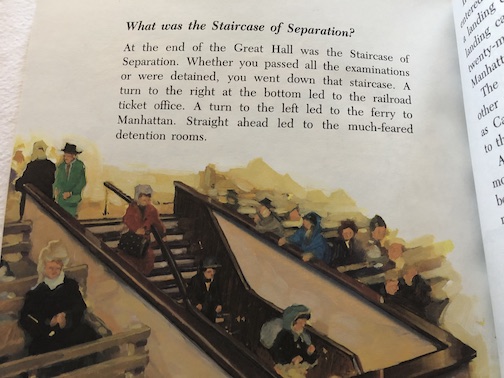
The processing center at Ellis Island wasn’t just a building; it was an entire complex.  The Great Hall alone was large enough to contain hundreds of people at a time, and when it was full of immigrants there were so many languages being spoken at once (sometimes as many as 30 different languages) that some people described it as sounding like the Tower of Babel.  There were also dormitories that could house more than a thousand people, a hospital for the sick, a post office, banks where people could change their cash for American money, a restaurant to feed everyone (with two kitchens, one kosher and one regular), a railroad ticket office where immigrants who would be moving on from New York could make their travel arrangements, and much more.  Some people called Ellis Island the “Island of Tears” because the arrival there after a long journey was an emotional experience and many immigrants were worried that they might be sent back if they couldn’t answer the inspectors’ questions to their satisfaction.  At the end of the Great Hall, there was a large staircase that came to be known as the Staircase of Separation.  Everyone had to go down this staircase after their examination by the inspectors.  At the bottom, they would go their separate ways, depending on their travel plans or whether they had passed inspection.  People who turned to the right were heading to the railroad ticket office.  People turning to the left were heading to the Manhattan ferry.  People who went straight were heading to the detention rooms because they hadn’t passed the inspection.

EllisIslandStaircase

As I mentioned before, the inspectors were very concerned about people who showed signs of serious diseases.  One of the first things that would happen during inspection was a brief examination by the Ellis Island doctors.  Because of the massive amount of people who had to be processed, this examination lasted only a few minutes, during which the doctor would quickly check for very specific symptoms and signs of possible illness.  If they didn’t see anything obviously wrong, such as red eyes (possible sign of eye infection, although for some, it was just because they’d been crying), difficulty in breathing, or lice, they would let the people pass.  If the doctors thought that they saw something that might be sign of illness, they would write a letter in chalk on the person’s clothes and send them on to be examined more thoroughly by another doctor.  Getting one of these letters didn’t always mean rejection.  If the other doctor decided that the first doctor was mistaken or that the person’s symptoms weren’t serious, they would still be allowed into the country.  Sometimes, if a person was ill but had a curable disease, they would be kept in the hospital on Ellis Island until they were better.  If the doctors weren’t quite sure if a person was ill or not, they might keep the person in the dormitories for a few days and then check them again after they had a chance to rest.  The people who were sent back on the ship were ones who had diseases that were incurable or seriously contagious.  (It sounds heartless, but they were trying to head off deadly epidemics.  During the 1800s, large cities like New York sometimes suffered serious epidemics of deadly diseases because of the sudden influx of new people who were living in overly-crowded conditions with relatively poor sanitation.  By preventing people with signs of serious diseases from joining the rest of the population, they were hoping to head off new epidemics and save lives.)

One of the more controversial parts of the examination was when they tested people for possible mental problems.  They wanted to make sure that they were mentally fit enough to find work, but the problem was that the tests designed by people who didn’t take cultural differences into account when they designed them.  The parts where they asked people to do simple arithmetic problems or to demonstrate that they could read, count backwards, or match up sets of similar drawings were pretty straight-forward.  However, sometimes they were shown a picture and asked to describe what was happening in the picture, and the immigrants gave the inspectors some surprising interpretations because it turns out that some experiences aren’t quite as universal as some people think.  For example, one picture was of some children digging a hole with a dead rabbit lying nearby.  It was supposed to depict children burying a dead pet.  But, some people view rabbits more as food than pets, and some immigrants said that the children were doing their chores because why shouldn’t the children work in the garden (the digging) after hunting a rabbit for dinner?  Fiorello La Guardia, himself from an immigrant family, an interpreter on Ellis Island and later, mayor of New York, particularly despised tests like these because the people who designed them and administered them were trying to test the minds of others without any real idea about what their lives had been like or how their minds actually worked.

EllisIslandGreatHall

The inspectors’ examinations in general weren’t always reliable because they were often hurried (dealing with so many people in a limited amount of time) and because the interpreters weren’t always accurate, which brings us to the question of why people’s names were sometimes changed at Ellis Island.  Sometimes, it was intentional.  Some immigrants thought that they would be more likely to be accepted by the inspectors if they had short, easy-to-pronounce names, so they would purposely give them shorter versions of their names.  There was some basis for this belief because, if an inspector didn’t understand a long, unfamiliar name, they wouldn’t have much time to figure it out and so would either take their best guess at the what the name should be, shorten it when they wrote it down, or give up altogether and write a much shorter name instead.  For example, when they processed Jewish people from Russia, the inspectors often ran into difficulties in understanding their last names and would sometimes just write down “Cohen” or “Levine”, no matter what the original name really was.  Sometimes, name changes were just an honest mistake because the inspector didn’t know how a name was really spelled (I can speak from personal experience because my family’s last name wasn’t always spelled like it is now, and when they found out that it had been changed, it was just too much trouble to fix it) or because they had misinterpreted something that the immigrant said.  One of my favorite examples of this was a young man who tried to explain to the inspector that he was an orphan (“yosem” in Yiddish). The inspector dutifully wrote his last name as Josem.

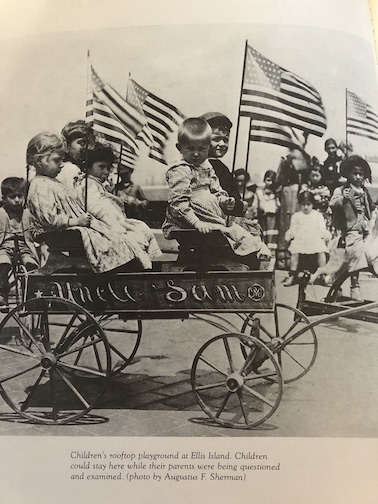
EllisIslandPlayground

The pictures in the book are paintings based on original photographs of immigrants and Ellis Island.  (See Immigrant Kids to compare some of the pictures.)

The book also contains some further information about the lives of immigrants once they arrived in America (Immigrant Kids goes into a lot more detail), the attitudes of Americans toward immigrants at the time (varied but with strong strains of anti-Catholic, anti-Irish, and general anti-immigrant attitudes during the 1800s), and the contributions of immigrants to American society.  I actually bought this book as a souvenir on a visit to Ellis Island years ago.

The book is currently available online through Internet Archive.

Immigrant Kids

ImmigrantKids

Immigrant Kids by Russell Freedman, 1980.

ImmigrantKidsEllisIsland

One of the best parts about this book is the pictures.  The preface of the book specifically talks about photography at the turn of the 20th century, how cameras were still fairly new technology but growing in popularity.  Cameras that were small enough to be held in a person’s hands were an 1880s innovation, and the book mentions that small cameras like that were known as “detective cameras” because they were small enough that they could be used to take pictures without the subjects noticing.  Over time, it became easier for amateurs to learn to use cameras, and it became more common for people to take pictures of their ordinary, everyday lives.  Pictures like these open up a window on the past.  The pictures in this book are of children whose families had only recently arrived in America from countries around the world.  The photographer for many of these pictures was Jacob A. Riis, a journalist in New York City who wanted to document the living conditions of poor immigrants.  He published a book called How the Other Half Lives in 1890, in which you can see more of his work.  Other pictures in this book are by Lewis Hine, who is known for his photographs of child laborers.  They are not the only photographers whose work appears in this book, but they are the most famous.

The book is divided into sections, covering different aspects of the lives of immigrant children.  In the chapter called Coming Over, the author describes what the journey to America was like.  One of the primary motivations for people to come to America around the turn of the century was money and employment opportunities.  If a family had little money and little or no chance of getting better jobs in their home country, they would decide to try their luck somewhere else.  Because most of the immigrant families were poor, it was common for families to immigrate gradually.  Often, the father of the family would come first, find a job, start establishing a life and home for his family, and eventually send for his wife and children when he’d saved enough money.  The actual journey was by ship, often in “steerage,” the cheapest form of passage available, in cramped rooms in the ship’s hold.

ImmigrantKidsFamilyQuestions

Although the journey could be harrowing, one of the most nerve-wracking parts was the immigrant processing that took place at immigrant ports like Ellis Island.  There were routine questions that immigrants were expected to answer and exams for them to take, and if the questioners weren’t satisfied, the immigrants could be sent back to the country they came from.  Doctors would examine the immigrants to evaluate their health and look for signs of possible mental defects.  They were particularly concerned about signs of infectious diseases.  Sometimes, it was difficult for immigrants to answer all the questions because of language barriers and the immigrants’ own nerves at being interrogated.  If an immigrant seemed too agitated, the examiners would typically let them rest for a while before trying again.

ImmigrantKidsTenement

The other chapters in the book are At Home, At School, At Work, and At Play, which give more details about the lives of immigrant children as their families settled in America.  They often settled in large cities because those were where the most employment opportunities were to be found.  Because they didn’t speak much English and needed help learning how things worked in America, such as how to find jobs and places to live and how laws worked, they tended to settle in neighborhoods with others from similar backgrounds who could help them.  That is why, even to this day, there are certain areas of large cities, such as New York, Boston, or Chicago, which are known for people of a particular nationality (like the Irish neighborhood, the Jewish neighborhood, Chinatowns, etc.).  New arrivals often joined friends or relatives who had already been living in the US for a while, seeking help in getting themselves established.  These ethnic neighborhoods were located in poor parts of town because the people there didn’t have much money.  People lived in small, crowded apartments called tenements, sharing water and toilet facilities with other families because the apartments were not provided with individual facilities.  However, once these groups of immigrant families became established, they remained established for a long time, and they gave these neighborhoods their own distinctive style.

ImmigrantKidsSchool

School was often difficult for new arrivals because the children had to learn English before they could study other subjects.  There were some special English language learning classes for them at larger schools with enough demand for them.  At smaller schools which didn’t have these classes, they often had help from other children who had arrived in America earlier and could act as translators.  They were also frequently put into classes for children who were younger than they were, studying easy subjects, until they had learned enough English to move up to classes with children their own age.

Typically, immigrant children aimed to stay in school until they were fourteen years old because that was the age when they could officially get full-time work.  However, because their families were poor, the children might have to leave school early to find jobs and help their families make ends meet.  The book describes how rules were frequently bent or broken because the laws were not well-enforced, and children often worked at younger ages, even under harsh conditions.  For immigrant children, the most important education was that which taught practical, vocational skills that would help them find jobs quickly.  Some agencies, like the Children’s Aid Society (known for the Orphan Trains), would help them with vocational training.

ImmigrantKidsBaseball

However, immigrant children still like to play.  Boys and girls usually played separately.  Boys frequently played games like baseball in the street, or stickball, which was a variant that could be played in smaller spaces.  In stickball, the “bat” was a stick or the handle of an old broom, and the ball was rubber and allowed to bounce before it was hit.  Girls would play other games, like “potsy,” which was a version of hopscotch.

Because of the lessons they were taught in schools and because the immigrant children mixed with children outside of their immigrant groups in school, the children absorbed the local culture and became Americanized faster than their parents.  Many of them experienced the feelings of being torn between their parents’ traditions and wanting to fit in with society around them.

In each of the chapters in the book, there are anecdotes from people who had arrived in the US as children around the turn of the century, telling stories about different aspects of their lives.

The book is currently available online through Internet Archive.

Under Copp’s Hill

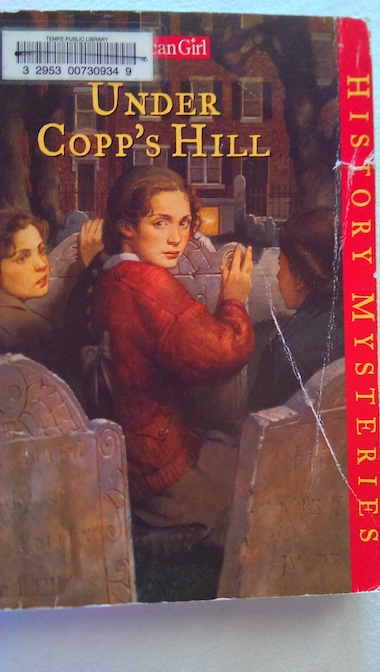
UnderCoppsHill

Under Copp’s Hill by Katherine Ayres, 2000.

This book is part of the American Girl History Mysteries series.

The year is 1908, and eleven-year-old Innocenza Moretti lives with her relatives in Boston.  They are immigrants from Italy.  Innie, as her family calls her, is an orphan.  According to the story that her grandmother told her, she was the only one of her parents’ children to survive infancy, her siblings being born prematurely and dying shortly after birth.  Innie’s mother was so grateful that Innie survived that she promised her to the Holy Mother at her baptism.  Then, Innie’s parents died in a fire in their tenement building when she was about two years old.  Innie and her grandmother, Nonna, survived the fire only because little Innie had started crying in the night, and she took her outside to walk her around so that she wouldn’t wake her parents.  Because of that experience, Nonna is deathly afraid of fire and also has become convinced that the Holy Mother must have spared Innie (as well as herself).  She thinks that Innie is destined to become a nun and has continued to promise her to the Holy Mother in prayer, repeating the promise regularly.  Although Nonna thinks that the miracles surrounding Innie’s life are signs of a future life in the Church for Innie, her grandmother’s promises in prayer terrify Innie.

Innie feels trapped by her grandmother’s expectations for her, expectations that the rest of her family don’t even know about.  She doesn’t want to be a nun, but her grandmother is sure that she will be.  Because of her fears that her grandmother may force her to become a nun when she grows up, Innie is never on her best behavior.  She thinks that if she gets a reputation as a trouble-maker, the Church will decide that she is unsuited for a religious life.  Unfortunately, Innie’s long-practiced habit of ignoring rules and her problem child reputation lead her to be suspected of something worse than just minor misbehaving.

Innie’s family owns a boardinghouse where they provide food and lodging for young immigrant men.  Innie and Nonna live on the ground floor, and Innie’s aunt, uncle, and cousins live above them.  Innie spends a lot of time with her cousins, especially Teresa, who is about her age.  Her older cousin, Carmela, persuades both Teresa and Innie to join a library club at a new settlement house with her.  The settlement house helps girls and young women from immigrant families by teaching them work skills and aspects of American culture that they can use as they become American citizens in exchange for some of the work that the girls do on behalf of the settlement house.  Carmela has taken a new job as a pottery painter there and tells her parents that it will be good for Teresa and Innie to go there as well because they will receive help with their schoolwork and they will also have classes to teach them skills like sewing, knitting, and pottery, that they can use to make money later.  However, the real attraction of the club for the girls is that they get to listen to music, have dancing lessons, read books, and socialize with other girls about their age.  The prospect of sewing classes isn’t appealing for Innie, but she loves books and looks forward to borrowing some from the settlement house library.

At the settlement house, Innie meets a variety of girls from other immigrant families, not just Italian ones.  In particular, Innie makes friends with a girl named Matela, who is a Jewish girl from Russia.  As the girls talk about a recent, large fire in town, Matela talks about the czar’s soldiers burning things back in Russia and how she misses her grandfather, who is still there.  Innie understands Matela’s feelings because she knows what it’s like to miss someone.  She doesn’t really remember her parents, but she feels the lack of them in her life.  Teresa also becomes friends with Matela, but the three girls agree to keep their friendship secret because each of their families prefers them to associate with girls from backgrounds similar to their own.  Innie’s uncle wants the girls to spend time with other Italians, and Matela admits that her father prefers her to spend time with other Jewish girls.  The adults don’t really understand the cultural mix at the settlement house.

However, from the very first day that the girls begin going to events at the house, strange things start happening.  Things disappear or are oddly moved about.  Food disappears.  A silver teapot belonging to the ladies who run the settlement house is stolen.  Then, someone steals some pottery and a shawl.

To Innie’s horror, she ends up becoming the prime suspect for the thefts because she was caught snooping in an area of the house where she didn’t belong and because she accidentally broke one of the pieces of pottery that the others girls made and tried to sweep it up without telling anyone.  When she and her friends snoop around and try to find the missing objects, Innie discovers one of the missing pottery pieces.  However, instead of being happy for the clue, the ladies who run the house just think that Innie must have broken more of the pottery and tried to cover it up, like she did before, by hiding the rest of the set.  After all, if she was doing some things she shouldn’t have been doing, it’s plausible that she could be a thief, too.

If Innie is going to remain a member of the library club (and continue to have access to books that she can read), she’s going to have to prove her innocence.  In fact, proving her innocence may also be important for Carmela, who is supposed to have a citizenship hearing soon.  If Innie’s bad reputation causes problems for her at work, she may lose her job and be denied American citizenship!

Matela thinks that the thief could be a ghost from the nearby Copp’s Hill graveyard, but Innie is sure that it must be a human being.  There are secrets at the settlement house that even the ladies who run it are unaware of and someone who desperately needs help and can’t ask for it.

Teresa and Matela continue to help Innie, and in the process, Innie confesses to Matela her fears about becoming a nun.  It is Matela who helps Innie to find the solution to her problem, urging her to step outside of the small community of Italian immigrants that her family clings to and to seek advice from a priest in the Irish area of the city.  As a priest, he has the knowledge that Innie needs to understand her faith, and because he doesn’t know Innie’s family personally, he has the objectivity to help Innie to see her grandmother’s promise in a new light and to understand that her future destiny is still in her own hands.  No one can speak for another person or make important promises on their behalf.  A religious vocation is a serious decision that only a mature adult can make for herself, or not make, as the case may be.  The priest tells her that, as young as she is, Innie should focus on learning to be a good person, and then she will see what direction life leads her.  With that knowledge, of course, Innie realizes that she will have to put more effort into behaving herself, but it’s a relief to her to realize that she doesn’t need to purposely misbehave in order to control her life.

Eventually, Innie’s aunt also learns about the grandmother’s promise and Innie’s worries and reassures her that, although her grandmother can be an intimidating woman with what she wants, Innie’s family loves her and that she shouldn’t be afraid to come to them with her questions and concerns. Innie has thought of herself as parentless, at the mercy of her grandmother’s wishes and expectations, but her aunt says that she loves Innie like she does her own daughters and that Innie is as much a part of their family as they are.  If Innie has problems, her aunt will be there for her, helping her find whatever answers she needs.

There is also a subplot about how girls in immigrant families (at least, in ones like Innie’s family) aren’t as highly-regarded as boys.  When the family is discussing important matters, Innie often tries to comment on what she thinks, but her grandmother keeps telling her to be quiet because it isn’t a girl’s place to comment on business that men should handle and her male cousins sneer at her because they don’t think she knows anything.  However, when Innie’s uncle is worried about the legal papers he has to sign in order to open his new grocery business because his English still isn’t good enough to understand them, Innie points out that Carmela’s English is the best of the family because of all the books she had to read and the paperwork she had to complete when she was applying for citizenship and that she would be the best person to study the paperwork.  At first, her grandmother makes her try to be quiet and her male cousins laugh, but Carmela speaks up and says that she can help her father, if he wants her to, and her father agrees, on the condition that she act as translator and adviser and let him make the final decisions about the business.  Carmela is happy because the arrangement allows her to use her skills without taking her away from the pottery painting that she loves.  The point of this part of the story is about acknowledging the talents that people possess and not disregarding them because they are outside of the usual roles and expectations.  It fits in with the subplot about the grandmother’s expectations for Innie’s future, which are not really in keeping with either her talents or character.  The young people in the story are growing up under different circumstances than their parents, and they will have to learn to find their own way in life, using the abilities they have and the education they can find.

In the back of the book, there is a section with historical information about Boston in 1908.  The fire that happens around the time that the story takes place was a real event.  The settlement house with its library club was also real, and the ladies who run the settlement house, Miss Brown and Miss Guerrier, were also real people.  The book explains more about what life was like for immigrant families like Innie’s and about what the future held for girls like her.  Many of the girls who attended the library clubs later became librarians and teachers themselves, which may be Innie’s eventual destiny when she grows up.  The book also mentions that the area of Boston where Innie’s family lived still has many Italian restaurants and groceries that were started by immigrant families like Innie’s, so we can imagine that the grocery store that Innie’s uncle wants to open will be successful.

The book is currently available online through Internet Archive.

Thunder Cake

ThunderCake

Thunder Cake by Patricia Polacco, 1990.

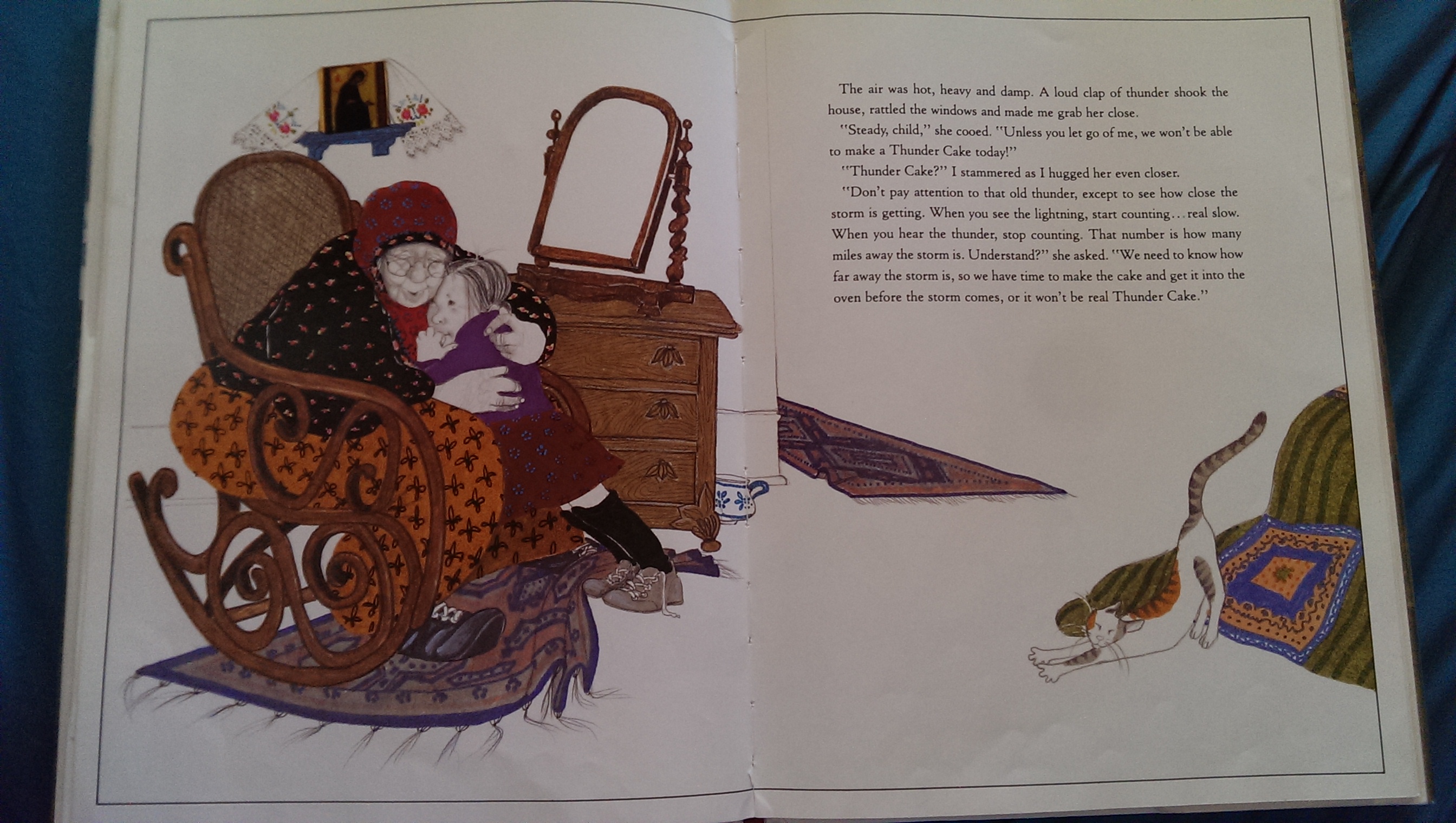
A girl talks about how her grandmother, who she likes to call “Babushka” because she originally came from Russia, cured her of her fear of storms by teaching her to make a special kind of cake, Thunder Cake.

The girl is staying with her grandmother on her farm in Michigan during the summer, and the sound of thunder terrifies the girl so much that she just wants to hide under the bed.  However, her grandmother insists that the girl come out and help her gather the ingredients for her Thunder Cake.

ThunderCakeGrandma

The grandmother explains to the girl how to tell how far away a storm is by counting the seconds between when she sees a flash of lightning and when she hears the sound of thunder.  She also says that they need to get the cake ready by the time the storm actually arrives, so they’d better hurry.

ThunderCakeIngredients

Keeping track of how close the storm is and getting all the ingredients together to make the cake helps to keep the girl busy, and by the time the storm actually arrives, she is no longer afraid.

ThunderCakeFinished

The pictures are an interesting combination of pencil drawings and bright colors.  The faces and hands of the girl and her grandmother are completely in pencil, but their clothes and everything around them are painted.

I didn’t include the recipe for Thunder Cake here because the book is still in print, and I have kind of a rule that I don’t include recipes from books that are still in print.  However, this recipe is one of the more well-known ones from children’s literature, and it’s pretty widely available on the Internet, some with pictures of the cakes people made from this recipe.  For example, this blog has a nice article about this book with helpful notes for those who want to try to make the cake.  This site also has the recipe along with some comments from others who tried it.  I was surprised the first time I read it that one of the ingredients in the chocolate cake was tomatoes, but the consensus seems to be that they are really necessary to make this cake properly.

The book is currently available online through Internet Archive.