
Mr. Pine’s Purple House story and pictures by Leonard Kessler, 1965.
Mr. Pine lives in a little white house. All of the houses on Vine Street are white, and they look completely identical. Mr. Pine thinks that he’d like to do something that will make his house different from all the other little white houses.

His first idea is to plant a pine tree in his front yard. Since his name is Pine, everyone seeing it will think of him, and his house will be different from everyone else’s. The problem is that all of his neighbors like his pine tree and decide to plant their own trees. Soon, all of the houses look alike again with pine trees in the yards.

To make his house look different, Mr. Pine tries to plant a bush next to his tree, but everybody likes that idea, too. Soon, everybody has both a bush and a pine tree in their yard, and the houses look identical again.

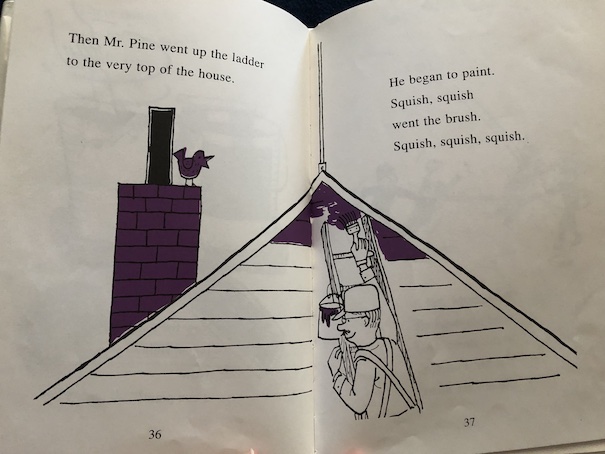
Mr. Pine tries to think of something that he can do with his house that his neighbors won’t imitate. He gets the idea of painting his house, but he can’t pick any obvious color that all of his neighbors will want, too. He decides to paint his house purple. Is this finally the idea that will make Mr. Pine’s house different from the rest?
This book is actually the second book in a series of picture books about Mr. Pine.
My Reaction
I often think of this book and The Big Orange Splot together because they’re both about people in a neighborhood of identical houses who make changes to distinguish themselves and their houses and end up changing the way their neighbors view their own homes. The difference between the books is that, in The Big Orange Splot, the neighbors were completely opposed to changes that made anyone’s house different until they began to see the opportunities for living out their own dreams through their homes. In this book, the neighbors immediately seize on everything that Mr. Pine does that’s different and start copying him. They think all of his changes are great and frustrate his efforts to be different by doing everything he does until they decide to all paint their houses different colors. Of course, Mr. Pine’s changes are all less outlandish than the ones from The Big Orange Splot, so they would be easier to accept.
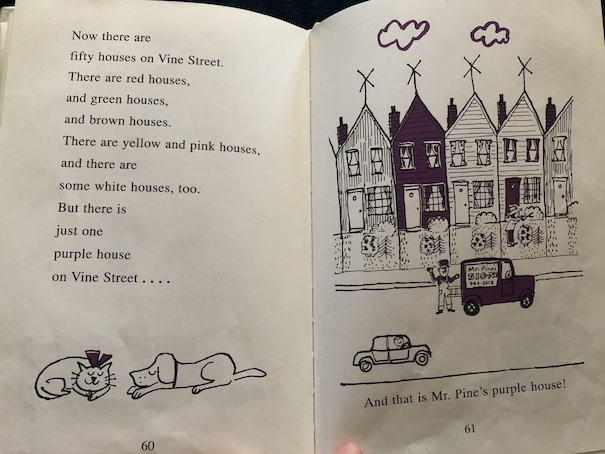
I liked it that Mr. Pine’s neighbors all have colors for names: Mrs. Gray, Mr. Gold, Mrs. Green, Mrs. Brown, and Mrs. White, and all the colors they eventually pick for their houses are different from the colors in their names. Even though this book mentions a lot of colors, the only colors shown in the pictures are black, white, and purple. In the end, when the houses are all different, the differences in color are shown with lines providing shading rather than with actual colors. It still works to show that the houses are now different from each other.




 Jestress's Forgotten Books and Stories