A Fence Too High

The Land of Pleasant Dreams

A Fence Too High by Jeanine Bartelt, Jeff Parker, and Tony Salerno, 1986.

Peter falls asleep while counting sheet jumping over the fence and meets Lacey the Lamb in his dream. Lacey the Lamb is sad and worried because, even though she’s growing up to be a fence-jumping sheep, there is one fence that she just can’t get over. Peter offers to take a look at the fence with her and see if he can help. When he does, it turns out to be a giant rainbow.
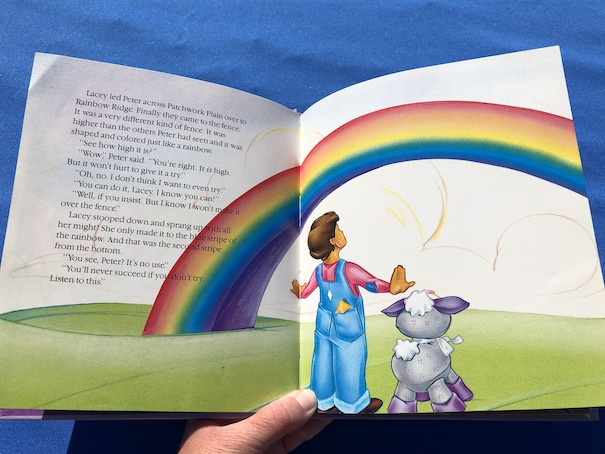
It’s important that Lacey make it over this fence because she is taking part in a fence-jumping contest in less than an hour. Lacey doesn’t think that she can learn to jump this fence in so little time. However, Peter encourages Lacey to try again.

After a few more tries in which she hits the blue stripe on the rainbow and then the yellow stripe and then the orange stripe, Lacey is ready to give up. She thinks that it’s hopeless. Peter points out that it isn’t hopeless because each time that Lacey has tried, she has improved, gradually hitting higher and higher marks on the rainbow. He doesn’t think that Lacey should give up so easily.
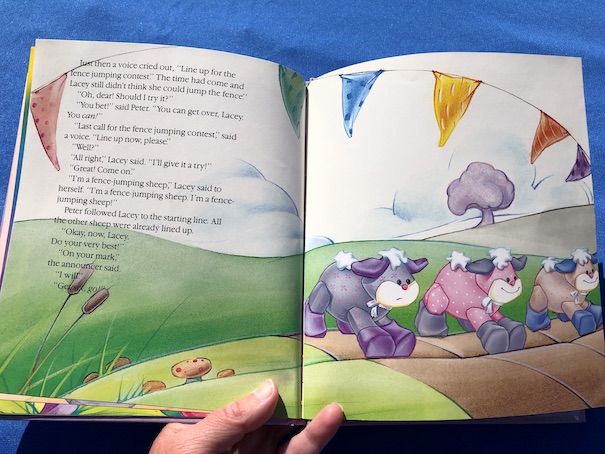
Even though she’s still feeling very unsure of herself, she decides to participate in the contest. This time, Lacey does make it over the fence, and she feels much better about herself because of her success. She thanks Peter for giving her the encouragement to try one more time.

Moral: If At First You Don’t Succeed, Try, Try Again.

It’s a nice story about the importance of making an effort, trying again, and not giving up just because there are obstacles and challenges. Life has many challenges, and just because something is difficult doesn’t mean that it’s impossible or not worth doing. People don’t need to be perfect; it’s enough to be willing to improve.

This book was made into an episode for the tv show version of the series with puppets.
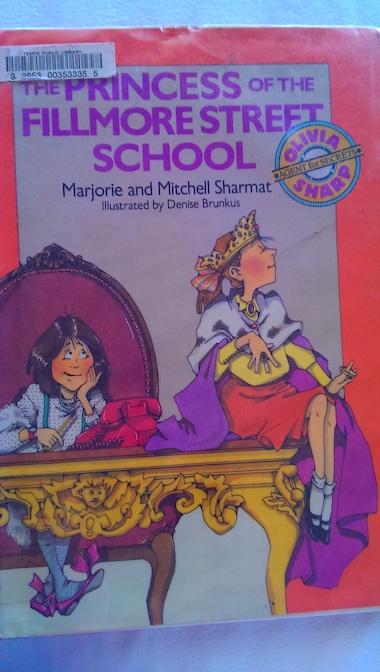
The Princess of the Fillmore Street School

Olivia Sharp, Agent for Secrets

OSPrincess

The Princess of the Fillmore Street School by Marjorie Weinman Sharmat and Mitchell Sharmat, 1989.

Desiree, who has always been a bit prissy, tells Olivia that she has decided that she wants to be princess of their school. She plans to prove that she is a perfect princess by trying to make all the other kids perfect. She is getting on everyone’s nerves, telling them to stand up straight or that their hair needs to be fixed.

When the others ask Olivia to help, she suggests to Desiree that she concentrate on making improvements to the school itself, but even that causes problems. Eventually, things get to the point where the school’s principal asks for Olivia’s help. Can anything stop the princess of Fillmore Street School before she drives everyone crazy?

Olivia’s solution is partly pointing out to Desiree the effect that she’s having on other people and partly explaining that a school which is already governed by a principal doesn’t also need a princess.  Then, she finds a way to help Desiree to feel like a princess even though she can’t be one.

Mrs. Armitage on Wheels

ArmitageWheels

Mrs. Armitage on Wheels by Quentin Blake, 1987.

Mrs. Armitage loves to ride her bicycle with her dog, Breakspear, running alongside.  However, she sometimes runs into difficulties that require some minor repairs to her bike, and she can’t resist the urge to tinker further.

The more she thinks about it, the more ideas for improvements she has.  Each idea starts with the words, “What this bike needs . . .”

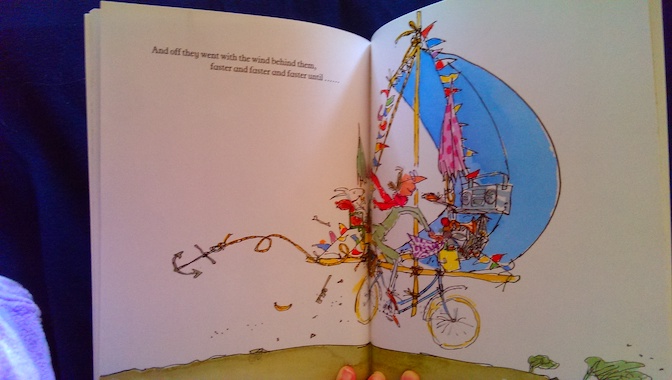
But, Mrs. Armitage goes well beyond what the bike really needs.  Beyond adding a seat for her dog and room for her lunch, she gradually turns her bicycle into a crazy, unwieldy contraption.

ArmitageWheelsSail

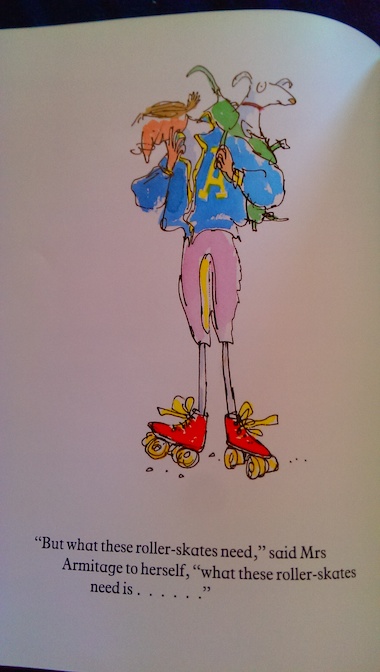
Was adding the sail and anchor where she went too far, or did she reach that point long before?  Even after she trades what’s left of her bike for some skates, one has the feeling that her tinkering is far from over.

The book is available to borrow and read for free online through Internet Archive.

ArmitageWheelsSkates