#15 The Mystery of the Goldfish Pond by Elspeth Campbell Murphy, 1997.
Timothy’s father wants him to sing at his boss’s retirement dinner. The boss’s wife heard Timothy sing once with his choir, and she wants him to sing a special song for her husband at the start of the dinner. His cousins are invited to come along so he won’t be the only kid there. Timothy doesn’t really want to do the singing, but his parents convince him to do it anyway because the boss’s wife is so fond of him and his singing.
Timothy’s father hopes that the dinner will go well because the boss has been worried about the possibilities of competitors getting their hands on information about their new product. Earlier, the boss temporarily misplaced an important memo about it, and he was worried that someone else got their hands on it.
Timothy’s song goes well, and after the dinner, the kids are allowed to walk outside in the garden while the adults listen to a series of speeches. The gardens outside the banquet hall are beautiful, and the kids start to enjoy themselves. Then, they accidentally overhear a couple of adults talking. They can’t quite catch everything they say, but something strange is going on, and something secret is hidden somewhere in the garden.
The theme of this story is Proverbs 11:13, “No one who gossips can be trusted with a secret, but you can put confidence in someone who is trustworthy.”
The book is available to borrow and read for free online through Internet Archive.
My Reaction and Spoilers
The crime that the adults were plotting involves the theft of information. The kids have to figure out the parts of the conversation they couldn’t hear clearly to figure out where the information is hidden. I thought that the clue the children try to figure out was fairly easy. Part of the conversation the kids try to figure out sounds like “-ake -urtle”, and there aren’t many words that sound like “-urtle.”
The boss’s wife seemed eager for the children to go outside, into the garden, and tell her about it later. The kids wondered why she seemed so eager for them to go outside and what she was hoping that they would tell her afterward. It sets the stage for the kids to expect that something unusual or mysterious might happen, which proves to be the case when they overhear the important conversation. The boss’s wife says later that she suspected something might happen because she knew her husband was worried about people stealing company information, and she realized that this dinner would be a convenient place to hand it off to someone.
We never learn exactly what kind of information or new company products the adults were concerned about. We also don’t know exactly who was trying to steal the information or what happens to that person later. The part that the children care about is that they were able to stop the hand-off of the information.
The Daring Book forGirls by Andrea J. Buchanan and Miriam Peskowitz, 2007.
This is an activity/hobby book for children, especially for girls, but really, full of activities that boys could enjoy, too. It’s often sold in sets with a companion book, The Dangerous Book for Boys. These books follow in the tradition of earlier activity/hobby books like The American Boy’s Handy Book and The American Girl’s Handy Book by the Beard siblings. Some of the activities in these modern books are similar to ones included in historical children’s activity/hobby books, but there are some notable differences. Although The Daring Book for Girls includes sports and outdoor activities, it has more scientific and academic information than The American Girl’s Handy Book.
The differences between these books show changes that have taken place in society, the activities that adults want to promote for children, and the types of activities that children can actually use in the 120 years between the times when the two books were published. For example, 19th century how-to books for girls tended to include instructions for making several different types of decorative embroidery stitches. In this book, there is just one paragraph dedicated to sewing stitches, tacked into the end of the section about different types of knots, and the stitches they show are very simple stitches that can be used for basic repairs to ripped clothing. The authors of the 19th century activity books for girls seemed to be trying to introduce girls to genteel and practical pastimes and healthy physical activities. The authors of The Daring Book for Girls explain in their introduction that they wanted to introduce 21st century girls to more nostalgic pastimes that don’t involve today’s technology, like cell phones, video games, and the Internet because they feel like modern childhoods are too high-pressure and push kids to grow up too fast.
I like to explain the contents of books so that people will know whether they would like to read them in more detail. It’s difficult to describe the contents of The Daring Book for Girls succinctly because the contents are extensive, and they are not grouped into convenient categories. Like in The Dangerous Book for Boys, it’s more like reading a very long magazine with isolated articles, although some of the articles are related to each other. It did strike me that more of an effort was made in this book to put some related topics next to each other. For example, Building a Campfire is immediately followed by Campfire Songs, and Reading Tide Charts is immediately followed by Making a Seine Net for fishing.
Because it would be difficult for me to explain everything in this book without basically copying the entire table of contents, which would take quite a lot of space to do, I’ll just hit some of the highlights by describing them in sections that the book doesn’t have but which explain the types of activities and information covered in this book. All of the types of activities that I describe below are included in the book, but there is also more in the book than I could take the time and space to describe in detail.
Useful Skills and Knowledge
There are instructions for different types of knots and stitches, tips for assembling a useful toolbox that can be used to building things or making repairs, how to change a tire, how to write a letter, and basic first aid.
There are two sections with phrases, idioms, and terms of endearment in French and Spanish. These sections are more for fun and getting girls interested in learning languages than a functional guide to speaking a language. However, there are other sections with information that will be useful in school, like the sections of Math Tricks, Greek and Latin Root Words, and Books That Will Change Your Life.
As expected in a book for girls, there are tips and information related to clothes and hair styles, like How to Tie a Sari and Chiton, Putting Your Hair Up With a Pencil, Tying a Bandana, and Japanese T-Shirt Folding. However, I disagree with the advice in the section called The Daring Girls Guide to Danger about high heels. Most of that section is about doing things that are a little scary but can lead to greater confidence, like standing up for yourself or someone else, riding a roller coaster, or seeing a scary movie, but I don’t like the advice to wear high heels. Their logic is that it gets easier with practice, which may be true for most people, but I have to say that I’m in my 30s, and the only type of heels I’ve ever been able to wear without turning an ankle are low and thick. Otherwise, I have to wear flats, and I’m not the only woman who says that. Wearing high heels for extended periods is hard on the feet and can lead to foot problems later in life, so I favor being practical. In my opinion, some things just aren’t worth getting used to, and girls would be better off in the future for not starting that now.
In spite of the authors’ assertion that they don’t want girls to grow up too fast, there are some tips and information that are focused on gaining grown-up skills and preparing for a career, like public speaking, learning Roberts Rules of Order to conduct meetings, learning how to negotiate a salary, and understanding financial information like stocks, bonds, and interest. The section about how to have a lemonade stand not only contains recipes for the lemonade and other treats to sell but how to calculate profits.
There is also advice for girls about how to talk to boys. Some of it is the kind of advice that I wish that boys would be given about talking to girl. For example, the book says, “Some girls are told that boys are different” and that girls need to be into things that boys like in order for boys to like them. I think that, sometimes, boys and girls are taught too much to think of each other as homogeneous groups, that all boys like certain things like sports and all girls like certain things like dolls and romantic movies, and that they each need to do certain things, talk about certain things, or not talk about certain things in order to get people to like them. I think kids should be taught to think of each other more as individuals with individual personalities and interests, whether they’re boys or girls, and not to try to do things that they think are pleasing to all boys or all girls. Nobody really needs to please everyone anyway. No girl needs to get all boys to like her, and no boy needs to get all girls to like him. It’s enough to learn how to bond with people you like. If you want someone to like you, ask them about the things they personally like and tell them about the things you personally like. That’s how you find people who are compatible with you. As the book says:
“Many things are said of boys: Boys like sports, boys are messy, boys don’t have any feelings, boys like trucks, boys don’t like girly things, boys like to run around and eat gross food. Whatever the specific generalization, the point of these notions about boys is to set them apart from girls as being entirely different.
Similar statements are made about girls: Girls like pink, girls like flowers, girls are neat and clean, girls are frivolous, girls are emotional. Are any of these things true about all girls? Of course not. But, it’s easier to think about boys and girls as being entirely different than it is to think about boys and girls as having lots of common ground.”
The book says that, depending on how a girl feels about boys, she could ignore them, be friends with them, or even consider romance with them, but “Wherever you are on the spectrum of how you feel about boys, do treat all of your friends, boys and girls, with kindness. This has gone out of fashion, and that’s a sad mistake. Overall, the truth is that there’s no great mystery about boys. Boys are people, and like all people, they are complicated. And that’s what makes being friends with other people interesting: you get to learn about how other people think and act, and, in the process, learn a little bit more about yourself.”
One of the stereotypes about boys is that they aren’t as good with relationships as girls are, but I think that this is partly due to the advice that they’re given about relationships. After comparing the advice about girls given in The Dangerous Book for Boys and the advice about boys in The Daring Book for Girls, I think that both boys and girls should take the advice in The Daring Book for Girls.
Games
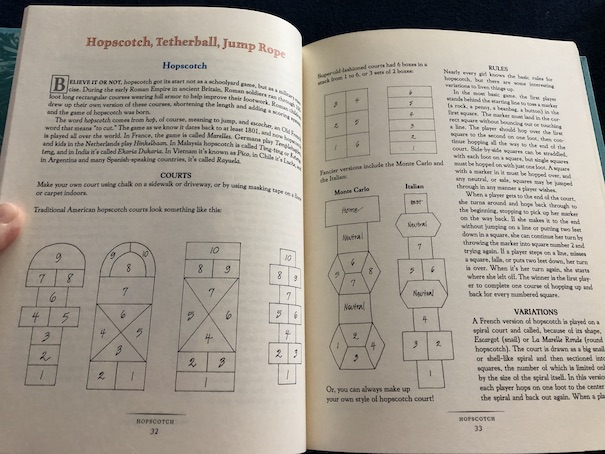
The book provides rules and tips for outdoor games, including Four Square, fourteen variations of Tag, Hopscotch, Tetherball, and Jump Rope (which includes jump rope rhymes, and there are separate sections for Double Dutch and Chinese Jump Rope). There are card games, like Hearts and Gin. There are also rules for playing Jacks, Darts, and Hand Clap Games.
There is a special section about slumber party games, which includes the classic Truth or Dare and a couple of games of the spooky variety, Bloody Mary and Light as a Feather, Stiff as a Board. Young girls often like to do spooky things to scare each other when they’re staying up late at night. Boys don’t usually do this stuff, but girls often do when they’re unsupervised at sleepovers or summer camp. The spooky types of “games” are really psychological tricks, and they seem much less mysterious and scary when you know how they work (Bloody Mary makes use of the “Strange Face Illusion“, which is admittedly still an eerie sensation when you’re an adult who knows what to expect and that it’s all a trick of the mind), so they tend to be at their maximum popularity when girls are in their tween and early teen years, old enough to get a little thrill from doing something a bit scary but not yet old enough to have learned why they work and have the mystery taken out of them. The book explains a little about the concept of levitation and the superstitions surrounding it for Light as a Feather, Stiff as a Board, and it ends by calling the effect a “magic trick, a phenomenon based in real-world explanations and techniques”, but it doesn’t go into details about the real-world explanation behind it, so it doesn’t ruin the sense of mystery for the girls who want to try it. There is also a section of advice for telling ghost stories that is separate from the slumber party section, but good for sleep-overs and camp-outs.
Sports and Exercise
The book provides rules for basketball, netball, softball, and bowling.
It also explains five basic karate moves, some basic yoga, and how to do cartwheels and back walk-overs.
Outdoor Activities
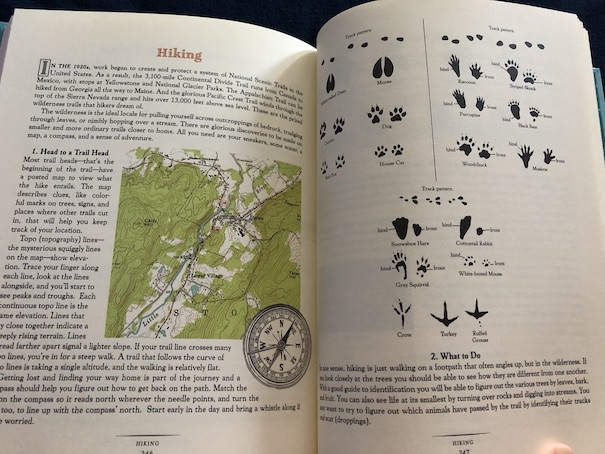
There are sections with activities related to camping out, like Sleep Outs, how to build a campfire, campfire songs, two ways to make a sit-upon, how to paddle a canoe, and how to go hiking, climbing, and bird watching. As I mentioned above, the book also explains how to read a tide chart and how to make and fish with a seine net.
There are also instructions for making clubhouses and forts, setting up a tree swing, rollerskating, and how to make traditional daisy chains and ivy crowns.
Science and Technology
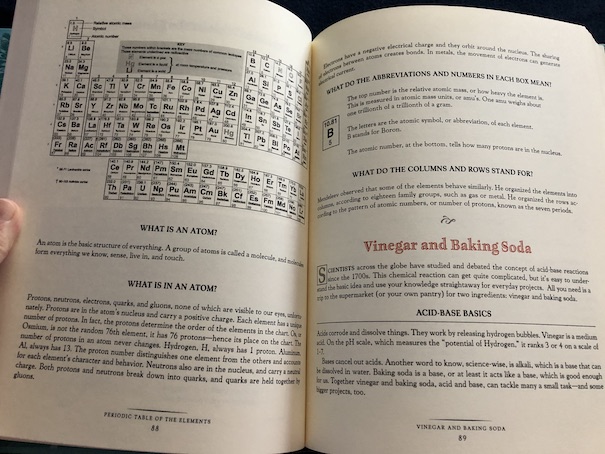
The book explains some natural and scientific concepts, such as weather and the Periodic Table of Elements.
There are instructions for creating projects of the type that would be good for a science fair, like a Lemon-Powered Clock, things to do with Vinegar and Baking Soda, how to demonstrate capillary action with paper flowers, and how to make a lamp, lantern, or flashlight with batteries.
History and Geography
The book covers the Bill of Rights and the 50 states of the United States and also has some information about Canada. There are also sections about the countries of Africa and the South Sea Islands.
All of the historical people or interesting people from around the world described in the book are women. The section about pirates describes famous female pirates from history. There is a section about female scientists and inventors and one about famous female Olympic athletes, and there are several sections about famous Queens of the Ancient World. There is a section about Modern Women Leaders from around the world and one section about what modern princesses are like and what they do, giving girls a more realistic reference for what princesses are beyond the usual fairy tale images. There are also stories and mini biographies about interesting and inspirational historical women, like Joan of Arc, and others that are related to other topics that the book covers. For instance, the section about first aid is followed by short biographies about Clara Barton and Florence Nightingale.
Spies and Secret Codes
The book discusses female spies from history, and there is some information about secret codes, but much of the sections about spies discusses assembling a spy team, the types of roles required for a team, and the skills that the members should have. There is also a section about “Spy Lingo”, terms and code words that spies use.
Arts and Crafts
The book has information and instructions for writing in italics, making a quill pen, painting with watercolors (even doing it “on the go”), pressing flowers, making friendship bracelets, making a cloth-covered book, making your own paper, making paper airplanes, making cootie-catchers (origami fortune tellers), and making God’s-Eyes.
There are some projects that involve wood working, like making a peg game, a willow whistle, and a scooter.
Stunts and Random Skills
The book explains how to read palms (this could go with slumber party ideas, although they’re not grouped together in the book, because young girls often like to speculate about the future, especially their future love lives, or do spooky things to scare each other when they’re staying up late at night) and how to pull Three Silly Pranks of the kind that are common at summer camps (like short-sheeting a bed).
Dangerous Book for Girls Badges
This is the final part of the book. Since many of the activities in the book are the kind done at summer camps or in scout troops, the book offers suggested “badges” you can award yourself and your friends for doing the activities. Even though the activities in the book are not sorted into specific categories, there are six categories of badges offered: Sports and Games, Girl Lore, Adventure, World Knowledge, Life Skills, and Arts and Literature. The book doesn’t specify what activities you should master to award yourself these badges, leaving that up to the reader. My copy says that if you go to their website, you can print out these badges, but that website no longer exists. I don’t know if later printings say something different. Fortunately, a site reader found an online pdf of the badges that still works, so you can print off copies for yourself or for a group of kids. Thanks, Mike!
If you’re looking for something to do with the kids during coronavirus lock-downs (I first published this post in May 2020) and/or over summer vacation, this book has plenty of ideas, and you can even make up your own “badges”, using their ideas, my category suggestions, or anything else you would like to do yourself.
If you would like some suggestions to get you started or give you some goals to aim for, I think I would award badges like this (of course, these are just my suggestions):
Sports and Games – Learn the rules to at least two games and/or sports from the ones in the book. They can be any two games you like, indoor or outdoor or one of each. I don’t think winning at the games is necessary. It’s more important that kids know how to play games and how to teach other people to play so they can use the games with their friends.
Girl Lore – This is a good category for the sleepover-related activities. To earn this badge, someone could either try each of the sleepover games or activities or practice story-telling skills with a camp-out or sleepover type story or by telling a story about one of the famous women described in the book.
Adventure – This badge has a lot of possibilities, but I would suggest either using it for practicing outdoor or camping skills or for doing activities that are new and challenging. If you don’t want to go on a hiking, bird-watching, or camping trip, you can challenge yourself or your group to do three things you’ve never done before, in the spirit of adventure. They can be activities in this book (like the spy activities), suggestions from the section called The Daring Girls Guide to Danger (like watching a scary movie or riding a roller coaster or trying a new food), or going to a place you’ve never been before, etc.
World Knowledge – Study one of the sections in the book about countries of the world or historical events or people and tell someone else what you’ve learned.
Life Skills – Pick a skill to study and demonstrate to someone else, like knots and stitches or the clothing and hair tips, or assemble a first aid kit or tool kit and discuss the purpose of each of the items included. Alternatively, study and discuss the sections about job skills and how you can use them in your life.
Arts and Literature – Try at least one of the arts and crafts activities from the book and/or read at least one of the books from the list of Books That Will Change Your Life. Show off what you create and talk about the book you read.
As a bonus suggestion, if you’re doing these activities with a group or over an extended period of time, like the entire summer, you can award badges multiple times for different levels of achievement. Completing one of the activities related to a badge theme could be Level 1, and doing another would be Level 2, etc. That way, if someone doesn’t like a particular activity category, like the outdoor or camping activities, they can put their focus into achieving more in a category they like better. At the end of the summer, you could offer recognition to members of the group who achieved the highest levels for each category and/or people who found particularly creative ways to use their skills. You could even include an extra Overachiever award for people who tried everything!
The purpose of badges and awards like this is really to encourage kids to try new things, to set personal goals, and to persevere, so whatever you do with the badges should keep these purposes in mind. If you use the badges, keep the badges fun and celebratory of achievements or at least attempts at trying new things! As long as it’s fun, like a game, kids will want to continue.
The book is available to borrow and read for free online through Internet Archive. There is also a sequel to this book called The Double-Daring Book for Girls which contains similar types of activities and is also available through Internet Archive. There are no badges with the sequel book, but if you like that format for marking achievements, you can either reuse the badges from this book or make up some of your own.










 Jestress's Forgotten Books and Stories