House of Many Ways

House of Many Ways cover

House of Many Ways by Diana Wynne Jones, 2008.

This is the third book in the Howl Trilogy. The Howl books are a loose series. Although the wizard Howl, his wife Sophie, and the fire demon Calcifer are the main characters in the first book and appear in all of the other stories, they are not the main characters in the other stories.

When her Great Uncle William, who is a wizard, has to go away for treatment for a health condition with the elves, Charmaine’s Aunt Sempronia volunteer her to house-sit for him. When Aunt Sempronia goes to tell Great Uncle William that Charmaine will be looking after his house, he asks whether Charmaine knows anything about magic. The aunt says that she doesn’t think so. Charmaine spends all of her time reading and doesn’t usually help much with the housework at home. Her aunt thinks this responsibility would do her good. Great Uncle William is a little concerned because his house is not an ordinary house, and he says that he had better take some precautions.

Although Charnaine could be annoyed at being volunteered for this chore without her permission, she is actually grateful for this opportunity to get away from her parents. Her parents are overprotective of her, and they never allow her to do anything that is remotely daring or doesn’t seem completely respectable. She feels stifled, and she wants the chance for a little independence. One of her first acts of independence is to write to the king, telling him that, more than anything, she would like to help catalog his library. She knows that the king is cataloging it himself with the help of his daughter, Princess Hilda (which was established in the previous book in the series), but Charmaine loves books more than anything and she has always dreamed of being an assistant librarian in the royal library. Her parents would think that she was being too cheeky by asking for this position.

In the meantime, Charmaine can prove herself capable and enjoy further independence in Great Uncle William’s house. When she arrives there, Aunt Sempronia tells her that living in a wizard’s house is serious business. Charmaine doesn’t know much about magic because her parents would never let her study it. They didn’t think magic was very respectable.

When Great Uncle William meets her, he seems pleased by her and starts to tell her that he has taken precautions for her stay in the house. Charmaine is about to tell him that she doesn’t know any magic, but they are interrupted by the elves, who come to take Great Uncle William away for his treatment. Charmaine asks the elves how long Great Uncle William will be gone, but they just say “as long as it takes.” Although Charmaine finds herself alone in the house, she hears Great Uncle William’s voice telling her that she will have to tidy the kitchen and apologizing for leaving so much laundry. His voice also says that there are more detailed instructions in the suitcase he left behind.

Before looking at the detailed instructions, Charmaine decides to take a look around the house and get herself unpacked. The kitchen is a horrible mess, and there are enormous bags of laundry. To her astonishment, there are no water taps in the kitchen sink, but there is a water pump outside. This is going to make her job harder. She is tempted to put her nose in a book and forget all her troubles and chores in the house, but she left the job of packing her own bag to her mother, and her mother didn’t include the books she had sitting out. Charmaine realizes that she should have packed her bag herself. This house-sitting job is going to be an education in responsibility as well as independence for Charmaine.

Charmaine also discovers that there’s a dog in the house that nobody told her about. Great Uncle William’s voice tells her that the dog is called Waif, that he used to be a stray, and that he’s afraid of everything. Charmaine was always afraid of dogs because of her mother’s worries about them, but Waif is so timid that she doesn’t worry about him and shares her food with him.

Charmaine realizes that she has led a very sheltered life, partly because of all of the things she was never required to do and also because of the things her parents wouldn’t let her do. It helps that anytime she asks a question out loud, Great Uncle William’s voice gives her the answer.

As Charmaine starts learning her away around the house, she discovers both that she has her work cut out for her and that it’s incredibly easy to get lost in the house. She also discovers that Great Uncle William’s study has many books in it. A note that her uncle left for her in the study says that he could be gone for about two weeks to a month and explaining more about the spoken instructions he left for her as well as the instructions in the suitcase. The note says that she can use the books in the study, but it warns her to be careful of the difficult spells. Charmaine is very appreciative for the books, although she finds them difficult to understand because they are all about magic. There are also many letters in the study written to her uncle by other wizards, including one from the wizard Howl. Many of the letters are from people asking Great Uncle William to take them on as apprentices. Charmaine thinks that her letter to the king probably sounded as pathetic as some of those letters to her great uncle.

Because Charmaine has never been allowed to try any magic before, she can’t resist trying one of the spells from one of her uncle’s books. She chooses one that looks pretty easy, but because the book’s pages turn every time she leaves to get more ingredients, she ends up putting bits and pieces of different spells together. Her spells does what she intends it to do, but the full results take some time.

Things get complicated when Charmaine has a terrifying encounter with a creature called a Lubbock while picking flowers in the mountains near the house. The Lubbock claims that it owns all the land around and everyone in it … including Charmaine. She has a narrow escape, getting away from the creature!

After she returns to the house, she meets a new arrival: Peter, Great Uncle William’s new apprentice. This unexpected guest gives Charmaine an extra responsibility. Peter is still pretty inexperienced with magic and often gets left and right mixed up, but even though he’s almost as inexperienced with everything as Charmaine, he is still company for her in this strange house. He recognizes that the reason why the house is so confusing and rooms seem to move around is that Great Uncle William has cast a spell on the house to bend space and include extra rooms in the house.

When Charmaine tells Peter about her encounter with the Lubbock, he is alarmed. The two of them research Lubbocks in Great Uncle William’s books, and what they learn is horrifying. Lubbocks need human hosts to reproduce, and those hosts die. The Lubbock offspring are also evil. While a full Lubbock looks like a purple insect, a human and Lubbock hybrid will have purple eyes. Charmaine and Peter reassure themselves that neither of them shows any sign of being part Lubbock. However, even with her aunt and mother coming to check on her, Charmaine isn’t prepared to let her fear of the Lubbock ruin her first experience with independence.

To her surprise, the king also accepts her application to work in the royal library! The cataloging work in the library isn’t quite as much fun as she had imagined it would be because much of it is routine documents, but Charmaine learns that the king and his daughter are searching for some very important documents. Before he went away, Great Uncle William was also helping them. Now, the princess has called in an old friend of hers, Sophie Pendragon, wife of the Royal Wizard Howl of Ingary. There is a plot against the royal family which has kept them poor. Not all of the royal family is what they seem to be, and some of the secrets of the past are hidden in Great Uncle William’s unusual house.

The book is available to borrow and read for free online through Internet Archive (multiple copies).

My Reaction

Some of the characters in this book other than Sophie, Howl, and Calcifer were introduced in the previous book in the series. The elderly princess was one of the princesses kidnapped by the djinn, which is how she met Sophie. The king’s cook, Jamal, and his dog were also introduced in Castle in the Air. However, Charmaine is definitely the main character of the story, along with Peter as her sidekick and main helper. The other characters are there for support. Howl and Sophie help Charmaine by providing her with information that she wouldn’t have had otherwise, and Calcifer destroys some of the threats because only a fire demon is powerful enough to do it. Howl is in the castle in disguise because, as one of the royal wizards of another country, it wouldn’t be right for him to seem to be working for the royal family of another country. Unlike in Castle in the Air, though, readers know right away what Howl’s disguise is, and it’s played for comedy. The villains of the story aren’t too difficult to spot once they appear. What is more mysterious is what the king is searching before and what happened to it.

Charmaine’s self-discovery is a major part of the story. Charmaine knows from the beginning that she has lived a very sheltered life because of her mother’s standards for what is “respectable” and proper for a young girl like her. She has already decided that she doesn’t agree with all of her mother’s ideas and that she wants some independence. To her credit, although she does resent some of the routine chores she has to do while taking care of Great Uncle William’s house, she is determined to learn what what she has to learn to achieve some independence and do some of the things she really wants to do. Peter knows more about some things than Charmaine does, like how to do dishes and laundry, so he is some help to her, but he has only recently left home to take up his apprenticeship, so there are things that he doesn’t know, either. Neither one of them knows how to cook, so they turn to Charmaine’s father for advice and recipes. Charmaine’s father is more broad-minded than her mother, so he is willing to help. Charmaine also gradually learns to get along with Peter, and they learn how to consider each other’s feelings and allow each other their own learning opportunities. At one point, Peter tidies up Charmaine’s room as a favor to her, but she is annoyed and tells him not to do that anymore because she wants to take care of her own things for herself.

From her own experimentation and from what her father tells her, Charmaine discovers that she has a natural talent for magic. She inherited her magical talent from her father, who admits to her that he has secretly been using his talent for making things in his bakery. He never tells his wife about his magic because she wouldn’t approve.

Murder at Midnight

Murder at Midnight by Avi, 2009.

This story is a prequel to Midnight Magic.

Fabrizio was an orphan living on the streets of the medieval city of Pergamontio before he was taken in as a servant by Mangus and his wife, Sophia. It was really Sophia’s idea that Mangus needed a personal servant. Mangus says that he is able to take care of himself, and he is impatient with Fabrizio because Fabrizio is ignorant and uneducated.

When Sophia goes to visit her sister, Fabrizio tries extra hard to please Mangus so that Mangus will continue to let him live in his house. Mangus is primarily a scholar, but he supplements his income by performing magic tricks at a local tavern. That evening, a black-robed figure appears at the magic show, warning of danger coming to Mangus. The next day, the magistrate, DeLaBina, accuses Mangus of spreading papers with treasonous messages about the king around the city. During this time, all writing is by hand, and no one can understand how these papers can all look so identical unless they were produced by magic.

At first, DeLaBina offers to let Mangus go if Mangus gets rid of the papers and reveals the identity of the traitor. When Mangus protests that he cannot do real magic and that he knows nothing about the papers, he is arrested. Shortly afterward, DeLaBina is murdered. Fabrizio’s only hope of saving his master, and himself, is to find the real traitor.

The book is available to borrow and read for free online through Internet Archive.

My Reaction and Spoilers

I didn’t like this book as well as I liked the original Midnight Magic.  Partly, the problem was that I feel like some of the events of this story should have changed people and events in the other book, and they don’t because this book, which is supposed to take place earlier than the other story, was actually written after the other story. It all just seems out of order, and I didn’t like the addition of Prince Cosimo to the royal family.  In this book, Prince Cosimo is the crown prince of Pergamontio, not Prince Lorenzo from the previous book.  Prince Cosimo did not appear in Midnight Magic (although his absence is explained by the end of this book) and was never even referred to in that book (which is the part that really bothers be me everyone in that book would have known all about him and what happened to him, and I feel like Fabrizio should have at least thought about him in passing, it’s just weird when characters suddenly exist in a series that you know didn’t exist before).

Basically, there is a plot (although not by the person who did the plotting in the other book) to overthrow the king, who is wildly superstitious. The printing press is a relatively new invention in this time period, and Pergamontio has never had one before, which is why no one can understand why the writing on the papers is so strangely uniform.  This is the other thing that bothers me about this book.  Pergamontio is supposed to be somewhat backward in comparison to other kingdoms, partly because the king is so superstitious, but it just seems like going a bit far for people to suspect that oddly-uniform writing would be a sign of witchcraft because people of that time would already be aware of the existence of signet rings and official seals which were used as stamps in wax to mark documents, like a kind of signature.  Like a printing press, those would also produce an identical image, time after time of use.  Basically, they’re all just complex forms of stamps.  Superstitious or not, I think that people of that time who were capable of reading probably would have been able to tell that a stamp of some kind was being used, even though they might not have seen one as complex as a printing press before.

In the story, a family has recently brought a printing press to the city, and printing the treasonous papers was the first job they were hired to do. Shortly afterward, Maria, the daughter of the family, was arrested while passing out the papers. Her parents are taken into custody by Count Scarazoni, who is a sinister character in his own right but is actually in opposition to the real traitor in this book.

Scarazoni was the figure in the black robe who tried to warn Mangus. Fabrizio is arrested when he tries to gather up more of the papers for Mangus so they can learn where they came from.  He is nearly executed for treason, but he is saved by Scarazoni because Scarazoni realizes that the real traitor wanted him dead because he feared that Fabrizio might know too much. At the prison, Fabrizio meets Maria and helps her to escape as well. Maria explains to him the true origins of the papers, and they find DeLaBina’s body.  This is the murder referenced in the title of the book, and they must solve it to uncover the identity of the real traitor!

As in the other book in this series, Fabrizio and Mangus use a magic trick at Mangus’s trial to shock the traitor into revealing himself.  Although, at the end of the story, the king still believes that Mangus is a real magician, Scarazoni points out that without Mangus’s “magic” the real traitor might not have been discovered. The king tells Mangus that he will let him go provided that he confine himself to his own home and no longer practice magic, setting events up for the beginning of the other story.

Searching for Dragons

Searching for Dragons by Patricia C. Wrede, 1990.

This is the second book in The Enchanted Forest Chronicles, continuing the adventures of Princess Cimorene, although the story is told from the point of view of Mendanbar, King of the Enchanted Forest.  The Enchanted Forest is no ordinary kingdom, and Mendanbar is no ordinary king.  To be King of the Enchanted Forest means being a skilled enchanter.  Mendanbar can use the forest’s magic directly, making him more powerful than wizards.  Most of the creatures in the forest obey him, and unlike ordinary people, he can find his way around the forest almost automatically, even though things in the forest tend to move around.

At the beginning of the story, Mendanbar’s steward, Willin, pesters him about the subject of getting married.  Mendanbar hasn’t given the matter much thought since his father died three years earlier, but then, there’s been a lot to do.  Queen Alexandra has several daughters, any of which would be considered “suitable,” but Mendanbar doesn’t like any of them.  Mendanbar is annoyed because he’d just gotten the elf clans’ feud settled and was looking forward to a period of relative calm, so he decides that he’s going to give himself the day off, for a change.

He decides to take a stroll by the Green Glass Pool to relax, but on the way, he encounters a princess.  That’s not too unusual for the Enchanted Forest (home to many fairy-tale creatures and the events that make up fairy tales), but this princess strikes Mendanbar as a particularly scheming and ambitious one.  She tells him a great tale of woe in which her wicked stepmother cast her out that Mendanbar can tell is carefully rehearsed and might have even been the idea of the stepmother in question, with the idea of hooking an adventurous prince.  (Royal families do things like that, see the previous book in the series.)  However, Mendanbar is puzzled because the forest usually keeps out people who are obviously selfish.  Then, the princess mentions crossing an area of waste to get into the forest, and Mendanbar is alarmed because there shouldn’t be a wasteland there.  Forgetting about the princess, he hurries off to investigate.

Sure enough, Mendanbar discovers that a section of the forest is actually missing, destroyed to the point where there are just dead stumps.  Even the magic is gone.  Upon further investigation, Mendanbar finds dragons scales.  He isn’t sure why the dragons would want to attack the Enchanted Forest because they haven’t had any quarrels and mostly leave each other alone.  On the advice of a nearby talking squirrel, Mendanbar goes to see the witch Morwen.

After examining the dragon scales, Morwen demonstrates that, although they appear to be different colors and look like they’re from different dragons, they have actually been disguised.  They are actually from one dragon only.  Morwen also doubts that a dragon was really responsible for the damage to the forest.  After all, why would a dragon waste time disguising his scales when he could just pick them up?  Also, healthy dragons don’t shed that many scales.  Morwen is a friend of Kazul, who is the current King of the Dragons, and she advises Mendanbar to go see Kazul. 

Morwen also chides Mendanbar for not visiting Kazul when she became the king the year before.  Mendanbar feels a little guilty, saying that he’s just been very busy, which is true.  However, Morwen points out that what he could use is more effective help to organize things in the kingdom, not just making lists of things for him to do, like his steward does.  It’s part of the reason why people are saying that Mendanbar should get married.

Before Mendanbar can visit Kazul, he gets an unexpected visit from Zemenar, the Head Wizard.  Zemenar says that the wizards have been having problems with the dragons (again, see previous book) and that the dragons will not let them enter the Caves of Fire and Night.  He hopes that Mendanbar will allow them access from the Enchanted Forest.  Mendanbar doesn’t really trust the wizards, and he refuses the request on the grounds that he has something important to discuss with the King of the Dragons himself.  Zemenar tells Mendanbar about Kazul’s princess, Cimorene, blaming her for the the “misunderstanding” between the wizards and dragons.  Mendanbar at first imagines that Cimorene is much like the scheming princess he met that morning, but soon discovers that she’s anything but.  Taking the enchanted sword that only the kings of the Enchanted Forest can use with him, Mendanbar goes to visit the dragons.

At Kazul’s cave, Mendanbar meets Cimorene, who informs him that her official title is now Chief Cook and Librarian.  She tells him that part of the point of advertising this title is that it cuts down on the number of princes who come around.  Lots of princes want to rescue a princess, but few people want to rescue a Chief Cook and Librarian.  Mendanbar finds Cimorene a surprising change from the other princesses he’s met.  Mendanbar also makes a positive impression on Cimorene by using his sword to fix a broken sink, even if she describes the magic as being a bit “flashy.”

However, all is not well among the dragons.  Although Cimorene is reluctant to admit it at first, Kazul has mysteriously vanished.  She was planning to go out and search before Mendanbar showed up.  Kazul had been visiting her grandchildren when she decided to go by the Enchanted Forest to investigate someone growing dragonsbane.  Mendanbar shows Cimorene the dragon scales he found, and she indentifies them as belonging to Woraug, a dragon who was changed into a frog in the previous book.

It doesn’t take the two of them long to realize that the wizards are back to their old tricks and scheming.  However, what would they really have to gain by setting the Enchanted Forest and the dragons against each other?  And where is Kazul?

Like the other books in this series, this book is full of humor and a touch of mystery.  There are many parodies on fairy tale tropes, including an Wicked Uncle who’s not very wicked and does both a favor and an evil deed for his nephew by sending him to boarding school instead of abandoning him in the forest to have an adventure, as he’d hoped.  There is also romance between Cimorene and Mendanbar.  As you might have guessed, Cimorene is just the kind of practical princess Mendanbar needs to help him manage the magical chaos that is the Enchanted Forest and Mendanbar is the kind of king who is happy to find an intelligent princess who can do magic and rescue dragons.

The book is currently available online through Internet Archive.

The Traitor’s Gate

TraitorsGate

The Traitor’s Gate by Avi, 2007.

The story is set in London, in 1849. Fourteen-year-old John Huffam lives with his parents and sister and their servant, Brigit and attends a school taught by a former military man who acts like he is still in the army and teaches them little beyond discipline and what army life would be like.

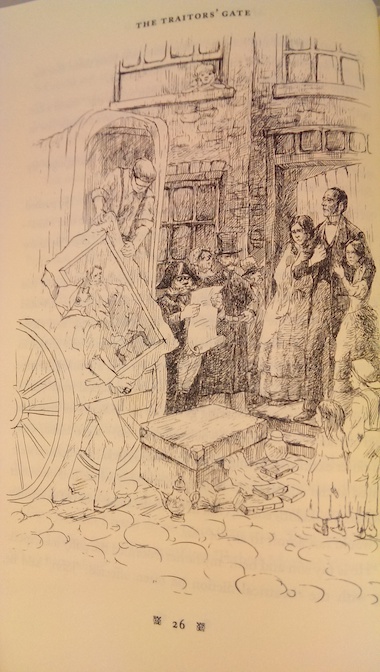
Then, one day, John is called home suddenly because of a family emergency. His family has fallen on hard times, and his father is in debt, so the family’s belongings are being confiscated. His father is summoned to appear in court, and if he cannot find the money to pay his debt, he will have to go to debtors’ prison. John’s father is shocked because he doesn’t actually owe any money to the man who is trying to call in the debt, Finnegan O’Doul.

TraitorsGateConfiscation

In spite of this, John and the rest of the Huffam family must spend the night in the bailiff’s sponging house, the Halfmoon Inn. There, John’s father again promises John that there is no debt between himself and Mr. O’Doul. He even says that he doesn’t really know O’Doul, although John doubts him. It seems like his father has had dealings of some kind with the man that he wants to keep secret.

John’s father, Wesley Huffam, was originally from a fairly well-off family, but all the family’s money ended up going to a great-aunt instead of to him (possibly because it became obvious to his relatives that he had little skill at handling money in the first place). John’s father is resentful toward the great-aunt, Euphemia Huffam, for inheriting when he thinks that, as a man, he should have been first in line for the family’s money. However, with this enormous (although possibly false) debt hanging over his head, he may be forced to appeal to Great-Aunt Euphemia for help. He persuades John to go and visit Great-Aunt Euphemia on his behalf, since he is not allowed to leave the sponging house for now and the past quarrels between him and his aunt would make it unlikely that his aunt would want to see him. John is beginning to realize that there are pieces of his father’s life and their family’s past that have been kept from him, and he doesn’t like the idea that his father has been deceiving him, but with their family in such a desperate situation, he agrees to visit Great-Aunt Euphemia.

TraitorsGateSary

The bailiff, John’s mother, and Brigid all agree that John is going to have to be instrumental in solving their family’s problems. Of all the people in his family, he is the most practical, in spite of his young age. His father is an impractical man, stuck in a vision of his family’s former glory (and his aunt’s current money, which he does not share in) that doesn’t fit their current circumstances. John’s mother thinks that her husband’s job as a clerk for the Naval Ordinance Office doesn’t provide enough money for the family to live on, even though he earns more than twice what typical London tradesmen of the time do. The real problem is that the family doesn’t live within its means (it is eventually revealed that Wesley Huffam has been withholding money from his family that he uses for gambling), and John’s father’s snobbish attitude because he thinks of his family as being more grand than the commoners around them alienates people who might otherwise be friends and help them. John knows that he’s young, and he’s not completely sure what he can do to help his family, but he knows that there is no other option but to try. In the process, he learns quite a lot about life, himself, the people in his family, and the wider issues in the world around him, including some political intrigue that hits uncomfortably close to home.

Great-Aunt Euphemia agrees to see John when he comes to her house, but their first meeting doesn’t go very well. Great-Aunt Euphemia is ill (or says she is), and she bluntly tells John that his father was always bad with money. She is not at all surprised that he is in debt and needs her help. John gets upset at the bad things that Euphemia tells him about his father, and she gets angry when John tells her the amount of the debt. At first, John is sure that she will refuse to help them completely, but Euphemia tells him not to assume anything but that he should come back the next day.  Her eventual contribution to helping John’s family in their troubles comes in the form of a job for John.

TraitorsGateRookery

As John moves around the city, he gets the feeling that he is being followed, and he is. One of the people following him turns out to be Inspector Copperfield (or so he calls himself) from Scotland Yard. When John confronts him, the inspector seems to have a pretty good idea of the difficulty that his family is in and what John himself has been doing. John asks him why he cares, and the inspector says that John’s father is suspected of a crime and that John had better learn more about what his father has been doing and share that information with him. John doesn’t believe that his father could be a criminal, but the accusation is worrying because he knows that his father is hiding something (his gambling addiction isn’t the only secret he has).

The other person following John is a young girl in ragged clothes. The girl, who calls herself Sary the Sneak, approaches John herself, freely admitting that she’s been following him. In spite of her young age, Sarah (or Sary, as she is frequently called) lives on her own and must support herself because her mother is dead and her father was transported to Australia. People don’t often notice a young girl on the street, so sometimes people will pay her to follow someone and provide information about them. The reason why she tells John about it is because she isn’t above playing both sides of the street; sometimes, she gets the people she’s been following to pay her to provide them with information about the people who hired her to spy on them. She considers it even-handed. However, John has no money to pay her for information and finds her spying distasteful, so he doesn’t want to take her up on the offer at first.

However, John does a little spying of his own when his father sneaks away from the Halfmoon Inn, which he is not supposed to do. He follows his father to a pub called the Red Lion, where he witnesses his father gambling with money that he had claimed not to have. More than that, he sees his father arguing with a man who turns out to be O’Doul, another gambler. To John’s surprise, his teacher also shows up and seems to know O’Doul. When John later confronts his father with what he saw at the Red Lion, all his father will say is that he is carrying a fortune around in his head. Later, John overhears the bailiff speaking with someone else, an Inspector Ratchet from Scotland, saying that it appears that Wesley Huffam may be a traitor involved with spies and that the Inspector Copperfield who spoke to John earlier was an imposter, probably also a spy.

Could it be true? Is John’s father really a traitor, selling naval secrets from his job? If so, who can John trust?  Conspirators seem to be around every corner, and John has the feeling that the people who are closest to him may be the biggest threats.

The book is currently available online through Internet Archive.

The Ship That Never Was

ShipThatNeverWasThe Ship That Never Was by Mickey Spillane, 1982.

Larry Damar and Josh Toomey are sailing in a boat off the coast of Peolle Island in the Caribbean when they rescue an old man from what seems to be a skiff. But, as soon as they get him aboard their own boat, they realize that what they thought was a skiff is actually more of a long boat, and it looks old. Very old.

They take the old man, who is suffering from exhaustion, to their fathers. While the old man rests, they inspect the boat and confirm that it is an antique. Oddly, from the condition of the wood, they believe that it has been resting in water for some years, but not salt water. It’s the kind of longboat that would have been carried aboard larger naval ships from a couple hundred years earlier. The name on the side of the boat, HMS Tiger, is familiar, but they heard that it was lost at sea ages ago. The old man is also carrying what appears to be some very old documents, but they are unable to read them, and when the old man speaks, they’re not quite sure what language he’s speaking.

They send a message to Sir Harry Arnold at the antiquities department of the British Naval Archives about the boat and the old man. When he arrives, he confirms that the longboat came from the HMS Tiger, a three-masted ship built in England in 1791. The Tiger was considered a jinxed ship because of everything that went wrong during its construction and its maiden voyage. Because of that, no one wanted to sail on it again or even work on the ship to dismantle it. So, the builder decided to send the boat on one last voyage by itself. He and his men loaded up the ship with supplies as if it had a crew aboard and then set it adrift, watching it sail off majestically, without a crew. Everyone had assumed that it would have eventually sunk, damaged by the weather, but apparently, it survived for longer than anyone had suspected.

Since no one can understand his language, the old man, who calls himself Vali, draws pictures to explain to them where he came from. Vali indicates which island he came from, and according to his other drawings, he lived there with many other people until many of them were killed in some kind of storm. He also draws a picture of a young girl with a crown on her head. Then, Larry’s dad, Vincent, recognizes the seal on a signet ring that Vali shows them. Vincent has read about the history of the country of Grandau (fictional country), and he recognizes its royal seal.

About 200 years before, Grandau was overrun by a neighboring country. Members of the royal family of Grandau escaped the invasion along with some loyal servants and tried to flee across the Channel to England to seek sanctuary. However, they were only in an old fishing boat, and it was thought that it sunk in a storm before they reached England because such a small craft would be unlikely to have survived. Grandau has not been a happy country since then. Over the years, they have been ruled by a series of dictatorships, and it has been in an almost constant state of unrest.

Now, the presence of the longboat from the HMS Tiger presents a much more intriguing theory of what happened to King Tynere of Grandau and his people. By an unbelievable coincidence (your suspension of disbelief is required for this story), the royal family’s attempted escape to England happened around the same time that the HMS Tiger was sent off alone and fully equipped for its final voyage. It now seems that the desperate people on the fishing boat were saved by encountering this grand, unmanned ship that no one else wanted, that everyone feared was jinxed. Grandau was not a seafaring nation, so the people were probably unable to actually sail the ship, simply letting it drift until they found land. Eventually, they arrived at an island in the Caribbean, and their descendants have been living there ever since in anonymity, until the disaster that prompted Vali to risk venturing out for help.

Unfortunately, their attempts to determine what language Vali was speaking and where he came from have also come to the attention of the wrong people. The government currently in power in Grandau has been working hard to stamp out the history and culture of the country in order to tighten its hold on the people, although their hold has never been more than tenuous, just like all the other dictatorships since Grandau’s royal family fled. Now that word has reached them that members of the royal family that the people of Grandau mourn may actually still be alive, they are determined to eliminate them before they can return to their ancestral home.

The author of this book, Mickey Spillane, is best known for his Mike Hammer series of hard-boiled mysteries for adults, and some of his hard-boiled style shows in this adventure book for children. This book is also part of a short series, although I don’t have the first book, The Day the Sea Rolled Back. In that book, Larry and Josh are helping their fathers hunt for sunken treasure, but their efforts are being sabotaged by a pair of treasure-hunting brothers.

Happy Birthday, Felicity!

American Girls

FelicityBirthday

Happy Birthday, Felicity! by Valerie Tripp, 1992.

FelicityBirthdayGuitarThis is part of the Felicity, An American Girl series.

It’s Felicity’s birthday, and her grandfather has given her a very special present: a guitar that once belonged to her grandmother, who is now dead. Felicity’s grandfather has heard Felicity singing and thinks that she shares her grandmother’s gift for music. He also thinks that Felicity is old enough to take proper care of the instrument, stressing the need for her to be responsible with it. Her mother tells her that she should keep the guitar safely in the parlor since she isn’t quite old enough for proper music lessons, like the ones Miss Manderly is giving Elizabeth’s older sister, Annabelle. Annabelle has been getting on Elizabeth and Felicity’s nerves by bragging about how they are still to young to even hold her guitar, although Annabelle really has no musical talent and struggles in her lessons.

Although Felicity knows that she should leave the guitar at home, she can’t resist taking it to Miss Manderly’s so that Miss Manderly can tune it for her and so that she can show it off to Elizabeth and Annabelle. Miss Manderly does tune the guitar for her and compliments her on owning such a fine instrument.

FelicityBirthdayGunpowderHowever, on the way home, something frightening happens. Felicity sees Elizabeth’s father, a known Loyalist, talking to a British soldier. She ducks into a bush so they won’t see her, and she hears them talking about the governor removing the gunpowder from the Williamsburg arsenal so the colonists can’t use it in the rebellion that has been threatening to come for some time.

Felicity hurries home to tell her family what she has heard, but when her mother and grandfather see that she has taken the guitar out of the house and gotten it wet and dirty while she was hiding, they refuse to listen to her. Her grandfather, also a Loyalist, particularly thinks that she’s making up stories to cover her irresponsibility about the guitar.

But, Felicity knows what she heard, and the situation is serious. What can she do to prove it to everyone?

In the back of the book, there is a section with historical information about how children were raised in Colonial America.  Another good book on the same topic is Going to School in 1776.

The book is currently available online through Internet Archive.