Among the Ghosts

Noleen-Anne Maypother’s mother died shortly after she was born, while holding her for the first time, so her life started with her first encounter with death. Since then, Noh has been raised by her widowed father with some help from her two aunts. Noh doesn’t realize it, but there’s usually one child in her family in each generation who has unusual talents, and in this generation, it’s her.

One summer, her naturalist father is going to study newts in the Appalachian Mountains, so he sends her to stay with one of her aunts. However, when she arrives, she finds out that her aunt has gone on a trip to the beach with her cousins because she wasn’t expecting Noh to arrive. Unsure of what to do at first, Noh realizes that she can just go to her other aunt, Aunt Sarah, who teaches English at a boarding school. Noh is supposed to attend this boarding school this coming fall anyway, so she decides that she can just go to the school early.

By the time Noh arrives at the school, her father and Aunt Sarah have realized what happened, and Aunt Sarah is expecting Noh to arrive. From the very beginning, this school is strange, though. Noh likes the school, but she has an odd encounter with a strange old lady when she tries to take a shortcut through a cemetery, and the woman gives her something that looks like an evil eye.

Later, when Noh is exploring the school, she meets a friendly girl called Nelly. Nelly chats with her, but Noh feels uneasy around her, for some reason. Although Noh doesn’t realize it right away, the reason is because Nelly is dead. Nelly is part of a group of ghosts who inhabit the damaged West Wing of the school, where no students live now.

Each of the ghost children who “live” there now died at the school at varying points in the past. Nelly died from an allergic reaction to a bee sting, which was ironic because she always wanted to be an entomologist. Trina died falling from a horse, although that doesn’t keep her from being friendly and nosing into other people’s business. She likes to follow living students around and listen to their gossip. Henry is an older ghost, having died at the school at the age of 13, about 50 years earlier. He is lonely for his parents and his old life, even though he has the other ghosts for company, and he sometimes broods over the letters he got from home before he died. Thomas is older still. He’s been dead for about 80 years, and he likes watching the school’s cook make pies in the kitchen.

At dinner that night, Noh tries to ask about Nelly because she notices that she is the only child among the faculty. The adults tell Noh that there are no other students at the school yet and that they’ll arrive in the fall. Someone suggests to Noh that maybe she saw a ghost, and Noh starts to wonder. When she returns to the West Wing to investigate, she meet Henry. Noh is startled at this confirmation that there are ghost children at the school, and Henry is startled that a living person can actually see him. There are plenty of ghosts around the school, but Henry has never met a living person who can see ghosts before.
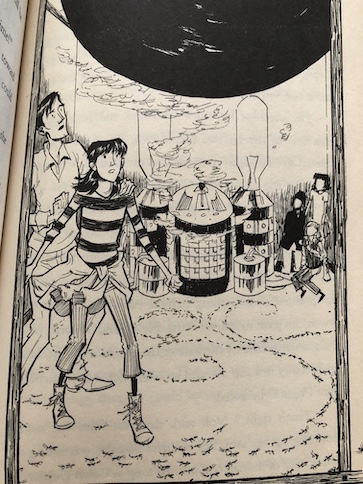
While the two of them are talking, something strange happens. A bright light appears, and Henry goes into it, disappearing. Noh doesn’t understand what happened or what it means. However, when she meets Trina later, she learns that other ghosts around the school have vanished, and Trina is worried. It seems to have something to do with the strange parades of ants that have been moving across the school, carrying something white with them.

Strange things have been happening at this school for generations. Noh learns that it’s a place that attracts people with unusual abilities, and it has been home to bizarre experiments and a shape-shifting monster that wants badly to eat “something big” as well as home to various ghosts. There are secret passages and hidden rooms and faculty who seem to know much more than they want to tell about the mysterious things that happen there. Noh must learn the school’s secrets to help her new ghost friends!

I enjoyed this creepy story. I think it was well-written and fun to read, although I also did feel like Noh figured out some things unnaturally quickly at the end. In the end, readers are given enough answers that the plot makes sense, and we can get a general pictures of what’s been happening at this school, but there are some things that appear intentionally open-ended. It felt to me like the author was setting up this story to be the first in a series, but as far as I can tell, it doesn’t have a sequel.

The story combines many elements of classic scary stories – spooky boarding school, ghosts, weird teachers with secret knowledge, secret passages and hidden rooms, girl with apparent psychic abilities that she doesn’t fully understand, secrets buried in the past, a bizarre invention that appears to have been made by some kind of mad scientist and has an unknown purpose, and a lurking monster that wants to eat someone. Although the story has plenty of creepy elements, they’re softened by humor along the way. There is a monster referred to as the “nasty thing that refuses to be named”, which appears periodically throughout the story to remind us that it once ate “something big”, that what it ate was “really big”, that it wants to eat “something big” again, that it can tell that readers don’t like it but that it doesn’t care what you think, etc. By the end of the story, we are told what the monster actually is, but it’s still on the loose, leaving it open to Noh and the ghost kids trying to hunt it down again later.

The author, Amber Benson, is also an actress, known for her role on Buffy the Vampire Slayer.

The Case of the Invisible Dog

McGurk Mysteries

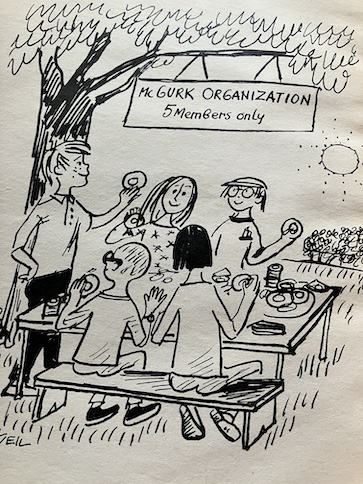
The members of the McGurk Organization are having their annual picnic in McGurk’s backyard when, suddenly, a doughnut leaps off the table and begins traveling through the bushes and grass. None of them can understand what’s happening because they can’t see anything that would cause the doughnut to move like that.

They go after the doughnut to see what happened, and they find Brains Bellingham, the nephew of Miss Bellingham, who lives next door. Brains has been staying with his aunt while his parents are out of town, and he always has a put-down for the members of the McGurk Organization. Brains is holding his aunt’s Yorkshire terrier, Dennis, and the missing doughnut, which has apparently been chewed by the dog. Brains apologizes for the dog ruining their “crummy” picnic, but he says that Dennis can’t resist doughnuts. However, that explanation doesn’t satisfy the McGurk Organization because none of them saw a dog carrying the doughnut, just the doughnut moving by itself. Brains makes an excuse about the dog being small and blending in with his surroundings, but the others can tell that he’s hiding something.

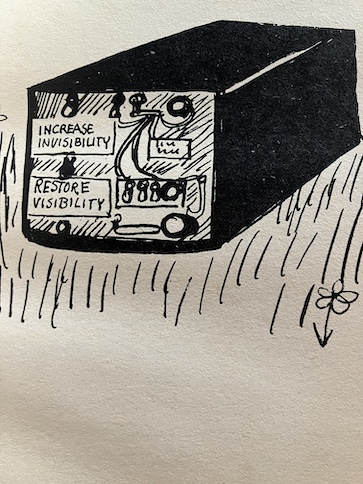
When Brains leaves for a moment because he says his aunt is calling him, they spot a strange black box in the grass. The box has dials and switches on it, and there are two labels: “Increase Invisibility” and “Restore Visibility.” Brains is known for building various inventions, so they know this is probably something he made, but does this device really make things invisible? Is that why they couldn’t see the dog when he stole the doughnut? They have a look inside the device, but since none of them is particularly good with electronics, they just know that it contains a bunch of wires and seems to be powered by batteries, and there is some kind of light inside the box. There are also doughnut crumbs inside the box.

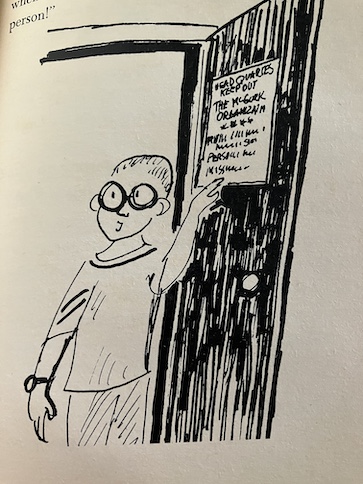
When Brains sees them messing with the box, he yells at them to stop snooping. Joey, the organization’s secretary, knows that part of Brains’s problem with the organization is that he’s jealous because he really wants to join. He’s hinted before that they need a laboratory man to help them with forensics. McGurk might have taken him up on the offer except that Brains was condescending and insulting in the way he made it, calling them “dummies.” He’s a little younger than the rest of them, too, so his condescending attitude makes him seem even more like an annoying little kid. McGurk tries to ask Brains about his strange device, but Brains just refuses to answer and takes the box and the dog away.

The members of the McGurk Organization return to their picnic, but they can’t stop wondering about Brains, his strange invisibility device, and how he accomplished the trick with the dog and the doughnut. Most of the organization members are pretty sure that there must be some kind of trick to it, but they can’t figure out how Brains did it. While they discuss it in their basement meeting room, they hear what sounds like the jingle of dog tags, and Willie, who has a very sensitive nose, says that he smells a dog. They search the basement and find a dog’s rubber bone. Then, Brains shows up, looking for Dennis. To their astonishment, Brains seems to pick up an invisible dog, who seems to be struggling and making dog noises, growling and jingling tags!

When the organization goes to confront Brains about what just happened, they find him with his strange box. The box appears empty on the inside, but they hear dog sounds from it. Brains operates the controls and opens the box again, and Dennis comes out! Brains claims that he invented the invisibility box by accident while he was trying to develop a treatment for getting rid of Dennis’s fleas and ticks using light rays. Brains says that there is a side effect where Dennis sometimes turns invisible at random times without Brains intentionally turning him invisible but that he’s working on the problem.

McGurk is thrilled at the possibility that Brains might be able to build a machine big enough to turn a person invisible, and he even offers Brains membership in the organization if he can do it. Brains says he could, but to everyone’s surprise, he turns down the membership offer. He says that he knows they don’t really want him in the organization; they just want his machine. It’s a little embarrassing, but it’s true.

The members of the McGurk organization consider ways that they could get Brains to change his mind. McGurk considers blackmail, but Wanda says that wouldn’t be right for a detective organization. Wanda thinks McGurk should apologize to Brains for the way he turned Brains away when he tried to join earlier, but McGurk can’t stand the idea of apologizing. Willie thinks they could offer to pay Brains, but they don’t really have anything they could pay him. They all ponder what would happen if they let word of Brains’s invention get out to the public or even the government.

Then, Brains comes to them, asking for help. He says that Dennis has turned invisible again, and he’s run off! Can the McGurk Organization find an invisible missing dog?

The book is available to borrow and read for free online through Internet Archive (multiple copies).

I didn’t read this book when I was a kid, although I read many others in the series. Because I didn’t read this book before, I didn’t really know the story of how Brains joined the McGurk Organization. There are some references to it in some of the later books in the series, so I knew that, when the other members of the organization first met Brains, they were investigating him for some trick he’d played on them. I was used to Brains being their friend, so it seemed odd to see him as the antagonist/suspect they are investigating in this book.

During the story, the members of the McGurk Organization are pretty sure from the beginning that Brains is playing some kind of trick, but they’re not sure how. He does manage to convince them temporarily that he has successfully developed an invisibility device, but McGurk soon realizes that something Brains has said contradicts what’s happened. Then, he and the others reexamine what happened to figure out how Brains staged his tricks. They’re a little mad at being tricked, so they pull one more trick on Brains to get even before they all forgive each other. Brains shouldn’t have called the others “dummies” or been condescending to them, and the others shouldn’t have been too quick to write him off just because he’s a year younger than they are. In the end, McGurk says that anybody who’s clever enough to work out a complicated trick like this one deserves to be a member of the organization, and they hold another picnic to celebrate their new member.

The Clue in the Classroom

The Bobbsey Twins

#9 The Clue in the Classroom by Laura Lee Hope (Stratemeyer Syndicate), 1988.

Before I begin, I’d like to acknowledge Sean Hagins, for supplying me with photos of this book! Usually, I take pictures of books myself, but I just couldn’t find a physical copy of this one. Sean is a big fan of the Bobbsey Twins, particularly the New Bobbsey Twins mysteries, and you can see some of his video reviews as well as videos about his photography work on his YouTube channel, SJHFoto. Thanks, Sean!

Nan and Bert are walking to school when Bert starts trying to follow Nan, practicing shadowing someone, like his favorite comic book detective, Rex Sleuther. Nan thinks that Bert’s attempts at following her are ridiculous, especially since she already knows he’s there. Then, she spots a tall man who is really being shadowed.

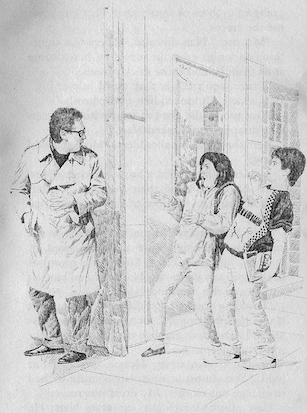
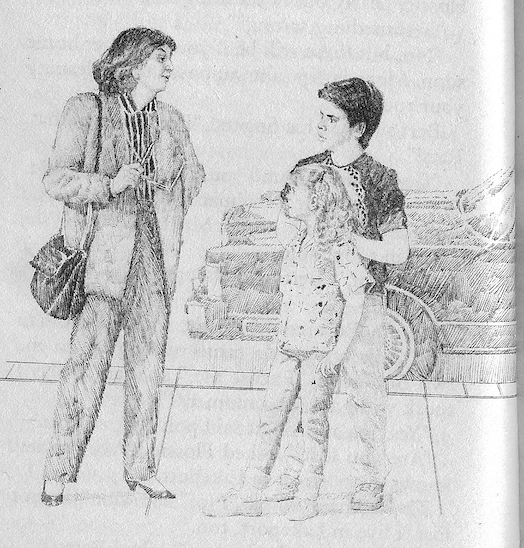
The tall man keeps looking over his shoulder and ducking into doorways, like someone is after them. It doesn’t take the kids long to realize who is following him because a man in a trenchcoat, who is walking behind the tall man, keeps pausing and pretending to tie his shoe or look in store windows every time the tall man glances back. It’s not very subtle. When the man in the trenchcoat sees Nan and Bert watching him, he gives them a menacing look and seems like he’s about to confront them, but then, he leaves. They lose sight of the tall man. It’s a bizarre experience, and it ends when the kids’ mother drives up with their younger siblings and gives them a ride.

At school, Nan meets her new science teacher, and she realizes that he is the tall man who was being followed by the man in the trenchcoat. He introduces himself as Mr. Newman (ha, ha), and he seems much more relaxed than he was before. That is, until they all see the message written on the blackboard in the classroom: “Newman, give up your plans. We’re watching you.” Mr. Newman exclaims, “Oh, no! They’ve found out! They know!” (I seriously wish that at least one of my old teachers had started their first day in class by saying that exact thing.) Mr. Newman doesn’t explain what it’s about. He just quickly erases the message on the board and begins talking about the science project he’s assigning.

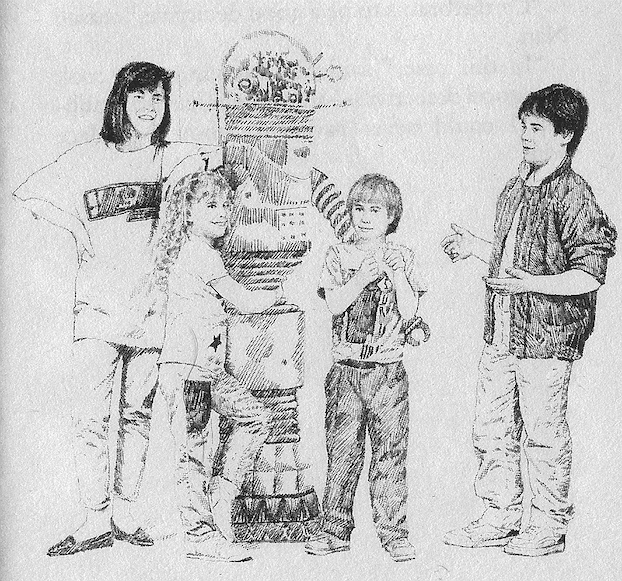
When Nan tells her siblings about Mr. Newman and what happened in class, Freddie says that Mr. Newman will also be teaching the afternoon science club that he joined. Mr. Newman will be teaching them about robots, and they’re going to have a meeting at his house, where Mr. Newman will show the club his inventions. Bert says that Freddie can help them figure out what Mr. Newman is doing and what and who he’s afraid of after he’s seen the projects that Mr. Newman is working on.

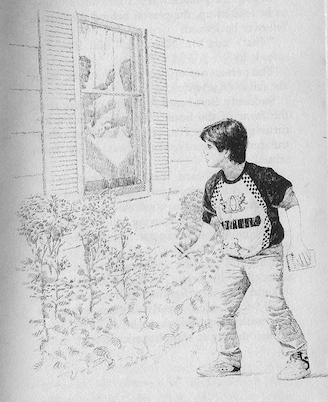
Bert decides to take a walk past Mr. Newman’s house to get a look at it before Freddie goes there. While he’s doing his reconnaissance, Bert sees what looks like people fighting in one of the windows. When he knocks on the door to see if Mr. Newman is all right, Mr. Newman says that he is and insists that there’s no one else there. Then, a strange woman shows up and starts asking Bert questions about Mr. Newman. She says that she’s his former boss at a computer company and wants to know if Bert saw anything in his house. She seems very interested in what he might be working on, but Bert just says that Mr. Newman was too busy for visitors.

Is this woman really Mr. Newman’s former boss, and does she have anything to do with the mysterious man in the trenchcoat? Someone breaks into the school and trashes Mr. Newman’s classroom. What is this secret invention of Mr. Newman’s that everyone seems so interested in, and why would someone threaten him over it or try to put a stop to his work?

The book is available to borrow and read for free online through Internet Archive.

My Reaction

The kids’ first thoughts about the mysterious people who are after Mr. Newman is that they might be spies, and they’re partly right. This is a matter of industrial espionage. People are after Mr. Newman’s invention because they can make a lot of money from it.

The robot Mr. Newman is building is really impressive, even by modern 21st century standards. Back in the 1980s, when this was written, a robot that large and sophisticated would have seemed almost like science fiction, although increasing developments in robotics technology would have made it seem more possible. Companies were working on developing robots during the 1980s, and Honda was working on a humanoid robot that could walk on two feet. Kids had toy robots. (I wanted one but never got one.) I don’t remember any classes for building robots for kids, but there may have been some that I didn’t know about at the time because I was still pretty young in the 1980s. In the 21st century, there are modern robotics classes for kids, and they sometimes show off their robots at competitions.

Frindle

Frindle by Andrew Clements, 1996.

Nick is a creative boy in elementary school who is known for pulling elaborate stunts, like turning his classroom into a tropical paradise with fake trees and real sand. When he gets to fifth grade, he has Mrs. Granger as his language arts teacher. Mrs. Granger has a sense of humor about some things, but she also has some strict rules and is all business when it comes to her specialist subject. Her vocabulary lists for her students are extensive, and her favorite thing is the unabridged dictionary. Nick likes words and enjoys reading, but he finds the dictionary to be boring. When he sees a word he doesn’t know, he would rather ask someone else what it means than look it up in the dictionary.

In most classes, Nick is good at asking teachers questions to sidetrack them from assigning homework. The other kids know he does this, so they aren’t surprised when he asks Mrs. Granger about her big unabridged dictionary and where all the words in it come from. Unfortunately, for Nick, Mrs. Granger is also onto his trick, and rather than answering the question herself, she assigns Nick to look up the answer and tell the rest of the class what he’s learned the next day in addition to his usual homework assignment. Nick is upset because he usually doesn’t have much homework at all, and now, he has to do more.

When Nick gets home, he reads about dictionaries in his encyclopedia, but he’s not sure that he understand everything he’s read, and it all sounds terribly dull. Then, Nick gets one of his creative ideas that he thinks will make this boring assignment more fun. When it’s time for Nick to give his report, even he is surprised at how much he has to say about the dictionary. Mrs. Granger loves his report, although even she tries to cut Nick short when he goes on for too long. Although the other kids were initially bored, they begin to enjoy Nick’s report when they realize that he is actually using it to waste an entire class period. Eventually, Mrs. Granger tells Nick that he’s at a good stopping place in his report, and she praises him for all of his work. Nick, annoyed that she’s making him look like a teacher’s pet, decides to ask one more question. He says that he still doesn’t understands who decides what the meanings of words are, like who decided that the word “dog” refers to a dog. Mrs. Granger tells him that everyone who speaks English does. Words mean whatever the people who use them agree that they mean. People who speak other languages use different words to refer to the same animal, but those words are valid to them because they all agree on the meaning of the words.

Then, Mrs. Granger says something that really starts Nick thinking. She says that if everyone in their classroom decided that they wanted to call a dog by some other word, and they got other English-speaking people to agree on it, that word would come to mean “dog.” If enough people agreed to use their new word and agreed on its definition, the new word would be put into the dictionary. To answer Nick’s original question, people who speak a language determine the words of that language and whether they are included in the dictionary. Mrs. Granger adds that the dictionary is the work of many experts over many years, and there are good reasons why each of the words included in the dictionary are there. The dictionary contains the laws of the English language, and while those laws can change, it takes time.

Later, when Nick is walking home with his friend Janet, Janet finds a fancy pen. Nick thinks about what Mrs. Granger said about how people like him, who use a language everyday, decide what words mean. It reminds him how, when he was little, he used to use a baby word that his family understood meant “music.” He had to give up using that word when he went to preschool because nobody outside of his family understood that word, but Nick understands how the word had meaning in his family because they all understood what Nick meant when he used it. While he’s thinking about it, he bumps into Janet, who drops the pen. On impulse, when Nick gives the pen back to her, he decides to give the pen a new name. He calls it a “frindle.”

At first, Janet is confused about what Nick means by “frindle.” It’s the beginning of a new experiment for Nick. Out of curiosity, Nick tries to see if he can teach a saleslady at a local store that the word “frindle” means “pen.” He goes to the store and asks for a frindle, pointing to the pens. Then, he gets some of his friends to do the same thing. After several kids all ask the same lady for a “frindle”, she begins to respond to it by automatically reaching for a pen. Nick is excited because he has just created a new word. “Frindle” now means pen because he decided that it did, and he got other people to agree on the meaning. Nick is making language history!

To make sure his word becomes part of language, Nick gets his friends to use the word “frindle” instead of “pen” at school … in Mrs. Granger’s class. Mrs. Granger isn’t amused by the class’s excessive use of the word “frindle” for pen because she knows that this is another of Nick’s stunts, and it’s a distraction from school lessons. She tries to discourage Nick from promoting it at school, and Nick points out that he’s only doing what she said about how words are made. Mrs. Granger explains how words in language evolved from other words that also have meaning, but “frindle” doesn’t have that kind of evolution because Nick just made it up, based on nothing. Nick insists that “frindle” means something to him and his friends, and they’ve already sworn an oath to each other to keep using it.

To Nick’s surprise, Mrs. Granger responds by showing him a sealed envelope. She tells him that it’s a letter for him, but she doesn’t want him to read it now. The letter is for him after the question of “frindle” is resolved. For now, she just wants Nick to sign the envelope and date it so that he’ll know what she hasn’t switched envelopes or tampered with the letter in any way. Nick is confused, but he does sign the envelope, and Mrs. Granger mysteriously says, “And may the best word win.” It seems like Mrs. Granger is declaring a war of words, pen vs frindle, but are Nick and Mrs. Granger really on opposite sides?

The book is available to borrow and read for free online through Internet Archive (multiple copies).

My Reaction and Spoilers

This is a fun and humorous story that does a great job of showing how languages evolve and the purpose and meaning of language. Nick and his friends unwittingly give themselves an education during the course of their stunt. The reason why Nick had to sign and date the envelope is that Mrs. Granger is also enjoying their experiment, and she has made a prediction about how it will all turn out. Anyone who has ever had to deal with a small child who has learned a bad word can guess what Mrs. Granger has realized and how her own actions are calculated to make sure she gets the result she really wants.

Something that not even Nick fully reckons with until his experiment is well underway is that, now that all of the kids at school know about “frindle”, he can’t stop them all from using the word, even if he wants to. Although Nick originally created the word, words in a language belong to everyone who uses them. This is both a thought-provoking book about the nature of words and language and a good story for stopping periodically and having kids make their own predictions about what will happen next.

Even kids have power because they are also language-users, and they have the ability to influence the language and understanding of everyone around them by the words they choose! Nick is very much an idea person, but after “frindle” starts getting so much national media attention, he starts to get intimidated by the level of power he has. He has become more conscious of the consequences of his ideas and how they can affect large numbers of people. For a time, he becomes more shy because of that realization, but Mrs. Granger gives him some encouragement. She tells him that he has many good ideas and that she’s sure he will go on to do great things with them. Nick regains his confidence and realizes that he can use his powers for good, supporting good causes.