Among the Ghosts

Noleen-Anne Maypother’s mother died shortly after she was born, while holding her for the first time, so her life started with her first encounter with death. Since then, Noh has been raised by her widowed father with some help from her two aunts. Noh doesn’t realize it, but there’s usually one child in her family in each generation who has unusual talents, and in this generation, it’s her.

One summer, her naturalist father is going to study newts in the Appalachian Mountains, so he sends her to stay with one of her aunts. However, when she arrives, she finds out that her aunt has gone on a trip to the beach with her cousins because she wasn’t expecting Noh to arrive. Unsure of what to do at first, Noh realizes that she can just go to her other aunt, Aunt Sarah, who teaches English at a boarding school. Noh is supposed to attend this boarding school this coming fall anyway, so she decides that she can just go to the school early.

By the time Noh arrives at the school, her father and Aunt Sarah have realized what happened, and Aunt Sarah is expecting Noh to arrive. From the very beginning, this school is strange, though. Noh likes the school, but she has an odd encounter with a strange old lady when she tries to take a shortcut through a cemetery, and the woman gives her something that looks like an evil eye.

Later, when Noh is exploring the school, she meets a friendly girl called Nelly. Nelly chats with her, but Noh feels uneasy around her, for some reason. Although Noh doesn’t realize it right away, the reason is because Nelly is dead. Nelly is part of a group of ghosts who inhabit the damaged West Wing of the school, where no students live now.

Each of the ghost children who “live” there now died at the school at varying points in the past. Nelly died from an allergic reaction to a bee sting, which was ironic because she always wanted to be an entomologist. Trina died falling from a horse, although that doesn’t keep her from being friendly and nosing into other people’s business. She likes to follow living students around and listen to their gossip. Henry is an older ghost, having died at the school at the age of 13, about 50 years earlier. He is lonely for his parents and his old life, even though he has the other ghosts for company, and he sometimes broods over the letters he got from home before he died. Thomas is older still. He’s been dead for about 80 years, and he likes watching the school’s cook make pies in the kitchen.

At dinner that night, Noh tries to ask about Nelly because she notices that she is the only child among the faculty. The adults tell Noh that there are no other students at the school yet and that they’ll arrive in the fall. Someone suggests to Noh that maybe she saw a ghost, and Noh starts to wonder. When she returns to the West Wing to investigate, she meet Henry. Noh is startled at this confirmation that there are ghost children at the school, and Henry is startled that a living person can actually see him. There are plenty of ghosts around the school, but Henry has never met a living person who can see ghosts before.

While the two of them are talking, something strange happens. A bright light appears, and Henry goes into it, disappearing. Noh doesn’t understand what happened or what it means. However, when she meets Trina later, she learns that other ghosts around the school have vanished, and Trina is worried. It seems to have something to do with the strange parades of ants that have been moving across the school, carrying something white with them.

Strange things have been happening at this school for generations. Noh learns that it’s a place that attracts people with unusual abilities, and it has been home to bizarre experiments and a shape-shifting monster that wants badly to eat “something big” as well as home to various ghosts. There are secret passages and hidden rooms and faculty who seem to know much more than they want to tell about the mysterious things that happen there. Noh must learn the school’s secrets to help her new ghost friends!

I enjoyed this creepy story. I think it was well-written and fun to read, although I also did feel like Noh figured out some things unnaturally quickly at the end. In the end, readers are given enough answers that the plot makes sense, and we can get a general pictures of what’s been happening at this school, but there are some things that appear intentionally open-ended. It felt to me like the author was setting up this story to be the first in a series, but as far as I can tell, it doesn’t have a sequel.

The story combines many elements of classic scary stories – spooky boarding school, ghosts, weird teachers with secret knowledge, secret passages and hidden rooms, girl with apparent psychic abilities that she doesn’t fully understand, secrets buried in the past, a bizarre invention that appears to have been made by some kind of mad scientist and has an unknown purpose, and a lurking monster that wants to eat someone. Although the story has plenty of creepy elements, they’re softened by humor along the way. There is a monster referred to as the “nasty thing that refuses to be named”, which appears periodically throughout the story to remind us that it once ate “something big”, that what it ate was “really big”, that it wants to eat “something big” again, that it can tell that readers don’t like it but that it doesn’t care what you think, etc. By the end of the story, we are told what the monster actually is, but it’s still on the loose, leaving it open to Noh and the ghost kids trying to hunt it down again later.

The author, Amber Benson, is also an actress, known for her role on Buffy the Vampire Slayer.

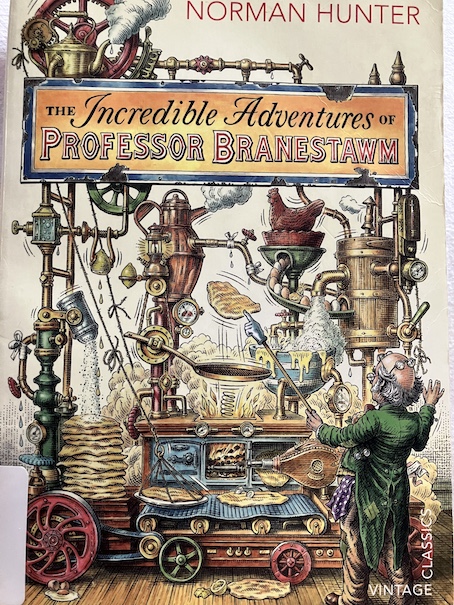
The Incredible Adventures of Professor Branestawm

Professor Branestawm is a classic absent-minded professor. He’s is a balding man who wears several pairs of glasses, one of which is for finding the other pairs of glasses when he inevitably loses them. He’s a very clever man, but everyone knows that his inventions are likely to cause chaos. He’s not an easy person to talk to, so he doesn’t have many friends. His best friend is Colonel Dedshott, who is a very brave man.

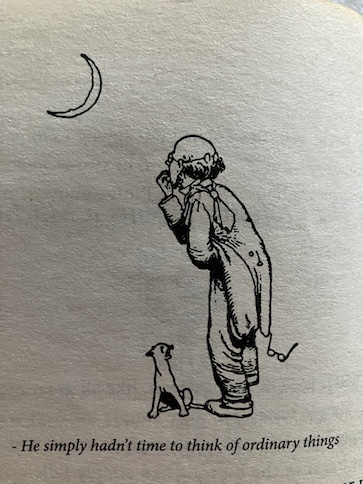
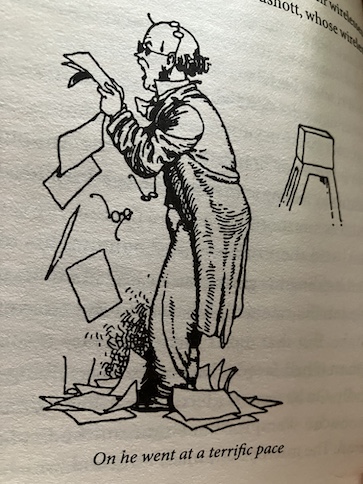
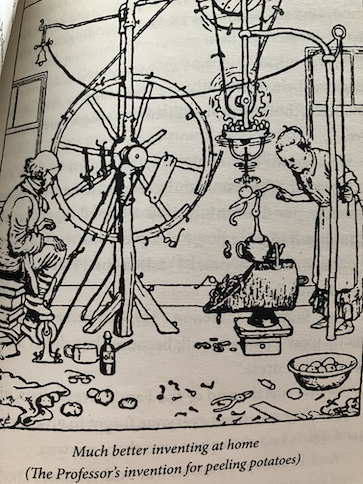
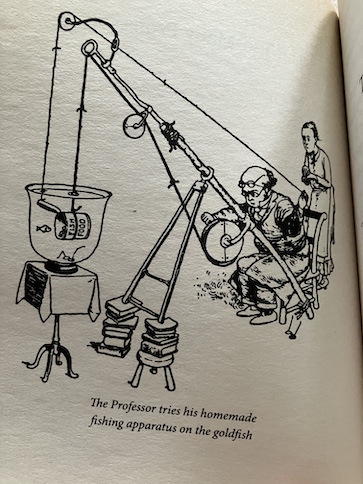
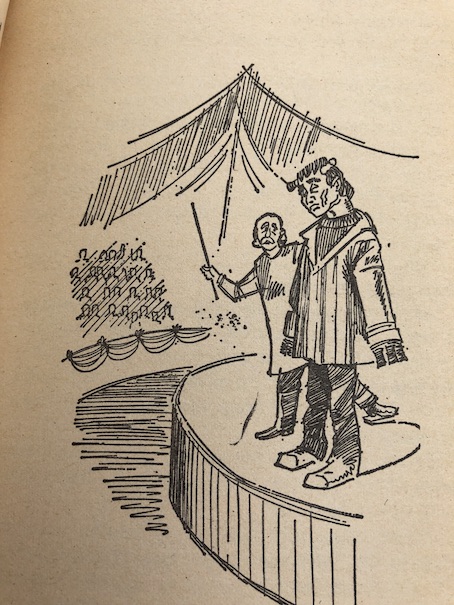
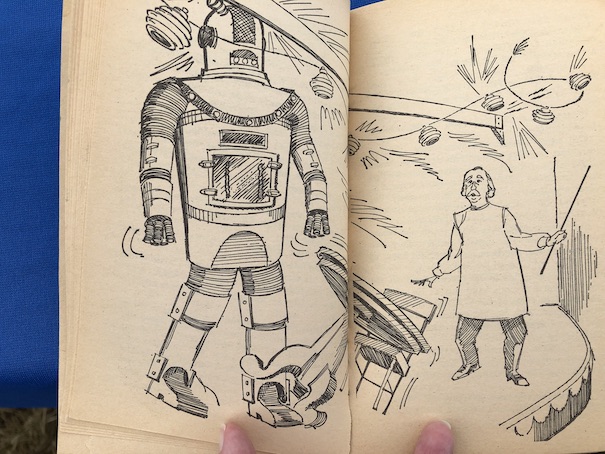
Every chapter in this book is about another of the Professor’s inventions and the adventures that the Professor, the Colonel, and the Professor’s housekeeper, Mrs. Flittersnoop, have with them and with various situations that the Professor creates with his absent-mindedness. The stories are accompanied by pen-and-ink drawings. I love the way almost every picture of the professor shows him shedding one or more of his many pairs of glasses and that the Colonel’s weapon of choice is a slingshot!

One day, Professor Branestawm invites the Colonel to his house to see his latest invention, which he says will revolutionize travel. When the Colonel arrives, Professor Branestawm explains his idea. First, he points out that, if you’re traveling somewhere, you’ll arrive in half the amount of time you ordinarily would if you travel there twice as fast. The Colonel says that makes sense. Then, Professor Branestawm says that, the faster and faster you travel, the sooner you arrive at your destination. That also makes sense. Further, Professor Branestawm says, you eventually start traveling so fast that you arrive before you even start, and if you go fast enough, you can arrive years before you start. The Colonel doesn’t really understand this, but he takes the Professor’s word for it. The Professor has built a machine that will allow them to travel that fast, and the Colonel is eager to try it. He suggests that they try going back in time to a party he attended three years earlier. The Professor insists that they take some powerful bombs with them, just in case of emergencies (don’t try to make sense of it, there isn’t any), and the Colonel has his trusty catapult (slingshot) and bullets with him.

It turns out that, rather than going to the party three years earlier, they arrive at the scene of a battle that took place in another country two year earlier. Although they already know how the battle turned out, the Professor and Colonel can’t resist joining in with their bombs and catapult, and they end up wiping out an entire army and changing the result of the battle in favor of the revolutionaries. The revolutionaries are so grateful to them for their help that they take them to the palace of their former king, put the two men on the enormous throne there, and make them the new presidents of the country. Professor Branestawm realizes that they’ve made a terrible mistake and changed history because the king’s army was the one that was originally supposed to win the battle. The Colonel, however, doesn’t care because he thinks it sounds like fun to be a president and can’t wait to do some ruling.

Of course, the ruling of the two presidents doesn’t go well. Neither one of them really knows anything about running a country. Since they blew up all the country’s troops, there are no troops left for the Colonel to review, and he ends up playing with toy soldiers. Meanwhile, the Professor really just wants to get back to his inventing. Eventually, the revolutionaries get tired of this and tell them that they’ve decided that they don’t want any presidents, so they’re giving them a week’s notice before they’re out of a job. The Professor and the Colonel try not to take any notice (ha, ha) of the revolutionaries’ attempts to dethrone them. This just leads to the revolutionaries trying to imprison them in the dungeon, so the Professor and the Colonel are forced to escape in the Professor’s machine, which takes them back to the exact time and location where they started. They arrive just as the Professor’s housekeeper brings them some tea, so they have their tea, go about their usual business, and leave it to the historians to deal with the complications of the two of them changing history.

When Professor Branestawm’s housekeeper puts a bottle of cough syrup with no stopper into the waste-paper basket, it accidentally creates a waste-paper monster! It turns out that it wasn’t really cough syrup in the bottle. It was a special life-giving formula that the professor invented. He only keeps it in a cough syrup bottle because cough syrup is the only thing that neutralizes the life-giving formula and stops it from bringing everything it touches to life, including the bottle holding it. Now that they’ve accidentally created a waste-paper monster, what can they do to stop it, especially since it seems to have the ability to use tools and is currently trying to saw down the tree where the Professor and his housekeeper are trying hide?

Professor Branestawm accidentally loses a library book about lobsters, so he goes to another library to get the same book. By the time that he needs to return the library book, he has found the first one and lost the second one. For a while, he manages to avoid library fines by continually returning and checking out the same book from both libraries because the libraries don’t notice which library the book is from. Of course, he eventually loses the first book, too. He tries to fix the situation by getting the same book from a third library and then one from a fourth library, when he loses the third book. Where will it all end? How many libraries will have to share this one book, and where on earth are all these books about lobsters going?

Professor Branestawm and his housekeeper go to the movies to see a documentary about brussels sprouts. (The housekeeper doesn’t care about brussels sprouts, but there’s a Mickey Mouse cartoon included with the feature, and she wants to see that.) When they get back, they discover that the house has been robbed! Professor Branestawm decides that he’s going to invent a burglar catcher, but the only burglar he catches is himself.

Professor Branestawm’s clock stops, so he takes it to a clock repair shop. It turns out that the clock has only wound down because the Professor has forgotten to wind it. The Professor decides that he’s going to invent a clock that will go forever and never need winding. (This story is set before clocks that don’t need winding became common.) The Professor does invent a clock that will never stop and never need winding, but he makes a critical mistake: the chimes never reset after they strike twelve. They just continue counting up and up, endlessly, with no way to stop them! Just how many times will they endlessly strike before something terrible happens?

The Professor visits a local fair and invites the Colonel to join him. The Colonel ends up winning most of the prizes for the various games, and the Professor accidentally gets left behind in the waxworks exhibit, being mistaken for a wax statue of himself. When the Professor decides that it’s finally time to get up and go home, the people who work in the waxworks think that a wax statue has come to life!

Professor Branestawm writes a letter to the Colonel, inviting him to tea, but because he is distracted, thinking about potatoes, he accidentally writes a muddled letter and then mails the paper he used to blot the letter instead of the letter itself. The message that arrives at the Colonel’s house is a backward, muddled mess, and he has no idea who sent it to him. Since it looks like it’s written in some strange language he doesn’t know, the Colonel decides to take it to the Professor to see if he can decipher it. The Professor fails to recognize the letter as what he sent and has forgotten that he sent it. Will the two of them figure out what the letter is about, or will they eventually just give up and have some tea?

Professor Branestawm’s housekeeper’s spring cleaning creates some chaos in the professor’s house, and the Colonel suggests that Professor Branetawm invent a spring cleaning machine. Predictably, the spring cleaning machine creates an even bigger mess and far more chaos.

Professor Branestawm invents a very smelly liquid that brings things from pictures to life. The things from the pictures go back to being pictures when the liquid dries. Of course, there are some things that cause big problems when they’re brought to life. Possibly the most chaotic pictures that come to life are pictures of the Professor and the Colonel and the professor’s housekeeper. Who is who and which is which?

Professor Branestawm is invited to give a talk on the radio, and the Colonel helps him to rehearse. However, because he gets mixed up, he almost misses his own talk, and when he finally gives it, he speaks too fast and discovers that the time slot for his talk is much longer than he thought it was. Listeners are confused, but everything is more or less all right when the Children’s Hour comes on.

The Professor and the Colonel are going to a costume ball. Since the Professor doesn’t know what to do for a costume, the Colonel suggests that the two of them dress as each other. This causes some confusion, and neither of them likes each other’s clothes. The Professor’s social skills aren’t even great at the best of times, and the truth is that he’d rather be inventing things at home in his “inventory” (pronounced “invEnt – ory” as in a laboratory where you invent things, ha, ha). Then, the Countess at the ball raises the alarm that her pearls are missing! Everyone is confused when they try to get “the Colonel” to find the thief, and he doesn’t seem to know what he’s doing. It takes a while for things to get sorted out, but at least the Professor and the Colonel develop a new appreciation for being themselves instead of being each other.

Professor Branestawm’s house has gotten so full of his inventions that it’s become difficult to live there, so he’s decided to move to a new house. Moving to the new house is an escapade, and when Professor Branestawm and his housekeeper get there, they discover that the water and gas haven’t been connected up yet. Professor Branestawm’s attempts to remedy the situation render the new house unlivable, so he is forced to move back to his older house.

Professor Branestawm invites his friends and various members of the community to his house for a party, where there will be tea and pancakes. Everyone is happy to go because of the promise of pancakes, but when they’re all there, Professor Branestawm reveals that the party is to unveil is newest invention: a pancake-making machine! As the library man predicts, the pancake-making machine goes wrong (just like the Professor’s other inventions), but it’s all right because the town council comes up with a new purpose for it.

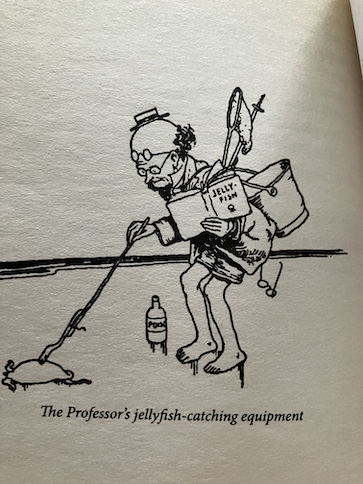
Professor Branestawm takes a trip to the seaside. He asks the Colonel to join him and bring his book about jellyfish, but unfortunately, he neglects to tell the Colonel where he’s staying (partly because he forgot where he was supposed to stay and is actually staying somewhere else). When the Colonel tries to find the Professor, he accidentally mistakes an entertainer dressed as a professor for Professor Branestawm. When the entertainer isn’t acting like himself (so the Colonel thinks), the Colonel becomes worried and decides medical intervention is necessary.

The book is available to borrow and read for free online through Internet Archive (multiple copies). It’s the first book in a series about Professor Branestawm, and it was also adapted for television multiple times.

Kids won’t learn anything about real science from Professor Branestawm, but the stories in the book are funny and not meant to be taken seriously at all. Most of the stories are about some pretty silly things that don’t really mean much in the end, but when you think about it, the Professor’s antics do lead to some pretty serious consequences, from wiping out an entire army just for the fun of it (pretty horrific in real life) and changing the course of history to accidentally blowing up someone’s house with his perpetually-chiming clock. No matter what the Professor does, though, there never seem to be any lasting consequences.

Even when people around him brace themselves for when the Professor’s latest project inevitably goes wrong, everybody still thinks that the Professor is pretty clever. The Colonel always thinks the Professor is clever, and even when he knows that the Professor is bound to do something that’s going to cause chaos, he enjoys the excitement. The housekeeper sometimes goes to stay with her sister, Aggie, when the chaos and excitement get too much for her.

The stories are just meant to be enjoyed for their zaniness, and there’s no point in analyzing them much. You don’t have to worry about whether anything the Professor does makes sense or exactly how he got any of his inventions to work. You can just enjoy seeing how everything develops and watch the craziness unfold! It sort of reminds me of Phineas and Ferb’s summer projects, which cause some chaos but are ultimately funny and always disappear at the end of the day. Enjoying these stories is what they used to say in the theme song for the tv show Mystery Science Theater 3000:

“If you’re wondering how he eats and breathes
And other science facts,
Just repeat to yourself “It’s just a show,
I should really just relax …”

I can promise you that, no matter what happens in any of the stories, the Professor and his friends will ultimately be fine and will probably have a cup of tea (or “a cup of something”) afterward. This book was originally published in Britain the early 1930s, and it was read by children during the Great Depression. I can imagine that it might have given children then a good laugh and some escapism during troubled times.

Strangely, at least one of the Professor’s inventions, the clock that never needs winding, is a real invention that we have every day because time has moved on (ha, ha) since this book was originally written and published. In fact, it’s very unusual to find clocks that need to be wound these days. Of course, the part about the clock perpetually chiming more and more and blowing up when it gets to be too much is just part of the craziness of Professor Branestawm.

Danny Dunn and the Swamp Monster

Danny Dunn

Professor Bullfinch receives a cryptic message, which he says is written in the style of a telegram (he calls it “cablese” – a way of shortening messages because people pay for telegrams by the word). As Professor Bullfinch and Danny study the message further, they can draw more conclusions about the sender, who is not specified. They know it’s someone with money because the hotel it was sent from is expensive. From one of the terms used, they think the sender is a scientist, and because he sent a message written to be a telegram as a letter, he’s probably absent-minded. That description seems familiar to Professor Bullfinch.

Then, a strange man comes to the door who seems oddly distracted and confused. He greets Danny as if he were an old friend, but Danny has no idea who he is. He thinks the man is crazy, but Professor Bullfinch recognizes him as his old friend Dr. Benjamin Fenster. Of course, Dr. Fenster is the person who sent the confusing message. It turns out that Dr. Fenster meant to send that message to Dr. Ismail at the University of Khartoum, but he accidentally got it mixed up with the message he was going to send to Professor Bullfinch. Dr. Fenster is an absent-minded professor type, and he’s always doing things like that. Although, he does correct Danny when he mentions this, saying that he’s not actually a professor, and it’s not so much that he’s absent-minded so much as that he has a lot to think about and can’t think of everything at once.

Their conversation is interrupted when something goes wrong with the experiment that Professor Bullfinch and Danny were working on before Dr. Fenster arrived. A warning goes off, and Professor Bullfinch yells to Danny to shut off the machine. However, Danny can’t find the shut off switch, so he panics and pulls an electrical cord, sending an electrical current through the project before Professor Bullfinch turns off the switch. When they examine the results of the experiment, they’re surprised. Professor Bullfinch was trying to develop a new polymer, but the accident with the machine and the electrical current have turned the polymer into a superconductor and a very powerful ring magnet with a circular magnetic field.

While they’re examining the results of the experiment, Dr. Fenster wanders off, lost in thought. Danny worries if he’ll be okay, wandering around on his own, but Professor Bullfinch says that he’ll be fine. Dr. Fenster often does this when he’s thinking something through. Danny’s friends, Joe and Irene, arrive, commenting on seeing a man who was acting strangely and wondering if there’s something wrong with him. Danny explains to them who Dr. Fenster is and tells them about the ring magnet. Then, Dr. Fenster bursts back in, very excited, because he’s figured something out. He thinks the magnetic polymer ring might be the solution to a problem he’s been trying to solve.

Dr. Fenster is a zoologist, and one of his projects is to investigate accounts of legendary animals. Although many scientists tend to disregard stories of unknown animals as purely legendary, sometimes, they turn out to be previously unreported/undiscovered species. (“Undiscovered” in the scientific sense. Obviously, people have seen them, or they wouldn’t tell stories about them. These are species that haven’t been officially documented as having been discovered among the scientific community.) Investigating rare or possibly unknown species is what Dr. Fenster does.

Dr. Fenster is currently investigating reports of a creature called the lau, which apparently lives in swampy areas around the source of the Nile River in Uganda. The lau is supposed to be an enormous serpent with tentacles on its head. The legend around it says that if a person sees the lau first, the lau will die, but if the lau sees the person first, the person will die. When the others ask him if he thinks that’s real, Dr. Fenster says that he thinks that’s more metaphorical, like when someone says they felt petrified, it doesn’t mean that they literally turned to stone, or if someone says that their blood froze, it just means that they felt horrified. He thinks that the idea is that a serpent could kill a person, if they didn’t see it and disturbed it, but if the person saw the serpent first, they would kill it to avoid the threat.

The problem that Dr. Fenster has been trying to solve is how to move around the swamp and keep the area under observation during the night as well as the daytime, without possibly disturbing the creature he’s trying to find. It’s difficult to get around that swampy area in daylight, but it’s even more difficult at night, and he doesn’t want to use lights because that could frighten away the lau. He’s been thinking that he would like to mount some specialized cameras in certain strategic areas, but he couldn’t figure out how to mount them, and the cables he would have to use would be long and heavy. Having seen what the magnetic polymer can do, though, he thinks that could be the solution to the problem. It doesn’t weigh much itself, but when they test it, they discover it can support the weight of a grown man.

Dr. Fenster invites Professor Bullfinch and the children to join him on his expedition. He’s independently wealthy, and he can afford to pay for all them to come along. However, Danny’s mother has reservations about how safe this expedition is, and she can’t imagine that Joe or Irene’s parents will allow them to go on the trip, either. It takes time for Dr. Fenster to persuade the children’s families that the trip is safe enough for them. Eventually, they give in and allow the children to travel to Africa as a special Christmas present. Dr. Fenster doesn’t have any time limit on his own investigations, but the parents limit the children to only two weeks.

When they get to Africa, the first place that Dr. Fenster takes them is to Khartoum University in Sudan, where he introduces them to Professor Ismail, the Director of the Department of Zoology. Professor Ismail has helped Dr. Fenster with travel arrangements, equipment for the expedition, and the necessary government permits. Danny asks Professor Ismail what he thinks about the stories of the lau and whether it could be something like a dinosaur that has somehow survived. Professor Ismail says that many things are possible because there known oddities among animals, like the platypus, which lays eggs even though it’s a mammal. He shows them a fish called clarias lazera, which has the rare ability to leave water and live on land for a period of time.

The children get something to eat at a local cafe and talk excitedly about what the lau could really be and how its discovery could be “the most important discovery of the century.” Irene notices that a man in the cafe looks very interested in what they’re saying and follows them when they leave.

When the expedition reaches the site Dr. Fenster wants to investigate, they persuade some of the Nuer people who live there to show them where they’ve see the lau. They are initially reluctant and warn them that the lau is dangerous, but they do show them an area, and the members of the expedition start setting up cameras to watch it. As they begin exploring, they do find large trenches that are like the paths supposedly left by the giant serpents.

Dr. Fenster explains to the disappointed children that he won’t take them along to confront the lau directly, even if they do find it because of the possible danger. He and Professor Bullfinch will handle the creature, using the tranquilizer gun that Dr. Fenster brought along. They plan to have the children watch on the monitors and keep an eye on the base camp. However, the children see something unexpected when they’re looking at the monitors: the same strange man who was following them in Khartoum. Who is he and why has he followed their expedition?

When the children tell Professor Bullfinch and Dr. Fenster about him, they meet up with the man, and he introduces himself as a rare animal collector. He offers to join their expedition and help them, but Dr. Fenster refuses. One of the Nuer recognizes the man as a disreputable character who would do anything for money, and Dr. Fenster thinks he’s a poacher, who would try to capture rare animals and sell them, rather than simply study them scientifically. It seems that, aside from protecting themselves from the possibly dangerous lau while they study it, they might also have to protect the lau.

The book is available to borrow and read for free online through Internet Archive (multiple copies).

The lau is a cryptid in the real world as well as in the story, and the details Dr. Fenster offers about where it supposedly lives and historical mentions of the creature are accurate. Accounts of what the lau might actually be in real life vary. It could be a type of python or a very large fish, like a catfish. In the story, when they do find the lau, it turns out to be an enormous catfish, the kind that can live without water for a time and move on land, but it also turns out to be electrical, like an electric eel. Professor Bullfinch and Dr. Fenster decide that it’s related to the malapterurus, which is in keeping with real world theories about the lau.

The story makes some good points about known animals in the real world that are considered oddities because they have qualities that don’t normally apply to other animals of their type, like how the platypus is an egg-laying mammal. Just because something sounds unusual doesn’t mean that it’s impossible. There are wide variations among creatures in the animal kingdom. I thought it was interesting that they brought up the clarias lazera, which is a type of catfish that can live and move on land. A similar type of catfish that can live and move on land appeared in the children’s mystery book The Mystery of the Other Girl.

I’m not sure whether the accident that produced the magnetic polymer makes any reasonable scientific sense, but there a few interesting facts in the story. When they get to Africa, Dr. Fenster explains to them that there are actually two Nile rivers – the White Nile and the Blue Nile. They get their names because the soil they pass through gives them each a different color.

There are some words of another language included in the story when they reach Uganda, but I’m honestly not sure whether they’re real words or just made up to make it seem like Dr. Fenster can speak the local language. I tried putting them through Google translate to see if it could recognize them as anything, but it came out as nonsense. However, it’s supposed to be a language spoken by the Nuer people, so it might be something that Google translate doesn’t know.

Sometimes, I’m a little suspicious when I encounter obscure foreign words in old children’s books. I’ve read other old children’s books which use made-up words in place of an actual foreign language, probably because the writers didn’t know how to write something in a real foreign language but they wanted something that looked like it could be from another language. They were probably also acting with the assumption that kids wouldn’t know the difference, so it wouldn’t matter. I could be doing these authors a disservice by being a little suspicious here. Perhaps they did some extra research to learn a few phrases in a language that would be very obscure in the United States. It’s just that, having seen fakery elsewhere, it’s something I find myself looking for when I see instances of languages that would be difficult to fact-check.

Faking words in a real spoken language is less tolerated in the 21st century than it used to be, especially in a book that’s supposed to have educational qualities, so I hope they didn’t attempt to do that. Faking lesser details in a fiction book that’s supposed to have some real facts tends to cast suspicion on just how many of the other “facts” in the book are fake. This is an adventure story, not a textbook, so it’s true that some creative license is allowed. I still don’t know if their magnetic polymer concept is at all plausible, but the Danny Dunn stories are science fiction adventures, so some creative license there is allowed. However, readers like to feel that they can trust a certain amount of supporting detail to be correct. It’s also considered a cultural insult to use fake nonsense words in place of actual words from a language people really speak. Hopefully, that’s not the case here, but I wanted to point out the concept so readers can see how the use of real words strengths a story while faking them weakens it.

The story offers about the Nuer people, but I’m not sure how accurate they are. I don’t know where the authors got their information. They say that Nuer people don’t have chiefs and don’t follow orders from anybody, but according to the eHRAF World Cultures collection through Yale University, their clans do have headmen, and they also have sub-chiefs.

The Wright Brothers

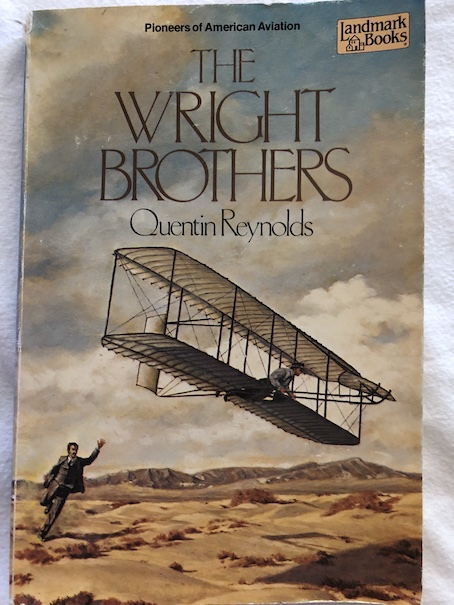
The Wright Brothers by Quentin Reynolds, 1950.

This book is part of the nonfiction history series Landmark Books, which focus on events and famous people in American history. This biography of the Wright Brothers, inventors of the airplane, is told in story format with dialog between characters. I’m not sure how accurate the dialog is, but it’s compelling way of presenting historical figures to children. I remember that I actually used this book for a report that I did about the Wright Brothers back in elementary school.

According to the story, the Wright Brothers’ mother, Susan, was responsible for inspiring their love of science and inventing things because she encouraged their curiosity and enjoyed answering their questions about how the world works, introducing them to concepts like wind resistance when explaining how birds fly and how to walk when you have to walk into the wind. Susan Wright was very good at math and had a talent for planning things out on paper that she taught to her children. She was accustomed to making her own patterns for clothes, and she showed the children how to apply similar principles to planning how to build a sled by drawing out their plan and figuring out, mathematically, the sizes of each piece of the sled. The boys learned a lot from her and applied what she taught them to their later projects, like building a wagon they could use in their first job, working for the local junk man. The boys would gather scrap materials in their wagon that the junk man would buy from them and sell to others. The junk man also gave them some supplies to work with and some tips for building their projects.

The Wright brothers enjoy flying kites with their friends, and now that they’re learning more about making things, they decide to try making their own kites. Their first attempt doesn’t work well, but by studying what went wrong, they learn how to modify different parts of the kite to get better results. Their second kite turns out better than the store-bought kites that the other boys have, and the brothers begin making and selling kites to the other boys.

When they were young, the boys were quite athletic, particularly Wilbur, who played both football and hockey. However, when he was a teenager, he was injured badly during a hockey game. A puck hit him in the face and knocked out several of his teeth. To make matters worse, the injury became infected, and the infection damaged his heart. His doctor advised him not to return to sports or athletics and not to pursue any line of work that involved hard physical work or heavy lifting to avoid further strain on his heart. It was a heavy blow, but it wad also a turn point in the brothers’ lives.

While Wilbur was resting and recovering from his injury and infection, their father gave him a drawing set and a small wood-working kit that included a book about the properties and uses of different types of wood. Wilbur had never been very interested in books before, but he discovered how useful they could be, and the boys used the new knowledge Wilbur gained in their projects. Orville made a good partner for Wilbur because he was happiest doing the actual assembly work of everything they built and had little interest in books and studying. He could handle the heavy work that Wilbur could no longer do while Wilbur studied design techniques and mapped out plans for their projects. In this way, the boys made a chair for their mother as a present. Wilbur came up with the basic concept and then discussed and worked out the plan with Orville. Orville gathered the materials and assembled the chair according to the plan, discussing the results with Wilbur. As Wilbur recovered further, he was able to get out of bed and help Orville more in their workshop in the family’s barn, but they continued to keep this partnership system that worked well for them, with Wilbur focusing on studying and planning and Orville handling the heaviest parts of the assembly.

The boys’ father was a minister, and for a time, he was the editor of a church newsletter. He gave Wilbur the job of folding the papers, with Orville helping. When they realized just how long it took to fold individual papers, they came up with the concept of building a paper-folding machine. Their machine worked incredibly well, finishing all the folding that ordinary took them a couple of days in the space of a couple of hours. Their father was amazed and realized that the boys could have a future as inventors.

In high school, Orville helped a friend of theirs, Ed Sines, with managing the school newspaper, which was printed on a very small printing press. He and Wilbur discussed making a larger press and starting their own newspaper with their friend. This was a harder job that required the boys to work with metal instead of just wood, but they accomplished it. There was one other obstacle, though. They had their own press, but before they could begin printing anything or selling advertising space in their paper, they needed to buy other supplies, like ink and paper. They realized that they and their friend would have to get other jobs to raise the money. Wilbur was the older of the two brothers by four years, and he thought he could get a job delivering groceries. However, Orville was worried that the job might be too difficult physically for his brother because it involved heavy lifting. He suggested that Wilbur get the job and then let him help with the heavier parts of the work. It turned out to be a good idea because they were able to gather pieces of news as they traveled to farms in the area and talked to people as they delivered groceries.

Their newspaper was successful, particularly after they started taking side jobs, using their printing press to print signs, flyers, and bulletins for local businesses and churches. Because it was just a small business, they underbid some of the bigger, established printers. However, the brothers soon became bored with the newspaper and printing press because what they really loved most was building things and fixing things. They sold their share in the printing business and newspaper to their friend, Ed Sines, and they decided to open a bicycle shop, where they could build and repair bicycles.

Orville had the idea of promoting their bicycle business with a bike race. His thought was that he could enter it himself and show off how their methods of cleaning and repairing bicycles improved their speed and performance. Unfortunately, the bike race didn’t turn out well. Although Orville’s bike was in excellent condition, they neglected to put new tires on it. He was just about to win when he blew a tire, and his loss of the race cost them business. People weren’t confident that they would do a good job repairing their bikes if they couldn’t properly take care of their own. However, a local businessman loved the bicycle race so much that he decided to sponsor another one, and Orville easily beat all of the other bicycles in that race. Customers’ confidence in their business was restored, and they learned that, when building or repairing any machine, they couldn’t afford to neglect any part of it or take it for granted that everything was right without checking for certain.

The Wright brothers began building their own bicycles, which they called Wright Fliers, and their mother bought an interest in the business to give them some money to get started. One of the features of their service that drew customers was their promise to repair any bike they sold for free for a full year after the purchase. When their mother died, they threw themselves even more into their business to work through their grief.

Then, Orville became ill with typhoid. It was a frightening and often deadly disease, and Wilbur and their sister Kate feared for him. The book (which was written in 1950, remember) discusses how typhoid was little understood at the time. Doctors at the time didn’t fully understand how it was transmitted. (Answer: It’s a bacterial infection spread through food or water contaminated with Salmonella Typhi. Besides vaccines, water purification methods, pasteurization of milk, and other food safety measures help prevent the spread.) They had no cure for it (which would be antibiotics later), only medicines that they could use to treat the symptoms, to try to help the sick through the worst of it. The book further notes that, by the time the book was written, most parents had their children vaccinated against typhoid and other dangerous diseases, like smallpox, but that wasn’t an option for the Wright brothers because those vaccines had not yet been developed in their time. (The book adds that, “Every single soldier in World War II was inoculated against typhoid fever, and very few of them caught the disease.” The author of this book was aware that this particular vaccine was not 100% effective and didn’t prevent 100% of cases, which is common among vaccines in general, but it was still massively effective and made a major difference in curbing the spread of the disease, even in wartime conditions, which are often unsanitary. The earliest typhoid vaccine dates back to 1896, and that was the year given for Orville’s illness, but the implication is that he caught the disease before he had access to the new vaccine. Missed it by that much.)

Orville’s illness was severe. He spent about two weeks just sleeping, and when he was awake, he was delirious because of his high fever. Wilbur and Kate looked after him with the help of a hired nurse. The doctor told them that there was little that he could do and that the fever had to “run its course.” (The book says at this point that, “You never hear a doctor say, “This disease has to run its course” today. Today doctors know how to fight many kinds of diseases, and they have medicines and drugs to kill the germs that cause the disease.” By 1950, when this book was written, the invention of antibiotics had made an enormous difference in treating infections, and the author of the book would have been aware of the difference it made in quality of life and the treatment and survival rate of diseases. However, I have to admit that it’s not true that all diseases have a cure, even in the 21st century. We have ways of treating viruses, but we still can’t really cure viruses, and most of those also have to run their course. For most of my life, people considered most viruses relatively mild compared to bacterial infections, but the coronavirus of the early 2020s challenged that assumption. It’s just interesting to me to compare these different expectations regarding illness and medicine in three different time periods: the late 1800s, the 1950s, and the 21st century.)

After about three weeks, Orville’s fever finally broke, and they knew that he was going to survive. He had lost weight, and he was very weak, and his doctor told him that he would have to rest in bed for two months. For a young man as active as Orville, that was going to be difficult, but Wilbur told him that he would read to him to keep him entertained. In particular, Wilbur had a book that he knew Orville would love: Experiments in Soaring by Otto Lilienthal. Ever since they had been making kites as boys, they had dreamed of one day building a kite big enough to allow them to fly in it, and that was basically what Lilienthal had done. Lilienthal had invented a glider. (Sadly, he was killed in a glider accident while trying to perfect his design in 1896, the same year of Orville’s illness.) Lilienthal was only one of many people who were experimenting with the concept of flight and flying machines in the late 19th century, but he had been one of the most successful with his designs up to that point. The brothers acquired other books and magazines about flight and the attempts people were making at building flying machines. Neither of the Wright brothers had actually graduated from high school, but their extensive reading and practical experimentation made up for the lack of formal education. Based on their reading, they developed a new goal: to build a glider that would fly farther than any that had so far been created.

At first, they didn’t want to tell anyone else other than their sister what they were working on because they didn’t know for sure that they would succeed, and they thought that everyone would think that they were crazy for trying to fly. A trip to the circus, where they saw an exhibit of a “horseless carriage” (an early automobile), gave them the idea that they might be able to attach an engine to some kind of glider to propel it. Their logic was that if it could work for carriages and boats, it might work for a flying machine. They imagined that an engine could propel the glider through the air as an engine could move a boat through water, and then, the flying machine would be less dependent on the wind, which could be variable.

When they had a glider design that satisfied them, they knew the only way to know for sure how well it would work would be to try it. They didn’t want to try it in Ohio, where they lived, because there were too many hills and trees that would get in the way. They wanted a flat place with few trees and where they could find a reliably steady wind. Since they had acquired their reading materials by writing to the Smithsonian Institute, they wrote to the Smithsonian Institute to ask if they had information about places with the conditions they required. The Smithsonian Institute forwarded the letter to the United States Weather Bureau, which recommended a few places, including Kitty Hawk, North Carolina. (Fun Fact: Kitty Hawk is just a little north of Roanoke Island, the site of the infamous vanished Roanoke Colony. It’s not important to the story, but I just wanted to tell you.)

As with their first kite, their first experiment with the glider was only partly successful. It glided for 100 feet before crashing. They fixed the glider and tried again, but it again ended with a crash because they couldn’t steer the glider. Just as they did with their first kite, they decided to build a new one, using what they had learned from the experiment and refining the design. They knew there were risks in their experiments because of Lilienthal’s death, but they were careful not to test their gliders at a very high altitude. They also added both vertical and horizontal rudders so they could not only steer from side to side but also move up and down, giving them greater control over the movement of the glider. What made their experiments different from others’ is that they ultimately wanted to create a “heavier than air” flying machine, propelled by an engine.

After their successful test at Kitty Hawk in 1903, in which Wilbur flew for 59 seconds, a record time, few people believe it at first. They were angry at first that their own neighbors thought that they made up the story about flying. They continued to work on their flying machine, and when they produced one that flew over a cow pasture near their town for 39 minutes, local people started believing them. Word was also spreading through the international scientific community. President Theodore Roosevelt first learned about the Wright brothers from an article in Scientific American, and he arranged for them to demonstrate their flying machine to the Secretary of War at Fort Myer, Virginia. During that demonstration, Orville flew their airplane for a whole hour, ending with a successful landing. Then, when a young soldier said that he wished he could fly, too, Orville took him for a ride with him on a second flight. The book ends with the Secretary of War hiring the Wright brothers to make bigger, more powerful airplane for the US Army, and the Wright brothers accepting an invitation to dinner from President Roosevelt.

The book is available to borrow and read for free online through Internet Archive (multiple copies).

My Reaction

I used this book for a school report about the Wright Brothers when I was a kid, and I think it holds up with time. Part of what I like about the Wright Brothers is their partnership as brothers. They had friends outside of the family, but their greatest friendship was always with each other because they had so many interests in common, even though there was an age gap of four years between them. They often felt like nobody understood them or their projects as well as they understood each other, and they could talk about things with each other that their other friends just wouldn’t understand because they weren’t into building things or studying technical methods and inventions. Not all siblings get along so well, but they really understood each other and complemented each other well. When Wilbur could no longer do some of the heavier work that he did when he was younger, Orville was happy to do the heavier physical work, which he preferred to the reading and studying that Wilbur discovered he really loved. They learned from a young age how to use their strengths to help each other and carry out their projects, and that’s real teamwork!

When I was a kid, I didn’t pay any attention to the About the Author section, but it’s interesting by itself. Quentin Reynolds was a famous war correspondent during World War II, which is part of the reason why he makes multiple references to World War II and World War II airplanes during the book. He also wrote other nonfiction books for adults and children, including four other books in the Landmark series.

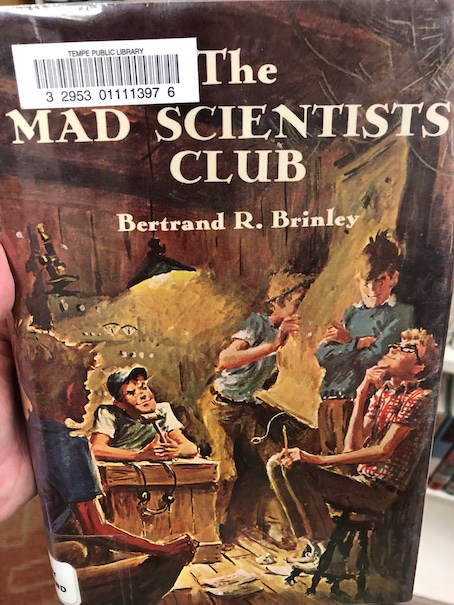
The Mad Scientists Club

The Mad Scientists Club Series

The Mad Scientists Club by Bertrand R. Brinley, 1965, 2001.

The Mad Scientists Club series is about a group of boys who like science and make things in their clubhouse laboratory. Their inventions are often part of pranks that they play on their town, Mammoth Falls, but the boys also use their inventions and skills to help people. People in town are aware that the boys pull pranks and stunts, but they are often unable to prove the boys’ involvement in particular pranks, and the boys typically keep the methods they use secret.

Henry is the idea man of the group, and the club’s rival is a former member named Harmon. Harmon’s cousin is still a member of the Mad Scientists Club, and Harmon likes to spy on them and pump his cousin for information so he can mess up their plans out of spite.

Each chapter in the book is its own short story about the club’s antics. Some of the stories originally appeared in Boys’ Life magazine in the 1960s. The stories are a good fit for Boys’ Life because some of the skills the boys use are skills that are taught in Boy Scouts, like what to do when someone is injured and how to tie different types of knots.

The stories reference scientific and mathematical principles, and the boys are methodical in their approaches to the problems in each story. The technology is old by modern 21st century standards (and so are some cultural references, like McGee’s closet), but the principles are sound. There are no projects for readers to do themselves in the book, but it does occur to me that these types of stories could work well with some included activities or nonfiction accompaniment.

The first story in the book was made into a live action tv movie by Disney, The Strange Monster of Strawberry Cove (1971), but the movie has different characters from the ones in the book. The Disney movie uses the same set of characters they used for their movie version of Secrets of the Pirates’ Inn (based on The Secrets of the Pirate Inn). The plot of The Strange Monster of Strawberry Cove is also very different from the original story because, in the Disney movie, the kids don’t know what the “monster” is at first and need to investigate it, whereas the boys in the Mad Scientist Club know exactly what the monster is in their story because they built it themselves. You can watch the movie online through Internet Archive, but unfortunately, I couldn’t find an online copy of the book.

Stories in the Book:

The Strange Sea Monster of Strawberry Lake

Dinky accidentally starts a town-wide rumor about a sea monster in the lake when he makes up a story about seeing a strange creature in the lake when he needs an excuse for arriving home late. His friends know it’s just a story, but they decide to play along and build a monster of their own out of canvas and chicken wire and scare people as a prank. Even though people in town are scared of the monster, the attention the town receives is so good for local businesses, the boys can’t bring themselves to stop their prank. Instead, they decide to make their monster more elaborate, and things start to get out of hand. How can they end the hoax while saving the town’s image and avoiding punishment?

Night Rescue

An Air Force plane explodes near the town of Mammoth Falls. The pilot escaped from the plane, but he’s now lost in the woods. The local authorities are searching for him, and the boys in the club want to help. The mayor doesn’t want the kids involved, knowing their usual pranks and stunts, but the Air Force colonel is willing to let them help, if they think they can, because he just wants his pilot rescued. The boys use a flare to determine which way the parachuting pilot would have drifted, and then, they calculate about how far he would have drifted to find him.

The Unidentified Flying Man of Mammoth Falls

The boys find an old department store manikin and keep it in their clubhouse until Henry gets the idea for how they can use it in an elaborate prank on the town’s Founder’s Day. They’re going to make the manikin fly!

The Secret of the Old Cannon

The town’s old cannon from the Civil War is a local landmark now. (We don’t know what state Mammoth falls is in, but there are statues of Confederate soldiers next to the cannon.) Years ago, the town filled the barrel with cement, so it can never fire again. Around the time that the cannon was filled in, there was a bank robbery in town, and some of the boys in the Mad Scientists Club think that the money might have been hidden in the cannon before it was filled with cement. The boys try to figure out how they can prove whether or not the money’s in there without removing all of the cement. Someone else also wants to know the answer to that, and the answer may be important to the upcoming race for mayor.

The Great Gas Bag Race

Henry has an idea for a new kind of balloon that he thinks will help the Mad Scientists Club win the balloon race, but the club’s rival, Harmon, is also entering the race.

The Big Egg

The boys are digging for fossils in the local quarry when they find a dinosaur egg! At first, they’re not quite sure what to do with it. They consider selling admission for people to come see it or maybe turning it over to a museum, but Henry announces that he has another idea. Henry wants to bury the egg in the ground and see if it hatches. It seems unlikely, but the other boys agree to try it. Then, when a couple of the boys go to check on the egg, they discover that it’s missing! They bring their friends back to look at it, and suddenly, the egg is there again! What’s going on? Did someone take the egg and then return it? Is this another one of Harmon’s tricks?

The Voice in the Chimney

One day, some of the boys in the club see Harmon throwing stones at an old, abandoned house in town while some girls watch him. Wondering what he’s doing, they get closer and hear him challenging the ghost that supposedly haunts the old house, trying to impress the girls with his bravery. The boys are disgusted because they know Harmon isn’t really that brave, and they hate seeing him show off for the girls. When they hear Harmon brag that he’s going to come back to the house at night, they tell the rest of their club, and the boys decide to put on a haunted house act of their own to scare Harmon. In the process, they also end up scaring the mayor and the chief of police!

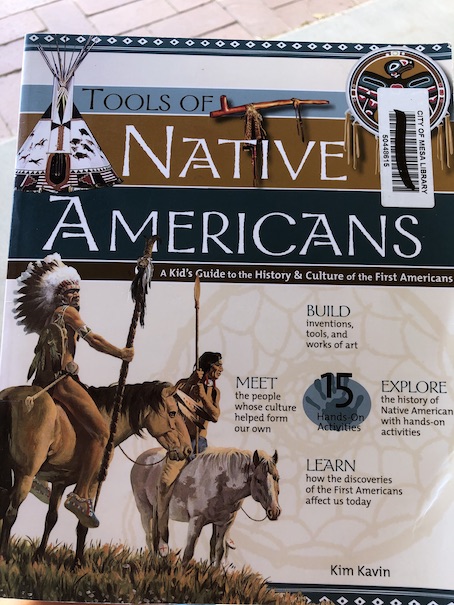
Tools of Native Americans

Tools of Native Americans by Kim Kavin, 2006.

This nonfiction book is part of a series recommended for kids ages 9 to 12. It provides insights into the daily lives of Native Americans of the past by explaining their tools and inventions. I was intrigued by the idea immediately because I love books that give insights into history through the lives of ordinary people.

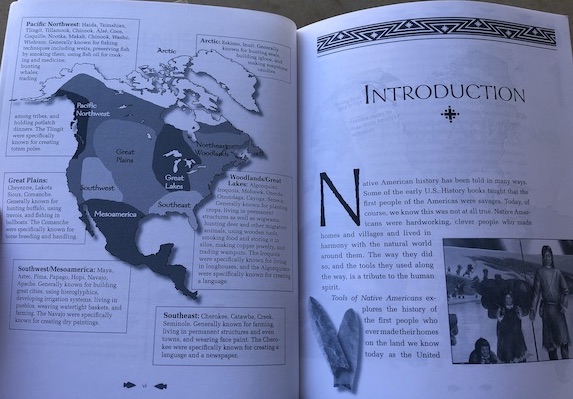
The book is divided into time periods and geographic areas of North America. At the beginning of the book, there is a timeline of important events in the history of North America and Native American culture, beginning c. 20,000 to 8000 BCE, when the ancestors of Native Americans are believed to have migrated to the continent and ending in 2006, the year the book was published. There is also a map showing major geographic regions of North America and the Native American tribes that live there. The chapters of the book are mostly grouped by region, except for the first two, which are about the First Americans and Archaic and Formative Periods.

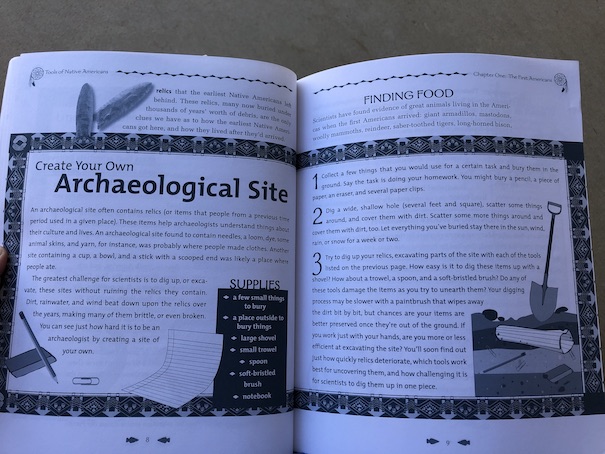
The first chapter, called The First Americans, discusses theories about how the ancestors of Native Americans first arrived on the continent from Asia. The exact circumstances of their arrival are unknown, but there are some possible migration paths that they could have taken. The chapter discusses the Ice Age that existed when this migration took place, how people found food, and Clovis culture, one of the earliest known civilizations in the Americas. One of the activities from this section is about archaeology, which is what we use to learn more about ancient civilizations that did not leave written records, and how to create an archaeological site of your own.

The next chapter is about the Archaic and Formative Periods, which were characterized by climate change as the Ice Age came to an end and many plants and animals that had thrived in the colder climate died off. The changes in the environment cause Native American groups to make changes in their own lifestyles. Rather than relying on herds of large animals for food, they began cultivating crops. They made pottery and developed new cooking techniques. They still hunted, using a device called an atlatl to throw their spears further and with more power. Civilizations like the Maya flourished.

After the second chapter, the other chapters discuss tribes by region:

The Northeast Woodland and Great Lakes Tribes – The Algonquian and Iroquois

This chapter discusses Native American tribes from the East Coast to the Midwest, around the Great Lakes, who primarily lived in woodland areas. The Iroquois and the Algonquian were both collections confederated tribes. There is information about the Algonquian language, which contributed some words to English, including moccasin, succotash, hominy, hickory, and moose. There is also an activity about creating Algonquian style pictographs and petroglyphs.

The Southeast Tribes – The Cherokee, Catawba, Creeks, and Seminoles

The tribes in this chapter lived in and around the Appalachian Mountains. It explains about Sequoyah, who developed a system of writing for the Cherokee language.

The Great Plains Tribes – The Cheyenne, Lakota Sioux, and Comanche

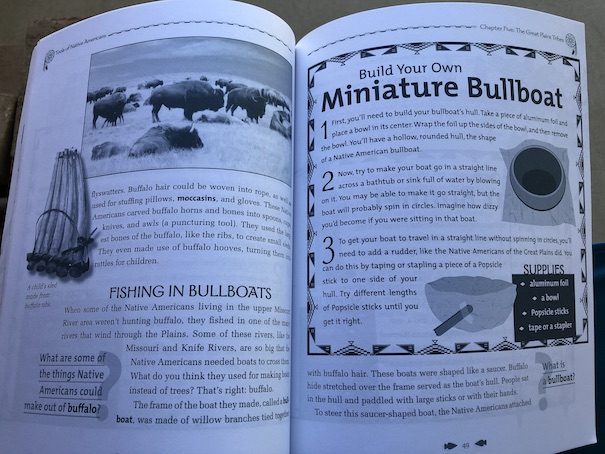
The tribes of the Great Plains were migratory, following herds of buffalo, which were a primary source of food. Because they moved often, everything they owned, from the tepees where they lived to the tools and other objects they used, had to be easily portable. The Comanche were particularly known for being expert horsemen. This chapter also discusses the Lewis and Clark Expedition and Sacagawea, who was part of the Shoshone tribe from the Rocky Mountains. She had been abducted when she was young, and when she joined the Expedition, she was able to guide Lewis and Clark and their men back to the territory she had known when she was a child and to the Pacific Ocean. Activities for this chapter include making a rattle of the kind children used as toys, making a miniature bullboat, and making a war bonnet (using pieces of poster board instead of feathers).

The Southwest and Mesoamerican Tribes – The Hohokam, Mogollon, Anasazi, Maya, Aztec, Hopi, Apache, and Navajo

I know this area because this is where I grew up. Much of it is desert, and the book is correct that there can be sharp differences in temperature between day and night. In modern Southwestern cities, buildings and pavement can hold in heat even at night, but there isn’t much to hold in heat in the open countryside, not even much humidity in the air to hold heat once the sun goes down. There is an abundance of clay in the soil in this region which local tribes used to make pottery and adobe homes.

Among the civilizations discussed in this section are the Hohokam, whose name means “Vanished Ones” (I’ve seen different versions of the translation of that name, but they’re all words to that effect – that they are gone, vanished, disappeared, etc.) because, for unknown reasons, they seem to have suddenly abandoned the area where they had previously lived and farmed for generations. They don’t seem to have died off, at least not all of them. It’s believed that they were the ancestors of the Pima and Tohono O’odham tribes, and the book discusses that a little further on in the chapter. There is a Pima story about a fierce rainstorm and a massive flood that killed many people, but The Hohokam were the ones who built the original irrigation canals for watering their crops. Later, when settlers came from the Eastern United States, they found these abandoned canals, dug them out, and started using them again. The canals are still in use today, and one of the activities in this chapter of the book is about irrigation.

This section of the book also covers the Maya and the Aztecs, who lived in what is now Mexico and Guatemala. There is an activity about creating hieroglyphs, like the kind that the Maya once used.

In the part that describes the Navajo, there are activities for sand painting and Navajo-style jewelry.

The Pacific Northwest Tribes – The Nootkas, Makahs, and Tlingits

Much of this chapter discusses hunting and fishing and the preservation of food. Because food-related work mostly took place during a single season due to the severity of the winters, there were periods of time when the members of the Pacific Northwest Tribes had time for social and artistic pursuits. The book explains the meaning of totem poles, and there is an activity for readers to create their own.

The Arctic Tribes – The Inuit

The lives of the Inuit were shaped by learning to live in a very cold environment. The book explains how they built igloos out of packed snow and ice, but really, igloos were temporary shelters. The houses they lived in long term where made of sod and were partially built underground for insulation. There are activities for building a snow cave called a quinzy (this requires that you live in a place with snow) and for playing a game called Nugluktaq.

The last chapter in the book is called New Immigrants, Manifest Destiny, and the Trail of Tears. It’s about how European settlers arrived in the Americas, the westward expansion of the United States, and the confinement of Native American tribes to reservations.

The book ends with an Appendix with further information about Native American Sites and Museums State by State. There is also a glossary, index, and bibliography.

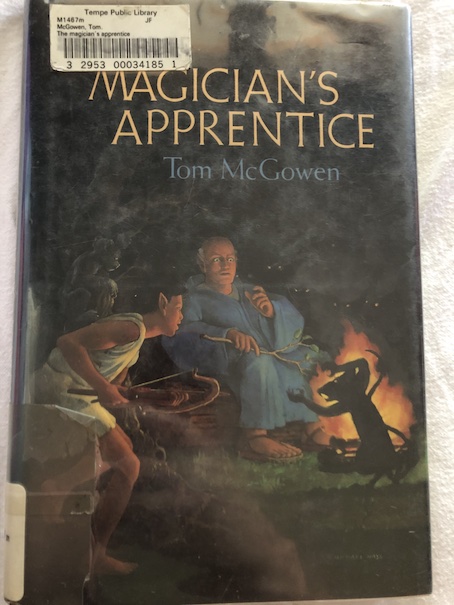
The Magician’s Apprentice

The Magician’s Apprentice by Tom McGowen, 1987.

From the title of this book and others in this series, it sounds like the stories take place in a fantasy world. When you’re reading this book, it seems like fantasy at first, but it’s not. It’s actually science fiction.

Tigg is a poor orphan boy who makes his living in the city of Ingarron as a pickpocket because he has no other means for survival. One night, he notices that a sage has left the door to his house open, and although it’s a risk, he decides to enter and see if he can find anything worth stealing. The sage, a man called Armindor the Magician, catches Tigg. In fact, Armindor had deliberately left the door open for Tigg to enter. When, Armindor questions Tigg about who he is, Tigg says that he’s about 12 years old (he’s unsure of his exact age and defines it in terms of “summers”) and that he has no family that he knows of. He lives with an old drunk who makes him pay to live with him with the money he steals.

Tigg asks Armindor what he plans to do with him. He can’t really punish him for stealing from him because Tigg hadn’t had a chance to take anything of Armindor’s before he was caught. Armindor says that’s true, but he was planning on stealing something, so Armindor tells him that he will do the same to him – plan to take something he has while still leaving him with everything he has. Tigg is confused, and Armindor explains his riddle. He witnessed Tigg picking someone else’s pocket and was intrigued by the boy because he seemed to possess courage, wit, and poise. He left his door open for Tigg because he has been looking for a young person with those qualities to be his apprentice. If Tigg becomes his apprentice, he will have to put his good qualities to use for him, but yet, he would keep these qualities for himself as well.

Tigg likes the praise but has reservations about becoming a magician’s apprentice because an apprenticeship would limit the freedom he currently has. His current existence is precarious, but the long hours of work and study involved in an apprenticeship sound daunting. However, Armindor isn’t about to let Tigg get away. He takes a lock of Tigg’s hair and a pricks his thumb for a drop of his blood and applies them to a little wax doll. He tells Tigg that the doll is a simulacrum and that it now contains his soul, so whatever happens to the doll will also happen to him. If Tigg runs away from his apprenticeship, Armindor can do whatever he likes to the doll as his revenge or punishment. Tigg, believing in the power of the simulacrum and feeling trapped, sees no other way out, so he becomes Armindor’s apprentice.

Although Tigg is fearful and resentful of his captivity as Armindor’s apprentice, it soon becomes apparent that life with the magician is better than what he used to have living with the old drunk. Armindor gives him a better place to sleep and better food. There is work and study, but it’s not as difficult or unpleasant as Tigg first thought. At first, he is daunted at the idea of learning to read and do mathematics, but Armindor is a patient and encouraging teacher, and Tigg soon finds that he actually enjoys learning things he never thought he would be able to do.

Armindor’s magical work seems to mainly involve healing sick people. When people come to him with illnesses, he gives them medicines that he calls “spells.” He keeps a “spell book” with instructions for remedies that he’s copied from other sources. Armindor teaches Tigg about the plants he uses in these spells. Armindor also does some fortune-telling, and he teaches Tigg that, too.

However, Tigg is still uneasy because, although Armindor treats him well, he still has that simulacrum of him, and he can also tell that the money he takes in doesn’t seem to account for his personal wealth. Armindor sometimes goes to meetings with other sages, and Tigg is sure that they’re doing something secret.

It turns out that Armindor is planning a special mission involving Tigg, one that will take them on a journey through uninhabited lands to the city of Orrello. Tigg realizes that if he leaves the city with Armindor, he will be committed to whatever secret plans Armindor has. At first, Tigg wants to take the simulacrum and escape, but when Armindor intentionally leaves the simulacrum unguaded where Tigg can easily take it, Tigg realizes that Armindor is telling him that he’s not really a captive and that Armindor is giving him a choice, trusting him to make the right one. Tigg realizes that he likes being trusted and that he trusts Armindor, too. He decides to stay with Armindor as his apprentice and go with him on his mission.

Tigg and Armindor leave town with a merchant caravan. On the way, the caravan encounters a wounded creature called a grubber. Grubbers are described as furry creatures about the size of a cat and have claws, but they have faces like bears and walk on their hind legs and may be intelligent enough to make fire and have their own language. One of the soldiers with the caravan things that the grubber is wounded too badly to save and wants to put it out of its misery, but Tigg insists on trying to save it. Armindor treats the grubber for Tigg, and it recovers. It is intelligent, and Tigg teaches it some simple human words, so they can talk to it. He tells them that his name is Reepah because grubbers have names for themselves, too. Armindor asks him if he wants to return to his own people when he is well, but by then, the caravan has taken them further from the grubber’s home and people, and he says that he doesn’t know the way back, so he’d like to stay with Armindor and Tigg, which makes Tigg happy.

However, Tigg soon learns that their journey has only just begun. They’re not stopping in Orrello; they’re just going to get a ship there to take them across the sea. Their eventual destination is the Wild Lands, an uninhabited area said to be filled with monsters and poisonous mists. Tigg is frightened, but also feels strangely compelled to see the place and have an adventure. Armindor finally explains to Tigg the purpose of their secret mission.

Years ago, there was another magician in Ingarron called Karvn the Wise, and he possessed some rare “spells” that no one else had. Armindor now has one of these “spells”, which he calls the “Spell of Visual Enlargement.” Tigg describes it as looking like a round piece of ice, and when he looks through it, things look much larger than they really are. Tigg is amazed.

Anyone reading this now would know from its description that what Armindor has is a magnifying lens. Tigg and Armindor don’t know the words “magnifying lens”, which is why they call it a “spell”, but that’s what they have. This is the first hint that this book is actually science fiction, and the “spells” are really pieces of lost technology and knowledge that are being rediscovered. One of Arthur C. Clarke’s Three Laws of science fiction is “Any sufficiently advanced technology is indistinguishable from magic.” Armindor the Magician thinks of himself as practicing magic with “spells” because he’s doing things and using things he can’t fully explain, but he’s actually a doctor and scientist. He doesn’t fully understand why these things work like they do, but he’s investigating how different forms of science, technology, medicine, and knowledge work, and he’s passing that knowledge along to his student and assistant, Tigg. So, you might be asking at this point, who made the magnifying lens and why doesn’t Armindor understand exactly what it is?

Armindor knows enough to understand that the lens is made of glass, not ice. He knows what glass is, but he says that their people don’t have the ability to make glass that clear and pure themselves. This lens is the only one of its type they have, and it’s more than 3000 years old, from what Armindor calls the “Age of Magic.” Tigg has heard stories and legends about the Age of Magic, when people apparently had the ability to fly through the air, communicate over long distances, and even visit the moon. The events that brought an end to the “Age of Magic” were “The Fire from the Sky and the Winter of Death.”

Spoiler: I’m calling it a spoiler, but it really isn’t that much of a spoiler because, by the time you reach this part in the story, it starts becoming really obvious, even if the characters themselves don’t quite know what they’re describing. This fantasy world is our world, but far in the future. For some reason, thousands of years in the future, so much of our knowledge and technology has been lost, society has reached the point where people don’t know what magnifying lenses are. Also, there are creatures in this world, like grubbers, that don’t exist in other times. Something major must have happened, and it doesn’t take too long to realize what it was. Even when I read this as a kid in the early 1990s, I recognized what the characters are talking about. This book was written toward the end of the Cold War, in the 1980s, and the concept of nuclear winter was common knowledge at the time and something that was pretty widely talked about and feared, even among kids. We know, without the characters actually saying it, that the winter was caused by nuclear weapons rather than an asteroid striking the Earth because Armindor knows from writings that he’s studied that animals mutated after the “Fire from the Sky.” An asteroid or massive eruption can cause climate change due to debris in the air, but they wouldn’t cause mutation like the radiation from a nuclear explosion would. People also mutated, and Tigg and Armindor and other people now have pointed ears. People have been like that for so long, they think of it as normal, and it’s only when Armindor explains to Tigg about the concept of “mutation” that Tigg wonders what people in the past looked like.

Armindor explains that Karvn had a nephew who was a mercenary soldier. One day, this nephew came home, seriously wounded. He died of his wounds, but before he died, the nephew gave Karvn this lens, explaining that it came from a place in the Wild Lands. He said that there were many other types of “spells” and magical devices there left over from the Age of Magic. The nephew and his friends had hoped to make their fortune selling the secret of this place, but there was a battle, in which the nephew was seriously wounded and his friends were killed. He told Karvn where to find this place in the Wild Lands, but Karvn was too old to make the journey himself. He wrote an account of his nephew’s story, and after his death, all of his belongings and writings became property of the Guild of Magicians, to which Armindor also belongs. Armindor has studied Karvn’s writings, and he thinks he knows where to find this place with magic and spells, and he is going there to claim whatever he can find on behalf of the Guild.

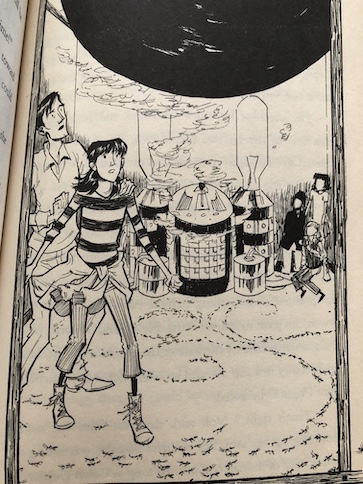
There is danger on this journey. These lands, which Armindor says were once one country long ago, are now smaller countries that war with each other. (This is probably the United States and the different lands were once individual states. When they travel across water, I think they’re crossing one of the Great Lakes, although I’m not completely sure. The author lived in Chicago, so I think that might be the jumping off point for the crossing.) There are bandits and mercenaries and the strange creatures that inhabit this land, and it’s difficult to say whether there is more danger from the creatures or the humans.

This book is available to borrow and read for free online through Internet Archive.

My Reaction

I remembered this series from when I was a kid. It made a big impression on me because of the way that technology was treated as magic. The types of futures depicted in science fiction books, movies, and tv series can vary between extremely advanced technology and civilization, like in Star Trek, and this kind of regression to the past, where even simple forms of technology that we almost take for granted today seem wondrous and are the stuff of legends. Nobody knows what the future actually holds, but I thought this series did a nice job of showing how people who had forgotten much of the everyday knowledge of our time might think and feel when encountering it for the first time, knowing that people who lived in the past were once able to make these amazing things themselves and use them every day.

Because of the mutations that have taken place in animals, probably due to radiation from nuclear fallout, some types of animals have become intelligent. The grubbers, who call themselves weenitok, are peaceful, but the reen (which Armindor realizes are a mutated variety of rat) actually want to gain access to old technology so they can conquer the humans and take over the world for themselves. These are Armindor and Tigg’s worst enemies, along with the human they’ve hired to do their dirty work. (Yes, the mutated rats are paying a human mercenary. Even the characters in the book realize that’s weird.)

When Tigg and Armindor finally reach the special place with the magical devices, it turns out to be an old military base. Much of what they find there has been destroyed by time. Armindor tells Tigg to look for things that are made out of glass, metal that hasn’t corroded, or “that smooth, shiny material that the ancients seemed so fond of” (plastic) because these are the things that are most likely to still be usable. Tigg makes a lucky find, discovering a “Spell of Far-seeing.” It’s a tube that can extend out far or collapse to be a smaller size, and it has glass pieces similar to the magnifying lens, and when you look into it, it makes things that are far away look much closer. (Three guesses what it is.) Tigg also discovers a strange, round object with a kind of pointer thing in the middle that moves and jiggles every time the object is moved but which always points in the same direction when it settles, no matter which way the object is turned. Most of what they find isn’t usable or understandable, but they do find four other objects, including a “spell for cutting” that Armindor thinks that they might actually be able to duplicate with technology and materials that their people have. Each object that they find is described in vague terms based on its shape and materials because Armindor and Tigg don’t know what to call these things. Modern people can picture what they’ve found from the descriptions, and it isn’t difficult to figure out what they’re supposed to be. Sometimes, Armindor and Tigg can figure out what an object is supposed to do just by experimenting with it, but others remain a mystery. Armindor explains to Tigg that is what magicians do, investigate and solve these types of mysteries, “to take an unknown thing and study it, and try it out in different ways, and try to think how it might be like something you are familiar with.” (They’re using a form of reverse engineering.) Tigg decides that he really does want to be a magician and make this his life’s work. He’s going to become a scientist.

I liked it that none of the objects they find are any kind of advanced super weapon or a miraculous device that instantly solves all of their society’s problems and launches them back into an age of technology (although there is an odd sealed box that proves to be important in the next book). There are no easy answers here. In the grand scheme of things, they risked their lives for things that nobody in modern times would risk their lives to retrieve, but they have to do it because, although these things are common in our time, they are unknown in theirs. If they can figure out not only how the objects work and what they were supposed to do but why they work the way they do, they can gradually rebuild the knowledge of the past. The objects that they find are generally useful. Some are labor-saving devices, some are examples of scientific principles they would use to create other things (demonstrating concepts like optics and magnetism) and one is a medical device, which if they can figure out how to use it, will help advance their medical knowledge and treatments.

One of the fun things this book inspired me to do was to look at the world around me while imagining that I had never seen some of the basic objects in the world before. This could be a fun activity to do with kids, something like the archaeology activity that some teachers of mine did with us years ago, where we had to intentionally create objects from some kind of “lost” civilization for our classmates to analyze, to try to figure out what they were supposed to do and how that civilization would have used them. But, you don’t even have to create anything if you use your imagination and try to think what a traveler from another time or another world might think if they saw some of the things in your own home right now. Imagine what someone from a world without electricity would think of something even as basic as a toaster. How would you explain such a thing to someone who had never seen anything like it?

Murder at Midnight

Murder at Midnight by Avi, 2009.

This story is a prequel to Midnight Magic.

Fabrizio was an orphan living on the streets of the medieval city of Pergamontio before he was taken in as a servant by Mangus and his wife, Sophia. It was really Sophia’s idea that Mangus needed a personal servant. Mangus says that he is able to take care of himself, and he is impatient with Fabrizio because Fabrizio is ignorant and uneducated.

When Sophia goes to visit her sister, Fabrizio tries extra hard to please Mangus so that Mangus will continue to let him live in his house. Mangus is primarily a scholar, but he supplements his income by performing magic tricks at a local tavern. That evening, a black-robed figure appears at the magic show, warning of danger coming to Mangus. The next day, the magistrate, DeLaBina, accuses Mangus of spreading papers with treasonous messages about the king around the city. During this time, all writing is by hand, and no one can understand how these papers can all look so identical unless they were produced by magic.

At first, DeLaBina offers to let Mangus go if Mangus gets rid of the papers and reveals the identity of the traitor. When Mangus protests that he cannot do real magic and that he knows nothing about the papers, he is arrested. Shortly afterward, DeLaBina is murdered. Fabrizio’s only hope of saving his master, and himself, is to find the real traitor.

The book is available to borrow and read for free online through Internet Archive.

My Reaction and Spoilers

I didn’t like this book as well as I liked the original Midnight Magic.  Partly, the problem was that I feel like some of the events of this story should have changed people and events in the other book, and they don’t because this book, which is supposed to take place earlier than the other story, was actually written after the other story. It all just seems out of order, and I didn’t like the addition of Prince Cosimo to the royal family.  In this book, Prince Cosimo is the crown prince of Pergamontio, not Prince Lorenzo from the previous book.  Prince Cosimo did not appear in Midnight Magic (although his absence is explained by the end of this book) and was never even referred to in that book (which is the part that really bothers be me everyone in that book would have known all about him and what happened to him, and I feel like Fabrizio should have at least thought about him in passing, it’s just weird when characters suddenly exist in a series that you know didn’t exist before).

Basically, there is a plot (although not by the person who did the plotting in the other book) to overthrow the king, who is wildly superstitious. The printing press is a relatively new invention in this time period, and Pergamontio has never had one before, which is why no one can understand why the writing on the papers is so strangely uniform.  This is the other thing that bothers me about this book.  Pergamontio is supposed to be somewhat backward in comparison to other kingdoms, partly because the king is so superstitious, but it just seems like going a bit far for people to suspect that oddly-uniform writing would be a sign of witchcraft because people of that time would already be aware of the existence of signet rings and official seals which were used as stamps in wax to mark documents, like a kind of signature.  Like a printing press, those would also produce an identical image, time after time of use.  Basically, they’re all just complex forms of stamps.  Superstitious or not, I think that people of that time who were capable of reading probably would have been able to tell that a stamp of some kind was being used, even though they might not have seen one as complex as a printing press before.

In the story, a family has recently brought a printing press to the city, and printing the treasonous papers was the first job they were hired to do. Shortly afterward, Maria, the daughter of the family, was arrested while passing out the papers. Her parents are taken into custody by Count Scarazoni, who is a sinister character in his own right but is actually in opposition to the real traitor in this book.

Scarazoni was the figure in the black robe who tried to warn Mangus. Fabrizio is arrested when he tries to gather up more of the papers for Mangus so they can learn where they came from.  He is nearly executed for treason, but he is saved by Scarazoni because Scarazoni realizes that the real traitor wanted him dead because he feared that Fabrizio might know too much. At the prison, Fabrizio meets Maria and helps her to escape as well. Maria explains to him the true origins of the papers, and they find DeLaBina’s body.  This is the murder referenced in the title of the book, and they must solve it to uncover the identity of the real traitor!

As in the other book in this series, Fabrizio and Mangus use a magic trick at Mangus’s trial to shock the traitor into revealing himself.  Although, at the end of the story, the king still believes that Mangus is a real magician, Scarazoni points out that without Mangus’s “magic” the real traitor might not have been discovered. The king tells Mangus that he will let him go provided that he confine himself to his own home and no longer practice magic, setting events up for the beginning of the other story.

Frankenstein and the Whiz Kid

Frankenstein and the Whiz Kid by Vic Crume, 1975.

This book is a novelization of a made-for-tv Disney movie called The Whiz Kid and the Carnival Caper (some editions of this book also use that title).  There was also an earlier movie with the same characters called The Whiz Kid and the Mystery at Riverton.  I haven’t been able to find either of these movies for sale or on YouTube.  Both of the movies are based on a character created for a series of books by Clifford B. Hicks.

The “Whiz Kid” is Alvin Fernald, a boy who is always creating amazing inventions.  He has quite a reputation in his town.  Sometimes, people also call him “The Magnificent Brain.”

One day, his sister, Daphne (called “Daffy”), borrows one of Alvin’s rockets, showing a friend how they work.  However, the rocket ends up falling down a storm drain, and Daffy climbs in to retrieve it.  Alvin comes along as Daffy has trouble getting out and gives her directions to the storm drain’s opening.  Daffy follows the directions and gets out, but while she’s still walking around in the storm drain, she sees a mysterious man with a gun.  Fortunately, he doesn’t spot her, but she wonders what he was doing in the storm drain with a gun.

The place where the storm drain comes out is near a carnival that has come to town.  Alvin, Daffy, and Alvin’s friend Shoie want to go to the carnival, but they need some money.  To get some, Alvin brings out one of his earlier invention, a car-washing machine.  The others are dubious about that invention because it has caused problems before, but Alvin says that he’s fixed it.

Their first prospect for a car wash is the person who has moved into a spooky old house in their neighborhood.  It turns out to be a beautiful young woman named Cathy Martin.  Alvin is eager to impress her, but unfortunately, his invention goes haywire and ends up making a mess that the kids have to clean up (as well as making apologies to other people affected by the chaos).  However, Cathy agrees to go to the carnival with Alvin.

The carnival turns out to be an opportunity for another of Alvin’s inventions when the automaton that they’re using as Frankenstein’s monster in a carnival show breaks down.  Alvin also has a robot that he has built, and he offers the use of it to the man who works on the carnival’s automaton, so the show won’t have to close down.  The man accepts Alvin’s offer, and Daffy volunteers to help with the robot’s costume.

Cathy meets them at the carnival, and to Alvin’s annoyance, suggests that the four of them have fun together, instead of just her and Alvin.  The four of them do have fun, but they stumble onto something strange about Cathy.  They spot a man who Alvin and Shoie met at Cathy’s house.  Cathy said that he was her younger brother, on leave from his base, and that he had to be heading back there soon.  But, Alvin and Shoie wonder what he’s doing at the carnival if he’s supposed to be back and his base.  Then, Daffy recognizes him as the man she saw in the storm drain with a gun!  Who is he really?
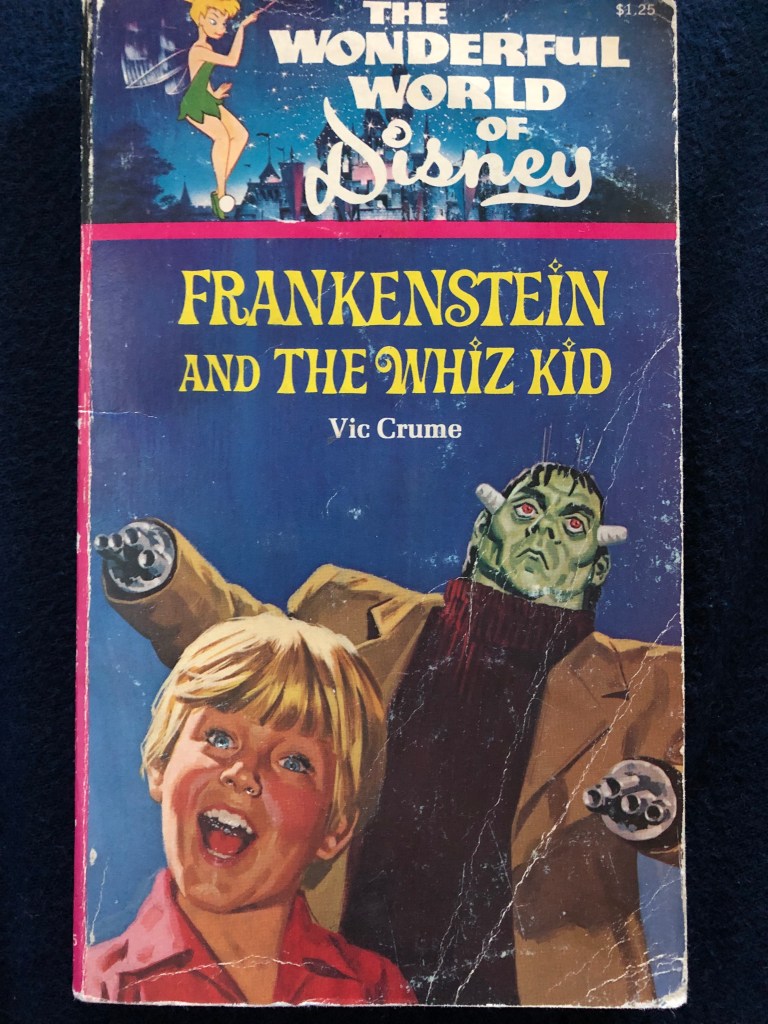
The kids decide to spy on Cathy’s house, and they learn that the man, called Ernie, and the magician from the carnival, Moroni, are planning a bank robbery and that Cathy is in on their plans.  It’s a terrible disappointment to Alvin because he liked Cathy, but he thinks that they have a duty to tell Police Chief Moody about their plans.

Chief Moody is somewhat skeptical about what the kids overheard, but he and he deputy stakeout the bank.  When nothing happens, he thinks that the kids raised a false alarm, but it turns out that the robbers’ plan is more complicated than they know.

Mrs. Armitage on Wheels

ArmitageWheels

Mrs. Armitage on Wheels by Quentin Blake, 1987.

Mrs. Armitage loves to ride her bicycle with her dog, Breakspear, running alongside.  However, she sometimes runs into difficulties that require some minor repairs to her bike, and she can’t resist the urge to tinker further.

The more she thinks about it, the more ideas for improvements she has.  Each idea starts with the words, “What this bike needs . . .”

But, Mrs. Armitage goes well beyond what the bike really needs.  Beyond adding a seat for her dog and room for her lunch, she gradually turns her bicycle into a crazy, unwieldy contraption.

ArmitageWheelsSail

Was adding the sail and anchor where she went too far, or did she reach that point long before?  Even after she trades what’s left of her bike for some skates, one has the feeling that her tinkering is far from over.

The book is available to borrow and read for free online through Internet Archive.

ArmitageWheelsSkates