Fin M’Coul

Fin M’Coul retold and illustrated by Tomie de Paola, 1981.

This is a retelling of a classic Irish folktale. The story is fun and silly, but one of the parts of this story I like the best is the introduction of the Giant’s Causeway – a real place with a magical look. There’s a geological explanation of this rock formation, but this story introduces the folkloric explanation.

In ancient times, when Ireland was inhabited by giants and magical creatures, a giant named Fin M’Coul lived on Knockmany Hill with his wife, Oonagh. One day, as he is building a causeway between Ireland and Scotland, Fin M’Coul hears that another giant, Cucullin, is coming.

Cucullin has a fearsome reputation, and he has beaten up many other giants, just to prove how strong he is. So far, Fin M’Coul has been able to keep out of his way, but Cucullin is now looking for Fin M’Coul to beat him. In fact, he’s so close that there’s no time for Fin M’Coul to get away.

Fin M’Coul goes home to his wife and asks her what he should do. Oonagh says that he won’t have any peace until he gets this confrontation with Cucullin over with, but Fin M’Coul doubts that he could be a match for Cucullin in a fight. Oonagh decides that they’re going to have to defeat Cucullin with cunning rather than strength.

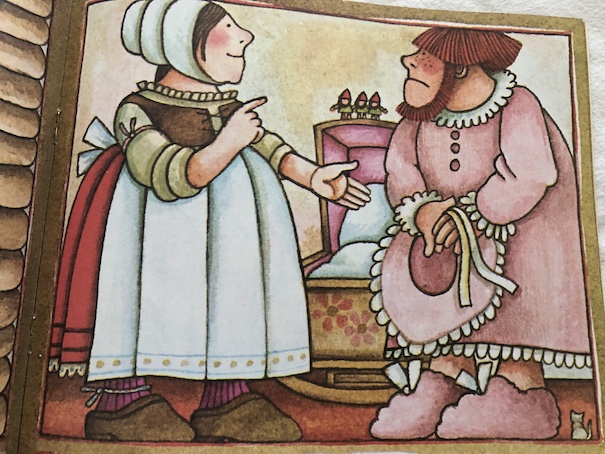
She quickly does a special charm to bring them success, and then, she begins setting the scene for the trick they’re going to play on Cucullin. She makes up a giant cradle and makes her husband dress in baby clothes and sit in the cradle. It’s ridiculous, but Oonagh has a plan.

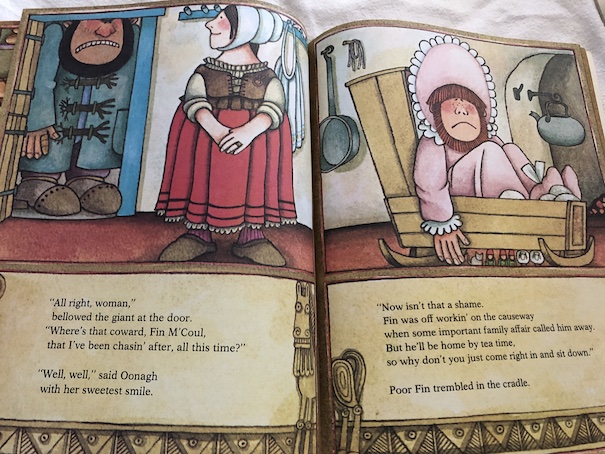
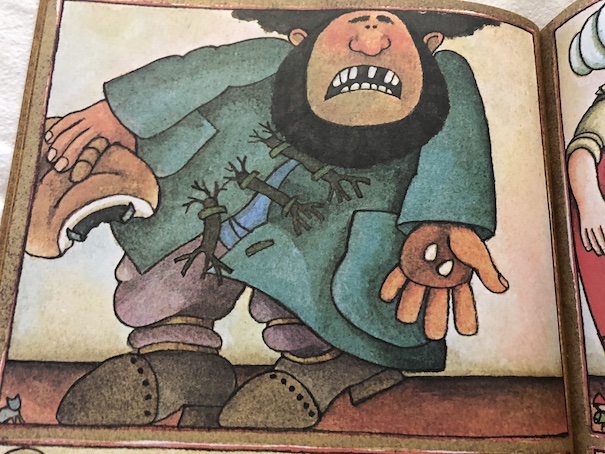
When Cucullin comes, Oonagh tells him that her husband isn’t home, but she invites him to come in and wait with her and her “baby.” Not only is the “baby” astonishingly large, even by giant standards, but Oonagh carefully convinces Cucullin of the baby’s unusual strength. She tricks him into thinking that the “baby” can eat bread and cheese that’s rock hard while giving Cucullin bread with a frying pan in the center and a real stone instead of cheese. Not only does Cucullin break his teeth on these things, but if Fin M’Coul’s “baby” can eat these things, how much stronger could Fin M’Coul be?

Oonagh’s tricks allow Fin M’Coul to get the upper hand against Cucullin and defeat him once and for all!

There is a brief section in the back of the book that explains a little about the background of the legend. I love the pictures in this version of the story. Tomie de Paola books always have fun illustrations, but if it weren’t for the little people and animals in the pictures with the giant characters, you might almost forget that the main characters in the story are all giants.

The book is available to borrow and read for free online through Internet Archive.

Patrick

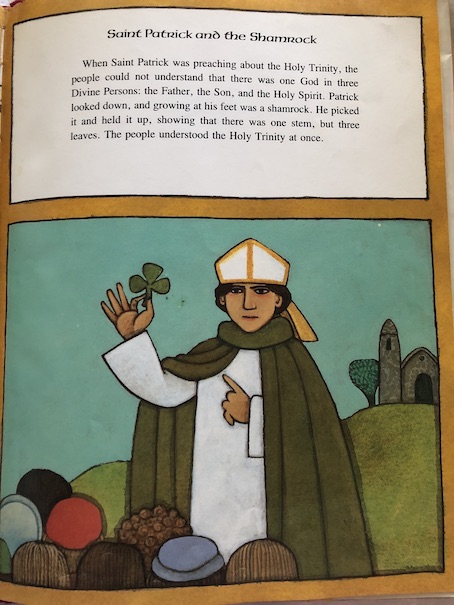
Patrick: Patron Saint of Ireland by Tomie dePaola, 1992.

This picture book is about the life and legends of St. Patrick, who is the patron saint of Ireland and the reason for St. Patrick’s Day, which is mainly celebrated in modern times by wearing the color green, and often, a shamrock or shamrock symbol. Some places also hold parades and other special celebrations.

The historical St. Patrick was born in Britain during the time when it was ruled by the Roman Empire. When he was young, he was abducted and sold into slavery in Ireland.

In Ireland, Patrick was forced to work as a shepherd for the man who bought him. Roman Britain was Christian, but Ireland was still pagan at this time. Patrick found it a strange and lonely place, and he prayed that he would be able to go back home.

Later, Patrick got his chance to return home aboard a ship that was carrying hunting hounds to be sold in France. Patrick tried to buy passage on the board, but the captain was reluctant to take him at first because he thought that Patrick was probably an escaping slave, and he didn’t want to get in trouble for taking him. However, the dogs on ship kept howling when Patrick was sent off, and the captain noticed that when Patrick was on the ship, the dogs were quiet, so he changed his mind.

When they reached France, the area where they landed was deserted because there had been a war. The men and dogs were hungry and couldn’t find anyone to help them. The captain said to Patrick that if his God was so powerful, why didn’t he pray and get God to help them? Patrick did, confident that God would help, and a herd of pigs appeared, providing them with food.

Patrick eventually returned home to Britain and rejoined his family, but he had dreams about Ireland in which a man called Victoricus appeared with letters from the Irish people, asking Patrick to return. Patrick felt that he was called to bring knowledge of God and Christianity to Ireland. He decided to become a missionary.

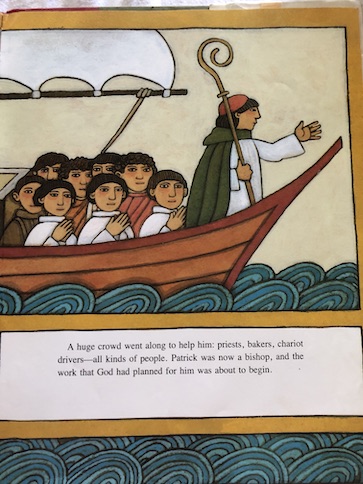
Patrick studied and worked his way up to become a bishop, and when he returned to Ireland, he brought others with him to help in his work. Upon his return to Ireland, he became friends with an Irish chieftain named Dichu, who also became a Christian. He gave Patrick a barn, which Patrick turned into the first church in Ireland.

Patrick and his followers suffered opposition in Ireland. At one point, a king tried to kill Patrick and ended up killing his chariot driver and friend, Odran, instead. In spite of that, Patrick persevered.

Patrick died on March 17, 461. After his death, he was declared a saint, the patron saint of Ireland, and the date of his death became his saint’s day. Many legends grew up around him, and the book explains the most popular stories.

Among the most popular stories about St. Patrick are that he drove all of the snakes out of Ireland, frightening them away by beating on a drum. Another story says that he used the shamrock to explain the concept of the Holy Trinity, which is why the shamrock is an important symbol of Ireland and St. Patrick’s Day.

The book is available to borrow for free online through Internet Archive.

Kathleen: The Celtic Knot

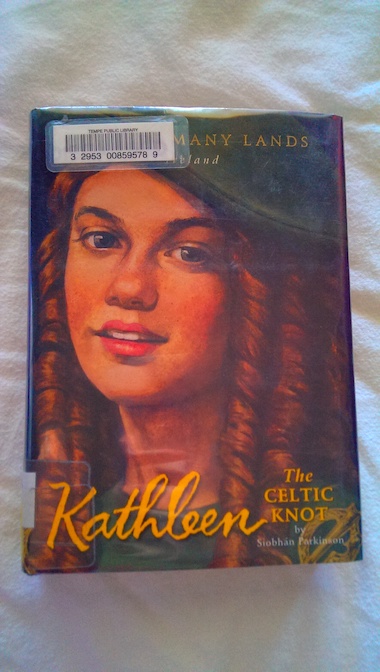
KathleenKathleen: The Celtic Knot by Siobhan Parkinson, 2003.

Twelve-year-old Kathleen lives with her family in Dublin, Ireland in 1937. Like the rest of the world, Ireland is suffering under the Great Depression, and Kathleen’s father has been having trouble finding work. Her mother helps to support the family by working as a midwife.

One day, when Kathleen’s mother is off delivering a baby, Kathleen accidentally burns the porridge at breakfast, making her and her sisters late for school. Although they should have been marked as being on time, they are considered one minute late because the nun’s watch was fast. Discipline is harsh at the Catholic school they attend, and after a harsh lecture to Kathleen, the headmistress, Mother Rosario, calls for a conference with her mother. Kathleen is very upset about it, but Mother Rosario softens somewhat and says that she merely wants to see that everything is alright with Kathleen’s family because a nice girl like her shouldn’t be acting up.  Kathleen still worries because she knows that the nuns look down on poor families like theirs and consider their authority higher than the parents of the children they teach.  They are often unaware of the circumstances that families live in.

However, Kathleen’s mother isn’t fazed by the nuns’ attitude and is blunt with the Mother Rosario, telling it like it is. The headmistress does show that she has some compassion and is somewhat aware of their circumstances because she says that Kathleen’s lateness was only part of the reason she wanted this meeting. She has guessed that Kathleen’s father is looking for work, and there is a position for an assistant gardener open at the school. It doesn’t pay much, and it’s not as good as her father’s old job was before the factory where he worked closed, but he agrees to take it because it’s better than nothing.

The headmistress also says that she has noticed that Kathleen is musically-talented. She likes to sing and has a good voice. Mother Rosario thinks it would be a good idea for her to take piano or dance lessons. The family doesn’t have a piano, so the headmistress suggest that Kathleen join the Irish dancing lessons because it’s a wholesome activity that reflects her heritage and that would keep her out of trouble. Kathleen’s mother isn’t big on heritage, but she agrees that dancing might be a good activity for Kathleen.

Kathleen isn’t happy about the dance lessons at first because the other girls who are involved are snobs. But, once she tries it, she realizes that she actually loves dancing. The problem is that the lessons aren’t free, like the other girls told her. At first, Kathleen feels cheated, finding out that she loves something that she can’t have after all, but her teacher says that she’s talented, so she offers Kathleen some free lessons anyway. She’s been looking for new talent so that her dancers can do well in the next dancing competition, and she doesn’t want to let a promising dancer like Kathleen slip through her fingers.

The snobby girls in class are all the more irritated when Kathleen is among those chosen to enter the next competition, but everyone also knows that there is one more obstacle for Kathleen: she doesn’t have a proper dancing costume or any money to buy one. She prays for one, even promising God that she’d become a nun if he gives her the costume she wants. Her mother has her eye on some beautiful cloth that she hopes to buy as a remnant, but the cloth gets snapped up by some of the wealthier, snobby girls, and her mother comes down with a serious illness shortly before the competition.

Kathleen begins to think that she was wicked for being so concerned about dancing and costumes when there are much more serious things in life. However, her aunt, Polly, understands how she feels and comes up with a plan to make the needed costume for Kathleen, using her favorite book, Gone With the Wind, as inspiration. Remember what Scarlett O’Hara did when she needed a new dress and couldn’t afford one?
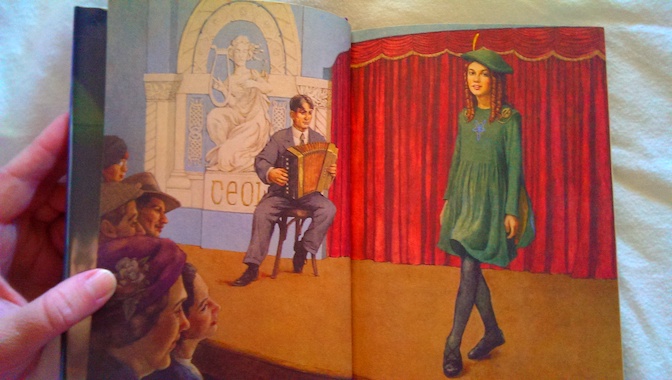
KathleenDancing

One of the themes that runs through the story is questions and answers. Kathleen has a lot of questions about life. She knows that her mother deliveries babies for money, but she doesn’t really understand much about it, and her mother doesn’t answer the questions she asks. In fact, Kathleen notices that most of the adults she knows (with the exception of her father) brush aside her questions about the way the way the world works or the things people do because they simply don’t want to be bothered with them. They have too many concerns of their own, and they don’t really know most of the answers themselves. It kind of contrasts with the answers that Mother Rosario demands from Kathleen and immediately dismisses upon getting. Most of the time, she doesn’t really want to bother with answering questions or even dealing with the answers to questions she’s just asked. Only once does she answer a question that Kathleen had asked about St. Patrick, and Kathleen is astonished at getting an answer about something.

I have to admit that the attitudes about questions and answers from most of the adults in the story really irritated me, especially the way Mother Rosario demanded answers from Kathleen about her lateness and then dismissed everything that Kathleen said, angry that she had “answers.”  I’ve met people like that before in real life, and they’re just as illogical and crazy-making as this headmistress. I’m not talking about teachers who refuse to listen to flimsy excuses like “the dog ate my homework,” but people who get angry at others who have real explanations just because they have real explanations. People who demand to know the reasons why things happen and then immediately reject any explanation offered without a real reason for doing so are obnoxious. I’ve encountered people like that before, and it’s hard to have anything resembling a meaningful conversation with them.   They don’t want to talk to you; they just want to yell or lecture at you.  They don’t really care what the answers or explanations are for anything, and no answer would make any difference to them because what they really want is for the other person to just feel bad. It’s an unethical one-upmanship tactic, and it loses my respect the moment I hear someone use it because I recognize what they’re attempting to do. It’s so obvious, but frustrating at the same time (Kathleen in the story wonders why Mother Rosario is trying to torture her in this way) because there’s nothing you can say to stop the other person once they start (at least, I haven’t figured it out). Kathleen’s approach was probably the most effective.  She just stopped talking and prepared herself for the headmistress to hit her, which caused the headmistress to wake up a bit to the fact that the message that she was sending to Kathleen was that her only intentions were to hurt her.  Fortunately, those were not her only intentions, but I have to admit that I never really had any respect for Mother Rosario after that, in spite of what she did to help Kathleen’s family.  You can tell this is one of my pet peeves.  One-upmanship really bothers me in all of its forms, and I have even less time for that kind of nonsense than these characters do for answering a twelve-year-old’s questions.  At least you can talk to a twelve-year-old. Getting back to that, part of Kathleen’s trouble with some of her questions is that her elders often underestimate her, thinking that she’s really too young to understand anything, but the fact that she’s asking questions says that she’s really not. In fact, she might even be putting more thought into some issues than the people who have decided that some things aren’t worth thinking about in the first place.

Another theme of the story is growing up and changing goals in life. By discovering her talent as a dancer, Kathleen has found something that she would like to dedicate her life to, and if she becomes a dance teacher herself, it would give her a job to do in her future that could make her life better. Her aunt, Polly, who is twenty years old, also changes her mind about what she wants in life. As a single young woman, she likes to go out and have fun with her small earnings, hoping to meet a man as elegant as Rhett Butler.   However, when her latest young man turns out to be a cad, she accepts a proposal from the very shy but much nicer young man who she had previous thought wasn’t handsome enough. Polly’s experiences make her realize that handsomeness by itself isn’t much, and she and her new husband have plans for building a life together. At first, Kathleen is disappointed because she and Polly had talked about leading a carefree life together as single ladies when Kathleen was grown, but Polly explains to her that things will be better this way and that grown-ups have to build real lives for themselves, not live on dreams alone. Kathleen is still in the process of discovering the possibilities that life might hold for her and the talents that she can use to build her life.

I also found the parts about Irish history and politics during 1930s interesting.  One of the reasons why Kathleen’s family isn’t big on the Irish heritage movement is because her grandfather fought during World War I and wasn’t treated well as a veteran when he returned. During the meeting with Mother Rosario, Kathleen’s mother is blunt about her views on things, and Mother Rosario is surprised how much she understands of politics, showing that she looks down on poor people (possibly the source of her general rudeness and bullying tactics, even when she’s trying to be helpful – she’s decided that she’s superior and will remain so, whether she’s right or wrong), thinking that they aren’t smart enough to understand what’s going on around them.  The story makes it clear that the nuns at school are often out of touch with what ordinary families go through in their daily lives.  They underestimate what people know or read about, they have trouble understanding their daily struggles with money and how they are barely able to keep food on the table, and they seem unable to grasp what it’s like to be part of a family where any family member’s actions can affect all of the others.  For me, they were far more aggravating than the snobby little girl characters because I usually expect adults of a certain age to have grown out of some of these behaviors.

While reading the story, I was kind of comparing Kathleen’s circumstances in Ireland in the 1930s to life in America during the Great Depression, and many of their struggles were the same.  I was also kind of fascinated by Polly’s fascination with Gone With the Wind because it shows how pieces of culture and entertainment could become popular in other countries during this time.

This book is part of a series by the same publishers of the American Girls Books.  There is a section in the back of the book with historical information about the period.

KathleenHistorical

Clever Tom and the Leprechaun

CleverTom

Clever Tom and the Leprechaun by Linda Shute, 1988.

This picture book is based on an Irish folktale, The Field of Boliauns.

Tom Fitzpatrick thinks that his fortune is made when he is lucky enough to catch sight of a leprechaun one day.  If a person can manage to catch hold of a leprechaun and frighten him, the leprechaun will hand over his gold.  Tom thinks of himself as a clever man, so he doesn’t see how he could fail.

CleverTomCapture

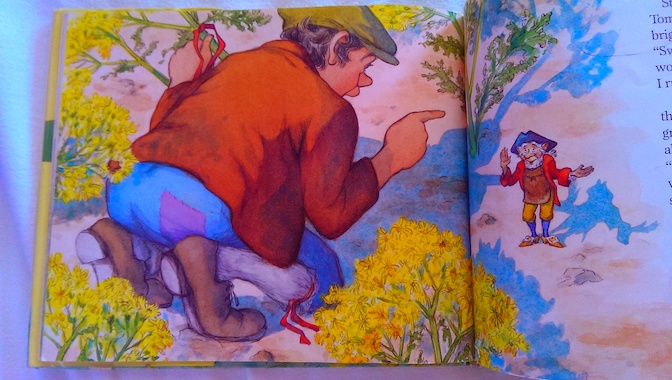
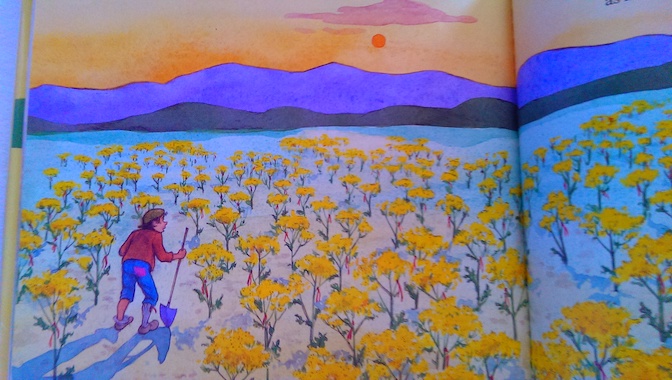
Tom does capture the leprechaun, and the leprechaun does promise to show him where his treasure is buried.  The leprechaun directs Tom to a field of boliauns (a kind of weed, also known as ragwort or ragweed) and points out the plant which marks the place where he buried his treasure.

CleverTomField

Tom needs to get a shovel to dig for the treasure, but he worries about whether he’ll correctly remember the spot when he gets back.  He takes off one of his red garters and ties it on the plant so he’ll be able to find it again, making the leprechaun promise not to touch it while he’s gone.

CleverTomGarter

The leprechaun promises not to touch the garter, but Clever Tom isn’t quite as clever as the leprechaun.  When Tom gets back to the field with his shovel, he’s in for an unpleasant surprise.

CleverTomTrick

Clever Tom might not have his fortune made after all, but he has a great story to tell to the younger generation.

CleverTomTaleTelling

In the back of the book, there is a section with more information about the folk tale, Irish legends and leprechauns, and Irish culture and history.  One of the things I found interesting was the explanation that the leprechaun in the picture book is wearing a red coat because that’s how they are described in Irish folklore.  It’s usually the Trooping fairies who are described as wearing green, like we often see leprechauns depicted in St. Patrick’s Day decorations.  The stories of buried gold left by leprechauns may also may also be based on treasure hoards left by Viking raiders during the Early Middle Ages.  The leprechaun in this story also has ale made from heather, which is something that only Danish Vikings were said to know how to make.

The Treasure of Kilvarra

TreasureKilvarraThe Treasure of Kilvarra by Elizabeth Baldwin Hazelton, 1974.

Christie and Kevin MacAlistaire go to Ireland with their mother to visit a family friend, Padraic O’Flaherty, and their visit turns into a terrifying treasure hunt!  Christie is fascinated by the gypsies living nearby and asks to visit them.  It’s her birthday, and the oldest gypsy, Sorcha, tells her fortune.  She says that Christie is fated to discover a treasure during her visit to Ireland, but there will be great danger involved, and she will need her brother to protect her.  Sorcha also gives Christie an amulet filled with holy ashes to help keep her safe.

Christie is eager to find the treasure Sorcha spoke of, although she doesn’t know what kind of treasure she is supposed to find or what kind of danger she will face along the way.  Their new friends tell them the history of the region with stories of ancient kings, fairy folk, and haunted castles.  Christie and Kevin visit some of these supposedly haunted ruins with their new friend Colum (a gypsy boy) and his pet crow, Ben.  Colum tells them the history of the castle ruins and the legends associated with it, and they discover that Christie has the ability to see and hear things that the boys can’t: spirits of the past.  Unfortunately, Ben is fascinated by Christie’s amulet and takes it, losing it in a nearby river.

KilvarraWithout the amulet to protect her, Christie continues her search for the treasure.  An accidental injury takes her to the place where it is hidden, but it’s a dangerous place.  Caught in a terrible storm, the children explore an ancient stone tower.  There, Christie sees the ghost of a long-dead monk, gesturing to her, begging her to follow him to the treasure that she seeks.  The monk died protecting it, and it’s a very unexpected but wonderful treasure indeed.  But, getting out of the place is going to be even more dangerous than getting in.
The book is currently available online through Internet Archive.

This is actually the second book in a series about Christie MacAlistaire and her brother Kevin.  Unfortunately, I don’t have the first one and haven’t read it.  I do know that the first book in the series is called The Haunted Cove.  Christie and Kevin spend the summer in a cottage by the sea in Oregon, where they investigate a cove haunted by the ghosts of sailors and a woman who may be a witch.

The Secret of Roan Inish

The Secret of Roan Inish (aka The Secret of the Ron Mor Skerry) by Rosalie K. Fry, 1957, 1959 (first US edition), 1995 (movie tie-in).

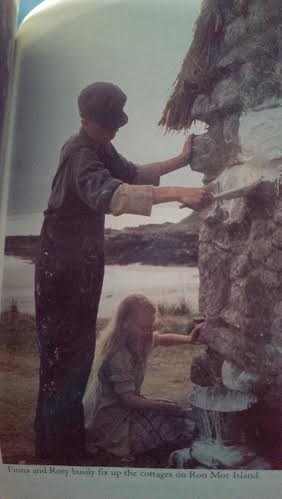
This is the book that the movie The Secret of Roan Inish is based on. The movie tie-in book contains the text of the original book, which was called Secret of the Ron Mor Skerry (Child of the Western Isles), and pictures from the movie (the original book had black-and-white drawings). The movie follows the plot of the original book fairly well, although the location was changed to Ireland and some of the names were altered to reflect the change in location. For example, the family name in the book was McConville, not Coneelly, and Fiona’s cousin was Rory in the book and Eamon in the movie. My book, like the original, takes place in Scotland, and notations under the pictures call the characters by their original names.

Ten-year-old Fiona has been living in a big city ever since her family left the island of Ron Mor about four years earlier to seek new jobs and new opportunities. However, Fiona’s health has been poor, and her doctor has advised her to return to the seaside for the healthier atmosphere. The book begins with her journey to stay with her grandparents who still live close to Ron Mor. Fiona’s homecoming is tinged with both sadness and hope, as she reflects on the mysterious disappearance of her baby brother the day that her family left the island.

Although her brother apparently floated out to sea in his cradle after being left unattended on the beach, Fiona has the feeling that he is still alive somewhere close to the island. She learns that her cousin Rory also believes the local rumors that the boy is still on Ron Mor in the company of the seals that populate the area around the island. Moreover, Rory and other family members share Fiona’s longing to return to their old home and their family’s traditional way of life as fishermen. Fiona’s determination to find her younger brother and bring him and the rest of their family home to the island is touching and emphasizes the importance of family ties.

There is also an element of fantasy because of the story that Fiona’s grandfather tells about the family’s heritage, which helps explain their special connection to the sea and seals around the island. He and other members of the family believe that one of their ancestors was a selkie, a magical person who could change into a seal.  The story is gentle and upbeat, which makes a nice change from a lot of modern children’s books.  I think that it’s just plain magic.

Something that the book clarifies, which is more vague in the movie, is that everyone in Fiona’s family, except for her little brother, has red hair.  All of the McConvilles always have red hair, except for those who are apparently closer to their Selkie ancestry, who have very dark hair.  They couldn’t clarify that point in the movie because the girl playing Fiona is blonde, and everyone else has different hair colors, but that’s why her brother is so markedly different in his appearance.

Physical copies of the original book are expensive collectors’ items, but there is good news: it’s now available on Kindle and through Internet Archive (where you can borrow an electronic copy for free), so if you’re nostalgic or just curious, it’s easier to read it now!