
Fin M’Coul retold and illustrated by Tomie de Paola, 1981.
This is a retelling of a classic Irish folktale. The story is fun and silly, but one of the parts of this story I like the best is the introduction of the Giant’s Causeway – a real place with a magical look. There’s a geological explanation of this rock formation, but this story introduces the folkloric explanation.

In ancient times, when Ireland was inhabited by giants and magical creatures, a giant named Fin M’Coul lived on Knockmany Hill with his wife, Oonagh. One day, as he is building a causeway between Ireland and Scotland, Fin M’Coul hears that another giant, Cucullin, is coming.

Cucullin has a fearsome reputation, and he has beaten up many other giants, just to prove how strong he is. So far, Fin M’Coul has been able to keep out of his way, but Cucullin is now looking for Fin M’Coul to beat him. In fact, he’s so close that there’s no time for Fin M’Coul to get away.

Fin M’Coul goes home to his wife and asks her what he should do. Oonagh says that he won’t have any peace until he gets this confrontation with Cucullin over with, but Fin M’Coul doubts that he could be a match for Cucullin in a fight. Oonagh decides that they’re going to have to defeat Cucullin with cunning rather than strength.
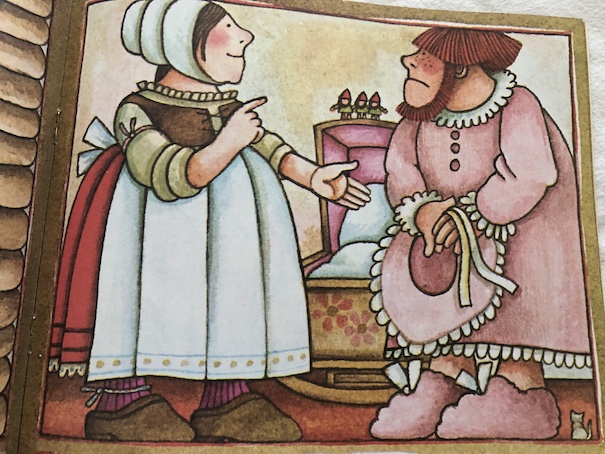
She quickly does a special charm to bring them success, and then, she begins setting the scene for the trick they’re going to play on Cucullin. She makes up a giant cradle and makes her husband dress in baby clothes and sit in the cradle. It’s ridiculous, but Oonagh has a plan.
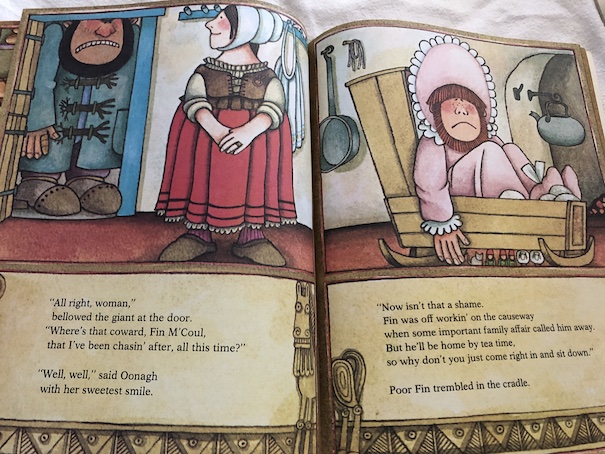
When Cucullin comes, Oonagh tells him that her husband isn’t home, but she invites him to come in and wait with her and her “baby.” Not only is the “baby” astonishingly large, even by giant standards, but Oonagh carefully convinces Cucullin of the baby’s unusual strength. She tricks him into thinking that the “baby” can eat bread and cheese that’s rock hard while giving Cucullin bread with a frying pan in the center and a real stone instead of cheese. Not only does Cucullin break his teeth on these things, but if Fin M’Coul’s “baby” can eat these things, how much stronger could Fin M’Coul be?
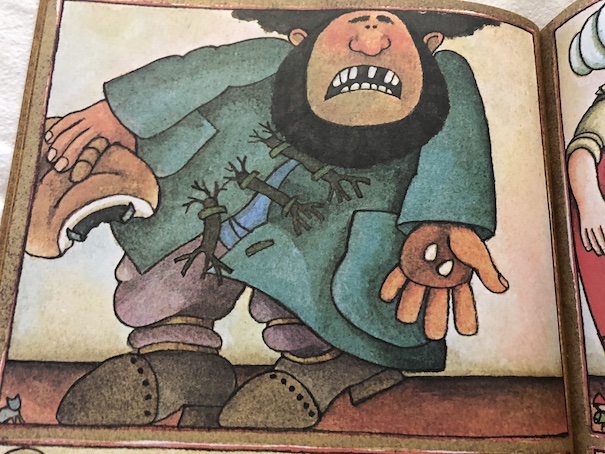
Oonagh’s tricks allow Fin M’Coul to get the upper hand against Cucullin and defeat him once and for all!

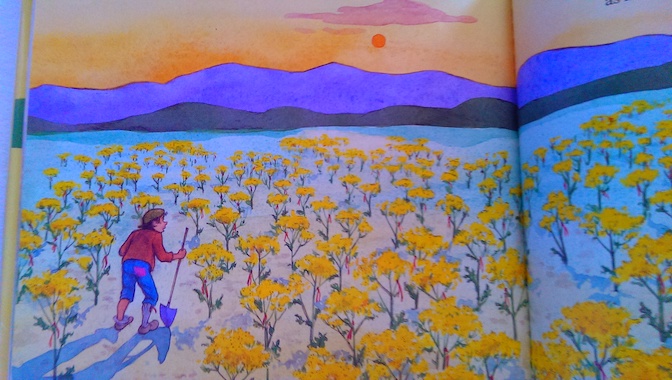
There is a brief section in the back of the book that explains a little about the background of the legend. I love the pictures in this version of the story. Tomie de Paola books always have fun illustrations, but if it weren’t for the little people and animals in the pictures with the giant characters, you might almost forget that the main characters in the story are all giants.
The book is available to borrow and read for free online through Internet Archive.



 Jestress's Forgotten Books and Stories