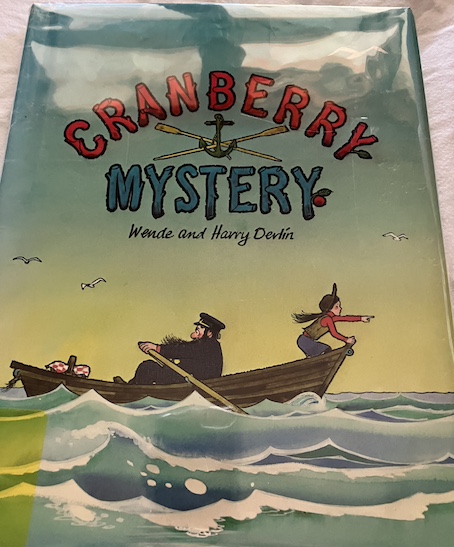
Cranberry Mystery

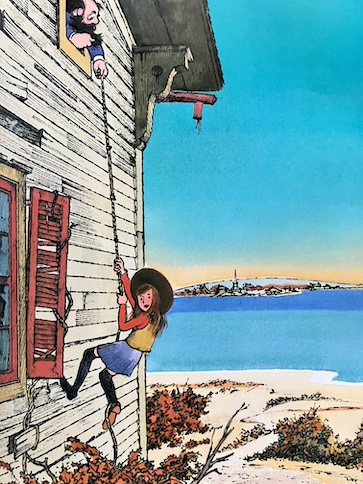
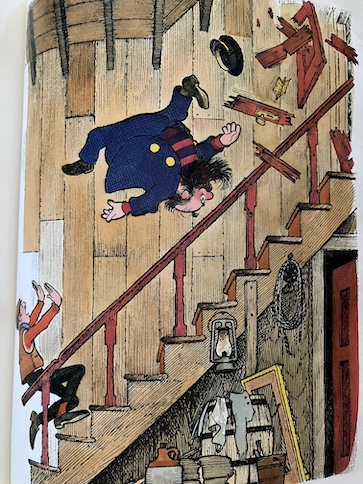
Antiques are being stolen from the people of Cranberryport, and no one knows who is responsible. People are looking at each other with suspicion.

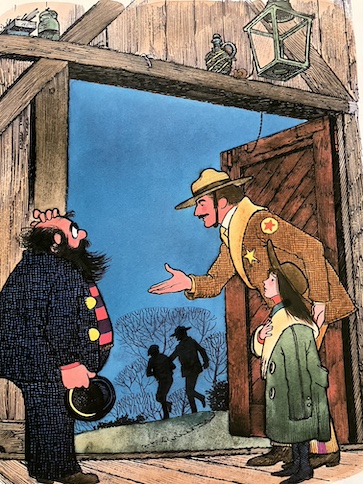
After Annabelle, an old figurehead that used to belong to Mr. Whiskers’s grandfather, is stolen from Mr. Whiskers’s house, Mr. Whiskers sees a light on Sailmaker’s Island. He believes that the thieves are hiding on the island, but the sheriff will not listen to him. The only person who listens to Mr. Whiskers and believes him is young Maggie.

When Mr. Whiskers and Maggie set out to the island to find the thieves by themselves, they are captured!  How can they escape and get the authorities?

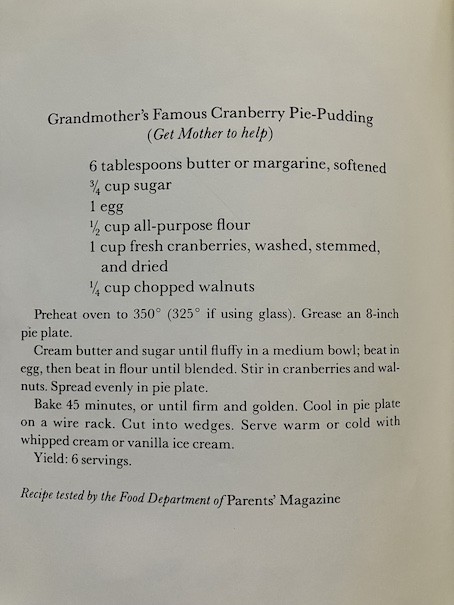
The book includes a recipe for Grandmother’s Famous Cranberry Pie-Pudding.

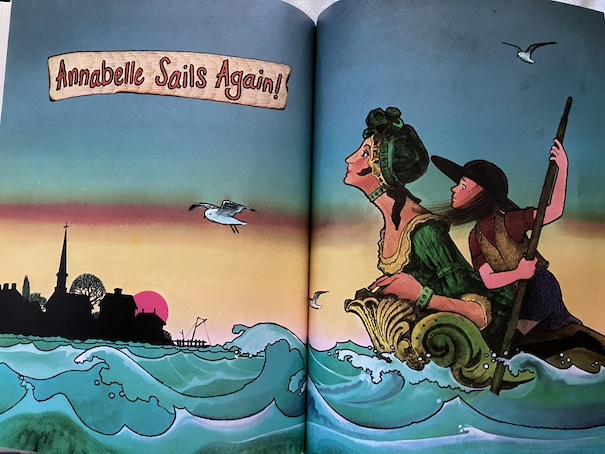
The story is more adventure than mystery. The thieves are strangers, not anybody from the town, so there’s no evaluation of different suspects, and Mr. Whiskers has a pretty good idea where the thieves are hiding, so there isn’t much searching for them. It’s more about how Maggie and Mr. Whiskers escape from the thieves and alert the authorities. It’s a nice story, but I just think that the “mystery” could use a little more mystery. The best part is when Maggie uses the old figurehead, Annabelle, as an improved raft to reach the authorities.

The season in this story is “Indian summer“, which is when it’s technically fall, but there’s a warm period. There are different names for this phenomenon, but the term “Indian summer” might be based on the concept that this is the time of year when Native Americans prepared food stores for the coming winter.

Dig for a Treasure

This is the second book in The Invisible Island series. It begins with the arrival of the Lennox family and their two children, Hugh and Barbie. The Lennox family has been staying with various relatives since the father got out of the army, but now, they’ve found a house to rent in the small town of Anchorage, Connecticut. The children are looking forward to having a yard to play in, and the mother wants to have a garden.

Unfortunately, when they arrive they are shocked to see that the house they were going to rent has been destroyed by fire. Their landlord, Mr. Prentice, is also on the scene, and he regretfully tells them that the fire just happened, although they don’t know the cause, and that there are no other houses in the area to rent. At first, they think that they will have to go back to staying with relatives, but Mrs. Lennox says firmly that they won’t. The family has had enough of staying with relatives, and they desperately need a place of their own. It’s summer, so her idea is that they can camp out on the property of the burned house for a few months while they look around for another place to rent. The children are excited about the idea of a camp-out. Mr. Prentice says that he wouldn’t have any problem with the family camping on the land, and he returns their rent deposit to them, saying that they can stay at his house that night and get some camping equipment the next day.

While Hugh and Barbie are exploring the area and looking for their cat, who ran off, they meet the children from the first book in the series. Hugh is about the age of David Guthrie, and Barbie is about the same age as Winkie Guthrie, the youngest of the children who play on the island they call “The Invisible Island.” Since the previous book in the series, they have finished their stone hut, and it has a grass and sod roof and four built-in beds for the four Guthrie children. Mr. Guthrie is an architect, and he helped the children build the house.

Hugh and Barbie admire the hut, and they say that they wish they had a stone house like that because it couldn’t catch fire. They explain to the other children what happened to the house that their family was going to rent, and they ask the children if they would consider renting the stone hut to their family until they can find another place to live. Mr. Lennox isn’t really happy about the idea of camping in tents because he lived out of tents when he was in the army.

At first, the Guthrie children and the Leigh children aren’t sure that they want to rent out their stone hut. They spend a lot of time there, and they’ve been trying to save up money to add improvements. The hut really belongs to the Guthries, who built it, but they want to add an extra room for the Leighs. However, after thinking it over, they realize that they can earn more money as rent from the Lennox family than they can by just doing chores, and while the Lennox family stays in the hut, they can camp out on other parts of their little island, like the woods that they call “Sherwood Forest.”

Since the little hut is just a one-room hut with no bathroom or other amenities, the children aren’t sure at first whether the Lennox adults would want to stay there or not. However, staying in a stone hut does sound better than in a tent, where they would also have no bathroom or amenities. Mr. Lennox is also intrigued by the pond, where he can go fishing. The children and the Lennox family talk things over with Mr. Prentice and the Guthrie children’s parents, and they all agree to renting the stone hut to the Lennox family.

The Lennox family still isn’t sure whether or not they’ll find another house for sale or rent in the area. They want to stay in the area because Mr. Lennox has a job nearby and Mrs. Lennox knows that some of her ancestors used to live in the area, although she doesn’t know much about them. However, Anchorage is a small town, and most of the houses already have people living in them. There is only one empty house in the area, but the owner has always refused to rent it or sell it. Mr. Prentice explains that the owner believes that there is a treasure in the house or nearby, a necklace that once belonged to a queen, and she’s been looking for it for years. Mr. Prentice doesn’t think that there really is a necklace or, if there once was, it’s probably long gone, but the owner insists that it exists and is still there, somewhere.

The children are fascinated, and they ask Mr. Prentice to tell them the story of the queen’s necklace. He says that during the time of Queen Elizabeth (Tudor), the ancestors of the Winthrop family who owned the house did something for Queen Elizabeth that caused her to reward them with a golden necklace that was passed down through the family for generations. When the Winthrops came to the colonies in America around 1650, they brought that necklace with them. However, when they came to this area and settled there, they had problems with the local Indians (Native Americans).

Mr. Prentice says that he can’t blame the American Indians for resenting strangers coming and taking over their lands and hunting grounds or for them trying to stand up for their rights, but the situation escalated with increasing violence. David Guthrie protests that American Indians scalped people and that, if he’d been there at the time, he’d “show them.” Mr. Prentice explains that was exactly the problem – everybody who was there at the time thought he’d “show them”, and that’s why the violence escalated. As for the scalping, Mr. Prentice says that white people committed their share of atrocities, too, and when David is older and learns more about it, he might not feel so proud of his side in this battle. (I thought that was an amazingly honest and self-aware interlude about European colonization and its effects on Native Americans for a book written in the late 1940s, when cowboy and western shows were becoming popular, and American Indians were mainly portrayed as violent enemies to be defeated. I was a little concerned at first when “Indians” entered the story, but I was relieved that the author took this attitude.)

Continuing with the local legend, Mr. Prentice explains that the colonists received warning one day that the local tribe was going to attack. In preparation for the attack, some families hid valuable items that they didn’t want stolen or destroyed in the coming battle. Some people buried valuables, and others hid their valuables in wells or caves. Presumably, the Winthrops hid their necklace, called the Queen’s Chain, during this time, but nobody really knows what happened to it. The colonists fled the area, and the American Indians burned the entire village to the ground. Every man-made structure was destroyed during this attack. Although people later returned to the area and rebuilt the town, it’s unknown what valuables they retrieved or when or if they ever retrieved them from their hiding places. Because all the buildings and some of the trees were burned, many landmarks were destroyed, so some people might not have found their hidden valuables again, even if they managed to return to look for them.

Mr. Prentice is related to the Winthrop family, and so is his cousin, Lizzie, who currently owns the rebuilt house known as the Winthrop house. Lizzie is firmly convinced that the Queen’s Chain is still there, somewhere. She thinks it was never hidden during the attack that destroyed the first house and was passed down through the family but hidden by a later generation, which is why she won’t sell or rent the house. Mr. Prentice, on the other hand, thinks that the necklace is lost forever. He thinks that either the necklace was hidden with other valuables that were never retrieved after the attack or that the family found the necklace and sold it to get money to rebuild the farm that was destroyed. Mrs. Prentice, on the other hand, sides with Lizzie, saying that nobody in the Winthrop family would have sold the necklace because it was part of a family trust.

The children are fascinated by the story, and they immediately begin thinking about searching for the necklace themselves. They talk to Miss Lizzie about the story Mr. Prentice told them and use some of the descriptions that she gives them of the old Winthrop property and the plants that once grew in their herb garden to see if they can pinpoint the exact location of the original house and the hiding place that the Winthrops might have used for their valuables. Even though everything manmade was destroyed in the attack, some plants have a way of coming back, and the remains of the old herb garden might still be there, even almost 300 years later.

The treasure hunt takes on greater importance when the Guthrie children learn that their family might not be able to buy the island from Mr. Prentice. Mr. Prentice is also the Guthrie family’s landlord, and the family has been saving up to buy their house from him. They had also hoped to be able to buy the island where the children have been spending so much time, but Mr. Prentice is reluctant to sell it. Lumber is valuable, and he’s thinking of cutting down the pine trees on the island to sell the wood. The children are horrified at the thought that their beloved “Sherwood Forest” might be cut down! Perhaps, if they can find the missing treasure, they can persuade Mr. Prentice to sell the land to them and Miss Lizzie to rent her house to the Lennox family.

The book is available to borrow and read online through Internet Archive (in audio form!).

There isn’t as much imaginary play as “castaways” in this book as their was in the first book in the series, but the theme still shows up in some ways. The kids still go camping on the island. They use tents when the Lennox family is living in their hut. The children’s search for treasure also offers plenty of outdoor adventure, and I really enjoyed the element of mystery in the story.

The children approach the treasure hunt from the assumption that the necklace is still hidden wherever the Winthrops hid their valuables. They do find that spot and recover some relics of the 17th century, but the necklace is not among them. Readers probably won’t guess exactly where the necklace has really been hidden, but there are a few clues to notice along the way. Mrs. Lennox says at the beginning that her ancestors were from this town, even though she doesn’t know much about them. I had guessed that they might have a connection to the Winthrops, especially when Miss Lizzie explains that the name of the girl who hid the family’s valuables before the attack was Elizabeth, and there are other Elizabeths in the family. Besides Miss Lizzie, Mrs. Lennox is called “Betty” when her husband addresses her by her first name, and Betty is another nickname for Elizabeth. When Barbie recognizes something that Miss Lizzie has as being like something her family owns, Miss Lizzie realizes that the Lennox family is related to her. By comparing what each of them has and what Miss Lizzie knows about their family, they figure out what really happened to the necklace. It not only solves the mystery of the necklace, but once Miss Lizzie realizes that the members of the Lennox family are relatives, she’s happy to have them living in the old Winthrop house.

The problem of what will happen to the children’s island and the trees on it is solved when the children win a bet with Mr. Prentice. In the first book, the children called their island “The Invisible Island” because it isn’t obvious at first that it really is an island, surrounded by water on all sides. So far, the children have kept the knowledge to themselves and their parents. When the children accidentally refer to the island in Mr. Prentice’s presence and realize that Mr. Prentice isn’t aware that it’s really an island, they start to explain. Mr. Prentice can’t believe that there’s actually an island on his land, and he says that he will give up ownership if they can prove that it’s really an island. The children easily demonstrate that it’s truly an island, showing him all of the waterways and bodies of water around it, and Mr. Prentice says that they’ve won. The Guthries end up with control of the island and the trees on it.

The Invisible Island

The four Guthrie children (Dit, Allen, David, and Winkie – short for Winifred) find it difficult to play in their family’s apartment, where they always have to be careful not to disturb the neighbors. One rainy day, while their mother is at a dentist appointment, the children act out a scene from The Swiss Family Robinson, where they’re throwing the animals overboard from the shipwreck to swim to the desert island when they accidentally break part of the floor, which is also the same as breaking part of the ceiling for the neighbors underneath. When they get a knock at their door, shortly after, they figure that the neighbors have come to complain.

However, it turns out that their visitor is the neighbors’ cousin, who is staying with them. The children explain about The Swiss Family Robinson, the shipwreck, and how they were throwing particularly heavy ducks overboard from their wrecked ship. The neighbors’ cousin is a good-natured man who enjoys talking to the children. When the children’s mother comes home, she apologizes for the damage and explains that she and her husband are currently looking for a new house with more room for the children to play, but they haven’t found a place yet. The cousin says that he comes from a smaller town himself, Anchorage, Connecticut, and he might be able to help them find a place to buy there.

The Guthries do rent a house in that town that has some land attached to it, and the children are excited about the move. They want to be able to camp out on their land, like castaways from their favorite book. When they stop in town to buy some supplies before heading to their new house, they are surprised that there don’t seem to be any children around. The shopkeeper explains that there’s a measles epidemic going around town, and most of the children have it right now. He asks the Guthries if their children have had measles before, and their mother says they have … except for the youngest, Winkie. She decides that, for safety’s sake, she should keep the children close to home until the epidemic is over, and the kids should wait to try to make some new friends in town.

The children are hoping to find some new friends, but there’s plenty to do at their new house in the countryside to keep them occupied for a while. On their first day there, they are delighted to find out that there’s a brook and a lake on their property. The children convince their father to come exploring with them, and he has them help him to make a map of the area, knowing that they will want to camp out later. After walking around a piece of land that’s bordered by the lake and the brook, they realize that it’s actually an island because it is bordered on every side by water. The lake is on one side, the brook on another, and there are two more brooks or streams on the other sides that separate it from the land around it and make it into a sort of oblong-shaped island. They call it “The Invisible Island” because it isn’t obvious that it is actually an island until someone walks all the way around it and realizes that it’s actually surrounded by water on all sides. As far as they know, nobody else besides them is even aware that it’s an island.

The children’s mother has some reservations about the children camping out on the island, but the children agree to some safety rules and bringing along some practical camping supplies. They make a raft to carry their supplies across the water to the island. The children begin calling their new house “The Wreck”, imagining that they are rescuing supplies from a shipwreck, like The Swiss Family Robinson. They create a hiding place for their tents, and they find a spring on the island, although their father won’t let them drink from it until he has the water tested to make sure that it’s safe.

The children have enough supplies to camp on the island for a week, and they begin having an idyllic summer, with little adult supervision. They swim and bathe in the lake, using colorful soap on a rope that Winkie found when the family bought supplies at the store in town. They feed the birds, explore, and pick wild strawberries. They get ideas for how castaways are supposed to act from The Swiss Family Robinson and The Mysterious Island.

Their parents do come to visit them and check on them, playing along with the shipwreck theme by calling themselves friendly “savages” when they visit the camp. Their father helps the children to bring stones from a quarry to build a hut. Their mother tells them that she has started to meet the neighbors, and they have some nice children who could make good friends for the Guthries, once they’re out of quarantine from the measles. Both the nice man who helped them find the house to rent and the local doctor have nieces and nephews. The children don’t care that their mother thinks the children are well-mannered. They’re more concerned about whether or not they’ll be adventurous types, who would have fun with them on their special island. They think that they would hate to share their island with “apron-string children” who would be too tied to their parents and home and wouldn’t appreciate the independence and adventure the island allows. The truth is that the children have been enjoying their freedom on the island so much that they’re not sure that they want to give it up yet to make friends with the local children, and in a way, they’re grateful to the quarantine for giving them this time to explore by themselves.

However, there are some strange things that the children have started to notice about the island. One day, Winkie’s soap on a rope disappears and reappears in a different place, strangely looking less used than when they last saw it. The children’s wishes also seem to be granted by a mysterious, unknown person. When they wish aloud for a book about castaways that they haven’t read before and book about birds so they know more about the birds they’ve been seeing, they soon find a wooden box that contains books matching that exact description. When they wish that they had more strawberries, they suddenly find more strawberries in their icebox that they can tell came from a store instead of the wild strawberry patch. Winkie has a bizarre encounter with a “dryad”, and the footprint of a 6-toed giant suddenly appears on the beach. Maybe they’re not as alone on the island as they thought, but who else is there with them?

The book is available to borrow and read for free online through Internet Archive (in audio form!)

Copies of this book are difficult to find now. It’s become a collector’s item, and copies go for hundreds of dollars on Amazon at the time of this writing. It’s a shame because it’s really a charming story, and I think it would really appeal to fans of Cottagecore. If I hadn’t found a copy on Internet Archive, I couldn’t even talk about this book at all.

There were many children’s book series published in the mid-20th century about children having adventures in the countryside and independent of their parents and guardians, like The Boxcar Children series or many of the books by Enid Blyton. Some of these books and series seem a little more realistic than others. Most require the children’s families to be at least middle-class or wealthy to be able to set the children up for their adventures. Some books, particularly the ones by Enid Blyton, feature parents who are preoccupied with their own problems or activities and seem less concerned with the children’s welfare than about getting the kids out of their hair. I thought The Invisible Island had a good balance of independence for the children and adult supervision.

The adults in this book know that the children have been camping before, so they have some basic camping skills, and they come to visit the children about every two days, to see how they’re doing and make sure they aren’t having any problems. The kids pride themselves on their independence (they brag that they’re “not apron-string children”), but at the same time, their parents do regularly check on them and are aware of developments on the island, sometimes more so than the children realize. The children confide to their parents some of the strange things they’ve noticed on the island, but not everything because they’re enjoying their adventure so much that “the castaways” don’t want to be “rescued.” Eventually, readers come to understand that the parents know who’s been hanging around the island and that the children are not in any danger.

Adults will probably realize pretty quickly that some of the neighbor children are also camping out in the area, and that these children are the ones moving things around, giving them things, and staging fantastical stunts, like the appearance of the “dryad” and the giant’s footprint. It’s just that they can’t introduce themselves to the Guthrie children yet because the quarantine is still on, and they have to stay mostly separate. As the quarantine ends, they’re able to let the Guthrie children see them and interact with them more, although the game doesn’t completely end until the official end of the quarantine and the surprise party they hold to celebrate. The book ends with the children and their new friends making plans for more adventures that summer.

One of the great things about this book is that it’s one of those children’s books that reference other children’s books. There are other vintage children’s books like this, where the child characters take their inspiration for their games of imagination from their favorite books. The books are named throughout the story, and presumably, child readers from the time when this book was originally printed, would also know these stories and identify with the children’s pretend play. The main favorite book of the Guthrie children is the classic The Swiss Family Robinson, which inspires them not just to camp out but to turn their camping trip into one big game of imagination in which they’re shipwrecked. Most of the things they do in the story are based around that concept, although some fantasy elements also creep in, like fairies and dryads and granted wishes, because the children also enjoy fantasy books and poems. The new friends they make in the area turn out to enjoy similar stories, so some of the mysterious incidents they stage are also based on those stories, further appealing to the children’s imaginations as well as their sense of adventure.

I wasn’t completely sure if the book that their new friends gave to the Guthrie children was meant to be a real book because there are many books with titles like The Smuggler’s Island, and I had trouble locating a book from before 1948 with that exact title. Since the other books and poems they reference are real, The Smuggler’s Island might be real, too. If anybody knows what it is and who wrote it, please let me know. On the other hand, that book, because the children say they’ve never read it before, might just be invented by the author to represent that general genre of children’s fiction.

Other real books, stories, and poems referenced by this story include The Mysterious Island by Jules Verne (which is a sequel to both his Twenty Thousand Leagues Under the Sea and In Search of the Castaways), The Hunting of the Snark by Lewis Carroll (at one point, David recites the lines from the poem, “His intimate friends called him “Candle-ends”, And his enemies “Toasted-cheese”), and the poem Overheard on a Saltmarsh by Harold Munro (which was the inspiration for the dryad scene because it contains a nymph and a goblin and a necklace of green glass beads).

The concept of a quarantine probably would have made this an excellent story for the coronavirus pandemic, but the setting is idyllic and enchanting for any time. The children are clever in the way they set up their camp, trying to keep it as secret as possible. Their island also includes a spring (which is safe to drink from) and a cave, and they start building a stone hut in this book.

There’s only one thing I can think of to complain about in this book, and that’s the concept of the “savages.” When the parents describe themselves as “savages” when they visit the children, they’re playing on themes from earlier vintage books with islands and shipwrecks. “Natives” and “savages” in those stories can either be helpful or, more commonly, threats to the castaways. I’ve complained about this before in previous book reviews with similar themes because there are stereotypes around these generic “natives” and “savages”, and modern children should be taught not to talk about people in those ways. However, there is no malice behind it in this story. The characters aren’t making fun of anyone or disparaging anybody for being “primitive.” It’s just that they’re playing a game of imagination built on these earlier stories, and they’re using this concept as a plot device to work themselves into the story as something other than visiting parents, preserving both the children’s sense of independence and the imaginary world of the children’s game. Anybody who can understand that should be fine with this book.

My only other complaint is that this book is so rare and so long out of print. I really do think it would appeal to modern audiences, especially fans of cottagecore.

Swallows and Amazons

Roger Walker is staying at a farm near a lake for the summer holidays in 1929 with his mother and siblings. His father is away on a ship, a destroyer, and the family write letters to him. The children are particularly waiting for a reply from their father because they’ve asked him for permission to do something special, and their mother says that they will be allowed to do it if their father agrees. What they want is permission to sail the family’s sailboat, the Swallow, by themselves and to camp out on an island in the middle of the lake. They are all thrilled when their father agrees that they can do it! Roger is especially thrilled because, until their littlest sister, Vicky, was born, he was the baby of the family, and he was often left out of things that the older children were allowed to do.

There are a couple of conditions on the permission for the children to go sailing and camping by themselves. The first is that the two oldest children, John and Susan, are in charge. Roger and their other sister, Titty, will have to follow their orders. Before the children can camp out, their mother also makes them tents to use, shows them how to set up the tents, and takes them on a sailing trip so she can make sure that the children know what they’re doing. The excited children prepare for their sailing and camping expedition, giving themselves sailing roles, working out ship’s articles, and gathering supplies. John will be the captain of their ship, while Susan will be the mate and cook. Roger is a cabin boy, and Titty is an able seaman.

When the children go to the island, they find a nice place to set up their camp and a harbor for their boat. Surprisingly, they also discover signs that someone else has been on the island before them, but they don’t know who that is. They begin to think of the mysterious people who have been there before as “Natives” of the island, and they also start to think of their mother and other adults who help them as “Natives.” Their mother plays along with it, as if she’s part of one of the stories the children have probably been reading. When their mother comes to bring them some supplies, the children also mention seeing a man with a parrot on a house boat. The man helping their mother, Mr. Jackson, says that the man often has his nieces with him, but they don’t seem to be with him this time. The children’s mother tells the children where to go to pick up milk, and she says that she wants the children to talk to her every couple of days so she will know they’re all right and so they can pick up more provisions from her.

The children continue with their camping and fishing, and they continue to notice the man on the houseboat, who they think of as being like a “retired pirate” with his parrot. They also notice that he has a small cannon on his houseboat. One day, the children spot another boat approaching the island, sailed by a pair of girls. The children hide and watch the boat. Then, it sounds like the cannon on the boat goes off, and the “retired pirate” is on the deck, appearing to shake his fist at the girls in the boat. The children from the Swallow think that the man on the houseboat might be firing at the girls! The girls also run a flag with a skull and crossbones on it up their mast. The girls are being pirates! The children try to follow the girls’ boat, the Amazon, to see who the girls are and where the boat docks, but they lose track of the Amazon.

The lady who gives the children their milk talks to them when they come to get their supplies. She tells them not to bother Mr. Turner, the man on the houseboat. The children realize that Mr. Turner thinks of them as a nuisance, although they don’t know why. The crew of the Swallow takes it as the “retired pirate” stirring up the “Natives” against them. Then, someone steals their boat, the Swallow, and the children are set upon by the pirate girls at their camp!

There is a battle at the camp between the Swallows and the Amazons, but one of the Amazons asks for a “parley.” The crew of the Swallow confronts the Amazons about the theft of their boat, and the Amazons confront the Swallows about the campers trespassing on “their” island. The crew of the Amazon says they’ve been coming to this island for years, and they’re the ones who built the little fireplace the Swallows found when they started setting up camp.

During their “parley”, the children sort of continue their imaginary roles as explorers and pirates in their talk, but they also reveal some of their real backgrounds. The two girls from the Amazon explain that Mr. Turner on the houseboat is their Uncle Jim. At least, they say that sometimes he’s their uncle and is nice to them. They’ve been visiting the island for years, and their uncle is the one who gave them their boat. However, this year, their uncle is a hostile “native” and their enemy. The Swallows say that Mr. Turner has apparently been complaining about them to the local adults, “stirring up the natives” against them, so he is their enemy, too. The Amazons, Nancy (real name Ruth) and Peggy (Margaret) Blackett, suggest a truce between the Amazons and the Swallows and an alliance against their shared enemy, the “pirate” Jim Turner, characterized as a Captain Flint type character. If the two crews are allied, it won’t matter who technically “owns” or controls the island because they have a shared mission against their enemies, particularly Uncle Jim, aka “Captain Flint.” The Amazons admit that they really have wanted to be allies all along. The Swallows agree to this plan, and the two crews sign a treaty with each other.

As the two crews celebrate their new alliance, the Amazons explain how their uncle came to be their enemy. Usually, their uncle likes playing with them when they visit during the summer, sailing and exploring with them and teaching them things he knows about sailing. However, this year, he’s writing a book about his travels, and he doesn’t have time for them. He gets upset when they disturb his work, and the girls’ mother has told them to leave him alone when he’s working. The girls feel betrayed that he isn’t paying attention to them and gets annoyed by them. The day when the crew of the Swallow thought the man on the houseboat fired his cannon at them, the girls say that it wasn’t the cannon. They set off a firecracker when Uncle Jim was asleep as a prank, and that’s why he was shaking his fist at them as they fled in their boat.

It sounds like the Blackett girls have been a nuisance to their uncle because they’re hurt that he’s not spending time with them, and they’re trying to get his attention. Still, the Swallows enjoy their new alliance with the Amazons. Each of the crews has some experience sailing, the Amazons having learned what they know from their uncle and the Swallows having been taught by their father. John is impressed by what the Amazons teach them, but there are a few things that they know that the Amazons don’t. The two crews learn from each other, and they begin planning war games with their two ships to practice for a battle with their sworn enemy. In between, they enjoy their camping and exploring activities.

It turns out that Mr. Turner on the houseboat has been blaming the children from the Swallow for his nieces’ pranks with fireworks, which is why he’s been complaining about them to local people. When Mr. Turner leaves a complaining note at the Swallows’ camp, John realizes why he resents them. John knows that he could tell Mr. Turner the truth about who had the fireworks, but he doesn’t want to tattle on the Amazons because of their alliance and because Mr. Turner is angry and offensive and accuses him of being a liar when he insists that he and his siblings didn’t do what he’s accusing them of doing.

The Swallows and the Amazons start a daring war game with each other, a contest for them to try to capture each other’s ship. The winning crew will have their ship declared the flagship of the fleet! The Swallows attempt to capture the Amazon after dark, but their attempt is foiled because the Amazons sneak out of their house and head for the island that night. Titty, left alone on the island to mind their camp, realizes that the Amazons are on the island and decides on a risky plan to take their ship herself!

However, the children aren’t the only marauders abroad that night. When Titty takes the Amazon, she overhears some men in another boat. Some charcoal burners told the children from the Swallow earlier that Mr. Turner should make sure that he locks up his houseboat securely because they’ve heard some talk that someone might try to break in, but they never delivered the message because Mr. Turner accused John and his siblings of setting off the fireworks, and they forgot they were going to tell him what the charcoal burners said. The men that Titty overhears are suspicious, and they seem to be hiding something. After the Swallows win the mock war, the Swallows tell the Amazons what the charcoal burners said, although the Amazons are reluctant to tell their uncle to lock up his boat because they want to stage their own raid on it.

The Walker family will be heading home in only three more days and bad weather may be coming, so the children have to hurry to make the most of their adventures as Swallows and Amazons. Titty tells her siblings about the men who seemed to be hiding something, and she thinks it’s some kind of treasure. Her older siblings think that she probably dreamed about hearing men hiding something because she fell asleep on the Amazon, but Titty persuades Roger to come with her to find the treasure.

The book is available to borrow and read for free online through Internet Archive. This is the first book in a series, and it’s been adapted for film and television multiple times.

The author of the story, Arthur Ransome, named the character of Roger after Roger Altounyan, who he met when the real-life Roger was a child, visiting grandparents in the Lake District of England with his sisters. (Real-life Roger Altounyan later became a doctor and pharmacologist, known for a pioneering treatment for asthma.) The names of the fictional Roger’s siblings are also based on the real-life Roger’s siblings. The name “Titty” is odd, but it’s actually a nickname. The real-life Roger had a sister, Mavis Altounyan, who was called “Titty” as a nickname after a children’s story, Titty Mouse and Tatty Mouse by Joseph Jacobs. The character of Titty is sometimes called “Kitty” in some adaptions of the story.

Although the story explicitly states the year as 1929 when the Swallows and Amazons sign their treaty with each other, most of the book could take place at just about any time during the 20th century and into the 21st century because the children are dedicated to camping and sailing and don’t use any form of technology that would firmly date the book. The book has a timeless quality, and it’s the sort of independent adventure that many children dream of having!

The books in this series have been popular in Britain since they were first published, and they have also inspired other books for children on similar themes, having outdoor adventures with minimal adult help or interference. Enid Blyton wrote several series for children on these themes after Swallows and Amazons was published, such as The Famous Five Series and Enid Blyton’s Adventure Series, and Elinor Lyon started her Ian and Sovra series in the 1950s, explicitly stating that she wanted to write books with similar adventures for children but with child characters who weren’t as competent as the children in Swallows and Amazons. The children in Swallows and Amazons are very knowledgeable about sailing and camping and seem to do almost everything right, and Elinor Lyon thought it would be more realistic if the children in her stories didn’t entirely know what they were doing but somehow managed to muddle their way through anyway. There are also similar books by American authors written after Swallows and Amazons, like The Invisible Island by Dean Marshall.

The children in the story take their inspiration for their imaginary play from books they’ve read, like Robinson Crusoe and Treasure Island. All of the children in the story seem familiar with sea stories and books about exploration and island adventures, and they make references to aspects of them and use those aspects when they’re playing. For example, they refer to adults and anyone who is unfamiliar to them as “Natives” and “savages”, and they call their bottles of ginger beer “grog”, while tea is “hot grog”, lemonade is “Jamaica rum”, toffee candy is “molasses”, and tins of corned beef is “pemmican”, living out their fantasy that they’re sailors exploring unknown territory. Later, they compare Jim Turner, the man on the houseboat, to Captain Flint and call him that for most of the story. Some of the language that the children use, like “natives”, “savages”, and the phrase “Honest Injun” are racially out of date and can have some offensive connotations. The children probably got those phrases from the books they’ve been reading, and they seem to think of them innocently, as part of their imaginary play, living out the stories they’ve read, but modern readers should be aware.

Ruth Fielding on Cliff Island

Ruth Fielding

Ruth Fielding on Cliff Island, or The Old Hunter’s Treasure Box by Alice B. Emerson (the Stratemeyer Syndicate), 1915.

Ruth Fielding and her friend, Helen, are waiting for their friend Jane Ann to arrive by train from her uncle’s ranch so they can all go off to boarding school together. Then, Helen’s brother, Tom, arrives with the news that the train has had an accident. They all get in Tom’s car and rush off to see if they can help Jane Ann.

When they reach the site of the train wreck, they discover that Jane Ann was rescued from the train by a young man named Jerry. Jane Ann is fine, but Jerry was hurt in the rescue. After a harrowing escape from a panther that was released during the train crash (Stratemeyer Syndicate books are like this. There has to be suspense and cliff hangers in every chapter.), they take Jerry to the Red Mill, where Ruth lives with her Uncle Jabez and have the local doctor come to treat him.

Jerry explains to the others that he wasn’t actually riding the train when it crashed. He had just been following the train tracks on foot while on his way to look for a job. Jerry used to live on Cliff Island with his Uncle Pete. Jerry is sure that his uncle actually owns the island because they always lived there, and he always said it was his. His uncle used to keep money and important papers in a lockbox hidden on the island because he didn’t trust banks, but there was a landslide that buried the box in its hiding place. After that, his uncle became distraught because the papers that proved he owned the island were in that box. Then, someone else, a man called Rufus Blent, claimed ownership of the land, and his uncle had trouble proving that the claim was false. Jerry’s uncle got into a physical fight with this man, and because he seemed so violent and unreasonable, the local authorities locked him up in an asylum, which is why Jerry is on his own now. Jerry is sure that Blent is on the island now, trying to find his uncle’s buried treasure box.

Jane Ann is touched by this story of injustice, and she immediately wants to write to her own uncle and get help for Jerry and his uncle, but Uncle Jabez urges caution, telling Jane Ann that they should verify Jerry’s story first before committing themselves to his cause. Uncle Jabez gives Jerry a job at his mill and a place to stay. Ruth and Jane Ann have plans to make for returning to boarding school and for preparing for Jane Ann’s first term there. Jane Ann doesn’t like her name, so they decide that when she starts classes, she’ll go by the name Ann.

Ann has a difficult time at school. She has never had formal education before, and she is behind the other girls her age. Some of the other girls at school tease her mercilessly about it, and after a particularly mean prank, Ann hits some of them until her friends finally restrain her. Ann is so upset that she thinks she can’t handle life at the school and doesn’t belong there. She thinks about running away, but she did that once before in a previous book, and after the last experience, she doesn’t want to do it again.

Ann later has a couple of opportunities to use some of the skills she learned from life on the ranch to save some of the other girls and an injured boy, and some of the girls who were mean to her apologize for the earlier prank. They say that they see her in a different light now and feel guilty about what they did earlier. The mean girls do start treating Ann better (their respect now having been bought), but the damage has already been done. Their belated improvement to the level of minimally-acceptable behavior isn’t enough to make Ann feel better before the school goes on winter break.

Mercy, who has been accustomed to being picked on by people because she uses crutches, understands Ann’s feelings and tells her that she should be mean back to people who are mean to her. Ruth thinks that sounds awful, but Mercy tells her that she doesn’t understand what it’s like. Mercy does use her disability to explain that she should have some allowances for her temperament and behavior, especially when people pick on her, although Ruth doesn’t think that’s quite right.

The conversation leads some of the girls to talk about their life goals. Mercy is glad that she’s able to go to school now because her disability made it difficult when she was younger. She’s determined to be the top of the class to show others that she’s as smart or smarter than they are, even if her legs don’t work as well. Mercy’s self-esteem suffered badly when she wasn’t able to walk, even with crutches, and people looked down on her (or at least, she felt like they did). Now that she can walk with crutches and go to school, she finds a new self-esteem in her ability to excel in her studies. That her ambitions are partly rooted in spite toward people who teased her in the past isn’t healthy, but she is determined to take her education as far as she can go and wants to get a scholarship to college. Other girls also start talking about their own ambitions and what they want from their education.

Rather than feeling better, Ann feels worse because she’s still not doing great at her studies, and she’s not sure about her own ambitions and what she really wants from her education. It makes her wonder what her real purpose is at the school and if she should really be there. The school friends are planning to spend the Christmas holidays together. Ann isn’t sure if she really wants to go with them after all, but they persuade her that she really does belong with them, and they want her.

Ruth hasn’t forgotten about Jerry and his situation. The family of a friend of hers at school, the Tingleys, has purchased some land on Cliff Island, where Jerry used to live, and they’re building a lodge there. The Tingleys have invited some of their children’s school friends, including Ruth, to the island over the Christmas holidays, and Ruth persuades them to hire Jerry to work at their lodge. Jerry is happy to be able to return to the island, and Ruth says that this will give him the opportunity to look for his uncle’s hidden box again. Jerry doesn’t have much hope of finding the box because it’s been buried, but Ruth thinks it could still be possible. Blent also seems to think it’s possible because he does everything he can to get Jerry fired and drive him away from the island.

The book is available to borrow and read for free online through Internet Archive (multiple copies) and Project Gutenberg (multiple formats).

My Reaction

Although books by the Stratemeyer Syndicate, especially the early ones, were criticized for being shallow and formulaic, I will say that they do have a way of making you care about the characters. In fact, I think that I found some of the characters in this book more personable than characters in the Nancy Drew books because there is more reflection on what people are feeling and why.

In particular, I really felt for Ann when she was being bullied, and I don’t blame her for hitting the ones responsible when she lost her temper. The other girls were deliberately mean and picked a fight. Learning that they get a fight when they pick one is a valuable life lesson. Actions have consequences, and these “girls” are too old to be doing this with any degree of innocence. I really wished that someone had made it clear to them that the situation was entirely their fault, not Ann’s, and that they failed in their obligations to behave respectfully to a classmate. A thoughtless prank that hurt someone unintentionally would be forgivable, but in this instance, it’s deliberate, calculated, and repeated cruelty. The book says that the mean girls pick on Ann even harder when they realize that they can hurt her and have hurt her, and deliberately hurting people who are obviously hurting for pleasure is really a very sick thing to do. I don’t like it that the book treats this behavior like it’s a normal thing for them to do. Even though I know this is something people do in real life, this type of behavior shouldn’t be normalized because causing pain for pleasure really is a disturbing thing to do when. The prank that broke Ann’s patience was dumb, but when you look at everything that led up to it and the emotions behind it, it says disturbing things about the nature of the people who did it. I always hate it when people give that sort of thing a pass without pointing out the full reality of their motivations to the people doing it.

I never really felt better about the mean girls during the course of the book, even after they started acting better because I didn’t like their motivations for fixing their behavior. The didn’t repent because they felt badly about hurting someone unfairly. Oh, no, they didn’t care that they had caused someone distress and hurt their feelings. No, they do it because Ann used her ranch skills to rescue people in danger. Not only that, but it took two such rescues, not just one, to get them shut their mean mouths. Yeah, it’s like in Rudolph the Red-Nosed Reindeer, if Rudolph had to do two missions to save Christmas instead of one. I now that the moral of Rudolph is supposed to be that people should be nice to other people because you never know if someone you don’t like might have something good to offer you later, but it leaves a bad taste in my mouth that they think that they’re entitled to be offered something in exchange for their good behavior instead of seeing good behavior and kindness as the minimal level of their own obligations. These mean girls (as all mean girls do) see themselves as being so self-important and such a high level of authority that other people have some obligation to prove themselves to them personally in order to be treated with even basic human respect, even though the reality from an objective observer is that the mean girls are nothing but a bunch of bratty, badly-behaved, immature children who should have their eyes opened to that reality. Their level of morality is that people have to buy their good behavior with some amazing deed or service. Otherwise, they’re fair game as bully prey. I’m not buying this, and I’m not buying their supposed reformation.

If relationships are really as transactional as the mean girls make them, someone should point out to them that they’re the most undeserving people of all because they have not offered Ann any sort of service to merit the payment she gives them. In fact, they are burdens to have around. If behavior is transactional, they’re actually in debt, and they’re not very good debtors. The whole thing about relationships being repaired when a victim becomes a hero to an abuser is a bad cliche. I think it sets terrible examples and warped views of human worth, but it’s admittedly a behavior I’ve seen in real life. When it comes to behavior, I prefer a line from an old Murder She Wrote episode, where a snobby man apologizes to being rude to Jessica Fletcher when they first met because he didn’t realize that she was “somebody” as a famous writer. She tells him that it’s perfectly acceptable to be polite to nobodies. Someone should really tell the mean girls that and make it stick. Fortunately, the mean girls do change their behavior for the long term. After they start treating her better, Ann has an easier time at school and can concentrate on her studies better.

There is a kind of parallel in the book between the way the mean girls at school treat Ann because they don’t think she’s good enough for “their” school (as if they owned it themselves instead of just being clients who have to pay money to go there) and how the local people, who are easily swayed by Blent, treat Jerry and his uncle. Mr. Tingley, who bought his property on the island from Blent, is appalled when Blent tries to not only drive Jerry away from the island but even gets together a posse to try to hunt him down with guns like an animal. The local authorities side with Blent because, first, they seem to be corrupt, and second, Jerry’s uncle was always a little strange, so they’re more than willing to believe that he was really crazy. Blent and his cronies even go so far as to kidnap Jerry and bribe the staff on a train to take him to another town, miles away. Tingley is horrified at the locals and what they’re doing. He recognizes that it’s difficult to fight them because they are presenting a united front in their wrongness and are laughing about his inability to stop them, so he has to call in some outside legal help. It’s not unlike the united school bullies, who think that their ability to get away with what they’re doing makes them superior and gives them the right to continue.

When Jerry’s uncle’s box is finally found, the papers inside establish the reality of the situation. Uncle Pete was in the process of buying the island from Blent, so Blent did originally own it. At the time of the box’s loss, Uncle Pete had paid most of the installments he owed to Blent, so although he hadn’t fully completed the transaction, it wasn’t true that he had no claim to the land, either. Blent covered up that he had already taken Uncle Pete’s money for the land or that they had been involved in a transaction at all, seeing it as his opportunity to not only keep Uncle Pete’s money but to make more by selling that same land to someone else. When his land fraud is uncovered, Mr. Tingley and Uncle Pete drag a humiliated Blent through the law courts. Since Mr. Tingley paid for the land he bought in good faith and with the entire amount, his sale stands, but Blent is forced to pay Uncle Pete back with interest. Mr. Tingley and Uncle Pete work out an arrangement where Uncle Pete will live on the island and work for Mr. Tingley, so Uncle Pete will be able to stay on the land he loves. Mr. Tingley also convinces Uncle Pete that banks are more trustworthy than hiding his money and important papers in a cave.

The Secret of Skeleton Island

The Three Investigators

The Secret of Skeleton Island by Robert Arthur, 1966.

In the original editions of The Three Investigators, their cases were introduced by Alfred Hitchcock. Later editions of the books were rewritten to remove Alfred Hitchcock, but I’m using the version of this book that includes Alfred Hitchcock for my review.

At the beginning of the story, Alfred Hitchcock himself brings the boys a new mystery and an acting job. Of the three boys, only Jupiter has done any acting before. However, Alfred Hitchcock knows that Pete’s father is a movie technician and that he’s working on a new suspense film. When Hitchcock speaks to the boys, Pete’s father is helping to restore an old amusement park on an island off the southeast coast of the United States that will be used in the movie. The name of the island is Skeleton Island because it’s shaped like a skull, and other formations around it look like part of a skeleton. It was once a place where pirates hid out. Sometimes, people still find buried bones there, and the island is supposedly haunted. The problem is that someone has been stealing equipment from the movie company and sabotaging their boats. Hitchcock wants the boys to discover who is behind the theft and sabotage. As their cover for the investigation, the boys can take part in a short film being shot at the same location, about a group of boys searching for pirate treasure.

When the boys arrive at Skeleton Island, they hear about the Phantom of the Merry-Go-Round. Supposedly, years before, there was a girl who was riding the merry-go-round at the amusement park when there was a terrible storm. The girl, Sally, refused to get off the merry-go-round with everyone else, and she was killed when the merry-go-round was struck by lightning. Since then, the merry-go-round supposedly runs by itself, and Sally’s ghost rides it. The amusement park has been abandoned for years, but people still report seeing Sally’s ghost and the running merry-go-round.

The man who was supposed to bring the boys to the island, Sam, maroons them in the wrong place at night during a storm. They are rescued by Chris, a young diver who originally came from Greece, who was hoping to get work in the movie industry and is currently looking for treasure because he needs money to help his father. He says that he has sailed the area many times in his boat, and he tells the boys the legend of the pirate who was executed there, Captain One Ear. Nobody was able to find his treasure, and he went to his execution saying that Davy Jones had it. People have believed that the treasure is lost at sea, dumped overboard by Captain One Ear, and occasionally, a gold doubloon washes up on shore on the island, which seems to indicate that’s what happened. (ch 3)

As the boys approach the island with Chris, they see what looks like the lights of the merry-go-round with a pale figure among the horses. It looks like a girl in a white dress, and they hear the music of the merry-go-round. The Three Investigators want to go see the ghost and investigate, but Chris refuses. Instead, he takes the boys to the boarding house in town.

When the boys tell Pete’s father and the other movie people about their night’s adventures, they learn that Sam is known as a local prankster and troublemaker, and he’s been in trouble with the law before. Could he be behind the thefts, sabotage, and apparent hauntings? Some people suspect Chris because he’s a foreigner, local people don’t trust outsiders, and everyone knows that Chris needs money for his father, who has health problems. Maybe he could be stealing from the movie company to get money. On the other hand, the movie people are suspicious of some of the local fishermen. Some of the local people suspect that the movie people are secretly looking for pirate treasure instead of making a movie. Then, the boys learn about a robbery that took place in the area years before and are told that the robbers have recently been released from prison. It seems like there’s no end of suspicious people!

The Three Investigators think that the culprit behind everything is someone who was to drive away the movie company and keep people off the island. Who could that be, and what is there on the island that someone wants to protect?

The book is available to borrow and read for free online through Internet Archive (multiple copies).

My Reaction

I enjoyed this book because of its abundance of suspects! I kept changing my mind about what was really happening and who was behind it. Because there were several mysterious things happening at once – lost pirate treasure, ghost at a haunted amusement park, sabotage of the movie crew, old robbery with the money never found and the robbers recently released from prison, and suspicious locals suffering from a failing local economy – it occurred to me that there might even be multiple plots being staged by multiple people. There is one main scheme, and it is the one that I thought would be most likely, but there’s plenty of adventure and plot twists along the way. In the end, things are wrapped up neatly without any hanging plot threads.

Island of Adventure

Enid Blyton’s Adventure Series

Island of Adventure by Enid Blyton, 1944.

Philip Mannering is spending part of his summer holidays at the home of one of his teachers, doing some extra studying, which is a bit depressing.  He has fallen behind in school because he recently suffered from Scarlet Fever and Measles, and he is trying to catch up.  He’s not the only boy studying at the teacher’s home, but he isn’t really friends with the others.

One day, he’s doing some studying on the hillside and hears a strange voice telling him to shut the door and not whistle.  There is no door on the hillside, and he wasn’t whistling.  Philip is very confused until he realizes that the voice is coming from a big, white parrot sitting in a tree.  Then, he hears a child’s voice calling the parrot from the garden of the teacher’s house.  Philip is happy, thinking that another boy has joined the study group, but it turns out that he’s only half right.

The voice in the garden belongs to Lucy-Ann Trent, who isn’t a student and isn’t there to study.  Her brother, Jack, is the one who needs to catch up in school because he never focuses on his studies.  Jack has only one interest in life, and that’s birds.  Jack owns the parrot, Kiki, and wants to be an ornithologist when he grows up.  He is bright but disinterested in anything that isn’t related to his chosen field.  Lucy-Ann is only there to spend time with him and keep him company while he gets extra tutoring.  The two of them are orphans.  They don’t remember their parents because they died in a plane crash when the children were very small.  Most of the time, they live at boarding school, which is why they don’t spend as much time together as they like.  Usually, during their holidays, they live with a fussy uncle, which is why the parrot is always barking orders at the children.

Philip also usually lives with an aunt and uncle when he’s not at school.  His father is dead. His mother is still alive, but she spends most of the time working at her art agency.  He also has a sister named Dinah, but they don’t usually get along.  Philip is surprised at how well Jack and Lucy-Ann get along with each other because he’s always fighting with his sister, who has a temper. (Although, admittedly, he does push Dinah to lose her temper.)  Strangely, Philip finds himself wishing that Dinah were also there because, when he becomes friends with Jack and Lucy-Ann, it occurs to him that she would nicely round out the group.

Philip, Jack, and Lucy-Ann become friends by bonding over their shared love of animals. Philip likes the parrot and tells Jack and Lucy-Ann that they would probably like his aunt and uncle’s house because they live by the sea, and there are many sea birds in the area.  Philip doesn’t know much about birds in general, but he likes collecting various small pets, including mice and caterpillars.  The teacher isn’t too happy about these animals because they disrupt study sessions.

Then, Jack and Lucy-Ann get a letter saying that they’re going to have to continue staying with the teacher through the rest of the summer because their uncle has broken his leg and can’t take them back.  The children aren’t happy about that and neither is the teacher because he had other plans after the summer tutoring session ended, even though the uncle has provided a generous check for the children’s care.

Then, Philip has a wonderful idea: maybe Jack and Lucy-Ann can come visit him and his sister at his aunt and uncle’s house.  Dinah has written to him that she’s bored and lonely and misses him, even though they usually fight.  She would like the company, and Philip knows that his aunt and uncle could use the money the children’s uncle is willing to offer for their boarding.  Jack and Lucy-Ann like that idea, but they’re not sure that their uncle and teacher would agree to let them go because they don’t know Philip’s aunt and uncle, and they think maybe Philip’s aunt and uncle wouldn’t want two strange children staying with them.  The children know their plan would be best for everyone, but since they’re not sure that they can persuade the adults, they take the attitude that it’s easier to ask for forgiveness than permission and plot for Jack and Lucy-Ann to run away and join Philip on the train home.  Jack and Lucy-Ann secretly send their trunks to the train station along with Philip’s and tell the teacher that they’re just going down to the station to say goodbye to Philip when he goes.  Then, they quietly buy their train tickets and leave.

When the children arrive at Philip’s home, Aunt Polly is irritated because she isn’t prepared for unexpected guests.  There are no rooms or beds for them, and she says that they can’t stay.  However, she is surprisingly won over by Kiki, who says, “Poor Polly!” over and over in a sad tone.  Not knowing that Kiki is also sometimes called Polly, Aunt Polly thinks that the bird knows her name.  She often feels overworked and rarely gets any sympathy, so she appreciates this gesture from Kiki, who repeats the phrase more often, seeing that it pleases Aunt Polly.  Aunt Polly is also charmed that Polly tells people to get a handkerchief when they sniffle or sneeze because she’s always saying that to Dinah.  When she telephones the children’s teacher to discuss the situation and learns about the fee the children’s uncle is willing to pay for caring for the children, she decides that maybe the children can stay after all.  The relieved teacher promises to endorse the check over to her.

Aunt Polly is relieved to get the extra money, and she reveals to the children that she’s been very worried about expenses because Philip and Dinah’s mother has been ill and hasn’t been able to send the money she usually sends from her job.  Her doctor says that she’s run-down and needs a rest, but her job is an important source of money to the whole family.  Everyone is relying on her, but since she hasn’t been able to send her usual support money for the children, Aunt Polly is worried about how she will afford the children’s school fees.  Philip bravely says that he’s willing to quit school and get a job instead to help out the family, but Aunt Polly says he’s still too young.  Philip has wished before that he was old enough to be the man of the family and provide for his mother.  His uncle isn’t much help with money and doesn’t pay attention to family expenses, too absorbed in his academic work.  Aunt Polly says that the money she’ll get from boarding the Trent children will help out.

Philip says that part of the trouble is that the house where they live is really too large. About half the house is crumbling into ruins from neglect, and the other half is really too big for Aunt Polly to maintain.  Aunt Polly agrees but says that moving would be difficult because few people would want a house like this one, crumbling and located in a rather lonely spot along the coast.  Besides, the children’s uncle loves it because he knows all the history of the area, and he wouldn’t want to leave.  Philip thinks the only thing that will really help is when he and Dinah are old enough to get jobs.  Then, the two of them will be able to help their mother afford a place for three of them.

Philip’s aunt and uncle have a gloomy man named Joe working for them, and he tells the children that the tower room where the boys will sleep on an old mattress (a prospect that seems adventurous to them instead of an inconvenience) isn’t a good room because it’s the only room where they can see the Isle of Gloom.  He says that bad things are associated with the Isle of Gloom because bad people who did terrible things lived there.  Jack asks Philip about the Isle of Gloom.  Philip says that it’s difficult to see, even from the tower room, and it’s always covered in mist.  Nobody lives there now.  Jack thinks it sounds great because the birds on the island have probably never seen people before and won’t be afraid of them, so he could get some amazing pictures.  He thinks maybe he’ll even find some rare birds.  Philip says that he and Dinah have never been there before themselves, and he’s not sure whether there are birds there or not. 

Staying at the house by the sea isn’t easy.  All of the children are expected to help with the chores.  There is no electricity, and they use oil lamps that need to be cleaned.  The water has to be pumped from a well.  Still, Jack and Lucy-Ann think that it’s just part of the adventure.  They enjoy going swimming and fishing with Philip and Dinah, and Jack has fun bird-watching, but Joe the handyman is always spying on them and acting creepy.  He keeps telling the children spooky stories about things lurking in the dark.  For some reason, Joe tries to discourage the children from exploring the area or going out in a boat, but they soon make an interesting discovery. 

While the children are exploring a cave, Philip teases Dinah, and she hits him.  He stumbles back and ends up in a hidden tunnel.  Philip and Jack explore the tunnel and discover that it leads to some carved stone steps and trapdoor that leads up to a storeroom that’s part of the cellars at the house.  Philip says that he never knew this part of the cellar existed.  The boys discover that the door to the storeroom is usually hidden by boxes, but Joe has the key and comes in.  Kiki, who is with Jack as usual, makes some sounds that terrify Joe, who thinks that there are strange and spooky things in the cellar.  The boys think that it’s hilarious that Joe got scared when he’s always trying to scare them.  They steal the key that Joe left in the door so they can come and go whenever they like, but they wonder why Joe even hides the door to the storeroom in the first place.  Philip is sure that even his aunt doesn’t know about that storeroom, or she would have mentioned it before.

Joe is definitely doing something suspicious, going out at night in a boat, fearful that the children will find out what he’s doing. The children make friends with a nice man named Bill, who is staying in an old shack nearby. Bill says that he’s there for bird-watching, but he doesn’t seem to know that much about birds or talk about them as much as Jack does. Bill has a boat and takes the children out sailing, but he doesn’t want to take them to the island and warns them to be careful of Joe. Does Bill know something the children don’t, or does he have some dangerous secrets of his own?

The book is available to borrow and read for free online through Internet Archive (multiple copies). It was first published in Britain, and some US copies use the title Mystery Island instead. The book was made into a movie in the 1980s, and you can see it on YouTube. The movie has John Rhys-Davies as one of the villains.

My Reaction

First, I’d like to get it off my chest that I didn’t like many of the family relationships throughout the book. Aunt Polly’s marriage is a little disturbing because she doesn’t have enough money to run the household, but her husband not only says that he has none to give her and wouldn’t give her any even if he did have money. He doesn’t seem to care about the welfare of either Polly, who is eventually revealed to have a heart condition, or the children in his care. He buries himself in his study most of the time and has almost no idea of what’s going on in the rest of the house or even who’s there. He’s not just obsessed with his studies, but at times, it seems like he’s deliberately hostile toward everyone else, including his wife, like their existence in the house is a terrible inconvenience to him.

I didn’t like the way Philip and Dinah were portrayed as always fighting physically in the book. Admittedly, my brother and I got into physical fights when we were little, but Dinah is twelve years old, and Philip is older than she is. Both of them seem to be too old to be acting the way they do in the story. Dinah is very emotional and has a hair-trigger temper, and Philip, knowing this, intentionally baits her into losing his temper. He likes to put creepy-crawly creatures on her or act like he’s going to, knowing she doesn’t like it and that she’ll react, and then he’s not happy when she lashes out and hits him. While Dinah shouldn’t react by hurting people physically, I could sort of understand it if she constantly has to put up with this from Philip. Living with someone who is always baiting you and escalating his behavior until you break would probably leave anyone broken in the end, and I can’t help but think that Dinah’s emotions would stabilize more if she didn’t have to deal with someone always trying to throw her off balance. Maybe she’d still be an emotional person, but I notice that it’s particularly Philip who gets her to fight physically while nobody else does because they don’t bait her into it. I found that sibling relationship kind of disturbing because Philip seems to know exactly what he’s doing, and as I said, he’s too old to be doing this stuff innocently.

Jack and Lucy-Ann seem to have a more fond sibling relationship. Lucy-Ann sometimes seems a little clingy with Jack, but I think that might be because the children are orphans and are not fond of their stern uncle, so they don’t really have anybody else to be close to except each other.

My copy of the book is one of the later editions that had some of the names and language changed to remove racially-problematic aspects of the story. In the original version of the book, the sinister handyman was a black man called Jo-Jo, and his race was unduly emphasized. I prefer the version where he’s just a weird guy named Joe.

The mystery isn’t bad. I knew right away that Joe was suspicious because he kept acting suspiciously, but the mystery is one of those type where it’s not so much about “whodunnit” as about “What is this person doing?” Readers know that Joe is up to something, but it isn’t clear for much of the book what it is. I had a couple of ideas early in the story, but neither was right.

Bill is also an interesting addition to the story. For part of the book, he looks a little suspicious because readers can tell that he’s not the bird-watcher he pretends to be, but he doesn’t seem to be allied with Joe. Bill is actually a good character, although he’s not what he appears to be, and he becomes one of the important characters in other books in the series.
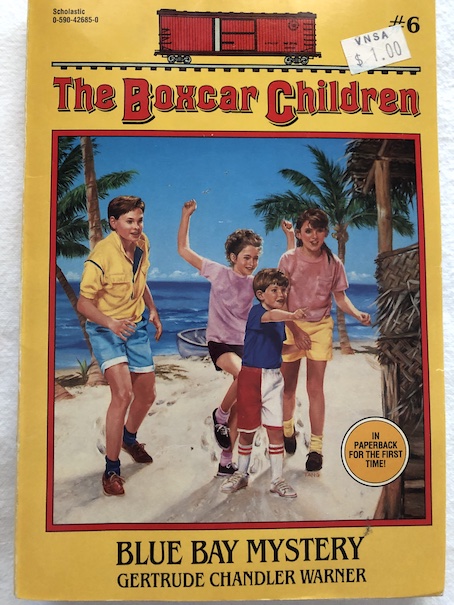
Blue Bay Mystery

The Boxcar Children

#6 Blue Bay Mystery by Gertrude Chandler Warner, 1961, 1989.

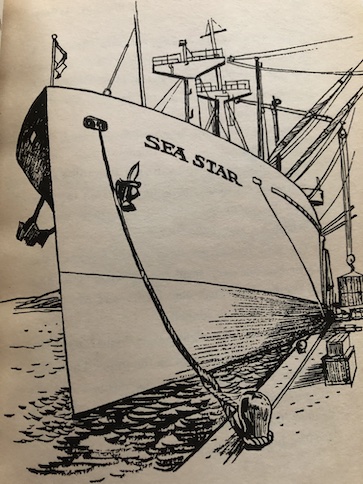
Grandfather Alden has a surprise for his grandchildren. He is arranging a special trip for them as an extension of a business trip of his. A business associate of his, Lars, has a ship going to Tahiti, and he offered to let them come along. However, rather than just having a tour of Tahiti, which would be pretty exciting by itself, Lars is going to take them to camp out on a tropical island. Lars found this island while escaping from a shipwreck himself. No one lives there, but there is plenty of fresh water and edible plants and no dangerous animals. Not every family would like to be on an uninhabited island when they could be in Tahiti, but the kids love camping out and do-it-yourself activities. Grandfather Alden has also invited the children’s friend, Mike Wood (who was introduced in a previous book), to join them. Mike is the same age as Benny.

The trip will take place during the school year, so their grandfather has arranged for the children to bring along some school supplies and lessons to study while they’re on the boat to the island. The lessons help not only to pass the time while they’re traveling but also to enhance it. They have science lessons about marine animals and how parts of the ship, like the radio room, work. Violet tells the others about how she’s been reading about Captain Cook and how he realized that eating certain types of food, like citrus fruit and sauerkraut, helped to prevent scurvy, even though he didn’t realize that the reason is that those foods are rich in vitamin C.

Once they reach the island, their grandfather says that they won’t have time for school lessons because they will have to set up their shelter and learn how to fish and forage for food, although he considers those to be educational lessons as well. They bring some supplies and tools with them so they won’t have to forage for everything, but the kids like assembling their own shelter and improvising things, like they did when they made their own home in a boxcar in the first book. They eat out of shells they find, whittle their own spoons, and use a huge turtle shell they find as a cooking pot.

However, they soon realize that they are not as alone on the island as they thought. Some of their food disappears, and they find some colored stones arranged in patterns. There is a stone with a carved face, sort of like the Easter Island heads, and the turtle shell they find has been carved with a knife. Later, they encounter a myna bird who keeps repeating the phrase, “Hello, Peter!” Someone taught the bird the phrase in English, but who is on the island, and why does this person seem to be hiding from them?

The book is available to borrow and read for free online through Internet Archive (multiple copies).

My Reaction and Spoilers

In the early Boxcar Children books, the children aged as the series progressed. After the death of the original author, when other authors continued the series, the children became frozen in age, but this book is one that was written by the original author. At the beginning of the story, the children’s grandfather mentions that the two oldest children, Henry and Jessie, are in high school, showing that they’ve aged about two or three years from the first book. This remark about the children’s ages only appears once at the beginning of the book, and their increasing ages aren’t really reflected in the story. The lessons the children have on the boat seem to be roughly about the same subjects, although it seems like the children’s lesson books aren’t identical because Violet seems like she’s the only one with the lesson about Captain Cook and scurvy.

This book also varies a little from the other books in the series because the children’s grandfather plays a larger role than usual. One of the hallmarks of the Boxcar Children books is that the children usually do things by themselves, with as little adult help or interference as possible. However, this time, their grandfather is with them on the island, sharing the adventure with them.

As with other vintage children’s mystery series, the early books of this series sometimes lean more toward adventure than mystery. The mystery in this story is pretty light, and the solution is pretty straight-forward. The children eventually find the person who’s camping out on the island with them. The person turns out to be a boy who was also shipwrecked. There was an adult sailor with him before, but the boy, Peter Horn, says that he went swimming one day and never came back, so he’s been alone ever since. The others say that he might have been attacked by a shark but they don’t dwell on it very long, as they do any time someone’s death is mentioned in one of the books in the series, so it doesn’t get too sad. Peter says his parents went overboard while they were escaping the shipwreck, and he doesn’t know whether they’re still alive. Mr. Alden says that he read about some people being rescued from a shipwreck, so it’s possible that they’re still alive. When they return to the mainland, Peter is reunited with this parents for a happy ending.

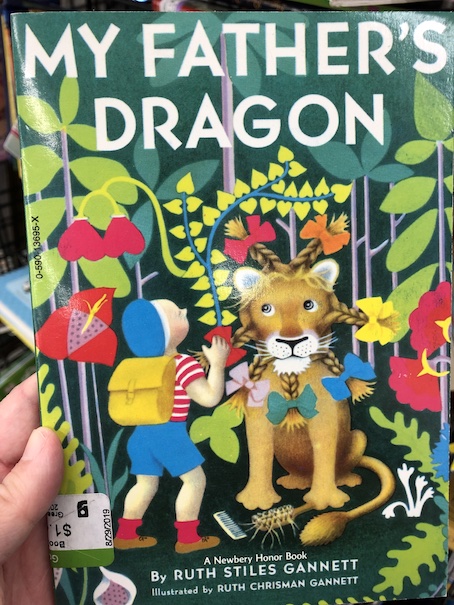
My Father’s Dragon

My Father’s Dragon by Ruth Stiles Gannett, illustrated by Ruth Chrisman Gannett, 1948.

This is a fantasy book where the author tells a story about her father’s adventures rescuing a dragon when he was a boy.

It all starts when the boy, Elmer Elevator, brings home an alley cat that he found. However, his mother doesn’t like the cat and doesn’t want Elmer to keep her. When he tries to feed the cat secretly, she throws the cat out and punishes Elmer. The boy and the cat take a walk in the park together, and the boy confides his wish to learn how to fly airplanes when he grows up. The cat says that he doesn’t have to wait until he grows up to learn how to fly.

The cat explains that she has traveled a great deal, and not too long ago, she visited the Wild Island, which is inhabited by wild animals. The island is divided in half by a river inhabited by crocodiles. Normally, the animals have to take the long way to get around the river to avoid being eaten by the crocodiles, but a few months before the cat visited the island, a baby dragon fell of his cloud and landed next to the river with an injured wing. The other animals on the island captured the poor baby dragon, and when his wing healed well enough for him to fly, they started forcing him to carry passengers and cargo over the river. They work the poor baby dragon too hard and mistreat him. The cat made friends with the little dragon and wanted to help him but didn’t know how because she couldn’t untie the rope that holds the dragon prisoner. The cat suggests to Elmer that the dragon would probably be happy to give him a ride if he helps to free him, and Elmer decides to do just that. Besides, he’s angry with his mother for mistreating the cat and doesn’t mind leaving home for awhile.

The cat decides that she’s too old to travel, so she stays behind, but she helps Elmer to prepare for the trip. Elmer stows away on a ship to the nearby Island of Tangerina and gets to the Wild Island by climbing over the rocks between them. When he reaches the Wild Island, he decides to look for and follow the river, but he has to be careful of the animals on the island.

Elmer is found by some tigers who say that they’re hungry and curious to know what little boys taste like. However, remembering some of the cat’s advice, he offers the tigers some chewing gum because (apparently) tigers love it. He also tells them that it’s special chewing gum that will change colors when they chew it, and then, they’ll be able to plant it in the ground to grow more chewing gum. The tigers fall for it and forget about Elmer, who sneaks away.

Elmer also has a dangerous encounter with a rhinoceros after he drinks from his “weeping pool.” The rhino wants to toss Elmer into his pool to drown him, but Elmer asks him what he has to weep about. The rhino says that he’s upset that his tusk is no longer as white and pretty as it used to be, and Elmer gives the rhino his toothbrush and toothpaste. The rhino lets Elmer go and begins using the toothbrush to clean his tusk, but by now, the boars have realized that there is someone on the island who doesn’t belong.

Elmer continues onward, helping a lion with a messy mane and a gorilla with fleas and befriending the crocodiles by offering them all lollipops, until he finally finds the dragon and rescues him. They fly away from the island together, but it’s not the end of their adventures.

There’s a reason why the author and illustrator’s names are very similar but not identical. If you read their short biographies, they explain that the illustrator was the stepmother of the author.

This book is a Newbery Honor Book, and it’s also the first in a trilogy about Elmer and the dragon and their adventures together. It’s available to borrow and read for free online through Internet Archive (multiple copies).

Samantha Saves the Day

American Girls

Samantha Saves the Day by Valerie Tripp, 1988.

This is part of the Samantha, An American Girl series.

Samantha and her family are spending the summer at their summer home at Piney Point. Besides Grandmary, Uncle Gard and Aunt Cornelia will be there. Cornelia has also brought her younger sisters, a set of twins named Agnes and Agatha. They are close in age to Samantha. Grandmary’s friend, Admiral Archibald Beemis, is also visiting from England.

The family’s summer home isn’t just a single house. They have a lodge in the style of a log cabin and separate guest cottages. This summer, Samantha and the twins will get a cottage to themselves with no adults. The girls have fun exploring the area around the lake together. However, there is one place that Samantha is afraid to go, the island in the lake called Teardrop Island. The only way to get to the island is by boat, and there are sharp, treacherous rocks in that part of the lake. That was where Samantha’s parents had their boating accident and drowned during a storm. To Samantha, Teardrop Island is a place of sadness and danger.

One rainy day, the three girls go up to the attic of the lodge to look for more paintbrushes so they can paint pictures. In the attic, they find old clothes and pictures of Samantha’s family. They also find Samantha’s mother’s old sketch book, labeled “Happy Memories of Teardrop Island.” In the sketch book, she drew pictures of Samantha and her father as they had picnics and played by a waterfall. Samantha was a very young child at the time, and she has no memories of having been on the island with her parents. From the pictures, it looks like it used to be her family’s favorite place.

Seeing the pictures makes Samantha want to visit the island once more, hoping to bring back memories of her earlier visits and her parents. The next day, the three girls go out to the island and try to find the places that Samantha’s mother drew in her book. Teardrop Island turns out to be a beautiful place, and Samantha loves it. The more time she spends there, the more she feels like she has been there before, although her memories are vague and dream-like.

However, the girls forgot to tie up their boat, and they find themselves stranded on the island! A storm comes, and the girls are afraid. When the Admiral tries to come out to the island to help them, he is injured, and the girls realize that they are going to have to find a way to save him! Can they make it home through the storm, or will they meet the same fate as Samantha’s parents?

In the back of the book, there is a section with historical information about how people would spend their summers during the early 1900s. Wealthy families like Samantha’s would go to summer homes in the countryside to escape the heat of the cities.

The book is currently available to borrow for free online through Internet Archive.