The Mysterious Giant of Barletta

This story is adapted from an Italian folktale. There is a note in the beginning about the town of Barletta and the statue that stands in front of the San Sepolcro Church. According to the note, nobody knows who the statue is supposed to represent, which is why there are stories about it. This one takes place during the Middle Ages, the 11th century.

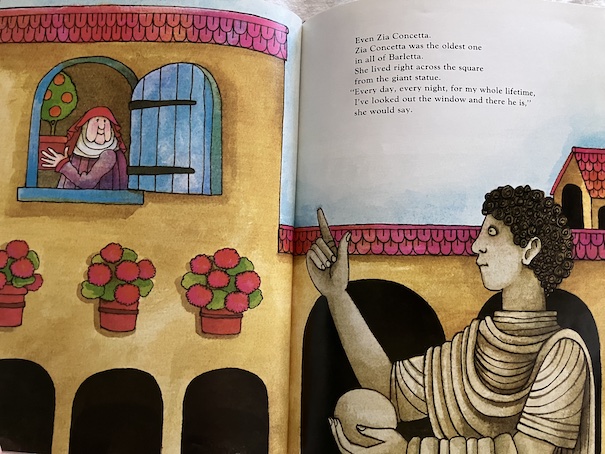
Because no one knows who the statue is supposed to be, the people of Barletta call it, “The Mysterious Giant.” No one even knows for sure how long it has been there. It has been there for as long as anyone can remember, including Zia Concetta, the oldest person in Barletta. People are accustomed to gathering around the statue to meet each other, and many of them will give the statue a friendly greeting or wish it good night.

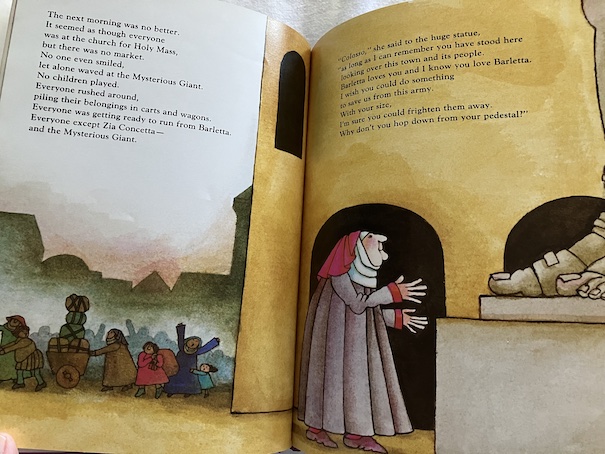
However, one day, the town is threatened by an invading army. The people of Barletta are unprepared for invaders, and many of them prepare to flee, not knowing what else to do. Zia Concetta appeals to the statue to save their town.

The statue hears Zia Concetta’s request, and it comes to life, climbing down from its pedestal. Together, he and Zia Concetta come up with a plan to discourage the invaders.

When the invaders arrive, they see the statue, sitting by itself outside the city, crying. When they ask the giant statue why it’s crying, it says that the other boys at school are mean to him because he’s smaller than everyone else. When the invaders hear that everyone else in Barletta is bigger than the giant statue, they decide that they don’t want to meet the rest of the townspeople and leave!

The book is available to borrow and read for free online through Internet Archive.

I always like books that reference folklore! The theme of someone who is large pretending like they’re much smaller than other people to scare off an attacker is one found in other folktales. For example, in Fin M’Coul (a version of which was also written and illustrated by Tomie dePaola), Fin M’Coul, who is a giant, pretends to be his own baby to make an enemy think that his father must be larger and more fierce than he actually is.

I particularly liked this story because, unlike other folktales, it has a real setting and a definite landmark, the statue that is sometimes called the Colossus of Barletta. The way it is drawn in the book isn’t exactly as it appears in real life. In real life, it holds a cross in the hand that is raised, although the cross was not part of the statue originally. It probably originally held a spear or a flag standard. It is about three times the size of an adult human, which isn’t as large as it is shown the book. As in the book, it isn’t certain exactly who the statue is supposed to be, although it appears to be the statue of an emperor. He appears to be a middle-aged man wearing a jeweled diadem. The reason why nobody knows exactly who it was supposed to be is that it wasn’t originally made or displayed in Barletta. It was probably originally looted from Constantinople by the Venetians. There is a story from Barletta that it was once lost in a shipwreck on the way from Constantinople and washed up on the shores of Barletta in 1309, where some of its bronze was used for casting bells for a monastery. Then, in the 15th century, the statue was restored and displayed in front of the church. That, by itself is a fascinating story, although it isn’t explained in the book.

The Magicians of Caprona

The Magicians of Caprona by Diana Wynne Jones, 1980.

This is the second book in the Chrestomanci series.  In this series, there are many different dimensions with different worlds, and in each of those different worlds, there is a copy of every person.  Different versions of our world can differ dramatically in their history across the dimensions, and individual people’s lives can differ dramatically between the worlds. There is one person in each generation who has no duplicates in any of the other worlds.  This person is called the Chrestomanci.  All of the talents, abilities, and lives that would have been spread across the other worlds are now centered on that one person, giving that person, literally, nine lives.  The Chrestomanci fills an important role, being better able than anyone else to travel across the dimensions, and he acts to keep a balance between them and make sure that the different worlds keep their proper course. This book begins with a brief explanation, although most of this was established in the first book in the series, Charmed Life.

In the world where the Chrestomanci lives, magic not only exists but is a known and accepted profession, and society is a little more old-fashioned than in our world. Also, there is a kind of alternate history, and some of the countries are organized differently. This story is set in Italy, which is not a unified country in this world, but a series of small dukedoms. The Chrestomanci series is a somewhat loose series, meaning that, while Chrestomanci appears in the different books and always plays some kind of role, he is not always one of the main characters. This story sets up a Shakespearean kind of feud between two families.

The dukedom of Caprona is known to having the best spell-makers in the world. The problem is that the best spell-makers belong to two particular families, the Montanas and the Petrocchis, who have a long-standing feud. The adults in the families never explain how, exactly, the feud started. They just warn the children to avoid to avoid the children of the other family. When members of the two families meet in public, they usually ignore each other, although sometimes fights break out. The fights are particularly bad when they use magic. Locals and tourists alike are alarmed by these fights and get out of the way to avoid being caught up in them.

Because the adults don’t talk about the cause of the feud, the children of the two families tell each other stories about it. In the Montana family, the children say that it started because the Duke of Caprona favored their family over the Petrocchis. The children also tell each other stories about the other family’s atrocious habits. Young Rosa Montana particularly likes telling her siblings and cousins scandalous stories about how the Petrocchis never bathe and sometimes kill their unwanted babies or eat their own family members. Because the members of the two families almost never see each other, the other Montana children can only suppose that the stories they hear about the Petrocchis are true.

When young Tonino Montana starts school, he is very upset. Things don’t seem to come as easily to him as they do to his siblings and cousins, and he feels awkward when the teacher tells him to do things differently from the way he’s always been taught to do them or repeats things that he’s already learned. When Tonino runs off into the city by himself because he’s upset, the rest of his family worries about him. Old Niccolo, the head of the family, talks to Benvenuto, the head cat in the Montana household, about Tonino. The Montana family keeps cats, who help them at their spell-making, but not everyone in the family has the ability to talk to the cats and understand them. Old Niccolo can communicate with the cats, but even Tonino’s father, Antonio, can’t. Benvenuto tells Niccolo that he will look after Tonino and not to worry about him. Tonino, like Niccolo, can talk to cats, and he hasn’t fully appreciated the talent yet.

Benvenuto becomes Tonino’s special friend. He helps Tonino to understand that, like the kittens he talks to, he’s still young and learning. Tonino needs to give himself time to develop. Benvenuto also tells Tonino that it’s fine to tell his teachers what he already knows, and Tonino comes to realize that he is far ahead of the other students in some ways, having already learned to read. His talent for talking to the cats also gives him a special place in his family. Benvenuto also allows Tonino to give him brushings, which he would never allow from any other family member before, so he becomes more well-cared for.

As time goes on, however, Tonino comes to realize that the adults in the Montana family are worried about the state of their family and the state of Caprona itself. Other dukedoms around them are becoming more powerful, and some of the old spells that the two families made to protect Caprona are breaking down. Of course, the Montanas blame the Petrocchis for the weakness of the spells and for not maintaining them properly, but Tonino realizes that the old Montana spells are breaking down as well. It’s not, as the older Montanas said, that they have had to bear the weight of making up for the weak Petrocchi spells.

Tonino gets his first look at the Petrocchis when both families are summoned to the duke’s palace to discuss the state of their spells and the rival states that are seeking to conquer Caprona. Speaking together for the first time in a long time, both families come to realize that, even though they have separately been working to make their spells stronger, each year, the protective spells they cast on Caprona have been getting weaker. There is a rumor that there is an evil enchanter who has been working against them on behalf of their enemies. Naturally, both Petrocchis and the Montanas secretly suspect each other of being involved. They also can’t help but notice that something is seriously wrong with the duke himself. He seems strangely childlike, and his wife seems to be running everything.

The Montana family offers a solution that even they aren’t sure they can fulfill. There is an old story that all of the children know about an angel who once protected Caprona with a magical song. Everyone thinks that, as along as the song is sung, Caprona will be safe. The children learn this song in school, but what they don’t know is that the words they learn to the song aren’t the original words to the song. The tune is original, but the original words were lost to time. The Montanas know that the song is a powerful spell, but it won’t function correctly until the original words to the song are restored. In their pride against the Petrocchis and their worry about the state of Caprona, the Montanas have pledged that they will find the original words to the song. Also, naturally, the Petrocchis have promised the same. Neither family knows exactly how they will do that, but they are each determined to somehow do it before the other family can.

There is only one person both of the families accept and who can work with either family without earning the resentment of the other: Chrestomanci. The situation is serious, war is pending, and Chrestomanci has also been summoned for help. As the most powerful enchanter in the world, he has the respect of all sides. Since Chrestomanci is British, he admits that he is somewhat limited in how far he can interfere in Italian affairs. His main interest is in the evil enchanter and their misuse of magic, although he will help Caprona and his friends in the magical families, if he can.

Chrestomanci notices that, aside from being able to talk to cats, Tonino also has an ability to tell when someone is an enchanter without being told. Chrestomanci says that he needs to go to Rome to make some inquiries, and he asks Tonino to stay close to his grandfather when his grandfather has to meet with anyone, to see if he can spot the evil enchanter. However, the evil enchanter already knows too much about the two families and about Tonino in particular.

When Tonino is kidnapped by the evil enchanter, his family immediately blames the Petroccis and sets out to confront them … only to be met halfway by the Petrocchi family, on their way to confront the Montanas about kidnapping one of their children, Angelica. The feud between the two families becomes worse than ever, but an accidental encounter between Tonino’s brother Paolo and Angelica’s sister Renata reveals that neither family has kidnapped anyone. The evil enchanter is playing both of the families against each other to distract them from what they really need to do: find the children and prepare to defend Caprona from its enemies. Paolo and Renata have trouble convincing either of their families of the truth because they are already too convinced that the other family is their real enemy, so they struggle to figure out how to save Tonino and Angelica themselves.

Meanwhile, Tonino and Angelica team up in captivity to find a way to escape and tell their families where to find the secret words to the angel’s song. While they are being held captive together, Tonino and Angelica argue about the nature of their families, but by talking together, they come to realize that each of their families has held half of the answer to the problem all along. If only the children can get together and reach their families to tell them the truth about the angel’s song and the identity of the evil enchanter!

The book is available to borrow and read for free online through Internet Archive (multiple copies, including some in different languages).

My Reaction

During the course of the story, we never learn the original cause of the feud between the two families. It might have been something with one family thinking that the other was being favored by a past duke, or maybe it was some private quarrel between the heads of the two families. The cause is less important than the result. For generations, each family has been quietly maligning the other to the children of the family, who have continued to pass on the stories.

When the younger members of both families finally meet and talk to each other, they are initially offended that the other family has been saying the same horrible things about them that they’ve been saying about the other family, but it’s also an eye-opening experience. The two families are actually very similar to each other, both in their professional work and in their private family life. In fact, they live nearly identical lifestyles. The fact is that both families have been contributing to the spells maintaining their city for centuries, working together since before their feud began. Their spells were always intertwined and made to work together. Since the feud started and the families stopped working together, they have still had to work together in the service of their city and duke, but the feud has also served as a distraction from the real sources of danger.

As with other Chrestomanci stories, Chrestomanci doesn’t solve all of the problems of the story himself. Instead, he acts as a helper, revealing key information and providing guidance to help the other characters to solve their own problems. As a neutral observer, Chrestomanci sees both of the families and their quarrel for what they really are. He also helps to reveal the true villain of the story for who they really are.

Chrestomanci also points out the hidden talents of the children in the story. Although Tonino doesn’t think he’s as good as magic as others in his family, he does have other talents and magical abilities. At the end of the story, he goes to England with Chrestomanci to study for a while. His adventures in England are part of one of the short stories in Mixed Magics.

Da Vinci

Da Vinci by Mike Venezia, 1989.

This book is part of a series of biographies of famous people from history. I’ve been familiar with the part of this series about famous artists since around the time the first ones were published. I was in elementary school school at the time, and we had the books because my mother used to teach the Art Masterpiece program at the school. She would come to class and talk about famous artists and show their paintings, and there would be an art project for the kids to do based on the style or subject matter of the artists. So, when I was young, we had books from this series (among other art books) around the house that she used for the art classes and a lot of arts and crafts materials (a tradition which exists to this day). At the moment, this is the only book from the series that I have because the book about Leonardo da Vinci was my favorite.

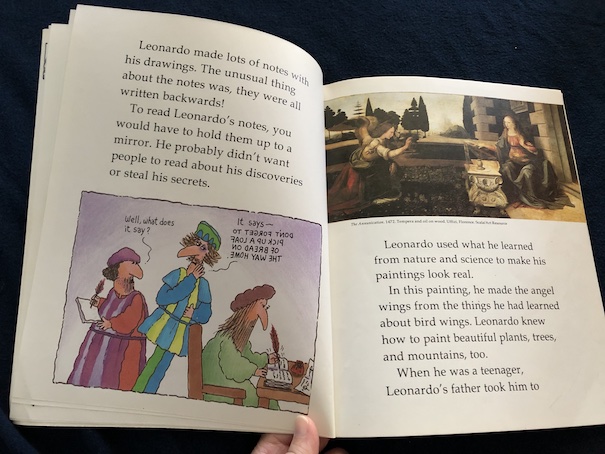
Leonardo da Vinci was one of the most famous artists of the Italian Renaissance, particularly known for his paintings The Last Supper and the Mona Lisa, but he was more than just a painter. The book is full of interesting facts about his life as well as his work. Aside from showing photographs of da Vinci’s work, the book also has humorous cartoons about da Vinci’s life, which is one of the things that makes this series of books fun.

Leonardo began showing an interest and talent for drawing while he was still a child. Throughout his life, he also developed and practiced many other skills, including architecture and mathematics, music, and sculpture. He was a scientist and inventor, experimenting in many different areas, from the mixing of different types of paints to weapons design. Along the way, he found creative ways to combine his various interests. He used his drawing skills to develop his scientific ideas, and he used his knowledge of science to make his art appear more realistic.

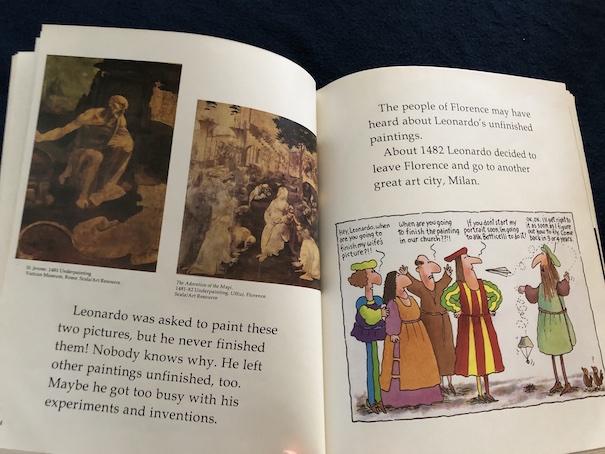
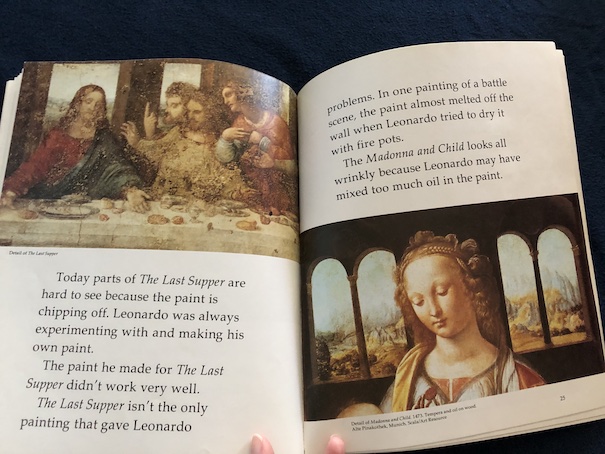
You might wonder how one person could find so much time to do so much, but part of the answer is that he didn’t finish everything he did. He is known to have left some of his work unfinished, possibly because he got distracted by other, more interesting projects and pursuits or because he just couldn’t finish them to his satisfaction. Not all of his designs for inventions really came to anything, and not all of his experiments worked out, either. Some of his paintings are now deteriorating because the experimental paints that he mixed didn’t quite work out.

However, Leonardo da Vinci was a perfectionist, and the paintings that he did complete show excellent techniques and a high degree of realism that have been an inspiration to later artists for centuries.

One final thing I’d like to add is that this book is part of the reason I thought The Da Vinci Code by Dan Brown was a dumb book. As I said, I grew up with art lessons. I read and loved this book about Leonardo da Vinci when I was a kid, and it has some very basic information about the life and work of Leonardo da Vinci that anybody who was seriously interested in him really should know. One of the cringiest parts of The Da Vinci Code for me was the part where our heroes are stupidly trying to figure out a message that is simply written backward. As this picture book about Leonard da Vinci points out, it’s common knowledge these days that da Vinci wrote notes using mirror writing. Some people, like the book suggests, think that he did that to make his notes harder for other people to read, although there’s also a theory that he did it because he was left-handed and that he decided that it was easier for a left-handed person to write that way. Left-handed people often complain about getting ink on their hands when they write left-to-right, but they don’t have that problem if they write right-to-left, so this might have been his attempt to get around the problem of ink-stained hands. Either way, if the people in The Da Vinci Code were such experts, they should have know this about da Vinci, and it should have been one of the first things they should have checked for. That’s not the only problem in The Da Vinci Code, but it’s one of the ones that rankled me the most because of how long I’ve known about this. (Also, The Da Vinci Code totally ripped off the albino assassin from Foul Play with Chevy Chase and Goldie Hawn, but that’s another issue.)

The book is available to borrow and read for free online through Internet Archive.

The Clown of God

The Clown of God by Tomie dePaola, 1978.

The book begins with a note that the story is based on an old French legend, although the story actually takes place in Italy.

A young boy named Giovanni has no parents and must live as a beggar, but he knows how to juggle. He juggles fruit and vegetables in the marketplace, and the produce sellers give him food in exchange for drawing people’s attention to their wares.

One day, Giovanni sees some actors putting on a play, and he asks for a job with the troupe. After he demonstrates his juggling ability, they agree to take him on in exchange for food and a place to sleep.

Over time, Giovanni’s juggling act becomes more elaborate. Eventually, he becomes famous in his own right and leaves the troupe to become an entertainer for many important people.

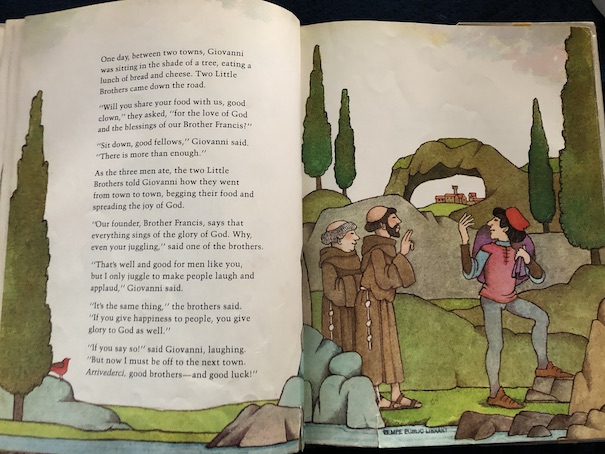
During his travels, he meets two monks, who ask him if he is willing to share his food with them. He agrees, and they tell him about Brother Francis, the founder of their order. (St. Francis of Assissi. They are Franciscan monks.) They say that everything in the world is a sign of God’s glory, even Giovanni’s juggling. Giovanni says that he never thought of it like that before. He just likes making people happy with his performance. The monks say that making people happy is a way of glorifying God.

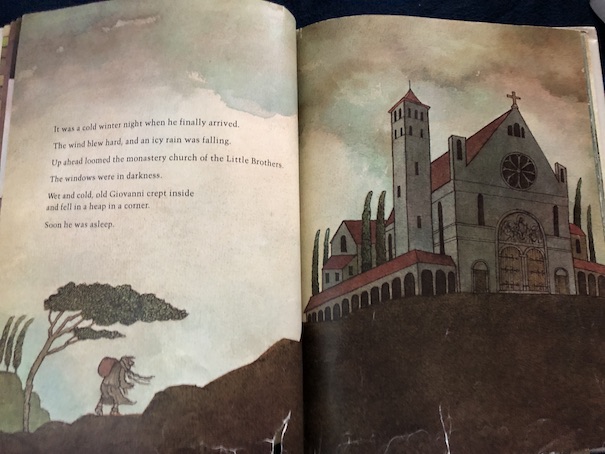
Giovanni continues his performances, but as he gets older, people get tired of his act, and one day, he actually drops one of his juggling balls. For a time, he has to live as a beggar again. However, he eventually finds his way to the monastery where the Franciscan monks live.

He arrives at the monastery at Christmas, and there is a special procession where people are offering gifts to the Christ Child, placing them in front of a statue of Jesus and Mary. Giovanni is struck by how serious the Christ Child looks in the statue, and so he decides to perform the act that used to make everyone smile.

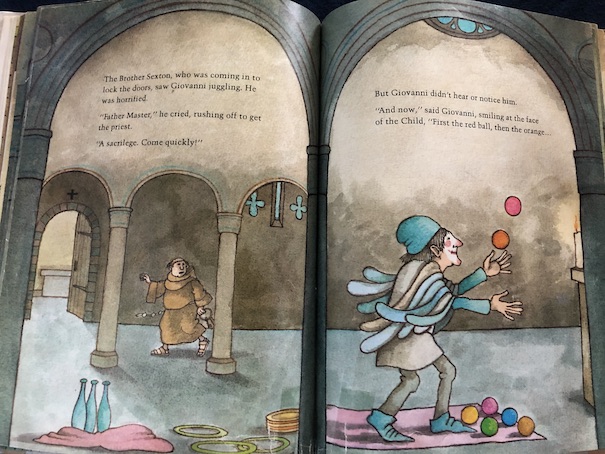
When one of the monks sees him juggling in front of the statue, he thinks that it’s a sacrilege and calls the priest to come see what Giovanni is doing.

The story is sad because Giovanni’s exertion in giving the best performance of his life causes him to have a heart attack and die. However, the priest and the monk notice that, suddenly, the statue is smiling and holding Giovanni’s special golden ball.

The story is about using talents to the fullest. The juggler’s talent, as the monks said, was a gift from God. For as long as he could, he used it to make people happy, and when he was too old to do so anymore, he gave his last, finest performance for Jesus.

The book is available to borrow and read for free online through Internet Archive.

Murder at Midnight

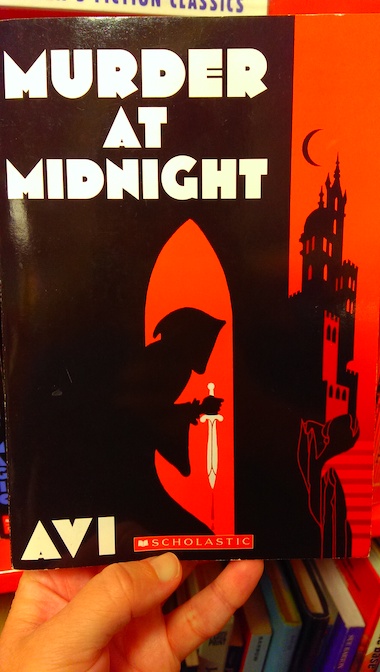
Murder at Midnight by Avi, 2009.

This story is a prequel to Midnight Magic.

Fabrizio was an orphan living on the streets of the medieval city of Pergamontio before he was taken in as a servant by Mangus and his wife, Sophia. It was really Sophia’s idea that Mangus needed a personal servant. Mangus says that he is able to take care of himself, and he is impatient with Fabrizio because Fabrizio is ignorant and uneducated.

When Sophia goes to visit her sister, Fabrizio tries extra hard to please Mangus so that Mangus will continue to let him live in his house. Mangus is primarily a scholar, but he supplements his income by performing magic tricks at a local tavern. That evening, a black-robed figure appears at the magic show, warning of danger coming to Mangus. The next day, the magistrate, DeLaBina, accuses Mangus of spreading papers with treasonous messages about the king around the city. During this time, all writing is by hand, and no one can understand how these papers can all look so identical unless they were produced by magic.

At first, DeLaBina offers to let Mangus go if Mangus gets rid of the papers and reveals the identity of the traitor. When Mangus protests that he cannot do real magic and that he knows nothing about the papers, he is arrested. Shortly afterward, DeLaBina is murdered. Fabrizio’s only hope of saving his master, and himself, is to find the real traitor.

The book is available to borrow and read for free online through Internet Archive.

My Reaction and Spoilers

I didn’t like this book as well as I liked the original Midnight Magic.  Partly, the problem was that I feel like some of the events of this story should have changed people and events in the other book, and they don’t because this book, which is supposed to take place earlier than the other story, was actually written after the other story. It all just seems out of order, and I didn’t like the addition of Prince Cosimo to the royal family.  In this book, Prince Cosimo is the crown prince of Pergamontio, not Prince Lorenzo from the previous book.  Prince Cosimo did not appear in Midnight Magic (although his absence is explained by the end of this book) and was never even referred to in that book (which is the part that really bothers be me everyone in that book would have known all about him and what happened to him, and I feel like Fabrizio should have at least thought about him in passing, it’s just weird when characters suddenly exist in a series that you know didn’t exist before).

Basically, there is a plot (although not by the person who did the plotting in the other book) to overthrow the king, who is wildly superstitious. The printing press is a relatively new invention in this time period, and Pergamontio has never had one before, which is why no one can understand why the writing on the papers is so strangely uniform.  This is the other thing that bothers me about this book.  Pergamontio is supposed to be somewhat backward in comparison to other kingdoms, partly because the king is so superstitious, but it just seems like going a bit far for people to suspect that oddly-uniform writing would be a sign of witchcraft because people of that time would already be aware of the existence of signet rings and official seals which were used as stamps in wax to mark documents, like a kind of signature.  Like a printing press, those would also produce an identical image, time after time of use.  Basically, they’re all just complex forms of stamps.  Superstitious or not, I think that people of that time who were capable of reading probably would have been able to tell that a stamp of some kind was being used, even though they might not have seen one as complex as a printing press before.

In the story, a family has recently brought a printing press to the city, and printing the treasonous papers was the first job they were hired to do. Shortly afterward, Maria, the daughter of the family, was arrested while passing out the papers. Her parents are taken into custody by Count Scarazoni, who is a sinister character in his own right but is actually in opposition to the real traitor in this book.

Scarazoni was the figure in the black robe who tried to warn Mangus. Fabrizio is arrested when he tries to gather up more of the papers for Mangus so they can learn where they came from.  He is nearly executed for treason, but he is saved by Scarazoni because Scarazoni realizes that the real traitor wanted him dead because he feared that Fabrizio might know too much. At the prison, Fabrizio meets Maria and helps her to escape as well. Maria explains to him the true origins of the papers, and they find DeLaBina’s body.  This is the murder referenced in the title of the book, and they must solve it to uncover the identity of the real traitor!

As in the other book in this series, Fabrizio and Mangus use a magic trick at Mangus’s trial to shock the traitor into revealing himself.  Although, at the end of the story, the king still believes that Mangus is a real magician, Scarazoni points out that without Mangus’s “magic” the real traitor might not have been discovered. The king tells Mangus that he will let him go provided that he confine himself to his own home and no longer practice magic, setting events up for the beginning of the other story.

The Thief Lord

The Thief Lord by Cornelia Funke, 2000.

Prosper and Bo (short for Boniface) are orphans, running away from their caregiver. They were living with their aunt, a wealthy woman who likes little Bo and treats him like a little doll but doesn’t like Prosper because he is too old to treat like a toy. When the aunt starts considering sending Prosper away to boarding school, they run away to Venice to hide. There, they meet up with a band of orphans who live in an old movie theater. The other orphans/homeless children are Riccio, Mosca, and Hornet. Each of them is running from something in their past, and lacking adults to take care of them, has made their home in the theater, stealing and picking pockets to survive. The Thief Lord, the leader of this group, is the mysterious Scipio, a boy with his own secrets.

Many of the adults in this book are varying degrees of unhelpful and threatening as the children struggle to take care of themselves and their own lives. The boys’ aunt hires a detective to find them, and he does eventually figure out where they are living. Scipio turns out to be the son of the wealthy man who actually owns the disused theater. However, in spite of his father’s wealth, he does not have a happy home life. His father ignores and neglects him because he is too obsessed with his business concerns. At one point, the boy’s beloved cat is very sick, and Scipio fears that she might die, but his father brusquely tells him that he has no time to take it to a vet, and he’ll just buy him another one. (Don’t worry, the cat gets saved.)

One of the thefts that Scipio has the children attempt is the theft of a lion’s wing owned by a woman named Ida Spavento. A man known as the Conte, a customer of the man who buys the band’s stolen goods, specifically requested this item, although the children do not initially know why. Ida catches them in the act and tells them that the wing was once part of a magical merry-go-round that can change the ages of the people who ride it, making older people younger and younger people older. When Ida learns that the children received a request to steal the lion’s wing, she allows them to have it on the condition that she is allowed to come with them to see who hired them.

The Conte and his sister have discovered the merry-go-round and need the missing wing to complete it. Once the wing is restored, the merry-go-round turns them into young children. When Scipio sees that the merry-go-round really changes a person’s age, he insists on riding it himself. After a ride on the merry-go-round, Scipio becomes a young adult, able to live independently from his hard-hearted father and take care of his beloved cat. Barbarossa, the man who fences their stolen goods, also rides the merry-go-round and becomes a little boy again, far more adorable than the man he used to be. However, he accidentally breaks the merry-go-round so that the magic no longer works.

With the exception of Ida and the detective, Victor, the other adults in the story are irresponsible and self-centered, really more like children than the children. When the merry-go-round changes the ages of some of the characters, the changes end up suiting their personalities. Scipio was always more mature, and his new status as an adult reflects that. He ends up becoming an assistant to the detective in his agency, who understands the whole situation. Ida adopts Prosper, Bo, and Hornet and takes care of them. Prosper and Bo’s aunt is charmed by the now adorable Barbarossa and takes him in. Barbarossa, who is as shifty as a child as he was as an adult, is more than happy to let the aunt pamper him and fuss over him because he knows that he’ll get to enjoy her money in the process. The end does reveal that the aunt catches Barbarossa stealing from her and sends him to boarding school for some discipline, but he bullies and dominates the other boys into doing his bidding and even stealing for him, becoming the new Thief Lord.

The book is available to borrow for free online through Internet Archive.

Papa Gatto

PapaGatto

Papa Gatto by Ruth Sanderson, 1995.

This beautiful picture book, set in a fairy-tale Italy, is based on several folk tales, as the author explains on the page with the publishing information.  Among the tales that served as inspiration for this story is The Colony of Cats, which is from Andrew Lang’s The Crimson Fairy Book.  In some ways, this story is similar to Cinderella and Mother Holle, with its wicked stepmother and stepsister.

In the distant past, so the story says, it was common for animals to talk, and one of the wisest cats was Papa Gatto, who served as an adviser to the prince.  Papa Gatto had a lovely wife and a beautiful mansion, but soon after the birth of their eight kittens, his wife died.  Needing someone to help care for the motherless kittens, Papa Gatto decides to advertise for someone to help.

PapaGattoAdvertises

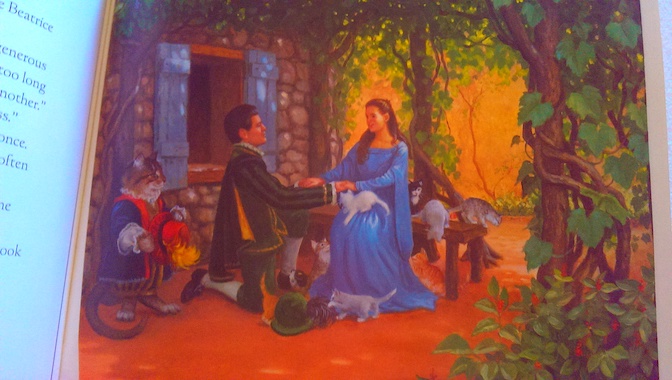
In the town, there is a widow who has a daughter named Sophia and a stepdaughter named Beatrice.  As in many fairy tales, the widow favors her own daughter, who is lazy and spoiled, while giving all of the hard work to her stepdaughter, who is much nicer.  When they hear about Papa Gatto’s advertisement, Beatrice feels sorry for the young kittens and wants to help.  However, the widow, thinking of the generous fee that the wealthy Papa Gatto is offering, decides that she wants it for Sophia.  Sophia doesn’t want the job, but at her mother’s urging, she goes to see Papa Gatto anyway.

PapaGattoSophia

Papa Gatto gives Sophia the job tending his house and family while he’s away on a trip, but Sophia doesn’t know how to work hard and has no real intention of doing a good job.  She simply makes herself at home in Papa Gatto’s lovely mansion, trying on his dead wife’s jeweled collars as bracelets and neglecting the housework and kittens.  When Papa Gatto returns home and sees what she’s done, he sends her away in anger.

When Beatrice hears that Papa Gatto is once again looking for help, she goes to see him without telling her stepmother about it.  Papa Gatto sees how interested she is in the kittens and how gently she treats them, he gives her the job, reassured that she will do it well.

PapaGattoBeatrice

Sure enough, when he returns from his next journey, he sees that Beatrice has taken good care of the house and kittens and rewards her with the jeweled necklace/bracelet that Sophia had admired.  Needless to say, Beatrice’s stepmother and stepsister are angry with Beatrice when she returns home, and Sophia takes the bracelet for herself.

Meanwhile, Papa Gatto has told the prince about Beatrice.  The prince has been thinking about marrying, and he says that he would like to meet Beatrice.  Papa Gatto tells him that she will probably be at the coming fair in town, and the prince should attend and look for the girl with the bracelet.

At first, the prince mistakes Sophia for Beatrice, a deception that she and her mother encourage.  However, when the prince speaks to Papa Gatto again, Papa Gatto realizes the deception and sets things right.

PapaGattoRevelation

The pictures in this book are beautiful!  And, of course, there’s a happy ending.

I liked it that Beatrice didn’t accept the prince’s offer of marriage immediately, saying that she’d like to get to know him first.  It’s more sensible than the fairy tales where they get married right away.

PapaGattoHappyEnding

Midnight Magic

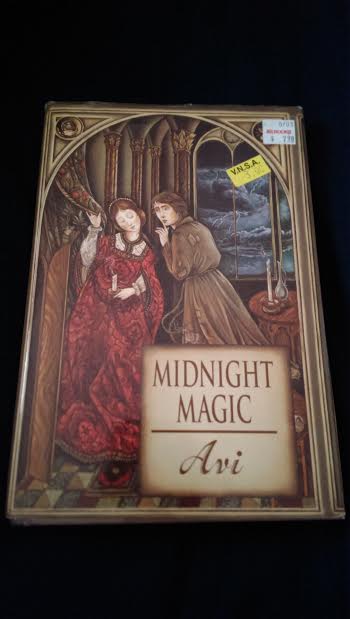
midnightmagicMidnight Magic by Avi, 1999.

The story takes place in Italy, toward the end of the Middle Ages.  Mangus, a formerly wealthy scholar and philosopher, is living under house arrest because the king believes that he has practiced black magic. Mangus was merely performing magic tricks to earn extra money, and in fact, does not believe in real magic.  However, the king is very superstitious and easily influenced by his scheming advisor, Count Scarazoni, who needed a scapegoat to distract everyone from his schemes.  Unfortunately, many people in the kingdom of Pergamontio believe that Mangus is a real magician with frightful powers.  Even Fabrizio, an orphan who is Mangus’s only remaining servant, believes that magic really exists.

When a messenger arrives, summoning Mangus to the castle to see the king, they are afraid that the king has reconsidered his decision to spare Mangus’s life. However, it turns out that the king is in need of Mangus’s help. He believes that his young daughter, Princess Teresina, is being tormented by a ghost, and he wants Mangus to use his magic to get rid of it.

Mangus again protests that he does not do real magic, but both the king and Count Scarazoni promise dire consequences if he fails to help them deal with the problem.  Mangus isn’t sure why Count Scarazoni has asked for his help because he knows that the count doesn’t really believe in magic, except perhaps as a way of appeasing the king.  The king promises that if Mangus can free the princess from the influence of the ghost, he will not only end Mangus’s house arrest but reward him with a generous pension.  Mangus has little choice but to agree to do his best, and the promise of the pension for his master convinces Fabrizio to do everything he can to make sure that Mangus succeeds, not only to save his master’s life but to restore his family’s fortunes.

But, what is the secret of the ghost?  Fabrizio believes in ghosts, even though Mangus doesn’t.  Princess Teresina insists that the ghost is real, appealing directly to Fabrizio to convince Mangus that it is. Adding to the mystery is the disappearance of the princess’s brother, Prince Lorenzo, and the murder of the princess’s tutor. Danger lurks in the castle, and conspiracies are around every corner. Could the troubled spirit really belong to the murdered prince?

The book is available to borrow and read for free online through Internet Archive.

My Reaction

I love historical books and spooky mysteries, and this is both! The Italian kingdom where the story takes place is fictional, but it takes its inspiration from real kingdoms of the later Middle Ages and early Renaissance, with Machiavellian intrigue, power struggles, and arranged marriages, even for children, that could influence the balance of power and successions. (There is talk of a potential arranged marriage in the story, but no child marriages actually take place.  If a child is old enough for ghost stories and murder mysteries and isn’t too frightened by them, there is really nothing more concerning than that to prevent them from reading this book.)

Princess Teresina is one of the most intriguing characters in the book.  Although young, she isn’t a shrinking violet or anyone’s fool, and she’s definitely not a tea party and ball gown kind of princess.  Like real life Medieval princesses, she is the product of a family who came to power by the sword and maintains it by the iron fist in the velvet glove and some clever political maneuvering, although some members of the family are more clever about it than others.  Princess Teresina well knows the family she was born into and what’s expected of her as royalty, and she knows to be careful about who she trusts and what the consequences of trusting the wrong people can be.  Although apparently terrified by the ghost, the princess has a kind of toughness and shrewd determination to do what she thinks is necessary.  She seems to be smarter and knows more than most people give her credit, and Fabrizio often wonders just how much she really knows.

One of the best things about the story is that, as soon as you think you know what’s going on, you learn that there is more to the story. There are conspiracies within conspiracies!

Hint: If you like pseudo-ghost stories, spooky stories of the Scooby-Doo variety, where there are logical explanations for the supernatural phenomena … you won’t be disappointed.

Kat and the Missing Notebooks

KatMissingNotebooks

Kat and the Missing Notebooks by Emma Bradford, 1999.

KatMissingNotebooksDaVinciThis book is part of the Stardust Classics series.

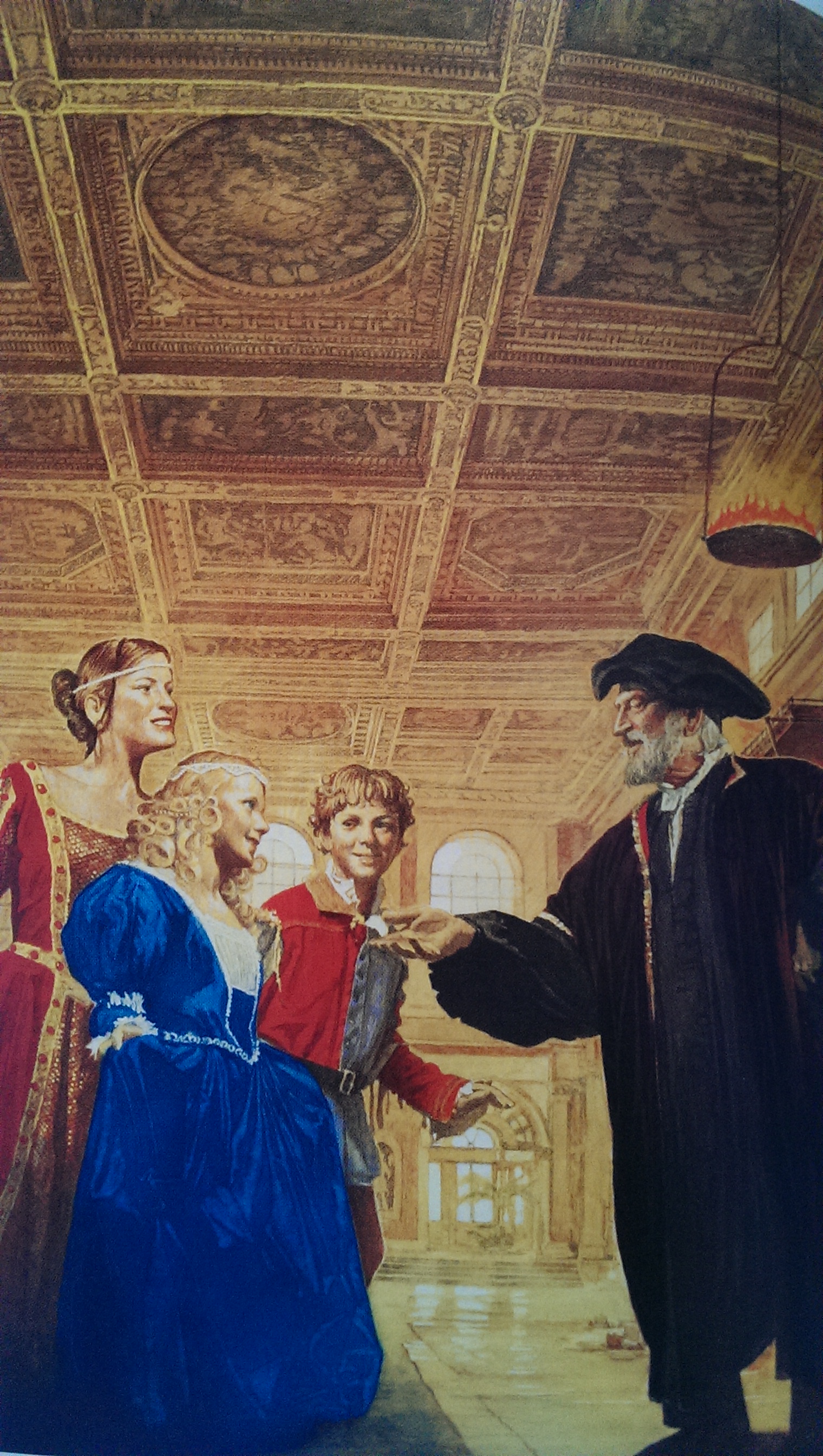
This time, Kat and her aunt, Jessie, find themselves in Florence during the Renaissance. They appear shortly before someone attempts to steal some very important papers belonging to the Florentine City Council from Signor Millori. Kat and Pietro, Signor Millori’s son, both run after the thief, and Kat helps to get the papers back. To thank Kat for her help, Signor Millori invites her and Jessie to stay with him and his family in their palazzo during their stay in Florence.

Signor Millori is a wealthy banker, and the palazzo is a grand place. Kat and Pietro become friends, and he confides in her how much he loves art. Pietro’s father wants him to become a banker, but Pietro’s dream is to study painting with Leonardo da Vinci. In fact, he takes Kat and her aunt to see Leonardo painting a mural at the Palazzo del Vecchio.

Leonardo notices Kat’s aunt and thinks that she has an interesting face. When he asks her to come to his studio to pose for some sketches, she eagerly accepts. Kat hopes that she can use the opportunity to show Leonardo Pietro’s artistic talent and convince him to take Pietro on as a student. However, although Leonardo likes the sketch of Pietro’s that he sees, he says that he has enough apprentices at the moment. Pietro cannot resist the opportunity to study Leonardo’s work, however, and borrows a couple of his notebooks to study.

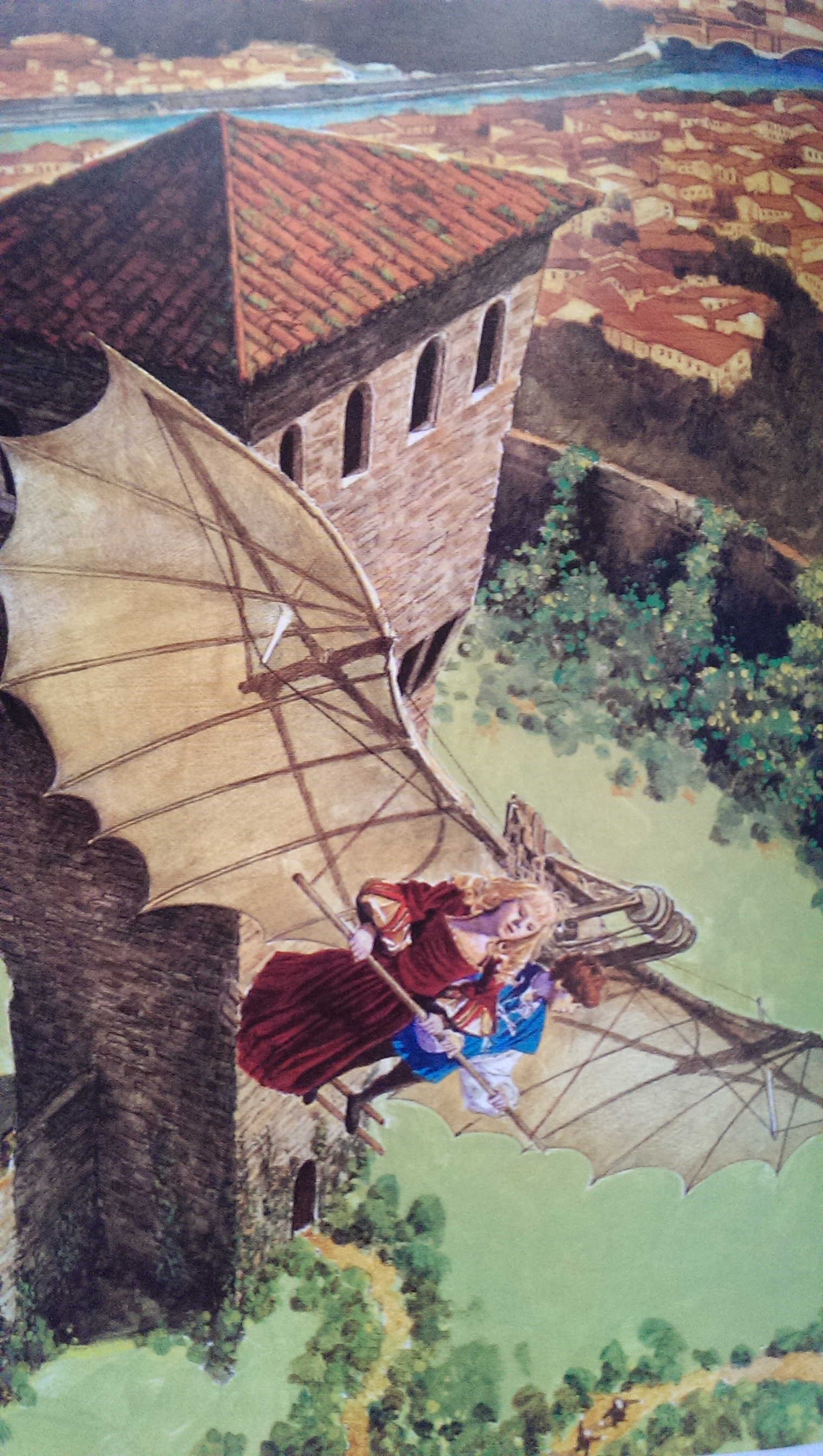
KatMissingNotebooksFlightBesides being a great artist, Leonardo da Vinci is also a scientist, and along with his notes on art, there are sketches and plans for possible inventions in the notebooks. Kat and Pietro go to return the notebooks the next day, but before they can get to Leonardo’s studio, the same thief who tried to steal Signor Millori’s papers steals the notebooks.

Florence has been at war with Pisa for some time, and the Florentine City Council has consulted with Leonardo da Vinci to see if he can come up with some inventions that would give them the upper hand. They know that the thief must be a spy for Pisa who is trying to see what Leonardo has been working on. However, Kat knows that if they do not retrieve the notebooks, history may be changed. Soon, it becomes obvious that the spy has an accomplice who is living in the Millori’s palazzo. Can Kat and Pietro find the notebooks and stop the spies before it is too late?

Although this is a fantasy story that involves time travel, it is based on historical events, and there is a section in the back that explains more about the Italian Renaissance and Leonardo da Vinci.  At the time of the story, Italy was not a united country.  The Italian peninsula was covered with many small city-states which frequently fought each other.  In 1494, Pisa broke away from Florence, and Florence fought for several years to bring it back under their control, until they eventually succeeded in 1509.  This conflict was the basis for the story, and the artist and inventor Leonardo da Vinci was consulted by the Florentine Council during the struggle.

Also in the back of the book is an explanation of mirror writing, which Leonardo da Vinci used in his notebooks.  There are also instructions for making fresco ornaments and a recipe for Nutty Biscotti.