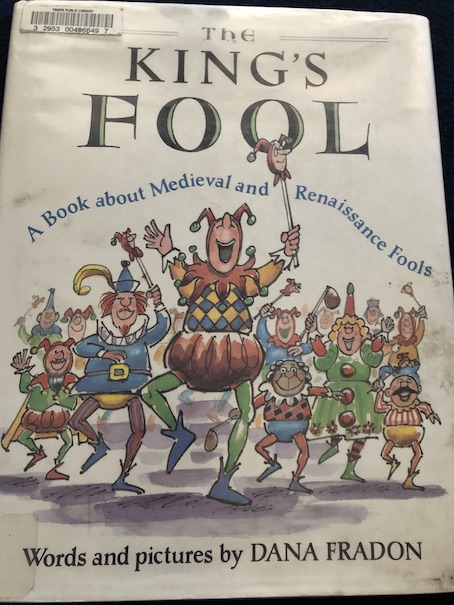
The King’s Fool

The King’s Fool by Dana Fradon, 1993.

I love nonfiction books about unusual and very specific topics! This is a non-fiction book about fools and jesters throughout history. The book begins in a museum, where a class of schoolchildren are being shown a collection of jester statues. One of the statues, Frambert, comes to life and tells the children about his life and the lives other other jesters.

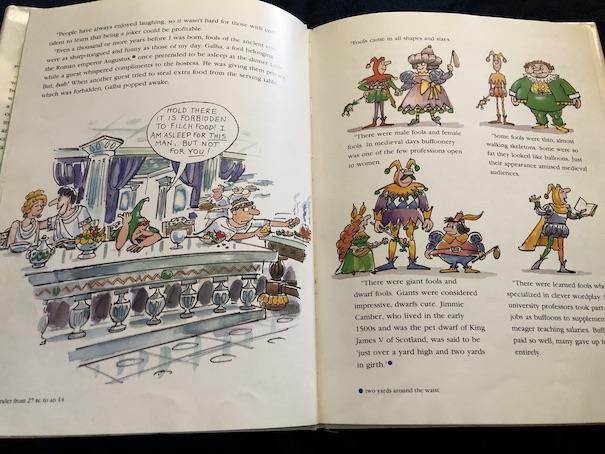
Fools and jesters were the comedians of the past. It was a job for women as well as men. There were different types of professional fools. Some of them were people with unusual appearances, such as dwarfs or people who were unusually tall. Sometimes, university professors took part-time jobs as jesters to supplement their income (teaching has always been a notoriously under-paid profession), using their public speaking skills and knowledge to make intellectual jokes or jokes based on wordplay. Some of them were very successful and made so much money as entertainers that they gave up their teaching jobs. (So, if you’ve discovered that you make more money producing humorous YouTube videos about history than you would as a history teacher or at least find it a useful supplement to your teaching salary, understand that this is just the modern equivalent.)
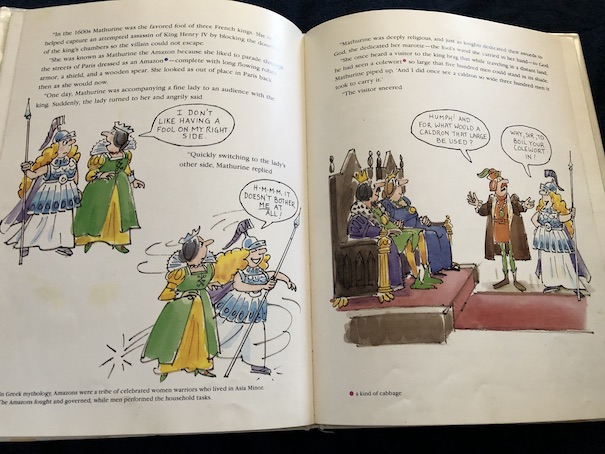
Among the individual jesters described in the book was Mathurine, a French jester from the 1600s. She liked to dress like an Amazonian warrior from Greek legends as part of her act.
Frambert is a fictional jester, but he describes how he became a jester to demonstrate what a jester’s life was like. According to his fictional biography, his talent for mimicry and making jokes was noticed when he was young, and he was selected for training as a professional fool. When he was 19 years old, he officially became a jester. His children also became jesters after him. Because he was well-loved by his king, he was given a generous pension: a village of his own to govern, which sometimes did happen to favorite jesters.

The book is available to borrow and read for free online through Internet Archive.

Hester the Jester

HesterJester

Hester the Jester by Ben Shecter, 1977.

This cute picture book takes place in a Medieval kingdom.  Little Hester’s father is the court jester.  Then, Hester decides that she wants to be a jester, too.  At first, Hester’s parents tell her that she can’t because she’s a girl.  (If you’re thinking that you know where this story is headed, wait.)

One day, the king is so sad that Hester’s father can’t cheer him up, no matter what he does.  When Hester starts putting on her jester act for her father and makes him happy, he decides to go ahead and have her perform for the king.  Hester does cheer the king up, but that isn’t the end of the story.

Hester tells the king that she has discovered that she doesn’t like being a jester after all because it makes her feel too silly.  So, the king, now in a much better mood, asks her what she would like to do instead.

This starts a sequence where the king allows Hester to try out various roles and see if she likes them.  She tells him that she wants to be a knight because knights are important, but she ends up not liking that when she learns that knights have to go into battle.  Then, Hester decides that being a king is even more important, so the king decides to let her try it.  But, Hester isn’t good at giving other people wise advice, as the king does.

HesterJesterKnight

In the end, when Hester’s mother is sad and doesn’t know what to do now that her daughter has become a king, Hester decides that what she most wants to do is to go home and be her little girl again.

In a way, this book seems like two little stories in one.  First, there’s Hester proving that she can be a jester even though she’s a girl, and then, there’s Hester trying to decide what she really wants to be the most, now that the king is letting her try anything she wants.  What she decides that she wants most is to be herself and go home.

So, is this little book anti-feminist, saying that girls are better off just forgetting about the other stuff they might want and staying girls?  I don’t think so.  Basically, this is just a silly little story about a little girl, one too young to have a profession of any kind, who is allowed to see the realities behind some of the things she’s been wanting to try.  Some parts, she likes, and some she doesn’t.  But, she’s too young and inexperienced for all of them (and some, she will never want to try again because she’s learned that they’re not what she really wants after all), so she’s just going to be what she is: a little girl with plenty of time to grow up, who needs her mother and whose mother needs her.  All throughout the book, Hester speaks her mind about what she wants and is honest about the things she doesn’t like, admitting when she changes her mind.  As for what might happen when Hester grows up and finds something else she might want to do . . . who knows?  By then, she may be willing to try new things again.  But, she knows what she wants for now and has a little better idea of some things that she won’t want in the future.
The book is currently available online through Internet Archive.