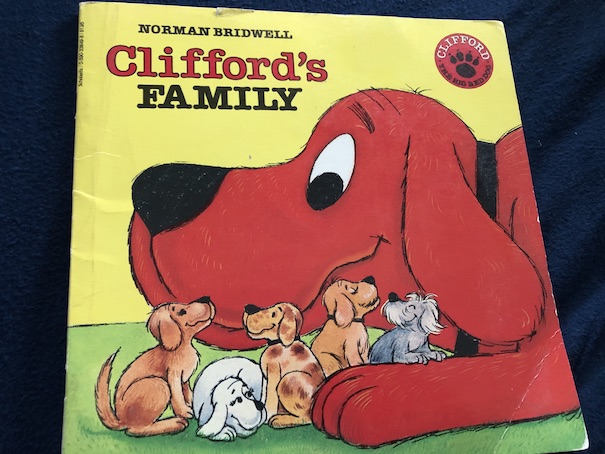
Emily Elizabeth and her enormous dog, Clifford, were both born in a big city, although they live in a smaller town now. They decide to go back to the city and visit Clifford’s mother, who is still there.
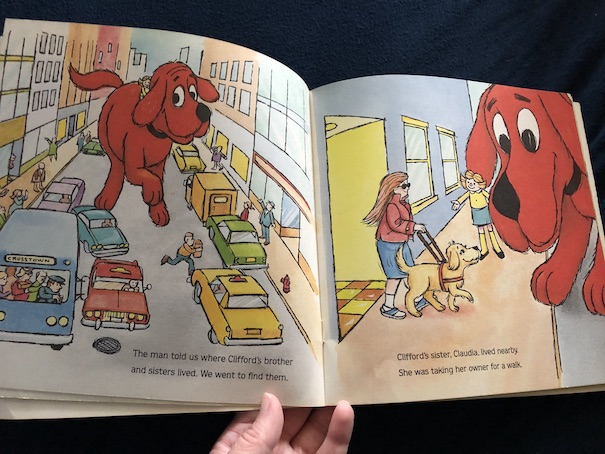
Clifford’s brothers and sisters all live with different people now, so they decide to visit them, too. Clifford’s sister, Claudia, has become a seeing-eye dog.
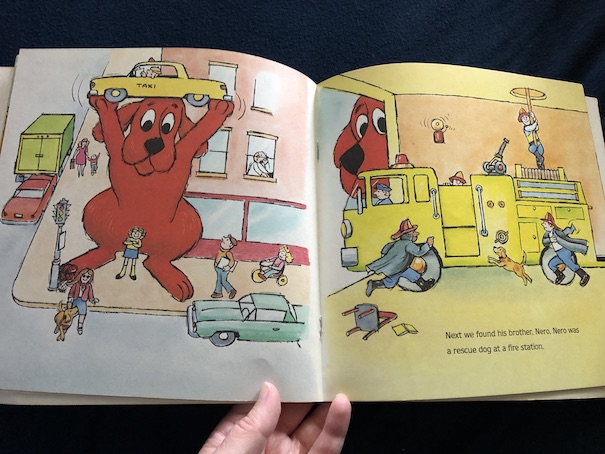
His brother, Nero, is now a fire rescue dog.
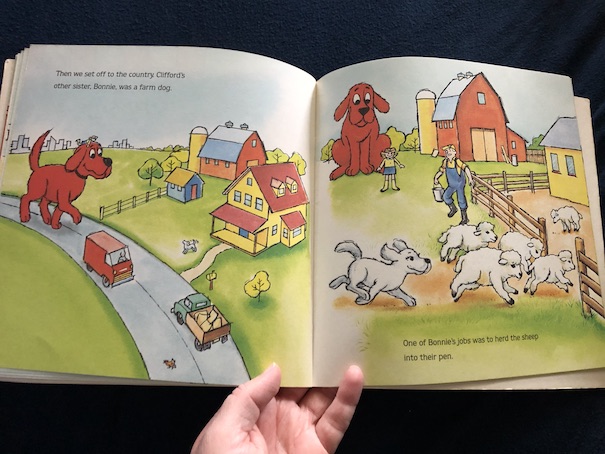
Clifford’s other sister, Bonnie, lives on a farm and herds sheep.
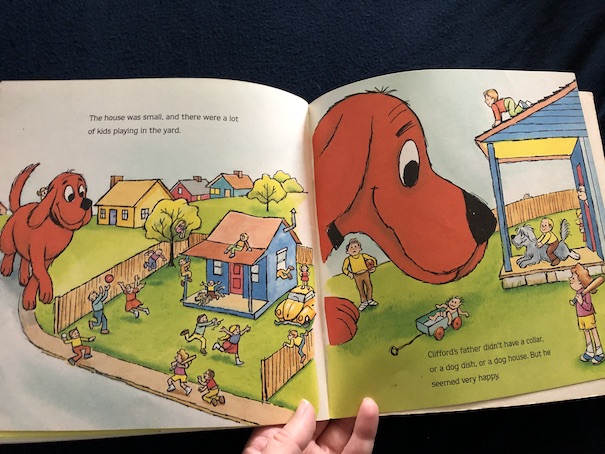
Clifford’s father doesn’t live with his mother. He lives in a house in another town with a lot of children, and he loves playing with them.
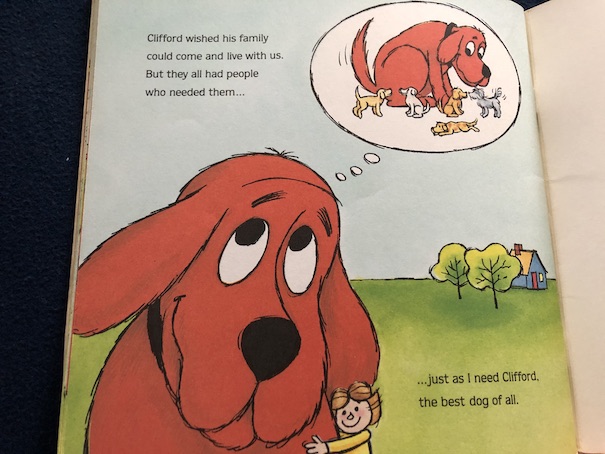
Clifford wishes that his family could live together, but he understands that every member of his family has other people who also need them.
I thought that this book did a good job of pointing out some of the jobs that dogs do, like seeing-eye dog, rescue dog, and herding dog. Clifford and his parents are all companions animals, like most pet dogs, but his siblings all have specific jobs to do for their owners.
The book is available to borrow for free online through Internet Archive.
Jeffrey lives with his widowed mother in a Medieval village (not a realistic one, this is a fairy tale type story), where his mother supports the both of them by selling her knitting. However, when his mother breaks both of her arms after falling off of a cart, eleven-year-old Jeffrey must find a job and earn some money. As a young boy from a poor family, there aren’t many options for him at first, and he doesn’t try very hard for the ones that are available because what he really wants to do is to be a knight. As a boy from a non-noble family, it isn’t likely that he’d ever actually become a knight, but it’s all that Jeffrey has ever dreamed of.
One
day, after Jeffrey has failed to get the jobs that were available in a nearby
town of Axington, he is walking home, sad and worried about what his mother
will say, he meets a knight. In fact, it’s
not just any knight but a famous one, Sir Walter! Jeffrey is thrilled to meet him. Sir Walter asks Jeffrey for directions and
invites him to join him for supper.
The two
of them discuss what it’s like to be a knight.
Sir Walter tells Jeffrey that it’s not all as glamorous as people think
it is. Some parts are very difficult,
and he has to travel a lot on his various assignments, keeping him away from
his family for extended periods. Unlike
real, historical knights, who would work for a lord, Sir Walter works for an
agency in Axington called Free Lance Rescue Services Limited, which gives him
his assignments. They send knights like
Sir Walter to rescue damsels in distress or deal with dragons or ogres. Although it’s not easy work, Jeffrey likes
the sound of it!
When Jeffrey returns home and his mother finds out that he didn’t get a job, she is upset. Jeffrey tells her about his meeting with Sir Walter, and she points out that, even though it’s exciting, he really needs to focus on finding work because they’re running out of money. Seeing his mother so upset, Jeffrey lies to make her feel better, telling her that Sir Walter has recommended him for a job with his rescue agency. His mother is doubtful at first, knowing that knights are usually from noble families and that her small son hasn’t had any training or shown any fighting ability. Jeffrey reassures her that he’ll probably just be helping in the office until he gets more training. To Jeffrey’s shame, his mother believes him and is proud of the job that he doesn’t have.
The
next day, after his mother sends him off to his first day on his new “job,”
Jeffrey decides that the only thing to do is to go to the agency in Axington
and try to find out if he can get a job there, or failing that, anywhere he can
in order to make things right with his mother.
When he gets to Axington, he is hungry, so he asks at a food stand in
the marketplace if he can help out for a while in exchange for some food. He spends the morning peeling potatoes in
exchange for lunch. However, although it’s
boring work, Jeffrey does get a good meal out of it, and he catches the eye of
a leatherworker, who compliments him for working hard. Jeffrey confides in the leatherworker that he’s
really hoping to get a job at the rescue agency, and the leatherworker tells
him that his fiancé is the secretary there.
He gives Jeffrey a message to take to the secretary, and Jeffrey sees it
as his opportunity to ask for a job.
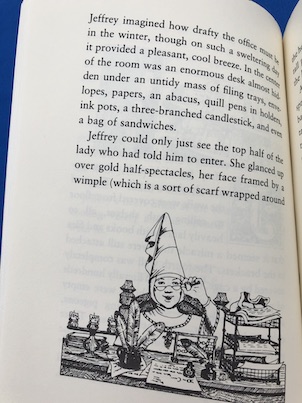
When Jeffrey delivers the message to the secretary (which is an invitation to join her fiancé for lunch), the secretary tells him that the rescue agency has no job openings at the moment, but that she’ll pay him a penny to watch the office and her mother’s rambunctious dog, Lancelot, while she’s at lunch. It’s not much, but a penny is enough to buy his mother a nice dinner, so Jeffrey takes the job. The secretary tells him a little about how the office works, but she doesn’t expect anything to happen while she’s at lunch because nothing ever does.
However,
while the secretary is away, a message comes in that Sir Walter is in
trouble! Sir Walter is in the cave of an
evil ogre and needs help at once! Jeffrey
tries to find the secretary to tell her and ask what to do. When he can’t figure out where she went to
lunch, Jeffrey decides that there’s no time to waste and that he must rescue
Sir Walter himself!
Although Jeffrey is eager to help Sir Walter, he does worry about the lies that he has told his mother about his new “job”, the fact that he isn’t really qualified for what he’s doing and doesn’t even have permission to be doing it, that the ogre might well end up eating him as well as Sir Walter, and that he left a mess in the office when he ran off on his rescue mission and is currently in possession of a dog that doesn’t belong to him. The book is a fun adventure story, but it makes some good points about truthfulness and responsibility as well.
Although Jeffrey really only brought the dog along because he had nowhere else to leave him, it is really Lancelot who defeats the ogre, partly by accident. At first, Jeffrey is tempted to claim the victory for himself, but he decides to be honest and admits the truth about the ogre’s defeat to Sir Walter. Still, Sir Walter is grateful and offers to sponsor Jeffrey for knight school and give him a part-time job polishing his armor. Jeffrey accepts, and he also gets to keep Lancelot, who needed a new home anyway, although his mother says that he will have to be responsible for the dog and its training.
The book is available to borrow and read for free online through Internet Archive.
This cute picture book takes place in a Medieval kingdom. Little Hester’s father is the court jester. Then, Hester decides that she wants to be a jester, too. At first, Hester’s parents tell her that she can’t because she’s a girl. (If you’re thinking that you know where this story is headed, wait.)
One day, the king is so sad that Hester’s father can’t cheer him up, no matter what he does. When Hester starts putting on her jester act for her father and makes him happy, he decides to go ahead and have her perform for the king. Hester does cheer the king up, but that isn’t the end of the story.
Hester tells the king that she has discovered that she doesn’t like being a jester after all because it makes her feel too silly. So, the king, now in a much better mood, asks her what she would like to do instead.
This starts a sequence where the king allows Hester to try out various roles and see if she likes them. She tells him that she wants to be a knight because knights are important, but she ends up not liking that when she learns that knights have to go into battle. Then, Hester decides that being a king is even more important, so the king decides to let her try it. But, Hester isn’t good at giving other people wise advice, as the king does.
In the end, when Hester’s mother is sad and doesn’t know what to do now that her daughter has become a king, Hester decides that what she most wants to do is to go home and be her little girl again.
In a way, this book seems like two little stories in one. First, there’s Hester proving that she can be a jester even though she’s a girl, and then, there’s Hester trying to decide what she really wants to be the most, now that the king is letting her try anything she wants. What she decides that she wants most is to be herself and go home.
So, is this little book anti-feminist, saying that girls are better off just forgetting about the other stuff they might want and staying girls? I don’t think so. Basically, this is just a silly little story about a little girl, one too young to have a profession of any kind, who is allowed to see the realities behind some of the things she’s been wanting to try. Some parts, she likes, and some she doesn’t. But, she’s too young and inexperienced for all of them (and some, she will never want to try again because she’s learned that they’re not what she really wants after all), so she’s just going to be what she is: a little girl with plenty of time to grow up, who needs her mother and whose mother needs her. All throughout the book, Hester speaks her mind about what she wants and is honest about the things she doesn’t like, admitting when she changes her mind. As for what might happen when Hester grows up and finds something else she might want to do . . . who knows? By then, she may be willing to try new things again. But, she knows what she wants for now and has a little better idea of some things that she won’t want in the future.
The book is currently available online through Internet Archive.





 Jestress's Forgotten Books and Stories