Abraham Lincoln Joke Book

The Abraham Lincoln Joke Book by Beatrice Schenk de Regniers, 1965.

I love joke books on oddly specific topics! This one is a little bittersweet because it was published 100 years after Abraham Lincoln’s death, but the book isn’t about that. Instead, it’s a fun celebration of some funny stories about Lincoln and some of his favorite jokes.

The jokes are mostly in story form, and many of them are stories about incidents from Lincoln’s own life. Some of them are stories about his youth, like the time he helped a classmate secretly during a spelling bee and the time he played a prank on his stepmother by holding some younger boys upside down so they could walk across the ceiling of the house, leaving muddy footprints.

Not all of the stories in the book are true tales about Lincoln. The book admits that some of them are “tall tales” that other people told about him. Many of them were jokes that people told about Lincoln’s height because that was one of the first things that people noticed about him. It was all the more notable when he was standing next to his wife because he was especially tall and she was especially short.

The end of the book discusses how Lincoln would often use jokes and stories to make a point in a conversation or soften the blow of criticism. As President, he liked to read joke books or humorous stories to cheer himself up during stressful times. He is quoted as saying, “I laugh because I must not cry.” The book ends with a timeline of events in Lincoln’s life.

The book is available to borrow and read for free online through Internet Archive (multiple copies).

101 Valentine Jokes

101 Valentine Jokes by Pat Brigandi, illustrated by Don Orehek, 1994.

This is one of those little themed joke books that I used to pick up at school book fairs and used book sales when I was a kid. Most of the jokes are really corny, but I remember finding them fun when I was a kid. Happy Valentine’s Day!

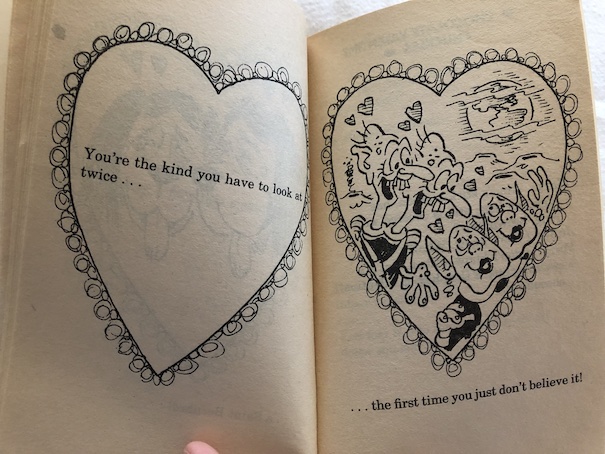
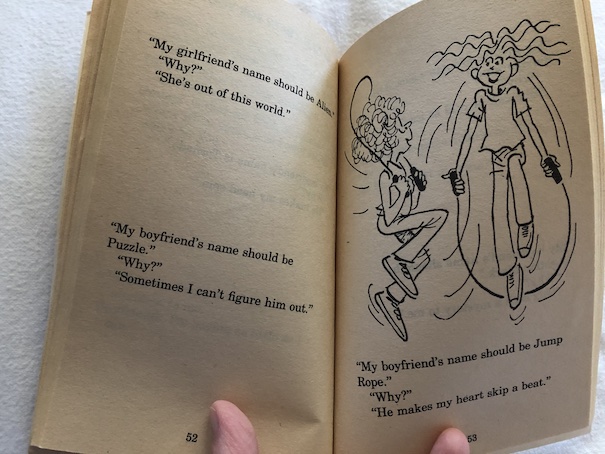
One of the things that surprised me about this book is that some of the jokes are weirdly insulting for a Valentine-themed book. It just struck me as odd that there were jokes with people basically insulting their boyfriends or girlfriends or sending insulting Valentines.

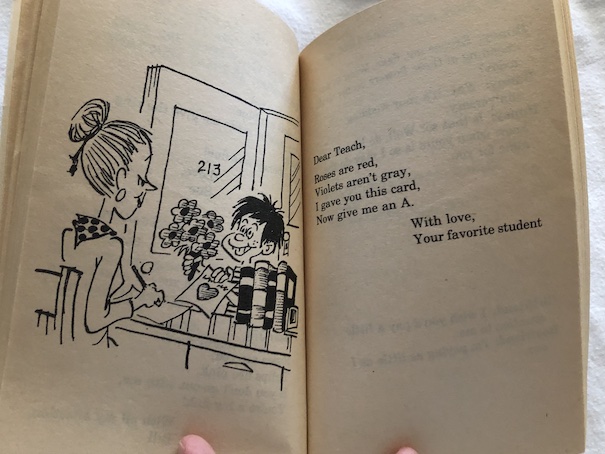
Actually, as I kid, I think I understood the point of the insulting joke Valentine cards because, when you’re a kid in school, there are rules that require you to give a Valentine to every person in class, whether you like them or get along with them or not, so nobody feels left out. Those rules make sense because teachers don’t want to create a situation a situation where somebody in class is being deliberately ignored by other students or the kids are playing one-upmanship about who is more popular than who. But at the same time, when someone else in class has been picking on you all year, that’s the last person you want to give a Valentine. You can’t really give people nasty Valentines like this (at least, not without getting into trouble), but there are times when it can be fun to imagine that you could so you can tell off some jerk who desperately needs it.

But, when it comes to people insulting their boyfriends or girlfriends, I’m just thinking, “If you feel that way about this person, why are you going out with them? Go find someone else!”

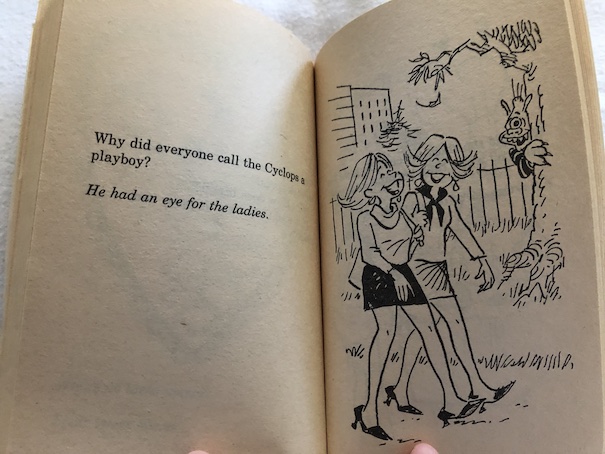
Fortunately, not all the jokes in this book are mean. It would have been depressing if all of them were negative in some way. There are the usual knock-knock jokes, jokes based on puns, and a few jokes that are told in story form or silly conversations.

There is one long joke that’s a form letter for “thanking” someone for a present. (Hint: It’s implied that the present wasn’t that great and the person isn’t thankful for it. It reminded me of one of the joke poems in The D- Minus Poems of Jeremy Bloom, and I think the poem was better.)

Overall, I think the best jokes were the kind that I think I kids really could use in class Valentines without getting in trouble. Because of all the insulting ones, though, I felt like there weren’t enough of this kind of joke.

What did the chewing gum say to the show?
I’m stuck on you.

This book does have the classic:

Will you remember me tomorrow?
Of course I will.
Will you remember me next week?
Of course I will.
Will you remember me next month?
Of course I will.
Will you remember me next year?
Of course I will.
Knock, knock.
Who’s there?
See, you forgot me already!

The book is available to borrow and read for free online through Internet Archive.

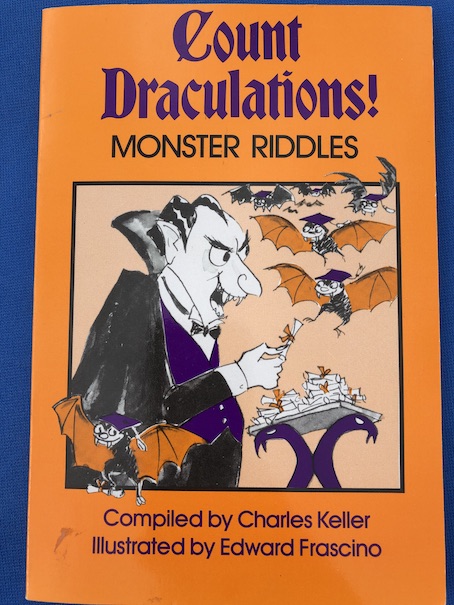
Count Draculations!: Monster Riddles

Count Draculations!: Monster Riddles compiled by Charles Keller, 1986.

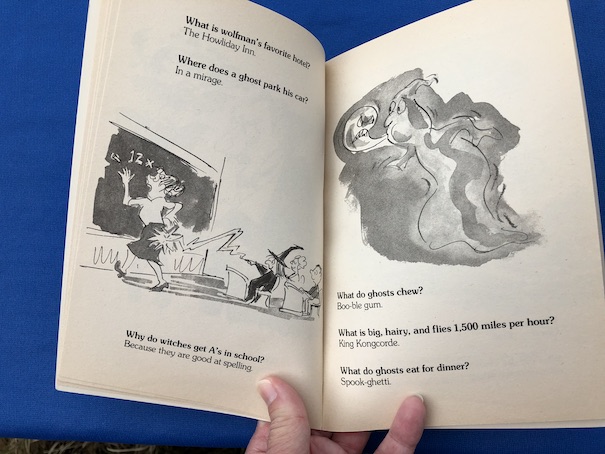
This is one of those themed joke books for kids that has monster and Halloween-themed jokes.  The jokes are the basic kid-friendly question-and-response type with lots of puns.  There are also some cute black-and-white illustrations.

Some of my favorite jokes:

Why do witches get A’s in school?

Because they are good at spelling.

How do you get into a locked cemetery?

With a skeleton key.

Why did Frankenstein’s monster go to the psychiatrist?

He thought he had a screw loose.

Why did the invisible man go crazy?

Out of sight, out of mind.

The Spookster’s Handbook

The Spookster’s Handbook by Peter Eldin, 1989.

This is a fun book of jokes and tricks for Halloween or just having some spooky fun with friends, possibly at a sleepover. The book is divided into the following sections:

Making Monsters – How to make costume pieces and turn yourself into a bug-eyed monster, a warty witch, and more! There are also tricks, like making a ghost image appear on a wall, casting a glowing face on someone else’s shadow, and making Bigfoot footprints.

Screamingly Funny – A chapter of ghost jokes.

Ghostly Tricks – Magic tricks that look somewhat ghostly, like making a friend “float” in the air and making magical symbols appear on blank cardboard.

Monster Pranks & Practical Jokes – Tricks that produce ghostly illusions, like how to take ghostly pictures, produce taps with no obvious source, and cause ghostly flashes of light in a dark room.

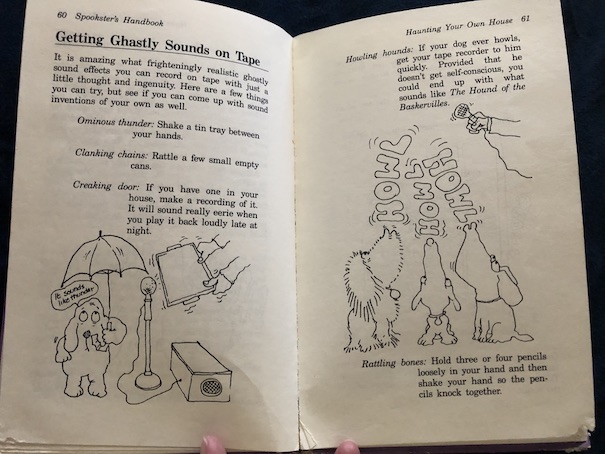
Haunting Your Own House – Describes typical do-it-yourself haunted house tricks for producing scary noises.

Monster Laughs – A chapter of monster jokes.

Scare Your Friends – Tricks and pranks for spooking your friends with a finger in a box, strange noises, or a glowing skull.

Terrible Trivia – Fun facts about superstitions and telling the future.

Fang-Tastic! – A chapter of jokes about vampires.

My favorite parts of the book are the superstitions and the ways to make scary haunted house noises. I haven’t actually tried the noise tricks yet, but at some point, I’m planning to try a few!

The book is available to borrow and read for free online through Internet Archive.

Disappearing Acts

Herculeah Jones

Disappearing Acts by Betsy Byars, 1998.

Herculeah’s friend, Meat, decides to take a comedy class at a local comedy club called Funny Bonz.  While he’s at the club for his class, he finds a dead body in the men’s restroom.  He quickly runs to get help, but when the club’s owner (who is also the teacher of the class), Mike Howard, goes to check, the body is gone.  It happens to be April 1st, so everyone assumes that it was just an April Fool’s Day prank.  However, Meat is sure that what he saw was a real dead body.

He tells Herculeah what happened, and he also remembers that he has proof of what he saw: a blue wallet that he picked from the floor near the body.  The ID in the wallet says is for a woman named Marcie Mullet.  Meat never got a clear look at the identity of the body because it was lying face down, but he remembers that it had a ponytail, so they assume that it was Marcie.  Marcie was supposed to be a student in the class, too, but she never showed up.  Meat and Herculeah assume that the body must have been Marcie.

However, Herculeah is somewhat preoccupied by something else.  She’s been getting strange vibes from a camera that she bought at a secondhand shop.  The camera was cheap, only a dollar, and there’s still a partially-exposed roll of film inside.  The camera was a great deal, but Herculeah’s hair is frizzling, and she senses danger approaching.

When she develops the film left in the camera, she realizes that the camera had once belonged to Meat’s mother, and the pictures show Meat’s father.  Meat has very little memory of his father because his parents separated when he was very young, and his mother has refused to talk about him for years.  Herculeah knows that Meat badly wants more information about his father, but she hesitates to show him the pictures because she doesn’t think that he’ll like what he sees.  He’s imagined that his father could have all kinds of cool professions, and she doesn’t know how he’ll react to his real one.

Self-perception is also very important to the solution to the murder.  Meat is the first to learn the killer’s true identity and is able to get the killer to confess and confide in him.  The killer was tired of the victim’s mean-spirited jokes, all of which were about the killer, who is fat.  The murder was unintended; the person just snapped when the victim gloated about using the mean-spirited comedy routine to become famous.  Meat understands how the killer feels because he hasn’t had a very good perception of himself and knows what it’s like to be fat.  There is a series of fat jokes in this part of the book, the meanest of which (the killer quoting the victim) are about a fat woman’s bra size.

When his father’s true identity is revealed, Meat is actually glad, which surprises Herculeah.  Meat’s father is very different from what he had imagined, but oddly, finding out that his father is a professional wrestler gives Meat something new to aim for.  Meat is sometimes self-conscious of his large size, but seeing his father makes him realize that he can change his fat to muscle and be really impressive.  The two of them meet, and Meat’s father apologizes for leaving so suddenly when Meat was young.  He explains that, much like his own father, he has trouble living anywhere for very long.  His own father had similarly abandoned his family when he was young.  Both of them just reached a point when they had an irresistible urge to pick up and move on.  However, Meat’s father makes it clear that he really does love him and is proud of him and says that he will continue to see him.  It’s a strange explanation, but Meat accepts it and forgives his father.

This book is available to borrow for free online through Internet Archive.