
In Darkness, Death

InDarknessDeath

In Darkness, Death by Dorothy and Thomas Hoobler, 2004.

This book is part of The Samurai Detective Series.

One night, after a party, Lord Inaba is killed in his room by a mysterious intruder. The only clue to the intruder’s identity is a red origami butterfly left at the scene. Lord Inaba’s death is an embarrassment to the shogun because Lord Inaba was in Edo under his protection.

It doesn’t take Judge Ooka long to decide that the murderer was a ninja. Ninjas are hired assassins known for their stealth and great skill with weapons. The butterfly left at the scene was to purify the spirit of the dead man and keep it from coming after his killer.

However, Judge Ooka says that it is not enough to know that that the murderer was a ninja; what they have to find out is who hired the ninja. He assigns Seikei the task of finding the source of the butterfly and learning who Lord Inaba’s enemies were. Judge Ooka finds a ninja he knows, Tatsuno, and convinces him to accompany Seikei on a journey through Lord Inaba’s territory and to teach him what ninjas are like. Although Seikei is not sure that he trusts Tatsuno, he learns to be grateful to him for his help and for saving him from the real danger, which comes from a surprising source.

While many children’s movies glorify the ninja, in real life, they were mercenaries, assassins for hire.  They used clever tricks in order to gain access to their victims and to get away without being caught, which ended up giving rise to a number of legends about them, attributing an almost supernatural quality to their skills.  While searching for the assassin and the person who hired him, Seikei learns a number of the tricks that ninjas used and the security measures that people would take to try to guard against them, such as nightingale floors (here is a video of a nightingale floor in a Japanese castle and another where you can hear the floor even better).

The book is currently available online through Internet Archive.
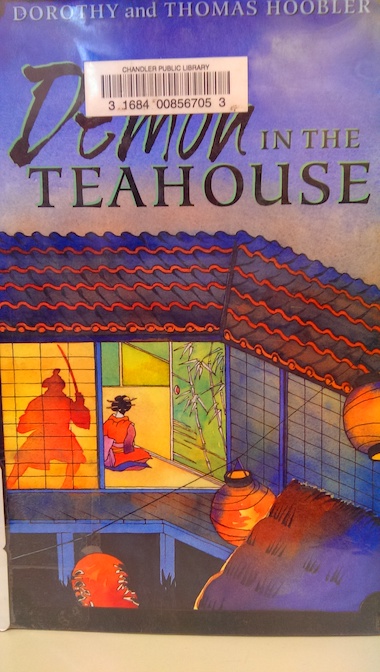
The Demon in the Teahouse

DemonTeahouse

The Demon in the Teahouse by Dorothy and Thomas Hoobler, 2001.

This is the second book in the Samurai Detective series.  Like other books in this series, it is not a book for young children!

Seikei is trying hard to learn all the things he must know as a samurai and Judge Ooka’s adopted son. One evening, while the judge is in Edo (now called Tokyo), he sends a message that Seikei and the other samurai must come immediately. Edo is in a state of emergency because of a series of fires that have been deliberately set in shops around the city. Although Judge Ooka helped to design a system of watch towers and fire brigades to help the city in case of fire, the threat of fire is still very serious because most of the buildings in Edo are made of wood.

The only clue they have to the person setting the fires is a geisha who was in one of the shops before it burned. Judge Ooka and Seikei go to the city’s pleasure district, Yoshiwara, where there are theaters and teahouses where geishas provide entertainment. While they are there, they learn that geishas have been dying under mysterious circumstances, and the people of Yoshiwara are afraid.

Judge Ooka has Seikei take a job as a servant at a teahouse in order to learn more. He soon discovers that the dead girls were all friends of Umae, one of the most popular geishas. Then, one of Umae’s many admirers brings her a present, and she is horrified to discover that it is the kimono that one of the dead girls was wearing. Who brought her the kimono, and what connection does she have to the fires?

The nature of the villain and the villain’s motives is rather dark for a middle school level book (although some middle school level books do get fairly dark).  Although the reading level of the book would be fine for someone aged twelve to fourteen, the subject matter might make the story more appropriate for someone a little older.  I recommend parental discretion on this one.  (Remember, it takes place in the “pleasure district” of Edo.)  It’s an exciting story, and it contains an interesting picture of feudal Japan, but it’s definitely not for young children!

The part about Judge Ooka organizing watch towers and fire brigades is something that the real, historical Judge Ooka actually did.

The book is currently available online through Internet Archive.
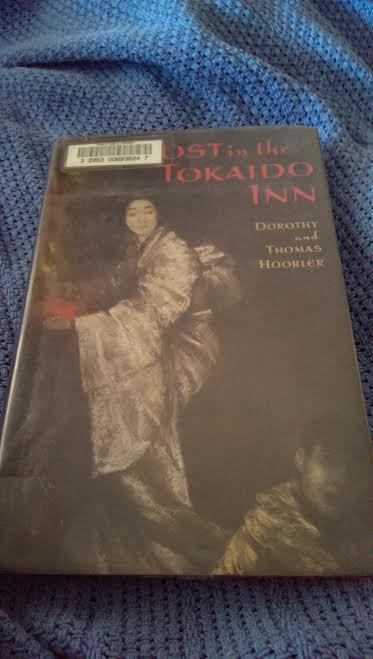
The Ghost in the Tokaido Inn

ghosttokaidoinnThe Ghost in the Tokaido Inn by Dorothy and Thomas Hoobler, 1999.

In feudal Japan, more specifically in 1735, the family you were born into determined what you were meant to be in life.  Samurai were born into families of samurai, and merchants were born into merchant families.

This is a terrible disappointment to Seikei, the fourteen-year-old son of a tea merchant, who would love nothing more than to be able to become a samurai.  He has studied the samurais and their ideals and greatly admires their bravery.  He even loves to write poetry, as the samurais do.

One day, Seikei accompanies his father on a business trip from their home in Osaka to Edo (the old name for Tokyo).  On their way, they stay overnight at an inn.  There, Seikei makes friends with the daughter of a paper merchant, and she entertains him with a ghost story.  During the night, Seikei sees a strange figure that attempts to enter his room, which he fears might be an evil spirit (like the one in the ghost story), but he is unable to get a good look at it before it disappears.

The next morning, Lord Hakuseki, a daimyo (lord, nobleman) also staying at the inn, says that a jewel was stolen from him during the night.  The famous Judge Ooka comes to the inn to investigate the crime.  The paper merchant and his daughter are accused of the theft because the jewel is found among their belongings.  Seikei recognizes the jewel as one that Lord Hakuseki showed to both him and the girl the night before when they each went to show him their fathers’ wares, and he also realizes that he saw the “evil spirit” holding it.

When Seikei tells Judge Ooka all of this, his father is angry, saying that Seikei must have imagined the whole thing.  However, Judge Ooka believes him.  He points out that the silent figure was no doubt the thief, who merely looked like an evil spirit to the boy who had just been startled awake, with a ghost story still on his mind.  Judge Ooka is also impressed with Seikei’s bravery when Seikei describes how he got up to try to get a better look at the figure, even though he believed that it was an evil spirit at the time.

Judge Ooka recruits Seikei to help him further investigate the crime, and they realize that the theft is only part of a much larger and more serious plot of revenge.  Judge Ooka, himself of the samurai class, also understands Seikei’s feelings better than his father does.  In the end, he offers Seikei a way of living the kind of life that he’s always dreamed.

This book is the first in a series.  Judge Ooka was a real, historical figure, although Seikei, his adopted son, is fictional.  Because the story contains violence and some religious oppression, I recommend it for middle school level readers.  The book is currently available online through Internet Archive.