Samantha, An American Girl

Samantha’s Cookbook by Polly Athan, Terri Braun, Jodi Evert, and Jeanne Thieme, 1994, 1998.
This cook book is one of the activity books that was written to accompany the Samantha series that is part of the American Girls franchise. The American Girls books were written to help teach American history (as well as sell the accompanying dolls and accessories), so this book has recipes of the type that people would have eaten during the early 1900s, when the character of Samantha lived, and some historical information about cooking and dining during that period.

The first section in the book discusses innovations that made cooking easier in Samantha’s time than it had been in earlier time periods. The kitchen in Samantha’s house had running water, a gas stove, and an icebox for refrigerating food. Because Samantha comes from a wealthy family, who can hire people to cook for them, Samantha’s education focuses more on learning how to be a good hostess, meaning that she would be more likely to be in the dining room, helping to entertain guests, rather than in the kitchen, preparing food. However, Samantha would have been familiar with cookbooks, discussing new recipes and studying sections of cookbooks that offered advice about dining etiquette. There are sections in this book that discuss the role of servants in shopping for and preparing food and the proper way to set a table for an elegant dinner party.

After that, there is a section of cooking tips and kitchen safety tips. The recipes in the book are divided into sections based on meals, followed by a section of Samantha’s favorite recipes. The recipes are also accompanied by historical information.
Breakfast
The book explains that, because Samantha is from a wealthy family, her family’s cook begins making breakfast before Samantha wakes up in the morning, so it will be ready for her as soon as she’s awake and dressed. In her time, breakfast was typically the lightest meal of the day, but wealthy households had a variety of foods at breakfast. Breakfast was typically served with hot drinks. Adults usually had coffee or tea, while children might have hot chocolate.
- Strawberries with cream
- Ham slice
- Cheese omelet
- Saratoga potatoes – These are fried potato chips, which were a relatively new innovation in Samantha’s time. The book explains that potato chips were invented by a Native American cook at a resort in Saratoga Springs, New York in 1853 after a customer complained that the fried potatoes should be thinner.
- Blueberry muffins

Dinner
“Dinner” is usually the biggest meal of the day, but depending on when and where you live, that might be either the midday meal or the evening meal. In the past and in rural areas, “dinner” was often lunch. By Samantha’s time, as it typically is in modern times, it was the evening meal, after a family or individuals are home from work or school and have more time for a large meal. For wealthy families, like Samantha’s family, dinner was a very formal meal. They would often dress up for dinner, and at formal dinner parties, there would be name cards on the table to tell everyone where to sit. At a formal dinner in a household with servants, individual dishes and parts of the meal would be served in “courses”, but the number of courses could vary. Samantha’s family followed the English style, with fives courses at dinner. The book mentions Samantha’s family having soup, salad, appetizers, a main course with roasted meat, and dessert and coffee at the end of the meal. Some larger, fancier dinner parties could have many more, some as many as 18 courses!
- Cream of carrot soup
- Roasted beef tenderloin
- Mashed potatoes
- Fresh green beans
- Corn oysters – These are fried corn patties.
- French salad
- Dressing
- Ice cream snowballs – These are scoops of vanilla ice cream coated in shredded coconut.

Favorite Foods
This section has an assortment of recipes for Samantha’s favorite foods. The book explains that, while Samantha was being trained to be a hostess more than a cook, even wealthy girls like her would taught some basic cooking skills. Sometimes, Samantha would help the family’s cook in the kitchen and make some simple recipes.
- Apple Brown Betty
- Jelly biscuits
- Cream cheese and walnut sandwiches
- Chicken salad sandwiches
- Gingerbread
- Lemon ice
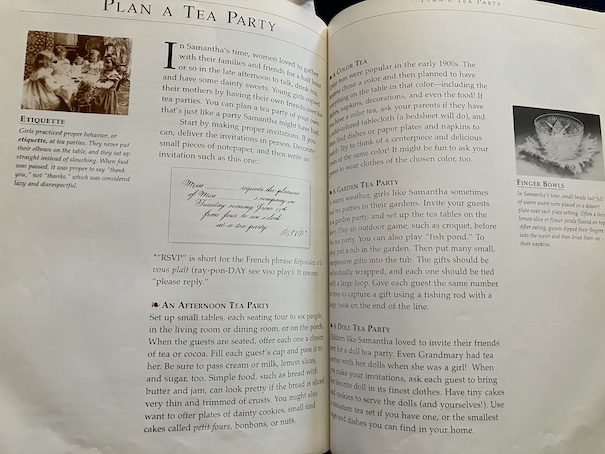
The book ends with a section about how to plan a tea party, like girls in Samantha’s time might have. The suggestions include themed tea parties, like afternoon tea, a color tea (a popular concept in the early 1900s, where everything at the party, from decorations to food, would be themed around a particular color), a garden tea party, and a doll tea party (girls would bring their dolls, and there would even be tiny treats to serve to the dolls).
The book is available to borrow and read for free online through Internet Archive.
 Jestress's Forgotten Books and Stories