
Kids Travel: A Backseat Survival Kit from Klutz Press, 1994.
This was one of the Klutz Press activity books that I had as a kid! I used to take it on the long road trips we would take across the country during the summer. The reason why this book is called a “kit” is that it came with a pouch with some extra equipment that could be used for the activities in the book and a special activity pad on a clipboard in the back. I don’t have my activity pad anymore, but it had pencil and paper games and puzzles, like mazes, connect-the-dots pictures, and grids for a Battleship style game that they called Lost on Earth, where you would attempt to find famous missing people or things instead of finding your opponent’s battleships.
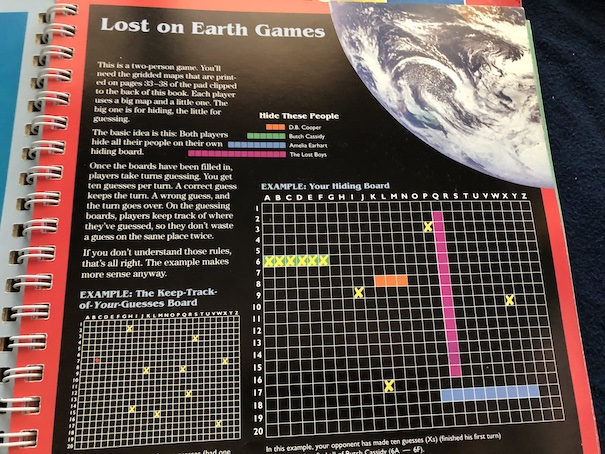
The Lost on Earth games are especially funny when you know the references for who the missing people or what the missing things are, like who Amelia Earhart or D.B. Cooper is/was. When I was a kid, I didn’t know about D.B. Cooper (this YouTube video from Buzzfeed Unsolved explains), but I think one of the missing people on the activity pad grids was Jimmy Hoffa, and I knew that name (Buzzfeed Unsolved also covered that). The great thing about these references is that, if you’re playing this game with a kid who hasn’t heard of some of these people or things, just explaining who or what they are is activity by itself.
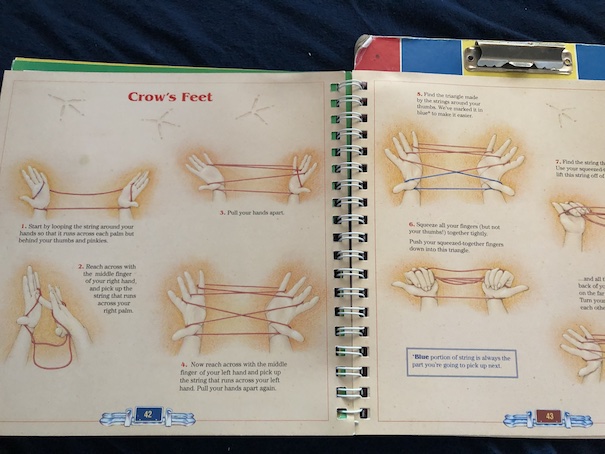
The pouch contained a set of markers for drawing and doing the activities on the activity pad, embroidery thread in different colors for making friendship bracelets and hair wraps, a loop of colorful string for making string figures, a small sheet for the Grown Up Pop Quiz, and some gummy playing pieces and dice for playing Parchesi (a board was included on one of the pages in the book). The gummy pieces would stick to the page, but not so tight that you couldn’t get them off. I think I saw a later edition of this book that used a different style of playing pieces, but I’m not sure now. The gummy pieces do gradually lose their ability to stick over time.


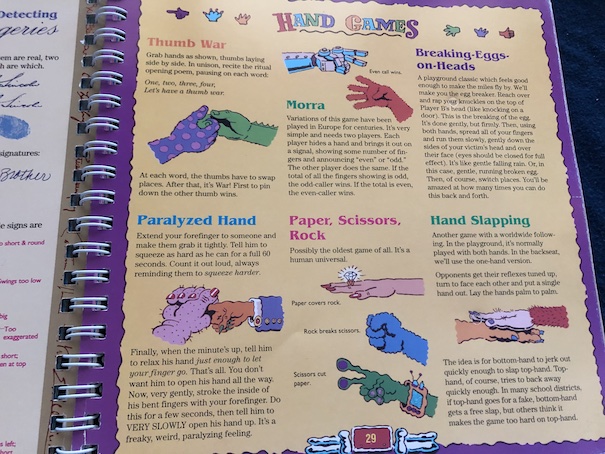
The activities in the book are meant to be done in a car. In the front of the book, there’s a section where you can record which license plates you’ve seen from different states in the US. (A common car activity on US road trips because there are 50 states, and they all have different styles of license plates. In theory, you could see examples of plates from all 50 states in a single, long car trip, but I never did. I’ve seen most of the states during a single trip, but I’ve never been table to check off all of them during a single trip.) There are also rules for playing many classic car games, mostly games that involve talking or hand motions or can be played on paper, like Twenty Questions, Paper, Rock, Scissors, and Hangman. It also describes popular car trip rituals, like holding your breath while passing a graveyard, lifting your feet while going over a bridge, or ducking your head while going under a bridge.


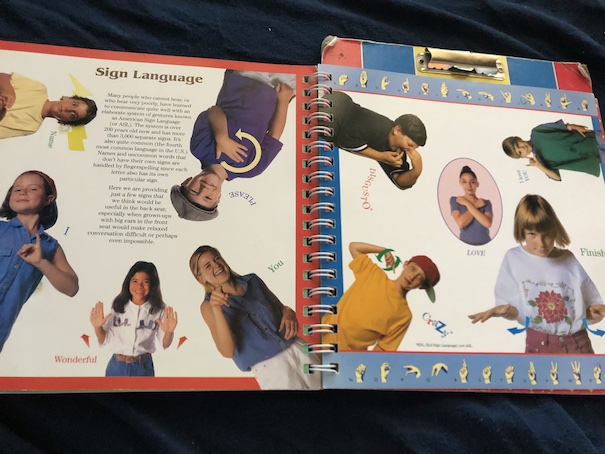
However, even though most of the activities are meant for car trips, many of them would be good for airplane trips as well. When I was a kid, airplanes were quieter, and it was much easier to talk to the person in the seat next to yours than it is now, so the talking games are still better for car trips. However, making friendship bracelets are ok for planes and trains as well as in a car. There are also activities for folding a dollar bill and making a paper fortune teller, making string figures, drawing superheroes, writing things in secret codes, reading palms, and learning some basic sign language.


What I’ve always liked best about this book is the variety of activities. There’s something for everyone in this book, and I’m still amused by some of the games and activities. If there’s an activity that the reader doesn’t like or that won’t work for the current location, there are plenty of others to move on to. Many of the activities in the book are either mentioned in other Klutz books or have entire Klutz books dedicated to them. Also, every part of this book is meant to be used for something. There is a finger maze around the title and copyright page, and when you remove the activity pad in the back, there is a board behind it to use for a game called Penny Hoops, which involves flicking pennies onto target areas on the board to earn points.

Sadly, I don’t think this book and activity kit are being sold new anymore, although there are some copies being sold used (I think most of the used books don’t come with the extra items in the original kit), and the book is available to borrow and read for free online through Internet Archive.



















 Jestress's Forgotten Books and Stories