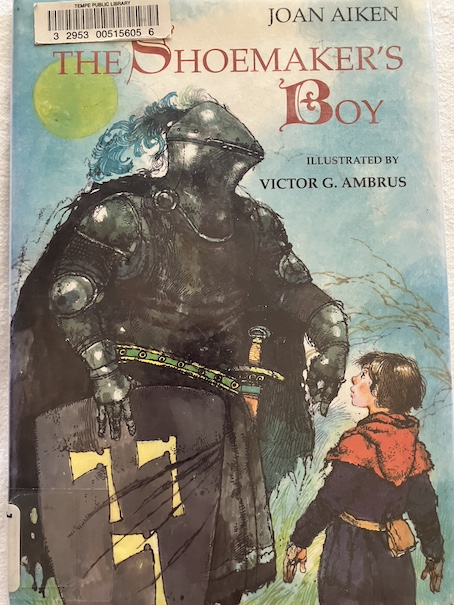
The Shoemaker’s Boy

Jem’s father is a shoemaker, and Jem is learning his trade. However, things take a bad turn when his mother suddenly becomes ill. It’s a strange kind of illness. She sleeps all the time, can’t eat, and is hardly breathing. The doctors can’t seem to help her, so Jem’s father decides to go on a pilgrimmage to St. James in Spain and pray for his wife to get better.

While he’s gone, Jem has to mind the family business and look after his mother. Jem’s father has a reputation as a incredible shoemaker, with people coming to see him even from other kingdoms, and Jem is worried that he won’t be able to maintain the business on his own because he’s still learning the trade. However, since nothing else seems to help his mother, it seems like his father’s holy pilgrimage is their last hope.

While his father is away, Jem tries his best, but he finds it difficult to keep up with the orders that come in for shoes. He falls behind on his work, and money is running short. Then, one day, he has a strange encounter with three little men, who are only the size of young children. They are all dressed in green, and they ask Jem for the three silver keys. Jem doesn’t know what they’re talking about, but the men say that they were sent to ask him for them because someone was supposed to leave the keys with him. Jem says that nobody has left any keys with him, and suddenly, the little men vanish! At first, Jem thinks that maybe he imagined the whole thing, but this is just the beginning of a series of strange happenings.

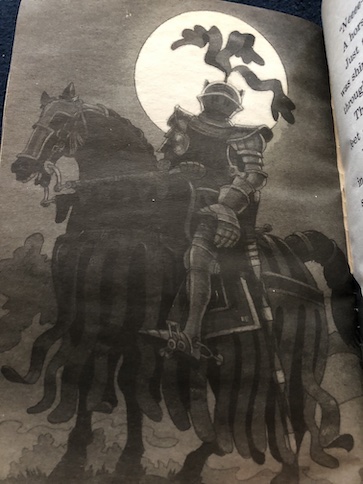
Late that night, there is a knock on the door, and when Jem answers it, he is confronted by a knight wearing black. The knight says that he wants Jem to make him a pair of boots because he’s heard that the boots from this shop are the best. Jem doesn’t want the knight to be disappointed, so he explains to him about his father being away and that he is not as good as his father at making boots. The knight appreciates his honesty and says that he will try Jem’s work anyway. He promises Jem an excellent fee for his services if the boots are ready by morning, and to Jem’s surprise, he also asks Jem if someone has left three silver keys for him. Jem tells him that nobody has left any keys with him, and the knight says that someone may leave them by the time the boots are ready, and he asks Jem to take good care of them.

Jem works on the boots through the night, and he’s making good progress when, in the middle of the night, a second knight arrives. The second knight is dressed in white. This knight doesn’t want any boots or shoes. Instead, he asks Jem to take care of a little packet for him while he runs an errand. He says that he has heard that Jem is very trustworthy, and he says that if he doesn’t return by morning, Jem can keep the packet. Jem agrees that he will take care of the packet and make sure no one else touches it.

The rest of the night is very strange. While Jem works hard on finishing the last boot, he hears strange sounds outside, and he thinks that he can hear the little men and the black knight calling out for the mysterious keys. What does it all mean? Are the keys in the packet left by the white knight, and if so, what are they for?

The book is available to borrow and read for free online through Internet Archive (multiple copies).

This is a short, easy beginning chapter book, and it’s a nice story with a Medieval setting, written in the style of an old fairy tale. The story leaves a few questions unanswered at the end. We never really find out who the two knights are or who the little men are, although there are implications that they are supernatural. I think that they also have religious significance, tying them to Jem’s father’s pilgrimage. The contents of the white knight’s packet are not obvious, but it is the solution to Jem’s main problem. When Jem’s father returns home, he also has some information about Jem’s mysterious visitors, although he doesn’t have all the answers, either. Readers know enough at the end to appreciate that Jem made the right decision when he handled the packet and that his experiences were partly a test of his character.

The book mentions Jem’s father putting a scallop shell on his cap when he’s about to begin his pilgrimage. The scallop shell is a symbol of St. James, one of the original Twelve Apostles. The place where Jem’s father was going on his pilgrimage, the shrine of St. James at Santiago de Compostela in Spain is a real place that has been a popular site of religious pilgrimages for centuries. After Jesus was crucified, His disciples traveled to other places to spread the word about Jesus and gain new converts to the new religion of Christianity. St. James went to what is now Spain, and after teaching there, he eventually returned to Jerusalem. It isn’t entirely clear what happened to his body after he died, but one of the stories is that his followers brought his body back to Spain and buried it at the site now known as Santiago de Compostela. St. James is now the patron saint of Spain, and pilgrims who visit Santiago de Compostela often collect a scallop shell as a souvenir of their journey. Actually, that is the one complaint that I have about this book. In the story, Jem’s father puts on a scallop shell as he begins his journey, but in real life, Medieval pilgrims usually used the shell as a sign of completion of their journey.

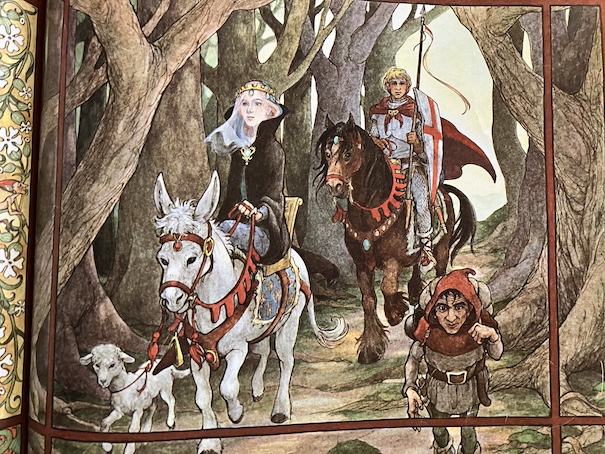
Saint George and the Dragon

The story of Saint George and the Dragon is an old folktale. The story as told in this children’s picture book was adapted from Edmund Spenser’s Faerie Queene.

The Red Cross Knight, who carries a shield decorated with a red cross, does not know his own name or even where he came from. He only knows that the Queen of the Fairies has sent him to face a terrible dragon. He is accompanied on his journey by a princess with a little white lamb and a dwarf. The Princess’s name is Una, and her kingdom is being attacked by the dragon.

On their journey, they meet a hermit, who shows the knight a distant palace on a mountaintop, where angels travel between the palace and heaven. It’s so beautiful that the knight wants to go there immediately, but the hermit says that this palace is in another world and that he cannot go there until he faces the dragon. The hermit also reveals the knight’s past to him. He is not one of the fairy folk, although the fairy folk are the ones who sent him. The hermit knows that he was kidnapped by the fairies as a baby and hidden in a farm field, where he was discovered by a plowman who named him George. His true destiny is to become Saint George, the patron saint of England.

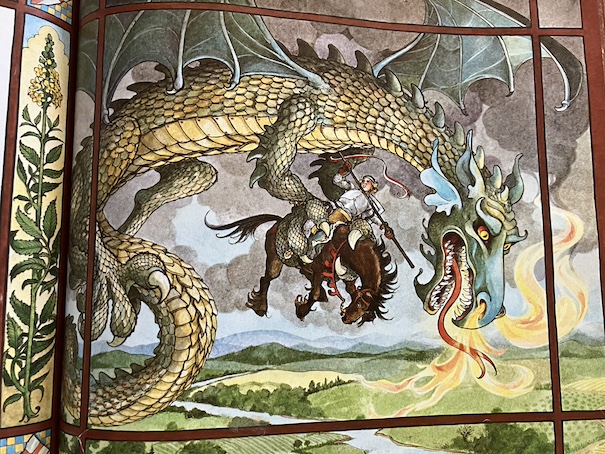
Una takes George to her parents’ fortress. As they approach, they see the dragon for the first time. George sends Una away from danger, and he and the dragon battle for the first time. The dragon picks up George, horse and all, and throws them to the ground. George manages to drive the dragon away, but he is also injured. At first, he and his friends think he is going to die, but he lies down in an ancient spring that cools and heals him. By morning, he is able to rise and fight again.

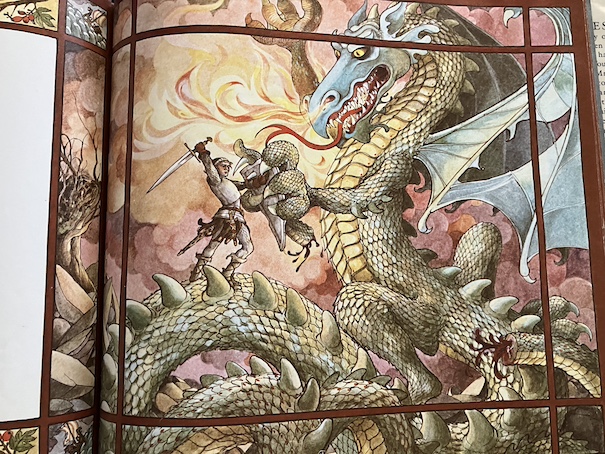
The second time George fights the dragon, he is able to cut off part of the dragon’s tail and one of its paws. The dragon’s fire finally drives George away, and once again, George seems too wounded to survive. However, he rests under an apple tree that drops healing dew, and George survives.

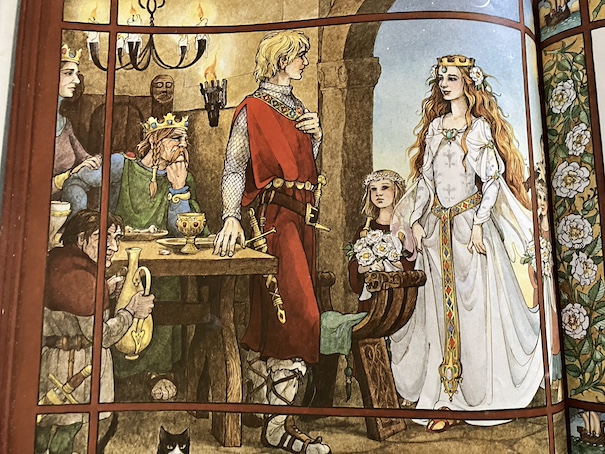
The third time George and the dragon fight, George manages to kill the dragon. Everyone celebrates, and Una’s parents thank George. The king gives George rich rewards, but George passes them on to the poor people. George is bound to the service of the Fairy Queen for six years, but the king allows George to marry Una and promises him that he will become the next king when his service is finished.

The book is available to borrow and read for free online through Internet Archive.

I love the colorful illustrations in this story, although some of them seemed a bit brutal for an audience of young children, showing George badly injured and the dragon spurting blood. Because I love folklore, I know that the legend of St. George and the Dragon is a Christian allegory, although it has some basis in earlier folktales and historical figures. I’ve heard different interpretations of what the dragon is supposed to represent. It can be a symbol of evil, the devil, or sin, and I think I’ve heard that it could represent paganism, which was replaced by Christianity (represented by St. George in the story), although I can’t remember where. In a way, I think this is one of those picture book that might mean more to adults because they would understand more of the symbolism, history, and folklore references in the story. On the other hand, who doesn’t love a story that ends with a gallant knight marrying a beautiful princess?

In case you’re wondering, the red cross on St. George’s shield isn’t the red cross used by the International Red Cross. However, Saint George’s Cross is on the national flag of England and is also part of the Union Jack flag of the United Kingdom.

As another odd piece of literary trivia, the legend of St. George has a connection to another story that I’ve on this blog, Phoebe the Spy. The connection isn’t an obvious one because Phoebe the Spy was set in New York during the American Revolution, which seems far removed from Medieval England. However, on April 23, 1770 (St. George’s Day), the St. George Society (originally called the Sons of St. George) was founded at the Fraunces Tavern in New York, just six years before the story of Phoebe the Spy begins at the same tavern. The St. George Society was and still is a charitable organization that helps immigrants from Britain, using the patron saint of England as its namesake.

The Knight at Dawn

The Magic Tree House

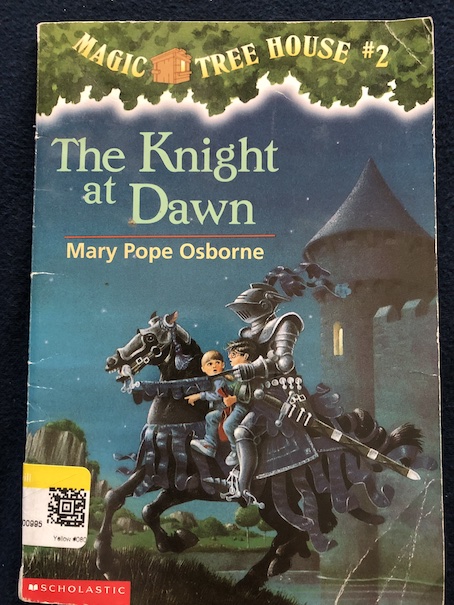
The Knight at Dawn by Mary Pope Osborne, 1993.

After the previous adventure that Jack and his sister Annie had in the Magic Tree House, Jack is still puzzled about how the tree house travels though time and who owns it and the books inside. He also wonders about the gold medallion with the letter ‘M’ on it. Both Jack and Annie are having trouble sleeping because they’re wondering about these things, so Annie suggests that they go to the tree house early in the morning to see if they can catch the owner there.

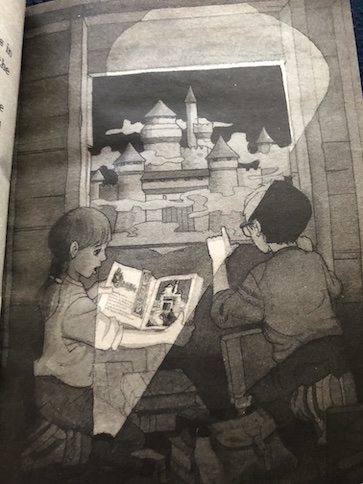
However, when the kids get there, nobody is there, and the books are still where they left them. Annie points out a book about knights and castles that she likes. Although Jack tries to warn her to be careful, Annie wishes that they could see the knight, and the tree house takes them back in time to the Middle Ages. They see a large castle outside the tree house and a knight on a black horse.

Jack thinks that they should use the book about their home town to go home immediately and make some plans before they do anything else in the past, but Annie wants to stay and look around before they leave. She climbs out of the tree house, and Jack has no choice but to follow her.

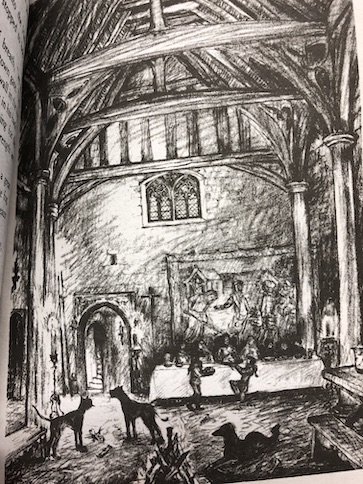
They discover that there is a feast at the castle, and Annie wants to see the feast for herself. As the children spy on the feast, a servant spots them and demands to know who they are. Jack and Annie run away and hide in the armory, but they are found by guards, who take them to the dungeon. Annie startles the guards with her flashlight, and they are able to escape.

They find their way out of the castle through a secret passage and encounter the knight on the black horse. But, is he a friend or an enemy?

My Reaction

The Magic Tree House series is meant to be educational as well as fun fantasy stories, and I enjoyed the pieces of Medieval trivia throughout the story. As the kids explore this new time period, Jack reads the book about knights and castles to learn more about where they are and what’s happening there.

However, not all the facts in the book are true. The part where Jack was reading about how heavy a knight’s armor was isn’t right. His book says that a knight’s helmet could weigh forty pounds by itself. Jack remembers that he weighed forty pounds when he was five years old, so he thinks wearing a knight’s helmet could be like having a five-year-old on someone’s head. However, according to The Metropolitan Museum of Art, entire suits of armor weighed roughly 45 to 55 pounds, with the helmet weighing about 4 to 8 pounds. That’s still a heavy amount for someone to carry on their head, but far more reasonable than 40 pounds.

The Door in the Wall

The Door in the Wall by Marguerite de Angeli, 1949.

The story takes place in Medieval England. Robin is the son of a noble family. All his life, there has been the expectation that Robin would learn to be a knight, like his father. Soon after Robin turns ten years old, Robin’s father goes away to fight in Scotland, and Robin’s mother arranges for him to be sent away to begin his training as a knight while she takes a position as lady-in-waiting to the queen. However, soon after his parents’ departure, Robin becomes terribly ill and loses the use of his legs.

Now, Robin is miserable and wishing that his mother was still with him to help him get over his illness. Instead, he is looked after by servants. Then, after Robin throws a fit and refuses to eat, his servants disappear. The next person Robin sees is Brother Luke, a friar from St. Mark’s monastery. The friar tells him that his servants were ill and have fled from the plague, but one of them sent him to care for Robin. He feeds Robin and tells him that he will take him to St. Mark’s and continue to care for him there. Robin tells Brother Luke about how he was supposed to be taken away for training but that he was unable to go because he was ill, and he asks how they will get to St. Mark’s because he cannot walk. Brother Luke says that the man who was supposed to escort him to the castle where he would live and be trained as a knight may be unable to get back into London because travel is restricted due to the plague, so Robin’s training will have to wait. As for how they will travel, Brother Luke has a horse that they can ride.

Before they leave, Brother Luke asks Robin to remember the wall around his father’s garden and the wall around the Tower. He points out that all walls have a door in them somewhere and that if you follow a wall long enough, you will eventually find the door. At first, Robin doesn’t understand what Brother Luke is trying to tell him, but the metaphor is the theme of the book and it becomes clear through the adventures that follow. The wall stands for adversity, and the door stands for solutions to problems, other paths to take, and ways to move forward in life. What Brother Luke is trying to say is that there are many types of problems in life (the walls), but that problems have solutions (doors). There are ways around obstacles, and if you persevere, you will find them. He reminds Robin of this throughout the story.

At St. Mark’s, Robin stays in Brother Luke’s quarters, and Brother Luke takes care of him. When Robin is a little stronger, Brother Luke gives him wood to whittle. When he grows stronger yet, Brother Luke gives him writing lessons. As the plague begins to pass and there are fewer patients to tend to, Brother Luke begins to carry Robin around or push him in a cart, taking him to visit other parts of of the monastery.

Since Robin still cannot walk, Brother Luke thinks it’s important to keep his mind and hands busy, one of the first “doors” that he finds for Robin around his current limitations. Brother Matthew oversees Robin as he learns and practices carving wood, teaching him patience when he has a temper tantrum on ruining one of his first projects. Brother Luke helps Robin to write a letter to his father, in which Robin explains his current situation, and a traveling minstrel, John-go-in-the-Wynd, will carry it to Scotland when he goes there with some soldiers. Later, Brother Luke even takes Robin to go fishing and begins teaching him to swim. In spite of these improvements, Robin still worries about his inability to walk and how it will affect his future and his father’s hopes for him to be a knight.

When John-go-in-the-Wynd returns with a reply from Robin’s father, Robin’s father says that he is distressed to hear that Robin has been ill, although he thankful that Robin did not get the plague and die with so many others. Robin’s illness was severe, but he is already showing signs of recovering. His father has made arrangements for him to travel to the castle of Sir Peter in Shropshire, who is Robin’s godfather and where he was meant to go for his training, accompanied by Brother Luke and John-go-in-the-Wynd, as soon as he is well enough to travel. Since Robin has already become well enough to make himself a pair a crutches with his new woodworking skills and has begun to use them, they decide to proceed with the journey.

On the journey to Sir Peter’s castle, they have adventures, narrowly escaping from thieves and visiting a fair in Oxford. Robin encounters Welsh speakers for the first time. Although Robin is worried about what Sir Peter will think of him when he sees his condition, Sir Peter welcomes the travelers gladly. He has recently been injured in battle and still recovering himself. Robin says that he doesn’t think that he will make a very good page because of his difficulties in walking but that he can read, write, and sing to provide entertainment. Sir Peter says that there are many ways to serve others and that people must do what they can.

Brother Luke and John-go-in-the-Wynd stay at the castle to help Robin settle in, and Sir Peter gives Robin duties that he can perform. Robin asks Brother Luke if he thinks that he will ever be able to walk normally again, and Brother Luke admits that he doesn’t know but that he is sure that Robin will have a fine life ahead of him. People are not perfect, but everyone has to do the best they can with what they have. Robin soon learns to get around well enough to navigate the castle easily and play with the other boys, but he is still bent and unable to walk without crutches. Robin’s disability and the craftsman skills he learned from the monks have taught him patience and that he feels better after accomplishing difficult tasks.

Then, one foggy day, the Welsh surround and attack Sir Peter’s castle. The defenders hold out in the keep, but they begin to run low on food, and strangely, the well seems to be running dry. As they run low on water, hope seems to be lost. They begin to devise a plan for someone to slip out and go for help. Robin volunteers to go. He knows where John-go-in-the-Wynd is staying with his mother nearby, and he can tell him about the situation in the castle and where to go for help. Robin knows that if anyone catches sight of him, he will look like a poor, lame, shepherd boy, and no one will suspect him of coming from the castle.

Robin has felt badly about his new disability, but his youth and disability are actually what allow him to pass unchallenged through the enemy lines. Suddenly, his disability actually becomes an advantage, allowing him to do what others cannot. Robin’s future may not be the one that he first expected, but he has found ways to move forward in his life and ends up a hero!

The book is a Newbery Award Winner. It is available to borrow and read for free online through Internet Archive (multiple copies).

Jeffrey Strangeways

Jeffrey Strangeways by Jill Murphy, 1990.

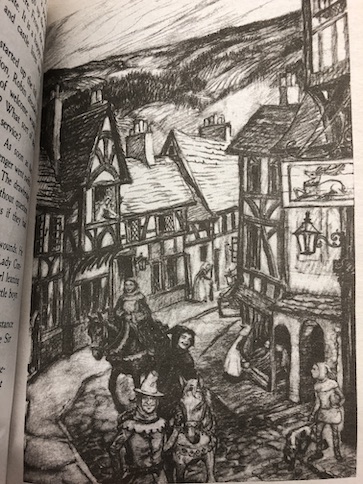
Jeffrey lives with his widowed mother in a Medieval village (not a realistic one, this is a fairy tale type story), where his mother supports the both of them by selling her knitting.  However, when his mother breaks both of her arms after falling off of a cart, eleven-year-old Jeffrey must find a job and earn some money.  As a young boy from a poor family, there aren’t many options for him at first, and he doesn’t try very hard for the ones that are available because what he really wants to do is to be a knight.  As a boy from a non-noble family, it isn’t likely that he’d ever actually become a knight, but it’s all that Jeffrey has ever dreamed of.

One day, after Jeffrey has failed to get the jobs that were available in a nearby town of Axington, he is walking home, sad and worried about what his mother will say, he meets a knight.  In fact, it’s not just any knight but a famous one, Sir Walter!  Jeffrey is thrilled to meet him.  Sir Walter asks Jeffrey for directions and invites him to join him for supper. 

The two of them discuss what it’s like to be a knight.  Sir Walter tells Jeffrey that it’s not all as glamorous as people think it is.  Some parts are very difficult, and he has to travel a lot on his various assignments, keeping him away from his family for extended periods.  Unlike real, historical knights, who would work for a lord, Sir Walter works for an agency in Axington called Free Lance Rescue Services Limited, which gives him his assignments.  They send knights like Sir Walter to rescue damsels in distress or deal with dragons or ogres.  Although it’s not easy work, Jeffrey likes the sound of it!

When Jeffrey returns home and his mother finds out that he didn’t get a job, she is upset.  Jeffrey tells her about his meeting with Sir Walter, and she points out that, even though it’s exciting, he really needs to focus on finding work because they’re running out of money.  Seeing his mother so upset, Jeffrey lies to make her feel better, telling her that Sir Walter has recommended him for a job with his rescue agency.  His mother is doubtful at first, knowing that knights are usually from noble families and that her small son hasn’t had any training or shown any fighting ability.  Jeffrey reassures her that he’ll probably just be helping in the office until he gets more training.  To Jeffrey’s shame, his mother believes him and is proud of the job that he doesn’t have.

The next day, after his mother sends him off to his first day on his new “job,” Jeffrey decides that the only thing to do is to go to the agency in Axington and try to find out if he can get a job there, or failing that, anywhere he can in order to make things right with his mother.  When he gets to Axington, he is hungry, so he asks at a food stand in the marketplace if he can help out for a while in exchange for some food.  He spends the morning peeling potatoes in exchange for lunch.  However, although it’s boring work, Jeffrey does get a good meal out of it, and he catches the eye of a leatherworker, who compliments him for working hard.  Jeffrey confides in the leatherworker that he’s really hoping to get a job at the rescue agency, and the leatherworker tells him that his fiancé is the secretary there.  He gives Jeffrey a message to take to the secretary, and Jeffrey sees it as his opportunity to ask for a job.

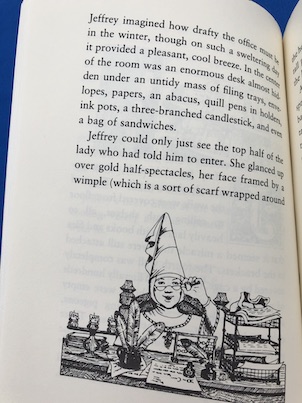
When Jeffrey delivers the message to the secretary (which is an invitation to join her fiancé for lunch), the secretary tells him that the rescue agency has no job openings at the moment, but that she’ll pay him a penny to watch the office and her mother’s rambunctious dog, Lancelot, while she’s at lunch.  It’s not much, but a penny is enough to buy his mother a nice dinner, so Jeffrey takes the job.  The secretary tells him a little about how the office works, but she doesn’t expect anything to happen while she’s at lunch because nothing ever does.

However, while the secretary is away, a message comes in that Sir Walter is in trouble!  Sir Walter is in the cave of an evil ogre and needs help at once!  Jeffrey tries to find the secretary to tell her and ask what to do.  When he can’t figure out where she went to lunch, Jeffrey decides that there’s no time to waste and that he must rescue Sir Walter himself!

Although Jeffrey is eager to help Sir Walter, he does worry about the lies that he has told his mother about his new “job”, the fact that he isn’t really qualified for what he’s doing and doesn’t even have permission to be doing it, that the ogre might well end up eating him as well as Sir Walter, and that he left a mess in the office when he ran off on his rescue mission and is currently in possession of a dog that doesn’t belong to him.  The book is a fun adventure story, but it makes some good points about truthfulness and responsibility as well.

Although Jeffrey really only brought the dog along because he had nowhere else to leave him, it is really Lancelot who defeats the ogre, partly by accident.  At first, Jeffrey is tempted to claim the victory for himself, but he decides to be honest and admits the truth about the ogre’s defeat to Sir Walter.  Still, Sir Walter is grateful and offers to sponsor Jeffrey for knight school and give him a part-time job polishing his armor.  Jeffrey accepts, and he also gets to keep Lancelot, who needed a new home anyway, although his mother says that he will have to be responsible for the dog and its training.

The book is available to borrow and read for free online through Internet Archive.

Knight’s Castle

Knight's Castle

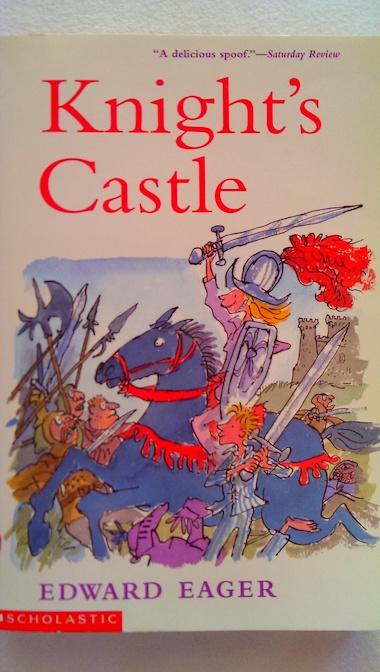
Knight’s Castle by Edward Eager, 1956.

Roger and Ann are the children of Martha from the previous two books in the series. Like their mother’s family when they were growing up, they live in Toledo, Ohio. Their Aunt Katharine (one of Martha’s older sisters) used to live close to them in the Midwest but now lives in Baltimore, Maryland. Roger and Ann don’t particularly get along with Aunt Katharine’s children, Eliza and Jack, because Eliza is bossy and Jack is only interested in photography. However, the four children end up spending the summer together when Roger and Ann’s father needs to have an operation at a hospital in Baltimore.

Like their mother and her siblings when they were young, Roger and Ann also like fantasy stories, which their father likes to read to them. Roger starts to believe in real magic when it seems like one of his toy soldiers comes to life at night. Roger collects toy soldiers, and he has over 200 of them, but this one is special because his father says that its been handed down in their family for generations. Roger calls it the Old One. It’s rather worn, so it isn’t obvious at first, but the Old One is actually a knight. Worried about his father’s illness, Roger takes the Old One to bed with him (which he thinks is more manly than taking a teddy bear to bed), and then feels it wriggling in his hand.

Knight's Castle Roger

Realizing that the Old One is magic and is coming to life when he holds him, Roger asks him if it’s part of his magic to grant wishes. If it is, then he wishes for his father to get well, and if possible, for him and his sister to have an adventure in Baltimore over the summer. The Old One doesn’t answer him immediately, but over time, he makes it clear to Roger that wishes have to be earned, and that will be the source of his summer adventure.

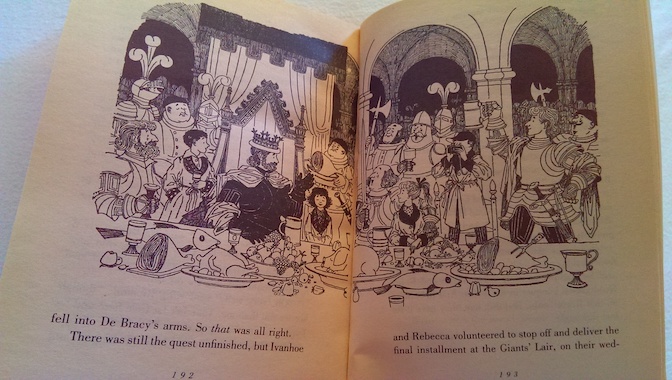
When the children arrive in Baltimore to stay with wealthy Aunt Katharine while their father is in the hospital, Aunt Katharine gives them presents. Ann gets a new dollhouse, and there is a toy castle for Roger. Since Aunt Katharine has also just taken all the children to the movies to see Ivanhoe, all of them become immediately interested in playing with the castle.

That night, Roger has a strange dream that he finds himself within the story of Ivanhoe, which is being acted out in his toy castle. The Old One is there as well, although he is mainly watching the action as Roger begins to take part in the story. When Roger comes face-to-face with the villain, he accidentally lets Ivanhoe’s plans slip to him. Things are looking pretty bleak when Roger suddenly realizes that the castle is still a toy and everyone around him is just a lead soldier. This revelation ends the magical adventure and brings him back to reality. However, Roger is disappointed that he ended the adventure so early when perhaps he could have done something really heroic.

Seeing the toy soldiers scattered around instead of poised for the battle they were planning the night before, Eliza and Ann think that Roger was just playing with the castle without them, but he explains to them what happened. The girls were just reading The Magic City by E. Nesbit, and they start building their own “magic city” out of random things from around the house, surrounding the toy castle. Roger is upset about the city because he says that it doesn’t fit in with the Ivanhoe story, and he’s sure that it will ruin everything, maybe from preventing the magic from working again at all. The Old One tells Roger that magic works by threes, so the next opportunity for magic will be in three days.

Knight's Castle Magic City

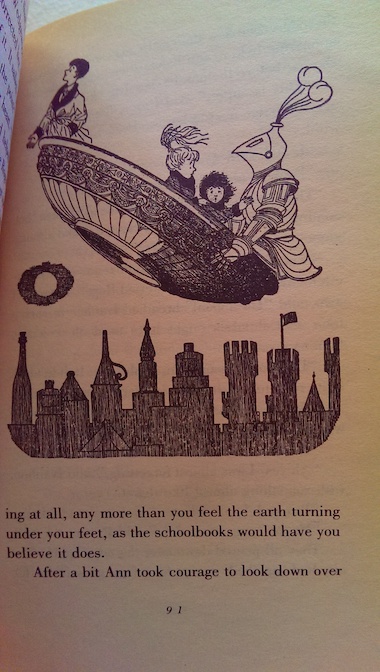
As it turns out, the city does end up becoming part of the story when the magic brings it all to life on the third night. Roger, Ann, and Eliza find themselves in the middle of the city, surrounded by knights attempting to drive modern cars. Ivanhoe has become a fan of science fiction books, via the public library in the city that the girls built. Although Ivanhoe has turned into something of a geek, the children persuade him to come on a mission to rescue the captive Rebecca, and they end up traveling in a flying saucer (made from a real saucer) to the Dolorous Tower, where the adventure ends as soon as Eliza remembers that the villain threatening them is still just a lead soldier.

Knight's Castle Flying Saucer

It was an even weirder adventure than Roger’s first one, but by now, the children are starting to understand the rules that go along with the magic. Jack, who says he doesn’t really believe in magic, accompanies the other children on the next adventure, as they try to prove to him that it’s real. They end up having to rescue some of the others from the “giant’s lair”, which turns out to be Ann’s new dollhouse. The dolls are angry that Ann has been neglecting them, only paying attention to the dollhouse when she and Eliza needed to borrow things for their magic city. They manage to escape again by remembering that the dolls are just dolls.

However, Roger is still worried about their father, who is about to undergo his operation. The Old One had told him that wishes needed to be earned, and he doesn’t think that they’ve managed to accomplish much in their adventures. Roger thinks that they need to do something really heroic so that his wish for his father to get better will come true. The Old One gives Roger a rhyme, hinting at what the children need to do on their next adventure, but Roger doesn’t understand what it means, and he doesn’t know if he can figure it out in time.

Actually, it is Ann who eventually realizes what the rhyme means and provides Roger with the “wisdom” that he needs to earn his wish. All throughout the story, Roger was criticizing his little sister for things she did wrong, saying that she was too little and only a girl. Because Roger thinks of her as being just his little sister, he overlooks what she has to contribute to the adventure. Roger’s acquired wisdom is to value the contributions of others and not underestimate their ability to contribute. Ann, being young and shy, frequently doubts herself, but she also learns confidence when she realizes that she has the answer to the riddle. Jack and Eliza learn lessons as well. Doubting Jack learns to believe in magic, and Eliza learns that she can’t always be the boss, that sometimes it is better to let someone else take the lead when they’re the right person for the job. (Although, she does say at the end of story, “If that wouldn’t be just like that magic’s impudence! Trying to teach me moral lessons!”)

Like other books in this series, there are a lot of references to popular pieces of children’s literature and jokes about things that happen in children’s stories.

The book is currently available online through Internet Archive.

Knight's Castle Feast

Castle Diary

CastleDiary

Castle Diary: The Journal of Tobias Burgess, Page by Richard Platt, 1999.

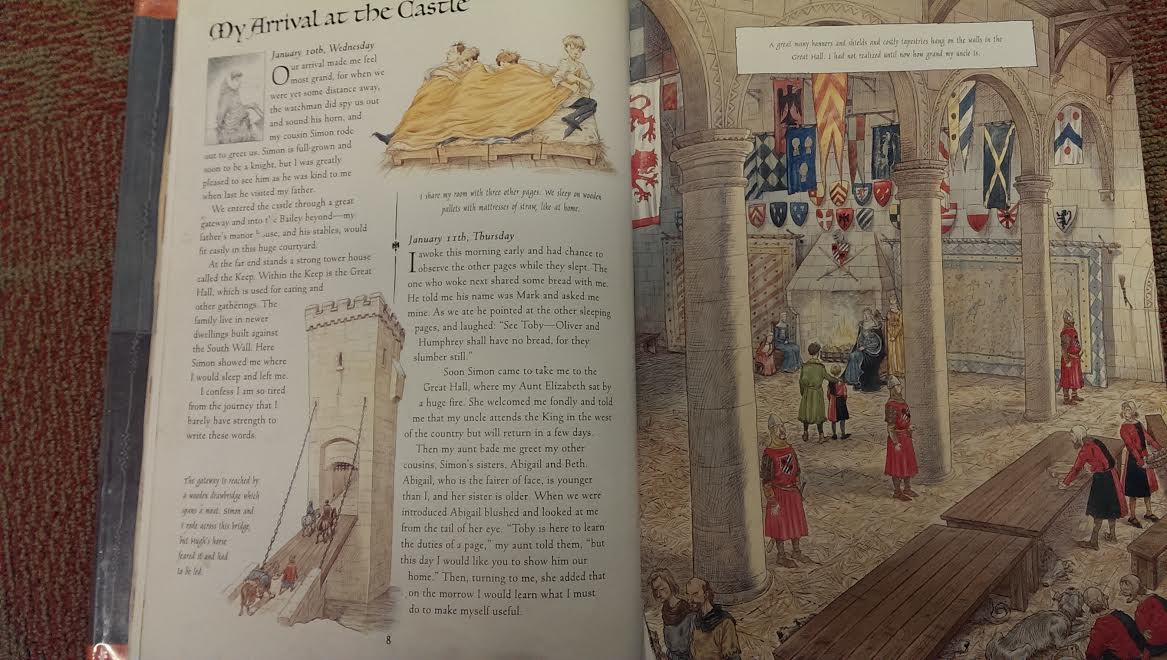
Tobias is an eleven-year-old boy living in England in 1285.  He is from a noble family, and his father is sending him to his uncle to become a page.  As a page, Tobias will learn manners and skills that he will need as he eventually becomes a squire and then a knight.  During the first year of his training that he spends with his uncle, he keeps a diary of everything that happens to him and everything he learns.  Toby is a fictional boy, but his life and family are meant to illustrate what life was like for a young boy from his social level during the Middle Ages.

CastleDiaryPic1

The castle were Toby’s uncle lives is much bigger than his parents’ manor house.  Toby has to learn the roles of all the servants who live there: who is in charge of what and who reports to who.  Not all servants are equal, and some command more respect than others.  Some of them are even from noble families like his, including his aunt’s companion, Isbel.  Toby himself is assigned to do chores for his aunt like running errands, delivering messages, serving food at meals, and holding up the hem of her cloak when she walks outside.

Toby shares a room with the other pages at the castle, all boys of noble families and destined to become knights, just like him.  They have lessons in reading, writing, mathematics, Latin, and scripture from the castle’s chaplain, and he is a harsh disciplinarian.  They practice their lessons on wax tables that can be smoothed out and used again.  The boys also learn manners and start learning archery and about all the weapons and armor that knights use.  When they have time to play, they try walking on stilts and play at being jousting knights by carrying each other on their backs and trying to knock each other off.

CastleDiaryPic2

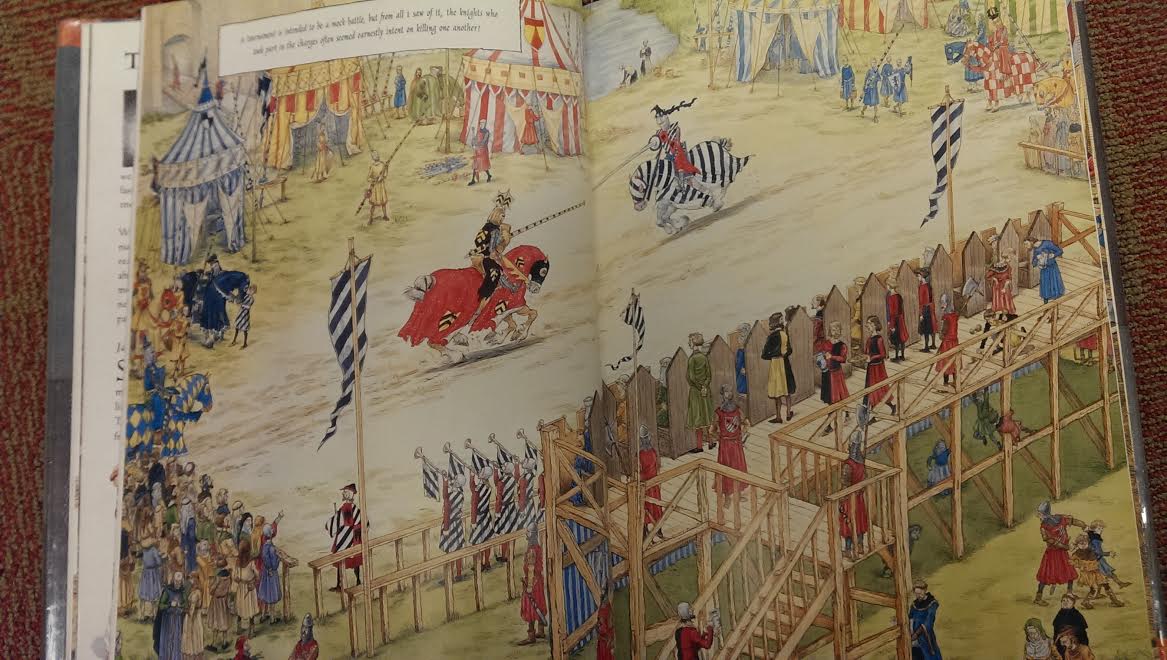
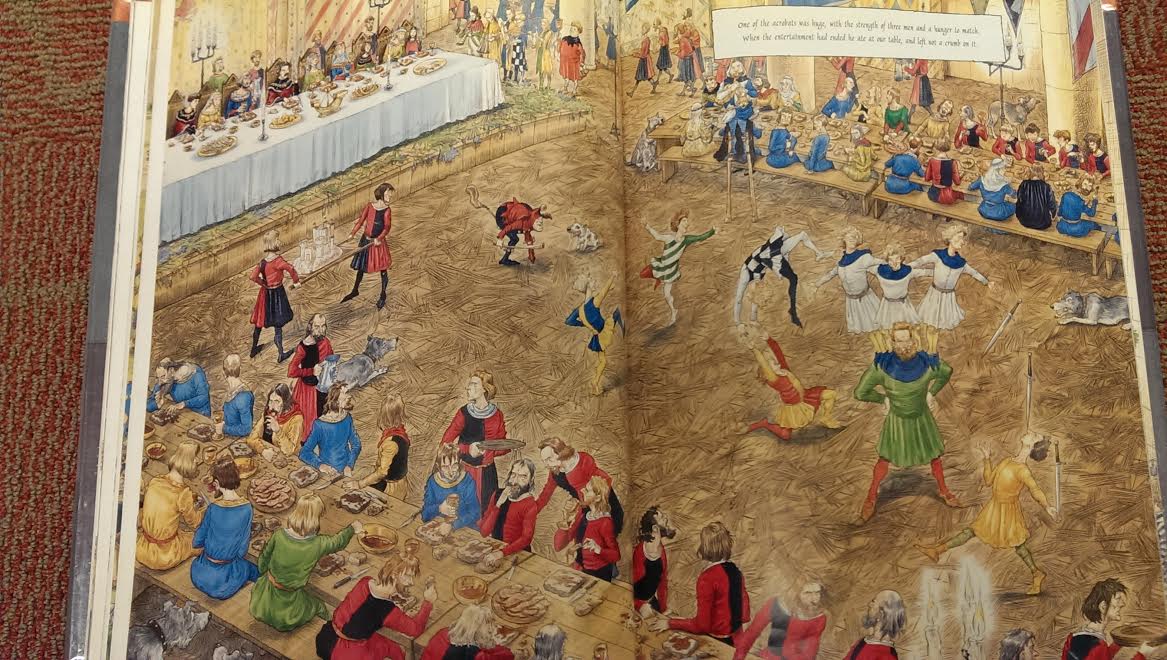
During the course of the year, Toby gets to witness a hunt, a joust, and a banquet with important guests.  At one point, he gets sick and receives treatment from a physician.  He also encounters a poacher on his uncle’s land.  This man is eventually caught (although Toby decides not to turn him in) and put on trial, but in the end, he is not punished because the jurors were sympathetic.  The book ends with a Christmas celebration, after which Toby goes home to visit his parents.

CastleDiaryPic3

In the back of the book, there is a section with more information about Medieval society, castles, sieges, weapons, armor, and the changes that eventually brought an end to feudal system that Toby knew.

The book is part of a series of historical picture books.  It is currently available online through Internet Archive.

CastleDiaryPic4

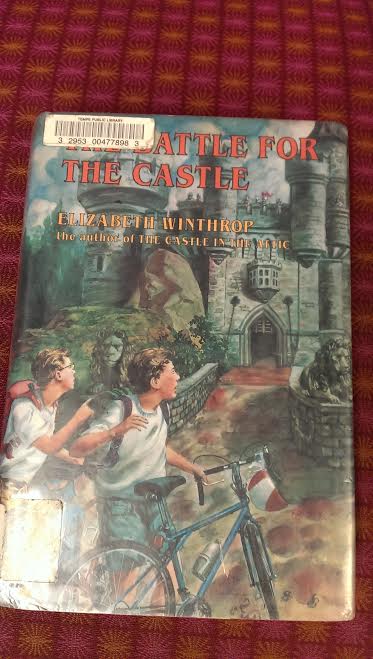
The Battle for the Castle

battlecastleThe Battle for the Castle by Elizabeth Winthrop, 1994.
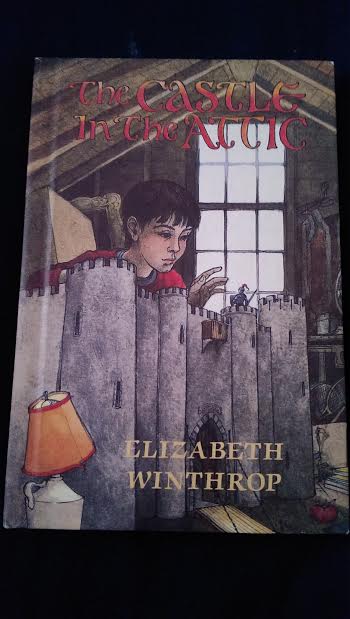
This is the sequel to The Castle in the Attic.

William is growing up.  As William’s twelfth birthday approaches, he feels like he and his best friend, Jason, are growing apart. Actually, what he fears is that Jason is out-growing him. Jason has grown taller than William and much more muscular, thanks to his off-road bike training sessions with his father. William, on the other hand, is still short and feels like a shrimp next to Jason.

In their town, it is traditional for boys to “jump the trains” when they turn twelve. It involves grabbing hold of a ladder on the side of one of the cars as the train reaches a point on the track when it slows down, climbing over the top of the car, and jumping off the other side. It’s a dangerous trick to pull, and parents try to keep the kids from doing it. Still, the boys who don’t do it are considered to be wimps by the others. When Jason and William try, Jason makes it, but William gives up when his hand starts to slip. William is not hurt, but he is embarrassed at his failure.

To show Jason that he’s not just a wimp, William decides to let him in on the secret of the castle in the attic. Mrs. Phillips decided not to drop the magic token into the sea along with Alastor as she said she would (see previous book), and she sends it to William as a birthday present. After William explains to Jason how the token works, he convinces him to become small with him and visit Sir Simon and William’s other friends. When the boys arrive, they are welcomed by Sir Simon, who is about to leave for a tournament. William and Jason agree to help look after Sir Simon’s castle until he returns, along with his friend Dick, Dick’s son Tolliver, and Dick’s niece Gudrin. Sir Simon’s old nurse, Callendar, has died, but before her death, she made a prophecy of death and danger. Almost everyone believes that she was just raving, but Gudrin knows that danger is approaching. A strange ship of skeletons has been seen approaching the town, and bones have been floating down the river. Sir Simon had the ship towed out to see again, and Dick thinks there’s nothing more to fear. However, the ship has returned, and the boys and Gudrin know that something must be done in order to keep Callendar’s prophecy from coming true.

There is an army of rats aboard the ship, led by a giant rat that walks on its back legs like a human. The boys and Gudrin attempt to burn the ship, but the rats escape and begin attacking people across the countryside. When one of these people makes it to the castle to warn everyone, Dick finally believes them that something needs to be done. Most of the people are sent away from the castle, Tolliver is sent to bring Sir Simon back to help, and the others stay to wait out the siege. Although William is scared, he manages to keep his head and come up with a plan that defeats the rats once and for all.

In the end, when the boys return to their own world, William declares that he will never jump the trains because he thinks it’s a crazy stunt. Jason doesn’t mind because, as he says, “there’s more than one way to jump the trains.” William doesn’t need to prove that he’s grown up by performing a crazy stunt because he’s already behaved with courage and maturity while facing real problems and saving the lives of other people.

The Castle in the Attic

CastleAtticThe Castle in the Attic by Elizabeth Winthrop, 1985.

Ten-year-old William’s life is being turned upside down.  Mrs. Phillips, his nanny, is leaving for good!  Mrs. Phillips has lived with William’s family and helped to take care of William ever since he was born. Both of his parents work, so William spends most of his time with Mrs. Phillips after school. She fixes him his snacks, takes him to his gymnastics lessons, spots for him as he practices his routine, and reads stories about King Arthur with him. However, now that William is ten years old, Mrs. Phillips thinks that she would like to go live with her brother in England, which is where she is from. William is upset because he can’t imagine life without Mrs. Phillips. Mrs. Phillips tells him that he will be fine without her and that his parents will start spending more time with him after she leaves. William tries everything he can think of to get her to stay, but she is determined that it’s time for her to go.

As a leaving present, Mrs. Phillips gives him a toy castle that has been in her family for generations, along with a little lead figure known as the Silver Knight. Still, William is determined to find a way to keep Mrs. Phillips from leaving.  Then, he discovers that the toy castle is magic! When the little knight comes to life and gives him a magic token that can make people small, William thinks he’s found the way he’s been looking for. With Mrs. Phillip’s impending departure and his fears of losing her, William suddenly realizes that he can use the magic coin to keep Mrs. Phillips with him.  Before she can leave, he shrinks her and puts her in the castle with the knight.

Of course, turning his nanny small and keeping her inside the toy castle was unethical, as Mrs. Phillips and the knight point out, but William’s mistake proves to be only the beginning of a fantastic journey that will fulfill a legend, free the knight’s kingdom from the reign of an evil wizard, and give William the confidence he’s been looking for.

Over the drawbridge of the castle is a poem about the beginning of a quest. Mrs. Phillips had said that there was a legend about the little knight, and when he comes alive, he tells William that his name is Sir Simon and that he was turned to lead by an evil wizard who has taken over his kingdom. The poem is the key to defeating the wizard, and the little token is really only half of one that the wizard was wearing around his neck. When William turns Mrs. Phillips small, he cannot reverse the spell because he lacks the other half of the amulet. To get it, he must become small himself and fulfill the poem by crossing the drawbridge as Sir Simon’s squire.  The two of them set out together to defeat the wizard and retrieve the other half of the token. Along the way, they become separated, and William must continue on to the wizard’s castle and finish the quest by himself. William has an inner strength that he doesn’t fully appreciate at first, and he can use it to defeat the evil wizard!

There is a sequel to this book called The Battle for the Castle.

My Reaction

I liked this story when I was a kid, and it’s a good coming-of-age story.  The sequel is also a coming-of-age story, but in a different way.  This book is about William coming to a better understanding of what kind of person he is and what he’s really capable of doing.  He can do more and handle more than he thinks he can.  In the end, although William is still a little sad at saying goodbye to Mrs. Philips when she leaves, he feels a little better about her going because he knows that he can take care of himself now, thanks to his magical adventures. Mrs. Phillips tells him that he always had what he needed inside himself but that he just didn’t believe it before.

The next book focuses on what it really means to be a man instead of a boy.  As William and his best friend grow up and are under social pressure from other boys to do a certain stunt in order to prove that they’re really grown-up, William and his friend set out on a magical adventure that teaches them that there are more ways of becoming a man than one.