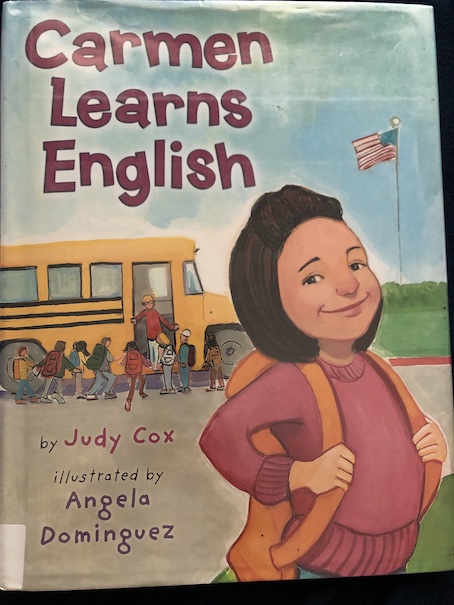
Carmen Learns English by Judy Cox, illustrated by Angela Dominguez, 2010.
Carmen is in kindergarten and has been learning English at school. Her little sister, Lupita, will start school next year, and Carmen thinks about how she wants Lupita to learn English before she starts school. The family is from Mexico, and the girls speak Spanish at home.
School hasn’t been easy for Carmen because the other kids don’t speak Spanish. They all speak English, and they speak fast, which makes it difficult for Carmen to follow their conversations. It helps that her teacher knows some Spanish. Her teacher’s Spanish isn’t very good, but in a way, Carmen finds that comforting because her teacher will understand if her English isn’t very good, either. People who are learning another language understand what it’s like when someone else is learning, too.
Carmen gradually learns new English words at school. When she gets home, she draws pictures of what she’s learned and teaches her mother and little sister the English words. At first, Carmen is too shy to say the words out loud at school because she isn’t confident about how she’s saying them, but she practices at home.
Sometimes, kids at school give Carmen a hard time. Some kids think that she talks funny. When she counts in Spanish instead of English, they think that she’s saying the numbers wrong. Her teacher helps by teaching all the class to count in both Spanish and English, so all the students will learn both languages. Carmen helps to teach the other students words in Spanish, and when she gets home, she teaches Lupita the English words that she has learned.
Because Carmen has been helping Lupita to learn English, Lupita will have an easier time at school than Carmen had when she started. Carmen realizes that she really likes teaching, and she thinks that she might like to be a teacher herself someday.
My Reaction
I thought this was a good story about a child starting school while having to learn a new language at the same time. My mother used to teach English language learners, and she liked the story, too. She said it reminded her of some of the students she used to teach.
I thought that the teacher’s approach, having Carmen teach the other kids some Spanish while she was learning English was a good idea. Some of the other students find Carmen a little strange and confusing at first because they don’t understand the way she speaks, but when they start trading words in different languages, they all start to understand each other better. The other students begin to understand the concept that people can speak in different languages and that there can be different words that mean the same thing, depending on the language they’re speaking. I think it also helps them start to identify with Carmen because, like her, they are also starting to learn an unfamiliar language. As I said, people who are learning a new language or who have studied another language before can understand the difficulties of now always knowing all the words they want to say or exactly who to say them and can sympathize with other people who are also learning new languages.
I also liked it that Carmen realizes that, if she helps her sister to learn some English before she starts school, her sister will have an easier time. She has compassion for her sister because of her own experiences and wants to make things easier for Lupita. By helping both her sister and her fellow students, she also learns that she likes sharing what she knows with other people. She discovers that she likes teaching and might want to be a teacher herself someday.
I read this book as an adult because it’s a relatively new book that didn’t exist when I was a kid, but it reminds me of another book that I did read as a kid, I Hate English, which is about a girl from China learning English. The Chinese girl has some similar troubles learning English and feeling uneasy around people who don’t understand her, although she also struggled with the fear that she would lose her native language or cultural/personal identity by learning a new one. Carmen doesn’t mention that in this story, but some of my mother’s old Spanish-speaking students had that worry when they were learning English, too. Perhaps part of the reason why Carmen doesn’t feel like that is because her teacher encourages her to teach the other students some Spanish, giving her the opportunity to keep speaking it from time to time and share the language with others. In a way, this story was closer to my experiences when I was younger because Carmen is like the kids my mother used to teach and because Spanish is what I studied in school myself.
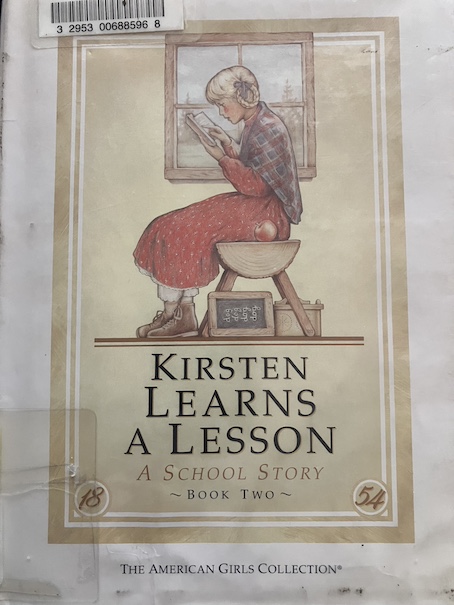
Kirsten Learns a Lesson by Janet Beeler Shaw, 1986.
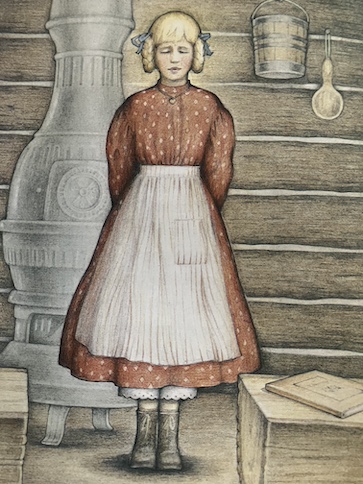
It’s November, 1854, and now that nine-year-old Kirsten’s family has settled in their new home in Minnesota and the harvest season is over, it’s time for the children to go to school. Kirsten and her brothers, Lars and Peter, will go to the small local school with their cousins, Lisbeth and Anna. Powderkeg School is a one-room schoolhouse in a little log cabin. Lisbeth and Anna’s stories about what Powderkeg School is like worry Kirsten. They talk about how strict their teacher, Mr. Coogan, is. Sometimes, the boys in class get rowdy and fight, and Mr. Coogan uses physical punishment on them. However, the girls tell Kirsten that she probably won’t have any problems with Mr. Coogan because he likes children who are well-behaved, and Kirsten is well-behaved. Still, Kirsten is nervous about what her new school will be like.
When they get to school, they learn that Mr. Coogan was injured in a fall from his horse, so they will have a replacement teacher, Miss Winston, who has only recently arrived from Maine. When one of the mean boys in class says he hops the horse also stepped on Mr. Coogan, Miss Winston tells him that nobody talks out of turn in her class and, although they live in the country, “we are not savages like the Indians.” (This is a 19th century attitude toward Native Americans, but this concept is challenged later in the story.)
Miss Winston has each of the children in class introduce themselves so she can get to know everyone. When it’s Kirsten’s turn to say her name, she forgets to address her teacher as ma’am, like the other students. Miss Winston insists that she say “ma’am”, and when she sees Kirsten struggling with the language, she asks Kirsten if she speaks English. Kirsten says that she speaks a little, and her cousins explain that her family just came from Sweden and that they speak Swedish at home. Miss Winston says that “practice makes perfect”, so Kirsten will practice her English in school. For now, she will have the easiest lessons and share seven-year-old Anna’s schoolbook.
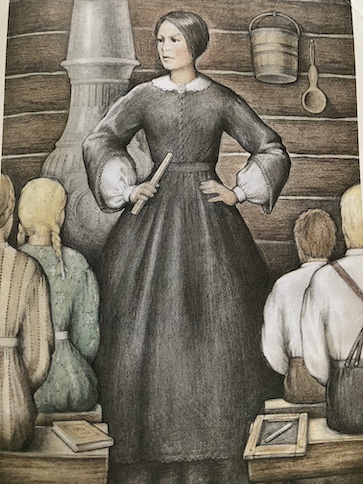
When the mean boy, Amos, laughs at Kirsten, Miss Winston glares at him and strikes the school’s iron stove with her ruler, startling the students. Miss Winston says that her father was a ship’s captain, so she knows how to be in charge of her students, like he was in charge of his crew. Then, she deconstructs the sentence “Miss Winston hit the stove”, pointing out which words are the subject, verb, and direct object of the sentence. Then she warns the class to “Be careful that the direct object of hit isn’t the student.” The implication is that Miss Winston is just as willing to use physical punishment against her students as Mr. Coogan was.
When Amos introduces himself to Miss Winston, we learn that he is nineteen years old, the same age as the new teacher, but the new teacher says that, in spite of being the same age, she’s still the teacher, and he’s the student. In spite of being more a young man than a boy in age, Amos has only just finished the third reader, and Miss Winston says her role is to help him read and do math like a man would, embarrassing Amos. (He can’t use his age to put himself on an equal footing with the new teacher because they are not intellectual equals. She’s the same age, but she has graduated from her own school and become a teacher, and he’s still struggling along with low level math and reading.)
Anna helps Kirsten with her lessons, and Miss Winston praises her for helping to teach Kirsten, but she doesn’t praise Kirsten for doing a good job. At the end of the school day, Kirsten and her cousins talk about the new teacher. Anna thinks that Miss Winston seems nice, but Kirsten thinks that Miss Winston doesn’t like her and that she seems very strict. She asks if that was what Mr. Coogan was like, and Lisbeth says he was worse. The best part of the day for Kirsten was lunchtime, when the children were allowed some play time. When she ran around and played tag with the other children, it didn’t matter if she didn’t speak much English.
When the girls play school with their dolls, Anna imitates Miss Winston and her comment about “savages.” Kirsten asks the other girls what that word means. They say it means “wild.” Kirsten asks them if the Indians (Native Americans) are really like that, and they say that some people say they’re kind and will help people if they need food but others day that they’re “cruel and bloodthirsty.” They’ve seen an Indian man before. He came to their house when their mother was roasting meat, and he left when their mother gave him some. They thought he looked pretty “savage” because his face was painted, and he had eagle feathers in his hair. The girls say that Native Americans also wear knives and live in tents. As a farmer, their father is concerned about the Native Americans. He knows that, if the farmers take too much of their usual hunting grounds for farming, it will drive away the animals, and the Native Americans will be starving and angry. While he is happy that he has been able to secure some farmland for his family (I explained a little about the famine conditions and lack of farmland in Sweden around this time that caused people like the Larsons to leave their country when I covered Meet Kirsten), he is aware that the Native Americans also need land for their survival.
At school, Miss Winston announces that each student will memorize a poem and recite it for the class. When they recite their poems, she wants them to say them with feeling and show the emotions their poem is trying to convey. Kirsten worries about this assignment because she’s still learning English. It’s hard enough for her to learn to read anything in English and understand the meaning of the words. She doesn’t know how she can also learn to memorize an entire poem and say it in front of everyone. Miss Winston gives Kirsten a short poem to learn, but having even a short one doesn’t seem to help Kirsten.
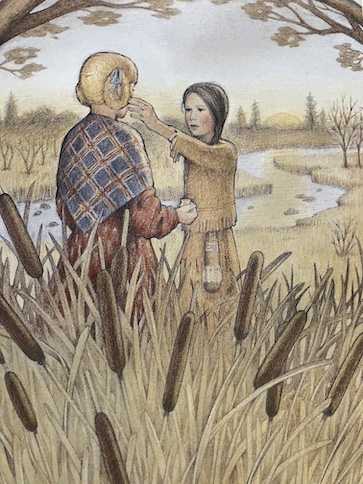
Meanwhile, Kirsten has her first encounter with a Native American when she spots an Indian (Native American) girl watching her while she’s getting water from the stream. The girl runs away, but Kirsten finds a blue bead that she dropped. Kirsten takes it and leaves her a little pretend cake that she and her cousins made for their dolls. Later, she finds that the cake is missing and that there’s a green duck feather in its place. She and the Indian girl trade little objects in this way, gradually becoming friends.
Kirsten’s secret friendship with the Native American girl becomes a comfort to her when school is stressful. Frontier teachers often board with families who live near the school, and when Miss Winston comes to stay at Kirsten’s aunt and uncle’s house, Kirsten feels like school is following her home. What’s worse is that Kirsten’s family will be joining them for dinner, and they will practice English during the meal. Kirsten knows that the meals, instead of being comfortable family time, will now be like lessons, and they will struggle to say things they would want to say because her family still hardly knows English. Worse yet, Miss Winston is cross with Kirsten because she can’t seem to memorize even her short poem.
Sneaking away to visit the Native American girl, who is called Singing Bird, gives Kirsten an escape from her struggles with English. Somehow, Kirsten and Singing Bird manage to communicate well enough with each other, even though neither of them speaks each other’s language. Then, Singing Bird takes Kirsten to see her village. To her surprise, Kirsten realizes that she has been gradually teaching Singing Bird English words without realizing it. However, Singing Bird’s people are going to be moving on soon. Kirsten’s uncle is correct that farming is driving away the animals the Native Americans depend on for food, and they’re suffering for it. Singing Bird invites Kirsten to come with her tribe when they leave, and it’s tempting to think of living an exciting life, traveling with Singing Bird and not going to school. But, is that what Kirsten really wants?
The book ends with a section of historical information about frontier schools in the mid-1800s.
The book is available to borrow and read for free online through Internet Archive (multiple copies).
My Reaction and Spoilers
Along with the first book in the series, this is the book that I remember the best of the Kirsten books. I think I either didn’t read the others or didn’t finish them because there are some sad things in the Kirsten stories that I didn’t like. In the first book, Meet Kirsten, another child Kirsten befriends on the journey to Minnesota dies of cholera. It’s historically accurate that some children died of disease on the journey west, but it was still hard to take. I also talked about how the reason why families like Kirsten’s wanted to come to America was that Sweden was experiencing famine around this time. The first book didn’t say much about that, but in this book, Kirsten remembers experiencing hunger in Sweden when her father’s crops failed and how her little brother cried from hunger.
Kirsten understands the plight of the Native Americans when they have to move to a new area when their food supplies run low. However, when Singing Bird invites Kirsten to come with them, she realizes that would mean leaving the rest of her family, and she can’t do that. While it’s tempting to go with her friend and escape the problems in her life, Kirsten can’t do that without also giving up the good things in her life and trading the problems in her life for a different set of problems. Although there are appealing aspects to their lives, the Native Americans also have their own struggles. To use an old adage, the grass isn’t always greener on the other side of the fence. People say it in different ways, but just because someone else’s situation is different doesn’t always mean that it’s better.
In this book, we also see what it’s like for Kirsten’s family as they begin learning English, so they can communicate with other people in their new country, and the children begin going to school. The little frontier school is different from other schools they’ve experienced before, and the teachers are strict. They have to be strict because some of the students are rough and fight with each other physically, and they have to make it clear that they’re not going to put up with that. This is a real-life aspect of schools from this time period. Fortunately, we never see the teacher actually using physical punishment against anybody. She just threatens to do it so her students will think twice about misbehaving.
When Miss Winston comes to board with Kirsten’s relatives, Kirsten thinks that everything is going to be worse, that she’s constantly going to be bombarded with lessons and the problems she’s been having at school. However, it turns into an opportunity for Kirsten and Miss Winston to get to know each other better. At first, Miss Winston can’t understand why Kirsten is having such a difficult time remembering her poem, even though it’s pretty short and easy. It’s partly because she’s still having difficulties with her English, but also, the content of the poem has no relation to anything currently happening in Kirsten’s life. It doesn’t interest her, and her mind is preoccupied with all the changes happening in her life, making it difficult for her to focus on the poem and remember it. When Miss Winston shows Kirsten a model of her father’s ship, it brings back memories of the ship Kirsten’s family traveled on when they came from Sweden. Miss Winston realizes that Kirsten has strong memories of the ship, so she gives her a different poem to memorize, one about a ship. Kirsten finds this poem easier to remember because it connects to memories she already has.
Although Miss Winston can be tough, she genuinely does care about Kirsten and looks for ways to help her learn. It just takes time to figure out the best way to help her, and Kirsten also needs time to adjust to her new language and new home. Once Kirsten sees that it’s possible for her to learn and for her new home to begin feeling like home, she begins to feel better about her new life in Minnesota.
I enjoyed the realistic aspects of the story and the references to historical events and real life conditions on the frontier. I think I liked this story better as an adult because I understood more about the historical background than I did when I was a kid. Parts of this series are still sad. Kirsten remembers people being sick and dying on the journey to America, and although she doesn’t go into detail about it, her family did suffer genuine hardship in Sweden.
Nick is a creative boy in elementary school who is known for pulling elaborate stunts, like turning his classroom into a tropical paradise with fake trees and real sand. When he gets to fifth grade, he has Mrs. Granger as his language arts teacher. Mrs. Granger has a sense of humor about some things, but she also has some strict rules and is all business when it comes to her specialist subject. Her vocabulary lists for her students are extensive, and her favorite thing is the unabridged dictionary. Nick likes words and enjoys reading, but he finds the dictionary to be boring. When he sees a word he doesn’t know, he would rather ask someone else what it means than look it up in the dictionary.
In most classes, Nick is good at asking teachers questions to sidetrack them from assigning homework. The other kids know he does this, so they aren’t surprised when he asks Mrs. Granger about her big unabridged dictionary and where all the words in it come from. Unfortunately, for Nick, Mrs. Granger is also onto his trick, and rather than answering the question herself, she assigns Nick to look up the answer and tell the rest of the class what he’s learned the next day in addition to his usual homework assignment. Nick is upset because he usually doesn’t have much homework at all, and now, he has to do more.
When Nick gets home, he reads about dictionaries in his encyclopedia, but he’s not sure that he understand everything he’s read, and it all sounds terribly dull. Then, Nick gets one of his creative ideas that he thinks will make this boring assignment more fun. When it’s time for Nick to give his report, even he is surprised at how much he has to say about the dictionary. Mrs. Granger loves his report, although even she tries to cut Nick short when he goes on for too long. Although the other kids were initially bored, they begin to enjoy Nick’s report when they realize that he is actually using it to waste an entire class period. Eventually, Mrs. Granger tells Nick that he’s at a good stopping place in his report, and she praises him for all of his work. Nick, annoyed that she’s making him look like a teacher’s pet, decides to ask one more question. He says that he still doesn’t understands who decides what the meanings of words are, like who decided that the word “dog” refers to a dog. Mrs. Granger tells him that everyone who speaks English does. Words mean whatever the people who use them agree that they mean. People who speak other languages use different words to refer to the same animal, but those words are valid to them because they all agree on the meaning of the words.
Then, Mrs. Granger says something that really starts Nick thinking. She says that if everyone in their classroom decided that they wanted to call a dog by some other word, and they got other English-speaking people to agree on it, that word would come to mean “dog.” If enough people agreed to use their new word and agreed on its definition, the new word would be put into the dictionary. To answer Nick’s original question, people who speak a language determine the words of that language and whether they are included in the dictionary. Mrs. Granger adds that the dictionary is the work of many experts over many years, and there are good reasons why each of the words included in the dictionary are there. The dictionary contains the laws of the English language, and while those laws can change, it takes time.
Later, when Nick is walking home with his friend Janet, Janet finds a fancy pen. Nick thinks about what Mrs. Granger said about how people like him, who use a language everyday, decide what words mean. It reminds him how, when he was little, he used to use a baby word that his family understood meant “music.” He had to give up using that word when he went to preschool because nobody outside of his family understood that word, but Nick understands how the word had meaning in his family because they all understood what Nick meant when he used it. While he’s thinking about it, he bumps into Janet, who drops the pen. On impulse, when Nick gives the pen back to her, he decides to give the pen a new name. He calls it a “frindle.”
At first, Janet is confused about what Nick means by “frindle.” It’s the beginning of a new experiment for Nick. Out of curiosity, Nick tries to see if he can teach a saleslady at a local store that the word “frindle” means “pen.” He goes to the store and asks for a frindle, pointing to the pens. Then, he gets some of his friends to do the same thing. After several kids all ask the same lady for a “frindle”, she begins to respond to it by automatically reaching for a pen. Nick is excited because he has just created a new word. “Frindle” now means pen because he decided that it did, and he got other people to agree on the meaning. Nick is making language history!
To make sure his word becomes part of language, Nick gets his friends to use the word “frindle” instead of “pen” at school … in Mrs. Granger’s class. Mrs. Granger isn’t amused by the class’s excessive use of the word “frindle” for pen because she knows that this is another of Nick’s stunts, and it’s a distraction from school lessons. She tries to discourage Nick from promoting it at school, and Nick points out that he’s only doing what she said about how words are made. Mrs. Granger explains how words in language evolved from other words that also have meaning, but “frindle” doesn’t have that kind of evolution because Nick just made it up, based on nothing. Nick insists that “frindle” means something to him and his friends, and they’ve already sworn an oath to each other to keep using it.
To Nick’s surprise, Mrs. Granger responds by showing him a sealed envelope. She tells him that it’s a letter for him, but she doesn’t want him to read it now. The letter is for him after the question of “frindle” is resolved. For now, she just wants Nick to sign the envelope and date it so that he’ll know what she hasn’t switched envelopes or tampered with the letter in any way. Nick is confused, but he does sign the envelope, and Mrs. Granger mysteriously says, “And may the best word win.” It seems like Mrs. Granger is declaring a war of words, pen vs frindle, but are Nick and Mrs. Granger really on opposite sides?
The book is available to borrow and read for free online through Internet Archive (multiple copies).
My Reaction and Spoilers
This is a fun and humorous story that does a great job of showing how languages evolve and the purpose and meaning of language. Nick and his friends unwittingly give themselves an education during the course of their stunt. The reason why Nick had to sign and date the envelope is that Mrs. Granger is also enjoying their experiment, and she has made a prediction about how it will all turn out. Anyone who has ever had to deal with a small child who has learned a bad word can guess what Mrs. Granger has realized and how her own actions are calculated to make sure she gets the result she really wants.
Something that not even Nick fully reckons with until his experiment is well underway is that, now that all of the kids at school know about “frindle”, he can’t stop them all from using the word, even if he wants to. Although Nick originally created the word, words in a language belong to everyone who uses them. This is both a thought-provoking book about the nature of words and language and a good story for stopping periodically and having kids make their own predictions about what will happen next.
Even kids have power because they are also language-users, and they have the ability to influence the language and understanding of everyone around them by the words they choose! Nick is very much an idea person, but after “frindle” starts getting so much national media attention, he starts to get intimidated by the level of power he has. He has become more conscious of the consequences of his ideas and how they can affect large numbers of people. For a time, he becomes more shy because of that realization, but Mrs. Granger gives him some encouragement. She tells him that he has many good ideas and that she’s sure he will go on to do great things with them. Nick regains his confidence and realizes that he can use his powers for good, supporting good causes.






 Jestress's Forgotten Books and Stories