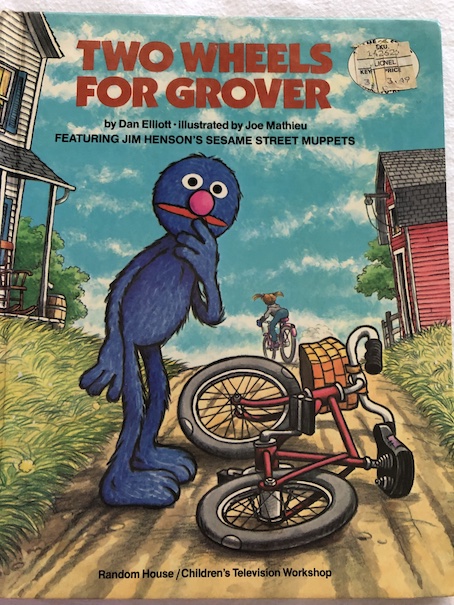
Two Wheels for Grover

Two Wheels for Grover by Dan Elliott, illustrated by Joe Mathieu, 1984.

Grover is happy about going to visit his aunt, uncle, and cousins in the country, but the visit becomes a little awkward when his cousin Rosie wants him to go bike riding with her. Grover doesn’t know how to ride a bike.
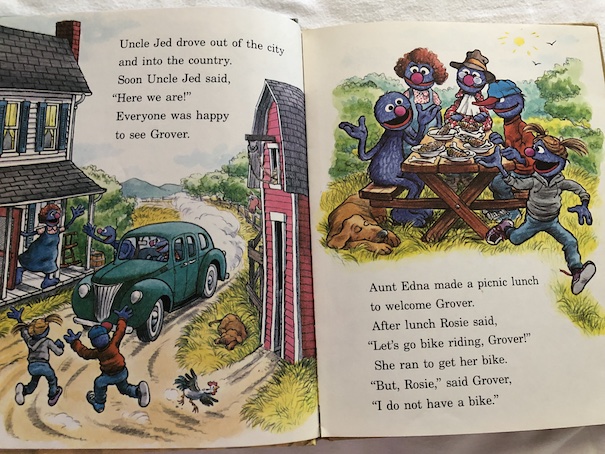
He points out to Rosie that he doesn’t have a bike to ride, but she offers to lend him one. Not wanting to admit that he can’t ride a bike and being too afraid to learn how, Grover keeps making excuses about why he can’t ride a bike.
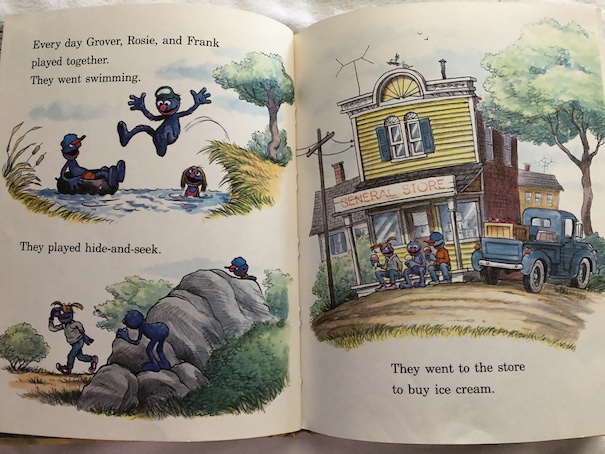
There are still plenty of other fun things to do with his cousins, but the problem of not being able to ride a bike still bothers Grover. Rosie keeps trying to find ways around Grover’s excuses, and Grover keeps trying to find new ones. Secretly, he wishes that he could ride a bike with Rosie, but he is too afraid that he can’t. Grover’s older cousin Frank points out to him that he loves playing in the tree house now, even though he used to be afraid to climb up to it.
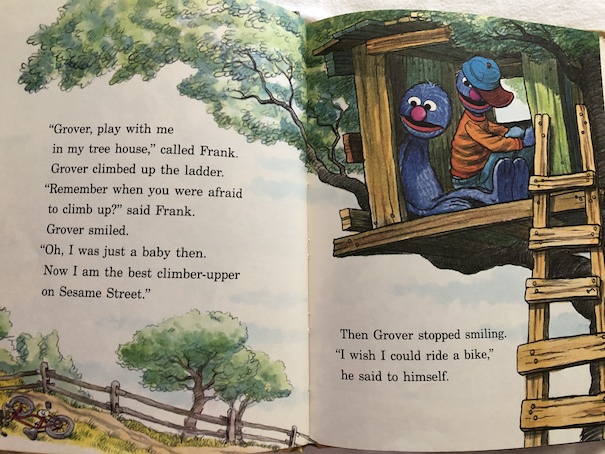
Grover eventually confides in Frank his worries about riding a bike, and Frank understands. Big Bird once tried to teach Grover to ride a bike, but he couldn’t do it then, and he doubts whether he can learn. Frank says that the problem is that Big Bird’s bike was too big for Grover, but he could learn to ride a smaller bike, like Frank’s old one.

Although Grover is still nervous, he lets Frank teach him to ride, and soon, he discovers that he can ride a bike!

Grover learns to ride a bike just in time for Rosie to come and tell them that someone is giving away kittens. Now, Grover can ride over with Rosie to get a kitten for himself!

The book is available to borrow and read for free online through Internet Archive. It’s part of a series of picture books with the Sesame Street characters.

My Reaction:

This was a favorite book of mine when I was a kid, even though I found riding a bike much harder than Grover did. Some kids, like me, have more difficulty learning to balance than others, and it was often hard when other kids wanted me to come riding bikes with them when I couldn’t. Learning to ride a bike is one of those rites of passage that most people have during childhood, and it can be difficult for people who take longer to learn.

However, this book focuses on the rewards of perseverance. Just because Grover had trouble the first time he tried to learn to ride a bike doesn’t mean that he can’t do it. Frank understands that Grover is nervous about riding a bike, and it helps that he points out that there are other things that Grover has found difficult before that are now easy and fun for him, like climbing into the tree house. Learning new things can take time and multiple tries, but there are rewards for those who keep trying!

The Beast in Ms. Rooney’s Room

The Kids of the Polk Street School

BeastMsRooney#1 The Beast in Ms. Rooney’s Room by Patricia Reilly Giff, 1984.

It’s the start of a new school year, and Richard Best (nicknamed “Beast”) is embarrassed to find himself in Ms. Rooney’s room once again because he was held back a year for his poor reading skills.  Everyone he knows has moved on to the third grade, and he’s still in a second grade class with kids who were first grade babies last year.  He feels awkward, being the tallest, oldest person in class, and kids in his old class tease him and refuse to let him play baseball on the playground with them because he’s a pathetic “left-back.”

At first, Beast tries to pretend that it was all a horrible mistake that will be straightened out soon, but that just makes him feel bad for lying.  The kids who are now in the same class he is, who he still thinks of as “babies,” try to make friends with him, but he doesn’t accept them at first because of his embarrassment at being older and still not as good at reading as some of them are.

BeastMsRooneyPic1However, even though he’s embarrassed at having to attend special reading classes with Mrs. Paris while most of the rest of his class has normal reading, these special classes really help him, not just to improve his reading skills, but to connect with other kids in his new class who have the same reading difficulties he does and who understand how he feels.
Beast discovers that it’s no shame to not know something or to have trouble doing something because everyone has different skills and it can take some people longer to learn certain things than others.  Emily Arrow, the girl who now sits next to him in class is a whiz at math but has as much trouble reading as he does.  Beast learns some new skills from his new, younger classmates and realizes that they’re not really babies.  They also really appreciate him and help him see some of the good things about himself.

The book is currently available online through Internet Archive.

Totally Useless Skills

uselessskills

Totally Useless Skills by Rick Davis, 1994.

The name of this book is intentionally deceptive, but only partly.  What I mean by that is that the little tricks and stunts in the book may not have much of a practical application except for just having fun and amusing your friends, but the techniques for learning them can be applied to learning just about anything.

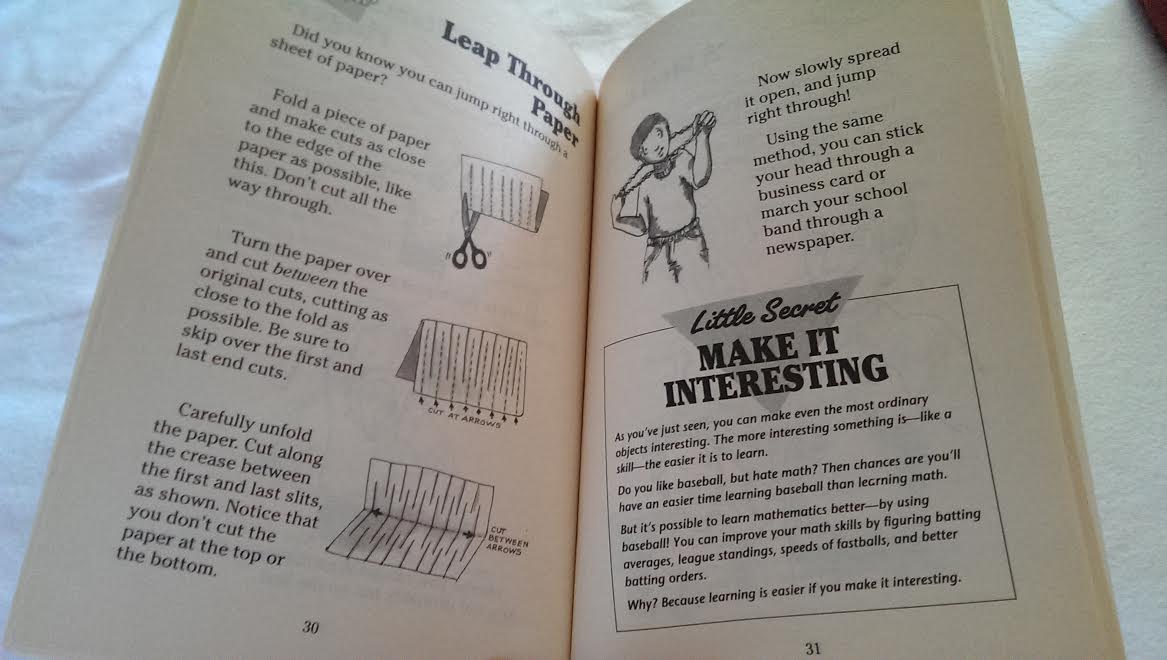
This book describes how to do fun tricks that don’t require any special equipment and are mostly based upon knowing things work, like the blind spot in the human eye (such as using the blind spot in your eye to make it look like your teacher’s head has vanished) and where your center of balance is (used in the trick showing how a girl can pick up a chair when a boy can’t). The tricks include making it look like your arms are lengthening or shrinking, making it look like you’ve broken your nose, how to hang a spoon from your nose, how to jump through a single sheet of paper, how to make a pencil float, how to make your leg disappear, and how to pronounce the longest word in the English language.

uselessskillspic1

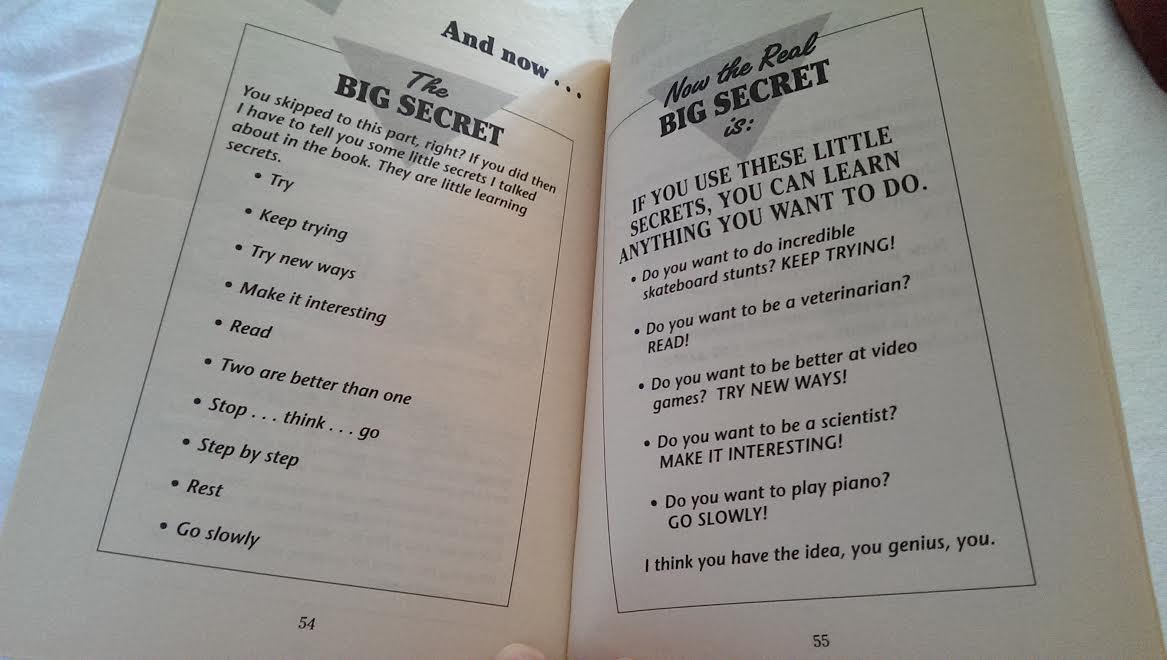
Kids will enjoy learning these little tricks to entertain their friends. However, the book also contains useful tips for learning these skills that can be used to learn anything you want to learn. The author emphasizes the importance of trying new things, practicing what you’ve learned, going slowly and dividing big tasks into smaller ones when trying to master something difficult, and making tasks interesting so they will be easier to learn. Aside from the fun of learning these little tricks, the book’s main purpose seems to be helping kids to develop self-confidence and new learning skills.

The book is currently available online through Internet Archive.

uselessskillspic2

Mystery at Camp Triumph

camptriumphMystery at Camp Triumph by Mary Blount Christian, 1986.

A year ago, sixteen-year-old Angie was blinded in a car accident.  It was shocking and devastating for her, especially since she was planning to become an artist.  She loved painting, and she feels like all of her dreams have died since she became blind.  Many of her friends no longer speak to her (partly because she has become angry and bitter and they don’t know how to cope with it), and she refuses to return to her old school, partly because of her fears of not being able to cope and largely because she doesn’t want to be the subject of ridicule or pity because of her new disability.  Her mother has been tutoring her at home, and her parents argue frequently about what’s best for her.

On the advice of a psychologist who has been trying to help Angie during her difficult adjustment, Angie’s parents have decided to send her to a special camp for children with disabilities called Camp Triumph.  Angie makes it plain that doesn’t want to go.  She feels that going to the camp with other disabled kids will just a painful reminder that she’s no longer “normal”, and she can’t imagine that there will be anything fun that she can do at a camp now that she can no longer see.  She knows that she’ll never be able to paint again, so she thinks arts and crafts are out, and how can she possibly ride a horse or go on nature walks?  However, her parents are firm with her, telling her that this is for the best.  There are things Angie needs to learn that they can teach her at camp.

Angie’s first days at the camp are miserable.  The other campers try to make friends with her, although she tries their patience with her bitterness and complaining that she doesn’t want to be there.  Then, someone messes with the guide ropes put up to help the blind children find their way around, sending a frightened Angie plunging into the river on her way back to her cabin.  Although she isn’t hurt, she becomes convinced that the camp is dangerous.  Everyone else thinks it was just a mean-spirited prank by one of the other campers.

Then, while visiting the doctor in town, Angie overhears a conversation between people she whose voices she doesn’t recognize, learning that what happened to her wasn’t just a prank.  Someone is deliberately committing acts of vandalism and sabotage at the camp, trying to get it shut down.  But why?   Angie flees the scene when she realizes that the people who were talking have heard her.  Unfortunately, she drops her cane as she flees.  Her cane has her name and address on it, and Angie later finds it lying on her bed in her cabin at camp.  Whoever these mysterious people are, they know who she is and can find her at any time.  Can Angie convince the other campers of what she heard and find the culprits before something worse happens?

Angie is terrified as she tries to solve the mystery, feeling helpless against her unknown enemies, who can see her while she can’t see them.  But, with the help of her new friends at camp, she comes to realize that she isn’t as helpless as she thinks she is.  Her experiences give her a new perspective on her life.  It’s true that things will never go back to being as they were.  Her life won’t be an easy one, and there are certain things that she can no longer do.  But, she comes to realize that there are still many things she can do, and there are other types of art that are still open to her.  In the end, Angie has friends she can count on, a life that’s worth living, and a better future ahead of her than she thinks.

Along with the story, the book describes some of the techniques that Angie has to learn to cope with her blindness: picturing a “clock” to remember the positions of objects around her (ex. “Your suitcase is at two o’clock.”), following the guide ropes with notches in them to know which path she’s on, listening for clues about her surroundings (she and other blind people recognize the sound of clinking from the flagpole at the center of camp and use that to orient themselves when things get confusing), putting notches in the tags of her clothes so that she knows which pieces of clothing match, using her sense of touch to make clay sculptures, etc.

Besides addressing Angie’s feelings and how she copes with them, the story also touches on how disabilities affect the people who are close to the disabled person.  At first, Angie’s parents don’t know how to help her, struggling themselves with coming to terms with what’s happened.  Her mother feels guilty because she was driving the car when they had their accident, and she wasn’t as badly hurt.  Her guilt leads her to baby Angie more than is good for her.  Angie’s father is a stern businessman with high ambitions, failing at first to understand and accept Angie’s feelings and the way her life has changed, reacting with impatience while Angie struggles.  Angie’s parents also had marital problems before the accident, which only added to the tension between them.  In the end, coming to terms with what has happened to Angie not only helps Angie to improve but helps her parents to improve their relationship with each other.

The book is currently available online through Internet Archive.