Fannie in the Kitchen

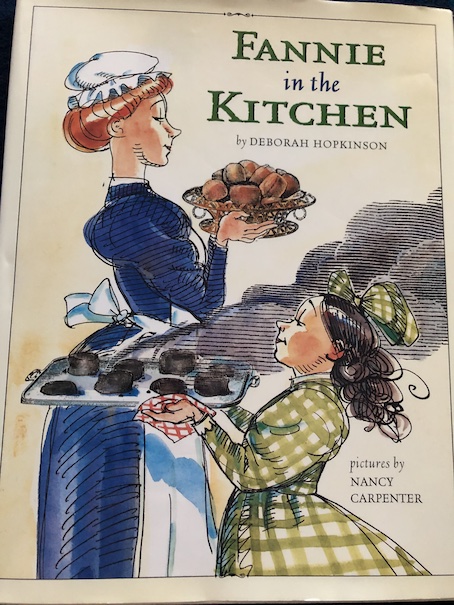
Fannie in the Kitchen by Deborah Hopkinson, 2001.

This is the story of Fannie Farmer and her famous and popular cookbook! When I first heard of the Fannie Farmer Cookbook (originally The Boston Cooking-School Cook Book (1896)), I wasn’t sure whether Fannie Farmer was a real person or if that was just a pseudonym or a marketing name for the cookbook, but Fannie Farmer was a real person in the late 19th century, and that was her real name. The story in this picture book is based on her real life, although details may be fictionalized, and the pictures give the story humorous twists.

In the beginning of the story, a little girl named Marcia Shaw prides herself on how many things she can do around the house and how much help she can give to her mother. However, she’s still a little girl, and there are some things she doesn’t know how to do well. In particular, Marcia doesn’t know how to cook. Now that her mother is expecting another baby, Marcia’s mother decides that she needs to hire some extra household help, especially with the cooking.

Marcia is a little offended that her mother considers her inadequate to help by herself, but when the new help arrives, a young woman named Fannie Farmer, Marcia has to admit that she’s a good cook. Even better for Marcia, Fannie doesn’t consider her cooking techniques trade secrets. She enjoys letting Marcia help in the kitchen and teaching her cooking tips.
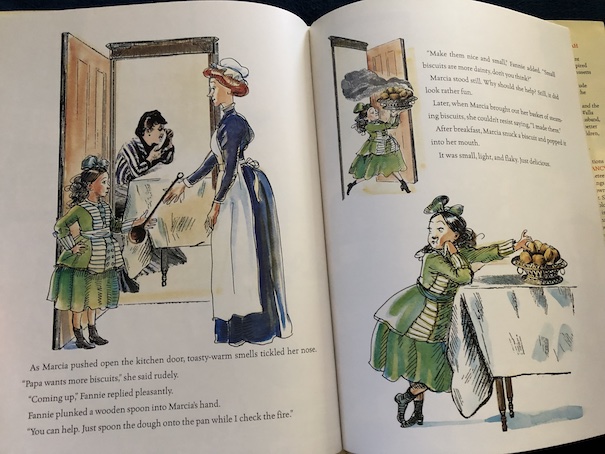
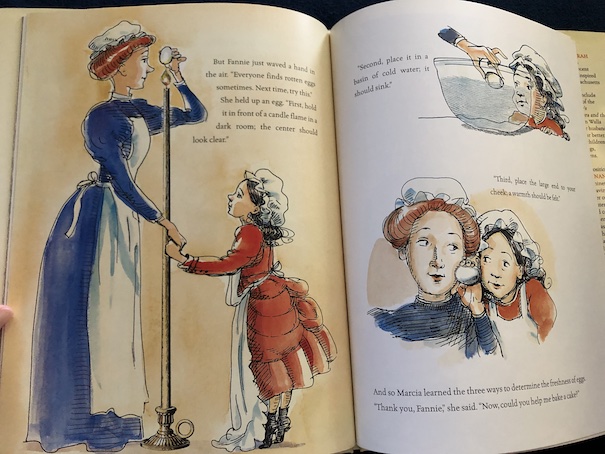
Under Fannie’s tutelage, Marcia’s cooking skills improve. Fannie teaches her many important pieces of information about cooking, like how to measure ingredients and how to tell when ingredients are fresh or if they’ve gone bad.
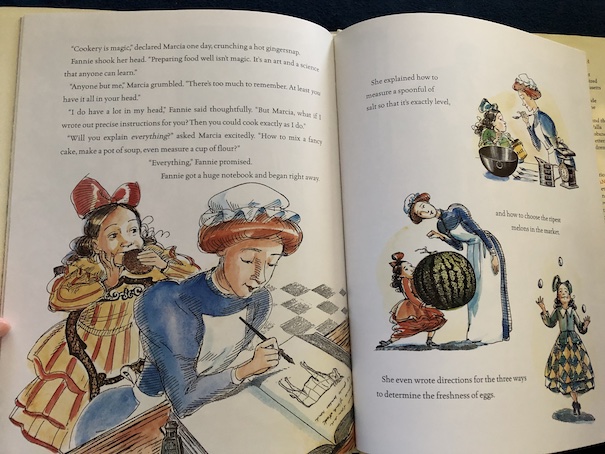
Marcia enjoys learning to cook with Fannie, but she thinks that she’ll never be as good as Fannie because there’s just too much to remember. She doubts that she’ll ever be able to memorize it all. Marcia is amazed that Fannie can keep all of that cooking information in her head. To help Marcia, Fannie decides to write out a notebook with recipes and cooking instructions, including all of the specific measurements for ingredients and detailed information about cooking techniques to make the recipes come out just right.
This is what makes Fannie Farmer and her cookbook so unique for their time period. If you’ve ever seen a very old recipe book or even just old family recipes written down, they often don’t have all of the amounts of ingredients written down, or the amounts are written in very vague terms. Old recipes also offer little to no cooking techniques, like how to tell when it’s time to turn a griddle cake over or how to tell if a cake is done baking. The assumption was that girls (usually girls for this time period) would learn to cook by watching their mothers and by learning from their examples. However, that assumes that their mothers knew all of these cooking tips themselves, that the mothers remembered to tell their daughters what they knew and explained it well enough for them to understand (some people don’t have much of a talent for teaching, even when it’s a subject they know themselves), and that the daughters understood or remembered everything their mothers said. Otherwise, the vague directions in cookbooks and family recipes were of little help, and new cooks had to learn through experimentation or trial and error. Fannie’s approach to cooking, as explained in the story, is an art and a science that anybody can learn if someone explains it well enough, so she puts her focus on recording all of the necessary details of her recipes.

Fannie’s recipe book, started for Marcia, turns out to be very popular with both the Shaw family and their friends and neighbors. As word spreads about it, people start coming by to borrow recipes or get cooking advice. Fannie realizes that there is a lot of demand for better teaching of cooking techniques, and she really enjoys teaching cooking, so she decides to accept a job at the Boston Cooking School.
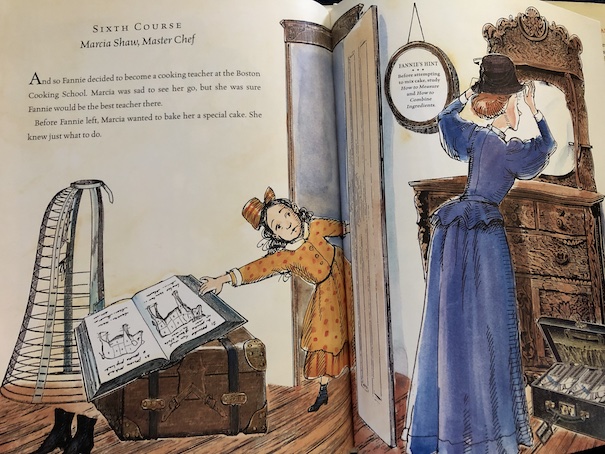
Before Fannie leaves the Shaws, Marcia borrows the cooking notebook and makes a special cake for Fannie to show her what she’s learned. The cake comes out just right because Marcia has followed Fannie’s directions.
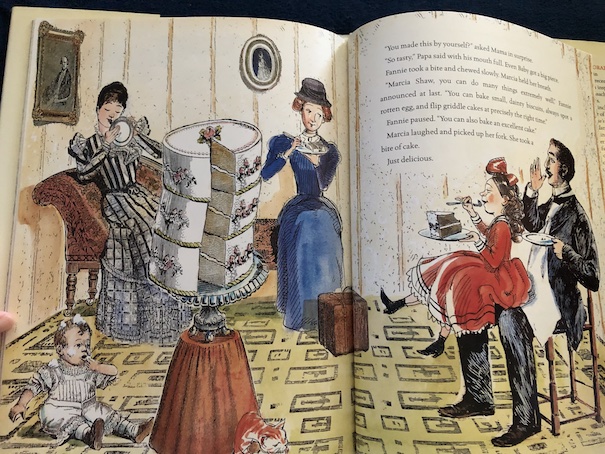
There are hints from the Fannie Farmer cookbook throughout the book, and there is a section in the back of the book with historical information about Fannie Farmer. It also includes a sample recipe for Griddle Cakes.

The book is available to borrow and read for free online through Internet Archive (multiple copies). New and used copies are also available on Amazon. You can also buy the original Fannie Farmer Cookbook through Amazon or read it online through Internet Archive (multiple copies).

My Reaction

One of the things I liked about this book is the illustrations. There are eccentric details in the pictures that add humor to the story, like how Marcia stacks a bunch of chairs on top of each other while making candles, so she can make them extra long, and one of her extra long candles appears later, when Fannie shows her how to tell if an egg is fresh by holding it up to a light. For some reason, Marcia’s mother also has a weird habit of licking her dishes when she’s eating one of the yummy recipes, and there is one picture where it looks like she’s lost control of the baby carriage, and it’s rolling away with the baby. I’m sure these aren’t historical details and were just thrown in to be funny.

I think it’s also important to point out that the real-life Fannie Farmer lived an unconventional life for someone of her time period. She was plagued with health problems from a fairly young age. At some points in her life, she was unable to walk, possibly because of a stroke, and when she walked, she had a limp. She never married, but she built a fulfilling career around her talent for cooking. and achieved lasting fame because she wanted to share her knowledge with others. She is credited with establishing exact and level measurements in cooking in the United States, and she was also a strong believer in quality food and proper nutrition, especially for people with health problems.
Two Wheels for Grover

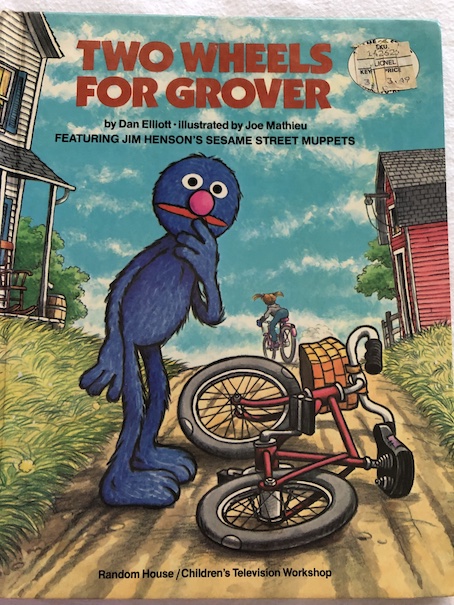
Two Wheels for Grover by Dan Elliott, illustrated by Joe Mathieu, 1984.

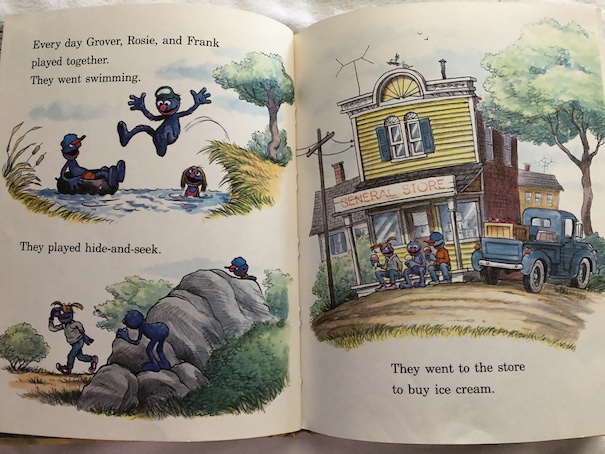
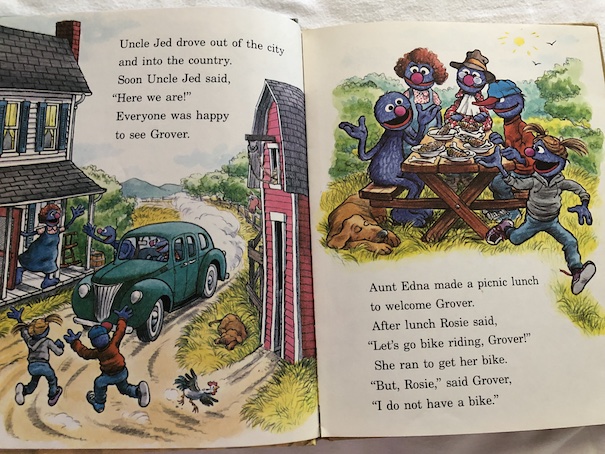
Grover is happy about going to visit his aunt, uncle, and cousins in the country, but the visit becomes a little awkward when his cousin Rosie wants him to go bike riding with her. Grover doesn’t know how to ride a bike.

He points out to Rosie that he doesn’t have a bike to ride, but she offers to lend him one. Not wanting to admit that he can’t ride a bike and being too afraid to learn how, Grover keeps making excuses about why he can’t ride a bike.

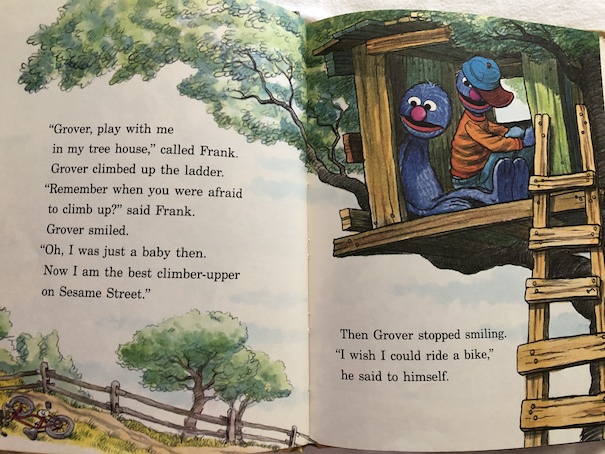
There are still plenty of other fun things to do with his cousins, but the problem of not being able to ride a bike still bothers Grover. Rosie keeps trying to find ways around Grover’s excuses, and Grover keeps trying to find new ones. Secretly, he wishes that he could ride a bike with Rosie, but he is too afraid that he can’t. Grover’s older cousin Frank points out to him that he loves playing in the tree house now, even though he used to be afraid to climb up to it.

Grover eventually confides in Frank his worries about riding a bike, and Frank understands. Big Bird once tried to teach Grover to ride a bike, but he couldn’t do it then, and he doubts whether he can learn. Frank says that the problem is that Big Bird’s bike was too big for Grover, but he could learn to ride a smaller bike, like Frank’s old one.

Although Grover is still nervous, he lets Frank teach him to ride, and soon, he discovers that he can ride a bike!

Grover learns to ride a bike just in time for Rosie to come and tell them that someone is giving away kittens. Now, Grover can ride over with Rosie to get a kitten for himself!

The book is available to borrow and read for free online through Internet Archive. It’s part of a series of picture books with the Sesame Street characters.

My Reaction:

This was a favorite book of mine when I was a kid, even though I found riding a bike much harder than Grover did. Some kids, like me, have more difficulty learning to balance than others, and it was often hard when other kids wanted me to come riding bikes with them when I couldn’t. Learning to ride a bike is one of those rites of passage that most people have during childhood, and it can be difficult for people who take longer to learn.

However, this book focuses on the rewards of perseverance. Just because Grover had trouble the first time he tried to learn to ride a bike doesn’t mean that he can’t do it. Frank understands that Grover is nervous about riding a bike, and it helps that he points out that there are other things that Grover has found difficult before that are now easy and fun for him, like climbing into the tree house. Learning new things can take time and multiple tries, but there are rewards for those who keep trying!

Aunt Morbelia and the Screaming Skulls

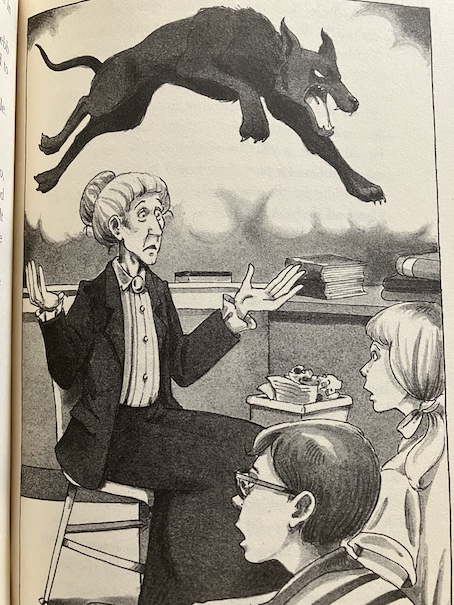
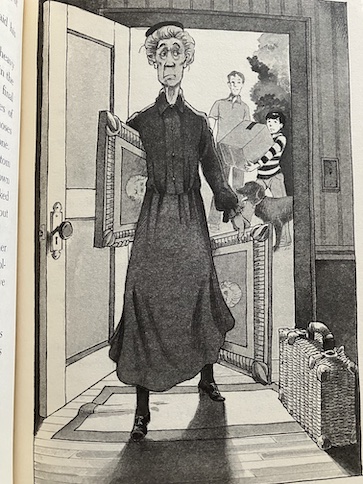
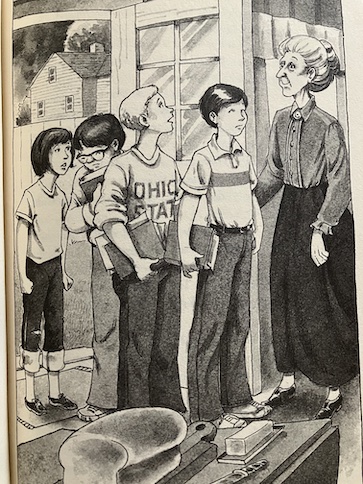
Todd Fearing is worried because his Great-Aunt Morbelia is coming to live with his family.  He has never met her before, but he has heard that she is rather strange, and he knows that his life will never be the same again.  Aunt Morbelia is very superstitious, and she sees bad omens everywhere.  When she first arrives at Todd’s house and sees that the family owns both a black dog and a black cat, she takes it as a sign that she should leave right away.  It takes a lot persuading to get her to stay on a trial basis.  By Joan Carris.

Having Aunt Morbelia at his house is sort of a mixed blessing.  On one hand, Aunt Morbelia likes baking good things for him to eat and helps him with his homework.  Todd is dyslexic and has extra assignments to help him improve his reading.  Aunt Morbelia used to be a teacher, and Todd really appreciates the help she gives him. On the other hand, Todd doesn’t like scary stories, and Aunt Morbelia’s talk of ghosts and bad omens gives him nightmares.  His friends like to hear her stories, particularly Rocky, a girl who typically doesn’t like feminine things.  Rocky, whose real name is RosaLynn, constantly pesters him about when Aunt Morbelia will tell more stories. 

Eventually, Todd gets tired of Rocky’s obsession with ghost stories and the way she encourages Aunt Morbelia to keep telling them, and he and his best friend, Jeff, decide to play a trick on her to cure her appetite for scary stuff.  However, their trick backfires, and in their attempt to make it up to everyone, especially Aunt Morbelia, they end up making things worse. 

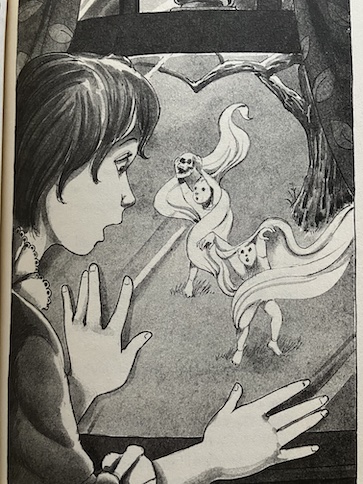
Todd and Jeff succeed in scaring Rocky by dressing up as ghosts and showing up at her house in the middle of the night. They have so much fun with their trick that they decide to go to their friend Alan’s house to try it on him. Alan lives in the house right behind Todd’s, and that’s where they run into trouble. When they start their ghost act, they can’t get Alan to wake up and come to the window to see them. Jeff decides to throw a rock at Alan’s window to wake him up, but the rock breaks the window. To make matters worse, they startle Todd’s black cat, causing the cat to yowl. The boys run back to Jeff’s house, but Jeff’s father catches them. Todd has to go home and apologize to Aunt Morbelia, who was frightened very badly when the cat started howling.

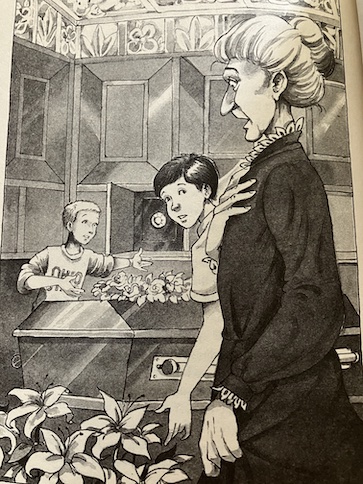
The boys decide to take Aunt Morbelia on a tour of the historic places in town to make up for scaring her. Unfortunately, Jeff includes the funeral home that his father runs on the tour because it is in one of the oldest buildings in town. Although Todd tells her that she doesn’t have to go in if she doesn’t want to, Aunt Morbelia thinks that it would be rude to refuse. Unfortunately, Jeff’s father arrives with a dead body before their tour ends, and Aunt Morbelia faints when she sees it. Aunt Morbelia tells the boys that it isn’t their fault, but she says that she’s not sure she really belongs in their town. Even with all of Aunt Morbelia’s superstition craziness and spooky stories, Todd still doesn’t want her to leave.  Is there still something he can do to convince her to stay?

The book is currently available online through Internet Archive. There is also a sequel to this book, Beware the Ravens, Aunt Morbelia!

When I first read this book, I was expecting a spooky mystery, but it’s really more about a boy adjusting to a relative coming to live with his family and dealing with his dyslexia. Although Todd initially has some reservations about Aunt Morbelia living with him and his parents and her spooky stories scare him, Todd and Aunt Morbelia gradually come to understand each other better, and Todd genuinely wants her to stay. To help Aunt Morbelia change her mind about leaving, Todd has all the people who have met Aunt Morbelia since she arrived come by the house and tell her how much they all want her to stay.  After everyone has visited her, Todd himself tells her that he doesn’t want her to go.  They talk about the scary stories and how Todd feels about them, and Aunt Morbelia tells Todd that if he doesn’t want to hear a scary story, he can be honest with her and tell her so.  Now that the two of them understand each other better, Aunt Morbelia agrees to stay, and she accepts the invitation that one of Todd’s teachers makes to help tutor children at the learning center.

I didn’t like the part where the boys played the trick on Rocky and how awkward things were with her afterward. Jeff’s father says that part of that, with Rocky drifting away from her friendship with the boys, is because the kids are growing up. He says that, as they grow up, girls start changing before boys do and have different interests from boys and different ways of looking at things, including more tomboy girls, like Rocky. Toward the end of the story, Rocky does appear to need more friendships with other girls, and Todd decides that Jeff’s dad is probably right, that Rocky thinks and acts differently from his guy friends because she’s a girl, even if she’s usually not a particularly “girly” girl. Part of that may be true, but the boys’ trick was pretty mean. I think that the real issue is that real friends shouldn’t do that to each other, and Rocky might really be questioning what she’s looking for in a real friend. Although, to hear some of my male friends talk about their youths, boys (at least certain ones) might be more accepting and forgiving of that kind of rough humor from friends than girls would be, so perhaps boys vs. girls issues are partly at the heart of it.

I thought that the parts where Aunt Morbelia was helping Todd with his dyslexia were interesting. I don’t really have any experience with the condition myself, and I’m not quite sure what techniques teachers really use to help dyslexics. One of the tricks that Aunt Morbelia uses is to break down tasks into smaller pieces to make them more manageable. For example, Todd feels badly that he can’t keep the orders of months straight. When he tries to recite the months of the year in order, he mixes them up, which makes him feel bad because most kids his age should be able to do this easily. When I first read this, I wasn’t sure if this is a common issue among dyslexics, although I thought that I remembered reading something about dyslexics having trouble remembering the orders of certain things, like lists of instructions. I looked it up, and apparently, it is a common issue, along with memorizing things like days of the week. There are different techniques for handling it, some of which involve associating the things to be remembered with something else that sticks in the mind more easily, such as a rhyme or song. Aunt Morbelia does some association with Todd but she also breaks the months down into groups of three, representing the four seasons of the year, and giving him small bits of information to memorize. She calls the spring months, “the flower months” and the fall months “the leaf months” and so on. Todd finds that technique helpful, and Aunt Morbelia says that once Todd has mastered the seasons of the year, they will put the season of the year together so that he can recite the entire year. Todd also describes other ways that he is affected by his dyslexia and techniques that his teacher uses to help him.

The Beast in Ms. Rooney’s Room

The Kids of the Polk Street School

BeastMsRooney#1 The Beast in Ms. Rooney’s Room by Patricia Reilly Giff, 1984.

It’s the start of a new school year, and Richard Best (nicknamed “Beast”) is embarrassed to find himself in Ms. Rooney’s room once again because he was held back a year for his poor reading skills.  Everyone he knows has moved on to the third grade, and he’s still in a second grade class with kids who were first grade babies last year.  He feels awkward, being the tallest, oldest person in class, and kids in his old class tease him and refuse to let him play baseball on the playground with them because he’s a pathetic “left-back.”

At first, Beast tries to pretend that it was all a horrible mistake that will be straightened out soon, but that just makes him feel bad for lying.  The kids who are now in the same class he is, who he still thinks of as “babies,” try to make friends with him, but he doesn’t accept them at first because of his embarrassment at being older and still not as good at reading as some of them are.

BeastMsRooneyPic1However, even though he’s embarrassed at having to attend special reading classes with Mrs. Paris while most of the rest of his class has normal reading, these special classes really help him, not just to improve his reading skills, but to connect with other kids in his new class who have the same reading difficulties he does and who understand how he feels.
Beast discovers that it’s no shame to not know something or to have trouble doing something because everyone has different skills and it can take some people longer to learn certain things than others.  Emily Arrow, the girl who now sits next to him in class is a whiz at math but has as much trouble reading as he does.  Beast learns some new skills from his new, younger classmates and realizes that they’re not really babies.  They also really appreciate him and help him see some of the good things about himself.

The book is currently available online through Internet Archive.

Totally Useless Skills

uselessskills

Totally Useless Skills by Rick Davis, 1994.

The name of this book is intentionally deceptive, but only partly.  What I mean by that is that the little tricks and stunts in the book may not have much of a practical application except for just having fun and amusing your friends, but the techniques for learning them can be applied to learning just about anything.

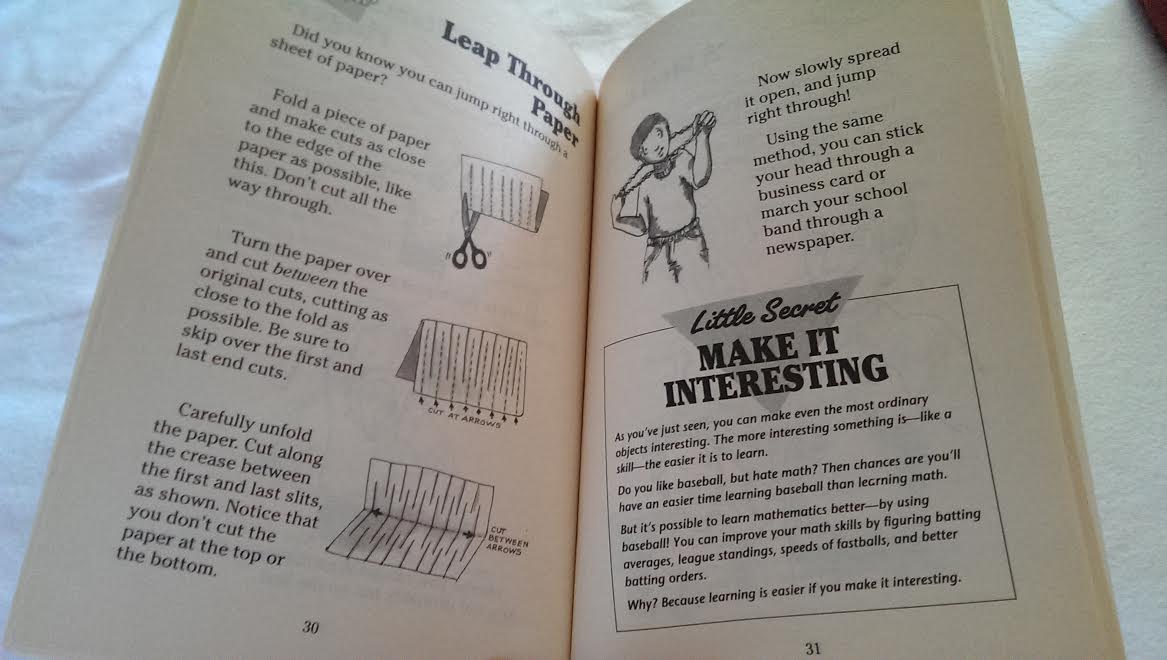
This book describes how to do fun tricks that don’t require any special equipment and are mostly based upon knowing things work, like the blind spot in the human eye (such as using the blind spot in your eye to make it look like your teacher’s head has vanished) and where your center of balance is (used in the trick showing how a girl can pick up a chair when a boy can’t). The tricks include making it look like your arms are lengthening or shrinking, making it look like you’ve broken your nose, how to hang a spoon from your nose, how to jump through a single sheet of paper, how to make a pencil float, how to make your leg disappear, and how to pronounce the longest word in the English language.

uselessskillspic1

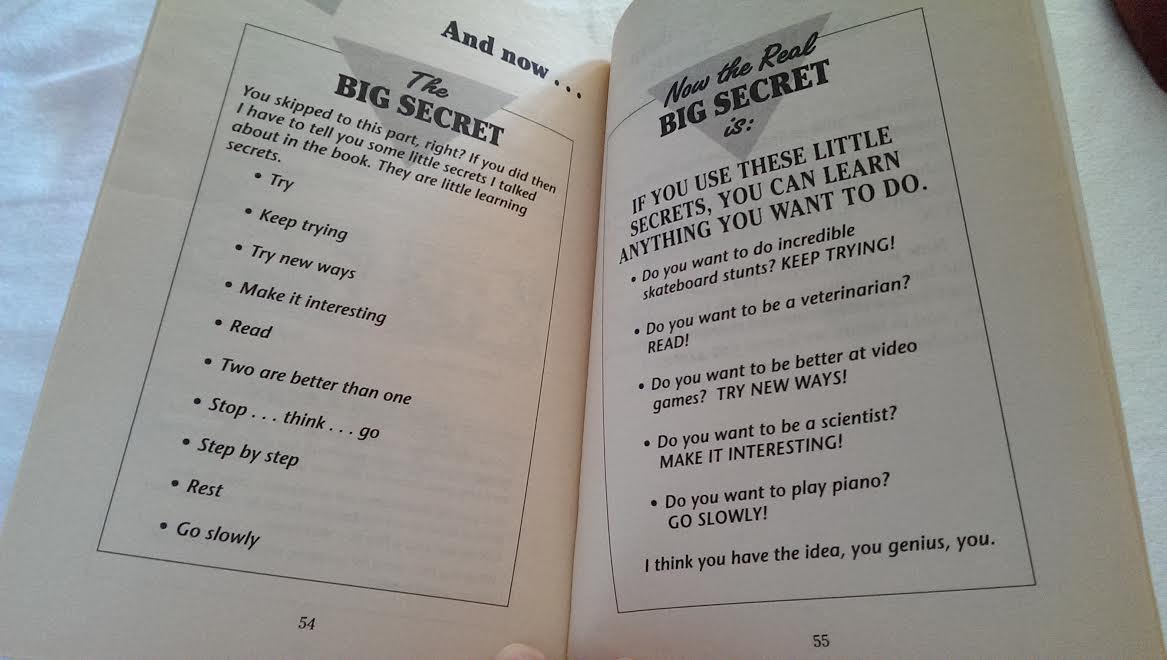
Kids will enjoy learning these little tricks to entertain their friends. However, the book also contains useful tips for learning these skills that can be used to learn anything you want to learn. The author emphasizes the importance of trying new things, practicing what you’ve learned, going slowly and dividing big tasks into smaller ones when trying to master something difficult, and making tasks interesting so they will be easier to learn. Aside from the fun of learning these little tricks, the book’s main purpose seems to be helping kids to develop self-confidence and new learning skills.

The book is currently available online through Internet Archive.

uselessskillspic2