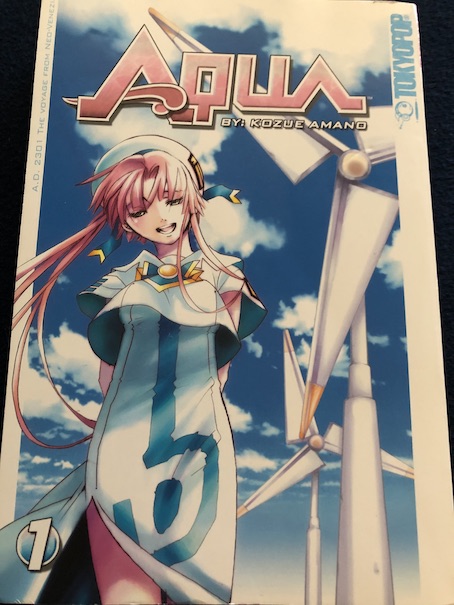
Aqua Volume 1 by Kozue Amano, 2003, English Edition 2007.
I debated at first about whether or not I wanted to include any Japanese manga or light novels in this blog. When I was in high school and college, I knew a lot of people who were really into anime and manga, and I know that there are teens who still are, and my overview of children’s literature in different decades wouldn’t be complete if I didn’t mention that. However, the variety is pretty extensive, some of the series run very long, and it’s impossible to just skip around in some series because the story-telling is very linear, and I didn’t want them to take over the blog. Also, I tend to like the less popular ones, so I’d be bound to get some grumbling from manga fans about why I chose these when there are so many others that are more exciting or more iconic. Notice that I didn’t say “better.” “Better” is subjective, and I like what I like. I decided to go ahead and make an exception in this case because this is one of my favorite manga series and because I think this is something that people could really use right now. The stories are very calming, and they’re good to read during stressful times.
This book is the first volume of a series. I don’t have them all because they haven’t all been published in English yet, but know how it ends, and it’s a really good series with a happy ending. If you’re not familiar with manga, they’re basically graphic novels from Japan. I can’t read Japanese, so I rely on the English translations. However, manga like this typically follow the Japanese format of reading from right to left instead of left to right, like in English, so the books open and the pages flow in the opposite direction. When you look at the panels on a page, remember to look at them in right to left order.
The Aqua and Aria series is unusual because it combines elements of science fiction and fantasy, but most of the stories themselves aren’t really either science fiction or fantasy. That’s just the setting for the stories. The stories themselves are more slice-of-life, about daily events or small adventures in the lives of the characters and sometimes lessons they learn from them. There is a lot of emphasis on slowing down and enjoying the simple pleasures in life.
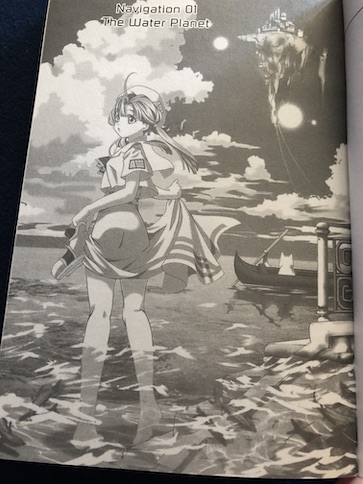
The series takes place in the future, when Mars has been terraformed and renamed Aqua (because of all the water on its surface). The human colonies on Aqua are designed to resemble cities on Earth (called Manhome here). The people of Aqua prefer a much slower pace of life than people on Manhome, and aspects of life on Aqua more closely resemble Earth’s past.
A young girl, Akari Mizunashi, comes to Aqua to learn to become a gondolier in the city of Neo Venezia, which resembles Venice. Female gondoliers, called Undines, give tours of the city, giving Akari plenty of time to admire the beauty of her new home and meet interesting people.
There are two parts to this series, called Aqua and Aria. The two Aqua books are the prequel to the main series, Aria. Aqua is only two volumes long, and it covers Akari’s arrival on the planet, her introduction to life on Aqua, and the people who will be her friends. In the Aria books, Akari progresses in her training as an Undine. All of the books in both series contain several short stories.
This book, the first one in the Aqua series, focuses on Akari’s arrival on Aqua and her friendship with Aika, the first fellow Undine trainee she meets.
The stories included in this first volume are:
The Water Planet
The series begins with Akari Mizunashi on the shuttle carrying her from Manhome to Aqua. She is typing a message to someone on her computer, but there is nothing to indicate who she is writing to. This is a running theme throughout the series, but the identity of Akari’s pen pal isn’t revealed until the very end of the series, and it wouldn’t make sense if I told you who it is right now. Akari explains a little about the history of Mars/Aqua, and how the melting of Mars’s polar ice caps during the terraforming of Mars 150 years earlier has turned it into a water planet, earning it the name Aqua. Currently, the year is 2301.
One of the nice things about the Aqua/Aria series is the imagery. As Akari’s shuttle arrives at Mars/Aqua, the walls of the shuttle turn transparent, so the travelers can feel like they’re flying in with the seagulls.
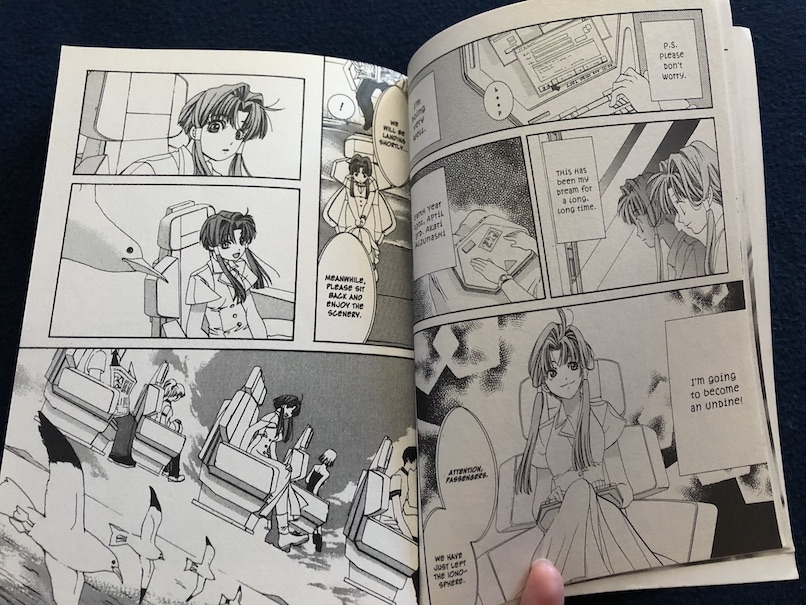
On Earth/Manhome, Akari lived in Tokyo, Japan. The modern cities of Manhome are very tidy and convenient, with people able to work and shop from home. Still, Akari has felt like something is missing from her life in all the convenience and tidiness. In Neo Venezia on Aqua, people rely on boats constantly to help them get around town, which is inconvenient, but Akari finds it calming and peaceful, which is why she wants to become an Undine, one of the female gondoliers who act as tour guides and help travelers to navigate Neo Venezia. Overall, life on Aqua and in Neo Venezia has a much slower pace than that on Manhome.

Akari arrives on Aqua and meets a friendly mailman and the only two employees of the gondola company she will work for: her mentor, Alicia, and the company’s president, a Martian cat named Aria. All gondola companies on Aqua have a Martian cat as their mascot/president. Alicia explains that Martian cats are as intelligent as humans, even though they can’t talk, but in many ways, President Aria still acts like a very large kitty.

The Guide on the Water
Akari wakes up on her first morning at the gondola company Aria, and she meets Aika, who is a trainee at Himeya, another gondola company. She catches sight of Aika hanging around, watching Alicia, and Aika witnesses Akari’s first time practicing in a gondola under Alicia’s watch.

Akari is embarrassed to learn that when she practiced rowing on Manhome, she was doing it backwards, standing in the front of the boat, which would block the view of her passengers. Because Akari practiced the wrong way on Manhome, she can row very fast the wrong way, but is clumsier when she tries to row the correct way.

However, Aika tells Akari that Alicia is the best of the Undines, and Akari is reassured that under Alicia’s guidance, she will do better. Aika hero-worships Alicia (for reasons that are explained further in later books), and she agrees to become Akari’s friend partly so that she can see more of Alicia. Aika and Akari become best friends through the course of the books, sharing their training and adventures.

The City Submerged
Akari wakes up one morning and is shocked to find that the lower floor of Aria company has flooded, but Alicia explains to her that this is a natural phenomenon in Neo Venezia in Spring.

Much of the city is flooded during this high tide, causing many of the businesses in town to close temporarily and making it unsafe to go out in gondolas. However, when President Aria needs more of his favorite food, Akari decides to venture into the city on foot.
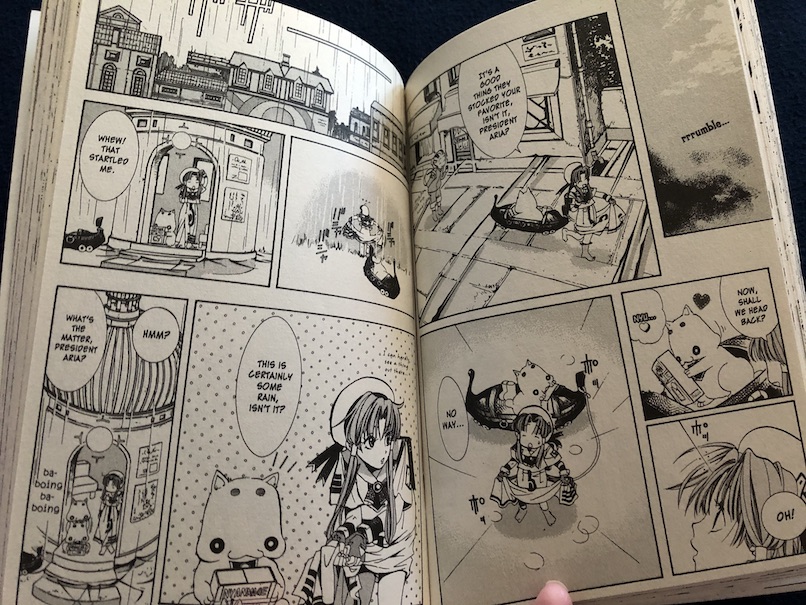
On the way home, Akari and Aria are stranded when it starts to rain and travel become more dangerous, but Aika sees them and invites them to spend the night at Himeya Company with her. Himeya Company is a much larger gondola company than Aria Company, with many more employees living there.

Aika and Akari have a sleepover in Aika’s room, and Aika asks Akari who she’s always writing to, but Akari tells her that it’s a secret. When the rain stops, Akari admires the view of the water by moonlight. (There are two moons in the sky because this is Mars.)

The Kingdom of Cats
President Aria sometimes ventures off alone, and Alicia tells Akari the story of Cait Sith and the mythical kingdom of cats.
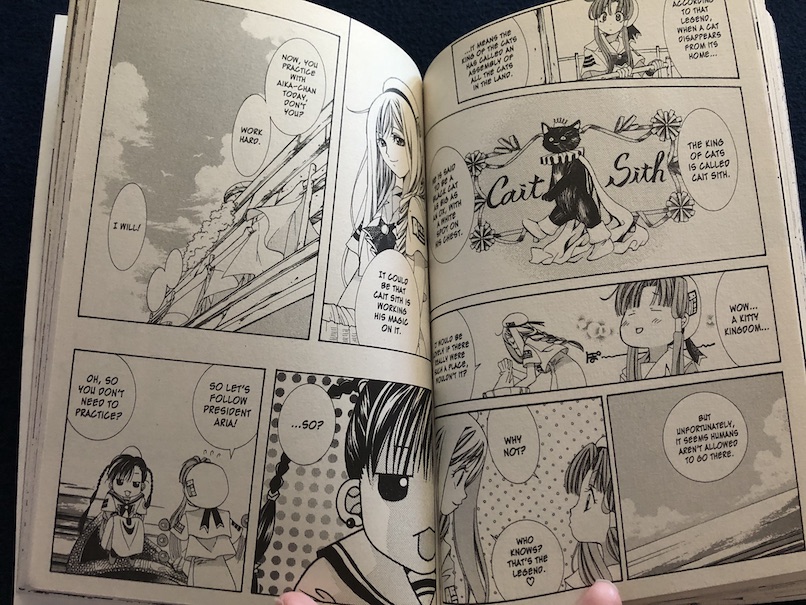
When Akari and Aika practice their rowing together, Akari convinces Aika to help her follow President Aira to see if there’s any truth to Alicia’s story perhaps get a look at the kitty kingdom ruled by the legendary king of the cats, Cait Sith.
However, the trip is stranger than they bargained for. The girls find themselves on a strange waterway through apparently abandoned buildings, going around in circles until President Aria points the way out. Akari only gets a glimpse of the cats before they leave.

The Hill of Hope
Aika shows up at Aria company one morning to brag about how she has been promoted to single (the next step up in gondola training, as shown by the gloves that the girls wear – as the trainee Undines learn the techniques to row their boats more skillfully, they get fewer callouses and need their gloves less, removing them one at a time as they are promoted to new levels).
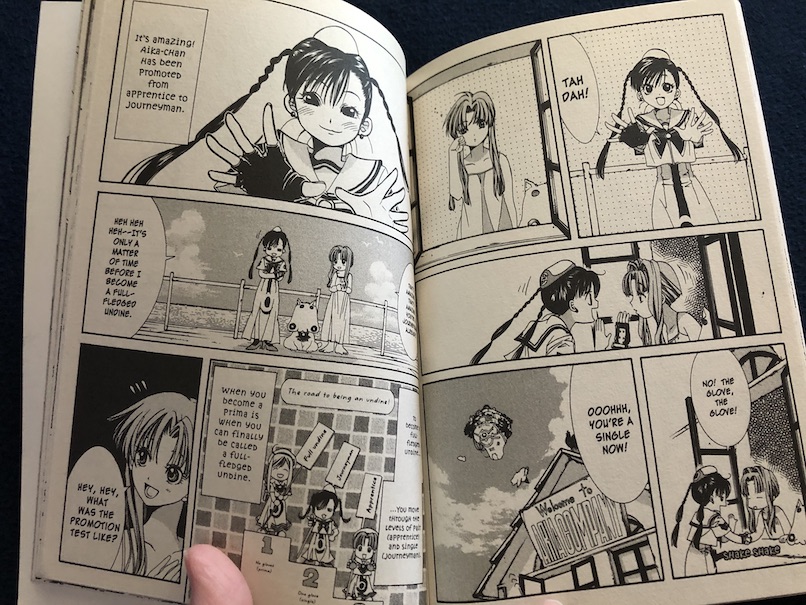
Akari tries to ask Aika what the promotion test is like, but Aika refuses to tell her. The Undines traditionally keep the test a secret from their trainees until they pass the test. When Alicia hears about Aika’s promotion, she decides to take Akari on a special picnic, giving her the opportunity to prove her skills and introducing her to the concept of aquatic elevators, or canal locks. There is a special surprise for Akari at the end of the journey.






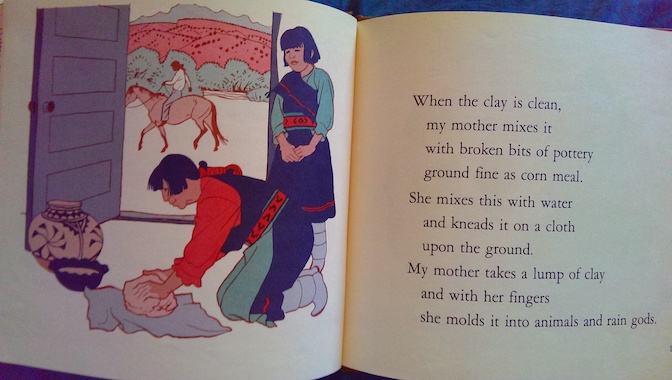


 #1 The Beast in Ms. Rooney’s Room by Patricia Reilly Giff, 1984.
 However, even though he’s embarrassed at having to attend special reading classes with Mrs. Paris while most of the rest of his class has normal reading, these special classes really help him, not just to improve his reading skills, but to connect with other kids in his new class who have the same reading difficulties he does and who understand how he feels.
 Going to School in 1776 by John J. Loeper, 1973.
 These explanations are told in story form, rather than simply explaining listing the ways children could live, learn, and go to school, trying to help readers see their lives through the eyes of the children themselves. The children’s lives are affected by the war around them. As the book says, many town schools in New England were closed during the war, so the students would attend “dame schools” instead. A dame school was a series of lessons taught in private homes by older women in the community. In other places, such as cities like Philadelphia, official schools were still open. Discipline was often strict, and school hours could be much longer than those in modern schools. Sometimes, children would argue with each other over their parents’ positions on the war.
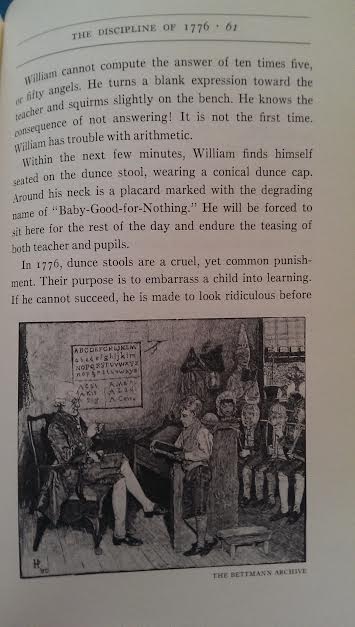 There were different standards for what girls and boys were expected to learn because their learning was guided by what they were each expected to do with their adult lives. A typical school might teach boys subjects like, “writing, arithmetick [sic], accounting, navigation, algebra, and Latine.” Generally, “reading, writing, arithmetic, and religion” were common elementary school subjects. Latin lessons and other advanced subjects were typically for boys who planned to become lawyers or clergymen. Girls were likely to receive little formal education beyond reading and writing, and black people were less likely to receive even that.

 Jestress's Forgotten Books and Stories