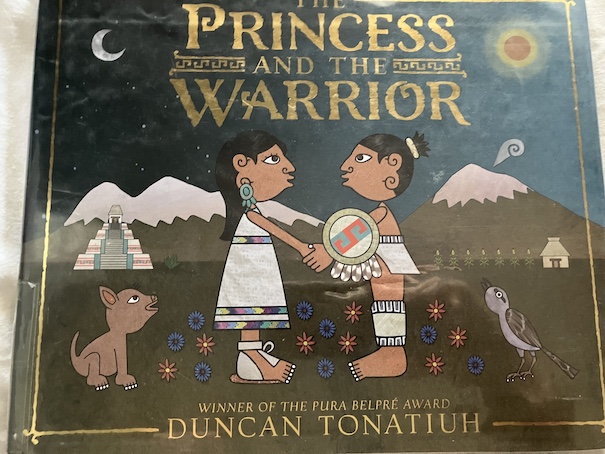
The Princess and the Warrior by Duncan Tonatiuh, 2016.
This story is a folktale about the origins of a pair of volcanoes near modern Mexico City.
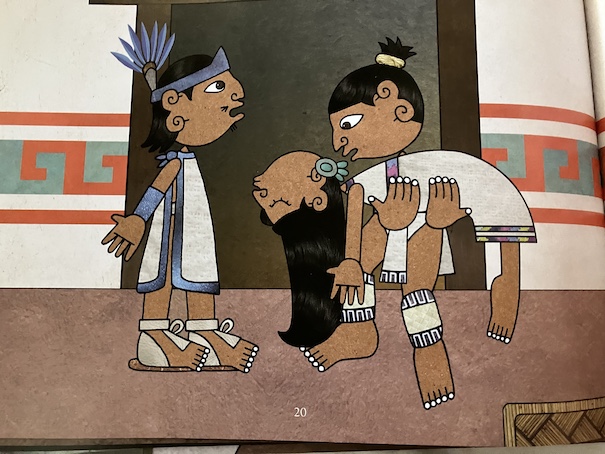
The Aztec emperor had a beautiful daughter, Princess Izta, and there were many men who wanted to marry her. They gave her many wonderful gifts, but Princess Izta wasn’t impressed by any of them.
The man she loved was a warrior called Popoca. Unlike her other suitors, he really loved her for the person she was. The emperor disapproved of Princess Izta marrying a warrior who wasn’t from a wealthy, influential, or royal family, but he also knew that Popoca was brave and a good warrior. Their kingdom was at war with a neighboring kingdom, led by Jaguar Claw, so the emperor promised Popoca that, if he could defeat Jaguar Claw, he would allow him to marry Princss Izta.
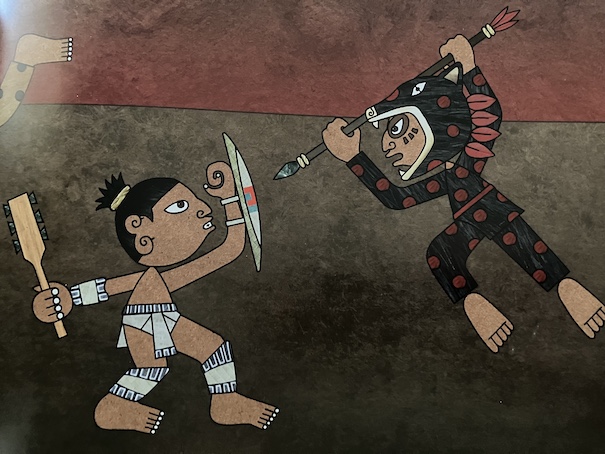
There were hard battles against Jaguar Claw, but Jaguar Claw gradually realized that he would lose the war. As a final act of revenge before defeat, he sent a messenger to tell Princess Izta that Popoca was dead. Worse still, the messenger gave Princess Izta a potion that would supposedly help her with her shock but which put her into a deep sleep.
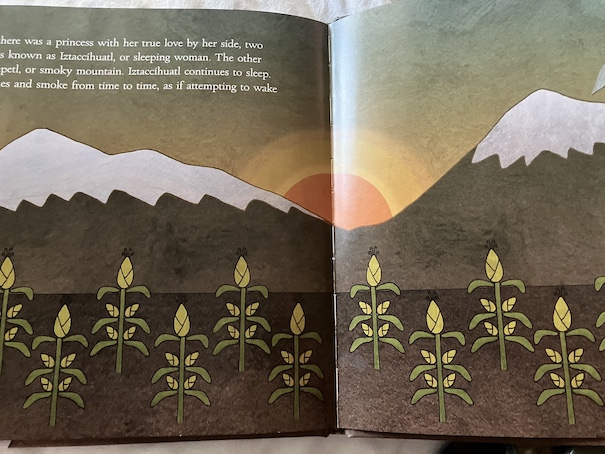
When Popoca finally returned victorious, he was shocked and grieved to find Princess Itza in a deep sleep, from which nobody seemed able to wake her. He sat by her side, waiting for her to wake up. The story is based around the two volcanoes, one which looks like a sleeping woman and is dormant, and the other which looks like it’s sitting upright and shows signs of activity.
There’s an author’s note in the back of the book about the origins of the legend and how this version of it differs from other versions and about the volcanoes that inspired the story, Iztaccihuatl and Popocatepetl. There’s also a glossary of Nahuatl words used in the story.
My Reaction
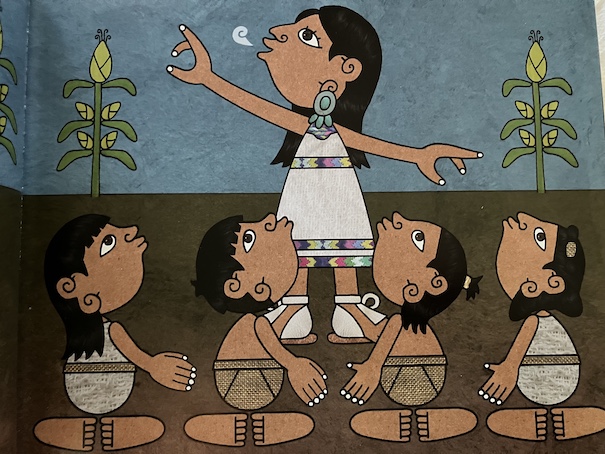
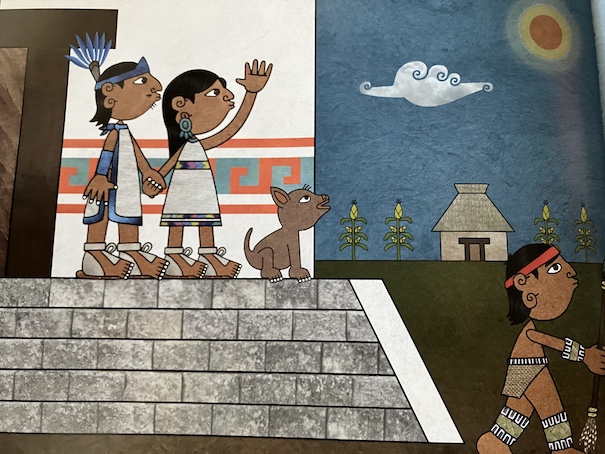
I hadn’t heard this story before, but I enjoy folktales from around the world! The art style is fascinating, incorporating aspects of traditional Aztec art, such as showing things in a very two-dimensional style and human beings in profile. Even though there is fighting depicted in the story, it isn’t too graphic for children
When I was a kid, I would never read author’s notes, but I appreciate them as an adult, especially in cases like this, where they provide more information about the background of legends. This picture book is meant for children, but it can also be fascinating for adults, especially with the addition of the background information.
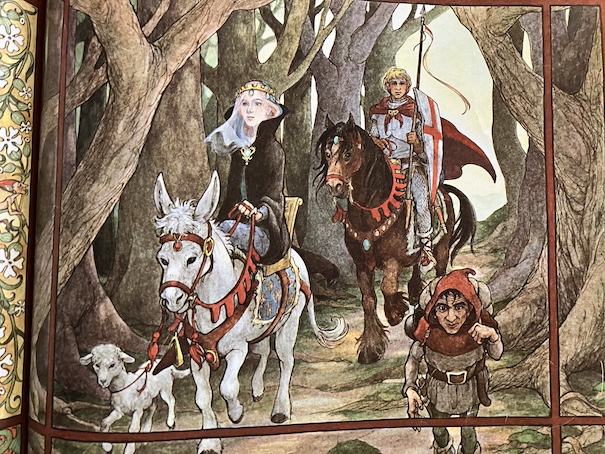
The Red Cross Knight, who carries a shield decorated with a red cross, does not know his own name or even where he came from. He only knows that the Queen of the Fairies has sent him to face a terrible dragon. He is accompanied on his journey by a princess with a little white lamb and a dwarf. The Princess’s name is Una, and her kingdom is being attacked by the dragon.
On their journey, they meet a hermit, who shows the knight a distant palace on a mountaintop, where angels travel between the palace and heaven. It’s so beautiful that the knight wants to go there immediately, but the hermit says that this palace is in another world and that he cannot go there until he faces the dragon. The hermit also reveals the knight’s past to him. He is not one of the fairy folk, although the fairy folk are the ones who sent him. The hermit knows that he was kidnapped by the fairies as a baby and hidden in a farm field, where he was discovered by a plowman who named him George. His true destiny is to become Saint George, the patron saint of England.
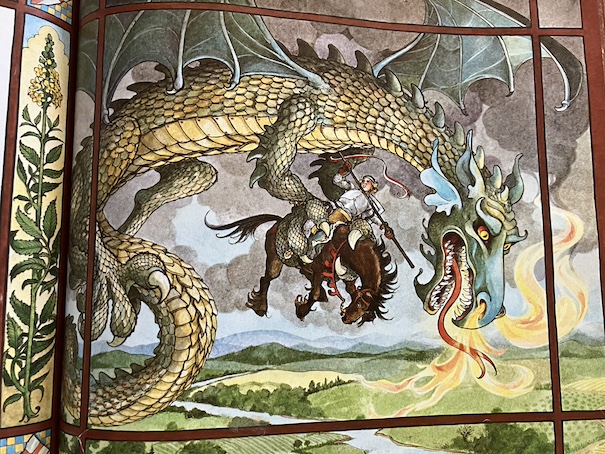
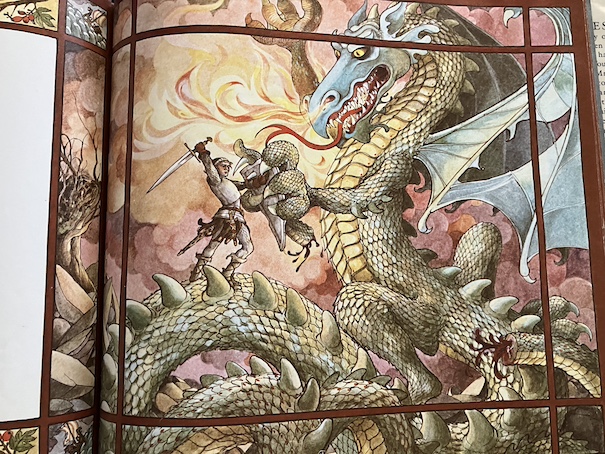
Una takes George to her parents’ fortress. As they approach, they see the dragon for the first time. George sends Una away from danger, and he and the dragon battle for the first time. The dragon picks up George, horse and all, and throws them to the ground. George manages to drive the dragon away, but he is also injured. At first, he and his friends think he is going to die, but he lies down in an ancient spring that cools and heals him. By morning, he is able to rise and fight again.
The second time George fights the dragon, he is able to cut off part of the dragon’s tail and one of its paws. The dragon’s fire finally drives George away, and once again, George seems too wounded to survive. However, he rests under an apple tree that drops healing dew, and George survives.
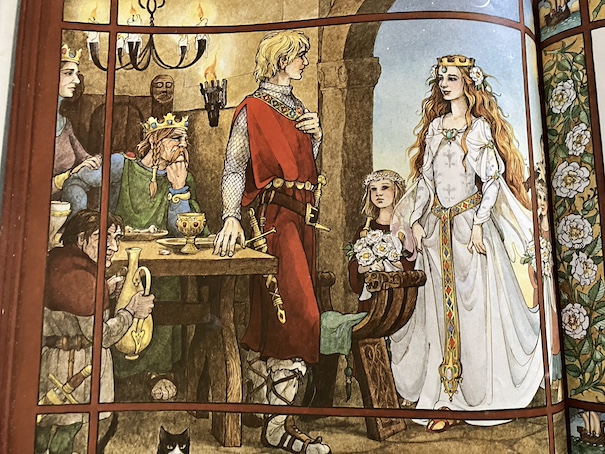
The third time George and the dragon fight, George manages to kill the dragon. Everyone celebrates, and Una’s parents thank George. The king gives George rich rewards, but George passes them on to the poor people. George is bound to the service of the Fairy Queen for six years, but the king allows George to marry Una and promises him that he will become the next king when his service is finished.
The book is available to borrow and read for free online through Internet Archive.
My Reaction
I love the colorful illustrations in this story, although some of them seemed a bit brutal for an audience of young children, showing George badly injured and the dragon spurting blood. Because I love folklore, I know that the legend of St. George and the Dragon is a Christian allegory, although it has some basis in earlier folktales and historical figures. I’ve heard different interpretations of what the dragon is supposed to represent. It can be a symbol of evil, the devil, or sin, and I think I’ve heard that it could represent paganism, which was replaced by Christianity (represented by St. George in the story), although I can’t remember where. In a way, I think this is one of those picture book that might mean more to adults because they would understand more of the symbolism, history, and folklore references in the story. On the other hand, who doesn’t love a story that ends with a gallant knight marrying a beautiful princess?
As another odd piece of literary trivia, the legend of St. George has a connection to another story that I’ve on this blog, Phoebe the Spy. The connection isn’t an obvious one because Phoebe the Spy was set in New York during the American Revolution, which seems far removed from Medieval England. However, on April 23, 1770 (St. George’s Day), the St. George Society (originally called the Sons of St. George) was founded at the Fraunces Tavern in New York, just six years before the story of Phoebe the Spy begins at the same tavern. The St. George Society was and still is a charitable organization that helps immigrants from Britain, using the patron saint of England as its namesake.
#23 The Mystery of the Invisible Dog by M. V. Carey, 1975.
Shortly after Christmas, a frightened man, Fenton Prentiss, calls the Three Investigators to his apartment to help him. Mr. Prentiss is an elderly art collector, and he says that he is being haunted. Things in his apartment get moved around when he’s not there, and he can tell that someone has been reading the mail in his desk. Sometimes, he even sees a shadowy figure when he is home, although he’s never gotten a good look at it before it disappears. He swears that it can’t be another person because he’s the only one who has a key to his apartment. He is also sure that there are no secret passages in his apartment building and that there’s no way for any living person to enter his apartment without being seen by someone. Mr. Prentiss could just be imagining the haunting, but Jupiter is intrigued, and if the boys don’t have a mystery to work on during the holidays, they know that Jupiter’s aunt will just assign them a bunch of chores.
They tell Mr. Prentiss that they need to talk over the assignment together before they accept his job, but Jupiter’s mind is made up when he also sees a shadowy figure that he initially mistakes for Pete just before they leave the apartment. However, Pete is not in the room where Jupiter saw the shadow. Did Jupiter just see Mr. Prentiss’s mysterious ghost?
When the boys get outside the apartment, they hear a loud bang and running feet and see a man in a ski mask running away. Pete tries to follow, and the police stop him, thinking that he might have something to do with a burglary that has just taken place. Fortunately, Mr. Prentiss speaks up for Pete, saying that the boys only just left his apartment and couldn’t have anything to do with what the police are talking about. The police think that the suspect who ran away could have gone into a nearby church, but he seems to have vanished. Mr. Earl, the janitor and caretaker of the church swears that he was in the church the whole time and no one came in, although the housekeeper at the rectory, Mrs. O’Riley, says that Mr. Earl is practically deaf and wouldn’t have heard anybody.
The place that was burgled turns out to belong to a deceased artist friend of Mr. Prentiss. His friend’s death is part of the reason why Mr. Prentiss is so on edge because it was very upsetting to him. The artist’s brother, Charles, hadn’t finished clearing out his brother’s house when it was robbed. He tells the boys that his brother was a sculptor, and his best piece was based on a legend of a ghostly, demonic hound from Eastern Europe. This is the sculpture that was stolen. It’s a bitter blow to Mr. Prentiss because the artist made this sculpture especially for him.
Jupiter believes Mr. Prentiss that someone has been sneaking into his apartment, so he sets a trap that will cause the intruder’s hands to be stained. Mr. Prentiss leaves for a while with the boys, and when they return, his nosy landlady’s hands are stained, indicating that she has been the intruder. Mr. Prentiss confronts her, and she admits that she had a spare key made for his door. The landlady has a long-term habit of spying on her tenants. Mr. Prentiss confiscates her spare key and thinks that his problem is over, but really, it’s just beginning.
Having seen the shadow in Mr. Prentiss’s apartment himself, Jupiter knows that the mysterious shadowy figure was not the landlady. For Jupiter to have mistaken the shadowy figure for Pete, he knows that the person is male and of similar size to Pete. Jupiter is not surprised when Mr. Prentiss calls them up to say that he’s seen the shadow again. The landlady was undoubtedly snooping, but there must also be a second intruder. At first, Jupiter thinks that he knows who the second intruder must be because there is another person in the apartment building who vaguely resembles Pete and who also seems to know about things that Mr. Prentiss owns when he’s supposedly never been in Mr. Prentiss’s apartment before. However, this person is accounted for when the intruder makes another appearance. Jupiter investigates the nearby church when he sees a light there, and he has a frightening encounter with a figure that Mrs. O’Reilly believes is the ghost of the former pastor.
Mr. Prentiss soon gets a ransom demand from the person who stole the sculpture. Then, strange misfortunes start to befall Mr. Prentiss’s neighbors. Some of these misfortunes look like accidents while others are direct attacks. Someone is apparently attacked by the thief, someone else is poisoned, someone’s apartment catches fire, and someone else’s car is sabotaged, and people are ending up in the hospital. It seems like someone who is close to these people is responsible for sneaking around Mr. Prentiss’s apartment, stealing the valuable sculpture, and harming the neighbors, but who is doing these things and why?
The book is available to borrow and read for free online through Internet Archive (multiple copies).
My Reaction and Some Spoilers
I enjoyed this mystery because it has many different facets. First, there is a wonderful cast of eccentric characters. All of Mr. Prentiss’s neighbors/suspects are eccentrics. There’s the nosy, sneaking landlady and a guy who takes care of stray cats. Mrs. O’Reilly at the church believes that the church is haunted by the ghost of a former pastor, adding another haunting figure to the mystery. Another resident of the apartment house works nights at the local market and is saving up money so he can go to India and find a guru to help teach him the secrets to life. His father wanted him to be a dentist, but instead, he wants to study meditation so he can see through life’s illusions and be truly awake, achieving the ultimate level of consciousness. It’s ironic because he’s so tired from working nights that he often falls asleep while meditating. The mystery somewhat resembles a classic old dark house mystery in the sense that it takes place in a contained area with a very definite set of suspects who are also either victims or potential victims.
Second, I enjoyed the layers of the mystery. We have a mysterious intruder (or intruders), the theft of a valuable sculpture, a possible haunted church, and a series of mysterious accidents or attacks on residents of the building. Are these things all connected or are some of them unconnected incidents that confuse the issue? Readers have the feeling that there are at least some connections, but it’s not clear for most of the story what the connections are and who’s responsible for what. On the one hand, books with several different mysterious happenings can feel a little cluttered and confusing to readers, but on the other, figuring out which of these incidents are connected to the main issues provide clues to the identity of the real villain.
There is a surprising supernatural element to the story that the Three Investigators discover when they consult a parapsychologist at a university. There was a strong interest in parapsychology during the 1970s and 1980s, which is why the subject of psychic abilities and people who study it appears in children’s books and tv shows around this time period. (Spoiler) It seems that the guy who is studying meditation has some psychic ability, and the things he experiences while meditating aren’t just him falling asleep and dreaming, although it seems like that at first. Because he really wants to get away from his boring life and dead end job when he meditates, he’s actually been using a kind of astral projection without being fully aware that’s what he’s doing. The characters realize this because he knows things that he shouldn’t really have any way of knowing from places where he shouldn’t have been and how he can sometimes appear in certain places when he’s actually somewhere else. Some of the strange things that people see around the apartment building at due to his astral projection, possibly including the ghost in the church, although part of that is left unclear at the end. However, there is a real thief and villain in the story who is unrelated to the psychic phenomena, and incidents that harm people in the building are related to the thief’s attempts to keep people away from the hiding place of the stolen sculpture. I thought both the psychic angle and the solution to the theft were clever, and I kept guessing all the way through the book who was responsible for what.
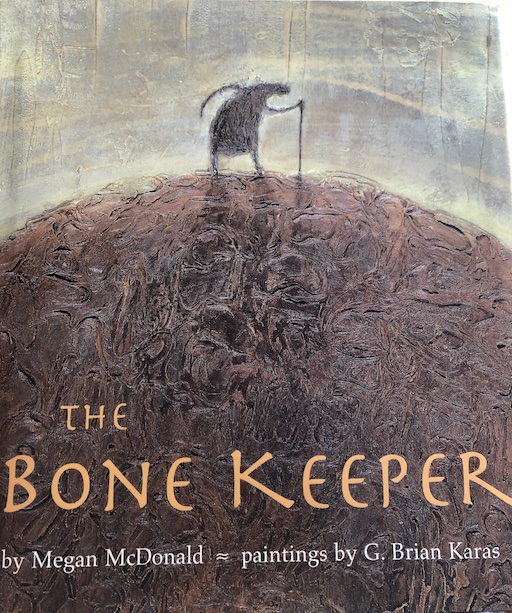
The Bone Keeper by Megan McDonald, paintings by G. Brian Karas, 1999.
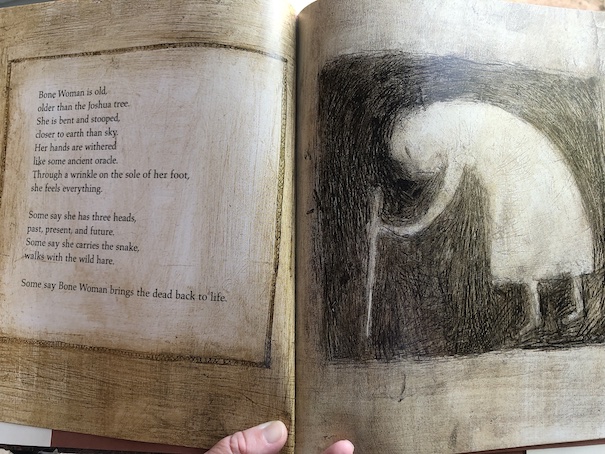
The story in this picture book is written as an unrhymed poem and illustrated with paintings that resemble paintings on a cave wall.
Bone Woman is a strange old woman. She is ancient, legendary, may have powers to bring back the dead, and lives in a cave full of bones.
She spends her time searching for bones in the desert sand. She collects the bones, studies them, and arranges them to form complete skeletons.
When she manages to complete a skeleton, she performs a ritual to bring the creature back to life!
The book is available to borrow and read for free online through Internet Archive.
My Reaction
This is one of those picture books that I think would actually be appreciated more by adults than by children. The poetry and art style seem more sophisticated than the styles that children seem to prefer. Most of the pictures are not very colorful, using a lot of grays and browns and black, although the art style is unusual and fascinating, looking like paintings and drawings scratched into rock.
I think kids could understand the action of the story – a strange old woman who lives in a cave collects bones, assembles them into skeletons, and can use them to bring animals back to life. It’s a strange story, partly because there is no explanation about why she is doing this.
One of my regrets about this book is that it doesn’t explain the background of this story. I had expected that there would be a section at the back of the book that would explain more, but there isn’t. From the context – the pictures, the style of the story, the names that the woman is called, and the fact that the artist thanked the Phoenix Public Library and the Heard Museum (both places that are familiar to me) in the dedication – adults can figure out that this is a story from folklore, but it’s not immediately clear what kind of folklore. Anyone who doesn’t already know the story might be confused. I didn’t know this story when I read the book, so I had to look it up.
The story of the Bone Woman has been told and referenced in other books. The story of La Huesera (the Bone Woman) is a Mexican folktale. Sometimes, it’s also called La Loba (the Wolf Woman) because that is the animal that she particularly wants to resurrect. The Bone Woman is a “wild woman” or a “crone” who uses a kind of natural magic to bring life to lifelessness and restoring what was lost.
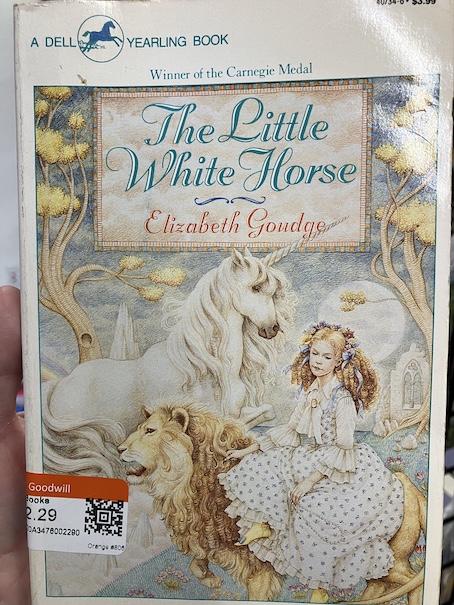
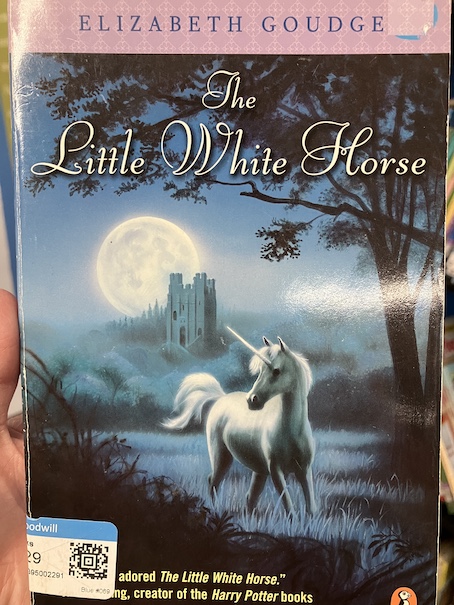
The year is 1842, and Maria Merryweather is on her way to her family’s ancestral home, Moonacre Manor. Thirteen-year-old Maria is an orphan. Her mother died when she was a baby, and now, her father has died. Their house in London had to be sold to pay his debts, and now, Maria is going to live with a distant cousin, Sir Benjamin Merryweather, in the country. She is traveling with her nurse, Miss Heliotrope, who has taken care of her since she was little and is like a mother to her, and her dog, Wiggins. Maria and her father were never really close. Maria isn’t sure that she’s going to like living in the country because she is accustomed to city life and the luxuries that come with it. She fears that life in the country will be rough and full of deprivation.
Maria begins to feel better when she actually sees Moonacre. It’s a lovely, romantic, castle-like manor house. The manor also gives her an odd feeling of home because so many Merryweathers have lived there for so long. Sir Benjamin welcomes her, and she likes him immediately. Oddly, Sir Benjamin refers to has as “one of the silver Merryweathers”, saying that she was born during a full moon. It’s true that Maria has unusual silvery gray eyes. Sir Benjamin says that he’s a “sun Merryweather”, born at midday, but that’s okay because moon Merryweathers and sun Merryweathers get along well. He does have a rather warm, sunny appearance.
Sir Benjamin shows them around the manor and to their rooms. The furnishings are a little shabby, but they’re quite comfortable, and they like their new rooms. Maria is charmed because her room is in a turret, and it has a very small door that’s really only big enough for a small girl like her to get in. Miss Heliotrope is worried that she won’t be able to get into Maria’s room if she is ill and needs her, but Maria is sure that isn’t going to be a problem. She loves the room because it just seems so perfect for her. Wiggins even seems to be getting along with Sir Benjamin’s big, old dog, Wrolf, although Maria has some doubts that Wrolf is actually a dog because he doesn’t look like any dog she’s ever seen before.
At dinner that evening, Sir Benjamin talks about giving Maria riding lessons, saying that he has a little gray pony who would be just right for her. Maria mentions a beautiful white horse that she saw from the carriage as they were approaching the manor, but Miss Heliotrope didn’t see it and thinks she just imagined it. Miss Heliotrope thinks that Maria imagines things all the time, like the little boy named Robin, who had a feather in his cap and was a childhood playmate, but Maria insists that the boy really did exist and so does the little white horse. Thinking about Robin makes her wish that he was here to keep her company at Moonacre, but she hasn’t seen him for a couple of years and doesn’t know where he is.
There are a few odd things that Maria and Miss Heliotrope notice about Moonacre, though. Aside from the odd dog, Wrolf, Sir Benjamin seems oddly evasive about who and where the servants are. They never see them, yet someone has been doing the cooking and cleaning and making fires in the fireplaces. There’s even a fire in Maria’s room, but she can’t figure out how anyone got in to make one since the door is too small for even an adult Miss Heliotrope’s size.
The next day, a riding habit appears in Maria’s room. It’s very nice quality, even though Maria can tell that it’s second-hand because it’s an older style and a little worn and has the initials LM on it. Maria like it, but who used to own it, and who put it in her room? In the parlor attached to her room, Maria also sees an old painting that contains a white horse and an animal that looks something like Wrolf, although she’s still not quite sure what kind of animal it is. (What’s that “brave-looking” animal that has a tawny mane and a tuft on its tail? I’m sure if we think about it, it will come to us.)
Sir Benjamin tells Maria that she shouldn’t wander the countryside alone, but she is free to explore as long as she’s with her pony Periwinkle or Wrolf. The one place he doesn’t want her to go is Merryweather Bay because there are rough fishermen there. He refers to Maria as a “princess” and the area around Moonacre as her “kingdom,” and from the way he says it, it seems that he somehow means that literally. Even the local people seem to have some kind of awe and respect for her.
Maria finds the nearby village of Silverydew charming. The Old Parson introduces her to the children of the village, and they tell her about the mysterious “Black Men” (because they all wear black, not their race) who hang out in the woods and by Merryweather Bay. They set traps for animals and steal livestock from the locals, and everyone is afraid of them.
Maria also discovers that Robin is here in the village of Silverydew, and he rescues her from an encounter with the Black Men. Robin tells her that her ancestor, Sir Wrolf, who founded the Merryweather family, was the one responsible for making the Black Men as evil as they are, and because of that, his soul has been unable to enter Paradise. Locals say that his spirit rides around nearby Paradise Hill, weeping because of what he did, and he will continue to do it until someone finds a way of solving the problem he caused.
Maria asks what exactly Sir Wrolf did, and Old Parson tells her the story of Sir Wrolf and how he acquired the lands around Moonacre. At first, Sir Wrolf just owned the land where the manor house sits, but he wasn’t satisfied with that. Although he was known for being brave and jovial, he was also a greedy and selfish person who thought that he was entitled to take anything he wanted from anyone. First, he kicked the monks out of the monastery on Paradise Hill and used the monastery for a hunting lodge. A fierce lightning storm made him abandon it later because he believed that it was sent by the monks as punishment. Then, he decided that he wanted the woods and bay around Moonacre for hunting and fishing, but they belonged to another nobleman called Black William. He tried various ways to take those lands from Black William, including direct warfare, but he was unsuccessful. Then, it occurred to him that Black William had a lovely daughter, his only child, and if he married her, he would share in her inheritance. Sir Wrolf put on a show of apologizing to Black William and demonstrating that he had mended his ways so he could win the affection of Black William’s daughter. The daughter, who was called the Moon Princess because she was as fair and lovely as the moon, believed that Sir Wrolf was sincere and married him. Sir Wrolf did end up falling in love with his bride, and they had a child together, but the lands he expected to acquire through her were still on his mind. Then, Black William suddenly remarried, and his new wife gave birth to a son, who replaced the Moon Princess as the heir to Black William’s lands. Sir Wrolf was outraged by this reversal of fortune, and while he ranted about it, he let slip how he had married his wife in the hopes of getting her lands. The Moon Princess was shocked and hurt, and although her husband insisted that he had come to love her even though he had married her for selfish reasons, she no longer believed him. She grew to hate him for his deception and even turned against the son they had together. She wanted no part of Sir Wrolf’s life anymore. Then, worse still, word reached them that Black William had mysteriously disappeared and his young son was dead. Although there were no indications of foul play, and it was possible that neither of them had really died at all, the Moon Princess came to believe that her husband was a murderer. One day, she rode away on the little white horse that her husband had given her when they married, and she was also never seen or heard from again. With Black William and his son and daughter gone, Sir Wrolf finally had possession of the lands he had coveted for so long, but he was no longer happy. He genuinely missed his wife and felt guilty for what he had done, and he couldn’t enjoy his prize.
The Old Parson explains that the sins of the past still affect the present and will continue to do so until someone makes them right again. The Black Men who now inhabit the disputed lands are probably the descendants of Black William’s supposedly dead son. The Old Parson believes that the boy’s mother probably feared what Sir Wrolf might do to the boy when his father left them, so she pretended that he was dead already. Every generation of Merryweathers since then have tried to push the Black Men out of the disputed lands, but they’ve never been successful. Also, every generation, a young woman very much like the Moon Princess comes to Moonacre, and she gets along well with the sun-like Merryweathers, but so far, a quarrel has always separated them. Maria worries about that because she likes her cousin Sir Benjamin and doesn’t want to leave Moonacre. Old Parson tells her that part of the legend of Moonacre is that, some day, there will be a Moon Princess who will come and will not leave. The legend states that she will right the wrongs of the past and make peace again, but only if she can get over the prideful nature that all Moon Princesses have and love a poor man who is below her station. The townspeople are in awe of Maria because they hope that she will turn out to be that Moon Princess.
Maria adopts the mission of righting past wrongs, reconciling old quarrels, and bringing peace to the valley once again, but she’ll have to be careful. Not everyone is ready for peace yet, and she has to guard against falling into the same bad habits that others have before her. Before she can complete her destiny, she must speak directly to the Black Men in their castle and when she does, they make a bargain with her. They agreed to end their poaching and thievery if she can prove that Black William wasn’t murdered by Sir Wrolf and if she will restore not only their lands but the pearl necklace that belonged to the original Moon Princess. However, that necklace has been missing since the first Moon Princess disappeared. How can Maria give them something that she doesn’t have and doesn’t know how to find?
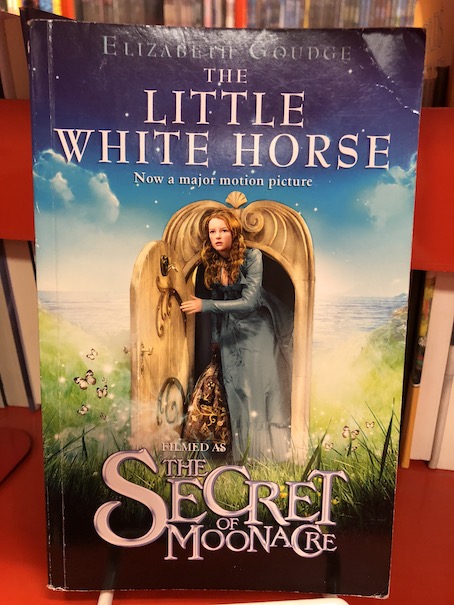
The book is available to borrow and read for free online through Internet Archive (multiple copies, including one in Chinese). There is also a movie version of the story called The Secret of Moonacre.
My Reaction and Spoilers
I didn’t read this book as a kid, but it’s one that I’ve been meaning to read for some time. I saw the movie version years ago, and I was curious about what the book was like. The movie and the book set up a somewhat different situation for the quarrel between the two families. In the movie, the quarrel was about the fabulous pearls owned by the first Moon Princess and not about land. Also, Loveday and Robin were members of Black William’s family in the movie, which they weren’t in the book, changing the dynamics of their relationships with Sir Benjamin and Maria.
This story is an enchanting light fantasy. The setting by itself is magical, and Maria’s rooms in the manor are like every little girl’s dream! The story also includes odd, seemingly intelligent animals with unusual capabilities, such as the Zachariah the cat, who takes messages for people and lets them into the manor house or guides them around, and Wrolf, who is clearly a lion, even though everyone calls him a dog. The fact that Wrolf is a lion dawns on Maria toward the end of the book, and Robin confirms that’s true, saying that they all keep calling him a dog because it sounds less scary, and they don’t want to alarm anyone.
Maria’s family history is not something to be proud of, as Old Parson points out. Her ancestors were not the greatest people, in spite of their land-ownership and high status. People are looking to Maria to be better than the others who came before her and to make past wrongs right.
From Robin’s mother, Loveday Minette, who also becomes like a mother to her, Maria learns a little more about what it means to be one of the Merryweather “Moon Princesses.” Gradually, it is revealed that Loveday was the last Moon Princess before Maria. She was in love with Sir Benjamin, and the two of them were going to be married, but like all Moon Princesses and Merryweather men, they had a stupid quarrel and parted. Loveday married someone else and had Robin, but even though she has remained near Moonacre and secretly helps the household, she has been careful not to see Sir Benjamin ever since. Over the years, she has come to realize that she made a terrible mistake with Sir Benjamin and regrets it, but like other Moon Princesses, she has too much pride to admit that she was wrong and apologize. She is more mature now, and she sees that, in some ways, she was aggravating to Sir Benjamin and provoked him, and having provoked him to anger, because Moon Princesses tend to love men with tempers (one of the curses of the Merryweather men), was too proud to make up with him. By the same token, Sir Benjamin was legitimately disrespectful of her and her feelings, and when he attempted an apology, it was a half-hearted effort that attempted to preserve his pride more than demonstrate care for Loveday’s feelings, which is why Loveday didn’t feel like she could accept it.
Members of the Merryweather family and the people they marry have a tendency to attach enormous importance to and emotional investment in small things (geraniums, the color pink, etc. – they either passionately love these things or are violently or oppressively against them), and then they blow up at each other when their partner doesn’t feel exactly the same way about them, taking it as personal insult if someone likes something they don’t like or doesn’t like something they do like. (Like in the Internet meme, “Stop liking what I don’t like!”) They don’t know how to tolerate interests they don’t share, not sweat the small stuff, or live and let live. I would say that a lot of it has to do with poor relationship skills and, ultimately, a lack of respect for other people, even the people they love. They don’t respect each well enough to find out why the other person cares so much about something that seems small and annoying. They are self-absorbed in their own feelings, seeing situations only from their own point of view and putting their own feelings first. They see every conflict as some kind of contest about who’s right, with the drive to win against each other, which puts them both in a position of being on opposite teams instead, where one of them has to get the better of the other in some way, instead of on the same winning team. The result is that neither of them ever really wins, and even if one of them defeats the other in something, they ultimately end up losing their whole relationship, so it’s a net loss for everybody.
This is the cycle that has repeated for generations in this family. Loveday realizes that, for this destructive cycle to end, the Moon Princess has to learn not to provoke the one she loves as well as overcome her sense of pride. Also the Moon Princess’s love (it’s pretty clear to everyone that it’s going to be Robin, in this case) has to learn to control his temper, not respond to things as if they were some kind of personal attack, and consider the well-being of others, especially his princess. Both of them need to learn caring and consideration for others and how to put aside pride and self-interest for the sake of peace, both in their personal relationship with each other and for the sake of the wider community. Loveday emphasizes to both Maria and Robin that they must not quarrel with each other. People are depending on them to put things right in the area, and their own future happiness depends on learning to get along with each other.
The things Loveday and other adults emphasize for the children are personal skills that real people do need to learn in order to have relationships with other people and be mature members of a peaceful, stable community:
Don’t aggravate people. You can’t have peace if you’re always teasing or provoking people, and picking fights.
Choose your fights carefully, and wherever possible, avoid turning small disagreements into big fights. Remember that any battle comes with a cost, and the costs of petty fighting are higher than the rewards.
Be considerate of other people’s feelings and respectful of their property. You don’t have the right to do what you want with other people’s property just because you want it or it bothers you that they have it.
Understand that nobody is perfect, including you.
It is not your partner’s responsibility to please you in every way or give you everything that you want. It is your responsibility to deal with your own emotions and control your own choices and behavior.
Sometimes, you really are in the wrong, and you can’t always have everything you want. Accept both of these facts with maturity and take responsibility for your choices.
Being wrong can be embarrassing, but not nearly as embarrassing or destructive as not dealing with situations that need attention or problems that need to be solved.
The problems you cause affect more than just you, and problems do not go away when they are ignored.
Whatever the circumstances, no matter who or what you’re dealing with, it’s never just about you.
The word “responsible” has two meanings. The first is being at fault. (Sir Wrolf was responsible for the situation in the valley and the problems it caused.) The second just means taking charge of a situation and doing what needs to be done, sometimes because you’re the only one who can or is willing to do it. (Maria didn’t cause the problems, but she was responsible because she fixed the problems.) The second type of “responsible” is necessary for successful relationships, no matter who the first type applies to.
Love requires understanding and accepting each other and allowing each other to be their own person with their own likes and dislikes.
Caring means making each other a priority, working as a team, and doing what’s best for the team, even if it requires some compromise and self-sacrifice.
Building a shared life or solving shared problems is team effort, not a competition with each other. There is no “winning” unless it’s a shared victory. Otherwise, everyone loses.
It’s not exactly a spell, but the children’s mission is based around learning to function as a couple and to control their tempers and personal behavior. Magical things do start to happen when they learn to consider others’ feelings and not just their own.
There does seem to be some magic in the story. Robin later explains to Maria that the reason why nobody else could see him playing with her in London when they were younger is because he was always in or around Silverydew or Moonacre. He says that he traveled to London to play with her when he was asleep, so he wasn’t physically there. It’s like a form of astral projection or out-of-body experience. Also, like Sir Benjamin’s “dog” turns out to be a lion, the “little white horse” turns out to be a unicorn.
I couldn’t help but notice that all of the known Moon Princesses since the first one and the men that they seem to love before before they quarrel with them seem to be cousins of each other. Loveday Minette and Sir Benjamin were cousins of each other because their fathers were brothers, and Maria and Robin are more distant cousins of each other because their grandfathers were brothers. The idea of marrying a cousin or even loving them romantically seems odd for modern times, but that did happen in noble families in the past, so it might not seem so odd for the characters and others in the story.
This book also taught me what a mangel-wurzel is. They just mention it in passing, like readers should know what it is. It has such a strange name that I had to look it up. It’s a kind of beet, and apparently, it has also been used to make “punkies” or jack o’lanterns in areas where people didn’t grow turnips, before people adopted pumpkins for the purpose. Just an odd bit of trivia.
Bells by Elizabeth Starr Hill, illustrated by Shelly Sacks, 1970.
I love books about oddball topics, so a children’s picture book about the history of bells was irresistibly intriguing.
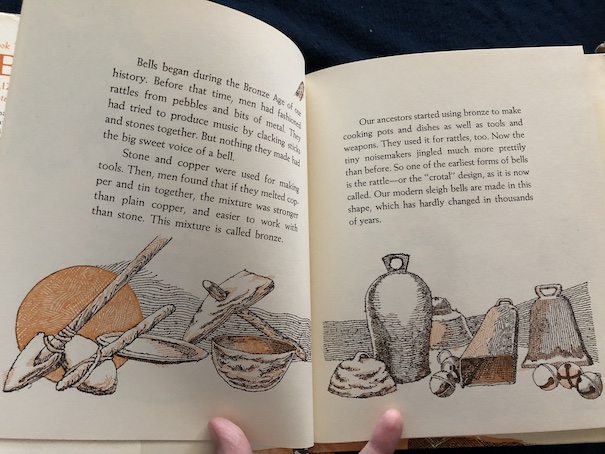
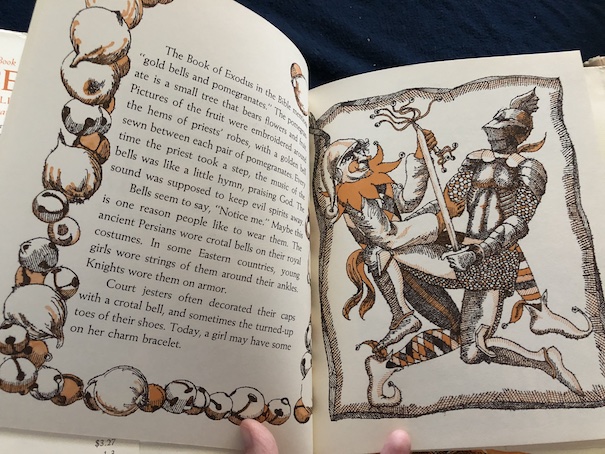
The book begins with the origins of bells in the Bronze Age. People had made rattles of various kinds before the Bronze Age, but after they learned to make bronze, an alloy of copper and tin, they discovered that they could make metal rattles with a much prettier sound. These metal rattles/early bells were made in the “crotal” design, which is the same shape as today’s jingle bells or sleigh bells. Other shapes of bells, like gongs and the classic bell shape may have been inspired when people realized that pleasant sounds could be made by banging bronze utensils against bronze dishes and bowls.
Bells have been used for thousands of years and have served many purposes. The oldest bell that has been found (at the time the book was written) was over 3000 years old and came from the area near Babylon. King Solomon of Israel used to have bells to frighten away birds from the roof of his temple. The Spartans were able to infiltrate a walled town in Macedonia because the sentry wore a bell on his uniform that helped them to keep track of where he was, but in other instances, nets with bells attached to them were used to warn of the presence of enemies. Bells have also been frequently used in religious services.
Sometimes, people wear bells to call attention to themselves. The classic jester’s cap with crotal bells (jingle bells) attached to it is meant to be attention-getting.
Bells can be made of many different materials, from different types of metal bells to glass bells to clay bells. There are even wooden ones, although they make more of a clunking sound than a ringing. People used to make bells by hammering pieces of metal into shape, but then they developed ways to cast bells in molds, which is how bells are made today.
There are many superstitions that have been attached both to the making of bells and their use. The book describes the Bilbie family, who famously made bells in Medieval England. The Bilbies were superstitious and consulted astrologers to determine the best times to make their bells. They also always rang bells for the first time on full moons. Various people have believed that ringing bells frightens away demons and witches.
The parts about superstitions and legends are my favorites. In particular, there is a legend in England about a town that was completely buried during an earthquake. The people in the town always rang their church bells at Christmas, and the legend is that if you go to a particular spot and put your ear against the ground, you’ll still hear them ringing the bells. However, the book says that there’s actually a scientific explanation behind the phenomenon. People who have put their ears to the ground at that spot have heard bells ringing, but they’re actually the bells from a nearby town, not one underground. The ground actually conducts sound very well, even better than sound waves moving through the air, so a person standing upright might not hear the bells ringing from another town, but someone who put their ear to the ground could hear the conducted sound vibrations. It’s not unlike the phenomena experienced by people who put their ears to the rails on railroad tracks to listen for the train. There are also stories of people having heard the approach of herds of animals, like buffalo, coming toward them in this way. The book doesn’t mention it, but “keep an ear to the ground” is actually an expression for watching and listening for signs of things that are going to happen because people noticed that vibrations in the ground could be indications of something coming toward them.
The book also describes some famous bells, like the Liberty Bell, Big Ben (Big Ben is actually the name of the bell in the clock tower, not the clock tower itself, although people informally think of the clock tower as Big Ben) and Tsar Kolokol, the largest bell in the world.
There are also a few nursery rhymes that mention bells (although the book doesn’t give any background information about the rhymes) and some information about change-ringing and carillons.
The book annoyed me a little in the way it kind of jumps around, telling some history, then some legends, then some more history, and then more legends. It’s a very easy read, and the information is interesting, but it’s a big disjointed. It sometimes feels more like a list of facts and short stories than one cohesive story. It might help if there were headings or chapter divisions in the book to organize the information, but there aren’t.
The book is available to borrow and read for free online through Internet Archive.
The Legend of the Bluebonnet by Tomie dePaola, 1983.
This is a story about the Comanche People in what is now Texas, based on an old folktale.
There has been a severe drought and famine in the land for a long time, and many people have died. The survivors pray to the spirits for help in ending the drought, and they receive a sign that it will not end until someone among the Comanches makes a sacrifice of the thing that is most dear to them.
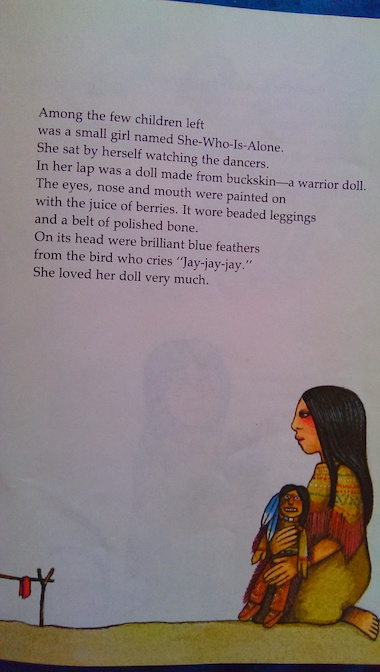
The people debate about who is supposed to make the sacrifice and what object the spirits could want, but one young girl thinks that the spirits are talking about her and her doll. The girl is called She-Who-Is-Alone because she is the last of her family. Her parents and grandparents are dead, victims of the famine. The only thing she has left to remind her of them is her doll, a warrior with blue feathers in its hair, that her parents made for her before they died.
Desperate to end the drought and famine and to save her people, the girl makes the difficult decision to sacrifice her doll by burning it. Her sacrifice is rewarded not only by the end of the drought but by the sudden appearance of a field of flowers as blue as the feathers in her doll’s hair. The girl receives a new name from her people, acknowledging her sacrifice on their behalf.
A section in the back of the book explains a little about the Bluebonnet flower, which is the state flower of Texas, and the origins of the story in the book, which is based on a folktale. This is also a little information about the Comanche People.
The book is currently available online through Internet Archive (multiple copies).










 Jestress's Forgotten Books and Stories