The Dark is Rising

The Dark is Rising Sequence

The Dark is Rising by Susan Cooper, 1973.

The day before his eleventh birthday on Midwinter, Will Stanton has an uneasy feeling that something is about to happen. First, the rabbits that his family keep behave oddly. Then, other animals seem to be afraid of him when they never have before. When he and his brother James go to pick up some hay from Mr. Dawson, Mr. Dawson makes an odd comment about “the Walker” being abroad and that it’s going to be a bad night. Then, Mr. Dawson says that he has something for Will for his birthday. He gives Will an odd iron ornament and tells him to keep it safe and not talk about it with other people. Everything about this day seems odd to Will, but he accepts this unusual gift.

That night, Will has an increasing sense of terror, and a rook apparently breaks the skylight in his room during a snow storm. The next day, Will can’t seem to wake up his sleeping family. He puts on warm clothes and leaves the house with a strange feeling that this is somehow his destiny. Things in the area look different, as if he is now in a different time, sometime in the past. Eventually, he sees a man he knows who works for Mr. Dawson, John Smith. John Smith is working on horseshoes for a black horse that belongs to a mysterious stranger in a dark cloak. The mysterious stranger offers him food and a ride on his horse, but Will refuses both. The stranger gives him an uneasy feeling, and without really knowing why, Will says that he is looking for “the Walker.” The cloaked stranger tells him that “the Rider is abroad” and tries to grab him, but John Smith pulls him out of the way, and the stranger is angry. John Smith tells Will that he is just newly woken and will have to figure things out for himself but to trust his instincts today. A beautiful white horse appears, and John Smith says that Will can ride it, if he wants, but Will’s instincts tell him that he needs to go on alone. As he leaves, Will sees John Smith giving the white mare shoes that look like the iron ornament that Mr. Dawson gave him.

As he explores the countryside further, Will encounters a wandering tramp that he saw attacked by rooks the day before and confronts him as being “the Walker.” The Walker is defensive and suspicious, and he asks Will to show him “the Sign.” Will realizes that he must mean the iron ornament that he now wears on his belt, but before he can show it to the Walker, the Rider comes and frightens the Walker away. The Rider sees his Sign and comments that Will only has one of them so far, and that won’t help him much. Fortunately, the white mare comes and carries Will away from the Rider.

The white mare carries Will away into the hills, he has a sensation like he’s falling, and then, he finds himself alone in the snow near a pair of carved wooden doors that appear to be standing by themselves, attached to nothing. Will pushes on the doors and finds himself in what seems to be a great hall, hung with tapestries. There is an old woman and a tall man standing by the fireplace, and they greet him. Will tries to ask them about the doors and why they seem to be standing by themselves, but the doors have vanished behind him. The man says that Will’s first lesson is that nothing is what it seems to be.

The man introduces himself as Merriman Lyon (introduced in the previous book in the series), and he says that he and Will were born with the same gift, the power of the Old Ones. Now that it’s Will’s eleventh birthday, his gift is awakening, but he must learn how to control it. At first, Will doesn’t think that he has any particular gift, so Merriman shows him how he can receive mental pictures from someone else’s mind and send them a mental picture and how he can even put out a fire with his mind. Will becomes convinced that he does indeed have powers that normal boys don’t have. Merriman tells him that this gift is a burden, like many special gifts, but he was born with this gift for a special purpose.

Merriman says that he doesn’t want to tell him too much yet because the full knowledge of his destiny may be dangerous for him while he is still learning to use his gift. However, he does tell Will that he is actually one of the Old Ones, the first of his kind to be born in the last 500 years, and he will be the very last of them. Like other Old Ones, he will play a role in the battle between good and evil. His first role is that of the Sign-Seeker. He must find the six Signs and guard them. The iron ornament is the first Sign, but the others won’t be as easy to find.

Will returns to his family and his ordinary life, buying Christmas presents for his siblings for the coming holiday, but he knows that his life is no longer ordinary. He has much to learn about how to use his powers, and the sinister forces that pursue him to try to stop him from carrying out his mission.

The book is a Newbery Honor Book. It’s available to borrow and read for free online through Internet Archive (multiple copies). The book was adapted as a movie called The Seeker in 2007.

My Reaction and Spoilers

Fantasy books sometimes have to deal with the subject of religion and the relationship between magic and religion. This book also does so somewhat, but I noticed that it also seems to try to remove itself from consideration of the issue at the same time. At one point, Merriman discusses the idea of witches and witchcraft trials with Will, telling him that none of those involved were Old Ones, like the two of them. He says that everyone involved with witchcraft trials were ordinary humans, most of the people who were called “witches” were innocent victims although a small number were genuinely evil, and generally, the witchcraft trials were the result of human madness and irrationality, not genuine magic. In other words, readers don’t need to worry about trying to reconcile the power of the Old Ones with witchcraft because the author says that the two of them are two different, unrelated things.

Will and his family celebrate Christmas during the course of the book, and they go to church, so it’s apparently fine for an Old One to also be a Christian. Yet, there is a scene at church on Christmas where Will and John Smith have to stop the forces of the Dark attacking the church. The minister tries by calling on the powers of God and exorcising the evil spirits, but John Smith says that the minister’s efforts don’t work because “This battle is not for his fighting”, apparently indicating that the powers of Light and Dark as portrayed in this story are somehow outside of any religion or the interference of any god because they are forces that are completely unto themselves. The traditional Christian view would be that God commands the forces of good and light while the devil commands the forces of evil and darkness, but they’re saying here that’s not the case in this story. Will’s thought is that there is a place that exists out of time where all the Gods that ever were came from and also all of the forces and powers in the world, and it seems like some of these exist independently of each other, that they don’t have any beginning and so none of them is less old than any of the others. There is an element of pagan and folklore traditions that runs through these books, and I think that part of this concept references that, but I also see that looking at the battle between Light and Dark in this way, as being something independent of absolutely everything else, leaves the author of the stories free to have it play out in whatever way makes a good story without having to make it adhere to any rules and traditions other than the ones she’s chosen.

Of course, even fictional magic has to follow some rules in order to make logical sense to the readers. As I said, there are pagan and/or folklore traditions that are implied to be true or to have more significance than most people would suspect. Will uses holly as a form of protection for his home during Christmas. Aside from its association with Christmas, there are also many folkloric superstitions about holly. It is also revealed that part of what makes Will so special is that he is the seventh son of a seventh son, another concept from folklore.

A theme that is carried over to this book from the first one in the series is that evil can sometimes appear innocent and even friendly. People who have appeared as friends before can be revealed to be secretly evil or coerced to the dark side, even people who have been close before. Those who aren’t as in tune with the battle between good and evil may be fooled by friendly smiles, charming manners, and a pleasant appearance, but those who are aware of the difference between dark and light can feel when someone isn’t right.

There is one case in this book where a previously good person turns to the Dark because he feels betrayed about how Merry put his life at risk for the cause of the Light. I feel like this could have been avoided if Merry had been more honest with him in the beginning about the risks of what they were doing and the reasons why it was so important, but Merry seems to feel like it was all inevitable, something that was fated to be. Yet, at the end of this person’s life, Merry emphasizes that all of the choices this person made were his own, and although he went through much suffering because of things that had to happen as they did, he could have still had a better life even while undergoing his ordeals if he had made different choices along the way. I think I see what he means, that there are some things in life that are unavoidable but people can make them better or worse through their own choices and behavior, but I still feel like Merry set him up for this bad situation because he didn’t explain things properly when he should have. Maybe that was Merry’s bad decision, too?

Parts of this book actually reminded me of The Box of Delights, a vintage children’s fantasy book that also takes place at Christmas. In both books, Herne the Hunter, a character from folklore, makes an appearance, and the boys in each story get turned into different animals through their adventures with magical books.
Over Sea, Under Stone

The Dark is Rising Sequence

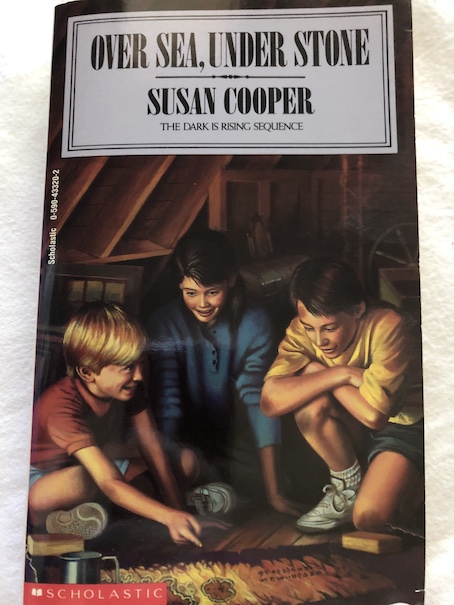
Over Sea, Under Stone by Susan Cooper, 1965.

The Drew family is spending the summer in Cornwall with their Great-Uncle Merry. Professor Merriman “Merry” Lyon isn’t really a relative, but a very old family friend who teaches at a university and has a somewhat mysterious past. Of the three Drew children – Simon, Jane, and Barney – Barney is the one most looking forward to their time in Cornwall because he loves Arthurian stories, and he is fascinated by Cornwall’s connections with King Arthur. Simon is more interested in watching boats.

One day, while the children are bored because it’s raining, they start playing at being explorers inside the house where they’re staying and discover a secret passage to a hidden room. There, they find an old manuscript that seems to be some kind of treasure map! It seems like parts are written in Latin, but even Simon, who has studied Latin in school, can’t read it all. At first, they wonder if they should tell their parents about it, but they decide not to, at least not right away, because their parents would probably tell them not to touch it because it doesn’t belong to them. They feel like they just have to figure out what it means and what it might lead to.

The family makes the acquaintance of a yacht owner, Mr. Withers, and his sister, and the two of them invite the whole family to go for a ride on their yacht. Mrs. Drew is an artist and wants to spend the day painting, so she declines, and so does Jane. Jane says that she’s afraid of getting seasick, but really, the Witherses give her an uneasy feeling. Jane feels like there’s something that’s not right about them, and it’s strange that Miss Withers asks them if they’ve found any secret passages in the house just after they actually found one. None of the children confide anything in Miss Withers. Mr. Withers seems oddly interested in the books in the house.

The next day, while her father and brothers go out on the yacht with the Witherses, Jane studies the manuscript and tries to figure out what it means. When she also finds an old guidebook to the area in an old trunk, she realizes that the map on the manuscript shows the area where they are staying, but there’s something strange about the coastline. The coastline on the old map is a slightly different shape. Jane wonders if one of the two maps could be wrong or if the coastline has changed somehow over the years because the manuscript looks very old.

Since the guidebook was written by the local vicar, Jane decides to go see him and ask him about the coastline and whether it’s changed over the years. She takes along the guidebook but not the manuscript. However, the vicar she meets says he’s the new vicar, not the old one who wrote the book. She talks to him about the book and the coastline anyway, but he gives her a bad feeling, similar to the one that the Witherses give her. The vicar discounts the idea of the coastline changing, and he asks Jane uncomfortable questions about the books in the house, pressing her for answers that she doesn’t have and doesn’t want to give him.

When the boys come back from the yacht, and Jane tells them about the guidebook and the vicar, Simon is irritated that Jane tried to investigate the manuscript without them, and he doesn’t think she should have talked to the vicar. Jane says that she didn’t tell the vicar about the manuscript, only the guidebook, and Barney says that what Jane learned is important.

The next morning, they wake up to find that the house has been ransacked. Books have been tossed all over in the middle of the night by someone who was clearly hunting for something. The children are sure that their mysterious intruder was searching for the manuscript, which is safe because Jane had it hidden in her bed. But, who was it? Was it the vicar or the Witherses? All of them seemed interested in old books and manuscripts, and they all seem suspicious. What is the real significance of the manuscript anyway?

Still not wanting to tell their parents or the police who were called to investigate the break-in, the children confide in Great-Uncle Merry about the manuscript and their suspicions. Uncle Merry knows more about the manuscript than the children know, and he tells them about a lost grail, a copy of the original Holy Grail, inscribed with the true story of King Arthur and about an ancient struggle between good and evil, a struggle that the children have now joined.

The book is available to borrow and read for free online through Internet Archive (multiple copies). The book was once adapted as a tv mini-series, but apparently, no copies of it survive.

My Reaction and Spoilers

This book is the first in a series about the struggle between good and evil, known as the Light and the Dark, and all of the other books in the series also draw on Arthurian legends. Merry and the children appear in other books, although not always together. Merry (the children sometimes call him Gumerry, which is short for Great-Uncle Merry) isn’t quite what he appears to be, which is how he knows things that other adults don’t know. There are hints in this book about Merry’s real identity, but it isn’t explained in this book, although Barney has a feeling that his name is a clue.

When Merry explains about the battle between good and evil, he says that the struggle has been going on for ages, and neither side ever completely wins or completely loses. It’s like that in this story, too. At first, I wasn’t completely sure whether they would actually find the grail or if it would turn out to be a MacGuffin, only existing to drive the action without it being really important whether it was actually found or not. The heroes do actually find and successfully retrieve the grail, but they also lose the manuscripts they’ve found before they can completely study them. It’s a victory, but not a total victory, and the villains are still around and may reappear in the future. This story ends in a way that indicates that this could have been a standalone book, which it might have been originally, before the author decided to continue the series, but the ending is also open, making the continuation of the series natural.

There are references to old folklore traditions throughout the story. I’ve never seen The Wicker Man, but I saw a comment on a YouTube video where someone compares a public festival from this story to a scene in The Wicker Man, so there may be the implication that this is a more ancient form of celebration with more significance than the modern characters think. In fact, old traditions and folklore from the British Isles also appear in various forms throughout the series, and there are references to pagan beliefs.

I didn’t like the part where the kids were pretending to be explorers, and they were talking about acting out one of those scenes with “rude natives” (Simon’s words, and even he has to admit that he doesn’t quite know what it means when Barney asks him, although he’s aware that it’s a different sort of “rude” from the word meaning “impolite”) who want to make them gods and encountering cannibals. That type of scene always annoys me in books, and I’m sure that they’re referencing some of the vintage books I’ve read where that happens or ones very much like them. It’s really my only complaint about this story. Fortunately, that part doesn’t last very long because the kids find the manuscript and get on with the fantasy story.

Tales of Ancient Araby

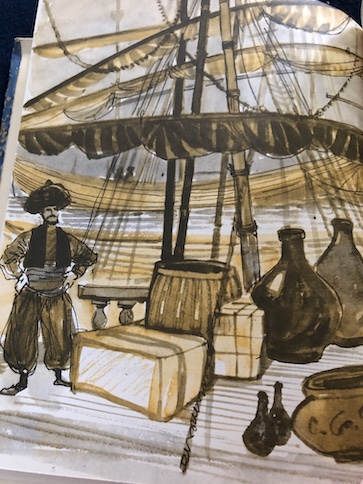
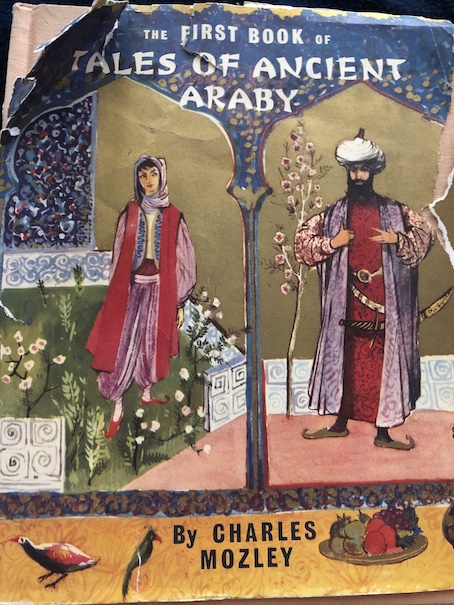
The First Book of Tales of Ancient Araby by Charles Mozley, 1960.

I’ve had this book for years, and one of the questions that I’ve had about this book is why is it Ancient “Araby”? Why “Araby” instead of “Arabia”? According to Wikipedia, “Araby” is an archaic name for Arabia, which explains it, I guess. This book was published in 1960, and I don’t think people were using “Araby” back then, but the book is trying to sound ancient.

The stories in the book are based on those from the collection of folktales called One Thousand and One Nights, in which Scheherazade tells stories to the murderous king who is her husband, but they’re simplified for children. The introductory section to this book says that . The book doesn’t explain, but the original stories in the book were rather racy.

The book has pictures for each story, but some are in black-and-white, some are monochromatic with a color other than black, and some are in full color.

The book is available to borrow and read for free online through Internet Archive.

The book contains the following stories:

Scheherazade – When the sultan’s wife betrays him, he not only has her executed but loses his mind with hatred for all women because he believes that they are all untrustworthy. He begins a murderous series of weddings, where he has his wives all executed the day after the wedding, so they can never betray him. (It’s dark stuff, but this story wasn’t originally intended for children). All of the unmarried women in the kingdom are terrified that they’ll be next, and the sultan’s vizier is beside himself because he doesn’t know how to stop the sultan and has an obligation to obey the sultan’s commands to bring him new brides. Then, his eldest daughter, Scheherazade, requests that her father send her to the sultan as his next wife. At first, the vizier doesn’t want to send her because it’s certain death to marry the sultan, but Scheherazade tells him that she has a plan to put an end to the weddings and executions. Every night, she starts to tell a story but leaves it unfinished, so the sultan keeps putting off her execution to hear the end of the story. This continues for 1,001 nights, until the sultan realizes that he’s actually happy with Scheherazade and no longer has any desire to execute her or any other woman. The rest of the stories in the book are among the ones that Scheherazade told the sultan. (The Scheherazade story is a frame story, a story that contains other, internal stories or creates the basis for the other stories.)

Aladdin and the Wonderful Lamp – A poor boy and his widowed mother are approached one day by a man claiming to be the brother of the widow’s dead husband, the boy’s uncle. At first, he is very nice to them, bringing them to live with him and providing them with everything they need. However, one day, he stakes the boy, Aladdin, to retrieve a strange old lamp from a series of treasure caves, giving him a ring to protect himself. Before the boy returns to the man, he comes to the realization that the man isn’t really his uncle but an evil magician who is just using him to get the lamp. The boy and his mother discover that there is a genie living in the lamp who will do their bidding and provide them with all they need. They use the lamp not only to provide for themselves but to make it possible for Aladdin to marry a princess. The evil magician almost ruins everything when he tricks the princess into giving him the lamp, but Aladdin and the princess get it back through some trickery of their own.

Ali Baba and the Forty Thieves – Ali Baba marries a kind but poor woman and makes his living as a woodcutter, while his brother, Kassim, marries a disagreeable woman from a wealthy family and becomes an wealthy merchant. One day, while cutting wood in the forest, Ali Baba sees a large group of horsemen. They are robbers, and they have a secret hideout nearby. Ali Baba hides and watches how they open the entrance to their secret cave with the magic words “Open, Sesame!” After the thieves stash their loot and leave, Ali Baba realizes that he can use their secret words to enter the cave himself and see what they left. He helps himself to some of the stolen loot. He and his wife decide to stash the second-hand loot and spend it a little at a time, ensuring their family’s security. However, Kassim’s wife finds out about their loot and tells Kassim, and Kassim damands that Ali Baba tell him where he acquired so much money. When Ali Baba explains about the thieves and the treasure cave, Kassim wants to go there and loot the place himself, but Ali Baba thinks it’s too dangerous to go back again because the thieves will be angry and will probably kill them if they get caught. When Kassim goes anyway and is caught and killed, Ali Baba must arrange a deception to prevent the thieves from learning who Kassim was and everyone else from learning how Kassim met his death so the thieves won’t take revenge on the rest of the family with the help of a clever slave girl, Morgiana.

The Fisherman and the Genie – A fisherman pulls a strange bottle from the sea that contains a genie, but to the fisherman’s shock, the genie threatens to kill him when he frees him from the bottle. The fisherman asks why he would do such a thing when the fisherman did him a favor, and the genie explains that he was imprisoned in the bottle by King Solomon for sins against Heaven. At first, the genie thought that he would reward whoever freed him, but as his imprisonment grew into hundred and hundreds of years with no rescue, he became increasingly enraged and decided to kill whoever released him. However, the genie decides to grant the fisherman one wish before death. The fisherman asks him to prove that he can actually fit into the bottle and imprisons the genie there again. He refuses to let him out again until the genie swears he won’t kill him. The genie promises the fisherman anything he wants, but the fisherman is a modest man and only asks that he always be successful as a fisherman. He gets his wish, and he uses the money he acquires from his success to build a better life for his family.

Sinbad the Sailor – When Sinbad’s father dies, he leaves Sinbad a considerable amount of money, but Sinbad quickly squanders most of his inheritance. When he realizes his foolishness, Sinbad uses what he has left to set himself up as a merchant sailor. However, this decision takes him on a series of wild adventures, from being nearly drowned to befriending a king to a hair-raising encounter with a roc (a giant bird that’s big enough to carry a grown man).

The Twice-blessed Arab – This is a legend about the origins of horses and camels.

The Story of Little Mukra – Little Mukra is a dwarf, and his father, fearing that the rest of the world will laugh at him and treat him cruelly for his size, hides him for his early life. When Little Mukra is sixteen years old, his father dies and the rest of his relatives declare that they don’t want him, so Little Mukra decides to go out and seek his fortune. One day, while Little Mukra is hungry, he hears an old woman calling for someone to come to eat. It turns out that she’s talking to her cats, but he persuades her to let him eat with the cats because he’s starving. The woman hires him as a servant to take care of her cats. It gives Little Mukra a place to live, but the problem is that the woman blames him for damage that the cats cause while the lady isn’t looking. The clever cats are always perfectly behaved when she’s watching but not when they’re alone with Little Mukra. Little Mukra escapes this situation with the help of the lady’s dogs, who are not so pampered as her cats and reveal to Little Mukra a paid of magical slippers that can make him run fast, securing him a position as the king’s special courier.

Norse Myths and Legends

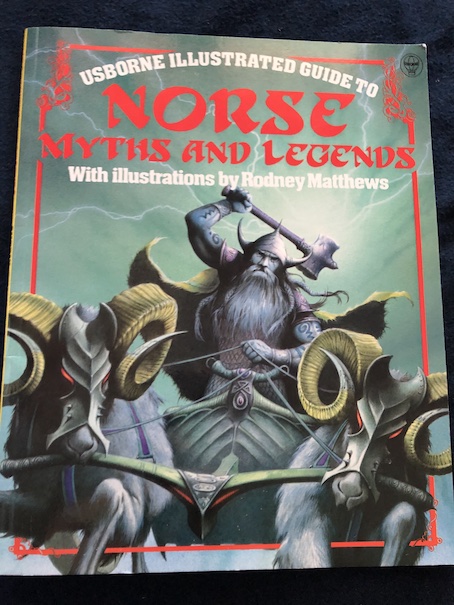
Usborne Illustrated Guide to Norse Myths and Legends by Cheryl Evans and Anne Millard, illustrated by Rodney Matthews, 1986.

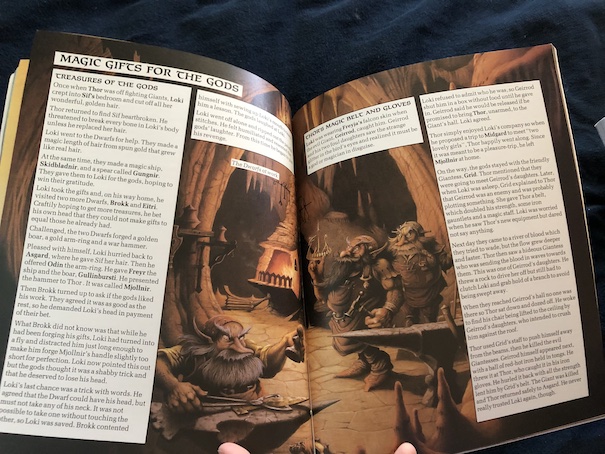
I like this book because, before it begins telling the myths and legends, it first gives an introduction to the history, territory, and religion of the Norsemen. By “Norsemen“, the book means not only people living in Norway but Scandinavians and people of Scandinavian descent speaking related languages and living in various areas across Europe. The Norsemen include, but are not limited to, the Vikings, who were specifically seafaring traders, mercenaries, and pirates/looters as opposed to farmers and fishermen.

There is still much about the history of the ancient Norsemen that we don’t know because, for much of their history, they did not have their own system of writing and relied on oral stories for passing down historical and cultural knowledge. The Norse myths were originally oral stories before they were written down. The introduction also explains that there is one myth in the book, the story of Sigurd and the Nibelungs, that was originally a German legend but was later adopted by Scandinavians.

Norse mythology is somewhat unusual because, while Norsemen were polytheistic, like other ancient groups, and their gods and goddesses had human emotions and relationships, like the gods and goddesses in Greek and Roman mythology, Norse gods were not immortal. Norse gods could be killed, like human beings, which meant that any risks they took had genuinely serious stakes for them. In fact, the legends predict that, at a future, world-ending event known as Ragnarok, most of the gods will be killed.

Although this particular book doesn’t mention it, the qualities of Norse gods being able to perform incredible deeds while still being mortal makes them rather like our modern concept of a superhero. Thor and Loki were both made into comic book characters by the time this book was written, and characters and events in Norse mythology have helped to form the 21st century Marvel Cinematic Universe.

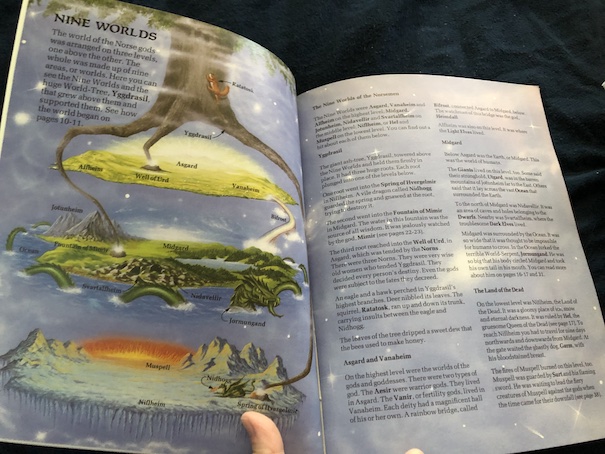
In Norse mythology, the gods and goddesses lived in a multilevel universe made up of nine lands or “worlds.” The highest level of their universe contained Asgard (home of the warrior gods), Vanaheim (home of the fertility gods), and Alfheim (home of the light elves). The middle level contained Midgard (our world, where humans live, connected to Asgard by a rainbow bridge), Jotunheim (home of the giants), Nidavellir (home of the dwarves), and Svartalfheim (home of the dark elves). The lowest level held Niflheim (land of the dead, dark and icy, ruled by a fearsome queen named Hel) and Muspell (where the creatures who will attack the gods at Ragnarok live). All three levels of this universe were kept in place by the roots of a giant ash tree called Yggdrasil.

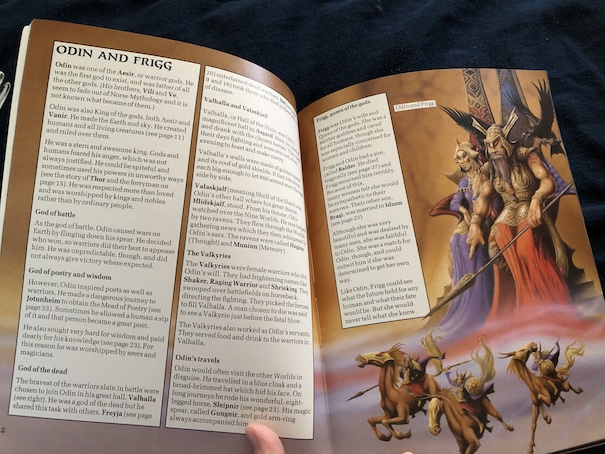
The book has pages dedicated to specific gods and goddess, explaining their histories and roles in Norse mythology. Odin, for example, was the king of the gods, who created the world and humans and was the father of the other gods. His wife’s name was Frigg, and she was a mother goddess figure. Thor was the thunder god and the god of law and order. Unlike other gods, he mostly relied on his strength instead of magic or tricks, but he did have magic weapons, including his hammer, Mjollnir, which would always strike its intended target and return to Thor after. Freyja was one of the fertility gods, and she was the goddess of love and beauty. She later also became a goddess of death and was responsible for starting wars among humans. Loki technically wasn’t a god because his parents were fire-giants, not gods, but he was a close friend and sworn brother to Odin, so he was able to live in Asgard, too. Loki is known for being a trickster figure.

After the book profiles some of the gods and goddesses and other notable figures in Norse mythology, it tells some of the myths and legends associated with theses figures. One story that particularly interests me is “The Curse of the Ring” because this story and other aspects of Norse mythology provided some of the inspiration for Tolkien’s Lord of the Rings. Before it inspired Tolkien, this same story was also made into an opera by Wagner.

In “The Curse of the Ring”, Odin, Loki, and Honir kill an otter who turns out to be the son of a magician who sometimes turns one of his sons into an otter to go fishing for the family. (Maybe not the safest choice of fishing methods.) The gods offer to compensate the magician with enough gold to fill the otter skin. Loki goes to get the gold from a dwarf named Andvari, who has a famous hoard. Andvari has no choice but to give Loki the gold he wants, but Loki notices that Andvari also has a gold ring on his finger, and Loki demands that Andvari give him the ring, too. Angry at having his ring stolen, Andvari curses the ring so that it will bring misery and destruction to anyone who wears it. When Loki brings the promised gold to the magician, the magician also sees the ring and wants it. Loki warns him about the curse on the ring, but the magician insists that he wants it anyway.

The curse on the ring comes true when one of the magician’s other sons, Fafnir, kills his father for his gold. Fafnir takes all of the gold instead of giving his other brother, Regin, a share of the inheritance and turns himself into a dragon so he can protect his hoard of gold from anyone who tries to take it. Regin raises their nephew, Sigurd, to kill Fafnir and avenge his grandfather. However, the curse of the ring and the gold doesn’t end there. Regin tries to kill Sigurd so he won’t have to share the gold with him, and Sigurd has to kill him in self defense. After Sigurd rescues a Valkyrie named Brynhild, and they fall in love, they both fall victim to treachery from Queen Grimhild of the Nibelungs. Wanting Sigurd’s gold, she gives him a love potion that makes him fall in love with her daughter, forgetting about Brynhild. Queen Grimhild’s son also wants to marry Brynhild. Abandoned by her lover, Brynhild marries him, but driven mad with by Sigurd’s abandonment of her, Brynhild arranges for Sigurd to be murdered and then kills herself, setting off a continuing chain of murder and revenge after her own death that destroys the royal family of the Nibelungs.

The book ends with a “Who’s Who” section with information about various characters and creatures in the Norse myths.

The book is available to borrow and read for free online through Internet Archive.

The Hidden Treasure of Glaston

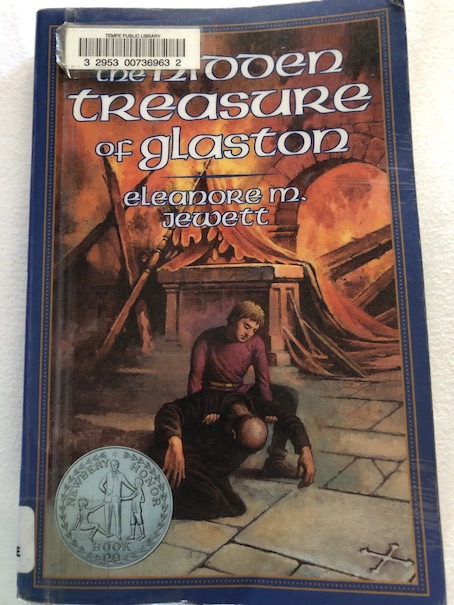
The Hidden Treasure of Glaston by Eleanore M. Jewett, 1946.

The year is 1171.  Twelve-year-old Hugh, a somewhat frail boy with a lame leg, arrives at the abbey of Glastonbury with his father on a stormy night.  Hugh’s father is a knight, and in his conversation with Abbot Robert on their arrival, he makes it known that, although he loves his son, he is disappointed in the boy’s frail condition because he can never be a fighter, like a knight’s son should be.  The abbot rebukes him, saying that there is more to life than war and that he, himself, is also of noble blood.  The knight apologizes, and says that, although it is not really the life that he would wish for his son, he asks that the abbey take him in and educate him.  Although the knight (who refuses to give his name, only his son’s first name) says that he cannot explain his circumstances, the abbot senses that the knight is in trouble and is fleeing the area, perhaps the country of England entirely. 

It is true that the knight is in trouble, and he is fleeing.  Since Hugh’s health is delicate, his father cannot take him along in his flight.  Realizing that the abbey will provide him with a safer life, Hugh’s father wants to see him settled there before he leaves and gives the abbey a handsome gift of expensive, well-crafted books as payment for his son’s education.  The abbot is thrilled by the gift, although he says that they would have accepted Hugh even without it.  Then, the knight leaves, and the monks begin helping Hugh to get settled in the abbey.

Hugh is upset at his father’s leaving and the upheaval to the life he has always known, although he knows that it is for the best because of his family’s circumstances.  Although the story doesn’t explicitly say it at first, Hugh’s father is one of the knights who killed Thomas Becket, believing that by doing so, they were following the king’s wishes. Hugh’s father did not actually kill Beckett himself, but he did help to hold back the crowd that tried to save Beckett while others struck the blows, so he shares in the guilt of the group.  Although Hugh loves his father, he knows that his father is an impulsive hothead.  Now, because of the murder, Hugh’s father is a hunted man. By extension, every member of his household is also considered a criminal.  Their family home was burned by an angry mob, their supporters have fled, and there is no way that Hugh’s father can stay in England.  However, the prospect of life at the abbey, even under these bleak circumstances, has some appeal for Hugh.

Hugh has felt his father’s disappointment in him for a long time because his leg has been bad since he was small, and he was never able to participate in the rough training in the martial arts that a knight should have.  Even though part of Hugh wishes that he could be tough and strong and become the prestigious and admired knight that his father wishes he could be, deep down, Hugh knows that it isn’t really his nature and that his damaged leg would make it impossible.  Hugh really prefers the reading lessons he had with his mother’s clerk before his mother died.  His father always scorned book learning because he thought that it was unmanly, something only for weak people, and Hugh’s weakness troubles him.  Hugh’s father thinks that the real business of men is war, fighting, and being tough.  However, at the abbey, there are plenty of men who spend their lives loving books, reading, art, music, and peace, and no one looks on them scornfully.  For the first time in Hugh’s life, he has the chance to live as he really wants to, doing something that he loves where the weakness of his bad leg won’t interfere. 

The abbot is pleased that Hugh has been taught to read and arranges for him to be trained as a scribe under the supervision of Brother John.  Hugh enjoys his training, although parts are a little dull and repetitive.  Hugh confides something of his troubles in Brother John, who listens to the boy with patience and understanding.  Although he does not initially know what Hugh’s father has done, Hugh tells his about the burning of his family’s home, how they struggled to save the books that they have now gifted to the abbey, and how there were more in their library that they were unable to save.  Hugh tells Brother John how much he hates the people who burned their home and how much he hates the king, who caused the whole problem in the first place. His father would never have done what he did if the king hadn’t said what he said about Thomas Becket, leading his knights to believe that they were obeying an order from their king.  Brother John warns Hugh not to say too much about hating the king because that is too close to treason and tells him that, even though he has justification for hating those who destroyed his home, he will not find comfort in harboring hate in his heart.  He also says that not all that Hugh has lost is gone forever.  People who have left Hugh’s life, like his father, may return, and there are also many other people and things to love in the world that will fill Hugh’s life.  Brother John urges Hugh to forget the past and enjoy what he has now.  When Hugh says how he loves books but also wishes that he was able to go adventuring, Brother John says that adventures have a way of finding people, even when they do not go looking for them.

One day, when Brother John sends Hugh out to fish for eels, Hugh meets another boy who also belongs to the abbey, Dickon.  Dickon is an oblate.  He is the son of a poor man who gave him to the abbey when he was still an infant because he was spared from the plague and wanted to give thanks to God for it.  Dickon really wishes that he could go adventuring, like Hugh sometimes wishes, although he doesn’t really mind life at the abbey.  Because Dickon is not good at reading or singing, he helps with the animals on the abbey’s farm.  Although he is sometimes treated strictly and punished physically, he also has a fair amount of freedom on the farm, sometimes sneaking off to go hunting or fishing.  He also goes hunting for holy relics.  Dickon tells Hugh about the saints who have lived or stayed at the abbey and how the place is now known for miracles.  He is sure that the miracles of Glaston will help heal Hugh’s leg, and he offers to take him hunting for holy relics.  Hugh wants to be friends with Dickon, but at first, Dickon is offended that Hugh will not tell him what his last name is.  Dickon soon realizes the reason for Hugh’s secrecy when a servant from Hugh’s home, Jacques, comes to the abbey to seek sanctuary from an angry mob that knows of his association with Hugh’s father.

The abbot grants Jacques temporary sanctuary but tells him that he should leave the country soon.  When Dickon witnesses Jacques’s explanation of why the mob was after him, comes to understand his connection to Hugh.  Although the mob does not know that Hugh is actually connected to Jacques, Dickon spots the connection and tells Hugh that he forgives his earlier secrecy.  Dickon even helps Jacques to leave the abbey the next day, in secret.

Now that Dickon knows Hugh’s secret, he lets Hugh in on his secrets and the secrets of the abbey itself.  He shows Hugh a secret tunnel that he has discovered.  There is an underground chamber between the abbey and the sea where more parchments and some other precious objects are hidden.  Dickon doesn’t know the significance of all of the objects, although there appear to be holy relics among them.  Dickon’s theory was that monks in the past created this room and tunnel to store their most precious treasures and get them away to safety in case the abbey was attacked and raided.  At some point, part of the tunnel must have collapsed, blocking the part of the tunnel leading to the abbey.  The boys are frightened away when they hear the ringing of a bell and can’t tell where it’s coming from.  Could there have been someone in a part of the tunnel that is now blocked off from the part where they entered?

Since Hugh is sworn to secrecy concerning Dickon’s discovery, he can’t ask Brother John about it directly, but he gets the chance to learn a little more when Brother John asks him to help clean some old parchments so they can reuse them.  Most of them are just old accounting sheets for the abbey that they no longer need.  Brother John said that they were stored in an old room under the abbey.  Hugh asks Brother John about the room and whether there are other such storage rooms underground.  Brother John says that there are rumors about a hidden chamber somewhere between the abbey and the sea where they used to store important objects for safety, but as far as he knows, no living person knows where it is or even if it still exists.  Hugh asks Brother John about treasures, but as far as Brother John is concerned, the real treasures of the abbey are spiritual.  However, when Hugh notices some strange writing on one of the parchment pieces that doesn’t look like accounting reports and calls it to Brother John’s attention, Brother John becomes very excited and orders him to stop cleaning the parchments so that he can check for more of the same writing.  Among the other scrap parchments, they have found pieces that refer to Joseph of Arimathea, who provided the tomb for Jesus after his crucifixion.  According to legend, Joseph of Arimathea also took possession of the Holy Grail, the cup that Jesus used at the Last Supper, which was supposed to have special powers, and that he left the Middle East and brought the Holy Grail to Glaston, where it still remains hidden. This story is connected to the legends of King Arthur, who also supposedly sought the Holy Grail. The parchments may contain clues to the truth of the story and where the Holy Grail may be hidden.

This story combines history and legend as Hugh and Dickon unravel the mysteries of Glastonbury and change their lives and destinies forever.  Although Hugh and Dickon both talk about how exciting it would be to travel and go on adventures, between them, Hugh is the one whose father would most want and expect his son to follow him on adventures and Dickon is the one who is promised to the abbey.  However, Hugh loves the life of the abbey and serious study, and Dickon is a healthy boy who is often restless.  Their friendship and shared adventures at the abbey help both Dickon and Hugh to realize more about who they are, the kind of men they want to be, and where they belong. Wherever their lives lead them from this point, they will always be brothers. 

There are notes in the back of the book about the historical basis for the story. In the book, the monks find the tomb of King Arthur and Guinevere. Although the story in the book is fictional, the real life monks of Glastonbury also claimed to find the tomb of King Arthur. The bones they claimed to find were lost when the abbey was destroyed later on the orders of Henry VIII, but this documentary (link repaired 2-27-23) explains more about the legends and history of King Arthur. The part about Glastonbury is near the end.

Aria Volume 1

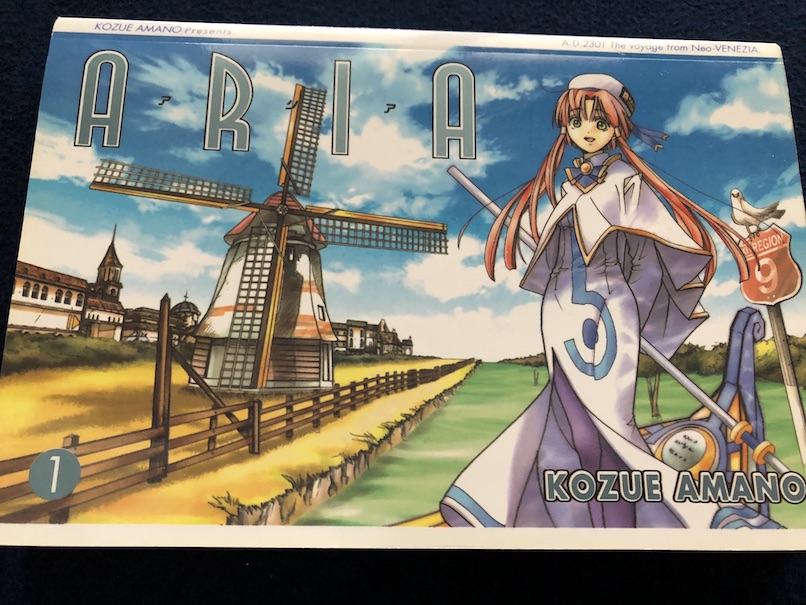
Aria Volume 1 by Kozue Amano, 2002, English Translation 2004.

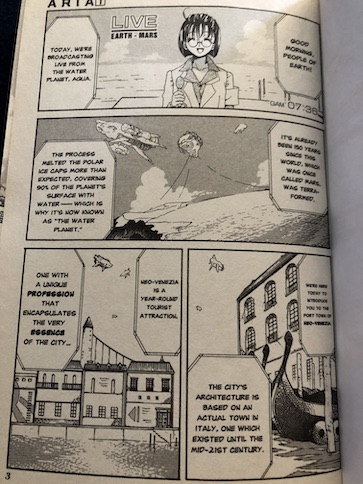
The is the first volume of the second part of a fascinating manga series that combines sci-fi, fantasy, and slice of life. The series takes place about 300 years in the future, when Mars has been terraformed and renamed Aqua (because of all the water on its surface). The human colonies on Aqua are designed to resemble old-fashioned cities on Earth (called Manhome here). The people of Aqua prefer a much slower pace of life than people on Manhome, and aspects of life on Aqua more closely resemble Earth’s past.

The series is divided into two parts. The first two books are the Aqua volumes and introduce Akari Mizunashi, the main character, a young girl who came to Aqua to learn to become a gondolier in the city of Neo Venezia (which resembles Venice). Female gondoliers, called Undines, give tours of the city, giving Akari plenty of time to admire the beauty of her new home and meet interesting people. The two Aqua books are the prequel to the main series, Aria. Aqua covers Akari’s arrival on the planet, her introduction to life on Aqua, and the beginning of her training. The main Aria series show Akari’s continuing training, her progression to becoming a full Undine, her evolving relationships with her friends, and as always, her delight in learning more about her new home and admiring its beauty.

The series has received some criticism for being slow and lacking danger and adventure, but that is not really the point of the series. The main purpose is to show people how to appreciate the small pleasures of life. The sci-fi and fantasy elements (the spaceships, advanced environmental controls, intelligent Martian cats, and even the occasional appearances of the legendary Cait Sith) are mainly background to the stories about the magic of friendship and simple pleasures. Each volume contains a few short stories about Akari and her friends and the little adventures they have on a daily basis and the life lessons they learn. It’s a great series for relaxing when you’re stressed out.

The stories included in this volume are:

Neo-Venezia

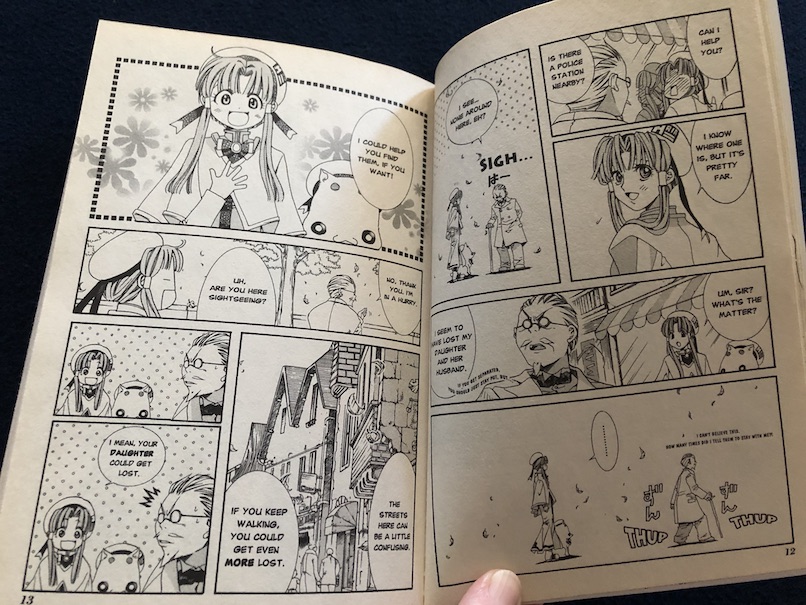
As autumn comes to Neo Venezia, Akari encounters a grumpy old man, a visitor from Earth, who has gotten separated from his daughter and lost in the city. He is frustrated with the confusing and inconvenient nature of Neo Venezia.

Akari says that she can help him find his daughter and gives him a tour of the city, showing him the beauty of the city and changes his mood with the help of some baked potatoes and green tea. A slower pace of life and appreciation for the little pleasures has benefits.

Drydocking

It’s time for the gondolas to be cleaned, so they are moved onto dry land. Akari and her friend, Aika are in charge of the cleaning, but it is Akari who makes it fun.

The Bridge of Sighs

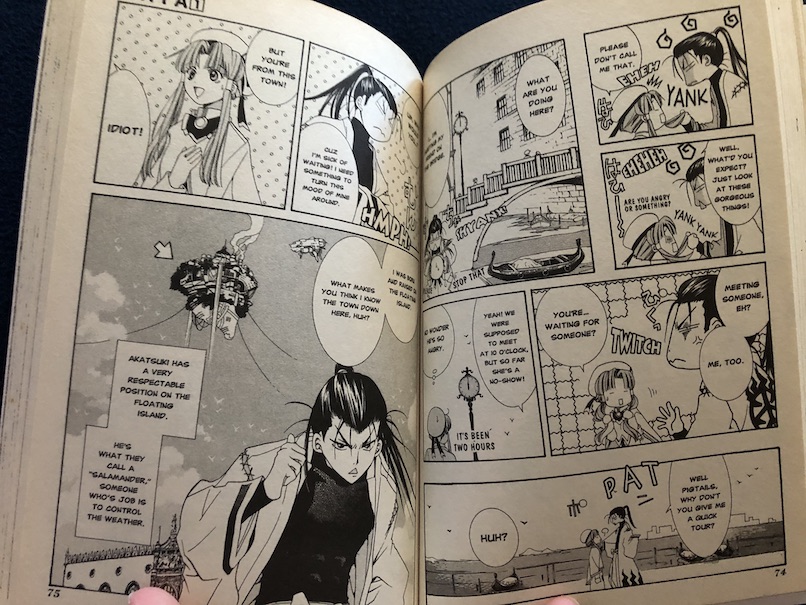
Like the original Venice, Neo-Venezia also has a “Bridge of Sighs.” Akari goes there one day to meet Aika and finds her friend, Akatsuki, waiting for someone. Akatsuki is impatient while he is waiting, so he convinces Akari to give him a short tour to pass the time. Akari tells him about the original Bridge of Sighs and how she thinks the name is still appropriate but for a different reason.

The original Bridge of Sighs, as Akari explains, was between an old courthouse and a prison, and the prisoners were said to sigh as they crossed the bridge because they were being led away to be incarcerated. However, Akari sighs because she likes living in the beautiful city of Neo-Venezia and feels like she’s lucky to be there. Her sigh is a sigh of contentment.

When the person Akatsuki is waiting for shows up, it turns out to be his older brother, who also appears in later stories.

Sun Shower

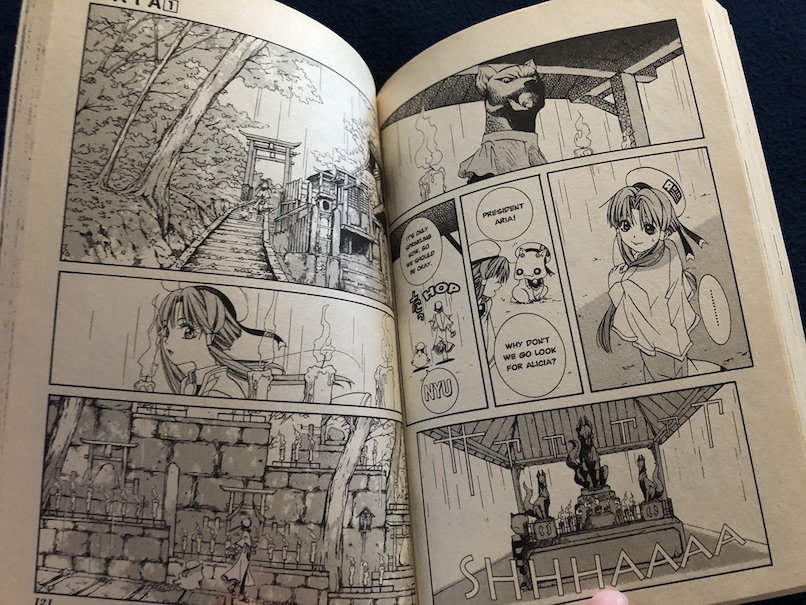
Although Akari lives in Neo-Venezia, which is designed to look like Venice, there are other parts of Aqua designed to look like different parts of Earth. Alicia takes Akari to an area much like Japan to see the changing autumn leaves and get some inarizushi.

They see a shrine on the island, and the woman at the sushi shop tells them a Japanese legend about the fox’s wedding, giving them a warning that the Inari fox might spirit them away to another world.

While admiring the red autumn leaves, Akari finds herself separated from Alicia, and she witnesses a strange wedding procession. When she seems to be invited to join it, she thinks quickly and gives the procession her inarizushi instead.

The story explains that a Japanese term for a sun shower (when it rains while the sun is still shining) is “the fox’s wedding.” Sun showers happen quite often when it rains where I live in Arizona, and I now think of this when I see one. I also know where to get some inarizushi. The Aria stories are good for making me want different types of food, whether it’s inarizushi or baked potatoes and green tea or pudding (from a previous book).

Vogare Longa

This story is based on a real gondola race that takes place in Venice.

Akari and Aika are told about the Vogare Longa gondola race, which all of the gondoliers, including the trainees, will participate in. Aika is determined to make a good showing in the race because there’s a rumor that it is used to judge trainees, but Akari gets caught up in the beauty of the day.

In the end, Akari admits to herself that she never forgot what Aika said about the race being used to judge trainees, but she just didn’t want to hurry because she was enjoying herself, and that’s the way she feels about her training in general. Akari wants to become a full Undine, but she wants to do it at her own pace and enjoy herself along the way.

It turns out to be just as well because the rumor about the race being used to judge trainees was only a rumor.

Patrick

Patrick: Patron Saint of Ireland by Tomie dePaola, 1992.

This picture book is about the life and legends of St. Patrick, who is the patron saint of Ireland and the reason for St. Patrick’s Day, which is mainly celebrated in modern times by wearing the color green, and often, a shamrock or shamrock symbol. Some places also hold parades and other special celebrations.

The historical St. Patrick was born in Britain during the time when it was ruled by the Roman Empire. When he was young, he was abducted and sold into slavery in Ireland.

In Ireland, Patrick was forced to work as a shepherd for the man who bought him. Roman Britain was Christian, but Ireland was still pagan at this time. Patrick found it a strange and lonely place, and he prayed that he would be able to go back home.

Later, Patrick got his chance to return home aboard a ship that was carrying hunting hounds to be sold in France. Patrick tried to buy passage on the board, but the captain was reluctant to take him at first because he thought that Patrick was probably an escaping slave, and he didn’t want to get in trouble for taking him. However, the dogs on ship kept howling when Patrick was sent off, and the captain noticed that when Patrick was on the ship, the dogs were quiet, so he changed his mind.

When they reached France, the area where they landed was deserted because there had been a war. The men and dogs were hungry and couldn’t find anyone to help them. The captain said to Patrick that if his God was so powerful, why didn’t he pray and get God to help them? Patrick did, confident that God would help, and a herd of pigs appeared, providing them with food.

Patrick eventually returned home to Britain and rejoined his family, but he had dreams about Ireland in which a man called Victoricus appeared with letters from the Irish people, asking Patrick to return. Patrick felt that he was called to bring knowledge of God and Christianity to Ireland. He decided to become a missionary.

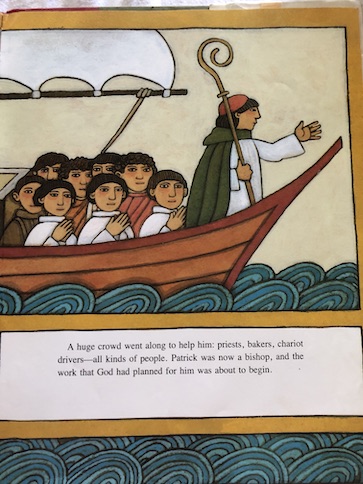
Patrick studied and worked his way up to become a bishop, and when he returned to Ireland, he brought others with him to help in his work. Upon his return to Ireland, he became friends with an Irish chieftain named Dichu, who also became a Christian. He gave Patrick a barn, which Patrick turned into the first church in Ireland.

Patrick and his followers suffered opposition in Ireland. At one point, a king tried to kill Patrick and ended up killing his chariot driver and friend, Odran, instead. In spite of that, Patrick persevered.

Patrick died on March 17, 461. After his death, he was declared a saint, the patron saint of Ireland, and the date of his death became his saint’s day. Many legends grew up around him, and the book explains the most popular stories.

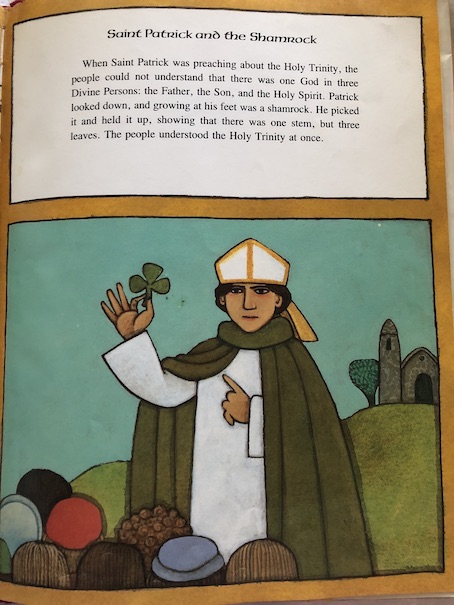
Among the most popular stories about St. Patrick are that he drove all of the snakes out of Ireland, frightening them away by beating on a drum. Another story says that he used the shamrock to explain the concept of the Holy Trinity, which is why the shamrock is an important symbol of Ireland and St. Patrick’s Day.

The book is available to borrow for free online through Internet Archive.

What Eric Knew

What Eric Knew by James Howe, 1985.

After his friend, Eric, moves away, thirteen-year-old Sebastian Barth receives strange messages from him, hinting at a mystery in the small college town of Pembroke. Eric always used to rope his friends into investigating things and having adventures, but before his family moved away, he started acting strangely and suffered an accident falling downstairs and breaking his leg.

Sebastian shares the notes with his best friend, David, and with Corrie, the new minister’s daughter. Corrie’s family has moved into the house where Eric used to live, near the church and graveyard. Eric’s notes seem to refer to a local legend about the ghost of a prominent woman, Susan Iris Siddons, who used to live in their town and supposedly searches for her lost wedding ring. Corrie thinks she sees this ghost in the graveyard. There is also something mysterious going on in the church, where the Siddons family still maintains a tradition of ringing the bell regularly at 9 o’clock in homage to their ancestors, Susan and her husband, Cornelius.

The dark secrets of the past mix with the troubles still surrounding the Siddons family. Can Sebastian and his friends solve the clues and learn what their friend Eric knew?

The book used to be available to borrow online through Internet Archive, but when I checked recently, it was no longer there.

My Reaction

The story leaves some things unresolved. The kids are never entirely sure how much Eric discovered before he moved, but they do learn that he recruited a couple of friends to help create the appearance of the ghost, possibly to draw attention to the real problem in modern times, which has nothing to do with the supernatural, although there is another troubling secret about the past that the kids uncover, too.

Both sets of problems do center around the prominent Siddons family and the pressures that the current family members, especially the younger generation, suffer as they try to keep up appearances and live up to images of their supposedly perfect relatives. The past secret explains one of the reasons why the Siddons family isn’t as perfect as they had always pretended to be and helps to put the “ghost” of Susan Siddons to rest. This is not a mystery story for very young children because of the dark and serious nature of the problems with the Siddons family. I would say the book would be best for ages 10 and up. The only question at the end is how much of these things Eric really knew.

Terror By Night

PFTerrorNight

Terror By Night by Vic Crume, 1971.

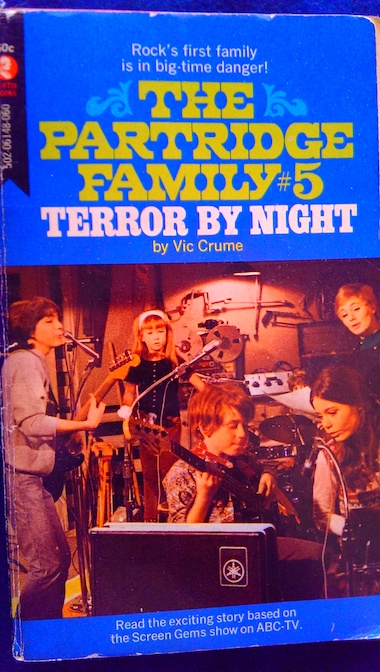
This book is part of the Partridge Family book series, based on the The Partridge Family tv show.

Shirley has been thinking that she and her children could use a vacation, and her family band’s manager, Reuben Kinkaid, suggests a place where they could have a little vacation and do some rehearsing.  Reuben arranges for the family to rent a large house with several acres of land attached in a small New England town not far from Salem, Massachusetts.  That should have been their first clue.  That, and the fact that the town’s name is Haunt Port.

At first, the Partridges are just thinking about how they can rehearse without disturbing anyone on such a big place, and Danny and Chris want to try camping out.  However, when they arrive in town, they learn that the name of the house they’ve rented is Witch’s Hollow and that it’s close to a place called Hangman’s Hill.  Soon after the family arrives at the house, Keith and Laurie also find a dummy hanging from a tree with a note that says, “Welcome! The Hangman.”  It’s pretty disturbing, but Keith and Laurie decide to hide the dummy and not scare the others.  They don’t know who is behind this awful joke, but they don’t want to give that person the satisfaction of seeing them react to it.

However, the disturbing things don’t end there.  The family’s dog, Simone disappears.  Also, people in town seem to have a strange attitude toward the house’s cook/housekeeper, Mrs. Judbury, and her daughter, Prudence.  Prudence is sullen and anti-social with a habit of catching toads for fun.  Keith has to admit that he can see how Prudence might have gotten a reputation for being a witch, but there’s more behind the strange happenings at Witch’s Hollow than that.

Simone eventually returns, although it’s clear that she’s frightened and hasn’t been fed well, and Mrs. Judbury tells the family the story of her family’s history in Haunt Port.  One of Mrs. Judbury’s husband’s ancestors was one of the accusers at the Salem witchcraft trials, but later, when people began to realize that they had executed innocent people, some of the accusers themselves found public opinion turning against them.  This ancestor decided to leave Salem and go to Judbury Port (the old name for Haunt Port) because he had family there, but he and his wife were never really accepted there, either.  This man later hanged himself in despair (at the place called Hangman’s Hill), and his wife later died alone, also shunned by the town.  Although some of the townspeople might feel bad about how things ended up with the Judburys, the old uneasy feelings about the family have remained, and Prudence’s stand-offish attitude, combined with her mother’s apparent psychic premonitions, has fueled some of the old stories.

At one point, Keith tells Prudence that he knows why she acts the way she does, because it’s much easier for her to keep her distance from people and behave strangely than it is for her to try to learn to get along with them and make friends.  Prudence isn’t responsible for what the townspeople did in the past, but she isn’t helping things in the present.  Jane Parsons, whose family owns the local store, also helps in a way because she and Prudence are cousins, and Prudence joins her in welcoming a cousin of their and his friend when they visit town.  As Prudence becomes friendlier, she and her mother become allies in trying to figure out the mysteries of Witch’s Hollow, which turn out to have less to do with past wrongs than current crimes.

The book is available to borrow for free online through Internet Archive.

Encyclopedia of Legendary Creatures

LegendaryCreatures

Encyclopedia of Legendary Creatures by Tom McGowen, 1981.

This book is organized into brief encyclopedia-style entries, describing legendary creatures from around the world.  Everything is in alphabetical order, not organized by country or any other over-arching categories.

There are two things that I particularly like about this book.  One is that the mythological creatures in the book aren’t just limited to the common ones, like giants, vampires, werewolves, and unicorns (although they each have entries of their own); there are also some lesser-mentioned creatures like the Hulder Folk and the Abatwa People.  The Hulder Folk, who come from Norse folktales, look like ordinary humans, but they have tails like cows.  According to the book, they love to sing and dance, but their songs are always sad, which makes me think of country music.  They also can intermarry with humans, although their marriages are usually unhappy, which also, oddly, makes me think of country music.  The Abatwa People are part of the folklore of the Zulus in South Africa.  They are tiny people, but fierce warriors, and they get offended if people don’t treat them like they are the same size as humans.  (There are also real people in Africa called Abatwa who are pygmies.  The legendary people in this book may be connected to old legends about them, exaggerating their shorter-than-average height.)

LegendaryCreaturesNisse

The other thing that I really like about this book is the pictures.  There are many books about mythology and folklore that don’t have pictures of the creatures, and it really makes a difference being able to see what something looks like (or supposedly looks like, since these are legendary creatures) as well as read a description.

As a side note, there is an episode of the kids’ cartoon show, Arthur, where his friend, Sue Ellen, who isn’t usually frightened by scary stories, hears a strange noise that makes her think about various mythological monsters that she’s heard about in the different countries that she’s visited with her parents.  These unusual monsters, like Baba Yaga, Kappas, and Bashees, which most of her friends haven’t heard about before, do frighten her.  When I saw Kappas described in this book, it reminded me of that.