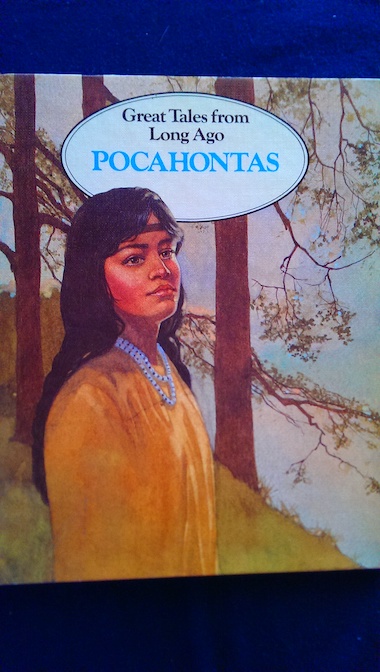
Pocahontas

Pocahontas

Pocahontas by Jan Gleiter and Kathleen Thompson, 1985.

The story about the life of the young Native American woman known as Pocahontas (“Pocahontas” was really a nickname, which the book mentions, although it doesn’t say that her original name was Matoaka) has been told many times in many forms, but this particular book is somewhat sentimental for me because it was the first one I ever read about her when I was a kid. It’s part of a series about famous and legendary figures in history and myth. Pocahontas was a real, historical person, but aspects of her life have taken on the characteristics of legend (as well as providing material for a Disney movie, although the Disney movie takes liberties with the real life of Matoaka/Pocahontas and the movie was not based on this particular rendition of her story).

When this particular book begins, Pocahontas is a grown, married woman going by the name of Lady Rebecca Rolfe. While living in England, she reflects back on her life and youth, remembering when she first met Europeans.

PocahontasEngland

When she was ten years old, she heard her father, Powhatan (who was the chief of their tribe) and other men talking about the white men. Although Pocahontas hears that the white people had betrayed her people’s trust and even killed some of them, she is curious to get a look at them.

PocahontasSettlerChildren

She ends up meeting with a group of boys from Jamestown and playing with them. She begins making friends with people in Jamestown and visiting them from time to time. A man named John Smith becomes curious about the girl and her people and gets Pocahontas to teach him some of her language.  (The book is more accurate than the Disney version here, showing that there is a significant age difference between Pocahontas and John Smith, with Pocahontas being a child at their first meeting.)

PocahontasJohnSmith

Then, one day, there is a feast in Pocahontas’s village, and some of the men of the tribe bring a white man who was caught trespassing in their territory. Pocahontas recognizes the white man as John Smith and, upon realizing that he is about to be executed, intervenes to save his life. (This is one of the most famous parts of the story of Pocahontas’s life, although the exact circumstances surrounding the real-life incident are a little confusing and may have actually been part of a more complex ritual that John Smith didn’t fully understand at the time, not an actual attempt at execution, if the event actually happened at all. This book offers a simplified version of the incident, supposing that John Smith’s life was in real danger, as he described it in his account of what happened.)
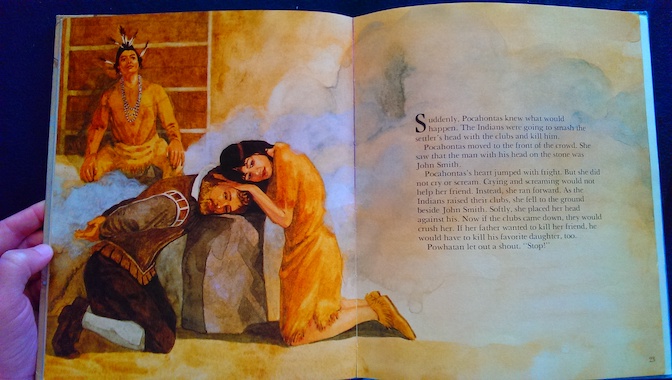
PocahontasExecutionAttempt

In the end, the settlers at Jamestown kidnap Pocahontas in the hope that Powhatan would end hostilities with them, using her as a bargaining chip.  (The book says that her father wasn’t too worried because he knew that the settlers were her friends and would treat her well, but I find this part of the book pretty worrying myself, reading it as an adult.  I’m pretty sure that is not how a parent would react to a missing child in real life.  I guess that the book is trying to keep the tone light for children, but it just sounds weird.) Pocahontas remains among the settlers, living according to their lifestyle and taking the name Rebecca. Eventually, she meets a man named John Rolfe and marries him. The two of them have a son together. With her new family, she travels to England and tries to help the people there to understand her people.  (The book says this in a very optimistic way, calling her visit a “success”, although in real life, this visit was largely a propaganda move on the part of the Virginia Company of London. On the other hand, she was, evidently, very well-received in England, if something of a social curiosity.)

PocahontasWedding

The story in the book ends here, with her still in England, thinking back on her life and her reasons for being there. Part of me wishes that it had explained a little more about Pocahontas’s earlier life and some other facts behind her story. Sadly, part of the reason why they might have been reluctant to tell the rest of the story to children was that the real Pocahontas didn’t live very long after the point where the story ends.  As she was preparing to return to Virginia from England, she became very ill and died.  Her exact age at the time of her death is unknown, but she was probably about 21 years old.  Her son, Thomas Rolfe, was very young at the time she died, but they do still have living descendants today.

Overall, I’d say that this is one of those stories that becomes more interesting when you’re older and realize the full depth of it.  This picture book is a very simplified version of the story, meant for kids, but when I was young, it did inspire me to learn more about Pocahontas.  There any many missing details of Matoaka/Pocahontas/Rebecca Rolfe’s life because of the limited records of it, but what is known is fascinating.  It’s sad because she died so young, but that the story of her life lived on in so many imaginations after her death is profound.  Different people, both when she was alive and after her death, tried to use her for their own purposes, but her legend still continues, out-living them all.  I’ve never seen the Disney Pocahontas movies, and I don’t really want to.  I already know how the story ends.

The book is currently available online through Internet Archive.
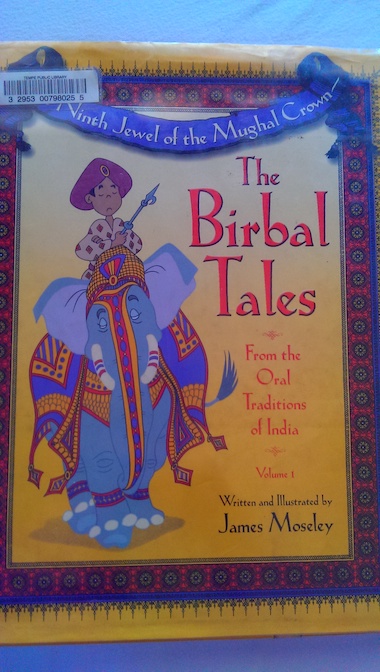
The Ninth Jewel of the Mughal Crown

BirbalTales

The Ninth Jewel of the Mughal Crown: The Birbal Tales by James Moseley, 2001.

BirbalTalesRealBirbalThe characters in the stories, Emperor Akbar and his friend and advisor Birbal (birth name Mahesh Das) were real people who lived in India during the late 16th century. Over the years, stories and legends have grown up around them, although the truth is pretty incredible by itself.

This book, which is a collection of some of the stories about Akbar and Birbal, begins by explaining a little about their history, and there is another section in the back that explains more about their lives.  The book’s introduction says that Akbar’s father died when he was young and that Akbar’s reign was considered a Golden Age in India’s history, although it mostly focuses on his “Nine Jewels.”  The section in the back gives a little more context.

To begin with, Akbar was one of the Mughal Emperors.  The book doesn’t explain much about what that means, but understanding it helps to set the stage for the stories.  The Mughal Empire consisted not only of modern day India but also some of the surrounding countries.  The empire was first established by Akbar’s grandfather, Babur, through conquest.  Babur was born in the region that we now call Uzbekistan, although his family’s origins were Mongolian.  They were distantly descended from Genghis Khan.  They were also descended from Tamir (sometimes called Tamerlane), giving them Turkic and Persian connections.  The early years of the Mughal Empire were unstable, but when Akbar’s father died and Akbar became emperor at a young age, his regent helped him to stabilize the empire and expand it through a mixture of further conquest and diplomacy.  The reputation of wealth and power in the Mughal Empire eventually led to the adoption of the word “mogul” in English to describe a wealthy and powerful person, especially one who has high standing in a particular field of expertise (something which, as you’ll see, was of particular importance to Akbar).  Using the riches and resources gained through his territorial expansion, Akbar worked to develop the economy of his empire and to support the arts and learning.

BirbalTalesRealAkbarAkbar had a great love of learning, but unfortunately, was dyslexic at a time when people didn’t understand the condition very well.  (To put it into context, Akbar was a contemporary of Elizabeth I of England.)  Even though, like the European Emperor Charlemagne (who lived much earlier but was also apparently dyslexic), he wanted to learn to read, he struggled with it throughout his life because of his condition.  Akbar didn’t want his reading difficulties to interfere with his learning or his love of the arts, so he found another way around the problem.  In a way, it’s similar to what Charlemagne did, surrounding himself with learned advisors who would read to him and discuss important topics with him, verbally teaching him whatever he wanted to know.  Akbar chose his advisors very carefully, seeking out people who had demonstrated excellence in subjects that were important to him. Akbar’s advisors became famous for their fascinating and unusual skills and personalities.  He had nine special advisors who were close to him, which is why they were called, “The Nine Jewels of the Mughal Crown.”  Legends grew up around these men and their abilities:

Tansen – An expert in music, whose singing voice was said to be so amazing that he could make candles burst into flame with a song.

Daswant – A master painter.

Todar Mal – An expert in finance.

Abul Fazl – A great historian.

Faizi – Brother of Abul Fazl, a famous poet.

Abud us-Samad – A master at calligraphy, he also designed the imperial coins.

Man Singh – A great military general.

Mir Fathullah Shirazi – A man of many skills, including the fields of medicine, astronomy, philosophy, and finances.

Birbal – Akbar’s Minister or Raja, who had a reputation for cleverness, quick wit, and the service of justice.  He was the “Ninth Jewel”, and his stories are the focus of this book.

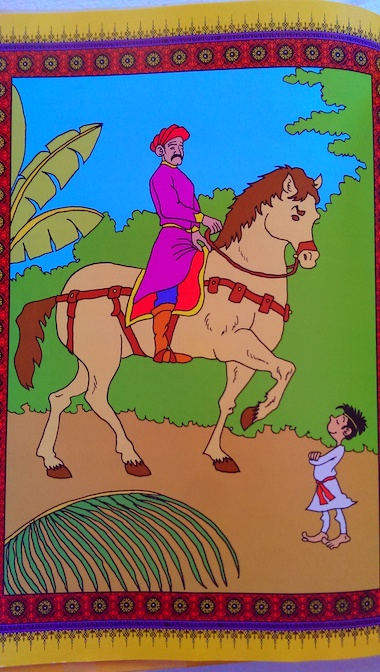
BirbalTalesMeetingThere are many more stories about Birbal than the ones included in this book, but they are all about how Birbal uses his wits to serve Akbar and aid the cause of justice.  Like all good legends, the stories are partly based in fact, but have grown with each retelling to the point where it can be difficult to say where the real people leave off and the legends begin.

In the first story in the book, Akbar meets Birbal when he is still a child.  Fascinated by the boy’s combination of courtesy and boldness and his unusual wit, he gives the boy a ring and tells him that when he is grown, he should come to his palace at Fatehpur Sikri.  Years later, Birbal does go there, but when he shows the ring with the emperor’s seal on it to the guard on duty, the guard refuses to let him in until he promises to give him half of whatever the emperor gives him.  When Akbar sees Birbal, he is pleased to meet him again but stunned when Birbal asks him to give him 100 lashes.  When Birbal explains the reason for his bizarre request, it not only gets the laughter of the court, but the approval of Akbar, who appreciates this bold approach to the problem of bribery.

BirbalTalesPortraitFrom then on, Birbal gains a reputation for his ability to mediate disputes and find unusual solutions to problems.  His favored position at court gives him some jealous enemies, but he handles them with the same cleverness that he uses to solve every problem.

In one of my favorite stories, one of the noblemen at court attempts to cheat Daswant out of his rightful fee for painting his portrait by changing his appearance (shaving his beard, shaving his mustache, etc.) after each portrait sitting and then claiming that the portraits Daswant paints do not really look like him.  When Daswant explains the situation to Birbal, he gets the nobleman to promise to pay for an “exact likeness” of himself in the presence of Akbar.  Then, Birbal shows him a mirror, which Akbar agrees contains an exact likeness of the nobleman and deserves payment.

BirbalTalesCoinPurseIn another of my favorite stories, Birbal determines who is the true owner of a coin purse when a flour merchant and an oil merchant each claim that it belongs to them.  He pours the coins into a pot of boiling water and notes the oil that bubbles to the surface.  Because the coins are covered in oil, they obviously belong to the oil merchant.  If they had belonged to the flour merchant, they would have been covered in flour.

One of the interesting aspects of Akbar’s friendship with Birbal was their religious differences.  Akbar, like the rest of his family, was Muslim, and Birbal was from a family of Hindu Brahmins. The Mughal Empire was a multi-cultural society, and Akbar was aware of it.   At one point, he attempted to develop a new religious movement that combined aspects of Islam and Hinduism in order to further unite his subjects, but it never caught on as a mainstream religion, possibly because Akbar’s own strong personality as its leader was one of the most attractive features.  Akbar did seem to genuinely believe in religious tolerance and promoted widespread education among his subjects.

Birbal, the historical person, was eventually killed in battle, and Akbar greatly mourned his loss.  The Mughal Empire continued for generations beyond Akbar, although it eventually collapsed through a combination of military, administrative, and economic decline; the decentralization of power in the empire; internal discord; and interference from outsiders that paved the way for the British colonization of India.  That’s kind of a simplistic description of a long, complicated period of history, but the end of the Mughal Empire was marked by the beginning of British rule in India.  In 1858, the British East India Company deposed the last of the Mughal emperors, sending him into exile, around 300 years after the reign of Akbar began.

Basil and the Pygmy Cats

BasilPygmyCatsBasil and the Pygmy Cats by Eve Titus, 1971.

Mouse detective Basil’s arch enemy, Professor Ratigan, has taken over the Asian country of Bengistan, near India.  Basil discovers that he is holding the real ruler of the country captive so that he and his gang can loot the country for everything they can get, keeping the populace in subjugation.  Basil is determined to go there and free the rightful ruler so they can vanquish Professor Ratigan!

When Dr. Edward Hagerup of the British Mousmopolitan Museum hears that Basil is heading to Asia, he asks him to investigate an historical mystery for him.  There have been tales of a race of pygmy cats, no bigger than mice, but new evidence has been found that suggests there is more truth behind the stories than anyone has realized.  Basil has an interest in archaeology and eagerly accepts this extra task as part of their mission.  Along the way, other mice who have heard of the expedition join up to help Basil.

At first, Basil’s original mission, stopping Ratigan, seems easy.  Basil and his friend Dawson allow themselves to be captured so that they can get into the palace and find the real Maharaja of Bengistan.  After solving a secret code in the dungeon, they find the Maharaja, who tells them that another acquaintance of theirs, the opera singer, Relda, is also a prisoner in the palace.  She was giving a performance there when Ratigan and his thugs took over, and Ratigan has forced her to stay, giving private performances for him.  During one of these performances, Basil and his friends manage to take Ratigan by surprise and capture him.

BasilPygmyCatsPic1Now, Basil thinks that he and his associates are free to continue their other mission, finding the lost civilization of pygmy cats.  However, that mission is fraught with danger and surprises, and they haven’t quite heard the last of Ratigan.

The story isn’t really much of a mystery.  It’s really more an adventure story.

Basil and his friends manage to locate the island of pygmy cats with the help of Jeannie (a sea serpent related to the Loch Ness Monster who lost her way back to Scotland after a family trip — I kid you not) and the Sacred Catfish (which they bribe with catnip — I also kid you not, and his nip trip is a little disturbing).

This is my least favorite of the Basil series, partly because of the lack of mystery and also because of “primitive” nature of the pygmy cats when they find them.  Basil makes it clear that the pygmy cats are inherently less intelligent than mice and that their greatest achievements were because of the influence of royal mice who washed up on the shores of their island years ago, only to be wiped out by a volcano.  (Really?  Really.  Basil, if these mice were so superior and the pygmy cats so inferior, why were the cats able to get away from the volcano when the mice didn’t, hmm?  Why didn’t the mice just go to the part of the island where the cats were until the volcano stopped erupting?  Just what kind of bill of goods are you trying to sell us, Basil?)  Basil comes off sounding like a 19th century imperialist, and the fawning adoration he gets for his discovery is really annoying.

In general, I don’t like the Basil stories that turn out to be more adventure than mystery, and Basil’s smug superiority at various points in the story are off-putting.  It’s true that that Sherlock Holmes (which this series parodies) had an ego as well, but these sort of imperialist attitudes in a children’s story are distasteful.  Although I like recommending nostalgic books for future generations, this is one that I really can’t recommend.  The brightest spot in this book was the secret code in the dungeon, which is more in keeping with the mystery theme.  If the book had made the plot to capture Ratigan and end his reign of terror in another country without all this stuff about an “inferior” species of small cats, it would have been a much better story.

Like other books in this series, this book contains a number of jokes on the original Sherlock Holmes stories.  Read a number of the names backwards, and you’ll see some familiar names from Sherlock Holmes as well as a reference to another series by Eve Titus.

This book is available to borrow and read for free online through Internet Archive.

The Mysterious Queen of Magic

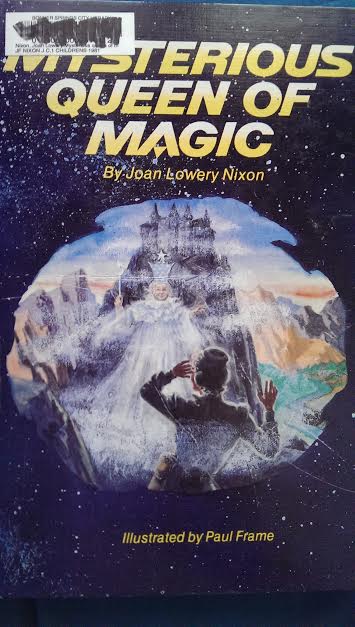
KleepQueenMagicThe Mysterious Queen of Magic by Joan Lowery Nixon, 1981.

This is part of the Kleep: Space Detective series.

Kleep and Till meet a strange young man who is looking for Kleep’s grandfather, Arko.  The young man, Mikkel, tells them a wild story, that an evil wizard is after him.  He is controlling Mikkel’s people on the planet Durth, putting them under a spell and forcing them to become his slaves. Mikkel believes that Arko may have the key to getting rid of him because an old wise man told him to ask Arko how to find Queen Stellara.  Queen Stellara was a legendary queen who could do magic, and Arko has some old write-rolls, scrolls of the kind people used to use before people began using computers alone for learning, that talk about her and her kingdom.  However, Arko doesn’t believe in wizards or magic spells or anything of the kind.

Kleep remembers Arko telling her the old stories from the write-rolls when she was little, and unlike her grandfather, she believes that wizards and magic may be real and wants to try to help Mikkel.  When Arko says that he doesn’t believe in magic and can’t help Mikkel, Kleep and her friend Till decide to use the scrolls to try to help Mikkel find Queen Stellara.  Taking Kleep’s robot, Zibbit, with them, they journey to the planet Loctar, where Queen Stellara was supposed to live.

Although this series is mostly sci-fi with a bit of mystery thrown in, this book is more fantasy.  When Kleep and her friends arrive on the planet Loctar, they discover that they must face a series of challenges to reach the legendary queen’s palace, like heros in a fairy tale.  Magic is real, and they must prove themselves worthy in order to meet the queen and ask her for the solution to the problem of the evil wizard.  But, their ordeal doesn’t quite end there because, while Queen Stellara provides them with the means to fight the wizard, they must face him themselves!

A little corny, but fun, although it’s not my favorite book in the series.  The others were more sci-fi, and this is more fantasy.  Also, for a “detective” series, there isn’t much mystery, more adventure.  It sort of reminds me of the original Star Trek episode Catspaw, except that the magical beings in this one are apparently really magical and not just aliens.  Like the other books in this series, I like the pictures, too.

KleepQueenMagicPic3

The Witch King

WitchKingThe Witch King by Maeve Henry, 1987.

Robert is the son of a fisherman in a small village by the sea. All his life, he’s grown up hearing stories of a mysterious City to the south that was fashioned ages ago from a silver tree. Wondrous things are said to happen there. People from the City used to visit the Witch Women in Robert’s village for advice, but no one has come there from the City in a long time, and people now doubt whether the City really exists. People have even stopped believing in the Witch Women. However, Robert believes in the old stories, and he wants desperately to see the City for himself.

The stories say that someday the Witch King will come to the City and plant a seed so that a new tree will grow. Robert wants to see this story come true, and Granny Fishbone, a strange old woman who tells Robert the old stories, says that the time of the Witch King is close. She gives him a pendant in the shape of a fish and tells him that it came from the City and that it is time for Robert to take it back there.

With some misgivings, Robert’s family lets him set off on his seemingly crazy quest of finding the City. To Robert’s surprise, he is met on the road by the Royal Wizard of the City. As Granny Fishbone said, the time of the Witch King is near, and there is trouble in the City. The Spell that controls the City is failing, and the King has been seeking a remedy for the problem.

The City has become corrupt because a usurper murdered the rightful king years ago and took over the City. He had his wizards cast a spell on the City that let him control everything in it, and he manipulated historical accounts to make it seem as though he was the founder of the City himself. Robert knows differently because Granny Fishbone is really one of the Witch Women, and she told him the true story about the miraculous tree and the founding of the City. The king’s grandson, David, is also corrupt and wants to learn to control the spell over the City for his own power. He believes that he is the prophesied Witch King, and he tries to convince Robert of it so that he will help him.

When Robert learns that David’s plans for controlling the spell may mean sacrificing his own sister, Princess Sophie, who Robert loves, Robert does his best to thwart his plans by telling the king and the Royal Wizard.  Although David at first seems to have the upper hand, he is not the true Witch King. Granny Fishbone was correct that the time of the true Witch King has come, and Robert has a much bigger role to play in the story than he thinks.  As the ancient prophesy says, the City will have to be destroyed in order to be saved.

Mandie and the Cherokee Legend

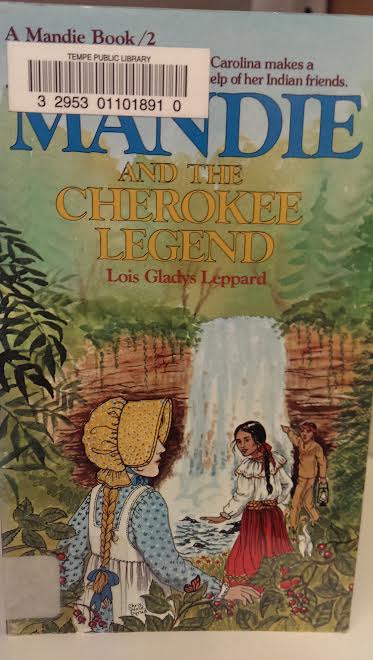
MandieCherokeeLegend#2 Mandie and the Cherokee Legend by Lois Gladys Leppard, 1983.

Mandie is going to visit her Cherokee relatives with her mother and Uncle John. Mandie is eager to meet her relatives, and she hopes that they all like her. The Cherokees all knew her father well, and most of them are eager to meet her. All except for her cousin, Tsa’ni, that is.

Tsa’ni knows the stories of how white men have oppressed the Cherokees and forced them to move off of their land years ago, and he resents all white people because of it. The others tell him that he is wrong to hate all white people because of what some of them did in the past and that Mandie and her Uncle John are good people. However, Tsa’ni doesn’t listen to them, and he plays a mean trick on Mandie, Joe, and Uncle Ned’s granddaughter, Sallie. He offers to show them a cave, but then he abandons them inside.

The three kids have to find their own way out, but they discover a fortune in gold nuggets in the process. First, the children have to make it back to Uncle Ned’s house after a frightening night in the woods. Mandie, Joe, and Sallie accidentally stumble onto a still (machinery for making alcohol) that belongs to a white couple while they are wandering around in the woods after leaving the cave. The couple are worried that they will tell people about their illegal still, so they hold the kids prisoner.

Although the kids manage to escape, they must return to the cave to find the treasure again (while dodging Tsa’ni’s tricks to foil their efforts) and keep it safe (from the still operators and anyone else who might want to steal it) until they can decide what to do with it. As far as Uncle Ned and the other Cherokees are concerned, gold is bad luck because it was the discovery of gold which forced the Cherokees out of their old homeland. However, the origin of this gold may help to change their minds.

This book is one of the Mandie Books.  It is currently available online through Internet Archive.

The Ghost on the Hill

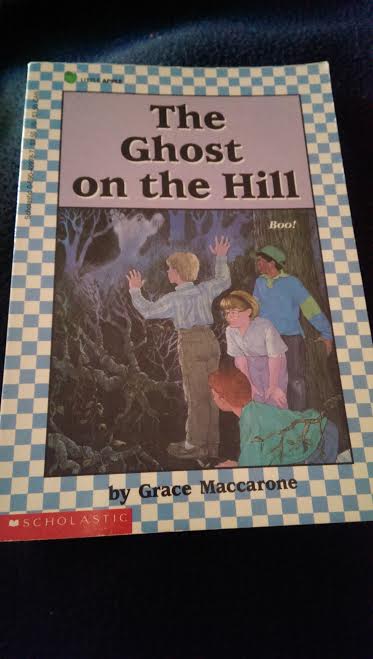
ghosthillThe Ghost on the Hill by Grace Maccarone, 1990.
This is the last book in the Third Grade Ghosthunters series.

The kids take another field trip, this time to a state park. Native Americans used to live on that land, but most of the tribe died from disease many years ago. There are stories about spirits that live in the hills and the forest. Young boys from the tribe used to perform a ritual where they would dance with the Great Spirit in order to become men.

The third graders have been studying Native American history and customs to prepare for the field trip.  Norma wrote a report about Native American names, which tended to describe some significant characteristic of the person.  Their teacher tells the students that they should think of names for themselves which describe something significant about themselves.  Most of the kids think it sounds like a fun idea, but Joey doesn’t.  He’s just one kid in a family with a dozen other kids, and he’s never felt like there was anything particularly special about him.  That’s why he makes up tall tales about himself that all the other kids find weird and annoying.

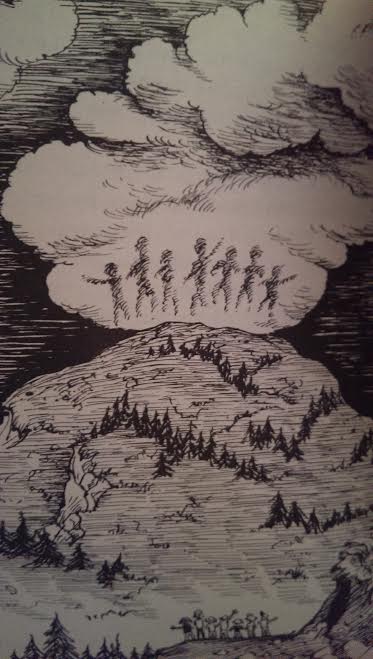
ghosthillpicWhen they reach the state park, Dennis Ten Foot Bridge, who is the last of his tribe, tells the students about his tribe, teaches them wilderness skills, and leads them in group activities.  One evening, Joey goes out to practice some rowing on the lake by himself, and he sees what looks like a large ghost at the top of a hill  However, everyone knows that Joey lies about a lot of things, so at first, no one believes him.  At least, no one except Adam.

Adam agrees to help Joey investigate the mysterious spirit. Eventually, all of the members of the ghosthunting group decide to go up on the hill together to see the ghost for themselves.  There, Joey finds the courage to face the spirit directly, and everyone sees the truth. Together, Joey and his friends end up repeating the ancient coming-of-age ritual that the tribe that used to live there would perform.

The solution to the mystery is a little strange, but the book is great for the characters alone. This final book in the Third Grade Ghosthunters series is a coming-of-age story. The other books in the series addressed personal issues and personality quirks in the characters as side-plots, such worrying about not being as smart others, worries about making and keeping friends, and the trouble with teasing. This one focuses on Joey and his sense of identity. He’s always felt that there is nothing special about him compared to his brothers and sisters. In this story, he develops his own character more and gains new confidence. In the process, he ends up becoming more comfortable with his role as a kid in a family with many children as well as appreciating his own uniqueness.  He also finds a name for himself that expresses his new sense of identity.