Kirsten Learns a Lesson

Kirsten, An American Girl
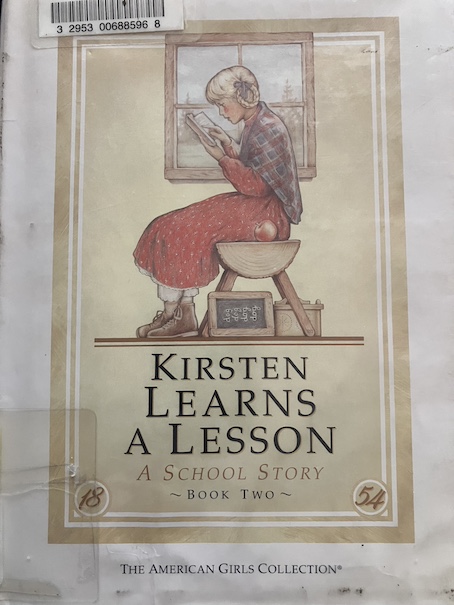
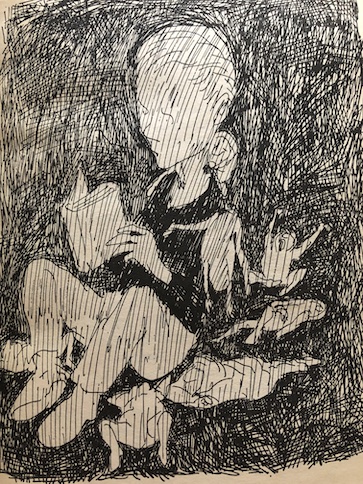
It’s November, 1854, and now that nine-year-old Kirsten’s family has settled in their new home in Minnesota and the harvest season is over, it’s time for the children to go to school. Kirsten and her brothers, Lars and Peter, will go to the small local school with their cousins, Lisbeth and Anna. Powderkeg School is a one-room schoolhouse in a little log cabin. Lisbeth and Anna’s stories about what Powderkeg School is like worry Kirsten. They talk about how strict their teacher, Mr. Coogan, is. Sometimes, the boys in class get rowdy and fight, and Mr. Coogan uses physical punishment on them. However, the girls tell Kirsten that she probably won’t have any problems with Mr. Coogan because he likes children who are well-behaved, and Kirsten is well-behaved. Still, Kirsten is nervous about what her new school will be like.
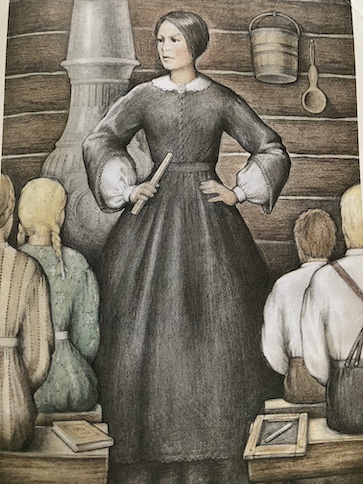
When they get to school, they learn that Mr. Coogan was injured in a fall from his horse, so they will have a replacement teacher, Miss Winston, who has only recently arrived from Maine. When one of the mean boys in class says he hops the horse also stepped on Mr. Coogan, Miss Winston tells him that nobody talks out of turn in her class and, although they live in the country, “we are not savages like the Indians.” (This is a 19th century attitude toward Native Americans, but this concept is challenged later in the story.)

Miss Winston has each of the children in class introduce themselves so she can get to know everyone. When it’s Kirsten’s turn to say her name, she forgets to address her teacher as ma’am, like the other students. Miss Winston insists that she say “ma’am”, and when she sees Kirsten struggling with the language, she asks Kirsten if she speaks English. Kirsten says that she speaks a little, and her cousins explain that her family just came from Sweden and that they speak Swedish at home. Miss Winston says that “practice makes perfect”, so Kirsten will practice her English in school. For now, she will have the easiest lessons and share seven-year-old Anna’s schoolbook.

When the mean boy, Amos, laughs at Kirsten, Miss Winston glares at him and strikes the school’s iron stove with her ruler, startling the students. Miss Winston says that her father was a ship’s captain, so she knows how to be in charge of her students, like he was in charge of his crew. Then, she deconstructs the sentence “Miss Winston hit the stove”, pointing out which words are the subject, verb, and direct object of the sentence. Then she warns the class to “Be careful that the direct object of hit isn’t the student.” The implication is that Miss Winston is just as willing to use physical punishment against her students as Mr. Coogan was.

When Amos introduces himself to Miss Winston, we learn that he is nineteen years old, the same age as the new teacher, but the new teacher says that, in spite of being the same age, she’s still the teacher, and he’s the student. In spite of being more a young man than a boy in age, Amos has only just finished the third reader, and Miss Winston says her role is to help him read and do math like a man would, embarrassing Amos. (He can’t use his age to put himself on an equal footing with the new teacher because they are not intellectual equals. She’s the same age, but she has graduated from her own school and become a teacher, and he’s still struggling along with low level math and reading.)

Anna helps Kirsten with her lessons, and Miss Winston praises her for helping to teach Kirsten, but she doesn’t praise Kirsten for doing a good job. At the end of the school day, Kirsten and her cousins talk about the new teacher. Anna thinks that Miss Winston seems nice, but Kirsten thinks that Miss Winston doesn’t like her and that she seems very strict. She asks if that was what Mr. Coogan was like, and Lisbeth says he was worse. The best part of the day for Kirsten was lunchtime, when the children were allowed some play time. When she ran around and played tag with the other children, it didn’t matter if she didn’t speak much English.

When the girls play school with their dolls, Anna imitates Miss Winston and her comment about “savages.” Kirsten asks the other girls what that word means. They say it means “wild.” Kirsten asks them if the Indians (Native Americans) are really like that, and they say that some people say they’re kind and will help people if they need food but others day that they’re “cruel and bloodthirsty.” They’ve seen an Indian man before. He came to their house when their mother was roasting meat, and he left when their mother gave him some. They thought he looked pretty “savage” because his face was painted, and he had eagle feathers in his hair. The girls say that Native Americans also wear knives and live in tents. As a farmer, their father is concerned about the Native Americans. He knows that, if the farmers take too much of their usual hunting grounds for farming, it will drive away the animals, and the Native Americans will be starving and angry. While he is happy that he has been able to secure some farmland for his family (I explained a little about the famine conditions and lack of farmland in Sweden around this time that caused people like the Larsons to leave their country when I covered Meet Kirsten), he is aware that the Native Americans also need land for their survival.

At school, Miss Winston announces that each student will memorize a poem and recite it for the class. When they recite their poems, she wants them to say them with feeling and show the emotions their poem is trying to convey. Kirsten worries about this assignment because she’s still learning English. It’s hard enough for her to learn to read anything in English and understand the meaning of the words. She doesn’t know how she can also learn to memorize an entire poem and say it in front of everyone. Miss Winston gives Kirsten a short poem to learn, but having even a short one doesn’t seem to help Kirsten.
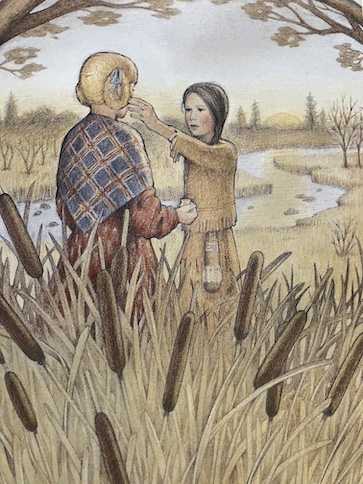
Meanwhile, Kirsten has her first encounter with a Native American when she spots an Indian (Native American) girl watching her while she’s getting water from the stream. The girl runs away, but Kirsten finds a blue bead that she dropped. Kirsten takes it and leaves her a little pretend cake that she and her cousins made for their dolls. Later, she finds that the cake is missing and that there’s a green duck feather in its place. She and the Indian girl trade little objects in this way, gradually becoming friends.

Kirsten’s secret friendship with the Native American girl becomes a comfort to her when school is stressful. Frontier teachers often board with families who live near the school, and when Miss Winston comes to stay at Kirsten’s aunt and uncle’s house, Kirsten feels like school is following her home. What’s worse is that Kirsten’s family will be joining them for dinner, and they will practice English during the meal. Kirsten knows that the meals, instead of being comfortable family time, will now be like lessons, and they will struggle to say things they would want to say because her family still hardly knows English. Worse yet, Miss Winston is cross with Kirsten because she can’t seem to memorize even her short poem.
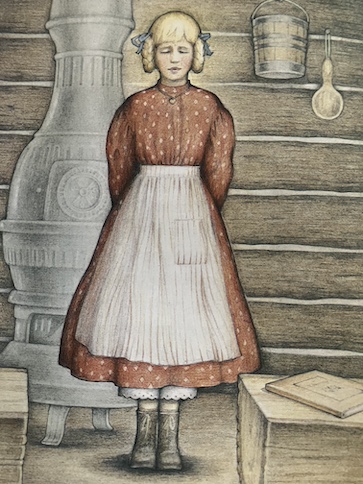
Sneaking away to visit the Native American girl, who is called Singing Bird, gives Kirsten an escape from her struggles with English. Somehow, Kirsten and Singing Bird manage to communicate well enough with each other, even though neither of them speaks each other’s language. Then, Singing Bird takes Kirsten to see her village. To her surprise, Kirsten realizes that she has been gradually teaching Singing Bird English words without realizing it. However, Singing Bird’s people are going to be moving on soon. Kirsten’s uncle is correct that farming is driving away the animals the Native Americans depend on for food, and they’re suffering for it. Singing Bird invites Kirsten to come with her tribe when they leave, and it’s tempting to think of living an exciting life, traveling with Singing Bird and not going to school. But, is that what Kirsten really wants?

The book ends with a section of historical information about frontier schools in the mid-1800s.

The book is available to borrow and read for free online through Internet Archive (multiple copies).

Along with the first book in the series, this is the book that I remember the best of the Kirsten books. I think I either didn’t read the others or didn’t finish them because there are some sad things in the Kirsten stories that I didn’t like. In the first book, Meet Kirsten, another child Kirsten befriends on the journey to Minnesota dies of cholera. It’s historically accurate that some children died of disease on the journey west, but it was still hard to take. I also talked about how the reason why families like Kirsten’s wanted to come to America was that Sweden was experiencing famine around this time. The first book didn’t say much about that, but in this book, Kirsten remembers experiencing hunger in Sweden when her father’s crops failed and how her little brother cried from hunger.

Kirsten understands the plight of the Native Americans when they have to move to a new area when their food supplies run low. However, when Singing Bird invites Kirsten to come with them, she realizes that would mean leaving the rest of her family, and she can’t do that. While it’s tempting to go with her friend and escape the problems in her life, Kirsten can’t do that without also giving up the good things in her life and trading the problems in her life for a different set of problems. Although there are appealing aspects to their lives, the Native Americans also have their own struggles. To use an old adage, the grass isn’t always greener on the other side of the fence. People say it in different ways, but just because someone else’s situation is different doesn’t always mean that it’s better.

In this book, we also see what it’s like for Kirsten’s family as they begin learning English, so they can communicate with other people in their new country, and the children begin going to school. The little frontier school is different from other schools they’ve experienced before, and the teachers are strict. They have to be strict because some of the students are rough and fight with each other physically, and they have to make it clear that they’re not going to put up with that. This is a real-life aspect of schools from this time period. Fortunately, we never see the teacher actually using physical punishment against anybody. She just threatens to do it so her students will think twice about misbehaving.

When Miss Winston comes to board with Kirsten’s relatives, Kirsten thinks that everything is going to be worse, that she’s constantly going to be bombarded with lessons and the problems she’s been having at school. However, it turns into an opportunity for Kirsten and Miss Winston to get to know each other better. At first, Miss Winston can’t understand why Kirsten is having such a difficult time remembering her poem, even though it’s pretty short and easy. It’s partly because she’s still having difficulties with her English, but also, the content of the poem has no relation to anything currently happening in Kirsten’s life. It doesn’t interest her, and her mind is preoccupied with all the changes happening in her life, making it difficult for her to focus on the poem and remember it. When Miss Winston shows Kirsten a model of her father’s ship, it brings back memories of the ship Kirsten’s family traveled on when they came from Sweden. Miss Winston realizes that Kirsten has strong memories of the ship, so she gives her a different poem to memorize, one about a ship. Kirsten finds this poem easier to remember because it connects to memories she already has.

Although Miss Winston can be tough, she genuinely does care about Kirsten and looks for ways to help her learn. It just takes time to figure out the best way to help her, and Kirsten also needs time to adjust to her new language and new home. Once Kirsten sees that it’s possible for her to learn and for her new home to begin feeling like home, she begins to feel better about her new life in Minnesota.

I enjoyed the realistic aspects of the story and the references to historical events and real life conditions on the frontier. I think I liked this story better as an adult because I understood more about the historical background than I did when I was a kid. Parts of this series are still sad. Kirsten remembers people being sick and dying on the journey to America, and although she doesn’t go into detail about it, her family did suffer genuine hardship in Sweden.

The Phantom Tollbooth

The Phantom Tollbooth by Norton Juster, 1961.

Milo is a boy who never really knows what he wants or what to do with himself.  He is always bored because he doesn’t really know the purpose or point of doing anything.  Nothing he learns in school interests him because he can’t see what he could ever do with the knowledge.  He never bothers to read the books he has, play with his toys, or learn to use his tools because he just doesn’t have the imagination to appreciate them or what he could do with them.

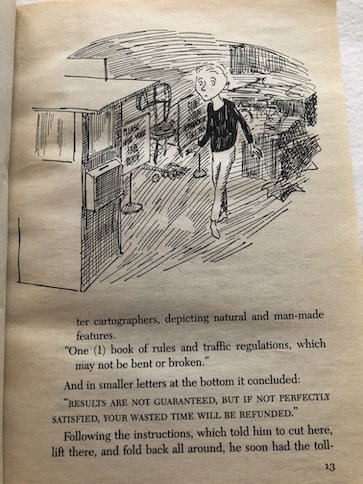
One day, when Milo gets home from school, he finds an unexpected package.  It’s not his birthday or Christmas, but the package is definitely intended for him because it has his name on it: “For Milo, who has plenty of time.”  There is a list of items contained in the package: 1 tollbooth (which must be assembled, according to the directions), 3 precautionary signs (“to be used in a precautionary fashion”), some coins for the tollbooth, a map (with no familiar places on it), and a driver’s rule book (which must be obeyed).  Interestingly, it promises that if Milo is not satisfied with his tollbooth experience, his time will be refunded.  Since Milo doesn’t think he has anything else to do anyway, he decides that he might as well unwrap the tollbooth and set it up. 

Although Milo thinks that the map is purely fictional and that the tollbooth is just a playset, he decides that he might as well select a destination on it for his trip through the tollbooth.  He closes his eyes, puts a finger on the map, and selects a place called “Dictionopolis.” He gets in the toy car, puts a coin in the tollbooth, and goes through it.

To his surprise, Milo suddenly finds himself driving down a real highway, no longer in his own apartment.  He sees a sign pointing the way to a place called Expectations, and he stops to ask a man about it.  At first, he thinks he’s talking to a weather man, but the man corrects him, saying that he’s really the “Whether man.”  Part of his job is to hurry people along, even if they have no expectations.  Nothing the Whether Man says to Milo makes sense to him, so he decides that he’d better just get going.

As Milo drives down the highway, he gets bored and starts daydreaming.  As his mind wanders, the scenery gets duller and grayer, the car slows down, and eventually, the car stops and won’t move further.  Milo looks around and wonders where he is.  It turns out that he’s in the Doldrums, the home of the Lethargarians.  They tell him that thinking isn’t allowed there.  Milo says that’s a dumb rule because everybody thinks.  The Lethargarians say that they never think and Milo must not have thought either because, if he had, he wouldn’t be there.  People usually get to the Doldrums because they’re not thinking, and once they’re there, nobody is allowed to think.  They refer Milo to the rule book that came with the tollbooth.  Milo looks in the rule book and sees that is a rule.  There are also limits on laughing and smiling in the Doldrums.  Milo asks the Lethargarians what they do if they can’t think or laugh.  They say that they can do anything as long as they’re also doing nothing.  Mainly, they do things like daydreaming, napping, loafing, loitering, and wasting time.  They say it gives them a full schedule and allows them to get nothing done, which they consider an important accomplishment.  Milo asks them if that’s what everybody here does, and they say that the one person who doesn’t is the Watch Dog, who tries to make sure that nobody wastes time.

At that point, the Watch Dog shows up.  The Watch Dog looks like a dog, but his body is an alarm clock.  The Watch Dog asks Milo what he’s doing, and is alarmed when Milo says that he’s “killing time.”  It’s bad enough when people waste time, but killing it is horrible!  (The book is full of these kinds of puns. It’s just getting started.)  Milo explains how he got stuck in the Doldrums while he was on his way to Dictionopolis and asks the Watch Dog for help.  The Watch Dog explains that if he got there by not thinking, he can also get out by thinking and asks to come along because he likes car rides.  Milo agrees, and the two of them get in the car.  Milo thinks as hard as he can (which the book notes isn’t easy for Milo because he’s not used to thinking and doesn’t do it too often).  Gradually, as Milo thinks of various things, the car begins to move.  The faster Milo thinks, the faster the car goes.  Milo learns that it’s possible to accomplish a lot with just a little thought.

The Watch Dog’s name is Tock because his older brother is named Tick. However, their names are a mistake because his older brother only makes a tock sound, and Tock only makes a tick sound.  It’s a source of pain and disappointment.  Tock tells Milo about the origin of time and why Watch Dogs find it important to make sure that people use time well.  He says that time is the most valuable possession because it always keeps moving.

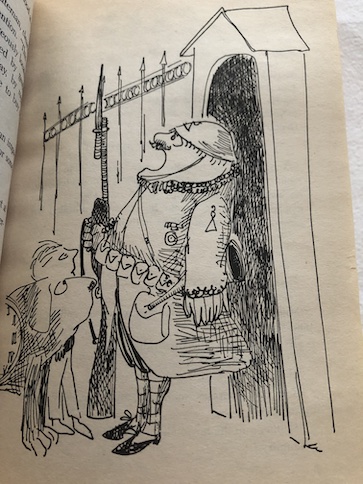
When they arrive at Dictionopolis, the gatekeeper won’t let them in immediately because Milo doesn’t have a reason for being there.  Nobody gets let in without a reason.  Fortunately, the gatekeeper always keeps a few spare reasons lying around, and he decides to let Milo have one.  The one he selects is “WHY NOT?”, which the gatekeeper considers a good, all-purpose reason for doing anything.  (I don’t know. I’ve heard that one followed up by an angry “I’ll tell you why not!” before.)

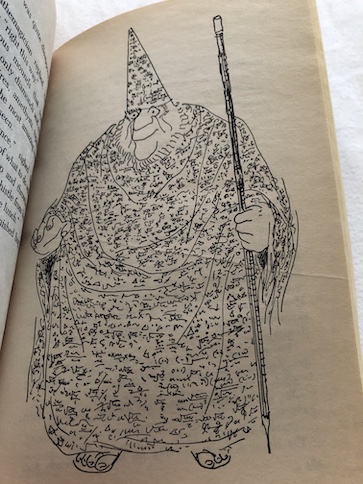
As readers have probably guessed, Dictionopolis is all about words. When Milo enters the city, he finds himself in the marketplace, which is called the “Word Market.”  The ruler of Dictionopolis is Azaz the Unabridged, and when Milo is welcomed to the city by the members of the king’s cabinet, they do so in multiple ways, using synonyms.  Milo asks them why they don’t just pick one word and stick with it, but they’re not interested in that.  They say that it’s not their business to make sense and that one word is as good as another, so why not use them all?  (That isn’t true, but the story tells you why not later.)  They go on to tell Milo that letters grow on trees here, and people come from all over to buy all the words they need in the Word Market in town.  Part of the cabinet’s duty is to make sure that all of the words being sold are real words and have real meanings because people would have no use for nonsense words that don’t mean anything and that nobody will understand.  The cabinet doesn’t seem to care about whether or not the words are being used in a way that makes sense as long as they’re real words. (If you’re familiar with business speak or buzzwords, you’ve probably noticed that much of it works on a similar principle.)  Putting the words into a context that makes sense isn’t their job.  (Later, you meet the person who had that job.)  However, the cabinet does advise Milo to be careful when choosing his words and to say only what he means to say.  They excuse themselves to get ready for the banquet and say that they’ll see Milo there later, although Milo doesn’t know what banquet they’re talking about.

Milo and Tock explore the Word Market.  Milo is fascinated by the variety of words available.  He doesn’t know what they all mean, but he thinks that if he can buy some, he can learn how to use them.  He chooses three words he doesn’t know: quagmire, flabbergast, and upholstery. (I’m surprised he didn’t know the last one because, surely, he has upholstered furniture in his apartment.)  Unfortunately, Milo quickly realizes that he has only one coin with him, and he’ll need that coin to get back through the tollbooth.  Eventually, he finds a stall selling individual letters for people who like to make their own words.  The stall owner gives them some free samples to taste. They taste good to Milo, and the stall owner tells them that sets of letters come with instructions.  Milo doesn’t think he’s very good at making words, but the Spelling Bee, a giant bee, begins showing him how to spell words.  However, the Humbug, a grumpy bug, tries to tell Milo not to bother learning.  The Spelling Bee tells Milo not to listen to the Humbug because he just tells tall stories and doesn’t actually know anything, not even how to spell his own name.

The Spelling Bee and the Humbug start fighting and knock over all the word stalls around them. There is a big mess, all the words get scrambled, and it takes some time before everyone sorts everything out.  By that time, the Spelling Bee is gone, and when the policeman comes, the Humbug blames everything on Milo and Tock.  At first, it seems like Milo will get off lightly because the policeman (who is also the judge) gives him the shortest “sentence” he can think of (“I am”).  Unfortunately, he’s also the jailer and takes Milo and Tock to prison for 6 million years.

In the prison, Milo and Tock meet the Which.  At first, Milo thinks that she’s a “witch”, but she says many people make that mistake.  The Which is King Azaz’s great-aunt, and her job used to be to make sure that people correctly chose which words to use and didn’t use more words than necessary. (A problem that Milo noticed in the market.)  The Which explains that she was thrown into prison because she got too carried away with her job and became too miserly with words. Word economy is good (and something I struggle with), but rather than promoting brevity, the Which started promoting silence instead,. It got so bad that people eventually stopped buying words and the market was failing, so the king had to put a stop to it.  The Which says that she understands now where she went wrong, and Milo asks her if there’s anything that he can do to help her.  The Which says that the only thing that would help her would be the return of Rhyme and Reason.  When Milo asks who they are, she tells him the story of the founding of the Kingdom of Wisdom.

Years ago, the King of Wisdom had two sons, and he was proud of both, but one of them had an obsession with words, and the other had an obsession with numbers.  The king didn’t realize how bad their conflict was growing, and it got worse over time. One day, the king found a pair of abandoned infant twins.  The twins were both girls, and the king had always wanted daughters as well as sons, so he adopted them and named them Rhyme and Reason.  Everyone loved Rhyme and Reason, and they had a talent for resolving problems and disputes. When the king died, he left his kingdom to both of his sons and left instructions for them both to look after Rhyme and Reason. The word-obsessed son, Azaz, established a capital city of his own, Dictionopolis, and the number-obsessed son, the Mathemagician, established the city of Digitopolis.  Rhyme and Reason remained in the city of Wisdom and acted as advisers to the brothers, mediating their disputes.  This system worked until the brothers got into their worst fight over whether words or numbers are most important.  They took this dispute to Rhyme and Reason, who said that both are of equal importance. This satisfied most people, but both brothers were angry because they had wanted the girls to make a definite choice between them. In their last joint act, they banished Rhyme and Reason to the Castle in the Air. Since then, there has been continued fighting between the two brothers and their respective cities, the city of Wisdom has been neglected, and there’s been no Rhyme or Reason to any of it. (Ha, ha.)

Milo says that maybe they could rescue Rhyme and Reason from the Castle in the Air. The Which says that would be difficult because there’s only one stairway to the castle, and it’s guarded by demons. Milo remembers that there is also the matter of them being stuck in prison for 6 million years. The Which says that being in prison isn’t really a problem. Although the policeman/judge/jailer likes putting people in prison, he doesn’t care much about keeping them there, so Milo and Tock can leave when they like, and he probably won’t notice. (Sounds like he’s not very good at the “jailer” part of his job.)  The Which points out a button on the wall, Milo presses it, and a door opens.

When they step outside, the king’s cabinet members come to take him to the banquet that they mentioned earlier. They have Milo and Tock step into their wagon and tell them to be quiet because “it goes without saying.” (Ha, ha.) They take Milo and Tock to a palace shaped like a book, where they meet King Azaz and join the banquet.

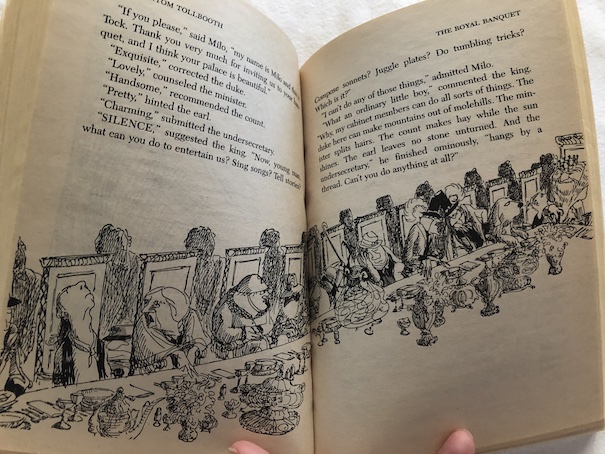
The banquet is a pun-filled meal where everyone has to literally eat their words and have half-baked ideas for dessert.  (Half-baked ideas look good, but you shouldn’t have too many because you can get sick of them. Tock says so.)  Nothing makes sense, and even the king realizes it, which gives Milo the opportunity to suggest bringing back Rhyme and Reason.  The king isn’t sure that’s possible, and the Humbug, of course, volunteers Milo and Tock for the job.  The joke turns out to be on him because the king volunteers the Humbug to assist Milo.  Reaching Rhyme and Reason will be a perilous journey, and possibly the most difficult part will be getting the Mathemagician to agree to let them do it.

The book is available to borrow and read for free online through Internet Archive (multiple copies). There is also a movie version of this book (mostly animated but part live action) with songs. You can see a trailer for it on YouTube.

My Reaction

The Phantom Tollbooth is a fantasy story, but like many fantasy stories, it’s also a morality story.  It’s a little like Charlie and the Chocolate Factory, which aims to correct children’s bad habits.  Milo’s boredom problems are due to his lack of thought for the things he could do and imagination to figure out how to make use of what he has.  His adventures after he goes through the Phantom Tollbooth help him to see things differently and to learn to use his mind creatively.

However, I wouldn’t say that the story is too preachy.  A couple of parts started to feel a little like a lecture, but it’s set in a fantasy land that feels a little like Alice in Wonderland.  There’s a healthy dose of nonsense that keeps things interesting and fun.  The book is peppered with puns and peopled by a fascinating variety of characters.  There’s the boy who can see through everyone and everything, who teaches Milo to look at things from an adult perspective and helps him to realize the benefit of keeping his feet on the ground (both of those are also puns). There’s the man who is the world’s shortest giant, the world’s tallest midget, the world’s thinnest fat man, and the world’s fattest thin man all at the same time.  Basically, he’s just an ordinary guy who’s noticed that people think of him in different ways when they compare him with themselves.

I was first introduced to this story when I was in elementary school, as many people were.  Our teacher read it to us and showed us the cartoon version.  Parts of songs from that version still get stuck in my head, almost 30 years later.  (“Don’t Say There’s Nothing To Do the Doldrums …”) The part of the story that stuck with me the longest was the Dodecahedron, a shape with twelve sides. If you’ve seen the twelve-sided dice used for Dungeons and Dragons and similar role-playing games, those are dodecahedrons. In the book, the Dodecahedron is talking character as well as a shape, but I remember it because our teacher gave us paper cut-outs to make our own dodecahedrons. I made two of them, and I might still have one somewhere.

Great Ancient Egypt Projects

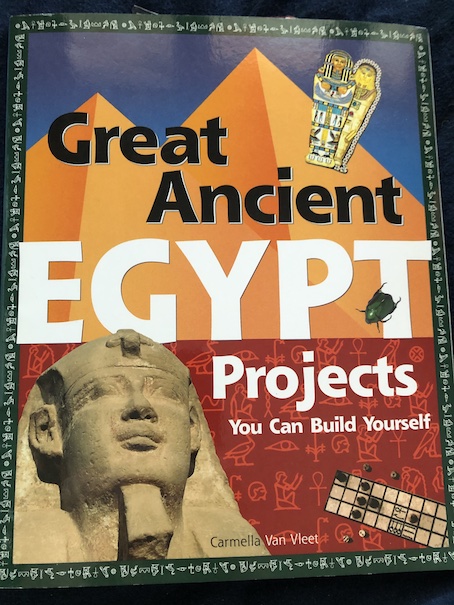
Great Ancient Egypt Projects You Can Build Yourself by Carmella Van Vleet, 2006.

I love this book because it combines lessons about history with hands-on projects and craft activities!

The book starts with a general timeline of Egyptian history, a brief introduction, and then a chapter about The Foundations of Ancient Egypt, which explains about the climate of Egypt, the role of the Nile in Egyptian civilization and farming, jewelry and other products produced by Egyptian artisans, pyramids and mummies, and forms of entertainment that the Ancient Egyptians enjoyed, like games and music. After this first chapter provides a general overview of Egyptian civilization, the other chapters go into more detail on different subjects related to Egyptian civilization with accompanying activities and projects. Each of the activities or projects comes with a list of materials needed and an estimate of the amount of time needed to finish.

Below is a list of the chapters in this book and descriptions of the types of projects that you will find in each section:

Boats

Boats were an important form of transportation of people and goods up and down the Nile. This chapter explains how the Ancient Egyptians made boats and has instructions for making your own miniature boat out of drinking straws in a similar manner as the Egyptians made papyrus boats.

Farming

This chapter describes the Egyptian flooding, growing, and harvesting seasons and the types of crops the Ancient Egyptians planted. The project for this chapter is how to build a shaduf, which is a device the Ancient Egyptians used for irrigating their crops.

Papyrus

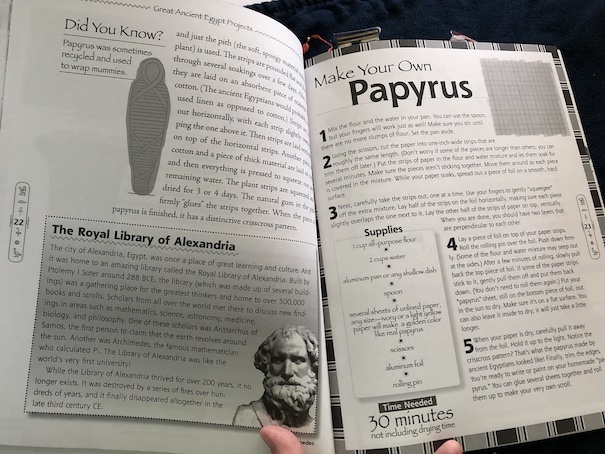
The Ancient Egyptians found many different uses for papyrus plants, including boats, baskets, mats, ropes, sandals, food, medicine, perfume, and paper. This chapter discusses how the Ancient Egyptians made papyrus paper and formed it into scrolls. The activity is to make your own papyrus-style paper using strips of regular paper instead of papyrus. It also has a recipe for a berry-based ink. It mentions that the Egyptians would have used different colored minerals, but the berry ink is easy for a beginner.

Homes

I always like books that discuss the lives of ordinary people and their homes. This chapter explains how Ancient Egyptian homes were made, how the homes of common people and wealthy people differed from each other, how homes were decorated, and the arrangement of rooms for sleeping, storing goods, and cooking. There are three activities for this chapter: making your own mud bricks, making a cat statue, and making a “soul house” – a miniature house or layout of rooms out of plaster of Paris.

Bread

This chapter is about what people ate in Ancient Egypt, and it particularly describes how the Ancient Egyptians made bread. An interesting fact in this chapter is that people in Ancient Egypt typically bartered for food instead of using money. This chapter includes two recipes, one for bread and one for date (fruit) candy.

Games

This is one of my favorite chapters! It’s about toys and games played by children in Ancient Egypt. It also describes board games that could be played by people of all ages, like Mancala, Hounds and Jackals, and Senet. The book provides instructions for making your own Senet board game and rules for playing.

Tunics and Fashion

This chapter is about what people wore in Ancient Egypt. Clothes at the time weren’t as much about modesty as in modern society. Clothing in Ancient Egypt could be pretty minimal, and it was common for Egyptian children to simply go naked. This chapter also discusses clothing accessories and wigs. The activities for this chapter are to make your own simple tunic, sandals (basically decorating a pair of flip-flops), and nemes (head covering).

Jewelry

This chapter explains the decorative and religious aspects of jewelry and the types of gems and minerals included in Egyptian jewelry. The projects are making paper beads and a wesekh collar (type of necklace).

Amulets

This chapter is about how Ancient Egyptians used amulets that they believed had the power to protect them from illness and other dangers. It describes different types of amulets and what they were supposed to do for people who had them. Part of this chapter covers The Book of the Dead, which was a collection of texts that provided a guide to funeral rituals and the afterlife. (You can actually get copies of this book today, translated into English.) The activity for the chapter is to make your own amulet out of a dough made from water, flour, and sawdust.

Kohl and Perfume

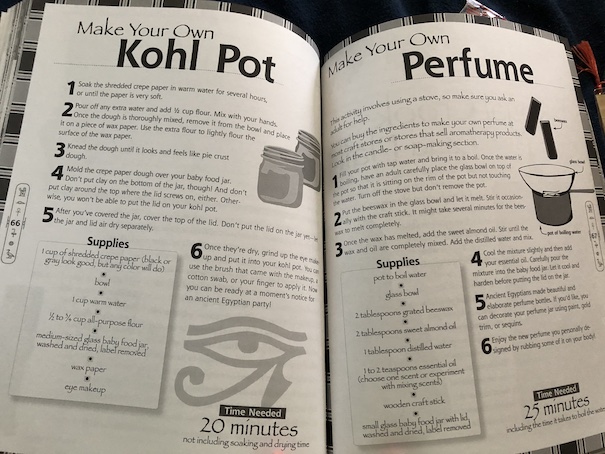
This chapter is about the makeup that people used in Ancient Egypt. Kohl is the substance that Egyptians used around their eyes. It was made from the mineral galena, and it may have helped the Ancient Egyptians protect their eyes from eye infections or provided some shielding from the sun’s glare. This chapter includes instructions for making a simplified version of kohl using black crepe paper, water, and flour and for making perfume out of beeswax, almond oil, and different essential oils. (The perfume activity looks the best of the two. Health food stores that also carry cosmetics, like Sprouts, probably have all or most of the ingredients, and if they don’t, you could probably get whatever’s missing from Amazon.)

Royal Crook and Flail

Pharaohs are often depicted holding a symbolic crook and flail. This chapter explains the meaning behind these symbols (the crook resembles a shepherd’s staff and was meant to represent the ruler of the king because he was supposed to look after his people like a shepherd looks after his sheep, and the flail is the same design as one that was used in harvesting and may have represented the pharaoh overseeing the fertility and prosperity of the land) and also discusses the duties of an Egyptian king or queen and what their subjects expected of them. The chapter also gives information about famous kings and queens and the crowns they wore. The activities for the chapter are making your own crook and flail and your own throne (by decorating an old chair, like one you might find at a garage sale).

Pyramids

This chapter covers Ancient Egyptian tombs and pyramids, how they were built, and how they were decorated. The activities for the chapter are building your own pyramid out of poster board and building a sledge of the type that the Ancient Egyptians used to transport stone blocks.

Temples

This chapter discusses Ancient Egyptian gods and their temples. It explains how the Ancient Egyptians would worship their gods. The activities are making your own foam obelisk and a miniature temple sanctuary scene in a box.

Mummies

This chapter explains how Ancient Egyptians made mummies and what they believed about the afterlife. The activities are making your own shabti (little figurines that were supposed to perform tasks on behalf of the deceased) out of a bar of soap and making your own funeral mask (like Tutankhamen’s famous mask).

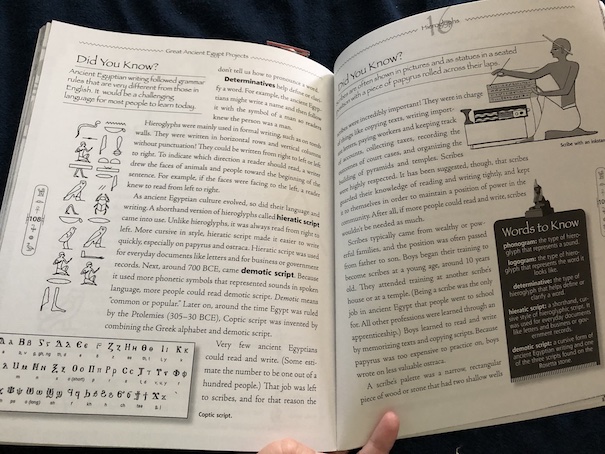
Hieroglyphs

This chapter explains how the Ancient Egyptian systems of writing worked and how modern people learned to read hieroglyphs by studying the Rosetta Stone. Th activities are making your own ostraca (piece of pottery used as a writing surface), mural, and cartouche.

I haven’t seen this particular book available to read online, but there’s a very similar by the same author on Internet Archive.

The Silver Slippers

Magic Charm Books

The Silver Slippers by Elizabeth Koda-Callan, 1989.

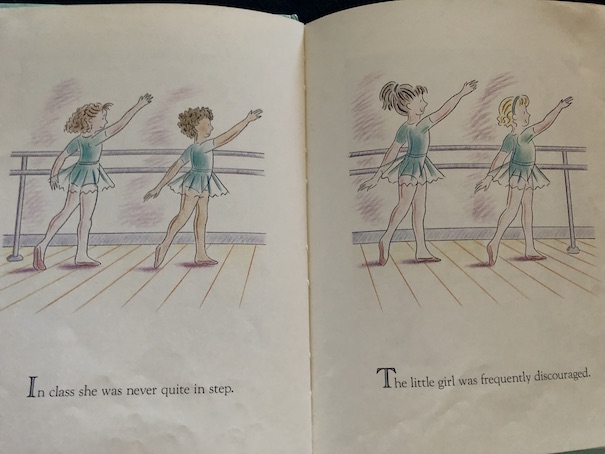
A little girl (unnamed, like the other girls in this series) wants to be a ballerina. She takes ballet classes, but she never seems quite good enough, like the ballet posters on the walls of her room. She feels discouraged because she is not perfect.

When her ballet teacher tells the class that there is going to be a dance recital and that one girl in class will be chosen to be the prima and lead the others, the girl doesn’t think that she has a chance to be chosen because her dancing isn’t good enough.

The girl tells her mother about the recital and her doubts about being chosen to be prima, and her mother tells her that it depends on how much she wants to be prima and how much she is willing to practice to improve. If the girl is willing to put in extra practice, she still has a chance to be prima. To remind her of her goals, her mother gives her a silver charm in the shape of a pair of ballet slippers.

In order to improve her dancing, the girl has to focus on her goal and give up participating in other activities to find more time to practice. However, her practicing pays off, and she gets the role of prima. On the night of the recital, she is nervous, but her silver slippers charm reminds her of her dream of being a real ballerina and gives her the courage to go on with her performance.

All of the books in this series originally came with charms like the ones described in the stories. This book originally included a little silver slippers charm for the reader to wear. The hole in the cover of the book was where the charm was displayed when the book was new. The books in the series often focus on the unnamed main character (who could represent any girl reading this story – the books were aimed at young girls) developing new self confidence, and the charms were meant to be either a sign of their new self confidence or inspiration for developing it. In this case, the charm is a reminder of the girl’s goals and how much she really loves dancing, giving her the inspiration she needs to persevere even when learning is difficult.

The book is available to borrow for free online through Internet Archive.

Samantha Learns a Lesson

American Girls

Samantha Learns a Lesson by Susan S. Adler, 1986.

This is part of the Samantha, An American Girl series.

Samantha attends Miss Crampton’s Academy for Girls in Mount Bedford. She is doing well and has some friends at school, but she misses her friend Nellie. She knows how poor Nellie’s family is and worries about how they are doing.

One day, Samantha comes home from school to a surprise: Nellie has returned to town with her family. Samantha’s grandmother recommended Nellie’s family to a friend, Mrs. Van Sicklen, who has hired Nellie’s father as a driver and Nellie’s mother as a maid. Nellie and her sisters will also be helping with household chores. They will also get the chance to go to school, although they will be attending public school and not the private school that Samantha attends.

When they begin attending school, Nellie’s younger sisters do fine in the first grade, where they are expected to be beginners, but Nellie herself has trouble in the second grade. Nellie is a little old for second grade, so the other children make fun of her for being there, and she is so nervous that she makes embarrassing mistakes in front of her teacher and the other students. Nellie thinks that perhaps she’s too old to start going to school, but Samantha realizes that what she needs is a little extra help.

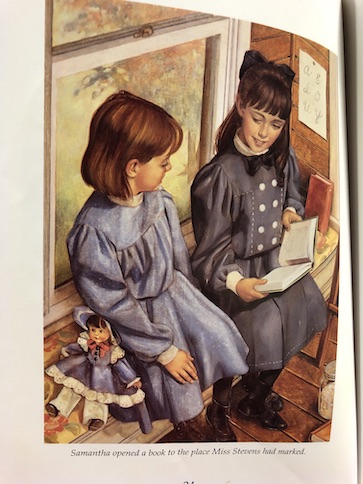
Samantha talks to her own teacher and explains the situation. She says that she would like to help teach Nellie what she needs to know, but she is not sure what Nellie needs to know in order to pass the second grade. Samantha’s teacher, Miss Stevens, thinks that it is nice that Samantha wants to help Nellie and gives her a set of second grade readers to study with pages marked for assignments. Samantha tells her grandmother what she is planning to do, and she says that it is fine, as long as the extra tutoring doesn’t interfere with Nellie’s house work too much.

Nellie accepts Samantha’s help at their secret, private “school” that Samantha calls “Mount Better School.” During their lessons, Samantha discovers that Nellie is very good at math because she used to have to help her mother with shopping and had to keep track of her money. Nellie cannot always come for lessons because of her work, but Samantha’s tutoring helps her to improve.

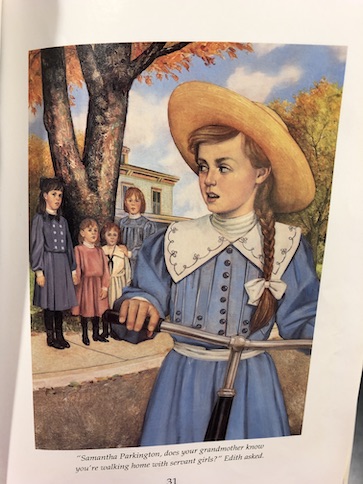
One day, when Samantha is walking home from school with Nellie and her sisters, a mean girl from Samantha’s school, Edith, sees them and criticizes Samantha for spending time with servants. She says that her mother would never allow her to play with servants. Samantha asks her grandmother what Edith means, and her grandmother says that Edith is a young lady. When Samantha asks why she is allowed to play with Nellie, her grandmother says that they are not really playing, that Samantha is helping Nellie, which makes it different. That explanation doesn’t entirely satisfy Samantha.

However, her grandmother is both understanding of the help that Samantha has been giving to Nellie and serious about the need to help others. When Edith’s mother and other ladies of the neighborhood come to visit and complain about Nellie’s family and how Samantha is spending time with them, Samantha’s grandmother defends them and says that Samantha is doing good.

Meanwhile, Samantha’s school is preparing for a public speaking contest with the theme “Progress in America.” To prepare for her speech, Samantha asks her grandmother, her Uncle Gard, and other people what they think about progress and what the best inventions are. They mention inventions like the telephone, electric lights, automobiles, and factories. Samantha is fascinated by the idea of factories and the variety of products that they can make. However, when Samantha reads her speech to Nellie, Nellie is not nearly so enthusiastic about factories as a sign of progress. Nellie used to work in a factory herself, and she knows that they are not pleasant places. She tells Samantha how factories are noisy and how dangerous the machines are for the workers. The factory workers are also very poorly paid, which is why the products they make are so cheap.

Nellie’s stories about factories bother Samantha. When it is time for the public speaking contest, Samantha delivers a changed version of her speech in which she discusses the dangers of child labor and how some form of progress, particularly ones that endanger children, are not good forms of progress. Samantha’s thoughtful speech wins the contest, and her grandmother understands that Samantha has been learning things from Nellie even while teaching her.

In the back of the book, there is a section with historical information about education and child labor during the early 1900s.

The book is currently available to borrow for free online through Internet Archive.

Miss Nelson is Back

NelsonBack

Miss Nelson is Back by Harry Allard and James Marshall, 1982.

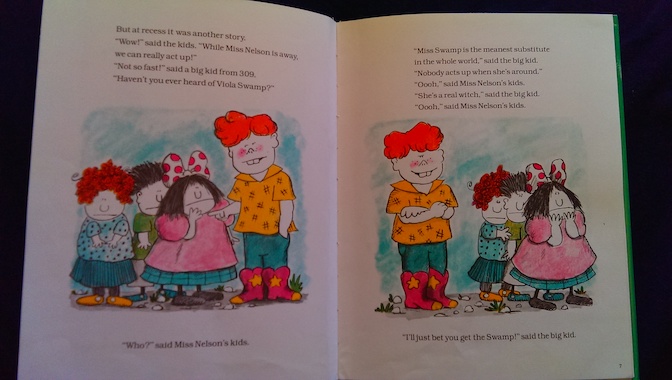
Miss Nelson, a teacher, tells her class that she will have to be away for awhile, having her tonsils removed, so someone else will be teaching their class.  At first, the kids think that they’ll be able to get away with a lot while Miss Nelson is away, but an older kid warns them that their substitute will probably turn out to be Viola Swamp, the meanest substitute ever.

NelsonBackWarning

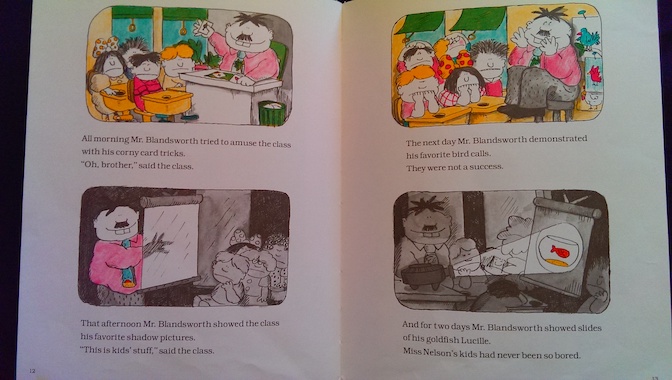
The kids are nervous until they find out that Mr. Blandsworth, the school principal, will be their substitute himself.  The worst thing about Mr. Blandsworth is that he’s boring, and he tends to treat them like they’re little kids.  They put up with it for awhile, but then, they realize that they can get rid of Mr. Blandsworth by convincing him that Miss Nelson has come back to school.

NelsonBackPrincipal

They put together their own Miss Nelson costume, with some of the kids sitting on each other’s shoulder’s to appear taller in the outfit.  It’s cheesy, but it convinces the principal.  But, the kids take it even farther than that.  Now that there’s no substitute teacher, they can do whatever they want!  Their “Miss Nelson” takes the class on an impromptu field trip to the movies and the ice cream parlor, and no one stops them because they’re with their “teacher.”

NelsonBackFieldTrip

Unfortunately, they make the mistake of walking past Miss Nelson’s house, and she discovers what they’ve been doing.

NelsonBackReveal

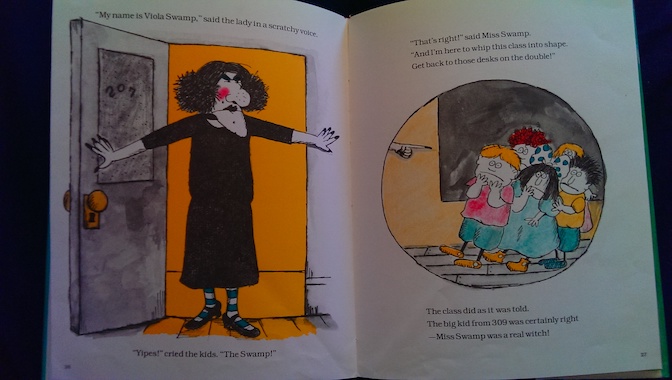
Miss Nelson arranges for Miss Viola Swamp to come and teach the class a real lesson.

NelsonBackSwamp

The book is currently available online through Internet Archive.

My Reaction

I actually like this book even better than the first book in the series because I think that the kids’ Miss Nelson costume is hilarious! Mr. Blandsworth is completely clueless about the kids’ deception, just as he never figures out what the real truth is about “Viola Swamp.”

As usual for the series, the story never explicitly states that Miss Nelson and Viola Swamp are the same person, but it’s heavily implied in the text (such as Viola Swamp’s scratchy voice from Miss Nelson having her tonsils out) and shown in clues in the pictures. Miss Nelson uses “Viola Swamp” as her alter ego whenever she needs to give her students some tough love, but that’s just a joke that Miss Nelson shares with the readers.

Knight’s Castle

Knight's Castle

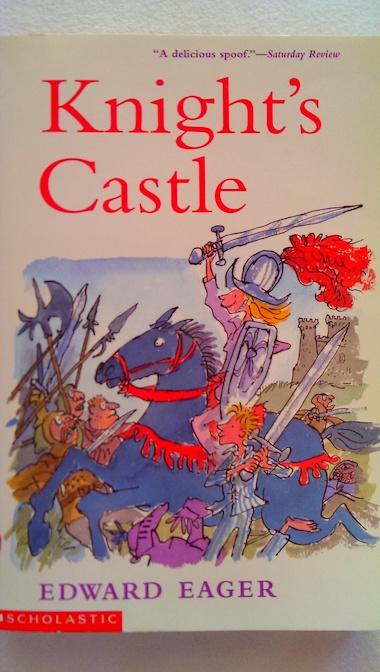
Knight’s Castle by Edward Eager, 1956.

Roger and Ann are the children of Martha from the previous two books in the series. Like their mother’s family when they were growing up, they live in Toledo, Ohio. Their Aunt Katharine (one of Martha’s older sisters) used to live close to them in the Midwest but now lives in Baltimore, Maryland. Roger and Ann don’t particularly get along with Aunt Katharine’s children, Eliza and Jack, because Eliza is bossy and Jack is only interested in photography. However, the four children end up spending the summer together when Roger and Ann’s father needs to have an operation at a hospital in Baltimore.

Like their mother and her siblings when they were young, Roger and Ann also like fantasy stories, which their father likes to read to them. Roger starts to believe in real magic when it seems like one of his toy soldiers comes to life at night. Roger collects toy soldiers, and he has over 200 of them, but this one is special because his father says that its been handed down in their family for generations. Roger calls it the Old One. It’s rather worn, so it isn’t obvious at first, but the Old One is actually a knight. Worried about his father’s illness, Roger takes the Old One to bed with him (which he thinks is more manly than taking a teddy bear to bed), and then feels it wriggling in his hand.

Knight's Castle Roger

Realizing that the Old One is magic and is coming to life when he holds him, Roger asks him if it’s part of his magic to grant wishes. If it is, then he wishes for his father to get well, and if possible, for him and his sister to have an adventure in Baltimore over the summer. The Old One doesn’t answer him immediately, but over time, he makes it clear to Roger that wishes have to be earned, and that will be the source of his summer adventure.

When the children arrive in Baltimore to stay with wealthy Aunt Katharine while their father is in the hospital, Aunt Katharine gives them presents. Ann gets a new dollhouse, and there is a toy castle for Roger. Since Aunt Katharine has also just taken all the children to the movies to see Ivanhoe, all of them become immediately interested in playing with the castle.

That night, Roger has a strange dream that he finds himself within the story of Ivanhoe, which is being acted out in his toy castle. The Old One is there as well, although he is mainly watching the action as Roger begins to take part in the story. When Roger comes face-to-face with the villain, he accidentally lets Ivanhoe’s plans slip to him. Things are looking pretty bleak when Roger suddenly realizes that the castle is still a toy and everyone around him is just a lead soldier. This revelation ends the magical adventure and brings him back to reality. However, Roger is disappointed that he ended the adventure so early when perhaps he could have done something really heroic.

Seeing the toy soldiers scattered around instead of poised for the battle they were planning the night before, Eliza and Ann think that Roger was just playing with the castle without them, but he explains to them what happened. The girls were just reading The Magic City by E. Nesbit, and they start building their own “magic city” out of random things from around the house, surrounding the toy castle. Roger is upset about the city because he says that it doesn’t fit in with the Ivanhoe story, and he’s sure that it will ruin everything, maybe from preventing the magic from working again at all. The Old One tells Roger that magic works by threes, so the next opportunity for magic will be in three days.

Knight's Castle Magic City

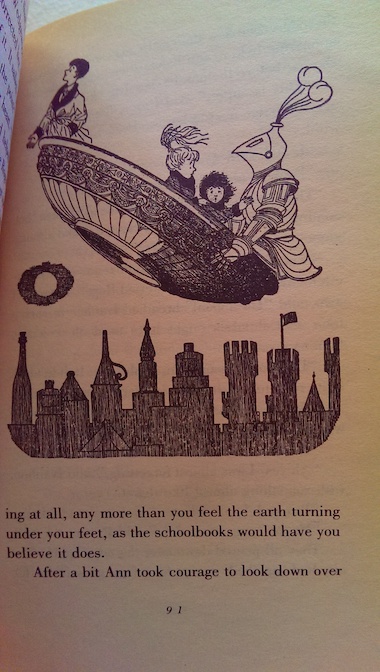
As it turns out, the city does end up becoming part of the story when the magic brings it all to life on the third night. Roger, Ann, and Eliza find themselves in the middle of the city, surrounded by knights attempting to drive modern cars. Ivanhoe has become a fan of science fiction books, via the public library in the city that the girls built. Although Ivanhoe has turned into something of a geek, the children persuade him to come on a mission to rescue the captive Rebecca, and they end up traveling in a flying saucer (made from a real saucer) to the Dolorous Tower, where the adventure ends as soon as Eliza remembers that the villain threatening them is still just a lead soldier.

Knight's Castle Flying Saucer

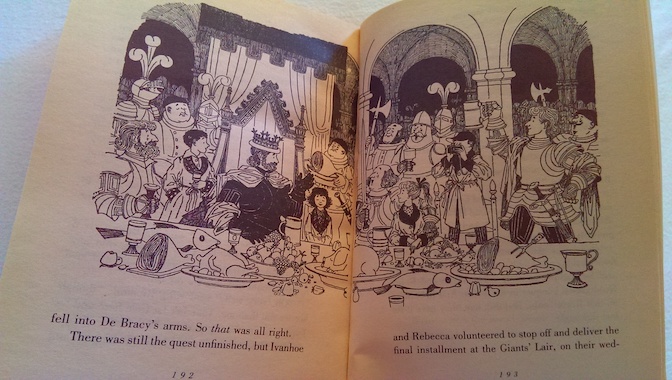
It was an even weirder adventure than Roger’s first one, but by now, the children are starting to understand the rules that go along with the magic. Jack, who says he doesn’t really believe in magic, accompanies the other children on the next adventure, as they try to prove to him that it’s real. They end up having to rescue some of the others from the “giant’s lair”, which turns out to be Ann’s new dollhouse. The dolls are angry that Ann has been neglecting them, only paying attention to the dollhouse when she and Eliza needed to borrow things for their magic city. They manage to escape again by remembering that the dolls are just dolls.

However, Roger is still worried about their father, who is about to undergo his operation. The Old One had told him that wishes needed to be earned, and he doesn’t think that they’ve managed to accomplish much in their adventures. Roger thinks that they need to do something really heroic so that his wish for his father to get better will come true. The Old One gives Roger a rhyme, hinting at what the children need to do on their next adventure, but Roger doesn’t understand what it means, and he doesn’t know if he can figure it out in time.

Actually, it is Ann who eventually realizes what the rhyme means and provides Roger with the “wisdom” that he needs to earn his wish. All throughout the story, Roger was criticizing his little sister for things she did wrong, saying that she was too little and only a girl. Because Roger thinks of her as being just his little sister, he overlooks what she has to contribute to the adventure. Roger’s acquired wisdom is to value the contributions of others and not underestimate their ability to contribute. Ann, being young and shy, frequently doubts herself, but she also learns confidence when she realizes that she has the answer to the riddle. Jack and Eliza learn lessons as well. Doubting Jack learns to believe in magic, and Eliza learns that she can’t always be the boss, that sometimes it is better to let someone else take the lead when they’re the right person for the job. (Although, she does say at the end of story, “If that wouldn’t be just like that magic’s impudence! Trying to teach me moral lessons!”)

Like other books in this series, there are a lot of references to popular pieces of children’s literature and jokes about things that happen in children’s stories.

The book is currently available online through Internet Archive.

Knight's Castle Feast

The Blind Men and the Elephant

BlindMenElephant

The Blind Men and the Elephant retold by Lillian Quigley, 1959.

This story is based on an old folktale from India.

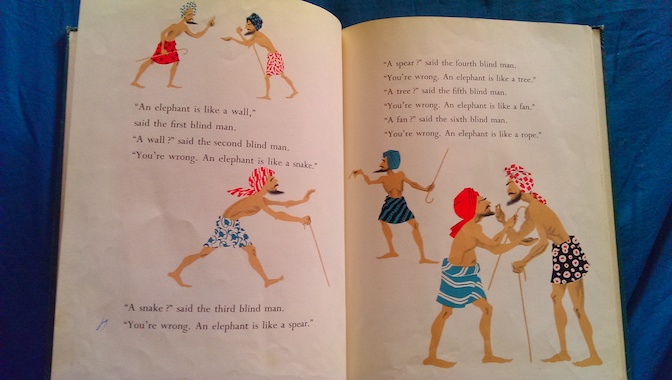
Six blind men, who all live together, realize that although they have heard a lot of people talk about elephants, none of them has ever seen one and that they don’t really know what elephants are like.  They have heard that the Rajah, whose palace they live near, has many elephants, so they decide to go to the palace to learn more about them.

BlindMenElephantCourtyard

When they reach the palace, where a friend of theirs works, there is an elephant in the courtyard, so the blind men start feeling it with their hands.  Because the elephant is large, each of the men ends up feeling a different part of the elephant and coming to different conclusions about what the elephant is like.

BlindMenElephantImpressions

As they stop to take a rest, they begin arguing about their conclusions because their experiences of the elephant were very different from each other’s.  When the Rajah hears them arguing, he explains to them that the problem is that each of them is only talking about one part of a very large animal and that if they really want to know what elephants are like, they must consider all the pieces together.  Recognizing the wisdom of what the Rajah says, the men sit down and discuss what they’ve learned more calmly.

BlindMenElephantArgument

The book doesn’t explain the background of the story, but the folktale is famous and is often used to describe situations where people each understand only part of a larger truth or where people stubbornly argue about very complicated issues from very limited viewpoints without considering all sides.

BlindMenElephantEnd

Kathleen: The Celtic Knot

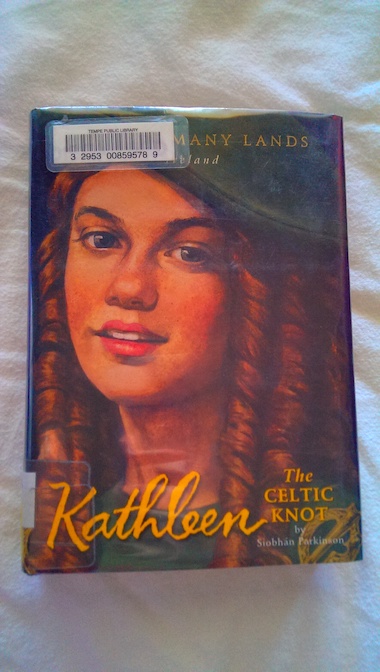
KathleenKathleen: The Celtic Knot by Siobhan Parkinson, 2003.

Twelve-year-old Kathleen lives with her family in Dublin, Ireland in 1937. Like the rest of the world, Ireland is suffering under the Great Depression, and Kathleen’s father has been having trouble finding work. Her mother helps to support the family by working as a midwife.

One day, when Kathleen’s mother is off delivering a baby, Kathleen accidentally burns the porridge at breakfast, making her and her sisters late for school. Although they should have been marked as being on time, they are considered one minute late because the nun’s watch was fast. Discipline is harsh at the Catholic school they attend, and after a harsh lecture to Kathleen, the headmistress, Mother Rosario, calls for a conference with her mother. Kathleen is very upset about it, but Mother Rosario softens somewhat and says that she merely wants to see that everything is alright with Kathleen’s family because a nice girl like her shouldn’t be acting up.  Kathleen still worries because she knows that the nuns look down on poor families like theirs and consider their authority higher than the parents of the children they teach.  They are often unaware of the circumstances that families live in.

However, Kathleen’s mother isn’t fazed by the nuns’ attitude and is blunt with the Mother Rosario, telling it like it is. The headmistress does show that she has some compassion and is somewhat aware of their circumstances because she says that Kathleen’s lateness was only part of the reason she wanted this meeting. She has guessed that Kathleen’s father is looking for work, and there is a position for an assistant gardener open at the school. It doesn’t pay much, and it’s not as good as her father’s old job was before the factory where he worked closed, but he agrees to take it because it’s better than nothing.

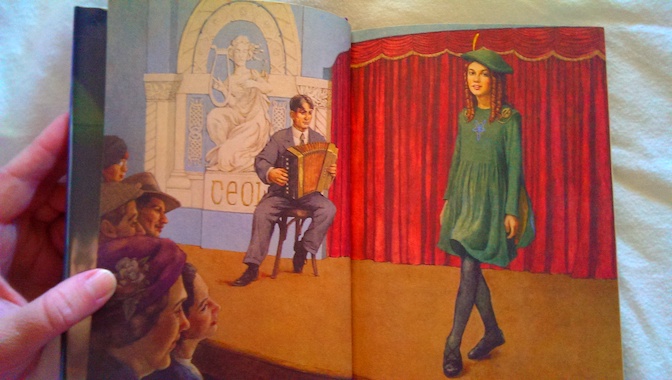
The headmistress also says that she has noticed that Kathleen is musically-talented. She likes to sing and has a good voice. Mother Rosario thinks it would be a good idea for her to take piano or dance lessons. The family doesn’t have a piano, so the headmistress suggest that Kathleen join the Irish dancing lessons because it’s a wholesome activity that reflects her heritage and that would keep her out of trouble. Kathleen’s mother isn’t big on heritage, but she agrees that dancing might be a good activity for Kathleen.
Kathleen isn’t happy about the dance lessons at first because the other girls who are involved are snobs. But, once she tries it, she realizes that she actually loves dancing. The problem is that the lessons aren’t free, like the other girls told her. At first, Kathleen feels cheated, finding out that she loves something that she can’t have after all, but her teacher says that she’s talented, so she offers Kathleen some free lessons anyway. She’s been looking for new talent so that her dancers can do well in the next dancing competition, and she doesn’t want to let a promising dancer like Kathleen slip through her fingers.

The snobby girls in class are all the more irritated when Kathleen is among those chosen to enter the next competition, but everyone also knows that there is one more obstacle for Kathleen: she doesn’t have a proper dancing costume or any money to buy one. She prays for one, even promising God that she’d become a nun if he gives her the costume she wants. Her mother has her eye on some beautiful cloth that she hopes to buy as a remnant, but the cloth gets snapped up by some of the wealthier, snobby girls, and her mother comes down with a serious illness shortly before the competition.
Kathleen begins to think that she was wicked for being so concerned about dancing and costumes when there are much more serious things in life. However, her aunt, Polly, understands how she feels and comes up with a plan to make the needed costume for Kathleen, using her favorite book, Gone With the Wind, as inspiration. Remember what Scarlett O’Hara did when she needed a new dress and couldn’t afford one?

KathleenDancing

One of the themes that runs through the story is questions and answers. Kathleen has a lot of questions about life. She knows that her mother deliveries babies for money, but she doesn’t really understand much about it, and her mother doesn’t answer the questions she asks. In fact, Kathleen notices that most of the adults she knows (with the exception of her father) brush aside her questions about the way the way the world works or the things people do because they simply don’t want to be bothered with them. They have too many concerns of their own, and they don’t really know most of the answers themselves. It kind of contrasts with the answers that Mother Rosario demands from Kathleen and immediately dismisses upon getting. Most of the time, she doesn’t really want to bother with answering questions or even dealing with the answers to questions she’s just asked. Only once does she answer a question that Kathleen had asked about St. Patrick, and Kathleen is astonished at getting an answer about something.

I have to admit that the attitudes about questions and answers from most of the adults in the story really irritated me, especially the way Mother Rosario demanded answers from Kathleen about her lateness and then dismissed everything that Kathleen said, angry that she had “answers.”  I’ve met people like that before in real life, and they’re just as illogical and crazy-making as this headmistress. I’m not talking about teachers who refuse to listen to flimsy excuses like “the dog ate my homework,” but people who get angry at others who have real explanations just because they have real explanations. People who demand to know the reasons why things happen and then immediately reject any explanation offered without a real reason for doing so are obnoxious. I’ve encountered people like that before, and it’s hard to have anything resembling a meaningful conversation with them.   They don’t want to talk to you; they just want to yell or lecture at you.  They don’t really care what the answers or explanations are for anything, and no answer would make any difference to them because what they really want is for the other person to just feel bad. It’s an unethical one-upmanship tactic, and it loses my respect the moment I hear someone use it because I recognize what they’re attempting to do. It’s so obvious, but frustrating at the same time (Kathleen in the story wonders why Mother Rosario is trying to torture her in this way) because there’s nothing you can say to stop the other person once they start (at least, I haven’t figured it out). Kathleen’s approach was probably the most effective.  She just stopped talking and prepared herself for the headmistress to hit her, which caused the headmistress to wake up a bit to the fact that the message that she was sending to Kathleen was that her only intentions were to hurt her.  Fortunately, those were not her only intentions, but I have to admit that I never really had any respect for Mother Rosario after that, in spite of what she did to help Kathleen’s family.  You can tell this is one of my pet peeves.  One-upmanship really bothers me in all of its forms, and I have even less time for that kind of nonsense than these characters do for answering a twelve-year-old’s questions.  At least you can talk to a twelve-year-old. Getting back to that, part of Kathleen’s trouble with some of her questions is that her elders often underestimate her, thinking that she’s really too young to understand anything, but the fact that she’s asking questions says that she’s really not. In fact, she might even be putting more thought into some issues than the people who have decided that some things aren’t worth thinking about in the first place.

Another theme of the story is growing up and changing goals in life. By discovering her talent as a dancer, Kathleen has found something that she would like to dedicate her life to, and if she becomes a dance teacher herself, it would give her a job to do in her future that could make her life better. Her aunt, Polly, who is twenty years old, also changes her mind about what she wants in life. As a single young woman, she likes to go out and have fun with her small earnings, hoping to meet a man as elegant as Rhett Butler.   However, when her latest young man turns out to be a cad, she accepts a proposal from the very shy but much nicer young man who she had previous thought wasn’t handsome enough. Polly’s experiences make her realize that handsomeness by itself isn’t much, and she and her new husband have plans for building a life together. At first, Kathleen is disappointed because she and Polly had talked about leading a carefree life together as single ladies when Kathleen was grown, but Polly explains to her that things will be better this way and that grown-ups have to build real lives for themselves, not live on dreams alone. Kathleen is still in the process of discovering the possibilities that life might hold for her and the talents that she can use to build her life.

I also found the parts about Irish history and politics during 1930s interesting.  One of the reasons why Kathleen’s family isn’t big on the Irish heritage movement is because her grandfather fought during World War I and wasn’t treated well as a veteran when he returned. During the meeting with Mother Rosario, Kathleen’s mother is blunt about her views on things, and Mother Rosario is surprised how much she understands of politics, showing that she looks down on poor people (possibly the source of her general rudeness and bullying tactics, even when she’s trying to be helpful – she’s decided that she’s superior and will remain so, whether she’s right or wrong), thinking that they aren’t smart enough to understand what’s going on around them.  The story makes it clear that the nuns at school are often out of touch with what ordinary families go through in their daily lives.  They underestimate what people know or read about, they have trouble understanding their daily struggles with money and how they are barely able to keep food on the table, and they seem unable to grasp what it’s like to be part of a family where any family member’s actions can affect all of the others.  For me, they were far more aggravating than the snobby little girl characters because I usually expect adults of a certain age to have grown out of some of these behaviors.

While reading the story, I was kind of comparing Kathleen’s circumstances in Ireland in the 1930s to life in America during the Great Depression, and many of their struggles were the same.  I was also kind of fascinated by Polly’s fascination with Gone With the Wind because it shows how pieces of culture and entertainment could become popular in other countries during this time.

This book is part of a series by the same publishers of the American Girls Books.  There is a section in the back of the book with historical information about the period.

KathleenHistorical

Addy Learns a Lesson

American Girls

AddyLesson

Addy Learns a Lesson by Connie Porter, 1993.

AddyLessonArrivalAfter escaping from slavery, Addy and her mother finally arrive in Philadelphia, Pennsylvania, where they will start a new life.  Philadelphia is a big city, and at first, Addy feels lost, not knowing where to go and what to do.  They have no family or friends to turn to, and neither she or her mother can even read the street signs, never having been taught to read.  They are dependent on help from other free black people, former slaves who have already established themselves in the community.

The first people they meet in Philadelphia are Mrs. Moore and her daughter, Sarah.  They are part of the Freedom Society of Trinity A.M.E. Church, which helps new arrivals escaping from slavery, like Addy and her mother.  The Moores take them to the church, where they attend a church supper, along with some other new arrivals.  Mrs. Moore asks Addy’s mother what work skills she has, and when she says that she can sew, Mrs. Moore says that she might be able to get a job in a dress shop.  Mrs. Ford, the white woman who owns the shop, is strict and fussy, but she hires Addy’s mother and gives them a room to live in.

Life in freedom isn’t as glamorous as Addy thought it would be at first.  Her mother works hard for little pay, and the attic room where they live is small and uncomfortable. She misses the rest of their family and still doesn’t know where her father and brother are.  There are also things that black people in Philadelphia can’t do, even though they aren’t slaves, like riding on the streetcar.

However, there is one thing that Addy is looking forward to: going to school for the first time.  Sarah Moore is Addy’s age, and she tells Addy about her family escaped from slavery in Virginia.  Like Addy, she couldn’t read when she first arrived, but now, Sarah attends school.  Addy is excited about attending the same school as Sarah and happy that she has made a new friend.  Addy’s new teacher, Miss Dunn, was also a former slave from North Carolina, and she reassures Addy that, although she hasn’t been to school before or learned to read yet, it won’t be long before she learns.


All of the other children at school are black, many of them former slaves.  However, Addy can’t help but notice that some of their families are more prosperous than others.  In particular, a girl named Harriet wears beautiful dresses, the kind that Addy has dreamed of having herself.  Sarah and Harriet don’t get along because Harriet is snobbish, but Addy is fascinated by her, wishing that she could have things like Harriet has.  Harriet says that her family were never slaves, and as bossy as Harriet is, Addy can’t help but admire her.  Harriet is nice to Addy at first, bragging about how smart she is and how much she can help Addy, but she isn’t as patient or as helpful to Addy as Sarah is.

When there is a spelling match at school, Addy accepts Harriet’s invitation to go to her house to study.  Harriet always seems to do well in class, and Addy is curious to see what her house is like.  However, Harriet and her friends force Addy to be their “flunky,” carrying all of their books, and they say insulting things about Sarah.  Then, Harriet retracts the invitation to study.

As Addy sees the way Harriet takes advantage of her, she comes to realize some important things about the way people act and about herself and the type of friends she really wants in her new life.  Unlike Harriet, Sarah is Addy’s real friend.  Addy realizes that she doesn’t need to admire people like Harriet because she is smart and works hard and can do just fine without Harriet’s false friendship.


In the back of the book, there is a section of historical information about education during the American Civil War, especially for black children.  It was actually against the law to teach slaves to read during Addy’s time, although some were able to learn in secret.  Even for free blacks in the North, there were few educational opportunities.  Black children couldn’t go to school with white children, and the schools for black children were poor, unable to afford many supplies.  Over time, more and more black people were able to get an education, in spite of the difficulties involved, and education helped to improve their lives.  However, segregated schools remained the norm until the 20th century.

I liked the way they showed the medal that Addy wins in the spelling bee.  Students who particularly excelled at a subject in class were sometimes given a small medal on a pin to wear as a badge of honor, something that people don’t do in modern times.