Last Battle

The Chronicles of Narnia

Last Battle by C.S. Lewis, 1956.

This is the last book in The Chronicles of Narnia series, and this is the book that shows the final days of the land of Narnia.

In Narnia, a wily old ape called Shift lives with a donkey called Puzzle. Shift is more clever than Puzzle and often tricks Puzzle into doing all his work for him. One day, they find an old lion skin in a pool. They think that it probably belonged to a non-talking lion that a hunter killed, but talking animals still show respect to lions because of Aslan. Puzzle thinks they should give the old lion skin a decent burial, but Shift says that he will use the lion skin to make a winter coat for Puzzle. Puzzle doesn’t think that sounds like a good idea because he wouldn’t like to have people thinking that he was trying to look like Aslan. Shift says that sounds like nonsense and makes the lion skin into a coat for Puzzle. Of course, sly Shift has a more diabolical plan in mind.

When Puzzle tries the coat on, he does look like a lion. Shift says that Puzzle looks like Aslan, and if people saw him, he could tell them what to do, and everyone would do it. Puzzle is alarmed at the idea, but Shift insists that Puzzle pretend to be Alsan with him advising him about what to say. Puzzle worries that Aslan would be angry, but Shift isn’t concerned because Aslan hasn’t appeared for a long time. At that moment, there is a thunder clap and a small earthquake. Puzzle is convinced that’s a warning sign from Aslan, but Shift tries to convince Puzzle that it’s actually a sign of approval.

The last king of Narnia is King Tirian. He is a young man, and he has a unicorn friend named Jewel. Word has reached him that Aslan has reappeared in the land, and he is very excited. A centaur wants him that this story much be false because the centaurs study the stars and have not seen the signs that should precede Aslan’s arrival. He is sure that the story about Aslan appearing is an evil lie. Jewel says that it’s difficult to say because Aslan is known to not be a tame lion, and that would make him unpredictable.

Before they reach any conclusions, a dryad stumbles toward them, wailing because the talking trees are being cut down, and her kind are dying. She falls dead at their feet because her own tree is cut down in the forest. The king is appalled and horrified! He insists that he and Jewel immediately go to the forest and find out what is happening and put a stop to it. The centaur urges caution, but the king doesn’t want to wait, telling the centaur to return to Cair Paravel to assemble his troops and follow him to the forest.

When King Tirian and Jewel come to a river, they are horrified to see a river rat with a newly-built raft, floating logs down the river. The king demands to know what he’s doing and by whose authority. The river rat says that he’s taking the logs to sell in another kingdom and that he’s doing it because Aslan the lion commanded it. King Tirian and Jewel find that alarming and difficult to believe, so they continue on to the forest. There, they see men from another country, known to be cruel, chopping down trees. They have also enslaved talking horses to help them. When the king and Jewel witness a couple of men abusing a horse, they kill them on the spot. They ask the horse how he was taken captive, and the horse says that it was at the command of Aslan.

The other men and talking animals realize that the king and Jewel have killed two of their people and turn on them. The king jumps on Jewel, and they run away, but they feel guilty about the men they killed. King Tirian realizes that this impulsive killing was murder because they had not needed to defend themselves. They also worry about whether they have violated Aslan’s command. They are not sure whether the Aslan who commanded these terrible deeds is the real Aslan. None of what has happened sounds like anything Aslan would want to happen, but Aslan is known to be wild and unpredictable, so they can’t be sure. What if they have become sinners for interfering with some grand plan of Aslan’s? Although they are afraid and feel guilty, they decide that the only thing they can do is surrender themselves to the horrible band and ask to be taken before Aslan, both to see if this Aslan is the real Aslan, and if necessary, submit themselves for punishment for killing the men, even if it means their lives.

When they are captured by the men, they are taken before Shift the ape. Shift has dressed himself as a king with a paper crown, and he tells everyone that he’s a human, just that he looks like an ape because he’s very old. He refuses to let anyone see Aslan up close, saying that he will deliver any messages Aslan has for them. He threatens the other animals with dire consequences if they don’t obey all of “Alsan’s” commands. He says that Aslan will turn the country into something amazing with lots of oranges and bananas (the things Shift wants more than anything) and roads and whips and kennels. The other animals try to say that they don’t want all those things, but Shift says that they should want what Aslan wants. A small lamb wants to know why they have to work with the men of the other nation when they know that they worship a different god, one who requires human sacrifices, instead of Aslan. Shift tells the lamb he’s stupid and these other people worship Aslan as well, just under a different name. Some of the animals are fooled by this logic, but others protest. Shift has a cat who protests taken away.

The mice are nice to the captive King Tirian, bringing him food and water. They want to help him, but they are afraid to help him too much because they are afraid of opposing Aslan. King Tirian asks them if it is the real Aslan, and the mice think it is. They say that “Aslan” is in the stable. As King Tirian watches “Alsan” appear by a bonfire on the hill, he notices that the “lion” doesn’t move like a lion should, and when he thinks about what the ape said about Alsan being the same as the cruel god who wants sacrifices, he sees through the fraud. He thinks about the past king and queens of Narnia and calls out to the Pevensies to return to Narnia and help him. To his surprise, he has a vision of the Pevensies at a dinner table, and he realizes that they can see him. The High King Peter calls out to him to speak, but then, the vision fades. Still, he has managed to let the Pevensies know that Narnia is in danger and needs them one more time.

The next morning, a strange boy and girl appear before him, and he recognizes them from his vision because they were at dinner with the Pevensies. The boy is the Pevensies’ cousin, Eustace, and his friend, Jill. Eustace and Jill untie King Tirian and help him escape. When they are safe, Eustace and Jill explain some things about their past adventures. King Tirian recognizes them as the children who rescued an ancestor of his. They also explain to him about the magic rings (which were introduced in The Magician’s Nephew and which they retrieved in his book). They were going to use the rings to reach King Tirian in Narnia, but they were on a train on their way to reach them when they felt a terrible jerk and suddenly found themselves in Narnia anyway.

With the past saviors of Narnia on his side, King Tirian recruits them to help him save Jewel. Jill finds Puzzle in the stable with the lion skin tied to him. She thinks that’s hilarious, but she convinces Puzzle to come with her. At first, King Tirian wants to kill Puzzle for his deception, but Jill persuades him not to because this situation isn’t Puzzle’s fault. Puzzle explains how Shift convinced him that Aslan wanted him to do this, and he says that he doesn’t know much about what’s been happening lately because Shift doesn’t let him out of the stable much. King Tirian agrees to spare Puzzle, and he is sure that many people will change their minds about Shift and what he’s been doing once they see Puzzle in his lion disguise.

King Tirian and the others begin showing Puzzle to everyone and explaining how Shift lied to them and tricked them. Some of the dwarfs find Puzzle as laughable as Jill did, but the humans from the cruel country are angry and fight them. They end up having to kill one of them. Some of the dwarfs disbelieve King Tirian and the children. The dwarfs explain that, yes, they see that the ape’s story about Aslan was a lie, but since they’ve been fooled once already, they’re not prepared to believe anybody else about anything. They don’t want to believe that King Tirian serves the real Aslan or that the real Aslan sent the children to Narnia to help. They don’t want to hear anything more about Aslan being real from anyone, and after the ape king, they don’t want anymore kings of any kind. They know that they were used by the ape, but what’s to say that King Tirian didn’t rescue them from the ape just to use them for some selfish purpose of his own. Having been fools once, they don’t want to risk being fools again by believing in anyone or anything else again. King Tirian and his allies realize that one fake Aslan, even one that was such an obvious fake, has damaged everyone’s faith in the real one because the fraud damaged everyone’s trust. The dwarfs say that they will now be entirely for themselves first and won’t listen to anyone else.

King Tirian thought that once people saw the truth, they would go back to being the way they were before, but he had underestimated the ways people can react when they find out they’ve been tricked. Not everyone will agree that they’ve been tricked, even when presented evidence, and even those who agree that they’ve been tricked may not have faith in the people telling them the truth. Also, now that the ape’s ruse has been exposed, others have seen how trickery can help them gain power and influence over others. Before King Tirian and his friends can tell others about the fake Aslan, Shift’s cronies start spreading their own fake stories about King Tirian and Aslan. Shift accuses Puzzle of being the deceiver because he’s the one who is wearing the lion skin, and it’s difficult to prove that Shift was the one who started all this in the first place. (What’s the best way to survive a witch hunt? Be the one who starts it. Bonus points if you can accuse other people of starting it later and blame them for victimizing you.) When King Tirian and the children try to tell people the truth, they’ve already heard so many lies and conflicting stories, many either aren’t convinced of the truth or are just so confused that they don’t know what to think. Some people realize that Shift has been playing them with the entire time and turn against him, while others still listen to Shift’s explanations and try to follow the convoluted logic and the scary things he promises them if they refuse to listen to them. Some people ally with King Tirian, while others stay loyal to Shift and his cronies, and others don’t want to trust either side and prefer to just try to look out for themselves.

When news reaches them that their enemies have already taken Cair Paravel and killed everyone there, they realize that the end of Narnia is close at hand. There is only one thing left to do: face down the enemy in a final battle for truth and the very souls of Narnia.

The book is available to borrow and read for free online through Internet Archive (multiple copies).

My Reaction

I was not looking forward to this book because I don’t like apocalyptic stories, and it was difficult for me to get through. I knew that this story would be about the end of Narnia, and in the Biblical tradition, the end of Narnia’s days are full of horrible things. It’s depressing to go into a story knowing that horrible things are going to happen, followed by the end of the world, at least a world that we’ve come to like through the other books in the series. I also knew that most of the characters we’ve come to know and love get killed in this story. Still, I decided to suffer through the story just to finish off the series and discuss my feelings about it.

It is also important to realize that the last battle of Narnia isn’t really about armies facing each other so much as the battle for truth against falseness, a subject of much debate in real life. Readers of this story are in on the objective truth of the situation along with our main characters, and they see how their enemies play tricks with lies and half-truths to manipulate other people. Their aim is to confuse people so they don’t know what to think, and then, everyone will follow them because they act like they are certain they are on the side of right. People who are insecure and uncertain in themselves will follow people who act confident, regardless of whether that confidence is real or deserved or not. That is the major theme that runs through the entire book. I think it’s an important lesson, but one that also makes me angry because I have seen people doing these things in real life, especially in recent years. I don’t really think that the end of our world is immediately at hand, although I’ve seen some people speculating about that because of things that have been happening.

Life is Unpredictable, and So Is History When You Live It

I was truck by the scene with Tirian remembering past glories of Narnia and its rulers, when there were bad times, but things went right in the end. He thinks how things like that don’t happen anymore, and it seems like there is no happy ending to this story. It reminds me of people who feel nostalgic and patriotic about things like World War II, when the Allied nations united and defeated a great evil and how it seemed like all of society agreed on the vision of victory and achieved it. Some people now, in the 21st century, almost seem like they wish they could return to those days. The only reason why those times provide any comfort now is because we are looking at them in hindsight.

We know what eventually happened and that the world wasn’t destroyed, but the people who actually lived during those times didn’t know that. They had no guarantees that they were going to survive, many of them didn’t. Many people died during WWII, in combat, in bombings, in concentration camps, etc. I’m sure that none of it seemed glorious at the time. At times, it must have seemed like the end of world to the survivors. Knowing the resolution of that conflict gives the false impression that people back then knew what outcome they wanted and were united behind that vision. They weren’t. There were some people who felt like the Nazis were in the right or at least couldn’t be opposed. Even in the United States, there was a pro-Nazi rally at Madison Square Garden. (Video footage on YouTube, courtesy of PBS.) If someone had told the people at that rally on the day the rally was held what was going to eventually happen, they probably would have felt that the defeat of the Nazis would be the end of the world because they were convinced that they were the ones in the right and everyone else was in the wrong. Whether they still felt that way by the time the war actually ended is debatable, but from where they stood at that moment, what was best for the rest of the world would have seemed terrible to them.

Even in Britain, there was sympathy and support for the Nazis among the aristocracy, like the Mitfords and even members of the royal family. C. S. Lewis would have been aware of people like that during his time, and the Mitfords are a good example because they were well-known for their scandalous political views. (P. G. Wodehouse’s character, Roderick Spode, was a parody on the husband of one of the Mitford sisters, who was the leader of the British Union of Fascists during the 1930s.) Their support for Nazis changed some of their lives for the worst, and some of them probably wouldn’t have wanted everyone to remember their earlier stances after the war was over, but while the entire situation was unfolding, they were certainly very sure of themselves. They may have thought that they knew what they wanted and what was going to happen, but outcomes were never guaranteed for anyone.

Life is unpredictable, like an untamed lion. While many of us have a sense of when things are going wrong or seem unreasonable, we’re not always right, and even when we are, it can be difficult convince others of that if they think they have reason to believe otherwise. The truth is that we have never had any guarantees at any point in our history. While we like to think that God will carry us through any situation, bad things do happen along the way, often to good or normal people. Outcomes are not completely assured for anybody. Every disaster, while not bringing about the total end of the world just yet, have been the end of days for some individual people, who didn’t live through them.

The only moral I can think of from that is not to envy people from the past too much. Their problems don’t seem as bad now because we know that the survivors survived, and the world went on. But, the world didn’t go on for everyone caught up in those situations, and survival wasn’t guaranteed for everyone in the middle of the crisis. Even those who did survive in the end couldn’t know for sure whether they would or not while they were struggling along. They didn’t even always have the comfort of knowing absolutely, for certain that they were on the side of right or not not or if they were carrying out their missions in the right way. While I’m sure that they tried to do what they thought was right in spite of everything, there were voices in their ears trying to tell them that they were in the wrong and it was time to give up at every step and stage. Of course, I would argue that Nazi supporters were the ones who really needed to be told that and that they should have taken it to heart, but while the situation was in motion, everyone just had to keep playing out their chosen parts to the end. You can’t rewrite people or situations while they’re in the middle of writing their own histories themselves.

The same is also true of the rest of us. I’ve said before that history is not written by “winners” but by writers, and actions are a form of writing history. We all do it, all the time. Nothing is guaranteed for us. Whatever you stand for and whatever sides you pick to follow are the parts you’ve written for yourself by your choices. Our outcomes will all be determined by the parts we’ve chosen to play and the way we’ve written them for ourselves to act out, and unfortunately, what others choose to act out upon us. We can’t control everyone’s decisions, only our own, and that’s part of what makes life and history unpredictable.

“Fake News!”

When C. S. Lewis wrote the Narnia books, he had already lived through WWII and knew the power of propaganda. From the beginning of the story, propaganda, or more simply, lies, play a major role. It starts with Shift’s plan to put his donkey stooge into a lion costume and use him to get bananas and oranges (or, more generally, wealth that can be used to buy these things). However, along the way, Shift himself becomes a stooge for other people who see the power of his lies and want to use lies for their own purposes. As the situation spirals out of control, the concept of truth itself loses meaning for people, and many people struggle with what to believe. Oh, gee, where have I heard that before about a million times over the last several years? They think they’ve gamed the system, but their own system of lies have gamed them, and none of them are bright enough to notice until it’s far too late. From there, it’s just a slow, excruciating train wreck to watch. (By the end of that book, the metaphor is disturbingly real.)

Yeah, I know that’s a political statement these days, but if you recognize what I’m criticizing without being told directly, you must know what I’m complaining about and why. (I’m sure I’ve complained about this before somewhere on this site because I never suffer anything in silence, and I’m my only editor.) In the story, when King Tirion tries to reveal the truth about the Aslan donkey hoax to everyone, it proves harder than he expected because everyone has been so inundated with lies that they either don’t know what to think or just don’t want to think anything about anything anymore. The villains in the story start spreading their lies faster than our heroes can explain the truth to everyone, and all the villains have to do is to accuse our heroes of being the liars or let others think that they’re just as bad as everyone else telling tales. (“Fake news!”, “Election fraud!”, “All politicians lie” and “Who cares if our favorite ones lie when it benefits us and makes us feel good?” – I could go on and on, but what would be the point? People who have seen the problems with all of this already understand, and those who say they don’t have already made a decision.) Everyone is left to make up their own mind, which wouldn’t be so bad except what some of them decide to do is to let the villains make up their minds for them. When they don’t know who or what to trust, they trust in what they’re accustomed to, and some of them have become accustomed to listening to Shift and his pals because they were the ones who started the whole situation and have been yelling the loudest since.

Puzzle the donkey keeps saying that the reason why he keeps letting Shift talk him into doing things is that he knows he’s not as clever as Shift, so he thinks that he’d better let Shift make the decisions. It’s not unlike those people who assume that someone with a lot of money or a high position must have gotten there through brains. It’s not always true. Sometimes, they don’t have to be bright or talented if they just convince other people that they’re not. Puzzle is sure that Shift is smarter than he is, but actually, Shift is just more manipulative. Yes, he knows how to sew, but it’s the only talent he uses other than lying and manipulation. He wouldn’t have even half of what he’s got if he didn’t routinely talk Puzzle and others into doing things for him or giving him things. Ultimately, he’s a conman. Of course, most of the reason why Puzzle thinks he can’t be clever or competent by himself is that Shift has been telling him that and insisting on making the decisions. Puzzle doesn’t have the confidence to stand up to him, even when he knows that Shift is asking him to so something wrong. Eustace gets frustrated with Puzzle’s attitude and tells him that he wouldn’t have to worry so much about how clever he is if he just focused on being as clever as he knows how to be. If you know better, do better! It’s a Christian concept, and the Narnia stories have Christian themes. Eustace is trying to get Puzzle to listen to those doubts that he has about Shift and what Shift wants, to take them seriously, and recognize that he can say “no” to Shift when he’s asking for something unreasonable.

So, what can you actually do in a situation where you’re not sure who’s telling the truth or what the best thing to do is? There are no hard and fast answers to that, but my answer is … don’t depend on hard and fast answers at all. Never be so married to any particular stance that it would be like ripping out a part of your soul to simply change your mind and change course. Again, “Do the best you can until you know better. Then when you know better, do better.” Be open to incoming information and feedback that lets you know how you’re doing and if you’re really understanding the situation correctly. The way I look at it, all humans are capable of being fooled, but those who aren’t afraid to back up or change their minds and are open to updating the information and understanding in their own minds are likely to spend less time continuing down a wrong course, even if they were wrong before.

Also, make sure that you have personal limits. Know when someone is pushing you to your limits or over them, and know when it’s time to back off. Puzzle the donkey has no boundaries whatsoever. Shift can talk him into anything, even things that are personally risky or harmful to him or downright immoral because, while there are things that Puzzle thinks are morally wrong, there is nothing in Puzzle’s moral view that is so far wrong that it would cause Puzzle to stop listening to the person telling him what to do. The only thing Puzzle is sure of is that Shift is smarter than he is, and he clings to that in spite of all evidence to the contrary. In the end, Puzzle is a major part of what brings down all of Narnia because he was the one person who could have stopped its destruction before it started, if he had only said no when he had misgivings. He didn’t invent the scheme, but he’s the one who chose to carry it out, even when he really knew he shouldn’t.

Trains Crash, Everyone Dies

This whole book was like a slow train wreck. It’s well-written, but it’s a well-written slow train wreck. There is the figurative train wreck, where everything spirals out of control in Narnia, and the world ends. Then, there is the literal train wreck that kills most of the characters we’ve come to know and love.

Eustace and Jill die in England at the moment they enter Narnia to help Tirian. Since time in Narnia works differently from time in our world, they don’t find out that they are dead or in the middle of being killed in a train accident until they reunite with the rest of their friends in the “true” Narnia, which is part of Aslan’s Country, which represents heaven. Although the Narnia they all knew before is gone, all the best parts of it and the friends that they knew from past eras of Narnia in their previous adventures are all alive again in True Narnia. The True Narnia is also one of all the “true” versions of all of the other worlds, including ours. The Pevensie children’s parents were also on the train when it crashed, so they appear in the True England that is also part of Aslan’s Country.

The only young Pevensie who isn’t killed in the railway accident on Earth is Susan, who was more worldly than the others and wasn’t on the train. We don’t see her reaction to the deaths of her parents and siblings or learn what the rest of her life on Earth is like. Her siblings say that she has stopped believing in Narnia, remembering it only as a game that the siblings used to play. Her main interests now are parties and fashion, much like other young women. The other characters think that she has become “silly” and has lost sight of what’s important. She may have, but this part of the book gets a lot of criticism because, from the description we have of her, she is just going through a normal phase of life where she wants to have fun, make friends, and date. She might be kind of silly in the way she’s going about it, but by itself, it’s not something abnormal or deserving of scorn. As I said, we also don’t know what the rest of Susan’s life will be like. I think there is an implication that she will someday come to True Narnia, too, because she was also once a Queen of Narnia, and once someone is a King or Queen in Narnia, they will always be a King or Queen there.

The rest of the characters who died in the train accident and are now in True Narnia spend the rest of eternity exploring Aslan’s Country and having endless adventures. It’s framed as a positive because it means that they get to be young forever in the True Narnia, having amazing adventures with the people they love, but it’s still upsetting to me. It bothers me because it occurs to me that they were destined for True Narnia eventually in any case, and I would have liked for them to have lived their full lives on Earth to old age first. Yes, True Narnia is wonderful, and they will get to enjoy eternity there, but it just seems to me kind of sad that they couldn’t have put it off for a few more decades anyway. Polly and Digory are elderly when they are killed, and Mr. and Mrs. Pevensie had the chance to enjoy their marriage and children before the accident, and it just seems like a shame that the young Pevensies didn’t have those opportunities. It’s also sad to think of Susan, mourning the loss of her entire family.

Another Problem

One other thing that bothered me about this book is that the Calormenes are described as being darker physically than the human Narnians. During the final battle of the book, Narnians jeer at them and call them “Darkies.” I don’t like the idea that that the light-colored people are described as being the good ones and the dark ones as the bad ones, especially not when paired with a known racial slur. These people are set in another world, but it just echoes the racism of this world too much for me.
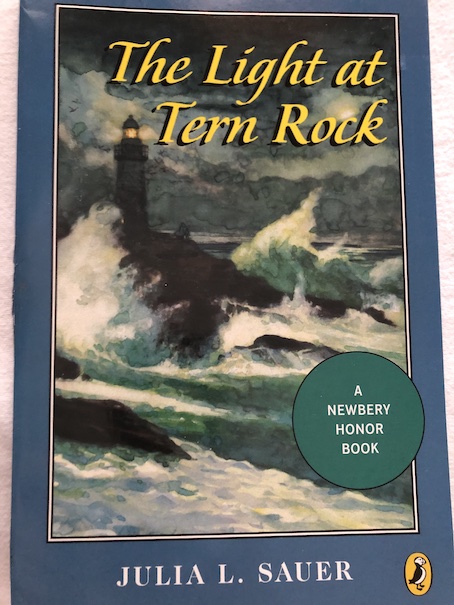
The Light at Tern Rock

The Light at Tern Rock by Julia L. Sauer, 1951.

Not long before Christmas, the lighthouse keeper at Tern Rock, Byron Flagg, approaches Martha Morse, asking her if she would be willing to temporarily take the job of tending the lighthouse while he takes a vacation. The lighthouse can never be untended because ships rely on that light, and it can be difficult for Mr. Flagg to find someone to take over his duties for an extended period of time, especially so close to Christmas. Mr. Flagg wants to hire a substitute with experience tending the lighthouse. Mrs. Morse lived there for 14 years while her late husband was the lighthouse keeper. Although many people would be daunted by the isolation of the lighthouse, Mrs. Morse actually loved it because she enjoyed the beauty of the sea and nature. She knows that she would enjoy staying there again. However, she hesitates to take the job of temporarily tending the light because she is caring for her young nephew, 11-year-old Ronnie. Ronnie might enjoy the adventure of staying in a lighthouse, but he would have to miss some school.

Mr. Flagg appeals to Mrs. Morse’s sense of nostalgia about the lighthouse and points out that Ronnie could bring along some of his schoolwork to study during their stay. Mr. Flagg says that their stay will only be for two weeks, and that he’ll return and relieve them on December 15th. Mrs. Morse points out that the weather around Tern Rock can be unpredictable and that he might not be able to return when he says he will, but Mr. Flagg says he is confident that he can. They talk to Ronnie about it, and Ronnie says that he would like to see the lighthouse, but he wants to be home for Christmas. Mr. Flagg assures them that won’t be a problem and that they will enjoy their stay at the lighthouse, so they agree to go.

When they arrive at the lighthouse, Ronnie is awed by rugged environment of Tern Rock and daunted by the isolation of the lighthouse. His Aunt Martha says that she understands how he feels, that he wonders if they’re up to the task, but she assures them that they are. The job they will do is a necessary one because, without the light, the rocks in this area are a danger to ships.

As they settle in, Ronnie becomes fascinated with the lighthouse. The interior is comfortable and designed to be compact, almost like the interior of a ship. His Aunt Martha establishes their schedule, teaching Ronnie what they need to do. She turns off the light at sunrise and lets it cool down while they have breakfast. Then, they clean the lamp, polish its lens, and do other chores to keep the light in working order. Ronnie does his schoolwork in the afternoon, and they turn on the light when the sun goes down. They spend their evenings doing quiet activities, like reading and playing games. Although Aunt Martha wasn’t sure that the quietness and monotony would appeal to an active boy like Ronnie, Ronnie finds the newness of the environment and the change in his usual routine fascinating.

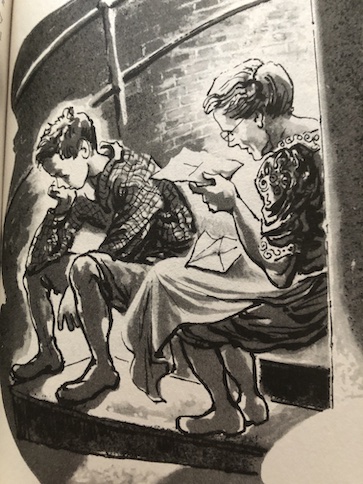
Ronnie’s feelings change when December 15th arrives, and Mr. Flagg doesn’t. The weather is good, so there’s no reason why a boat shouldn’t approach Tern Rock, but Aunt Martha says that there may have been some other problem that delayed him. She doesn’t think an extra day or two at the lighthouse will hurt them, but the days go by, and still, Mr. Flagg doesn’t come. They are still comfortable in the lighthouse and there haven’t been any problems with the light, but Ronnie is angry because he realizes that Mr. Flagg lied to them. Christmas is approaching, and it becomes clear that Mr. Flagg never had any intention of being back at the lighthouse in time for Christmas.

Ronnie has trouble understanding and excepting Mr. Flagg’s lies and broken promises. Ronnie and Aunt Martha discuss the importance of honesty and the meaning of broken promises. Ronnie thinks that Mr. Flagg has been wicked. He has certainly been unfair, but Aunt Martha says that there are worse kinds of wickedness, and before they jump to conclusions about what has happened, they need to know the reasons for it.

Aunt Martha says that the Christ Child visits every home on Christmas, and no place is too distant for Him to reach, so they should make the lighthouse ready and prepare for Christmas. Ronnie doesn’t see how they can because they didn’t bring any decorations or anything for Christmas. Ronnie considers firing the cannon that would signal an emergency to bring someone out to the lighthouse, but Aunt Martha firmly tells him no. The cannon is only for serious emergencies, when there are lives in danger, not for mere disappointment and self-pity. However, Mr. Flagg has left some special surprises for them.

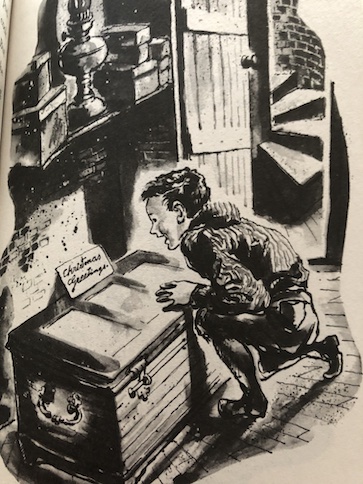
It is true that he intentionally deceived them about being back in time for Christmas. When Ronnie finds a sea chest with a Christmas message, he knows for certain that Mr. Flagg was lying to them the entire time, which makes him angrier. However, a letter that Mr. Flagg left explains his reasons, which earns their sympathy. To soften the blow of his deception, he has also left them some special presents and treats gathered from exotic places. This still isn’t the Christmas that Ronnie and Aunt Martha had originally planned, and being lied to doesn’t feel good. Still, in the end, this Christmas is pretty special and memorable, and they both realize that they are exactly where they need to be.

The book is a Newbery Honor book. It is recommended for ages 8 to 12 years old. It is available to borrow and read for free online through Internet Archive. The author, Julia L. Sauer, also wrote Fog Magic.

My Reaction

I wasn’t familiar with this story when the Coronavirus Pandemic started, which is a pity because this would have been a great book for the type of Christmas we had in 2020. Still, this is a lovely Christmas story, and the pandemic isn’t quite over yet. Things have improved considerably since 2020 because people have been vaccinated, but for those who still need to be cautious and are disappointed that things aren’t completely back to normal or anyone who has hard feelings toward someone or is having a rough Christmas for any other reason, this story is a useful reminder that disappointments are still temporary, and sometimes, the place where you find yourself is exactly where you need to be. Also, disappointments and inconveniences can come with compensations, if you’re open to experiencing them.

Mr. Flagg shouldn’t have lied to Mrs. Morse and Ronnie. He acknowledges in his letter that this was a hurtful thing to do, and he explains his reasons. Basically, he was lonely and desperate. As a lighthouse keeper, he is what we might call an “essential worker”, someone who can’t easily take time off from his work because he does a necessary job that can only be done in a particular place. People’s lives depend on the light from the lighthouse, so Mr. Flagg can’t leave his job for any length of time unless he finds someone qualified who is willing to take his place. This story is set during a time before lighthouses became automated, so there must be a human in this role.

Mr. Flagg is in his 60s, and he explains in his letter that he has spent most of his Christmases either alone or with other adults because of his life as a sailor and lighthouse keeper. He has a niece who has several children and who would be happy to have him for Christmas, but he has never managed to find anyone who was willing to relieve him from his duties during Christmas before. He was desperate to spend at least one Christmas with his family, so he resorted this deception out of desperation, but he left all the presents and special treats for Aunt Martha and Ronnie because he didn’t want them to be miserable.

Aunt Martha is getting older herself, and she understands how Mr. Flagg feels, having lived a similar sort of life. When she lived at the lighthouse, she and her husband were together, but Mr. Flagg has never married, and he was desperately lonely. Ronnie has more trouble understanding the feeling because he is younger and hasn’t experienced this type of loneliness before. Aunt Martha points out that Ronnie will have many more Christmases before him, more than either she or Mr. Flagg have left. One disappointing or just bizarre Christmas won’t mean that much to him in the long term. With maybe 50 or more future Christmases to come as well as the ones he’s already experienced, this strange Christmas in the lighthouse is just one more memory or story to tell other people in Christmases to come.

Part of this story is about forgiveness, but they don’t use that word at all in the story. People have different views about what forgiveness entails, but I think it’s important that Aunt Martha and Ronnie don’t excuse Mr. Flagg’s actions. They come to understand his motives, and they feel pity or sympathy for him for the kind of rough and lonely life he’s lived, but that doesn’t make lies to them good or right. He did something hurtful by betraying their trust, and there will probably be some kind of reckoning between them when Mr. Flagg eventually shows up. Mr. Flagg acknowledges that in his letter, that the knowledge that he betrayed their trust will keep him from fully enjoying Christmas with his family, even when he’s finally getting the kind of Christmas he has wanted, and he can’t blame them for whatever they’re feeling as they read his letter. So, the story never says that what Mr. Flagg did was okay or that it didn’t hurt that he lied to the people who were helping him. Lying was wrong, and it was hurtful, and the characters are honest about that. They don’t try to pretend that they’re not hurt, which I think would have made their feelings worse in the long run. Instead, it’s about looking past that hurt to something better and finding things to be happy about even in a situation where they didn’t want to be.

Aunt Martha sees that what’s really preventing Ronnie from enjoying Christmas as they happen to have it is his anger, disappointment, and bitter feelings and the way he broods about them. Brooding about the angry things he wants to say to Mr. Flagg when he sees him isn’t making his Christmas any better. Aunt Martha compares cleaning out negative emotions to cleaning house before the holiday. You have to clear out all the dust and negativity to let in something better. They will eventually see Mr. Flagg, and there will probably be words between them, but those words can wait while they enjoy themselves as best they can for this Christmas. By then, each of them will probably have a better sense of just how they really feel about the situation and what they want to say about it anyway.

Once Ronnie works through his feelings and is able to put aside his anger, he realizes that this Christmas is something special. He does miss the class Christmas party the rest of his school is having, but in return for that sacrifice, he is experiencing something truly unique that his school friends will probably never experience. He doesn’t fully consider how unique this experience actually is at first, but he senses that there is a unique feel to Christmas in the lighthouse, with its giant light. Ronnie considers the tradition of putting candles in windows at Christmas, to guide the Christ Child or other travelers. (They emphasize candles as welcoming the Christ Child in the story, but when I first heard of the tradition, it was to welcome travelers or absent family members.) He realizes that, by tending the lighthouse, he and his aunt are doing the same thing, but they’ve got the biggest candle of anyone!

Whatever your Christmas happens to be this year, wherever you’re spending it, and whoever you’re spending it with (even if it’s just yourself), don’t forget to do the little things to make it special and enjoy it for whatever it is! Merry Christmas!

The Silver Spoon Mystery

The Silver Spoon Mystery by Dorothy Sterling, 1958.

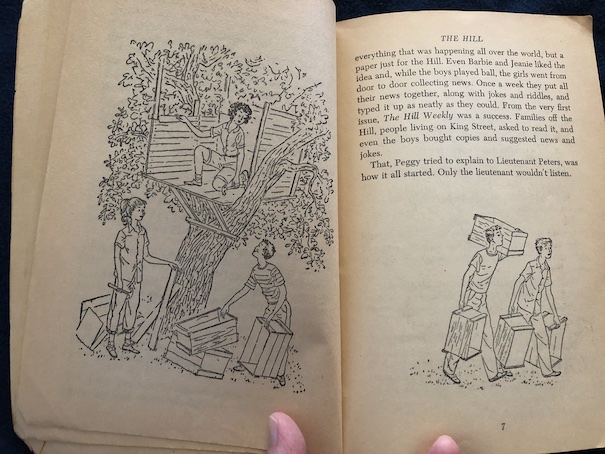
A group of families move into the new suburb built on The Hill overlooking the town of Dwighton. The kids in the new neighborhood become close friends, visiting each other’s houses, playing games, and running around town together. It’s idyllic, but then the boys in the group start playing baseball together, and they begin excluding the girls from the group, even though they’ve all played baseball together before and the girls are good at it. The boys also stop working on the tree house that the kids were all making together, taking some of the tools and materials and building themselves a clubhouse near the baseball field with a sign that says, “NO GIRLS ALLOWED.”

The girls are offended at suddenly being shunned by the boys, so they decide that they need to have some special project, something that will show the boys that girls are just as good as they are and that the girls don’t have to rely on the boys to have some fun. They decide to start a neighborhood newspaper, writing about local events and having fun stuff, like jokes. The newspaper is a success, and adult neighbors buy copies. Then, the boys decide to start a competing newspaper themselves. One of the girls, Peggy, is upset because she’s sure that the boys’ newspaper will be more successful. Some of the boys are older than the girls so they might write better, there are more boys than girls in the group so they have more people to gather news and sell papers, Davey is better at drawing cartoons than the girls are, and worst of all, the boys splurged to buy a hectograph, which uses a gelatin substance for making copies of writing and drawings (as in this video) and will allow the boys to print papers by the hundred (“hecto” means one hundred, and that’s how many copies a hectograph makes at a time). (This is before home computers, so the characters have to rely on manual printing methods. People used hectographs to make copies before modern copy machines, but modern hectographs still exist, and some people use them for artwork or tattoo stencils.)

Peggy’s afraid that the girls won’t be able to compete with the boys’ advantages and thinks that the boys are mean for trying to steal their business. Peggy’s mother tells her that she shouldn’t worry about being better than the boys but focus on being different. She says that the girls should make sure that their paper has different content from the boys’ paper so people will still have a reason to buy theirs even if they’ve already bought the boys’ paper. If the boys’ paper has cartoons, the girls’ paper should have things the boys wouldn’t think to include, like recipes, poems, and fictional stories that could be written and submitted by local people.

Peggy gets an idea from what her mother says, but it’s not a good one. Peggy still wants to show up the boys, and she thinks that the best way to do it is to get a “scoop”, meaning printing an exiting news story that the boys won’t have in their paper. The problem is that the girls don’t know where they’re going to get an exciting news story that the boys don’t know anything about. Nothing that exciting is happening in their town anyway. There haven’t been any shocking events, no murders, no robberies. Peggy tells the other girls that means that they have write about something that hasn’t happened yet. Peggy poses the idea of writing about someone stealing the silver on display at the local library that was made by the silversmith who was the founder of their town. Of course, the problem with that is that the silver hasn’t actually been stolen. One of the girls, Ellen, objects to writing a story about something that hasn’t happened because that’s not actually “news.” However, Peggy talks the other girls into it by saying that they would be writing about it as fiction because people write fictional books all the time, and that’s allowed. Ellen still isn’t convinced, but Peggy goes ahead and writes the story anyway. (Basically, she’s turning the girls’ newspaper into a tabloid, although the kids don’t seem to quite get the difference, even though Ellen can tell that this isn’t right for a newspaper.) The girls all discuss how they would go about stealing the silver spoons from the library, if they were going to do it, and Peggy writes the story from their speculations.

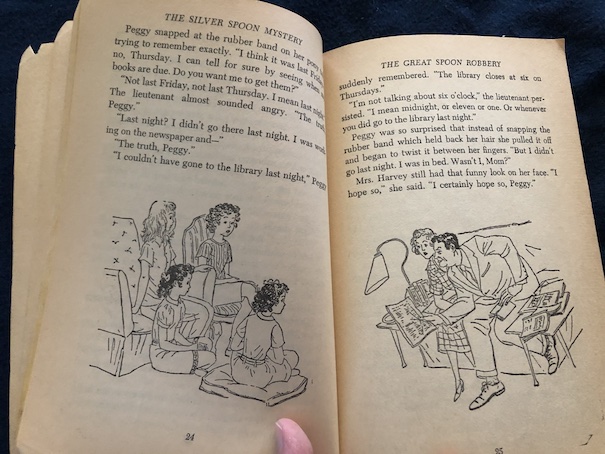
You just know that there’s going to be trouble with Peggy trying to sell a story that everyone knows didn’t happen, but what actually happens is even stranger. After the girls sell their paper with the spoon theft story, Peggy gets home to find a policeman, Lieutenant Peters, waiting for her with her mother. Lieutenant Peters wants to talk to Peggy about the robbery at the library because it turns out that the very night when Peggy was writing her big fictional scoop about silver spoons being stolen from the library, someone was in fact stealing silver spoons from the library, and this thief apparently did it the way Peggy described in her story. Lieutenant Peters wants to know everything that Peggy knows about the theft, and he won’t believe that Peggy wasn’t there to witness it because her description of what happened is so accurate. She even has a description of the thief in her story. Since the theft happened in the middle of the night, Peggy points out that she was asleep in bed, but even Peggy’s mother isn’t sure that Peggy didn’t sneak out. When Peggy’s friends show up at her house, Lieutenant Peters questions them too and comes to the conclusion that Peggy and maybe also her friends stole the spoons themselves to make their story true. Lieutenant Peters says that they’ll be forgiven if they give the spoons back, but the girls can’t do that because they don’t have them.

As Lieutenant Peters and Peggy’s mother continue to question the girls about their story, the girls admit that they made up the whole thing as a fictional story just to attract attention to their paper. Lieutenant Peters catches the boys listening in on their conversation and questions them about what they know about the situation. The boys don’t really know anything about the theft, either, but they were pretty sure that Peggy made up the story she wrote, and they’re fascinated that she might be about to be arrested and taken to “children’s jail.” Peggy’s mother believes her that she just made up the story and it’s all a coincidence that someone happened to steal the silver spoons from the library around the same time, but Lieutenant Peters isn’t convinced.

Word of the spoon theft spreads across town quickly, partly because of Peggy’s story in the neighborhood newspaper and partly because of the story in the regular news. People call Peggy’s house to ask for details, and kids at school look at Peggy and her friends suspiciously, wondering how much they had to do with the theft. Peggy is especially offended when Davey says that his father thinks that it’s an unlikely coincidence that Peggy would write a story about the theft and then the theft would just happen. Before the boys started their “no girls allowed” stuff, Peggy and Davey used to be close friends. However, Davey assures her that he doesn’t think that she’s responsible for the theft. He also tells her that he and the other boys are sorry about pushing the girls by trying to compete with their paper, and they’ve decided to give up theirs and let the girls use the hectograph. The kids discuss trying to investigate the crime themselves because, until the real thief is found, people are going to keep looking at the girls suspiciously.

Most of the neighborhood kids, both boys and girls, join the investigation as the “Hill Detective Club”, except for one of the older girls who is studying for exams and Davey’s older brother, Allen, the only boy who’s mad at the other boys because they don’t want to play baseball now. (Allen is apparently the one who started all the “no girls allowed” stuff because he didn’t make the high school baseball team and he’s been ultra-serious about practicing during the neighborhood games. He’s trying to organize a game between the boys in the neighborhood and their fathers. The book doesn’t explicitly say so, but there might also be an element of embarrassment for him that some of the girls play better than he does. Peggy is described as being the fastest runner in the neighborhood, and Ellen is a good batter.) As they begin their investigation, the kids visit the scene of the crime and study the ways the thief could have gotten into the library, starting to separate the made-up details from Peggy’s fictional story from the real facts and circumstances of the case. Peggy admits that her mind is biased because she still thinks of her story as the way things happened and her fictional suspect as the type of thief they’re looking for, but the truth is that they don’t know for sure how the crime actually happened or what type of person they’re looking for.

When the kids talk to one of the librarians, Miss Bancroft, they learn that the police did find a few sets of fingerprints on the case that held the silver spoons: Miss Lowell, the head librarian; Mrs. Simpson, a descendant of the town’s founding father and part of the local antiquarian society; and Mr. Weatherspoon, who owns a local antique store. Could one of these people be the thief?

The book is available to borrow and read for free online through Internet Archive.

My Reaction

To begin with, this book seems like it’s meant for fairly young elementary students. It tries to teach readers the meaning of some of the words in the story because some of the characters don’t know the meanings of various words the other characters use or words that they encounter in various places, like “descendant” or “optometrist.” The kids in the story are a variety of ages even though they all play together in the neighborhood, and I could understand why some of the younger kids would struggle with bigger words, but there were times when I thought that they were carrying it a little far. Peggy is twelve years old, so it seems like she should have been old enough to know what an optometrist is. Has she never had her eyes checked before? Actually, maybe she never has. If her vision is good or seems good, maybe her family just doesn’t bother. I guess it’s educational for young readers just branching out into chapter books.

I like books that bring up interesting historical topics. The parts about older printing/copying techniques and Mrs. Simpson’s old electric car with the steering stick instead of a steering wheel (possibly a Baker Electric, like the one Jay Leno owns, or something very similar – this video explains the history of the Baker Electric and shows what it’s like to drive it) were interesting, and one of the characters in the story explains more about the history of the town’s famous silver spoons to the kids. Although the town, its founder, and the spoons are all fiction, spoons of this sort did exist in real life. The silver spoons are specifically christening spoons. It used to be traditional to give presents made of silver to new babies and their parents for the child’s christening. One of the most popular presents of this type was small silver baby spoons, especially with special designs or engravings to remember the child’s birth. The character explains why this particular set of spoons is so distinctive, talking about their unique design, how antique dealers would be able to look them up in a reference book and learn their history, and how each of the of the spoons is marked with the maker’s hallmark, the special symbol that the maker would use to identify himself.

Part of the mystery hinges on the coincidence of the theft occurring just when Peggy decides to write a sensational story about an imaginary theft to get attention for her neighborhood newspaper. For readers, the question is whether the timing of the actual theft is really just coincidental or if there’s a direct connection between the story of the theft and the theft itself. I would have been very disappointed in the book if it was just a coincidence, so I immediately approached the story with the idea that the timing of the theft was a clue. I enjoyed considering different possibilities. My first thought, when the theft happened mysteriously immediately after Peggy and her friends invented their theft story, was that someone overheard the girls talking about how they would commit a theft like that and decided to use their imaginary scheme as their own. However, the conversation between Peggy and her friends took place in Peggy’s room, which was pretty private. For someone to overhear them, it would have to be someone in Peggy’s own house, possibly family or a neighborhood friend, or someone listening in from outside, probably one of the neighborhood kids. Those possibilities didn’t seem likely. Then, I remembered the Nero Wolfe murder mystery story Not Quite Dead Enough. What if the theft didn’t occur when the police thought it did (mostly because they believed Peggy’s original story) but actually at the point where the theft was supposedly discovered? The person who claimed to discover the theft was one of the people with the strongest motives to commit it, and this person could have done it after reading the fake news story, seeing an opportunity to make it true and cast suspicion on Peggy’s fictional suspect. The mystery is simple enough to figure out for an adult who likes mystery stories, but probably much more mysterious for kids. Once the kids realize who has the spoons, there is also the additional challenge of proving it and getting the spoons back without getting everyone in trouble.

I thought it was interesting that the story shows some of the problems with sensationalist or tabloid style “news” stories, or “yellow journalism“, as it used to be called. It’s the sort of “news” that relies on flashy and misleading headlines, buzzwords and catch phrases that appeal to its fans and rile them up emotionally, hyperbole and emotionally-charged language, conspiracy theories, pseudoscience, and poorly-qualified or debunked “experts”, to draw readership and advertising money. Basically, they aren’t really “news.” They don’t try to describe things as they actually happened for informative purposes. These are “news” stories that are less about fact than about entertaining their audience or shocking people and stirring up strong emotions to grab people’s attention. That’s basically what Peggy was trying to do with her fake news story, even if she wasn’t quite thinking about it in those terms. Just like tabloid or sensationalist news, Peggy’s story was almost a kind of fan fiction based on the real world. That is, she took real things and situations that she knew existed (the silver display at the library) and wrote an exciting conspiracy story around them that didn’t actually happen (the made-up theft) as a shocking, attention-getting entertainment piece to encourage people to buy the paper she and the other girls were selling. She thought what she was doing was like harmless entertainment, but it wasn’t because it was based on something real, and her made-up story had real consequences. Not only is there a direct connection between the fake story and the real theft, but Peggy’s fake story confuses people, including the local police and insurance investigator, because they have trouble telling how much of Peggy’s story is false, and it biases their minds and the direction of their investigations. Even Peggy herself sometimes gets confused during the investigation, mixing up details from her made-up story with real events. Even though she wrote the fictional story herself, knowing it was fictional, she gets hung up on the way she imagined things would happen when she invented the story and needs to be occasionally reminded to look at the situation as it actually exists, not as she imagined it would be. If the author of the fictional news story can’t even keep her own fiction and the real facts straight in her mind at first, how can the police or anyone else?

Sensationalist journalism can and has led to real problems in real life, setting up dangerous situations by stirring up the emotions of people who may already be unbalanced and suggesting unrealistic events or courses of action that interfere with people’s sense of reality and ability to make informed, reasoned decisions (something else that ties in with the story). In a famous real life case from the early 1900s, the famous newspaper publisher William Randolph Hearst had his own reputation seriously damaged when he published articles written by two of his columnists smearing President McKinley’s reputation and seemingly recommending his assassination. (“If bad institutions and bad men can be got rid of only by killing, then the killing must be done.”) These articles were published only months before President McKinley was actually assassinated. Hearst had used yellow journalism in his papers for years to manipulate public opinion to further his political causes and gain readership. (“War makes for great circulation,” Hearst said after successfully urging public opinion in favor of the Spanish-American War.) After the assassination of the president, people made a connection between the assassination the articles in Hearst’s papers seemed to be advocating (although they called it a “mental exercise” and a joke) and the assassination that actually happened. Whether Hearst actually wanted McKinley to be killed by someone or whether the man who assassinated McKinley was directly inspired by those sensationalist articles is questionable, but the suspicion that was what happened, in a sort of “Will no one rid me of this turbulent priest?” kind of moment, did seriously damage Hearst’s own political ambitions. Hearst did intentionally want to smear McKinley’s reputation, but his lack of consideration for the possible results of his stories, which seemed to be advocating an actual murder that did occur soon after, caused the public to turn against Hearst himself.

We frequently caution people to be careful of what they read because you can’t trust everything, which is sensible advice, but I’d go a little further and say, be careful of why you choose to read what you’re reading and why believe what you read. Was it because the information was presented logically and authoritatively, or is it because you decided ahead of time what you were going to read because of something you already believed or something you already knew you really wanted to do? Picking the right information source is good, but it may be even better to ask yourself what you, as an individual, plan to actually do because of the news sources you’re following. Is it a good thing to do that’s going to help someone or something that’s going to hurt people? Take a look in the mirror once in a while and question your motives as one of your own primary sources of information. You are the one who chooses what news sources you consume. You are the one who decides what you believe because you always have the choice to accept or reject anything you hear from someone else. You are the one who decides what your standards are and where your limits are set. You are the one person who knows exactly what you’re willing to do to accomplish your goals. You are the one who moves your body to the locations you decide to go and makes your mouth say the things it says and your body do the things it does. You are the one who has ability to say “yes” or “no”, not only to other people but yourself when necessary. Anything you may decide to do involves not just a single choice but multiple choices along the way that can only be made by you, so you’re going to have to be your own fact checker at every step, not just about what other people are telling you but what you’re telling yourself and why.

Sensationalist news stories are intentionally emotionally manipulative in order to get people hooked on reading that source, but you’re the only one who gets to decide if you’re hooked and what you’re going to do about it. The next time you read something that makes you really mad at somebody, before you do whatever you’re considering doing about it, pause a moment to ask, not just whether the source you just read might be wrong, but “What if I’m wrong? What if I’m wrong about this situation, and I’m about to do the wrong thing? Am I prepared to face the consequences for my actions if this turns out to be serious?” The reason for asking these questions is, if the consequences of what you’re planning to do are serious, there will be a point where people won’t want to hear about what you believed or thought you believed or what someone else told you earlier. If you’re the one who did the thing, you’re the one who’s going to be facing the consequences for that thing. There’s a point where everyone has to accept the consequences for themselves all by themselves. (To put a finer point on it, riot and people will riot with you, but you’ll be tried as an adult alone.)

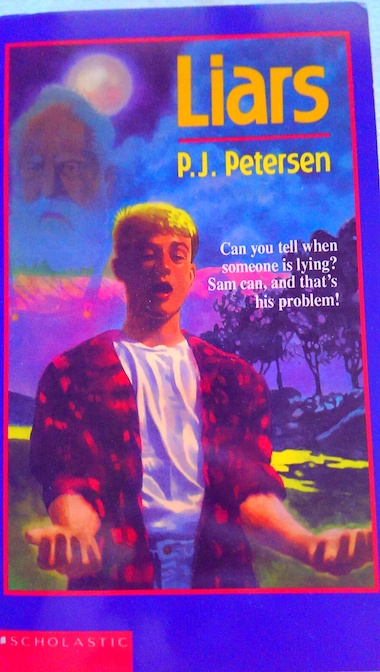
Liars

LiarsLiars by P.J. Petersen, 1992.

Sam lives in the small town of Alder Creek in California. The town is so small that they only have a one-room school (well, two rooms, if you count the library/storage room). Sam’s friend, Marty, describes most of what happens there as SOT (Same Old Thing) or MOTSOT (More of the Same Old Thing). However, their town contains some disturbing secrets, which they are about to learn.

Uncle Gene, an old man in town, has a reputation for being a “water witch.” He has the ability to find good sources of water when they need to dig a new well. He lets the local kids watch him when he’s using his dowsing stick and even lets Sam and Marty have a try. Sam has never really believed that Uncle Gene has any special abilities, even kidding Marty for believing in it. However, when Sam takes hold of the dowsing stick, he finds it drawn toward sources of water, like a magnet. Uncle Gene says that Sam has the gift and is a water witch, too. Sam is still somewhat skeptical, thinking that there’s probably something more scientific behind what he experienced, but from that time on, he finds himself sensing other odd things from the people around him.

In particular, Sam can sense when people around him are lying. It sounds like it would be a handy gift to have, but it has some drawbacks. Even when he can tell that someone isn’t telling the truth, he can’t tell exactly what they’re lying about. Some lies are obvious, like those of classmates bragging about things or Mr. Lopez saying that he enjoys living in the small town when, apparently, he really doesn’t. However, Sam can’t always distinguish between small lies or serious ones. Some lies seem to affect him more than others, possibly because the liars themselves feel more guilty about those, but by itself, that doesn’t tell him whether the lie is serious or not. He knows about Mr. Lawlor poaching animals in the forest, so that lie is also obvious to Sam, and he later realizes that his wife is lying about her teaching credentials. When he exposes Mrs. Lawlor’s lies, everyone becomes aware of Sam’s gift.

This ability becomes disturbing for Sam because it seems like everyone around him is lying about something. It’s also somewhat unsettling for some of his friends, like Carmen, who worries about what he’ll think of her if he catches her in a lie. Even Sam lies somewhat himself, saying that he knows that Carmen wouldn’t lie to him when he’s already caught her. But, Carmen sees right through his reassurance, even without sharing Sam’s gift. She’s the one who points out to him that the problem with his gift is that, even though he can tell when someone lies, he can’t tell exactly what they’re lying about or why they’re doing it. She mentions the little white lies people tell to spare someone’s feelings, like saying that they like a person’s clothes when they really don’t, but also how people sometimes lie when the truth is none of someone else’s business. The lie that Carmen told Sam earlier was about why the two of them couldn’t hang out together one day. She said that her parents were expecting company that evening, but the truth was that her parents have been fighting a lot, and she didn’t want Sam to see it because their personal problems are no business of his. This incident, along with a time when Sam has suspicions about an innocent person because the person falsely thought that she might actually be guilty of a crime lead Sam to worry even more about his gift.

However, there are real crimes being committed in his town, and Sam’s gift might be the only way to find who is behind it all. First, someone tries to break into Uncle Gene’s house. Uncle Gene thinks he knows why. Supposedly, there’s a hidden mine in the area, and he’s been looking for it for a long time. He thinks that he’s getting close and that someone was after his maps. Later, his house is set on fire.

But, is the lost mine the real reason why someone is after Uncle Gene? He’s been poking around in some out-of-the-way places during his search, and the kids know that he’s reported someone for growing illegal marijuana. Is the grower out for revenge? With Sam’s own father lying to him about his whereabouts, Sam worries that he may have something to do with what’s going on. It’s only a pity that his gift can’t tell him what his father, or anyone else, is lying about. It only tells him that they’re liars.

With more places making marijuana legally these days, this part of the story might not seem so serious as it did back in the 1990s, when schools were emphasizing that kids should “just say no” to drugs. Marijuana was viewed as being as bad as any other drug, and in this book, the grower doesn’t seem concerned about the possible medical uses.

Sam’s father is not the villain of the story, although he is engaged in something that he doesn’t want to reveal to his son or the rest of the town immediately. There is also a subplot about the death of Sam’s mother. She is already dead when the story begins, but Sam and his father haven’t completely healed. At the urging of Marty’s mother, who also helps Sam to explore his gift, the two of them begin talking about her more, when they had been avoiding discussing her for some time because talking about her was too sad for them.

In the end, Sam thinks that he’s found a way to stop sensing people’s lies (the less he pays attention to what he senses, the less he feels it, so he thinks that ignoring his gift will cause it to fade over time), which is a relief to him because he didn’t like always wondering what people were really lying about, and as Carmen said, some lies are for the best and should be none of his business. I think that’s true, especially the part about lying about things that should be no one else’s business. Some people can be rather pushy in wanting to know the details of other people’s lives, and if they won’t accept “I don’t feel like talking about it” or “I don’t want to tell you” for an answer, a lie of some sort might be a person’s only recourse. Depending on the circumstances, a lie might be harmful or it might protect. Like with Sam’s gift, it may not be immediately obvious which it is, either. Not that people should make a habit of lying, but there are times when it might be the best course of action for all concerned.

I’d like to add that there are many different ways of being truthful as well as lying.  If there are partial lies, and there are partial truths as well.  Some people think that politeness is a kind of lying, like in Carmen’s example of pretending that you like someone’s clothes when you really don’t, but that’s not necessarily so.  Being polite doesn’t mean that you’re pretending but perhaps you’re just choosing which of your thoughts are the most important to mention. Many, perhaps most of us, don’t just think one thing when someone asks us what we think about something.  For example, when someone asks your opinion of their clothes, you might think something like, “Well, I like the color, but I don’t like the style.  At least, I don’t like the way that style looks on you.  But, maybe that’s just because I’m not used to seeing you wear things like that.  I might change my mind later.  Actually, later on, I’ll probably forget that you ever wore that because I don’t care that much about clothes anyway.  Still a nice color, though.”  At least, that’s what goes on in my mind frequently.  There’s no point in telling anyone those random, meandering thoughts, so I just pick the most important part and tell them that I like the color.  Why bother being critical in an effort to sound truthful when the real truth of the matter is that clothes in general aren’t that important to me and I’ll probably just change my mind later, if it sticks in my mind long enough for me give it a second thought?

Then, there are the lies that some people label as the truth for their own purposes. I’ve seen plenty of people say harmful and insulting things to others and then hide behind the defense that they are “just telling it like it is,” when they actually aren’t. Usually, when people say that, they’re actually telling it like it isn’t: lies, exaggerations, or just plain insults disguised as truth. In those cases, their intentions were not to point out some important truth for the benefit of anyone.  Often, they were just trying to hurt someone’s feelings and then further hurt them by accusing them of not being able to handle the truth.  My rule of thumb for distinguishing between people who are really “telling it like it is” and liars who are just pretending is the same as the one I use with assessing advertisements: If a company has to shell out lots of money to tell you something about their product, it’s because what they’re saying isn’t something that you’d ever notice by actually using it.  If it were obviously true, there would be no need to put so much effort into telling you because you’d just know.  I think it’s the same with people who “tell it like it is.”  If someone has to actually say that they’re “telling it like it is,” it’s a strong hint that they’re probably not.  Similarly, anyone who brags about being truthful and trustworthy is probably doing it because they know that no one else would ever think to associate those qualities with them without being told.