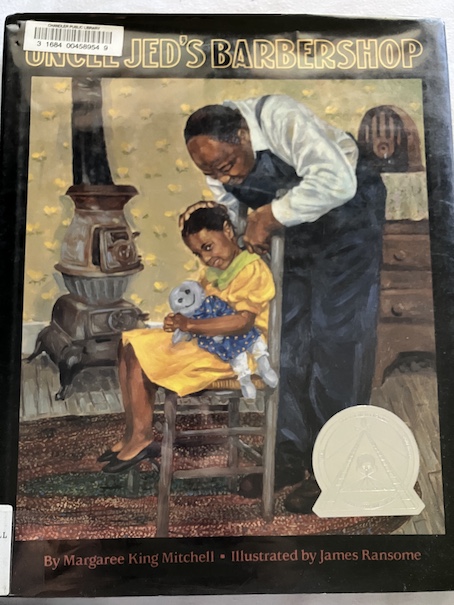
Uncle Jed’s Barbershop by Margaree King Mitchell, illustrated by James Ransome, 1993.
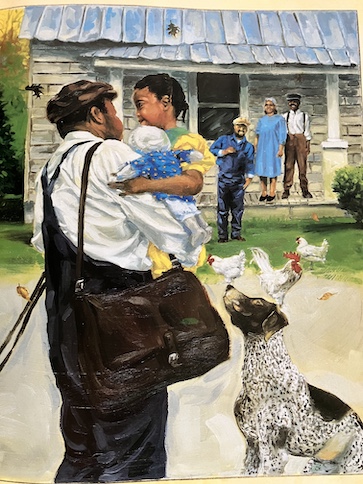
Sarah-Jean remembers her grandfather’s brother, Uncle Jed, and how he would travel to people’s houses to cut their hair during the 1920s and 1930s. He’s the only black barber in their area, so he cuts everybody’s hair in the black community. What he really wants is to own his own barbershop, with proper barbers’ chairs and equipment, but times are tough, and helping out his family means delaying his dream shop.
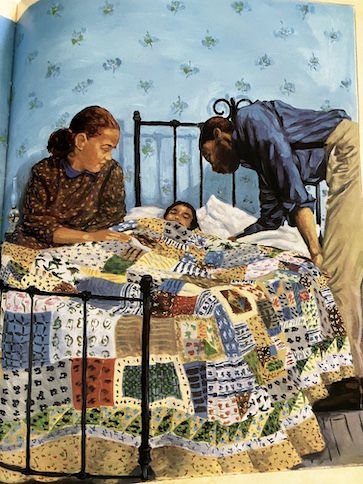
Everybody is poor in their town, so many people think Uncle Jed will never be able to get enough money to open a shop. However, even though things are tough and money is tight, Uncle Jed is willing to help out when he can. When little Sarah Jane develops a serious illness and needs an operation, Uncle Jed gives her father the money they need for her operation, saving her life.
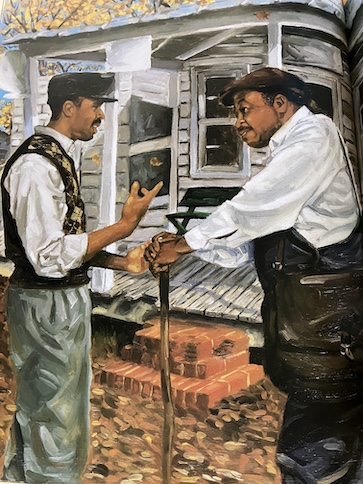
Later, Uncle Jed loses his savings when the bank fails during the Great Depression, so he has to start saving all over again. Even though he has it hard during the Great Depression, Uncle Jed still helps other people, sometimes cutting hair for customers who can’t afford to pay him because they’re even worse off. He takes payment in whatever form they can offer, like garden vegetables or eggs.
Eventually, things improve, and Uncle Jed is able to afford his barbershop, and everybody comes to the opening. He acquired his shop toward the end of his life, so he doesn’t have it for long before his death, but he was still happy because he accomplished his goal and did something people didn’t think he’d be able to accomplish.
The book received the Coretta Scott King Award.
My Reaction
I thought it was a nice story. The ending seemed a little sad, that Uncle Jed didn’t live very long after finally acquiring his shop, but the book has an optimistic tone. Although Uncle Jed accomplished his life goal toward the end of his life, he did get to accomplish it and enjoy it before he died. It’s less important how long he got to enjoy it than the fact that he did enjoy it.
It took a long time for Uncle Jed to accomplish his goal of having his own barbershop, but I think it’s important to note that he had a pretty good life along the way. Even though he lost his savings in a bank failure, he had steady work through the Great Depression, and he was also able to help friends and relatives when they needed it. He had good relationships with his family and neighbors because of his helpfulness and generosity, and everybody shows up to congratulate him when he finally opens his shop.
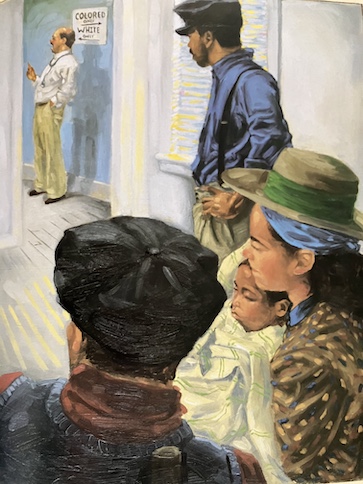
This story takes place in the South during times of segregation, which enters the story when Sarah Jane is ill and needs to go to the hospital. Although her condition is serious, not only is her family sent to a segregated waiting room, they also have to wait until all the white patients are tended to before the doctor will even see them. The doctor also insists upon payment before performing the operation she desperately needs, the implication being that the doctor will let her die if he doesn’t get paid up front to save her. Before anybody think that this is an exaggeration, that a doctor would refuse to treat a sick child or save her life because of her race, even during the Jim Crow era South, no, it’s not an exaggeration at all. It was routine:
“It’s absolutely incredible how little organized resistance there was,” says Theodore Marmor, emeritus professor of public policy at Yale University and a key health policy adviser during the Johnson administration.
Before the passage of Medicare and Medicaid, Smith says, the healthcare system was tightly segregated. Hospitals in the South complied with Jim Crow laws, excluding blacks from hospitals reserved for whites or providing basement accommodations for them.
“There were a lot of black communities in the South that had basically no access to hospitals,” says Smith. “Most of the black births in Mississippi were at home. The infant and maternal mortality rates were hugely different for blacks and whites because of that.”
The surgeon who developed the practice of blood storage and blood transfusions, Charles Drew, was also an African American who lived in the early to mid-20th century. He died relatively young of serious injuries from a car accident in North Carolina. There was a popular rumor, which was repeated on an episode of the tv show MASH, that he would have survived if he hadn’t been refused treatment at the hospital because he was African American. The reality is that doctors did try to save him, but his injuries were simply too serious for him to be saved. However, the rumor developed and persisted because the reality also is that hospitals of this time were known to turn away black patients. They had done it to others, so it was completely credible that they could have also done that to Dr. Charles Drew, even if they didn’t do it in this particular case. The fact that this rumor was completely believable and consistent with the practices of Jim Crow hospitals is an indication of their general behavior and conditions. With that in mind, it is also believable and credible that the doctor in the story would have refused to see a seriously ill black child until all white patients were seen and also that he would have refused her life-saving treatment until being paid.
However, rather than lamenting about the prejudices and inequities of this time period, the story focuses on Uncle Jed as one of the good people. The doctor and hospital in the story are not only prejudiced, but their behavior also contrasts with Uncle Jed, who is willing to put off payment or accept lesser or alternate forms of payment for people who need his services but are too poor to pay. The emphasis of the story isn’t on how bad other people or circumstances were so much as how Uncle Jed made things better for everyone as best he could. It meant some sacrifices on his part, putting off his own goals and dreams, but Uncle Jed enjoyed a good life and good relationships with other people along the way and accomplished his goals in the end.
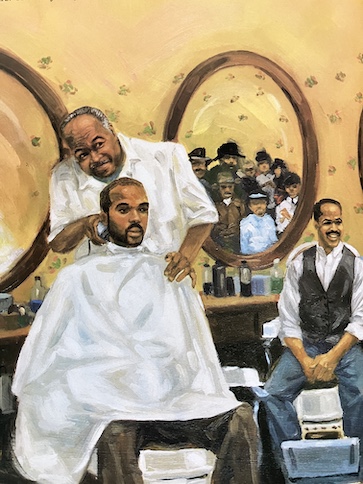
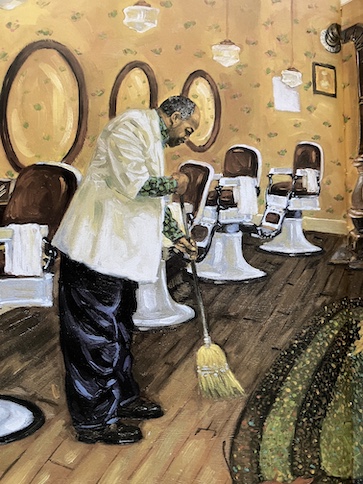
I also enjoyed the pictures in this story, showing the old-fashioned country and small town life in the early 20th century. The illustrator also did the illustrations for Aunt Flossie’s Hats (And Crab Cakes Later).
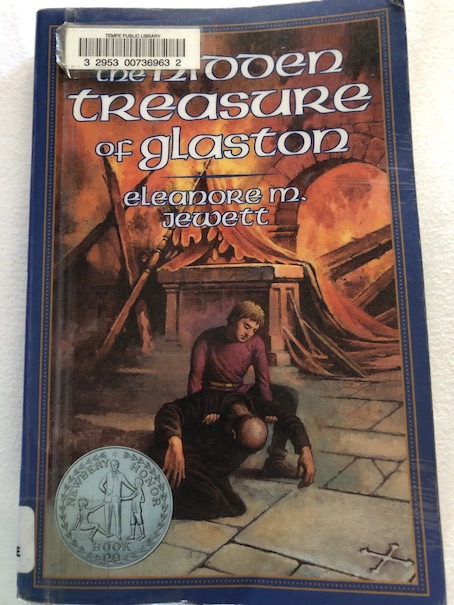
The Hidden Treasure of Glaston by Eleanore M. Jewett, 1946.
The
year is 1171. Twelve-year-old Hugh, a
somewhat frail boy with a lame leg, arrives at the abbey of Glastonbury with
his father on a stormy night. Hugh’s
father is a knight, and in his conversation with Abbot Robert on their arrival,
he makes it known that, although he loves his son, he is disappointed in the
boy’s frail condition because he can never be a fighter, like a knight’s son
should be. The abbot rebukes him, saying
that there is more to life than war and that he, himself, is also of noble
blood. The knight apologizes, and says
that, although it is not really the life that he would wish for his son, he asks
that the abbey take him in and educate him.
Although the knight (who refuses to give his name, only his son’s first
name) says that he cannot explain his circumstances, the abbot senses that the
knight is in trouble and is fleeing the area, perhaps the country of England
entirely.
It is
true that the knight is in trouble, and he is fleeing. Since Hugh’s health is delicate, his father
cannot take him along in his flight.
Realizing that the abbey will provide him with a safer life, Hugh’s
father wants to see him settled there before he leaves and gives the abbey a
handsome gift of expensive, well-crafted books as payment for his son’s
education. The abbot is thrilled by the
gift, although he says that they would have accepted Hugh even without it. Then, the knight leaves, and the monks begin
helping Hugh to get settled in the abbey.
Hugh is upset at his father’s leaving and the upheaval to the life he has always known, although he knows that it is for the best because of his family’s circumstances. Although the story doesn’t explicitly say it at first, Hugh’s father is one of the knights who killed Thomas Becket, believing that by doing so, they were following the king’s wishes. Hugh’s father did not actually kill Beckett himself, but he did help to hold back the crowd that tried to save Beckett while others struck the blows, so he shares in the guilt of the group. Although Hugh loves his father, he knows that his father is an impulsive hothead. Now, because of the murder, Hugh’s father is a hunted man. By extension, every member of his household is also considered a criminal. Their family home was burned by an angry mob, their supporters have fled, and there is no way that Hugh’s father can stay in England. However, the prospect of life at the abbey, even under these bleak circumstances, has some appeal for Hugh.
Hugh has felt his father’s disappointment in him for a long time because his leg has been bad since he was small, and he was never able to participate in the rough training in the martial arts that a knight should have. Even though part of Hugh wishes that he could be tough and strong and become the prestigious and admired knight that his father wishes he could be, deep down, Hugh knows that it isn’t really his nature and that his damaged leg would make it impossible. Hugh really prefers the reading lessons he had with his mother’s clerk before his mother died. His father always scorned book learning because he thought that it was unmanly, something only for weak people, and Hugh’s weakness troubles him. Hugh’s father thinks that the real business of men is war, fighting, and being tough. However, at the abbey, there are plenty of men who spend their lives loving books, reading, art, music, and peace, and no one looks on them scornfully. For the first time in Hugh’s life, he has the chance to live as he really wants to, doing something that he loves where the weakness of his bad leg won’t interfere.
The abbot is pleased that Hugh has been taught to read and arranges for him to be trained as a scribe under the supervision of Brother John. Hugh enjoys his training, although parts are a little dull and repetitive. Hugh confides something of his troubles in Brother John, who listens to the boy with patience and understanding. Although he does not initially know what Hugh’s father has done, Hugh tells his about the burning of his family’s home, how they struggled to save the books that they have now gifted to the abbey, and how there were more in their library that they were unable to save. Hugh tells Brother John how much he hates the people who burned their home and how much he hates the king, who caused the whole problem in the first place. His father would never have done what he did if the king hadn’t said what he said about Thomas Becket, leading his knights to believe that they were obeying an order from their king. Brother John warns Hugh not to say too much about hating the king because that is too close to treason and tells him that, even though he has justification for hating those who destroyed his home, he will not find comfort in harboring hate in his heart. He also says that not all that Hugh has lost is gone forever. People who have left Hugh’s life, like his father, may return, and there are also many other people and things to love in the world that will fill Hugh’s life. Brother John urges Hugh to forget the past and enjoy what he has now. When Hugh says how he loves books but also wishes that he was able to go adventuring, Brother John says that adventures have a way of finding people, even when they do not go looking for them.
One
day, when Brother John sends Hugh out to fish for eels, Hugh meets another boy
who also belongs to the abbey, Dickon.
Dickon is an oblate. He is the
son of a poor man who gave him to the abbey when he was still an infant because
he was spared from the plague and wanted to give thanks to God for it. Dickon really wishes that he could go
adventuring, like Hugh sometimes wishes, although he doesn’t really mind life
at the abbey. Because Dickon is not good
at reading or singing, he helps with the animals on the abbey’s farm. Although he is sometimes treated strictly and
punished physically, he also has a fair amount of freedom on the farm,
sometimes sneaking off to go hunting or fishing. He also goes hunting for holy relics. Dickon tells Hugh about the saints who have
lived or stayed at the abbey and how the place is now known for miracles. He is sure that the miracles of Glaston will
help heal Hugh’s leg, and he offers to take him hunting for holy relics. Hugh wants to be friends with Dickon, but at
first, Dickon is offended that Hugh will not tell him what his last name
is. Dickon soon realizes the reason for
Hugh’s secrecy when a servant from Hugh’s home, Jacques, comes to the abbey to
seek sanctuary from an angry mob that knows of his association with Hugh’s
father.
The abbot
grants Jacques temporary sanctuary but tells him that he should leave the country
soon. When Dickon witnesses Jacques’s
explanation of why the mob was after him, comes to understand his connection to
Hugh. Although the mob does not know
that Hugh is actually connected to Jacques, Dickon spots the connection and
tells Hugh that he forgives his earlier secrecy. Dickon even helps Jacques to leave the abbey
the next day, in secret.
Now
that Dickon knows Hugh’s secret, he lets Hugh in on his secrets and the secrets
of the abbey itself. He shows Hugh a
secret tunnel that he has discovered.
There is an underground chamber between the abbey and the sea where more
parchments and some other precious objects are hidden. Dickon doesn’t know the significance of all
of the objects, although there appear to be holy relics among them. Dickon’s theory was that monks in the past
created this room and tunnel to store their most precious treasures and get
them away to safety in case the abbey was attacked and raided. At some point, part of the tunnel must have
collapsed, blocking the part of the tunnel leading to the abbey. The boys are frightened away when they hear
the ringing of a bell and can’t tell where it’s coming from. Could there have been someone in a part of
the tunnel that is now blocked off from the part where they entered?
Since Hugh is sworn to secrecy concerning Dickon’s discovery, he can’t ask Brother John about it directly, but he gets the chance to learn a little more when Brother John asks him to help clean some old parchments so they can reuse them. Most of them are just old accounting sheets for the abbey that they no longer need. Brother John said that they were stored in an old room under the abbey. Hugh asks Brother John about the room and whether there are other such storage rooms underground. Brother John says that there are rumors about a hidden chamber somewhere between the abbey and the sea where they used to store important objects for safety, but as far as he knows, no living person knows where it is or even if it still exists. Hugh asks Brother John about treasures, but as far as Brother John is concerned, the real treasures of the abbey are spiritual. However, when Hugh notices some strange writing on one of the parchment pieces that doesn’t look like accounting reports and calls it to Brother John’s attention, Brother John becomes very excited and orders him to stop cleaning the parchments so that he can check for more of the same writing. Among the other scrap parchments, they have found pieces that refer to Joseph of Arimathea, who provided the tomb for Jesus after his crucifixion. According to legend, Joseph of Arimathea also took possession of the Holy Grail, the cup that Jesus used at the Last Supper, which was supposed to have special powers, and that he left the Middle East and brought the Holy Grail to Glaston, where it still remains hidden. This story is connected to the legends of King Arthur, who also supposedly sought the Holy Grail. The parchments may contain clues to the truth of the story and where the Holy Grail may be hidden.
This story combines history and legend as Hugh and Dickon unravel the mysteries of Glastonbury and change their lives and destinies forever. Although Hugh and Dickon both talk about how exciting it would be to travel and go on adventures, between them, Hugh is the one whose father would most want and expect his son to follow him on adventures and Dickon is the one who is promised to the abbey. However, Hugh loves the life of the abbey and serious study, and Dickon is a healthy boy who is often restless. Their friendship and shared adventures at the abbey help both Dickon and Hugh to realize more about who they are, the kind of men they want to be, and where they belong. Wherever their lives lead them from this point, they will always be brothers.
There are notes in the back of the book about the historical basis for the story. In the book, the monks find the tomb of King Arthur and Guinevere. Although the story in the book is fictional, the real life monks of Glastonbury also claimed to find the tomb of King Arthur. The bones they claimed to find were lost when the abbey was destroyed later on the orders of Henry VIII, but this documentary (link repaired 2-27-23) explains more about the legends and history of King Arthur. The part about Glastonbury is near the end.
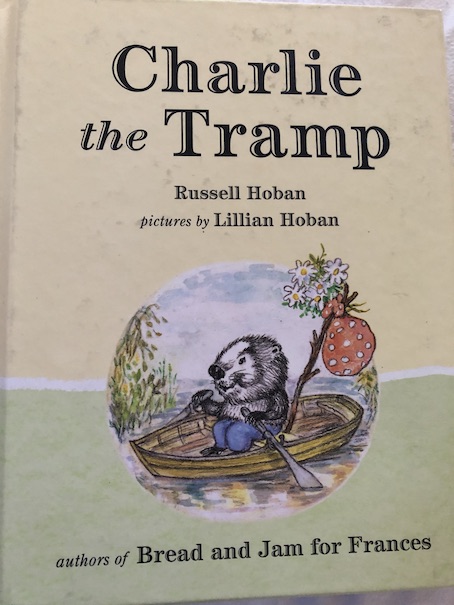
Charlie the Tramp by Russell Hoban, illustrated by Lillian Hoban, 1966.
Disclosure: I am using a newer edition of the book, published by Plough Publishing House. Plough sent a copy to me for review purposes, but the opinions in the review are my own.
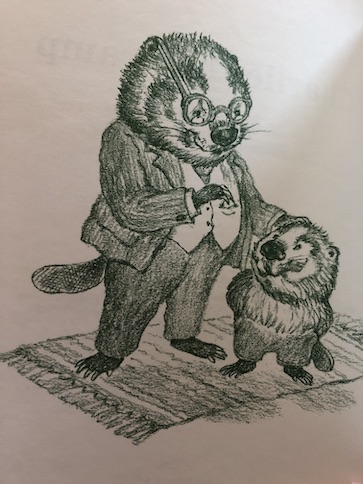
One day, when Charlie Beaver’s grandfather comes to visit, his grandfather asks him what he wants to be when he grows up. The grandfather assumes that he knows the answer to the question because everyone in the family is a beaver, and beavers naturally do beaver work. (Beaver is apparently both species and profession in books where beavers talk and wear clothes.) However, Charlie stuns his family when he declares that he wants to be a tramp.
Few families would be happy to hear a child say that he wants to be a tramp. Charlie’s grandfather says that he’s never heard a child want to be tramp, and his mother says that she doesn’t think he means it. However, Charlie thinks that being a tramp would be good because he wouldn’t have to learn how to chop trees or build dams or other routine jobs. Charlie thinks that tramps have a lot of fun and just work now and then at little jobs when they need something to eat. Charlie thinks that the little jobs would be much more fun than the ones his father really wants him to do. Charlie’s grandfather says that kids these days just don’t want to work hard.
However, Charlie’s parents decide that if he wants to be a tramp, they’ll let him try it out. Charlie makes himself a little bundle with some food, and his parents let him sleep outside, telling him to come back for breakfast. Both the father and grandfather quietly admit that they both wanted to be a tramp when they were his age, so it’s not just kids these days.
Charlie has some fun, roaming the countryside, sleeping under the stars, and enjoying his freedom. In the morning, he comes home and does some chores to earn his breakfast, lunch, and dinner. In between, he goes out to roam the countryside again.
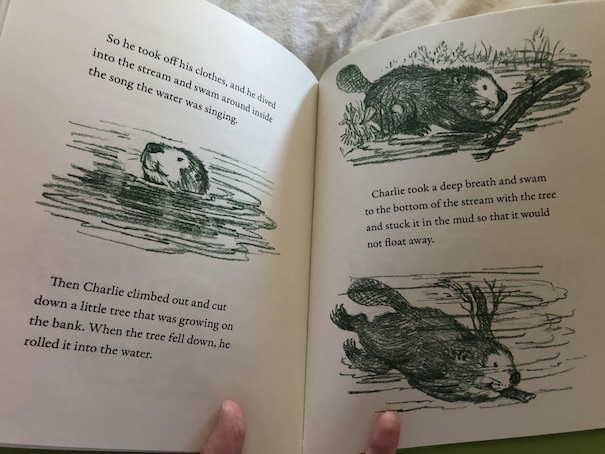
Charlie begins to notice that something keeps waking him up in the night, an odd sound that he can’t identify at first. Eventually, he realizes that it’s the sound of a nearby stream. For some reason, the trickling sound of the stream seems nice but makes him feel restless. It inspires him to swim in the stream and begin building his own dam, working through the night.
When Charlie sleeps through breakfast, his family comes looking for him and admires the good job that Charlie did on his dam and the pond that he has created. When they ask him about why he was making a dam when he was trying to be a tramp, Charlie says that he likes doing both and can do either sometimes. His family is satisfied that Charlie is a good worker, and his grandfather says, “That’s how it is nowadays. You never know when a tramp will turn out to be a beaver.”
It isn’t that Charlie expects to go through life without doing work because he insisted on working to earn his meals even when he was being a tramp. It was more that Charlie wanted the freedom to decide when he wanted to work and what kind of work he was going to do. However, he is a beaver and has a beaver’s instincts. In the end, he sees the appeal of doing a beaver’s work, building dams, enjoying it because he made the dam himself in the way he wanted to make it. I think it shows that when a person has the knowledge and ability to do something and the interest in doing it, they will eventually use their skills, perhaps in surprising ways. I remember reading some advice to writers that said that people write because “they can’t not do it,” and that’s true of many aspirations in life. Sometimes, when people know what they really want to do with their lives, they can’t resist doing it, and sometimes, people realize what their aspirations are when they find something that they can’t resist doing. Charlie is a beaver because it’s a part of who he is, and he can’t not do it. As he grows up, he will continue growing into that role, just as human children eventually grow up to be the people they are going to be.
This book is available to borrow for free online through Internet Archive, but it’s also back in print and available for purchase through Plough. If you borrow the book and like it, consider buying a copy of your own!
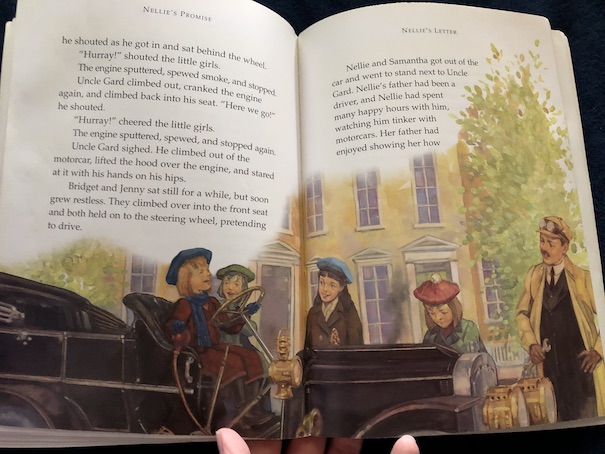
This book is a companion book to the Samantha, An American Girl series, focusing on Samantha’s best friend, Nellie. Personally, I don’t like the companion books to the main American Girls books as well as the original books, but this book does follow up on the events to the main series. At the end of Samantha’s series, Samantha’s aunt and uncle took in Nellie and her sisters, Bridget and Jenny, after their parents died. Nellie and her sisters were from a poor family and had to start working from a young age before their parents died. After their parents died, their disreputable uncle abandoned them, and they were sent to an orphanage before Samantha discovered where they were. Samantha’s aunt and uncle are wealthy, and the girls’ lives have improved considerably.
Nellie’s happiness is threatened by the sudden reappearance of her Uncle Mike. Uncle Mike sees Nellie walking down the street in her nice new clothes and wants to know what rich family the girls are living with. Nellie runs away from him, but he threatens to find out where she’s living and to take her and her sisters back, saying that it’s his right as her uncle. He says that he means to put the girls to work earning money for him. Nellie is afraid that he might be able to reclaim them from Uncle Gard and Aunt Cornelia because he is a blood relative.
At first, Nellie is afraid to tell anyone that she’s seen her uncle and that he threatened to take her and her sisters back. Before her parents died, her mother made her promise to look after her younger sisters, so Nellie makes up her mind that’s what she’s going to do.
Nellie worries about the future for her and her sisters. She feels like she doesn’t fit in with the wealthy girls at Samantha’s school, who have had very different lives from hers, and the lessons they learn are the type of lessons for fine young ladies who will marry rich men and spend most of their time raising families, overseeing a house with servants, and entertaining friends and their husbands’ business associates, not preparing for practical professions outside the home. Nellie thinks that it’s important that she have some kind of job skills because the future can be very uncertain, and she wants to know that she can provide for her sisters, no matter what happens.
Samantha senses that Nellie is unhappy, and she asks her if she likes living with Uncle Gard and Aunt Cornelia. Nellie tells her that she does, but she hesitates to explain what’s really worrying her. Instead, she lets Samantha think that she just wants to feel like she’s doing something useful for the family. Before her parents died, Nellie used to get sewing lessons at a settlement house (a place where immigrant families could go to learn English, new job skills, and other skills they would need in their new lives in the United States) run by Miss Brennan. Aunt Cornelia is involved with many good causes, and she wants to visit a settlement house and get an introduction to Miss Brennan. Because Nellie knows Miss Brennan, she can help arrange that. It’s in a rough part of town, but Nellie is more accustomed to navigating rough neighborhoods than Samantha or her aunt. It also occurs to Nellie that she could ask Miss Brennan what to do about Uncle Mike.
Miss Brennan is glad to see Nellie, and she lets her show Aunt Cornelia and Samantha around the settlement house. They have many different types of classes for children as well as adults. Nellie says that she likes the practical classes that she used to have there, and even the types of dances that they do seem more practical than the more purely artistic ones that they do at the school she now attends with Samantha. Aunt Cornelia is pleased with the classes that they offer for women, and because she is interested in women’s education, decides that she wants to help out at the settlement house. However, the visit to the settlement house leaves Samantha irritated for reasons that Nellie doesn’t fully understand.
As Nellie begins spending more time with Aunt Cornelia at the settlement house, Samantha begins spending more time with Bridget and Jenny, and Nellie becomes jealous of how Samantha seems more like their older sister than she is. However, the others still don’t know about Uncle Mike’s reappearance, and Nellie is still fearful of what he might do and what will happen to her and her sisters if Uncle Mike tries to take them away. She feels like her only option is to try to prepare herself for a better job than that of factory worker.
When Nellie finally gets the courage to tell Miss Brennan about her worries, Miss Brennan tells her that she needs to discuss the situation with Uncle Gard. Uncle Gard is a good man, but he’s also a lawyer, and he will know how to legally stop Uncle Mike from trying to take custody of the girls. However, Miss Brennan adds that, whatever else happens, Nellie will still need to make some decisions about her future and what she wants to do with her life and education. The more Nellie thinks about it, the more certain she is about what she wants to do. She wants to become a teacher, like Miss Brennan.
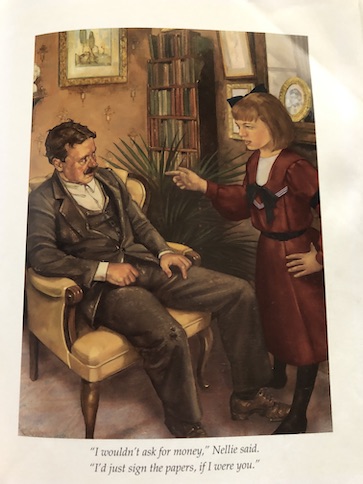
Nellie provokes more drama by applying to the boarding school in Boston where Miss Brennan said that she trained to be a teacher without talking to Aunt Cornelia, Uncle Gard, or Samantha about her decision or about her uncle. However, when the truth comes out about Uncle Mike, everyone understands that she was trying to hide and protect her sisters from him. It turns out that Uncle Gard has actually been looking for Uncle Mike because he already has the documents that he needs to legally adopt Nellie, Bridget, and Jenny, and he just needs Uncle Mike to legally release them into his custody. At first, Uncle Mike tries to extort money from Uncle Gard for the girls, but Nellie gets up the courage to tell him off, promising that if he doesn’t sign the papers and leave, she’ll tell everyone about how he stole all of their money and abandoned them to freeze the last time they were in his custody. The book ends happily, with Aunt Cornelia and Uncle Gard adopting the girls and understanding Nellie’s ambition to be a teacher. They enroll Nellie in a school in New York that teaches the skills she really wants so that she can continue living with them and not go to Boston. It also turns out that Samantha was mostly uncomfortable at the settlement house because she felt so sorry for the young children there and that spending time taking care of Bridget and Jenny was part of her way of trying to help Nellie by leaving her more free to do some of the things that she felt like she had to do. With everything out in the open, Nellie and her sisters are able to more fully become part of the family.
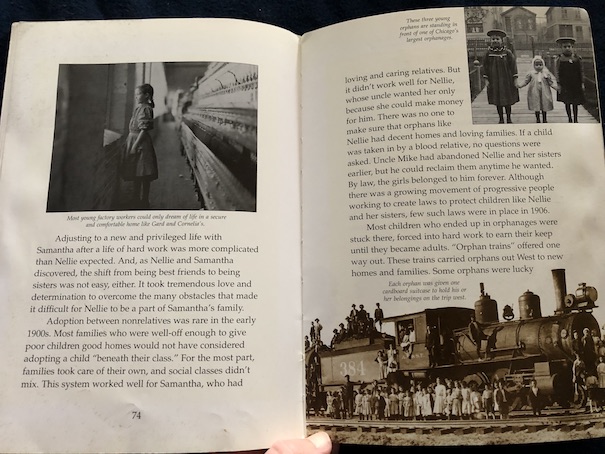
In the back of the book, there is a section with historical information about orphans and adoption in the early 1900s. There were not many laws and regulations governing care of orphans. Usually, orphans would be taken in by relatives, like Samantha was when her parents died. If a child didn’t have any relatives who were willing and able to take them, the child might be sent to an orphanage and possibly sent west on an orphan train as Nellie almost was at the end of the Samantha series. Families didn’t usually adopt children from different levels of society.
Settlement houses were important resources for poor immigrant families, and the education they received allowed immigrants to enter higher professions than servant or factory worker, which had been the primary source of income for many of them. It was common for settlement houses to help train young women to become teachers. There are still similar institutions and organizations in operation in 21st century America.
The book is available to borrow for free online through Internet Archive.
My Reaction and Further Historical Information
Part of the reason why I don’t like the companion books as much as the original American Girls series is that they tend to get more dramatic than the original books, and sometimes, I feel like the attitudes of the characters are less realistic for their time periods than they were in the original books. I think what made the original books more realistic was the restraint of the stories – they had their share of excitement and sometimes drama, but they never went overboard. The return of Nellie’s disreputable uncle struck me as both unlikely and unnecessary to Nellie’s and Samantha’s larger stories.
The historical details in this book are good. What they say about orphans of the time is basically true, although they note in the historical information section in the back of the book that Nellie’s experience of being adopted by a wealthier family was not typical of the time, and I think that’s part of what bothers me. Adoptions in general during the early 1900s were less formal than they are in modern times, and the idea of Uncle Gard hiring a private detective to find Uncle Mike and get him to sign legal documents doesn’t seem entirely realistic. I think it would have been more realistic to me the way that the last Samantha book ended, with Uncle Mike leaving and the assumption that none of the characters would see him again.
The reason why Nellie and her sisters were sent to the orphanage and why the orphanage was considering sending Nellie west on the orphan train was that no one expected that Uncle Mike would ever want to see the girls again. He’d already taken everything he could from them and left with them with no concern for what would happen to them. In the time that has passed since then, I would have expected that Uncle Mike would already have gotten into trouble that would keep him busy and out of their lives, maybe ended up in prison for being drunk and disorderly or hopping from job to job or begging for money as their little money ran out. Even if Uncle Mike had some thought of finding the girls, I don’t think it’s likely that he would have succeeded or even gotten close on his own because he is not that bright and he is not the kind of person who makes friends in places where he’s been before. I doubt that his former neighbor who took his nieces to the orphanage would have told him much if he had shown up again, looking for them. She knew that he was a drunk who abandoned the girls, and she made it clear that she didn’t like him. The people at the orphanage would have probably sent him away with no information because they would probably view the situation as closed since the girls are already placed out and Mike may not even have any proof of his identity and relationship to the girls. There is no such thing as a driver’s license during this period and many people did not even have birth certificates, so it’s possible that the people at the orphanage could simply choose to disbelieve this disreputable character and send him away. When I was watching a documentary about the orphan trains, former orphan train riders said that the orphanages that sent them west deliberately took notes from them that had their living parents’ addresses and otherwise cut off contact with living parents because they wanted the children to sever their ties to their difficult pasts and devote their attention to their new families, not maintain contact with the parents who were unable to care for them financially, so I wouldn’t expect that anyone at the orphanage in these books would go out of their way to reunite the orphaned girls with a rather shady uncle when they knew that the girls were already placed with a wealthy family and no longer their responsibility. Without help, which would be unlikely to be forthcoming, it doesn’t seem likely that Uncle Mike would be able to stumble on the girls by accident. As mentioned in Changes for Samantha, New York is a big city, people can be difficult to find if you don’t have a hint of where to look, and the wealthier part of the city where Nellie and her sisters live now is not a part of town where a guy like Uncle Mike would be likely to hang out. They could all easily live in New York City for years without meeting each other.
I feel like the situations in the story were a little contrived. By now, I would have thought that Nellie would know that Uncle Gard is a lawyer and would be the best person to ask about the laws. I don’t recall the earlier books saying what Uncle Gard did for a living, but Nellie lives with him now, and I would think that someone would have mentioned Uncle Gard’s profession by now. In the book, it oddly seems like as much of a surprise to Nellie as it is to the readers. I could believe that Nellie would go to the settlement house and do volunteer work there with Aunt Cornelia because it was already established in the previous books that Aunt Cornelia supports good causes, and although women of her level of society didn’t usually work for living, supporting good causes and charitable works would have been acceptable. Nellie’s level of knowledge seems a little odd, considering that she needed extra tutoring in basic subjects, like reading, in Samantha Learns a Lesson. In that book, Nellie never mentioned settlement house lessons, which she would have done if it hadn’t been a sudden decision to insert that this in book. Here, Nellie talks about classes that she had at the settlement house, where I would have expected to have more lessons to improve her reading, and it seems like she learned more there than she seemed to know before, even knowing a few words of foreign languages. In Samantha Learns a Lesson, one of Nellie’s skills was her ability to do math quickly handle money because she used to do the shopping for her mother, and in this book, she mentions that she helped to teach immigrants about American money, which she never mentioned before. These things are necessarily contradictory, but it all just seems a little off because they don’t quite fit into Nellie’s established character and history, and it implies that Nellie has had more education and training than she seemed to have before. It’s not necessarily impossible for a girl of Nellie’s time to know some of these things, but it’s the departure from what was already established about Nellie and her situation in life than kind of grates on me.
I think it could be reasonable for Nellie to develop the ambition to be a teacher. Even Samantha has previously some interest in that direction, having helped to tutor Nellie before. Not all women of this time went on to higher education, but those who did might attend a normal school, which is basically a college that focuses on training teachers. By contrast, the daughters of wealthy, high society families would be more likely attend a finishing school that emphasized social skills and entertaining more than academics. Both Samantha and Nellie are about twelve years old during this story and would be a little young for either of these options, but Samantha’s school seems to be more inclined toward preparing the girls for a finishing school. Given Aunt Cornelia’s interest in education and social causes and Uncle Gard’s support of it, I would expect that Samantha would be more likely to attend a women’s liberal arts college when she gets older, preparing her to marry a well-educated and culturally aware man as well as a wealthy one and probably engage in some form of social work and/or the arts in her spare time, but that’s just a guess. (I discussed some of this already in my review of Happy Birthday, Samantha. See also the book Daddy-Long-Legs for a description of what that might have been like for a girl of Samantha’s and Nellie’s time. The book was written a little later in than the time period of this book, but it’s set at about the right time for Samantha and Nellie to be old enough for college and includes characters of approximately their social backgrounds.) This book doesn’t really go into the subject, but if that’s the case, Samantha’s future might not be as different from Nellie’s as it first seems, and there might be a kind of middle path that both of them could choose. The Finch College in Manhattan, which was a fairly new preparatory school in Samantha’s and Nellie’s time, seems like it would have been a good option for both Samantha and Nellie, catering to upper-class girls while focusing on a more practical liberal arts education than the less academic finishing schools. Its founder, Jessica Finch, was a women’s rights activist and may have moved in similar circles to Aunt Cornelia. Her attempts to balance theoretical and practical knowledge sound like they would have appealed to the characters in the story. I’m not an expert on the Finch College, only having heard a little about it, but I think a school like that would present an intriguing possibility for the girls’ futures.
Sawdust in his Shoes by Eloise Jarvis McGraw, 1950, 1977.
Disclosure: I am using a newer edition of the book, published by Plough Publishing House. Plough sent a copy to me for review purposes, but the opinions in the review are my own.
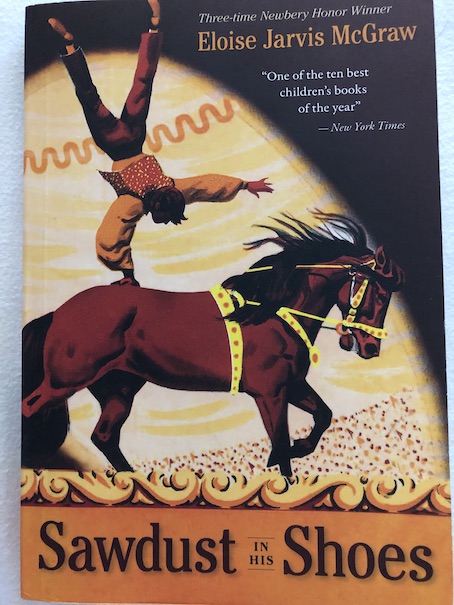
At fifteen years old, Joe Lang is a rising star in the circus, a trick rider. Circus life is the only life he’s ever known because his father is a lion tamer. Many of the children whose parents work for the circus also work for the circus, competing for the spotlight and top billing, and Joe loves that type of life, even though it means hard training, an element of risk, and constantly moving.
Unfortunately, things change for Joe when his father is killed during an accident in one of his performances. (Mercifully, the accident is not described in the book. Joe does not witness his father’s death. In the story, he hears screams from the circus patrons and is shortly informed that his father has been killed.) Because Joe is still only fifteen, his father’s death raises the question of who will have custody of Joe. Joe’s mother is dead, and his stepmother, who did not grow up with the circus herself, was never fond of circus life or of Joe. After the death of Joe’s father, his stepmother leaves to go live with her sister, and Joe never hears from her again. Mo Shapely, an older man who works for the circus as a clown, wants to assume responsibility for Joe, and Joe would be happy with that because Mo is an old family friend who helped raise and train him. However, the local authorities are not convinced that Mo is a suitable guardian for the boy because of his age, his unsettled lifestyle, and lack of savings.
Mo waits in town with Joe while the authorities make up their minds, but they soon run short of money, and Mo is forced to catch up with the circus and return to his job. Since Joe’s guardianship is still unsettled, the authorities send him to the County Industrial School for Boys, where he will stay until Judge Reynolds has completed his inquiries into Mo’s background. The boarding school offers vocational training, but Joe finds the place dull and bleak and the people unfriendly. When the other boys find out that he used to be with the circus, they are envious and tease him, and even the teacher mocks him. Only one boy tries to be friendly with him, and Joe asks him if any boys ever escape from the school. The boy tells him that some have tried, but no one has succeeded. However, Joe realizes that he just can’t stand life at the school, and all he wants to do is run away and try to rejoin the circus.
When Joe runs away from the school, he cuts across some farmland, loses his way, and ends up getting caught on some barbed wire, where he is found by the Dawson family. The Dawsons treat his wound, and Joe despairs, realizing that he has gone the wrong way and that he has no chance to catch up with the circus before they move on. The Dawsons ask Joe what his name is and offer to help him get home, but Joe is reluctant to tell them the full truth because he doesn’t want to be sent back to the horrible school. Instead, he tells them that he has no home or parents but that he’s worked before, since he was young, and that he hopes to find a job when he’s recovered from his wounds and exhaustion. The Dawsons are concerned about Joe and curious about his mysterious past and vague answers, but Mr. Dawson decides to offer Joe a position as farm hand. Joe is surprised at the offer and a little suspicious, and he asks Mr. Dawson why he’s so willing to take in a perfect stranger. Mr. Dawson answers him in an equally vague way, saying that if Joe really feels like he needs to steal their silver, he must need it more than they do, and he’s welcome to it. Joe decides to accept Mr. Dawson’s offer of employment.
Joe isn’t used to farm work, but he’s strong from his work with the circus (Mr. Dawson had noticed his athletic build), and he is good with horses and other animals. Although Mrs. Dawson is concerned that they know so little about Joe or his background, Mr. Dawson tells his family to allow Joe to have his privacy and not question him too much about his past. Still, Joe can’t resist showing off and trying one of his old tricks on horseback one day, accidentally making his injury worse because it isn’t healed yet. He begins to worry that the injury might be bad enough that he’ll never be able to be a trick rider again. By the time he has fully recovered, he is also long out of practice.
Eventually, Joe’s secrets are exposed, and he must make some choices about his future. Although Joe had lived many different places when he traveled with the circus, living on the Dawsons’ farm provides him with new experiences and broadens his horizons in unexpected ways. He had never had much respect for non-circus people before (partly because of his bad experiences with his non-circus stepmother). He still dislikes some of the Dawsons’ neighbors for their unfriendliness and suspicious toward him, but the Dawsons themselves are very different from most of the people Joe has met before. Joe comes to realize that he has not forgotten everything that he learned from his old life and that he can apply his old skills in new ways. He even starts to consider that there are more ways of living than he had previously thought, and he begins to see the appeal of non-circus life. Still, the circus is what he always loved first, and he feels torn between what he’s always wanted and the people who have loved and supported him when he needed it the most.
Children today probably don’t look at the circus in the same way as past generations. Some of the larger, mainstay circuses, like Ringling Brothers and Barnum and Bailey, have closed. People make jokes about how scary clowns are, and animal acts aren’t considered humane to the animals. Circuses still exist in the early 21st century, but they’re not quite what they used to be, and they aren’t looked at in quite the same way. Even when I was a young child, in the 1980s and early 1990s, I wasn’t particularly wild about the circus. A large part of that is temperament. I’m not fond of loud noises or large crowds, and I tend to avoid places where there are both. I’m very different from my grandmother, who absolutely loved circuses and parades and excitement of all kinds, dragging her children with her, even when they didn’t always feel like going. In my grandmother’s youth (1910s and early 1920s), there were few things more exciting than a circus coming to town!
However, this story isn’t just about love of circuses or a look back on the forms of entertainment that people used to enjoy. There’s always some nostalgia of that type to vintage books, but this book is about more than that. This is about a person finding his way in life and facing an unpredictable future, who has to decide what’s really important to him. I’m sometimes fascinated by people who seem to know what they want to do in life from an early age. They are born to parents with a profession they want to follow or who have connections to a profession they want to follow, and they start training very early for something they truly love. At first, that seems to be Joe’s situation in life. He loves the circus, he was born into that kind of life, he gets that early training, and there’s nothing else he would rather do. Some people like that become early success stories, just being lucky enough to be born in the right place and with the right connections for the life they want to live, and it all looks like smooth sailing. Most people aren’t that lucky, though, and even for people who think they know what they want, life has a way of throwing a monkey-wrench into their plans. That is what this story is really about.
Joe’s life abruptly changes when his father dies and his guardianship remains in limbo. Things often happen in our lives that we can’t fully control, taking us down paths we never thought that we’d travel. There are times when many of us start to question what we really want out of life, whether our first choices were really the best ones, or if there’s something else that we really want. Sometimes, these unexpected detours make us feel like we’re headed for a dead end, like when Joe fears that he has lost his skill and he’ll never live the life he once dreamed he would. However, sometimes, these things are just a temporary bend in the road. In some ways, an adult who has been through this sort of process would understand it better, but even children know what it is to have a dream and not know whether or not it will become reality.
Children need time to discover and develop their talents, and, as they grow and step into the wider world, they routinely discover that they have to make other decisions that they knew nothing about before. Children also know what it’s like to be at the mercy of adults who can either help guide them on their way or who stand as an obstacle to their dreams and efforts, like the judge who takes so long to decide what he thinks is best for Joe that Joe feels he must take his fortune into his own hands. Right up until the very end, Joe’s ultimate choice remains uncertain as readers wonder what he’s really going to decide to do and what his destiny is going to be. At first, Joe seems like he’s in a bad situation, with limited options, but his experiences show him that his options in life are broader than he thinks. It seems like saying yes to one of the choices confronting him means saying no to something else he cares about, but even that isn’t as straight-forward as it seems. I think this is one of those timeless books that can appeal to all ages because what it’s really about is a person finding his way in life and discovering that a difficult, unpredictable path may be just the path he needs to take.
In the end, it’s not just about what Joe chooses or where he ends up; it’s about what he does along the way. When Joe runs away from the school, he is the one who is injured and in need of help, but he also has a positive impact on the people who were kind enough to help him when he needed it. In fact, there are some situations that would have turned out much worse for everyone if Joe hadn’t been there and been able to help. Joe’s unexpected detour in life changed everyone else’s lives as well, and it was well worth doing, in spite of the struggle.
This book is available to borrow for free online through Internet Archive, but it’s also back in print and available for purchase through Plough. If you borrow the book and like it, consider buying a copy of your own!
The year is 1925, and what 14-year-old Ida Bidson wants most is to graduate from her community’s small, one-room schoolhouse so that she can go to high school in a nearby city. She dreams of becoming a teacher when she grows up, and she knows that she can’t do that without more education. The problem is that, in her rural community in Colorado, not everyone thinks that higher education is important, especially for girls.
When their teacher’s mother becomes ill toward the end of the school year and the teacher has to leave, the man in charge of the local school board, Mr. Jordan, doesn’t want to bother to hire a new teacher to finish off the year. In fact, it seems a little dubious about whether they’ll even get a new teacher in the fall. Ida is crushed because, without a teacher, she can’t graduate this year as planned, and she had just about persuaded her parents to let her attend high school in the fall. Her friend, Tom, is in a similar position. More than anything, he wants to work with radio, the latest technological development of their time, and he also needs to attend high school. (So far, he’s just been teaching himself by reading Popular Mechanics – the magazine started in 1902 and is still in circulation today.) However, Tom comes up with a plan that could help everyone: What if Ida becomes their teacher?
Ida
knows that there’s no way that Mr. Jordan would actually hire her as the new
teacher. Everyone knows that he’s a
miser and that a large part of the reason they’re not getting a new teacher is
that he doesn’t want to have to pay for one.
Besides, what school board would hire a 14-year-old girl who hasn’t yet
graduated? After discussing it with the other
children, they make the decision to keep their school open secretly with Ida as
their secret teacher. Although Ida
confesses the truth about what they’re doing to her parents, most of the others
don’t, figuring that they’ll wait to tell them when the school year officially ends
in another month.
Although
it’s a daunting challenge, going from student to teacher while still continuing
her own studies, Ida sees it as the only way to get what she wants. She does her best to act out the part of
teacher, telling her friends to call her “Miss Bidson” when she’s teaching
instead of “Ida”, giving them their assignments to study, and checking their
work.
Most of
the other children agree to her terms as their new, secret teacher, although
one boy, Herbert, deliberately gives her a hard time. Herbert’s future ambitions don’t include
higher education, and he was originally looking forward to having an early
summer break. At first, he delights in
trying to push Ida, to see how she’ll deal with him as a discipline problem. Ida partly earns his cooperation by pointing out
with him that their secret school is voluntary, that no one is making him come,
that they had all voted to make her the teacher, and that if he makes problems
for the other students, they can also vote him out of the school. The thought of being rejected by his friends
for making problems keeps him more or less in line.
Then, a
woman from the County Education Office, Miss Sedgewick, comes to the school and
finds Ida teaching there. She is the one
who administers tests to graduating students, and she has come to ask how many
students will be tested this year. Ida
is forced to admit her circumstances to Miss Sedgewick. Miss Sedgewick is surprised to discover that
Ida is both teacher and student and says that she isn’t quite sure if she can
give the exams if the local school board has officially closed the school. She leaves, promising to look into the matter. What she eventually tells them is that they
can keep the school open with Ida as the teacher, but in order for the children
to get credit for their work, they will all have to take exams at the end of
the year, not just Tom and Ida.
As the
end of the school year approaches, Ida does her best to prepare the other
children for the exams and thinks about how her relationships with them have
changed. Tom, her best friend, has become
more her student and less her friend, which feels uncomfortable to her. She also has her own studying to do if she
hopes to pass the exams herself, which is difficult both with her teaching work
and the work that she must do on her family’s sheep farm.
Then,
Herbert’s father, who doesn’t value education at all and just wants Herbert
home to work their farm, finds out what they’re doing and gets Mr. Jordan to
shut the school down for good. Ida feels
like all her dreams and hard work have been for nothing. However, a talk with Herbert changes her
mind. Herbert knows that his father
fears his education. Herbert’s father is
afraid that Herbert will look down on him for not having as much education or
that Herbert will want to leave him.
Herbert admits that he’s been very unhappy at home because his father is
a bitter, angry man who doesn’t treat him much better than he does other
people. Herbert has actually learned
more than he pretends at school and really does have plans to leave home. Herbert also tells Ida that his father and
Mr. Jordan are planning a secret meeting to close the local school permanently,
purposely telling only people they know will agree about it, not local people
who value education.
Knowing about the secret meeting gives Ida’s parents, as well as other parents in the community who support their children’s education, to show their support for their children’s hard work. Faced with their opposition, Mr. Jordan agrees to let the school remain open while the children take their final exams. Ida not only does better on the final exam than she had feared, but she finds an ally in Miss Sedgewick, who will help her fulfill her wish to attend high school and become a real teacher.
The book is available to borrow for free online through Internet Archive (multiple copies).
The Mystery of the Crimson Ghost by Phyllis Whitney, 1969.
Janey
Oakes loves horses and wishes that she had one of her own. Her family lives on Staten Island in New
York, so they don’t have room to keep a horse.
The only horses that she has ridden are rented ones. However, her parents are now considering
moving to the countryside in northern New Jersey, where Janey’s Aunt Viv
lives. If they do, there will be room
for Janey to keep a horse, so she is hopeful.
Janey’s
parents take her to visit Aunt Viv during the summer, while they decide if they
want to move. Along the way, they stop
to ask directions at a half-ruined house.
The people there, Mrs. Burley and her grandson Roger, aren’t too
friendly, and when Janey thinks that she hears a horse there, they seem oddly
resentful and say that she should ask her aunt about it.
Aunt
Viv seems oddly evasive on the subject of horses when Janey asks, saying that
she doesn’t ride anymore. She does tell
Janey more about the strange, half-ruined house. It was once a hotel for people who came to
take the spring waters. However, it eventually
lost its popularity and was partly destroyed in a fire. Mrs. Burley’s husband died in the fire, but
she has remained living in the part of the house that is still standing,
raising a couple of grandsons there after the death of her younger son. Her older son is a doctor in New York City. Aunt Viv says that she used to be friends
with the younger of the two grandsons, Denis, but that ended when she did
something wrong and something bad happened which she doesn’t want to talk
about.
Aunt
Viv introduces Janey to a girl who lives nearby named Coral, in the hopes that
they will be friends. Coral isn’t
interested in horses, but when Janey questions her about the Burleys, she
confirms that they do have a horse called the Star of Sussex. She takes Janey up to the Burleys’ house
again (partly in the hopes of seeing the older Burley boy, Roger, who she has a
crush on). There, Denis and Roger each
explain to Janey that their grandmother had hoped to train Star as a racing
horse. Star is an excellent horse and
had a lot of potential for racing, but Denis allowed Aunt Viv to ride her one
day, and the horse stepped in a woodchuck hole and injured her leg. The leg has healed, and the horse is able to
gallop, but she still limps and can’t run at the same speeds she used to,
ending Mrs. Burley’s racing hopes. Since
then, Mrs. Burley has been very bitter, especially toward Aunt Viv. She behaves strangely, driving people away,
and is also angry toward Denis for allowing Aunt Viv to ride the horse in the
first place. It was just an accident,
but she blames them both. Roger realistically
thinks that they should sell Star for breeding because she has a good bloodline,
and Denis’s real interest lies with airplanes, which fascinate him in the same way
that horses fascinate Janey. Their
differing interests seem to support what Aunt Viv says about how the family
should move and that the boys would probably have a better life away from the old,
ruined hotel and Mrs. Burley’s obsession with the past.
Coral also
tells Janey about a ghost dog that supposedly appears on nights when a strange
red light appears on the Burleys’ property.
Later, Janey hears the howling at night. Aunt Viv doesn’t think it’s a
ghost. She says that people have tried
to talk to Mrs. Burley about her dog, but she denies having one and gets really
angry with people for accusing her of having one. Yet, the howling does seem to come from the
Burleys’ property, and Denis even says that he’s seen the ghost dog, that it
seems to be covered in flames. He claims
that it’s the ghost of his grandfather’s dog, who died in the fire years ago. Aunt Viv thinks that Denis is just saying
that to try to protect his grandmother and because he can’t handle what other
people have come to believe about her: that she’s losing her mind. Mrs. Burley’s behavior is undeniably odd, and
she’s prone to sudden mood swings.
People are worried that she’ll drive newcomers away from the area and drive
down property values, and they think that she might need professional help.
Janey
doesn’t think that Mrs. Burley’s mind is gone as much as people believe. When she sneaks over one day to visit Star,
Mrs. Burley is angry but notes that she has a good manner with horses. To Janey’s surprise, Mrs. Burley agrees to
let Janey ride Star. Denis almost ruins
things by making Janey believe that Mrs. Burley has changed her mind about the
invitation and also by not telling his grandmother that Janey asked to meet at
a later time. Janey isn’t sure why Denis
seems to have a grudge against her, although it might have to do with his own
guilt for allowing the horse to be ridden and injured in the first place; his
own grandmother still seems to have a grudge against him for that. Neither one of them tells Janey that Star has
a particular trick for throwing riders, even though she had specifically asked if
there was anything that she should know about the horse or if it had any
tricks. After she’s thrown by the horse,
however, Janey gets back on and proves to both the Burleys and to Star that she’s
not intimidated and not going to fall for the trick again. (The Burleys have deep, personal hurts, but I
wouldn’t call them nice people. There are
people who would probably view this is a test of Janey’s skills and her ability
to stick with a challenge, but I think that their lies and deliberate deception
when Janey was asking the right questions show only their immaturity. It may not bother some readers as much as it
did me, but I have a very low threshold of patience for such things, and the
characters lost a lot of my sympathy right there.)
Mrs.
Burley warms up to Janey after that and confides in her some of the reasons why
she has been so unfriendly, trying to drive people away, and why the horse
meant so much to her. Years ago, she and
her husband made quite a lot of money, raising racing horses. Star is from the same bloodline as their
original horses. Mr. Burley lost quite a
lot of their money on various business ventures that didn’t work out, even before
the hotel fire that killed him, but for a long time, Mrs. Burley was always
able to keep one horse from that bloodline, hoping to get at least one last racing
horse. Star is an excellent horse who
really would have made a good racing horse, but Mrs. Burley’s hopes were destroyed
when Star was injured. Mrs. Burley
thinks that she’s too old now to raise another, that she wouldn’t live to see
any of Star’s offspring become racers.
Janey still thinks that Star has the potential to be a racer, but Mrs.
Burley says that the effects of her injury won’t let her get the speed she once
had. Mrs. Burley resents outsiders hanging
around because she fears their “interference” in her life, and the injury of
Star while Aunt Viv was riding her seems to prove that her fears are justified.
Janey tries to talk to Mrs. Burley about the ghost dog, but she gets angry with Janey for believing the things that people have been saying about her. Worse still, Roger tells her that Mrs. Burley will probably sell Star soon. She needs money badly and has been refusing to let anybody help her, even her son in New York. Her pride at her independence may be her undoing. Now that Janey has ridden Star successfully, she can’t bear the thought that the horse might be sold and sent away. If only she could unravel the mysteries surrounding the Burley family, the strange red light, and the ghost dog!
My Reaction and Spoiler
Toward the end of the story, one of the characters talks to Janey about Mrs. Burley’s attitude, saying that “it’s important in life to have something to fight for. Something we care about and want. I don’t mean fight for with our fists, but something to try for, struggle for. Something we can do that uses whatever we are to win the fight.” He means that people need a purpose in life, something like a cause to believe in or a way of life to pursue that is suited to their talents. Janey says that she doesn’t like struggles, but the person points out to her that everything in life that you want involves a struggle, including the horses Janey loves. Janey has focused mostly on the struggle of getting her parents to agree to let her have a horse and Mrs. Burley to agree to let her ride Star, but even if she ended up owning a horse, including Star, there would still be the struggle of caring for the horse, devoting time to keeping the horse happy and healthy. Janey might enjoy that kind of struggle because it appeals to her talents and interests, but it would still require time and sacrifice on her part. Mrs. Burley loves horses as much as Janey does, and she loves the area where she lives to the point where she can’t image living anywhere else. All of her efforts focus on allowing her to continue living in the place she loves, although she feels like her horse dreams are lost.
Much of the emphasis of the book is placed on Mrs. Burley’s determination to maintain her independence as part of the lifestyle she loves, but I wish that there was a little more emphasis on the methods that people use to get what they want in life because that is central to the secret of the “ghost.” That the “ghost” isn’t really a ghost isn’t too much of a spoiler, but while people in the area think that Mrs. Burley is faking the ghost because she’s mentally unbalanced, the real culprit is someone who wants Mrs. Burley to leave because there’s something that he wants very badly and doesn’t think that he’ll get it otherwise. Once his scheme is exposed, the others make sure that he doesn’t get what he wants because, after what he has done, he doesn’t deserve a reward. However, I wish that they had explained a little more plainly that there were other ways of getting what he wanted besides the scheme he planned. The culprit thinks that no one was listening to him and what he wanted, but from my perspective, what he wanted was simply a matter of time, and he wasn’t willing to wait. His scheme would have ended with Mrs. Burley being declared mentally incompetent and being put away in a home, which is a cruel thing to do to someone. The other characters tell him that, but I wanted someone to explain to him that harming others for his own benefit would make him no better than someone who robs a bank because they want money. That is, crime and fraud are still wrong even if they succeed because the ends don’t justify the means. In some ways, I think that Mrs. Burley was selfish, but she still didn’t deserve to be labeled as crazy, and even if people weren’t listening to the culprit and taking him seriously as much as they should, the scheme still wasn’t his only option.
To say more would be to tell you who the culprit is, and it’s not as obvious as it might seem. It was one of my favorite suspects, but I changed my mind a few times, going back and forth between suspects up until the end. In the end, Mrs. Burley is prepared to forgive the culprit and start over again, and there are hints that he may get what he wants in the future if he behaves better. Personally, I think he probably would have gotten it eventually, anyway, so his situation is relatively unchanged, although he is now under pressure to prove his behavior to everyone.
As for Star, she does become Janey’s horse as a gift from the one person who is in a position to give the horse to her while making sure that Mrs. Burley gets the money she needs. Because of Janey’s help in revealing the culprit to Mrs. Burley and because of her devotion to the horse, Mrs. Burley is fine with the arrangement.
Since the Civil War ended, most of Addy‘s family has managed to reunite in Philadelphia. The one person who is missing is Addy’s little sister, Esther. When Addy and her mother escaped from the plantation where they had been living as slaves, they were forced to leave Esther behind with family friends because she was too little to travel. Since the end of the war, slaves have been released from plantations, but the Walkers haven’t received any word from their friends, Auntie Lula and Uncle Solomon Morgan and don’t know where they or Esther are.
Over the past months, the Walker family has sent inquiries to various aid societies helping war victims and displaced people, asking if the Morgans or Esther have sought help from them. Finally, they get a response from the Quaker Aid Society, saying that the Morgans and Esther were at one of their camps in North Carolina. They stayed for awhile because Esther was ill, but as soon as she was well enough to travel, they were eager to move on to Philadelphia.
Addy is happy because the news means that the Morgans and Esther might already be in Philadelphia, looking for them. However, Addy’s parents are still worried because the Morgans are elderly, and from what the letter said, they were not in good health. The family makes further inquiries to see if they could be at any of the local hospitals.
Eventually, the search for the Morgans and Esther pays off when Addy finds them at a church. Uncle Solomon passed away on the journey to Philadelphia, and Esther seems unsure of who the people in her family are because she was so little the last time she saw them. Auntie Lula pressed on for Philadelphia because she wanted to make sure that Esther made it safely back to her family. Auntie Lula is in bad health herself, and she knows that she isn’t likely to live much longer, making the reunion bittersweet.
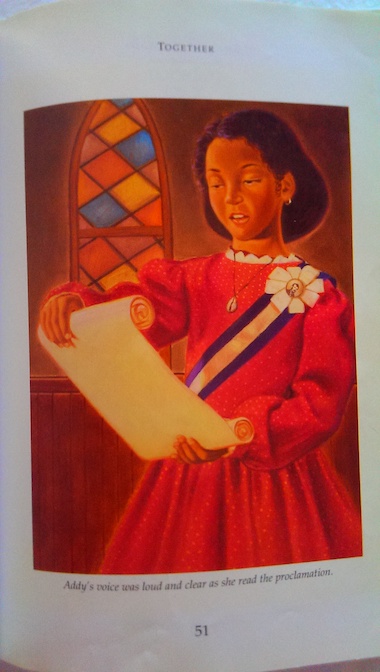
However, Auntie Lula does get to spend a little time with the family before her death, and she tells Addy not to be sad. People don’t always get everything they want in life, but they can take some pride in what they do accomplish. Lula and Solomon may not have gotten everything they wanted in life, not having had much time to enjoy being freed from slavery, but they did get to accomplish what was most important to them. Solomon died knowing that he was a free man, far from the plantation where he’d been a slave. Lula managed to reunite Esther with her family. From there, Lula says, she is depending on the young people, like Addy and her family, to make the most they can of their lives, hopes, and dreams.
The theme of this story is hope and the need to persevere with determination. Life has its difficulties, and not every problem can be solved. However, things can get better. After the reunion with Esther, Addy points out to her mother that Esther wasn’t walking or talking when they last saw her, and they never got to experience seeing her learn. Addy is sad at the time they’ve lost with Esther, which they can never recover. However, because of Lula and Solomon’s determination to bring Esther to them, they will have many more years to come with Esther. Addy’s mother also reminds Addy that those who love us never leave us. Auntie Lula and Uncle Solomon changed the family’s lives for the better because of the good people they were, and their memory will stay with them forever.
In the back, there is a section of historical information about the end of the Civil War, the emancipation of the slaves, and it further explains how racial issues continued into the 20th century, leading to the Civil Rights Movement in the 1960s.
This cute picture book takes place in a Medieval kingdom. Little Hester’s father is the court jester. Then, Hester decides that she wants to be a jester, too. At first, Hester’s parents tell her that she can’t because she’s a girl. (If you’re thinking that you know where this story is headed, wait.)
One day, the king is so sad that Hester’s father can’t cheer him up, no matter what he does. When Hester starts putting on her jester act for her father and makes him happy, he decides to go ahead and have her perform for the king. Hester does cheer the king up, but that isn’t the end of the story.
Hester tells the king that she has discovered that she doesn’t like being a jester after all because it makes her feel too silly. So, the king, now in a much better mood, asks her what she would like to do instead.
This starts a sequence where the king allows Hester to try out various roles and see if she likes them. She tells him that she wants to be a knight because knights are important, but she ends up not liking that when she learns that knights have to go into battle. Then, Hester decides that being a king is even more important, so the king decides to let her try it. But, Hester isn’t good at giving other people wise advice, as the king does.
In the end, when Hester’s mother is sad and doesn’t know what to do now that her daughter has become a king, Hester decides that what she most wants to do is to go home and be her little girl again.
In a way, this book seems like two little stories in one. First, there’s Hester proving that she can be a jester even though she’s a girl, and then, there’s Hester trying to decide what she really wants to be the most, now that the king is letting her try anything she wants. What she decides that she wants most is to be herself and go home.
So, is this little book anti-feminist, saying that girls are better off just forgetting about the other stuff they might want and staying girls? I don’t think so. Basically, this is just a silly little story about a little girl, one too young to have a profession of any kind, who is allowed to see the realities behind some of the things she’s been wanting to try. Some parts, she likes, and some she doesn’t. But, she’s too young and inexperienced for all of them (and some, she will never want to try again because she’s learned that they’re not what she really wants after all), so she’s just going to be what she is: a little girl with plenty of time to grow up, who needs her mother and whose mother needs her. All throughout the book, Hester speaks her mind about what she wants and is honest about the things she doesn’t like, admitting when she changes her mind. As for what might happen when Hester grows up and finds something else she might want to do . . . who knows? By then, she may be willing to try new things again. But, she knows what she wants for now and has a little better idea of some things that she won’t want in the future.
The book is currently available online through Internet Archive.
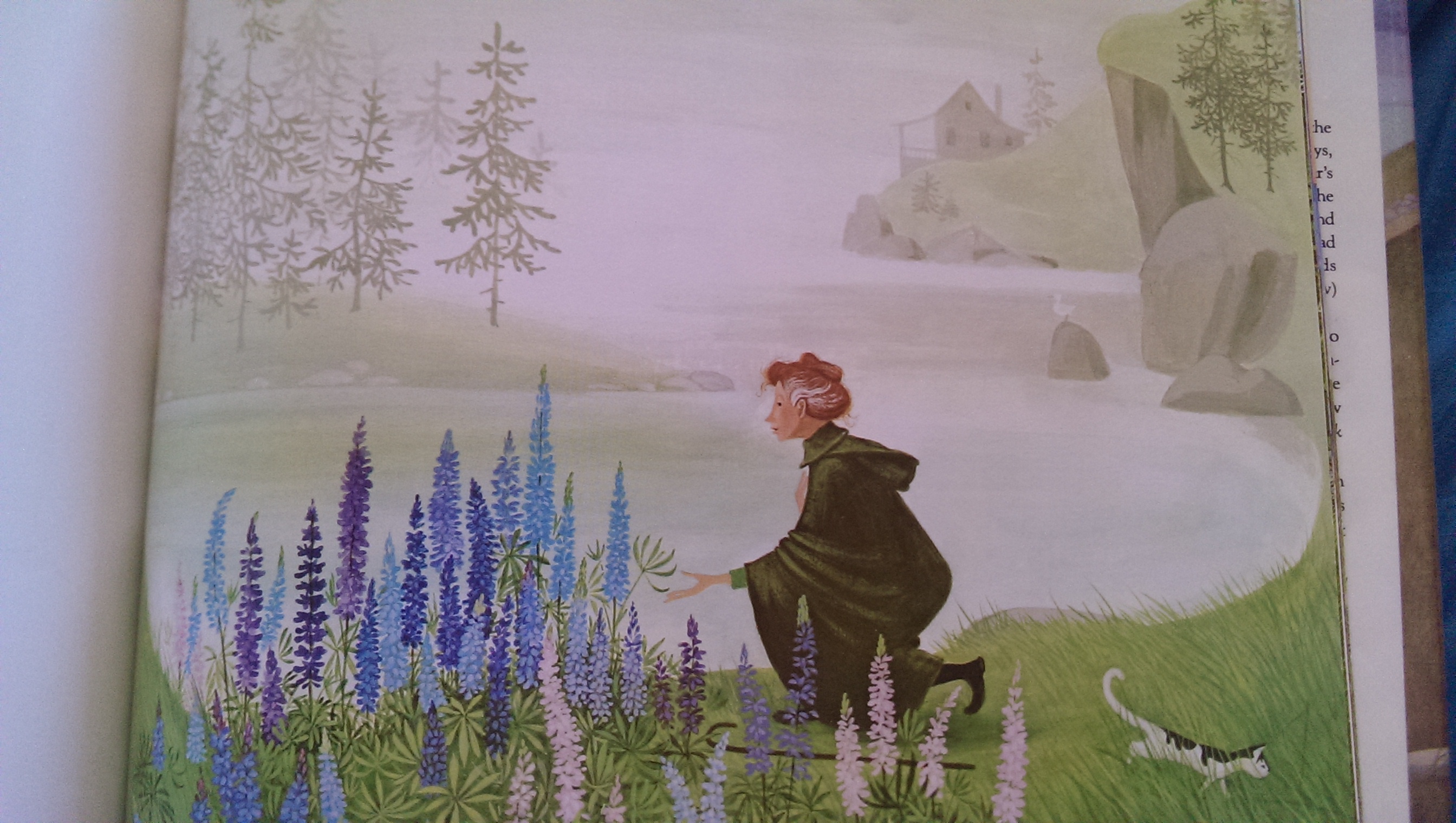
From the time she was young, Alice Rumphius wanted to travel and see the world. She planned to return home to live by the sea when her travels were over. However, her grandfather, an artist, gives her one more mission in life: to make the world more beautiful. Although Alice isn’t quite sure how she will accomplish that, she agrees.
When she grows up, she lives out her dream of traveling, seeing all the places that she read about while she working in a library. However, she ends up hurting her back while getting off of a camel she was riding, so she decides that it’s time to retire and find a home by the sea, as she planned.
As she recovers from her injury, she thinks about her mission to make the world more beautiful. At first, she still doesn’t know how to accomplish that, but some flower seeds she planted and her particular love of lupines give her the inspiration for her final legacy of beauty.
Her gift of spreading seeds of beautiful flowers gives her a reputation as an eccentric, the Lupine Lady, but it also inspires a new generation to undertake their own missions to see the world and to create beauty in their own way.
One of the things that fascinates me about Miss Rumphius and her story is that she leads a very non-traditional life. She has very definite goals from childhood and sticks to them throughout her life, but they are not quite the common goals of most people, like marriage and career. She remains unmarried throughout her life (the book never says anything about whether she had any romances in her life because that wasn’t one of her main life goals and therefore not really important to the story), and her only listed career was that of working in a library, which allowed her to have some money and to read about the places where she wanted to travel. In the end, she is not wealthy and has no husband or children of her own, but she is happy because she has achieved the things that always meant the most to her. She has had rich life experiences, she has made the world a little better for her presence, and she encourages her nieces and nephews to see the world, to enjoy their experiences, and to leave their own mark of beauty.







 However, Auntie Lula does get to spend a little time with the family before her death, and she tells Addy not to be sad. People don’t always get everything they want in life, but they can take some pride in what they do accomplish. Lula and Solomon may not have gotten everything they wanted in life, not having had much time to enjoy being freed from slavery, but they did get to accomplish what was most important to them. Solomon died knowing that he was a free man, far from the plantation where he’d been a slave. Lula managed to reunite Esther with her family. From there, Lula says, she is depending on the young people, like Addy and her family, to make the most they can of their lives, hopes, and dreams.



 Jestress's Forgotten Books and Stories