In the Circle of Time

In the Circle of Time by Margaret J. Anderson, 1979.

This is the second book in the In the Keep of Time Trilogy. There are a couple of characters from the first book that appear in this one, but most are new.

Robert lives on his family’s farm outside of a small town in Scotland.  He loves to draw, but his father doesn’t think much of Robert’s art.  He wants Robert to take over the family farm when he’s grown, especially since Robert’s older brother, Duncan, disappeared two years earlier.  Everyone assumes that Duncan just got tired of the farm and ran off to the city to find work, but Robert has trouble believing that.  Duncan always loved Robert and looked after him, and Robert can’t believe that Duncan would just run off without even telling him.

One day, Robert goes to the ancient circle of stones that stands near his town, known as the Stones of Arden, to draw before school.  There, he happens to meet Jennifer, an American girl who has recently moved to the area because her father is working in the nearby city.  Jennifer has an interest in archeology, and she points out to Robert that there are depressions where there used to be stones in the middle of the circle that aren’t standing anymore.  She persuades Robert to help her do a little digging to see if they can find them.  As they dig, a strange fog comes in, and Jennifer sees a vision of dark-haired people also digging.  However, no one is really there because the ground where they were digging is undisturbed.  Robert doesn’t see the people, but he believes Jennifer when she tells him what she saw.  There are a lot of strange stories about the stones, and Robert has heard many of them from his grandfather.

Jennifer, although spooked by what she saw, refuses to believe any superstitious stories.  She persuades Robert to come back to the stones with her so that she can take another look at them.  However, when they do, the strange fog comes, and the kids suddenly find themselves many years in the future.

The kids learn where (or when) they are when they meet a boy named Karten, who was digging in the spot where Jennifer had seen him digging in her earlier vision.  He tells them that the year is 2179 (two hundred years after the book was written).  The kids can suddenly hear the sound of the ocean from the stones when they couldn’t before, and when they ask about it, Karten tells them that the polar ice caps melted in the 21st century, raising the level of the ocean and bringing the water much closer to the stones.

The future is a harsh place, and Karten fears the people he calls “the Barbaric Ones.”  The Barbaric Ones are people from “across the sea” who, as Karten and his people explain, “have retained the ways of people who lived long ago. They are interested in wealth and machines and factories.” The problem is that resources are in short supply, so the Barbaric Ones kidnap people to use as slaves, gathering as much of the scarce resources as they can to sustain their standard of living.  Karten and his people don’t want to fight the Barbaric Ones if they can avoid it because they have lost people who tried to fight them and because they believe in the values of love and trust above all.

Jennifer is quick to insist that she and Robert return to the stones where they entered this strange and disturbing future, but Robert persuades her to stay awhile and meet more of Karten’s people. Karten particularly tells them about an older woman who told him before about other people from the past who came to their time (the kids from the first book in the series), and Robert is hopeful that this woman will not only be able to tell them how to get home but maybe also what happened to his brother, Duncan. Robert has started to suspect that when Duncan suddenly disappeared, he may have come to the this time period the same way he and Jennifer did and may still be there.

The book is available to borrow and read for free online through Internet Archive.

My Reaction:

I don’t generally go in for dystopian novels because I find them depressing. The real world has enough problems without trying to imagine new and worse ones. However, I do find it interesting that this book, which was written a few years before I was born, has a vision of the future that specifically addresses things that are of major concern to people in the early 21st century. It imagines that the polar ice caps have melted and the sea level has risen. Many of the old coastal cities are gone, and there are new cities and communities in areas where there weren’t before.

Because of what’s happened, the world’s population has separated into two parts that have different ways of coping with the situation. The “Barbaric Ones” are much more technology-oriented, but what makes them barbaric is the way they exploit other people to serve their purposes and support the lifestyle that they want to maintain, which is much harder to maintain in this new future. Karten’s people, on the other hand, have developed a more old-fashioned, communal style of living. In fact, it’s unusually communal, to the point where young children are raised collectively by the adults of the community, nobody really knowing or caring about who their birth parents are. When children are nine years old, they select families they want to join, usually because of similar interests they have, and are raised as children of that family. Karten also likes art, and so he joined a family of artists.

These two types of societies are extreme in their views and lifestyles, polar opposites of each other, and neither is really the sort of society that Jennifer or Robert want to be part of. Jennifer is unnerved that people in Karten’s society don’t really know or care who their parents are and just kind of pick families for themselves without attachment to their birth parents. It just seems unnatural to her. Karten explains that their view is that children belong to the community as a whole. If everyone is part of the same big community, what does it matter who they live with? Their concept of marriage or partnership is never fully explained, but there don’t seem to be any rules or even social conventions about who can live with whom. One girl, called Lara Avara, tells Jennifer that her chosen parental figures/mentors are a pair of women, which surprises Jennifer, who thinks of family in terms of mothers and fathers, one of each per family. However, the future people have a different concept of family that seems to be centered more around sharing personal interests, with no particular conventions around how the family should be shaped. The chosen parental figures/mentors raise the younger members who chose to join their family, teaching them skills and professions they have mastered, according to their interests. It is not explained in the story if these older women are or were married or lovers, and it doesn’t seem to be important to any of the characters in the story, either. Lara Avara just tells Jennifer, “There cannot be rules deciding whom you love and from whom you learn.” I see one disadvantage to not knowing who one’s parents and full-blooded siblings are because there would be no way to ensure against incest, which is worrisome because that tends to bring out certain genetic health problems and weakens the genetic pool of the community, especially if it goes on for generations (unless this society has thought of that and just doesn’t mention their solution during the course of the story – maybe the elders of the community who remember who has the same birth parents and who doesn’t will intervene if siblings try to match up with each other). In some ways, Robert is attracted to this style of life because it would make things easier for him. In his own time, his family undervalues his artistic gifts and his unpleasant, temperamental father forces him to do hard physical labor on the family farm. There are times when Robert would love to exchange his problematic family for one that would help him hone his craft and appreciate his personal talents.

For awhile, Jennifer worries that Robert likes these future people so much that he wants to stay there, and she’ll be stuck in the future with him. Unlike Robert, Jennifer is close to her family and happy in their time, and she wants to go home. The two of them are accidentally separated from each other when a character from the previous book in the series (Ollie) brings Robert back to their own time without Jennifer, through the tower that the previous set of characters had used for their time travels. As Robert figures out how to rescue Jennifer from the future, he discovers the truth about Duncan, who has not traveled through time at all (although it looked like that was the way the story was going to go) but really did run away from home, as people thought he did. Like Robert, Duncan was also unhappy about their home life. Although Duncan is better suited to the farm work than Robert, he also found life there stifling, constantly having to work for their father and deal with his angry moods. Their father’s attitude problems are what makes the farm life difficult for both boys, and Duncan also seems to have been feeling overworked and unappreciated. Although life as a teenage runaway has been difficult for Duncan, he has at least managed to find work (paid, unlike the farm work he was doing for his father, and payment is a monetary form of appreciation as well as providing the worker with a living) and the freedom to begin building a life of his own.

Rescuing Jennifer means returning to the stone circle where their time travels began. After Jennifer returns home to their time, she and Robert talk about their experiences. They feel badly that they were not able to help the future people more with their problems and dangers, but Robert says that maybe what’s important is what they’ve learned from the experience themselves and how it’s changed them. Their problems (just like Robert’s brother, Duncan) have always been in their own time, and they have to live their lives in the present. What they do in the present may also change the future and help make it a better place. By the end of the book, Duncan returns to his family’s farm to tell his parents that he’s all right. Duncan will not work on the farm again, as he once did, but he decides to take a new job nearby and help out on the weekends, which will make things easier for Robert. Their family has some healing to do. A talk with Robert’s grandfather also reveals that other members of Robert’s family have traveled through time in the stone circle, and although Robert’s grandfather did his time traveling many years earlier, the vision he got of the future was actually after Robert and Jennifer’s adventures. They can tell that it was further along in time by the people and things he saw, and it reassures them that their future friends will be all right in spite of everything.

The Mystery of the Crimson Ghost

The Mystery of the Crimson Ghost by Phyllis Whitney, 1969.

Janey Oakes loves horses and wishes that she had one of her own.  Her family lives on Staten Island in New York, so they don’t have room to keep a horse.  The only horses that she has ridden are rented ones.  However, her parents are now considering moving to the countryside in northern New Jersey, where Janey’s Aunt Viv lives.  If they do, there will be room for Janey to keep a horse, so she is hopeful.

Janey’s parents take her to visit Aunt Viv during the summer, while they decide if they want to move.  Along the way, they stop to ask directions at a half-ruined house.  The people there, Mrs. Burley and her grandson Roger, aren’t too friendly, and when Janey thinks that she hears a horse there, they seem oddly resentful and say that she should ask her aunt about it.

Aunt Viv seems oddly evasive on the subject of horses when Janey asks, saying that she doesn’t ride anymore.  She does tell Janey more about the strange, half-ruined house.  It was once a hotel for people who came to take the spring waters.  However, it eventually lost its popularity and was partly destroyed in a fire.  Mrs. Burley’s husband died in the fire, but she has remained living in the part of the house that is still standing, raising a couple of grandsons there after the death of her younger son.  Her older son is a doctor in New York City.  Aunt Viv says that she used to be friends with the younger of the two grandsons, Denis, but that ended when she did something wrong and something bad happened which she doesn’t want to talk about.

Aunt Viv introduces Janey to a girl who lives nearby named Coral, in the hopes that they will be friends.  Coral isn’t interested in horses, but when Janey questions her about the Burleys, she confirms that they do have a horse called the Star of Sussex.  She takes Janey up to the Burleys’ house again (partly in the hopes of seeing the older Burley boy, Roger, who she has a crush on).  There, Denis and Roger each explain to Janey that their grandmother had hoped to train Star as a racing horse.  Star is an excellent horse and had a lot of potential for racing, but Denis allowed Aunt Viv to ride her one day, and the horse stepped in a woodchuck hole and injured her leg.  The leg has healed, and the horse is able to gallop, but she still limps and can’t run at the same speeds she used to, ending Mrs. Burley’s racing hopes.  Since then, Mrs. Burley has been very bitter, especially toward Aunt Viv.  She behaves strangely, driving people away, and is also angry toward Denis for allowing Aunt Viv to ride the horse in the first place.  It was just an accident, but she blames them both.  Roger realistically thinks that they should sell Star for breeding because she has a good bloodline, and Denis’s real interest lies with airplanes, which fascinate him in the same way that horses fascinate Janey.  Their differing interests seem to support what Aunt Viv says about how the family should move and that the boys would probably have a better life away from the old, ruined hotel and Mrs. Burley’s obsession with the past.

Coral also tells Janey about a ghost dog that supposedly appears on nights when a strange red light appears on the Burleys’ property.  Later, Janey hears the howling at night. Aunt Viv doesn’t think it’s a ghost.  She says that people have tried to talk to Mrs. Burley about her dog, but she denies having one and gets really angry with people for accusing her of having one.  Yet, the howling does seem to come from the Burleys’ property, and Denis even says that he’s seen the ghost dog, that it seems to be covered in flames.  He claims that it’s the ghost of his grandfather’s dog, who died in the fire years ago.  Aunt Viv thinks that Denis is just saying that to try to protect his grandmother and because he can’t handle what other people have come to believe about her: that she’s losing her mind.  Mrs. Burley’s behavior is undeniably odd, and she’s prone to sudden mood swings.  People are worried that she’ll drive newcomers away from the area and drive down property values, and they think that she might need professional help.

Janey doesn’t think that Mrs. Burley’s mind is gone as much as people believe.  When she sneaks over one day to visit Star, Mrs. Burley is angry but notes that she has a good manner with horses.  To Janey’s surprise, Mrs. Burley agrees to let Janey ride Star.  Denis almost ruins things by making Janey believe that Mrs. Burley has changed her mind about the invitation and also by not telling his grandmother that Janey asked to meet at a later time.  Janey isn’t sure why Denis seems to have a grudge against her, although it might have to do with his own guilt for allowing the horse to be ridden and injured in the first place; his own grandmother still seems to have a grudge against him for that.  Neither one of them tells Janey that Star has a particular trick for throwing riders, even though she had specifically asked if there was anything that she should know about the horse or if it had any tricks.  After she’s thrown by the horse, however, Janey gets back on and proves to both the Burleys and to Star that she’s not intimidated and not going to fall for the trick again.  (The Burleys have deep, personal hurts, but I wouldn’t call them nice people.  There are people who would probably view this is a test of Janey’s skills and her ability to stick with a challenge, but I think that their lies and deliberate deception when Janey was asking the right questions show only their immaturity.  It may not bother some readers as much as it did me, but I have a very low threshold of patience for such things, and the characters lost a lot of my sympathy right there.)

Mrs. Burley warms up to Janey after that and confides in her some of the reasons why she has been so unfriendly, trying to drive people away, and why the horse meant so much to her.  Years ago, she and her husband made quite a lot of money, raising racing horses.  Star is from the same bloodline as their original horses.  Mr. Burley lost quite a lot of their money on various business ventures that didn’t work out, even before the hotel fire that killed him, but for a long time, Mrs. Burley was always able to keep one horse from that bloodline, hoping to get at least one last racing horse.  Star is an excellent horse who really would have made a good racing horse, but Mrs. Burley’s hopes were destroyed when Star was injured.  Mrs. Burley thinks that she’s too old now to raise another, that she wouldn’t live to see any of Star’s offspring become racers.  Janey still thinks that Star has the potential to be a racer, but Mrs. Burley says that the effects of her injury won’t let her get the speed she once had.  Mrs. Burley resents outsiders hanging around because she fears their “interference” in her life, and the injury of Star while Aunt Viv was riding her seems to prove that her fears are justified.

Janey tries to talk to Mrs. Burley about the ghost dog, but she gets angry with Janey for believing the things that people have been saying about her.  Worse still, Roger tells her that Mrs. Burley will probably sell Star soon.  She needs money badly and has been refusing to let anybody help her, even her son in New York.  Her pride at her independence may be her undoing.  Now that Janey has ridden Star successfully, she can’t bear the thought that the horse might be sold and sent away.  If only she could unravel the mysteries surrounding the Burley family, the strange red light, and the ghost dog!

My Reaction and Spoiler

Toward the end of the story, one of the characters talks to Janey about Mrs. Burley’s attitude, saying that “it’s important in life to have something to fight for.  Something we care about and want.  I don’t mean fight for with our fists, but something to try for, struggle for.  Something we can do that uses whatever we are to win the fight.”  He means that people need a purpose in life, something like a cause to believe in or a way of life to pursue that is suited to their talents. Janey says that she doesn’t like struggles, but the person points out to her that everything in life that you want involves a struggle, including the horses Janey loves. Janey has focused mostly on the struggle of getting her parents to agree to let her have a horse and Mrs. Burley to agree to let her ride Star, but even if she ended up owning a horse, including Star, there would still be the struggle of caring for the horse, devoting time to keeping the horse happy and healthy. Janey might enjoy that kind of struggle because it appeals to her talents and interests, but it would still require time and sacrifice on her part. Mrs. Burley loves horses as much as Janey does, and she loves the area where she lives to the point where she can’t image living anywhere else. All of her efforts focus on allowing her to continue living in the place she loves, although she feels like her horse dreams are lost.

Much of the emphasis of the book is placed on Mrs. Burley’s determination to maintain her independence as part of the lifestyle she loves, but I wish that there was a little more emphasis on the methods that people use to get what they want in life because that is central to the secret of the “ghost.”  That the “ghost” isn’t really a ghost isn’t too much of a spoiler, but while people in the area think that Mrs. Burley is faking the ghost because she’s mentally unbalanced, the real culprit is someone who wants Mrs. Burley to leave because there’s something that he wants very badly and doesn’t think that he’ll get it otherwise.  Once his scheme is exposed, the others make sure that he doesn’t get what he wants because, after what he has done, he doesn’t deserve a reward.  However, I wish that they had explained a little more plainly that there were other ways of getting what he wanted besides the scheme he planned.  The culprit thinks that no one was listening to him and what he wanted, but from my perspective, what he wanted was simply a matter of time, and he wasn’t willing to wait.  His scheme would have ended with Mrs. Burley being declared mentally incompetent and being put away in a home, which is a cruel thing to do to someone.  The other characters tell him that, but I wanted someone to explain to him that harming others for his own benefit would make him no better than someone who robs a bank because they want money.  That is, crime and fraud are still wrong even if they succeed because the ends don’t justify the means.  In some ways, I think that Mrs. Burley was selfish, but she still didn’t deserve to be labeled as crazy, and even if people weren’t listening to the culprit and taking him seriously as much as they should, the scheme still wasn’t his only option. 

To say more would be to tell you who the culprit is, and it’s not as obvious as it might seem. It was one of my favorite suspects, but I changed my mind a few times, going back and forth between suspects up until the end. In the end, Mrs. Burley is prepared to forgive the culprit and start over again, and there are hints that he may get what he wants in the future if he behaves better.  Personally, I think he probably would have gotten it eventually, anyway, so his situation is relatively unchanged, although he is now under pressure to prove his behavior to everyone. 

As for Star, she does become Janey’s horse as a gift from the one person who is in a position to give the horse to her while making sure that Mrs. Burley gets the money she needs.  Because of Janey’s help in revealing the culprit to Mrs. Burley and because of her devotion to the horse, Mrs. Burley is fine with the arrangement.

Miss Rumphius

MissRumphius

Miss Rumphius by Barbara Cooney, 1982.

From the time she was young, Alice Rumphius wanted to travel and see the world.  She planned to return home to live by the sea when her travels were over.  However, her grandfather, an artist, gives her one more mission in life: to make the world more beautiful.  Although Alice isn’t quite sure how she will accomplish that, she agrees.

RumphiusPainting

When she grows up, she lives out her dream of traveling, seeing all the places that she read about while she working in a library.  However, she ends up hurting her back while getting off of a camel she was riding, so she decides that it’s time to retire and find a home by the sea, as she planned.

RumphiusCamel

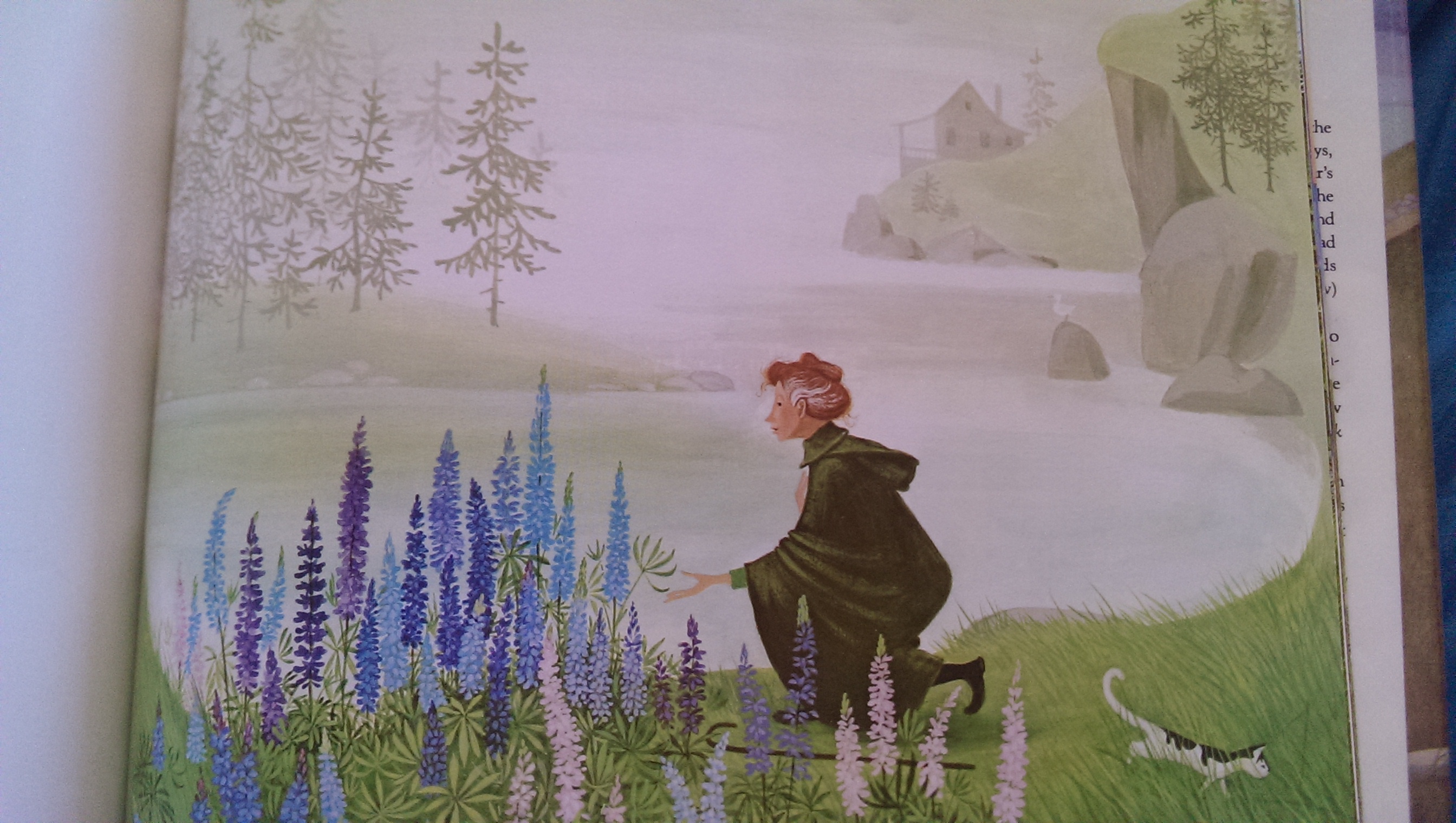
As she recovers from her injury, she thinks about her mission to make the world more beautiful.  At first, she still doesn’t know how to accomplish that, but some flower seeds she planted and her particular love of lupines give her the inspiration for her final legacy of beauty.

RumphiusLupines

Her gift of spreading seeds of beautiful flowers gives her a reputation as an eccentric, the Lupine Lady, but it also inspires a new generation to undertake their own missions to see the world and to create beauty in their own way.

RumphiusChildren2

One of the things that fascinates me about Miss Rumphius and her story is that she leads a very non-traditional life.  She has very definite goals from childhood and sticks to them throughout her life, but they are not quite the common goals of most people, like marriage and career.  She remains unmarried throughout her life (the book never says anything about whether she had any romances in her life because that wasn’t one of her main life goals and therefore not really important to the story), and her only listed career was that of working in a library, which allowed her to have some money and to read about the places where she wanted to travel.  In the end, she is not wealthy and has no husband or children of her own, but she is happy because she has achieved the things that always meant the most to her.  She has had rich life experiences, she has made the world a little better for her presence, and she encourages her nieces and nephews to see the world, to enjoy their experiences, and to leave their own mark of beauty.

Apparently, parts of the story are based on the author’s own life and on the life of Hilda Hamelin, the original Lupine Lady.  The book is currently available online through Internet Archive.

The Mysterious Visitor

Trixie Belden

tbvisitor#4 The Mysterious Visitor by Julie Campbell, 1954.

Now that school has started again, Trixie and Honey see more of the other kids who live in Sleepyside, including a girl named Diana Lynch. Trixie has known Diana for a long time, but ever since her father made a lot of money, Diana has been distant.

Di is deeply unhappy because her parents, particularly her mother, have been trying to live up to their new status by having the household run by fussy servants who don’t care much for children. Diana always has to wear formal clothes, she doesn’t get to play with her younger siblings as much, and she finds it increasingly hard to just relax and have fun with friends.

When Honey and Trixie invite Diana to become a member of the Bob-Whites, she tells them about her long-lost uncle who has recently come to visit her family. Her mother is happy about finally meeting the brother she has not seen since she was a baby, but Uncle Monty has been making Di’s life miserable. Whenever she makes plans to have a Halloween party or do things with friends, he tries his best to interfere and ruin everything. Uncle Monty is rude and offends people. Trixie is convinced that Di’s Uncle Monty is not what he seems to be, but she’s not sure how to prove it.

I love the description of the Halloween party that the kids have at Diana’s house!

The book is currently available online through Internet Archive.