#7 The Mystery of the Haunted Lighthouse by Elspeth Campbell Murphy, 1995.
Sarah-Jane’s parents have been planning a trip, and her cousins, Titus and Timothy are coming, too. At the request of an old family friend, Ned, they are going to visit him and take a look at an old lighthouse that he is thinking of buying. He wants to turn the lighthouse into a bed and breakfast.
However, strange things have started happening at the lighthouse. Someone has vandalized the outside, and Sarah-Jane sees a frightening face up in the tower. Could the old lighthouse be haunted?
The theme of the story is faithfulness.
The book is available to borrow and read for free online through Internet Archive.
My Reaction and Themes
Since this is a Christian-themed mystery, readers can guess that there won’t be any real ghosts. This is more of a light, pseudo-ghost story, like Scooby-Doo mysteries, with another explanation for what’s happening.
There’s more than one kind of haunting. People can be haunted by memories, and living humans are also attached to the places associated with their happy memories. There is someone who has an attachment to the lighthouse and is unhappy that it’s being sold. This person needs to reconcile their feelings to the situation.
Some Christians don’t like the concept of ghost stories at all. In the book, Sarah-Jane likes hearing ghost stories, although she admits that she doesn’t like remembering them later, when she’s alone at night. She enjoys a little spooky excitement, as long as she knows it’s just a story, and she’s hearing it in a safe setting.
The Lighthouse Mystery by Gertrude Chandler Warner, 1962, 1994.
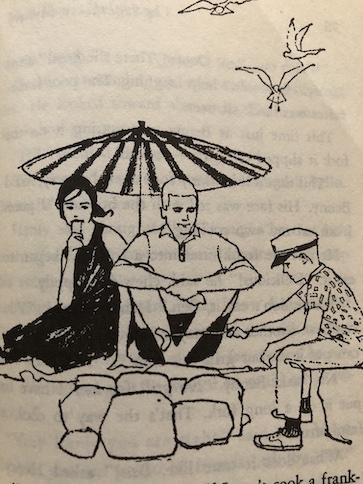
The Boxcar Children and their grandfather have been visiting the children’s Aunt Jane. They are there to see her get married, and now they’re on their way home again. While driving home, they stop to look at a lighthouse and see a For Sale sign. The children are intrigued at the idea of owning a lighthouse, and their wealthy grandfather decides to ask a nearby storekeeper what he knows about the place. It turns out that the storekeeper has recently purchased the lighthouse himself, so it’s no longer for sale, but he’s willing to rent it out to visitors. The children’s grandfather is as fascinated at the idea of living in a lighthouse as the children are, so he decides to rent it for them to stay in.
During their first night at the lighthouse, the children’s dog, Watch, suddenly starts barking and growling. They can’t figure out what is upsetting watch, although Benny thinks that he smells food. They wonder if someone could be cooking something at the little old house near the lighthouse, but after a while, Watch calms down, and they all decide to go back to bed and check out the situation in the morning.
The next day, they go shopping for food, and the children find themselves looking suspiciously at everyone they meet, wondering if someone was near the lighthouse the night before. The first suspicious person they see is a man who almost knocks Violet over because he’s not looking where he’s going. Then, they meet a young man who seems angry about something. The storekeeper says that the young man graduated from high school early because he’s very smart, but his father won’t let him go to college. Grandfather Alden explains to the storekeeper that they had a prowler the night before, and he’s thinking about talking to the police about it. The children persuade their grandfather not to talk to the police because they want to investigate the mystery themselves.
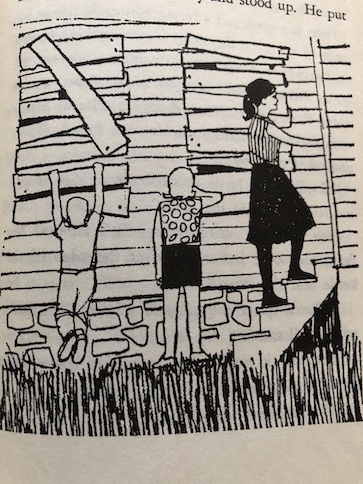
The next night, the children see a woman outside the lighthouse, but when they investigate, they can’t find anyone. They think maybe she went into the little house nearby. Later, they look through the windows of the old house, which are mostly boarded-up. Inside, they see food and cooking equipment, which means that someone might have been cooking there the night that Watch started barking. Strangely, they also see a microscope, seaweed, and something that looks like its glowing. They think maybe someone is doing an experiment of some kind. It could be the woman they saw, or it could be the clever but angry boy who isn’t allowed to go to college, Larry Cook.
When the town holds a special Village Supper, the children learn that Larry loves to cook. They make friends with him while helping him to prepare the food. As the kids become friendlier with Larry and talk with other people in town, they learn more about Larry’s father’s opposition to him attending college and how Larry has been trying to study on his own. They’re pretty sure that Larry is the one who’s been conducting some kind of experiment in the little old house, but what is he trying to do?
The book is available to borrow and read for free online through Internet Archive (multiple copies).
My Reaction and Spoilers
This is one of the early Boxcar Children books, written by the original author. Because it’s one of the early books, the children in the story age. In the books written by other authors after the original author’s death, the children’s ages are frozen, and Henry is always 14, but in this book, he’s in college. That means that he’s not too different in age from Larry, and the kids find out that the college Larry wants to attend is the same one that Henry attends.
At first, I thought that Larry’s father objects to him attending college because they can’t afford tuition, but someone else who knows the family says that Mr. Cook is just a selfish man. I’ve noticed that some people who never went to college take other people’s levels of higher education as some kind of personal insult, like people who go to college are just trying to make them look bad or somehow discredit their personal life choices. It doesn’t seem to occur to them that people might do things for themselves and make decisions for the sake of their own lives that have nothing to do with them in any way. I think that might be the kind of selfishness that the story is trying to describe. Mr. Cook is one of those people who makes everything about himself and feels the need to control other people’s lives to make himself feel good or justify his choices. I’ve also noticed that people who haven’t been to college often don’t understand how changing technology and job requirements cause people to need more education to do jobs that used to require less. They also don’t have the imagination to see how more education can help someone progress further and faster in their field or how it might open the door to new fields they haven’t experienced or even thought about. Because they haven’t sought more education themselves and aren’t accustomed to stretching themselves and looking for new ways to skill up, they don’t think that there might be possibilities beyond their scope. Mr. Cook even admits all of that later, saying, “I just made up my mind that he couldn’t go, and I hated to give in. You see I never had a chance for much schooling. I’ve done all right. I couldn’t see why Larry needed to go to college. A waste of money, I thought. I guess I’m quick to lose my temper and slow to change my mind.”
In spite of his selfishness, this acquaintance says that he thinks Mr. Cook really loves his son. He’s just accustomed to putting his son and his son’s future second to himself. What causes Mr. Cook to change is when Larry is in danger, out on the family’s boat in a storm. Faced with the prospect of losing his son completely, Mr. Cook promises that, if Larry is rescued, Larry can have whatever he want. College turns out to be the right course for Larry. It not only helps him to pursue his field of study but to connect with professors and students who also share his passions and love of learning. It suits him and the life he wants to live.
In some ways, this story is more adventure than mystery. By the time that Larry is rescued from the storm, the Aldens think they have a pretty good idea what Larry is trying to do, but Larry explains it all to them after his rescue rather than the Aldens needing to prove anything themselves. There is also no crime in this story. The mystery part is more about unexplained or mysterious circumstances. Larry hasn’t done anything wrong or illegal. He’s not even trespassing in the little house because his family owns it. Larry’s experiments combine his love of science with his love of cooking. He’s trying to produce new kinds of foods using seaweed and plankton that can help to feed the world.
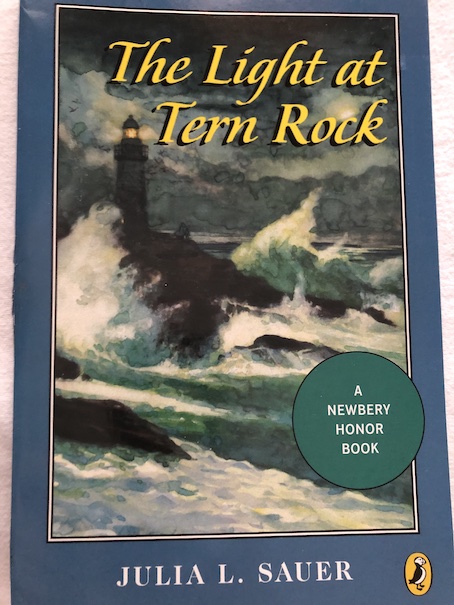
Not long before Christmas, the lighthouse keeper at Tern Rock, Byron Flagg, approaches Martha Morse, asking her if she would be willing to temporarily take the job of tending the lighthouse while he takes a vacation. The lighthouse can never be untended because ships rely on that light, and it can be difficult for Mr. Flagg to find someone to take over his duties for an extended period of time, especially so close to Christmas. Mr. Flagg wants to hire a substitute with experience tending the lighthouse. Mrs. Morse lived there for 14 years while her late husband was the lighthouse keeper. Although many people would be daunted by the isolation of the lighthouse, Mrs. Morse actually loved it because she enjoyed the beauty of the sea and nature. She knows that she would enjoy staying there again. However, she hesitates to take the job of temporarily tending the light because she is caring for her young nephew, 11-year-old Ronnie. Ronnie might enjoy the adventure of staying in a lighthouse, but he would have to miss some school.
Mr. Flagg appeals to Mrs. Morse’s sense of nostalgia about the lighthouse and points out that Ronnie could bring along some of his schoolwork to study during their stay. Mr. Flagg says that their stay will only be for two weeks, and that he’ll return and relieve them on December 15th. Mrs. Morse points out that the weather around Tern Rock can be unpredictable and that he might not be able to return when he says he will, but Mr. Flagg says he is confident that he can. They talk to Ronnie about it, and Ronnie says that he would like to see the lighthouse, but he wants to be home for Christmas. Mr. Flagg assures them that won’t be a problem and that they will enjoy their stay at the lighthouse, so they agree to go.
When they arrive at the lighthouse, Ronnie is awed by rugged environment of Tern Rock and daunted by the isolation of the lighthouse. His Aunt Martha says that she understands how he feels, that he wonders if they’re up to the task, but she assures them that they are. The job they will do is a necessary one because, without the light, the rocks in this area are a danger to ships.
As they settle in, Ronnie becomes fascinated with the lighthouse. The interior is comfortable and designed to be compact, almost like the interior of a ship. His Aunt Martha establishes their schedule, teaching Ronnie what they need to do. She turns off the light at sunrise and lets it cool down while they have breakfast. Then, they clean the lamp, polish its lens, and do other chores to keep the light in working order. Ronnie does his schoolwork in the afternoon, and they turn on the light when the sun goes down. They spend their evenings doing quiet activities, like reading and playing games. Although Aunt Martha wasn’t sure that the quietness and monotony would appeal to an active boy like Ronnie, Ronnie finds the newness of the environment and the change in his usual routine fascinating.
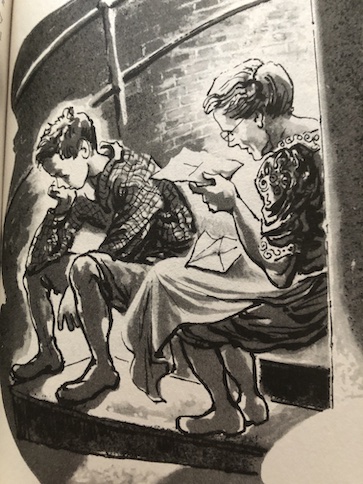
Ronnie’s feelings change when December 15th arrives, and Mr. Flagg doesn’t. The weather is good, so there’s no reason why a boat shouldn’t approach Tern Rock, but Aunt Martha says that there may have been some other problem that delayed him. She doesn’t think an extra day or two at the lighthouse will hurt them, but the days go by, and still, Mr. Flagg doesn’t come. They are still comfortable in the lighthouse and there haven’t been any problems with the light, but Ronnie is angry because he realizes that Mr. Flagg lied to them. Christmas is approaching, and it becomes clear that Mr. Flagg never had any intention of being back at the lighthouse in time for Christmas.
Ronnie has trouble understanding and excepting Mr. Flagg’s lies and broken promises. Ronnie and Aunt Martha discuss the importance of honesty and the meaning of broken promises. Ronnie thinks that Mr. Flagg has been wicked. He has certainly been unfair, but Aunt Martha says that there are worse kinds of wickedness, and before they jump to conclusions about what has happened, they need to know the reasons for it.
Aunt Martha says that the Christ Child visits every home on Christmas, and no place is too distant for Him to reach, so they should make the lighthouse ready and prepare for Christmas. Ronnie doesn’t see how they can because they didn’t bring any decorations or anything for Christmas. Ronnie considers firing the cannon that would signal an emergency to bring someone out to the lighthouse, but Aunt Martha firmly tells him no. The cannon is only for serious emergencies, when there are lives in danger, not for mere disappointment and self-pity. However, Mr. Flagg has left some special surprises for them.
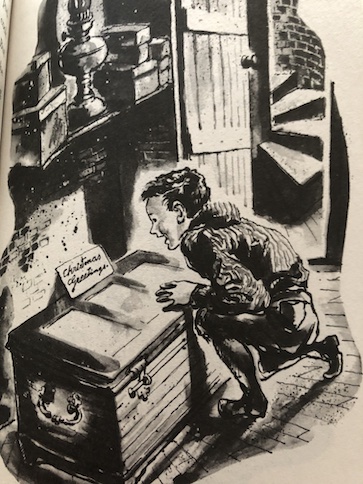
It is true that he intentionally deceived them about being back in time for Christmas. When Ronnie finds a sea chest with a Christmas message, he knows for certain that Mr. Flagg was lying to them the entire time, which makes him angrier. However, a letter that Mr. Flagg left explains his reasons, which earns their sympathy. To soften the blow of his deception, he has also left them some special presents and treats gathered from exotic places. This still isn’t the Christmas that Ronnie and Aunt Martha had originally planned, and being lied to doesn’t feel good. Still, in the end, this Christmas is pretty special and memorable, and they both realize that they are exactly where they need to be.
The book is a Newbery Honor book. It is recommended for ages 8 to 12 years old. It is available to borrow and read for free online through Internet Archive. The author, Julia L. Sauer, also wrote Fog Magic.
My Reaction
I wasn’t familiar with this story when the Coronavirus Pandemic started, which is a pity because this would have been a great book for the type of Christmas we had in 2020. Still, this is a lovely Christmas story, and the pandemic isn’t quite over yet. Things have improved considerably since 2020 because people have been vaccinated, but for those who still need to be cautious and are disappointed that things aren’t completely back to normal or anyone who has hard feelings toward someone or is having a rough Christmas for any other reason, this story is a useful reminder that disappointments are still temporary, and sometimes, the place where you find yourself is exactly where you need to be. Also, disappointments and inconveniences can come with compensations, if you’re open to experiencing them.
Mr. Flagg shouldn’t have lied to Mrs. Morse and Ronnie. He acknowledges in his letter that this was a hurtful thing to do, and he explains his reasons. Basically, he was lonely and desperate. As a lighthouse keeper, he is what we might call an “essential worker”, someone who can’t easily take time off from his work because he does a necessary job that can only be done in a particular place. People’s lives depend on the light from the lighthouse, so Mr. Flagg can’t leave his job for any length of time unless he finds someone qualified who is willing to take his place. This story is set during a time before lighthouses became automated, so there must be a human in this role.
Mr. Flagg is in his 60s, and he explains in his letter that he has spent most of his Christmases either alone or with other adults because of his life as a sailor and lighthouse keeper. He has a niece who has several children and who would be happy to have him for Christmas, but he has never managed to find anyone who was willing to relieve him from his duties during Christmas before. He was desperate to spend at least one Christmas with his family, so he resorted this deception out of desperation, but he left all the presents and special treats for Aunt Martha and Ronnie because he didn’t want them to be miserable.
Aunt Martha is getting older herself, and she understands how Mr. Flagg feels, having lived a similar sort of life. When she lived at the lighthouse, she and her husband were together, but Mr. Flagg has never married, and he was desperately lonely. Ronnie has more trouble understanding the feeling because he is younger and hasn’t experienced this type of loneliness before. Aunt Martha points out that Ronnie will have many more Christmases before him, more than either she or Mr. Flagg have left. One disappointing or just bizarre Christmas won’t mean that much to him in the long term. With maybe 50 or more future Christmases to come as well as the ones he’s already experienced, this strange Christmas in the lighthouse is just one more memory or story to tell other people in Christmases to come.
Part of this story is about forgiveness, but they don’t use that word at all in the story. People have different views about what forgiveness entails, but I think it’s important that Aunt Martha and Ronnie don’t excuse Mr. Flagg’s actions. They come to understand his motives, and they feel pity or sympathy for him for the kind of rough and lonely life he’s lived, but that doesn’t make lies to them good or right. He did something hurtful by betraying their trust, and there will probably be some kind of reckoning between them when Mr. Flagg eventually shows up. Mr. Flagg acknowledges that in his letter, that the knowledge that he betrayed their trust will keep him from fully enjoying Christmas with his family, even when he’s finally getting the kind of Christmas he has wanted, and he can’t blame them for whatever they’re feeling as they read his letter. So, the story never says that what Mr. Flagg did was okay or that it didn’t hurt that he lied to the people who were helping him. Lying was wrong, and it was hurtful, and the characters are honest about that. They don’t try to pretend that they’re not hurt, which I think would have made their feelings worse in the long run. Instead, it’s about looking past that hurt to something better and finding things to be happy about even in a situation where they didn’t want to be.
Aunt Martha sees that what’s really preventing Ronnie from enjoying Christmas as they happen to have it is his anger, disappointment, and bitter feelings and the way he broods about them. Brooding about the angry things he wants to say to Mr. Flagg when he sees him isn’t making his Christmas any better. Aunt Martha compares cleaning out negative emotions to cleaning house before the holiday. You have to clear out all the dust and negativity to let in something better. They will eventually see Mr. Flagg, and there will probably be words between them, but those words can wait while they enjoy themselves as best they can for this Christmas. By then, each of them will probably have a better sense of just how they really feel about the situation and what they want to say about it anyway.
Once Ronnie works through his feelings and is able to put aside his anger, he realizes that this Christmas is something special. He does miss the class Christmas party the rest of his school is having, but in return for that sacrifice, he is experiencing something truly unique that his school friends will probably never experience. He doesn’t fully consider how unique this experience actually is at first, but he senses that there is a unique feel to Christmas in the lighthouse, with its giant light. Ronnie considers the tradition of putting candles in windows at Christmas, to guide the Christ Child or other travelers. (They emphasize candles as welcoming the Christ Child in the story, but when I first heard of the tradition, it was to welcome travelers or absent family members.) He realizes that, by tending the lighthouse, he and his aunt are doing the same thing, but they’ve got the biggest candle of anyone!
Whatever your Christmas happens to be this year, wherever you’re spending it, and whoever you’re spending it with (even if it’s just yourself), don’t forget to do the little things to make it special and enjoy it for whatever it is! Merry Christmas!
Uncle Quentin and Aunt Fanny are expecting their daughter George and her three cousins and dog to come for a visit because their parents are going away on a cruise when Uncle Quentin hears from a friend of his, a professor, who also wants to come for a visit to discuss his latest invention. Aunt Fanny says that they won’t be able to accommodate the children and the professor at the same time, and Uncle Quentin had better tell the professor not to come. However, Professor Haling is already on his way, and he’s bringing his son with him. The children have also already left home, so there’s nothing for them to do but try to accommodate their guests as well as they can.
It’s not going to be an easy visit. Uncle Quentin and Professor Haling both want quiet to discuss their work, but the professor’s nine-year-old son, Tinker, is obsessed with cars and keeps making noises to imitate them. Tinker has also brought his pet monkey, Mischief, with him. At first, Mischief and George’s dog, Timmy, don’t get along with each other. The animals eventually make peace with each other, but Uncle Quentin and Professor Haling decide that they can’t put up with the children’s noise. Uncle Quentin insists that Aunt Fanny send the children away somewhere so they can continue their important work.
Aunt Fanny doesn’t like it that such important men, who are admittedly working on things that will help people, don’t seem as interested in making their families happy, and George points out the hypocrisy that Uncle Quentin can’t stand their noise when he often slams doors that interrupt her studies and that he wants to push her out of the home where she lives, too. Aunt Fanny says that part of the problem is that George and her father are too much alike, but the noise issue and overcrowding in the house are still problems that have to be solved.
The children ask if they can go camping, but Aunt Fanny says that it’s too cold for that. Tinker suggests that they could all go to his lighthouse. They ask him what he means by “his” lighthouse, and Tinker happily explains that he owns a lighthouse. Actually, his father bought it when he was working on an important project and wanted a quiet place to stay where he wouldn’t be interrupted by phone calls or visitors or other distractions. When his project was finished, he no longer cared about the lighthouse, but Tinker love it, so his father gave him the key and told him that it could be his lighthouse now. The other children are amazed at the idea of a private lighthouse, and they agree to go there. Aunt Fanny agrees to let them go, and they begin planning for the trip. It’s at a place called Demon’s Rocks.
On the way to the lighthouse, their taxi driver, who was born at Demon’s Rocks tells them a little about the history and legends of the place. He says that it’s called Demon’s Rocks because there are formidable rocks there that people say could only have been placed by demons. The old lighthouse was meant to steer ships away from the rocks, but one time, some wreckers captured the lighthouse keeper and turned off the light to intentionally wreck a ship so they could raid the wreck for its cargo. The driver says that his great-grandfather still lives in the area, and if they ask him, he can tell them more stories about the place and maybe show them the cave where the wreckers used to hide out.
When the children meet the taxi driver’s great-grandfather, Jeremiah, he is an eccentric old man, but he likes children and even knows how to get along with Mischief the monkey. The children ask him about the wreckers, and he tells them the story about how One-Ear Bill and his wreckers put out the light in the lighthouse and used a lamp to misdirect a ship to make it crash. Jeremiah says he witnessed what they did and reported them, sending One-Ear Bill to prison. But, he says that One-Ear Bill didn’t care that much about going to prison because he hid the treasure that he took from the wrecked ship and expected to be rich when he got out. However, he died in prison, and nobody ever found the hidden treasure. The relatives of the other wreckers have tried to find it, but nobody has ever succeeded. The children are fascinated by the story and ask Jeremiah if he will show them the wreckers’ cave, and he agrees to show them sometime.
A local shopkeeper says that there is a kind of rivalry between Jeremiah and the descendants of the wreckers because the wreckers’ descendants make a marginal living by giving paid tours of the wreckers’ cave. The children don’t really expect that there’s still a treasure hidden in or around the cave. They think that, probably, someone found the treasure years ago and didn’t tell anyone or that the treasure might have been in some insecure spot and got washed out to sea.
However, strange things soon start happening. Someone steals the key to the lighthouse when Tinker leaves it in the lock and some other things from the lighthouse. The local police discover one of the wreckers’ descendants, Jacob, stole the things from the lighthouse, and the children get them back, but they can’t find the key on Jacob.
Then, when Jeremiah gives the children a tour of the cave, Mischief gets lost and finds a gold coin. The children aren’t sure where Mischief found the coin or if there are any others, but they begin to think that maybe the treasure is still in the cave after all. They also begin to consider that there may be a tunnel that leads from the lighthouse to the cave. However, someone else seems to have the same idea, and they’re trying to stop the children from finding the treasure before they do!
My Reaction
Part of the concept of the Famous Five series is that the children are very independent and have adventures that are unsupervised by adults. Children like stories about independent kids, but as an adult, I’m still struck by the family relationships the children have. I’ve noticed that the adults in Enid Blyton’s stories often have personal issues or dysfunctional relationships.
The reason why the children are having their independent adventure in this story is that the children’s fathers are too absorbed in their work and bothered by the presence of the children, so they just want them out of the house. Although George likes having adventures with her cousins, she does feel a little resentful that her father is basically pushing her and the others out of the house. I particularly noticed the part where Aunt Fanny reflects that important men who are working on things that will help people, don’t seem as interested in making their families happy. Uncle Quentin seems oblivious about the effect he has on his family, and when the children are getting ready to go to the lighthouse, he seems confused about where they are going, apparently having even forgotten that they were going anywhere. I keep getting the feeling that part of the reason why the children are so independent is that the adults in their family aren’t particularly nurturing and don’t make their home lives very pleasant.
Tinker’s home life isn’t terribly happy, either. His father is very permissive, letting him have a pet monkey and even giving him the lighthouse, but he also seems pretty oblivious to the things Tinker does. The other children find out that Tinker’s mother died giving birth to him, and with his father so utterly absorbed in his work, Tinker hasn’t had much supervision or guidance in how to behave, which is why he’s so wild. Tinker’s father takes him places and lets him have things or do things that other children can’t, but he doesn’t seem to get much personal attention or affection from his father. At one point, the other children are sending post cards home, and Tinker says there’s no point in sending one to his father because he won’t read it. That says a lot, and the other children feel sorry for him.
What I’m saying is, while I like the adventure and would have loved that sense of freedom as a kid, as an adult, I recognize that behind the children’s independence in many of the stories are some unresolved family issues and self-absorbed adults. The adults don’t worry as much about the children as most parents would, not only because they trust them on their own, but because they seem too absorbed in their own issues to think that much about what the children are doing and what could happen to them. The children go to boarding school much of the time, but their parents don’t seem too eager to spend time with them and bond as a family during their breaks, content to let them go off by themselves so they can get back to what they were doing. This also seems to be the case in other series by Blyton, like the Adventure series, which starts off with a pair of siblings going to stay with an aunt and uncle who seem to have a dysfunctional marriage and a pair of orphans who live with a strict uncle who seems to see them as a nuisance. Since the kids are fictional and the children’s circumstances are only there to set up their adventures, it’s not that big of an issue to enjoying the adventure, but yet, as an adult, these things do jump out at me.






 Jestress's Forgotten Books and Stories