This book is part of the Madeline series about a little girl at a small boarding school in Paris. The son of a Spanish Ambassador, Pepito, lives next door to the girls. He’s a menace to them at first, but the girls make friends with him. However, in this book, Pepito moves to London because his father has been relocated for his job.
When Pepito and his parents go to London, Pepito is unhappy there because he’s lonely for Madeline and the other girls from the boarding school. With Pepito growing thin and depressed from his unhappiness, Pepito’s father arranges for the girls from the boarding school to visit for Pepito’s birthday to cheer him up.
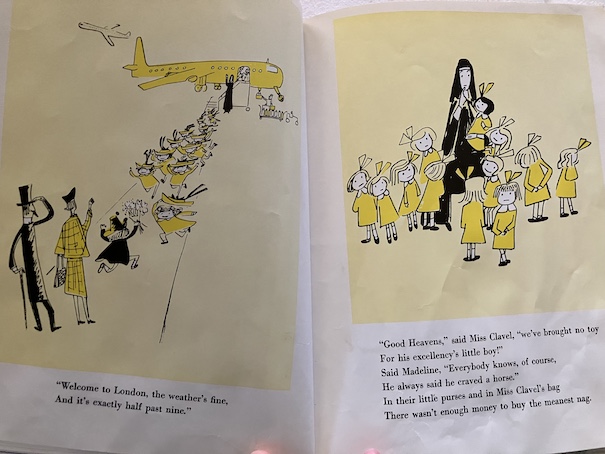
When Miss Clavel and the girls arrive in London, there’s a happy reunion, but then, they remember that they didn’t bring Pepito a present for his birthday. Madeline remembers that Pepito has always wanted a horse, and they find an old, retired army horse who is still healthy and gentle.
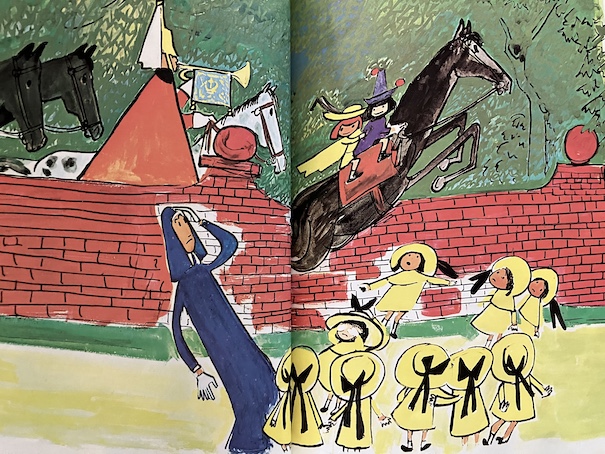
However, when they give the horse to Pepito, they quickly discover that there are complications to owning a horse as a pet. The horse hears a trumpet, and reacting to his army training, he runs off with Pepito and Madeline on his back to join a parade.
Then, they forget to feed him, so he eats everything in the garden, making himself sick. It seems like the embassy in London is no place for a horse, but Madeline and her friends may have room for one at their school!
The book is available to borrow and read for free online through Internet Archive (multiple copies).
My Reaction
Giving someone a horse for a present without checking with their parents or making sure that they have what they need to take care of a horse isn’t something that people realistically do, but the Madeline books rarely worry about the practicalities of a situation. It’s all fun and adventure!
I was seriously worried about the horse after they forget to feed him and he helps himself to random plants in the garden, especially when they find him with his feet up in the air. Fortunately, everything works out okay, which is characteristic of Madeline books, too. How the trustees of Madeline’s school will react when they find out that the girls now have a pet horse, since they raised a fuss earlier about the girls having a dog, is anyone’s guess, but the story doesn’t worry about that, either.
Like other books in this series, the pictures in the book alternate between limited color images, mostly in black and yellow, and full color images.
The story is set in London, in 1849. Fourteen-year-old John Huffam lives with his parents and sister and their servant, Brigit and attends a school taught by a former military man who acts like he is still in the army and teaches them little beyond discipline and what army life would be like.
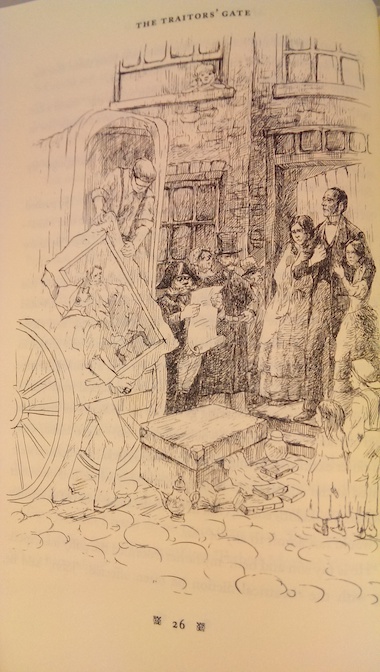
Then, one day, John is called home suddenly because of a family emergency. His family has fallen on hard times, and his father is in debt, so the family’s belongings are being confiscated. His father is summoned to appear in court, and if he cannot find the money to pay his debt, he will have to go to debtors’ prison. John’s father is shocked because he doesn’t actually owe any money to the man who is trying to call in the debt, Finnegan O’Doul.
In spite of this, John and the rest of the Huffam family must spend the night in the bailiff’s sponging house, the Halfmoon Inn. There, John’s father again promises John that there is no debt between himself and Mr. O’Doul. He even says that he doesn’t really know O’Doul, although John doubts him. It seems like his father has had dealings of some kind with the man that he wants to keep secret.
John’s father, Wesley Huffam, was originally from a fairly well-off family, but all the family’s money ended up going to a great-aunt instead of to him (possibly because it became obvious to his relatives that he had little skill at handling money in the first place). John’s father is resentful toward the great-aunt, Euphemia Huffam, for inheriting when he thinks that, as a man, he should have been first in line for the family’s money. However, with this enormous (although possibly false) debt hanging over his head, he may be forced to appeal to Great-Aunt Euphemia for help. He persuades John to go and visit Great-Aunt Euphemia on his behalf, since he is not allowed to leave the sponging house for now and the past quarrels between him and his aunt would make it unlikely that his aunt would want to see him. John is beginning to realize that there are pieces of his father’s life and their family’s past that have been kept from him, and he doesn’t like the idea that his father has been deceiving him, but with their family in such a desperate situation, he agrees to visit Great-Aunt Euphemia.
The bailiff, John’s mother, and Brigid all agree that John is going to have to be instrumental in solving their family’s problems. Of all the people in his family, he is the most practical, in spite of his young age. His father is an impractical man, stuck in a vision of his family’s former glory (and his aunt’s current money, which he does not share in) that doesn’t fit their current circumstances. John’s mother thinks that her husband’s job as a clerk for the Naval Ordinance Office doesn’t provide enough money for the family to live on, even though he earns more than twice what typical London tradesmen of the time do. The real problem is that the family doesn’t live within its means (it is eventually revealed that Wesley Huffam has been withholding money from his family that he uses for gambling), and John’s father’s snobbish attitude because he thinks of his family as being more grand than the commoners around them alienates people who might otherwise be friends and help them. John knows that he’s young, and he’s not completely sure what he can do to help his family, but he knows that there is no other option but to try. In the process, he learns quite a lot about life, himself, the people in his family, and the wider issues in the world around him, including some political intrigue that hits uncomfortably close to home.
Great-Aunt Euphemia agrees to see John when he comes to her house, but their first meeting doesn’t go very well. Great-Aunt Euphemia is ill (or says she is), and she bluntly tells John that his father was always bad with money. She is not at all surprised that he is in debt and needs her help. John gets upset at the bad things that Euphemia tells him about his father, and she gets angry when John tells her the amount of the debt. At first, John is sure that she will refuse to help them completely, but Euphemia tells him not to assume anything but that he should come back the next day. Her eventual contribution to helping John’s family in their troubles comes in the form of a job for John.
As John moves around the city, he gets the feeling that he is being followed, and he is. One of the people following him turns out to be Inspector Copperfield (or so he calls himself) from Scotland Yard. When John confronts him, the inspector seems to have a pretty good idea of the difficulty that his family is in and what John himself has been doing. John asks him why he cares, and the inspector says that John’s father is suspected of a crime and that John had better learn more about what his father has been doing and share that information with him. John doesn’t believe that his father could be a criminal, but the accusation is worrying because he knows that his father is hiding something (his gambling addiction isn’t the only secret he has).
The other person following John is a young girl in ragged clothes. The girl, who calls herself Sary the Sneak, approaches John herself, freely admitting that she’s been following him. In spite of her young age, Sarah (or Sary, as she is frequently called) lives on her own and must support herself because her mother is dead and her father was transported to Australia. People don’t often notice a young girl on the street, so sometimes people will pay her to follow someone and provide information about them. The reason why she tells John about it is because she isn’t above playing both sides of the street; sometimes, she gets the people she’s been following to pay her to provide them with information about the people who hired her to spy on them. She considers it even-handed. However, John has no money to pay her for information and finds her spying distasteful, so he doesn’t want to take her up on the offer at first.
However, John does a little spying of his own when his father sneaks away from the Halfmoon Inn, which he is not supposed to do. He follows his father to a pub called the Red Lion, where he witnesses his father gambling with money that he had claimed not to have. More than that, he sees his father arguing with a man who turns out to be O’Doul, another gambler. To John’s surprise, his teacher also shows up and seems to know O’Doul. When John later confronts his father with what he saw at the Red Lion, all his father will say is that he is carrying a fortune around in his head. Later, John overhears the bailiff speaking with someone else, an Inspector Ratchet from Scotland, saying that it appears that Wesley Huffam may be a traitor involved with spies and that the Inspector Copperfield who spoke to John earlier was an imposter, probably also a spy.
Could it be true? Is John’s father really a traitor, selling naval secrets from his job? If so, who can John trust? Conspirators seem to be around every corner, and John has the feeling that the people who are closest to him may be the biggest threats.
The book is currently available online through Internet Archive.
Daily Life in a Victorian House by Laura Wilson, 1993.
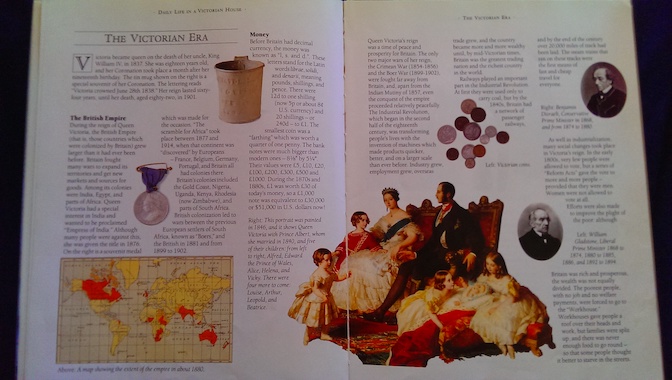
The book begins by giving some background on the Victorian era, which lasted from 1838, when Victoria became Queen of England, to Queen Victoria’s death in 1901. It was a time of expansion and colonization for the British Empire. Society was becoming increasingly industrialized and urban, although there was still great inequality about who had voting rights, and there were great gaps between rich and poor people.
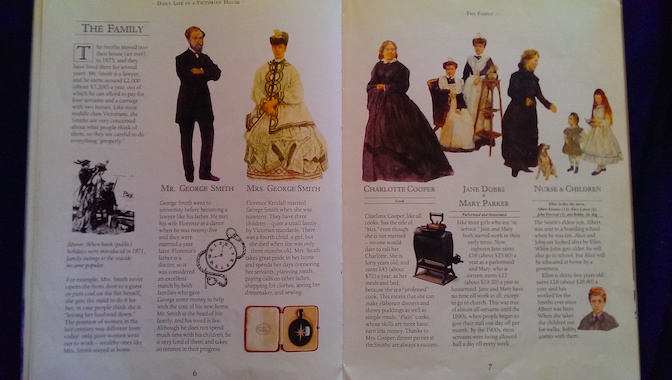
To explain what a typical day might be like for people living in the Victorian era, the book introduces a fictional upper middle class family, the Smiths. It explains some of the background of the Smith family and the members of the Smith household. Mr. George Smith, the head of the household, is a lawyer. His wife, Florence, does not need to work, so she spends her time overseeing the household servants, managing the household accounts (how much money is needed for household expenses such as food, clothes, and supplies), visiting friends, and shopping. Mr. Smith’s income is good enough to afford for the family to have a cook, two maids, and a nurse to look after the youngest children in the family.
The Smiths have three living children. One of their daughters died in infancy, which was sadly common for that era. The eldest boy in the family, Albert, spends most of his time away at boarding school. The two youngest children, Alice and John, are cared for by their nurse. When John is old enough, he will go away to boarding school, like Albert, but Alice will probably be tutored at home. Their parents spend surprisingly little time with them, even in the general course of a day.
There is a map of the Smiths’ house, and then the book begins explaining what each of the members of the house do at different times of the day. Each day, the servants are the first to get up because they need to light the fires to heat the house and start cleaning and making breakfast, which would be a large meal.
Something that I thought was interesting was that the cook typically purchased food from tradesmen who sold their goods door-to-door. This was also important to the maids, who are in their teens, because they worked such long hours that they really wouldn’t have had time to get away and met young men in any other way. Their suitors would likely be the young tradesmen. Of course, the young tradesmen would have met many young female servants at all of the households they visited during their daily rounds.
The maids would have spent their days cleaning, tasks that would have been more time-consuming without more modern inventions. Vacuum cleaners were invented toward the end of the era, in 1899. Cooking was also a time-consuming job, although the book does explain some innovations for the Victorian kitchen. Because Mrs. Smith had servants to do all of her cooking and cleaning for her, she never even went into her own kitchen at all. It was considered improper for a lady with servants to handle menial tasks herself, and the servants wouldn’t have welcomed her interference in their work.
I liked the sections of the book that explained about the lives of children in the Victorian era the best, although I was surprised at how little time children from well-off families would have spent with their parents. Generally, young children would see their parents in the morning for prayers and spend about an hour with their mother in the late afternoon. Other than that, they would spend most of their time in the nursery with their nurse, who would take care of them and didn’t welcome much parental interference any more than the cook would welcome the lady of the house supervising her work.
I also liked the sections about toys and games and entertainment as well as the description of what young Albert’s life would have been like at boarding school. The book also explains what life and childhood were like for less fortunate people during the Victorian era.
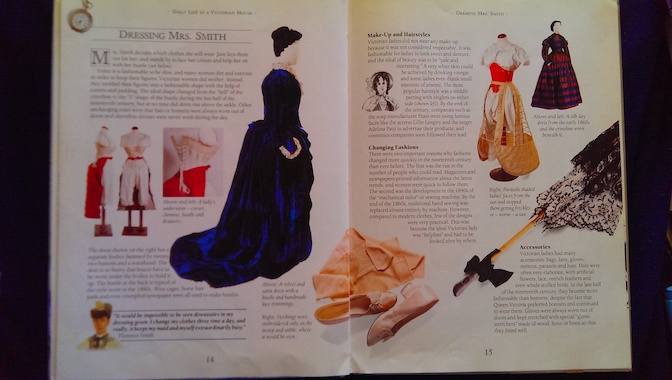
Overall, I really liked this book. It’s a good introduction to Victorian history and life, and it does one of the things that I really wish adult books would do more often: have pictures. Pictures really are worth a thousand words, and actually showing the objects that people of this time would have used in their daily lives is far more effective than pages of lengthy descriptions of them in words only.
The book is currently available online through Internet Archive.








 Jestress's Forgotten Books and Stories