Disappearing Acts

Herculeah Jones

Disappearing Acts by Betsy Byars, 1998.

Herculeah’s friend, Meat, decides to take a comedy class at a local comedy club called Funny Bonz.  While he’s at the club for his class, he finds a dead body in the men’s restroom.  He quickly runs to get help, but when the club’s owner (who is also the teacher of the class), Mike Howard, goes to check, the body is gone.  It happens to be April 1st, so everyone assumes that it was just an April Fool’s Day prank.  However, Meat is sure that what he saw was a real dead body.

He tells Herculeah what happened, and he also remembers that he has proof of what he saw: a blue wallet that he picked from the floor near the body.  The ID in the wallet says is for a woman named Marcie Mullet.  Meat never got a clear look at the identity of the body because it was lying face down, but he remembers that it had a ponytail, so they assume that it was Marcie.  Marcie was supposed to be a student in the class, too, but she never showed up.  Meat and Herculeah assume that the body must have been Marcie.

However, Herculeah is somewhat preoccupied by something else.  She’s been getting strange vibes from a camera that she bought at a secondhand shop.  The camera was cheap, only a dollar, and there’s still a partially-exposed roll of film inside.  The camera was a great deal, but Herculeah’s hair is frizzling, and she senses danger approaching.

When she develops the film left in the camera, she realizes that the camera had once belonged to Meat’s mother, and the pictures show Meat’s father.  Meat has very little memory of his father because his parents separated when he was very young, and his mother has refused to talk about him for years.  Herculeah knows that Meat badly wants more information about his father, but she hesitates to show him the pictures because she doesn’t think that he’ll like what he sees.  He’s imagined that his father could have all kinds of cool professions, and she doesn’t know how he’ll react to his real one.

Self-perception is also very important to the solution to the murder.  Meat is the first to learn the killer’s true identity and is able to get the killer to confess and confide in him.  The killer was tired of the victim’s mean-spirited jokes, all of which were about the killer, who is fat.  The murder was unintended; the person just snapped when the victim gloated about using the mean-spirited comedy routine to become famous.  Meat understands how the killer feels because he hasn’t had a very good perception of himself and knows what it’s like to be fat.  There is a series of fat jokes in this part of the book, the meanest of which (the killer quoting the victim) are about a fat woman’s bra size.

When his father’s true identity is revealed, Meat is actually glad, which surprises Herculeah.  Meat’s father is very different from what he had imagined, but oddly, finding out that his father is a professional wrestler gives Meat something new to aim for.  Meat is sometimes self-conscious of his large size, but seeing his father makes him realize that he can change his fat to muscle and be really impressive.  The two of them meet, and Meat’s father apologizes for leaving so suddenly when Meat was young.  He explains that, much like his own father, he has trouble living anywhere for very long.  His own father had similarly abandoned his family when he was young.  Both of them just reached a point when they had an irresistible urge to pick up and move on.  However, Meat’s father makes it clear that he really does love him and is proud of him and says that he will continue to see him.  It’s a strange explanation, but Meat accepts it and forgives his father.

This book is available to borrow for free online through Internet Archive.

Who’s Haunting the Eighth Grade?

Junior High Series

JHHaunting

#13 Who’s Haunting the Eighth Grade? by Kate Kenyon, 1988.

A group of eighth graders are going on a field trip to see a Shakespeare play in another town, but right from the start, everything seems to be going wrong. The teachers who are accompanying them on their trip are in a foul mood and spend a good part of the trip arguing with each other, which bothers the kids because they know that the teachers have recently become engaged to each other. Then, the bus breaks down in a small town before they can reach their destination.  The entire class is going to have to spend the night somewhere in the small town.

At first, things look like they’re going to improve when the group decides to spend the night at a local bed and breakfast in a big, beautiful, old house. However, their spirits are almost immediately dampened again when they are told that the house is haunted and that anyone who tries to stay there is scared away by the ghost. Still, they proceed with their plan to stay there in order to avoid staying at the dumpy local motel, the only other choice of accommodation.

Needless to say, before the night is over, the ghost puts in an appearance, and strange things start to happen.  By then, the students have come to feel sorry for the owner of the bed and breakfast, a nice older lady who grew up in the house but can’t really afford to keep it unless she can make her inn a success. Can the eighth graders catch the ghost, stop the hauntings, save the bed and breakfast from having to close, patch up the relationship between their feuding teachers, and still make it in time to see the play?

The book takes place in the 1980s, and the kids in the story are 14 years old. They mention the decade somewhere during the course of the story, and the descriptions of the clothes and some pop culture references make the time period fairly obvious. It also has some of the stock characters that books for pre-teens and early teens in the 80s have (ex. a boy-crazy space cadet, a level-headed health nut, a class clown, and a couple of young punks). Still, even though there are some things about the book that are a bit dated, it is still pretty enjoyable. The author has a sense of humor, and she plays with the characters’ stereotypes a bit. The class clown is secretly quite sensitive and even a bit perceptive. There are also a couple of fun scenes when the girl who is only interested in boys is shocked to discover that the boys are more interested in the mystery than in her.

Ghosts in the Gallery

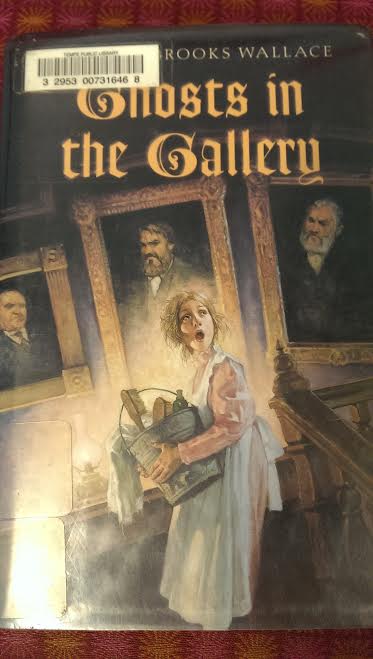
ghostsgalleryGhosts in the Gallery by Barbara Brooks Wallace, 2000.

Eleven-year-old Jenny was raised in China by her mother and stepfather, who ran a dance studio. She has no memory of her real father, who died when she was a baby. When her stepfather dies and her mother becomes deathly ill, her mother writes a letter to her real father’s father, a grandfather that Jenny never even knew existed before. In the letter, her mother explains that she is dying and that she will be sending Jenny to live with her grandfather. Then, Jenny starts the long journey from China to the East coast of the United States alone.

Leaving her dying mother to head to a strange country to live with her previously unknown relations is frightening enough, but there is still worse to come. When Jenny arrives at her wealthy grandfather’s home, no one is expecting her or knows who she is. Her uncle, Winston Graymark, insists that her mother’s letter never arrived. Worse still, he believes that Jenny is an imposter, and that her mother merely made up the story about his long-lost brother being her father.

At first, he angrily threatens to send Jenny back to China, but Madame Dupray, a servant who cares for Jenny’s ill grandfather, suggests that she be taken on as a household servant. Jenny is given a dreary little room in the cellar and embarks on the drudgery of household chores. Could the Graymarks really be her relatives? If so, what happened to the letter that Jenny’s mother sent? Something sinister is happening in Graymark House, and Jenny will have to face suspicious servants and attempted murder before she finds the truth.

The “ghosts” in the title are the portraits of Jenny’s ancestors, which hang in the gallery. They appear grim and frightening at first, but when Jenny begins to recognize them as her relatives, they no longer frighten her.  Like many of Wallace’s books, this book contains sinister characters with hidden motives, but ends happily.  The story takes place at some point during the Victorian era.