Madeline in London

This book is part of the Madeline series about a little girl at a small boarding school in Paris. The son of a Spanish Ambassador, Pepito, lives next door to the girls. He’s a menace to them at first, but the girls make friends with him. However, in this book, Pepito moves to London because his father has been relocated for his job.

When Pepito and his parents go to London, Pepito is unhappy there because he’s lonely for Madeline and the other girls from the boarding school. With Pepito growing thin and depressed from his unhappiness, Pepito’s father arranges for the girls from the boarding school to visit for Pepito’s birthday to cheer him up.
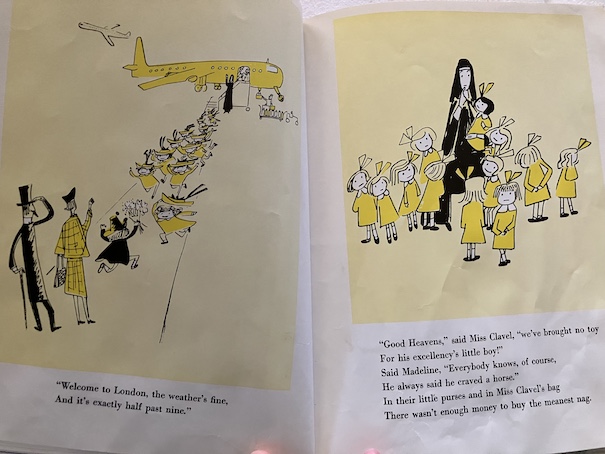
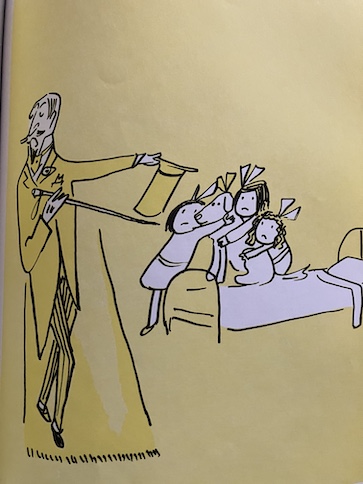
When Miss Clavel and the girls arrive in London, there’s a happy reunion, but then, they remember that they didn’t bring Pepito a present for his birthday. Madeline remembers that Pepito has always wanted a horse, and they find an old, retired army horse who is still healthy and gentle.

However, when they give the horse to Pepito, they quickly discover that there are complications to owning a horse as a pet. The horse hears a trumpet, and reacting to his army training, he runs off with Pepito and Madeline on his back to join a parade.
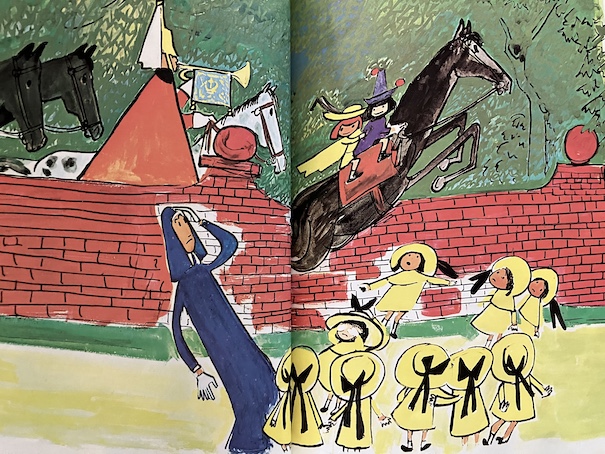
Then, they forget to feed him, so he eats everything in the garden, making himself sick. It seems like the embassy in London is no place for a horse, but Madeline and her friends may have room for one at their school!

The book is available to borrow and read for free online through Internet Archive (multiple copies).

Giving someone a horse for a present without checking with their parents or making sure that they have what they need to take care of a horse isn’t something that people realistically do, but the Madeline books rarely worry about the practicalities of a situation. It’s all fun and adventure!

I was seriously worried about the horse after they forget to feed him and he helps himself to random plants in the garden, especially when they find him with his feet up in the air. Fortunately, everything works out okay, which is characteristic of Madeline books, too. How the trustees of Madeline’s school will react when they find out that the girls now have a pet horse, since they raised a fuss earlier about the girls having a dog, is anyone’s guess, but the story doesn’t worry about that, either.

Like other books in this series, the pictures in the book alternate between limited color images, mostly in black and yellow, and full color images.
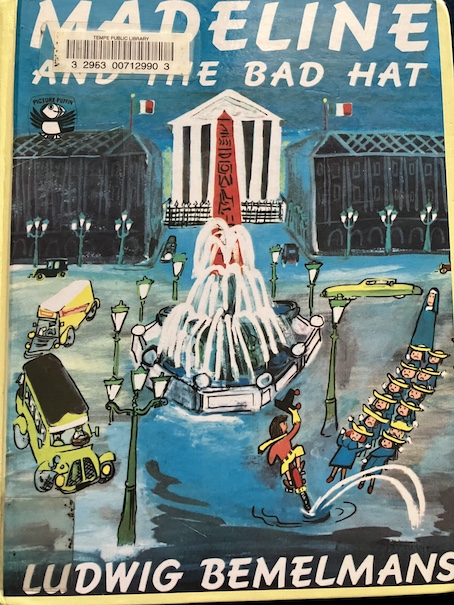
Madeline and the Bad Hat

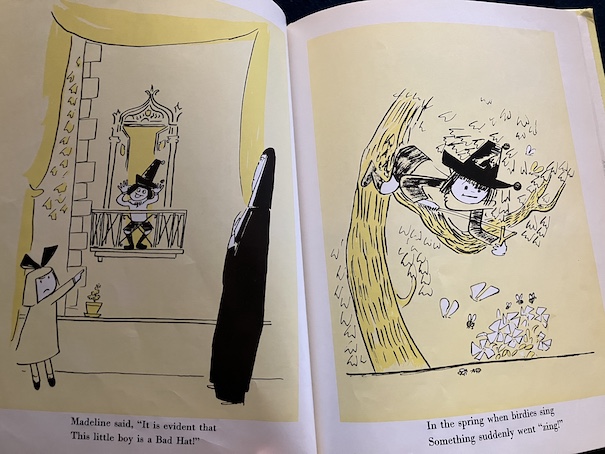
Madeline is a little girl at a small boarding school in Paris. The Spanish ambassador moves into the house next door, and the girls at the boarding school get to know his son. However, his son, Pepito, is a wild boy who Madeline starts calling the “Bad Hat.” He teases the girls, scares them by playing ghost, and worst of all, is cruel to animals.

However, Pepito is actually lonely, and he wants the girls’ attention. He tries to win them over by being polite and doing things to impress them. Unfortunately, his idea of what impresses people can be horrific, like building a guillotine for the chickens the cook will prepare and playing practical jokes.

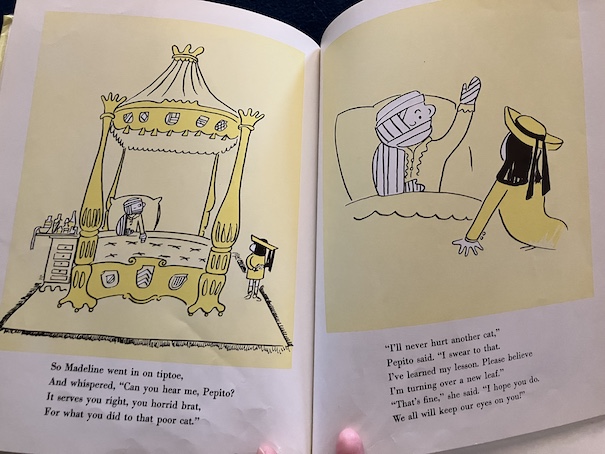
One day, he goes way too far and tries to release a cat into a pack of dogs! The cat tries to evade the dogs by getting on top of Pepito’s head, so the girls and Miss Clavel have to rescue both the cat and Pepito himself from the dogs!

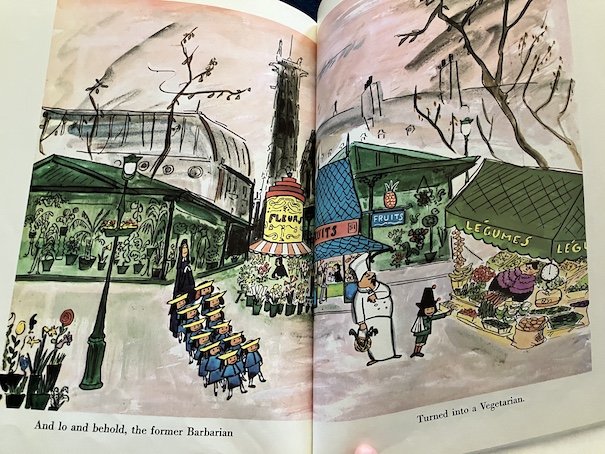
Because Pepito has now gotten hurt himself by one of his pranks, he swears to Madeline that he’s learned his lesson, and he won’t do anything to hurt another animal. He even decides to become a vegetarian!

The book is available to borrow and read for free online through Internet Archive (multiple copies).

I didn’t remember much about this book from when I was a kid. I vaguely remembered that Pepito was a troublemaker who played pranks and teased the girls, but I didn’t remember that he was cruel to animals. Actually, I was kind of horrified by the guillotine for distressed chickens and the cat that he attempted to feed to the dogs.

Pepito only learns his lesson when he gets hurt himself and discovers what it’s like to be on the receiving end of pain. I didn’t mind him showing off a bit or playing pranks like dressing up like a ghost. The cruelty to animals part, though, I found distressing, even as an adult. I don’t think I’d read this book again because of that.

Madeline’s Rescue

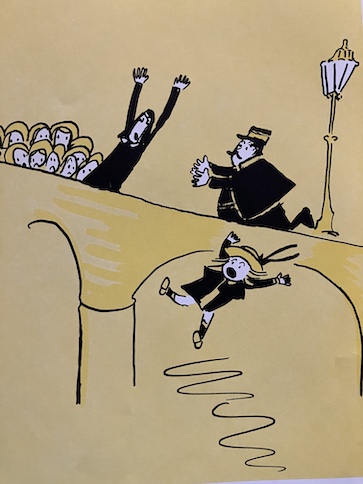
The Madeline stories are considered children’s classics, and this is one of the best-known books in the series. It starts out much like the first book in the series, introducing the old house in Paris where Madeline and her classmates stay for boarding school and describing how brave Madeline is. However, at the part that explains that Madeline knows how to frighten their teacher, Miss Clavel, Madeline falls from a bridge over the river while she’s trying to walk on the edge.

Fortunately, Madeline is saved from drowning by a dog that jumps into the water to save her. Miss Clavel and the other girls take Madeline and the dog back to the school, dry them off and put them to bed. The girls keep the dog and name her Genevieve. Genevieve is a smart dog, and soon, she’s a very pampered and happy pet.

However, when the trustees of the school come for an inspection, they raise a fuss about the girls keeping a dog in the school and turn Genevieve out! The girls are very upset, so they immediately go out and search for Genevieve.

Fortunately, Genevieve returns, and there is a surprise for the girls that finally settles all the arguments they’ve been having about whose bed the dog will sleep in that night!

The book is available to borrow and read for free online through Internet Archive (multiple copies).

As with the other books in the Madeline series, the beginning of the story echoes the first Madeline book, but this one expands on Madeline’s habit of walking on the edge of the bridge and frightening Miss Clavel, showing that Miss Clavel has reason to worry about Madeline’s stunts.

I remember reading this book when I was a kid and being really worried about what would happen to the dog, Genevieve! I always loved dogs, and I was worried about her when the trustees turned her out of the school. After Genevieve returns to the school, there’s no follow-up on how the trustees react and whether or not they approve of her and her puppies staying at the school, but it seems like everything will be okay. With plenty of puppies for the girls at the school, they no longer fight about who gets to sleep with Genevieve or give her attention. Staying at a boarding school where every girl gets a puppy of her own to look after would be a dream for many girls!

Something I noticed in this book is that the style of the pictures varies between cartoon style in black and yellow and a more impressionistic style with full color. This is also true in other Madeline books. The more colorful pictures tend to show more emotional or dramatic moments.

Madeline

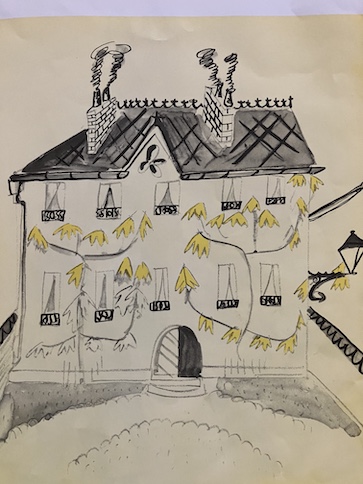
“In an old house in Paris
that was covered with vines
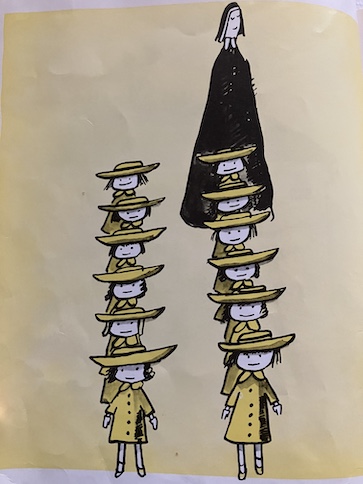
lived twelve little girls
in two straight lines.”

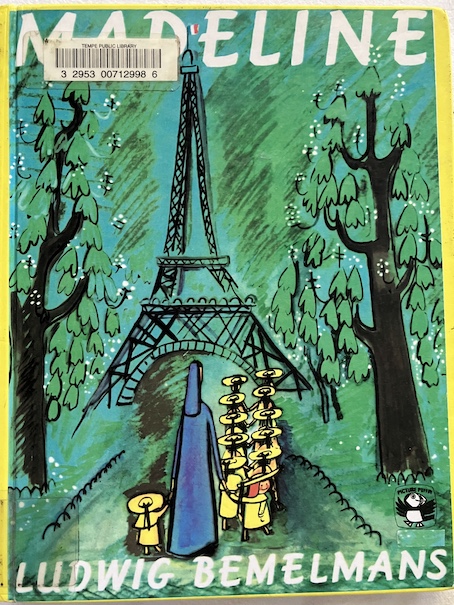
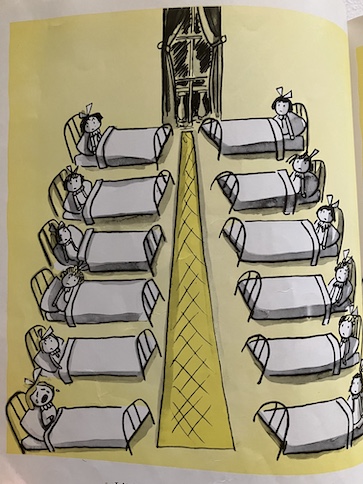
The Madeline stories are considered children’s classics today, and these words, which are the opening lines in other books in the Madeline series, introduce Madeline’s school. Madeline is a little girl who lives in a small boarding school in Paris, tended by Miss Clavel.

Madeline is the smallest girl at the boarding school. She’s a brave girl, who isn’t scared of either mice or lions at the zoo, and she sometimes does daring stunts that frighten Miss Clavel.

One night, Miss Clavel wakes up because Madeline is crying. She calls the doctor, who examines Madeline and rushes her to the hospital because she needs to have her appendix removed.

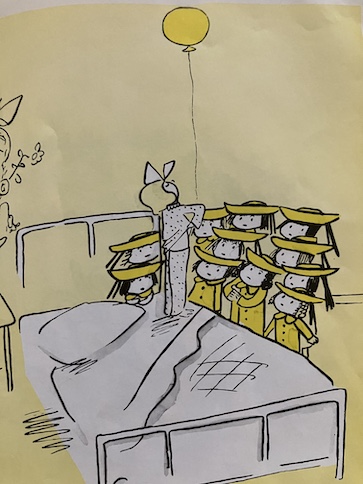
After the operation, Madeline has to stay in the hospital for a while. Miss Clavel brings the other girls from the school to visit her, and they are impressed by all the candy and presents that Madeline has received from her family. Even more impressive, Madeline now has a scar that she shows to the other girls.

After the other girls return home and go to bed, Miss Clavel wakes up to find them all crying. Madeline has made having her appendix out look like so much fun, they all want to do it!

I wouldn’t say that I was a particular fan of Madeline as a kid, but I did read at least some of the books in the series. As an adult, I had forgotten that they were told entirely in rhyme, even though I still sometimes get those opening lines stuck in my head.

I remember thinking as a kid that I wouldn’t want to have my appendix out! Even if you get presents and an impressive scar, having an operation always sounded awful to me. It didn’t occur to me until I was older, but the Madeline cartoons and movie tended to portray Madeline as an orphan, but she isn’t. She’s just a student at a small boarding school. This book is one of the stories that mentions her family, with her papa sending her a dollhouse as one of the presents she receives while she’s in the hospital.

I also didn’t realize, until I was researching this series for the blog, just how old the first Madeline book was. It was originally published in 1939, on the eve of WWII. I don’t think the books ever have anything in them to tie the stories to any particular events, and they seem almost timeless, although I suppose that the girls’ school uniforms are a little old-fashioned. This timeless, idealized portrayal of Paris was popular with the book’s original audience of Americans during WWII.

I was curious about the author, Ludwig Bemelmans. He was born in Austria and grew up in Austria and Germany during the late 19th century and early 20th century. As a young man, he was apprenticed to his uncle, who owned a hotel, but Bemelmans was difficult to manage and got into trouble while working there. He later told a story about shooting and wounding a headwaiter who whipped him, although that might have been just a tall tale. Eventually, however, his uncle decided that he couldn’t deal with him, so he told him he would either have to go to reform school or go to the United States, where his father was living after having left him and his mother years before. He moved to the United States and lived there during WWI. He spent some time working in a series of hotels and restaurants. He eventually joined the US Army in 1917, although they wouldn’t send him to Europe because the US was at war with Germany, and he was German. He became a US citizen in 1918, and he developed an interest in art. He worked as a cartoonist before writing and illustrating children’s books. He wrote the first seven of the Madeline books, and the last one was published after his death. Since then, his grandson, John Bemelmans Marciano has written other Madeline books.