The Lives of Christopher Chant

This is the fourth book in the Chrestomanci series.  In this series, there are many different dimensions, and in each of those different dimensions, there are alternate versions of our world, and there are copies of every person in the world.  Different versions of our world can differ dramatically in their history, and individual people’s lives can differ dramatically between the worlds. There is one person in each generation who has no duplicates in any of the other worlds.  This person is called the Chrestomanci.  All of the talents, abilities, and lives that would have been spread across their duplicates in the other worlds are now centered on that one person, giving that person, literally, nine lives.  The Chrestomanci fills an important role, being better able than anyone else to travel across the dimensions and between worlds, and he acts to keep a balance between them and make sure that the different worlds keep their proper course. This book is about the childhood of the current Chrestomanci, Christopher Chant, and how he came to be the Chrestomanci.

Young Christopher Chant’s early childhood isn’t very happy. His parents have a very unhappy marriage, and his father never pays any attention to him at all. In fact, Christopher hardly even sees him and isn’t confident that he’d recognize him if he met him anywhere. Christopher later learns that his parents’ marriage was one of convenience. His mother has a great deal of money, and his father is from an important family. Christopher’s social-climbing mother wants him to be very important when he grows up. Christopher is mostly raised by a series of nannies and governesses, none of which stay very long. Servants in general don’t stay very long in the Chant household because the parents’ angry bickering and the passive aggressive notes that they force servants to pass to each other when they eventually stop speaking to each other directly make life unbearable. Christopher only learns that this is not how most households are when his nannies and governesses apologize to him before they leave.

Eventually, his parents’ relationship collapses entirely after his father loses a great deal of money, and his father either leaves his mother or is sent away in disgrace. His mother brings her brother, Christopher’s Uncle Rafe, to live with them instead, and she lets Uncle Rafe run the family finances and attend to Christopher’s education. Christopher enjoys having Uncle Rafe in the house because Uncle Rafe is a jolly man and actually pays attention to him, unlike his own father.

Something else that Christopher first thinks is normal but later learns isn’t normal at all are the strange dreams he has. Christopher often dreams of a strange place filled with valleys. Every time he enters one of the valleys, he has adventures there, and people give him presents. He often loses the presents before he returns home, but sometimes, he manages to keep them, waking up with them in his bed in the morning.

One day, the new governess Uncle Rafe hired catches Christopher playing with one of the strange objects and asks him where he got it. When he tries to tell her about his dreams, she doesn’t believe him at first. Thinking that he may have stolen the strange object from somewhere, she takes him before his mother and Uncle Rafe. However, Uncle Rafe does believe Christopher’s explanation. He says that Christopher seems to be a spirit traveler, having the ability to go to other worlds in his sleep, and he is amazed that Christopher was able to bring an object back with him.

Uncle Rafe asks Christopher to try a few tests of his abilities. First, he asks Christopher to look for a man in his dreams and to bring back a package from that man. Christopher does so successfully. The man is called Tackroy, and Tackroy explains more about the other worlds to Christopher. Every valley Christopher sees is a different world. There are series of worlds, and those series of worlds have numbers. The world where Christopher lives is number 12. At first, Tackroy thinks that there are only 12 worlds, but Christopher says that there are many more than that. Christopher can see better in the space between worlds because, as Tackroy realizes, he is actually there physically, where Tackroy can only be there mentally or in spirit. It is because Christopher can go to other worlds physically that he can bring back objects. Tackroy has hardly any substance in these other worlds, being almost like a ghost, until Christopher realizes that he can help make him more substantial. Both Tackroy and Uncle Rafe are excited by Christopher’s abilities.

Then, they decide to do a test of whether Christopher can carry something living from one world to another. Tackroy asks Christopher to get one of the cats from a temple in world 10. When Christopher enters the temple, he meets a young girl, just a little younger than he is. She says that she is the living embodiment of the goddess Asheth, which gives her special powers. However, she is not allowed to leave the temple except once a year to do a blessing, and she can’t interact much with anything or anyone from outside the temple. It’s a very boring life, and she isn’t very happy in it. When Christopher explains to her about wanting one of the temple cats for his uncle, she agrees to give him the most disagreeable cat in exchange for some books from his world because she is so bored. Christopher agrees, and she helps him to capture the cat. Unfortunately, the cat gives him away when he tries to leave the temple. Christopher is actually killed when a temple guard puts a spear through his chest! That is the first indication that Christopher has nine lives.

When Christopher wakes up, he is in his own bed at home, he has no injuries, and he still has the cat. At first, Christopher’s lack of injury makes him think that the other worlds might be a kind of dream after all, but that doesn’t explain how he still has the cat. Then, he has an accident while pursuing the cat in his room that brings down the curtain rod, which stabs him in the chest again! When he screams, the governess rushes in and tends him.

When Christopher wakes up again, he hears the governess and Uncle Rafe talking. The governess has placed healing spells on him, and she thinks he will recover. Uncle Rafe says that the cat from the Asheth temple is very rare and magical and that wizards would pay a lot of money for parts from the cat. Later, when Christopher sees that the cat is pleading for Christopher to let it go, he does so. As much as a he wants to please his uncle, it does seem cruel to kidnap an animal from its own world and take it to another to be killed and have its parts sold off, even if it’s a mean cat that almost got him killed. When the governess looks for the cat later and can’t find it, Christopher just reminds her that it is a magical cat, so she supposes that it just vanished.

Then, unexpectedly, Christopher’s worried father comes to see him without his mother’s knowledge. His father tells him that he had placed a spell on Christopher to monitor his life, and it seemed like the spell had told him that Christopher was dead. Christopher assures him that he’s fine. His father is relieved, but he is also still worried. He tells Christopher that he did Christopher’s horoscope and that the next year and a half will be dangerous for him. He also warns Christopher that his Uncle Rafe isn’t a nice person and that he should avoid getting mixed up in his business.

In spite of his father’s warnings, Christopher continues to participate in his uncle’s experiments in other worlds with Tackroy. Tackroy apologizes to Christopher profusely for the incident with the spear, saying that he would have felt horrible if Christopher had been killed. It becomes clear that Uncle Rafe’s “experiments” involves a business collecting and selling rare objects from one world to people in another. As Christopher helps Tackroy with it, the two of them become friends, and they enjoy exploring and learning about other worlds.

Things change when Christopher is sent to boarding school. He likes school and making his first friends with other boys. He does well in most of his subjects, although strangely, he can’t seem to do any magic in his magic lessons. It’s strange because Tackroy had told him that he’d probably be really good at magic because of his ability to travel through worlds. He hates to give up on magic studies because he really does want to learn more about magic.

Remembering his promise to bring some books to the goddess girl, Christopher asks a school friend with a sister for advice about what girls like. He buys a set of books about a schoolgirl called Millie. Unfortunately, he can’t seem to travel in his dreams at school, like he did at home. His uncle becomes impatient with him for not keeping his appointments with Tackroy, too. Christopher can’t think what’s wrong. Was there something special about his night nursery at home? Is he growing out of his old abilities?

When the school matron notices that Christopher is having trouble sleeping, she removes the new braces that he had put on his teeth, thinking that they’re causing him pain. Suddenly, Christopher is able to travel in his dreams again. He is able to deliver the books to the goddess girl and rejoin Tackroy in their work in the other worlds. Then, another accident that kills him again reveals his secret, extra lives to everyone, including his parents.

At first, it’s difficult to prove that Christopher has multiple lives, and his parents (of course) argue about what to do about it. After learning that Christopher’s mother secretly plans to take him abroad, Christopher’s father quickly removes him from his boarding school and takes him to Cambridge to be tested by an expert. In spite of his earlier apparent neglect, Christopher’s father does care about him, and for Christopher’s own good, needs to confirm a few things that he has already suspected about Christopher. The expert not only discovers the reason why Christopher was unable to perform magic in class (a sensitivity to silver that shuts down his powers whenever he comes in contact with it) but also proves that Christopher is a rare, nine-lived enchanter. Being one of those rare enchanters means that Christopher is destined to become the next Chrestomanci!

Christopher is shocked and dismayed when he is immediately made the ward of the current Chrestomanci, Gabriel DeWitt, and sent off to Chrestomanci Castle. It’s really the best place for him to learn about his new-found abilities, but Christopher fights it. DeWitt embarrasses him by telling him things about both of his parents and why neither of them is really suited to be his guardian. It’s all true, but that only makes it more embarrassing.

Christopher is lonely as the only child in Chrestomanci Castle, and while he is considered very important, nobody there seems to consider his feelings at all. Nobody cares that he would rather be a professional cricket player than a Chrestomanci! If it wasn’t for his natural abilities, which were just an accident of birth, nobody would have any interest in him at all. Also, even the heavy enchantments of Chrestomanci Castle can’t seem to stop the series of bizarre accidents that begin robbing Christopher of his extra lives. The only person who seems to understand Christopher is his secret friend, the goddess girl in world 10. Like Christopher, she is also a prisoner in her temple, being used by other people for her abilities but not really cared for as a person. More than anything, she wishes she could be an ordinary girl, like the girls in the books Christopher brings her, going to school and having friends.

Christopher wants to keep on working with Tackroy for his uncle because he loves exploring the other worlds and because it gives him some freedom from his life in Chrestomanci Castle, but Tackroy points out that his uncle has also been taking advantage of him. His uncle is getting rich off their activities, and he hasn’t even been paying Christopher for making them possible. Tackroy now knows that Christopher has died or nearly died more than once for his uncle’s business. Christopher has been getting deeply involved in something he doesn’t fully understand. The full truth is going to hurt, but Christopher needs to see it to save the lives he has left and realize his proper place in the world(s).

The book is available to borrow and read for free online through Internet Archive (multiple copies).

Some book lists place this book first in the Chrestomanci series because, if you follow a linear timeline of events in the stories, it does come before the other books, but it was originally the fourth book published, and I think it’s best to read the other books first, especially Charmed Life. The books in this series are fantasy, but they’re also mystery stories. There are secrets to be revealed in every book, and if you read this book first, it spoils some of the mysteries in Charmed Life.

It is a good book to read, though, because it provides some of the missing backstories of some of the other characters. At the end of Charmed Life, Christopher (as the current Chrestomanci) tells Eric/Cat about how he found out that he had nine lives and that he was going to be a Chrestomanci even though he couldn’t cast spells at first. His sensitivity to silver is a part of the story, and the way it is revealed in this book matches his earlier description in Charmed Life.

During the course of the book, we also learn a little more about the extended Chant family and get brief glimpses of Christopher’s cousins, who later go on to marry each other and become the parents of Cat and Gwendolyn Chant. The Chants are known for being a powerful magical family that produces enchanters, who are much more powerful than ordinary witches. Once every generation, they produce a disreputable one, which happens to be Christopher’s father in this generation. Christopher’s father is an enchanter, so he’s more powerful than general witches, but not nearly as powerful as Christopher. He has an over-reliance on the horoscope charts he draws, and they don’t always turn out right.

Christopher’s mother and his Uncle Rafe are part of the Argent family, which is also magically powerful but has a bad reputation. DeWitt doesn’t even specify at first what they are known for, only that he would never associate with them. It’s Christopher’s father, who does care about his son even though he doesn’t really know how to care for him, who points out that “Argent” means “silver”, and this is part of the reason for Christopher’s sensitivity to the metal. The Argent family, including his mother, and especially his Uncle Rafe, are toxic to Christopher in ways that he doesn’t fully understand and finds difficult to accept. Christopher’s mother doesn’t actually mean him any harm, like his Uncle Rafe does, but she is foolish and easily swayed by Rafe. Christopher comes to forgive her because he was also tricked by Uncle Rafe into doing his evil business when he was too young and naive to understand.

We also learn the origins of Christopher’s future wife, Millie, in this book. She is very powerful in Charmed Life, but this book explains why she is so powerful. One thing that I don’t think is adequately explained is how Christopher’s children, Julia and Roger, are not Chrestomancis themselves. After all, there is only one of their father, so I think it should be assumed that there are no duplicates of either of them in the other worlds, but they may be exceptions somehow because there was never a chance that they could have had duplicate selves or because their mother is actually the incarnation of a goddess.

The books in this series blend dark parts with some humor, which make the books lighter to read than they otherwise would be. Because of the dark parts, I wouldn’t recommend these books for anyone younger than the middle school level. Christopher does get killed multiple times in the book (although he still has extra lives left at the end), and there is trading in human lives and souls. The goddess girl, who takes the name of Millie, comes to realize that she is meant to be sacrificed when she gets too old to be the young incarnation of the goddess, which is a horrifying revelation. She runs away to Christopher’s world and begs him to help her go to a boarding school, like in the books she likes to read. Her goddess’s followers pursue her to Christopher’s world, and there is more bargaining for her life. Fortunately, the old priestess who has been caring for her is not as heartless as it seems at first. When she finally meets with the girl in front of Gabriel, she admits that she usually finds a way of sparing the young goddess incarnations, buying their lives with one of the nine lives from the temple cats. She has to do it in secret, but she has saved up enough money in jewels to pay for Millie’s education where she can be safe in this other world. To spare Christopher and the cats the children love from losing their lives, Gabriel kindly gives the priestess one of his own spare lives because he still has several lives left. He also accepts the responsibility of having Millie as his ward and arranging for her education.

Through his adventures and having to take charge as the Chrestomanci and rescue Gabriel when he is in trouble, Christopher comes to more fully understand what it means to be the Chrestomanci. He also comes to understand Gabriel a little better. He is surprised to realize that Gabriel has hated the job of Chrestomanci. Like Christopher, he also felt forced into the role and resented it, but he made himself do the job anyway because it is a vital job for the protection of his world and others. To Christopher’s even greater surprise, he realizes that when he does the job for real instead of just having boring lessons, he actually likes the job much better than Gabriel does and no longer resents being trained for it. Gabriel has also realized how lonely and isolated Christopher is, and he says that he is taking steps to bring other young magicians to the castle to work and be trained, so Christopher will have companions. The story ends happily, and there is even a reconciliation between Christopher’s parents.

The Magicians of Caprona

The Magicians of Caprona by Diana Wynne Jones, 1980.

This is the second book in the Chrestomanci series.  In this series, there are many different dimensions with different worlds, and in each of those different worlds, there is a copy of every person.  Different versions of our world can differ dramatically in their history across the dimensions, and individual people’s lives can differ dramatically between the worlds. There is one person in each generation who has no duplicates in any of the other worlds.  This person is called the Chrestomanci.  All of the talents, abilities, and lives that would have been spread across the other worlds are now centered on that one person, giving that person, literally, nine lives.  The Chrestomanci fills an important role, being better able than anyone else to travel across the dimensions, and he acts to keep a balance between them and make sure that the different worlds keep their proper course. This book begins with a brief explanation, although most of this was established in the first book in the series, Charmed Life.

In the world where the Chrestomanci lives, magic not only exists but is a known and accepted profession, and society is a little more old-fashioned than in our world. Also, there is a kind of alternate history, and some of the countries are organized differently. This story is set in Italy, which is not a unified country in this world, but a series of small dukedoms. The Chrestomanci series is a somewhat loose series, meaning that, while Chrestomanci appears in the different books and always plays some kind of role, he is not always one of the main characters. This story sets up a Shakespearean kind of feud between two families.

The dukedom of Caprona is known to having the best spell-makers in the world. The problem is that the best spell-makers belong to two particular families, the Montanas and the Petrocchis, who have a long-standing feud. The adults in the families never explain how, exactly, the feud started. They just warn the children to avoid to avoid the children of the other family. When members of the two families meet in public, they usually ignore each other, although sometimes fights break out. The fights are particularly bad when they use magic. Locals and tourists alike are alarmed by these fights and get out of the way to avoid being caught up in them.

Because the adults don’t talk about the cause of the feud, the children of the two families tell each other stories about it. In the Montana family, the children say that it started because the Duke of Caprona favored their family over the Petrocchis. The children also tell each other stories about the other family’s atrocious habits. Young Rosa Montana particularly likes telling her siblings and cousins scandalous stories about how the Petrocchis never bathe and sometimes kill their unwanted babies or eat their own family members. Because the members of the two families almost never see each other, the other Montana children can only suppose that the stories they hear about the Petrocchis are true.

When young Tonino Montana starts school, he is very upset. Things don’t seem to come as easily to him as they do to his siblings and cousins, and he feels awkward when the teacher tells him to do things differently from the way he’s always been taught to do them or repeats things that he’s already learned. When Tonino runs off into the city by himself because he’s upset, the rest of his family worries about him. Old Niccolo, the head of the family, talks to Benvenuto, the head cat in the Montana household, about Tonino. The Montana family keeps cats, who help them at their spell-making, but not everyone in the family has the ability to talk to the cats and understand them. Old Niccolo can communicate with the cats, but even Tonino’s father, Antonio, can’t. Benvenuto tells Niccolo that he will look after Tonino and not to worry about him. Tonino, like Niccolo, can talk to cats, and he hasn’t fully appreciated the talent yet.

Benvenuto becomes Tonino’s special friend. He helps Tonino to understand that, like the kittens he talks to, he’s still young and learning. Tonino needs to give himself time to develop. Benvenuto also tells Tonino that it’s fine to tell his teachers what he already knows, and Tonino comes to realize that he is far ahead of the other students in some ways, having already learned to read. His talent for talking to the cats also gives him a special place in his family. Benvenuto also allows Tonino to give him brushings, which he would never allow from any other family member before, so he becomes more well-cared for.

As time goes on, however, Tonino comes to realize that the adults in the Montana family are worried about the state of their family and the state of Caprona itself. Other dukedoms around them are becoming more powerful, and some of the old spells that the two families made to protect Caprona are breaking down. Of course, the Montanas blame the Petrocchis for the weakness of the spells and for not maintaining them properly, but Tonino realizes that the old Montana spells are breaking down as well. It’s not, as the older Montanas said, that they have had to bear the weight of making up for the weak Petrocchi spells.

Tonino gets his first look at the Petrocchis when both families are summoned to the duke’s palace to discuss the state of their spells and the rival states that are seeking to conquer Caprona. Speaking together for the first time in a long time, both families come to realize that, even though they have separately been working to make their spells stronger, each year, the protective spells they cast on Caprona have been getting weaker. There is a rumor that there is an evil enchanter who has been working against them on behalf of their enemies. Naturally, both Petrocchis and the Montanas secretly suspect each other of being involved. They also can’t help but notice that something is seriously wrong with the duke himself. He seems strangely childlike, and his wife seems to be running everything.

The Montana family offers a solution that even they aren’t sure they can fulfill. There is an old story that all of the children know about an angel who once protected Caprona with a magical song. Everyone thinks that, as along as the song is sung, Caprona will be safe. The children learn this song in school, but what they don’t know is that the words they learn to the song aren’t the original words to the song. The tune is original, but the original words were lost to time. The Montanas know that the song is a powerful spell, but it won’t function correctly until the original words to the song are restored. In their pride against the Petrocchis and their worry about the state of Caprona, the Montanas have pledged that they will find the original words to the song. Also, naturally, the Petrocchis have promised the same. Neither family knows exactly how they will do that, but they are each determined to somehow do it before the other family can.

There is only one person both of the families accept and who can work with either family without earning the resentment of the other: Chrestomanci. The situation is serious, war is pending, and Chrestomanci has also been summoned for help. As the most powerful enchanter in the world, he has the respect of all sides. Since Chrestomanci is British, he admits that he is somewhat limited in how far he can interfere in Italian affairs. His main interest is in the evil enchanter and their misuse of magic, although he will help Caprona and his friends in the magical families, if he can.

Chrestomanci notices that, aside from being able to talk to cats, Tonino also has an ability to tell when someone is an enchanter without being told. Chrestomanci says that he needs to go to Rome to make some inquiries, and he asks Tonino to stay close to his grandfather when his grandfather has to meet with anyone, to see if he can spot the evil enchanter. However, the evil enchanter already knows too much about the two families and about Tonino in particular.

When Tonino is kidnapped by the evil enchanter, his family immediately blames the Petroccis and sets out to confront them … only to be met halfway by the Petrocchi family, on their way to confront the Montanas about kidnapping one of their children, Angelica. The feud between the two families becomes worse than ever, but an accidental encounter between Tonino’s brother Paolo and Angelica’s sister Renata reveals that neither family has kidnapped anyone. The evil enchanter is playing both of the families against each other to distract them from what they really need to do: find the children and prepare to defend Caprona from its enemies. Paolo and Renata have trouble convincing either of their families of the truth because they are already too convinced that the other family is their real enemy, so they struggle to figure out how to save Tonino and Angelica themselves.

Meanwhile, Tonino and Angelica team up in captivity to find a way to escape and tell their families where to find the secret words to the angel’s song. While they are being held captive together, Tonino and Angelica argue about the nature of their families, but by talking together, they come to realize that each of their families has held half of the answer to the problem all along. If only the children can get together and reach their families to tell them the truth about the angel’s song and the identity of the evil enchanter!

The book is available to borrow and read for free online through Internet Archive (multiple copies, including some in different languages).

My Reaction

During the course of the story, we never learn the original cause of the feud between the two families. It might have been something with one family thinking that the other was being favored by a past duke, or maybe it was some private quarrel between the heads of the two families. The cause is less important than the result. For generations, each family has been quietly maligning the other to the children of the family, who have continued to pass on the stories.

When the younger members of both families finally meet and talk to each other, they are initially offended that the other family has been saying the same horrible things about them that they’ve been saying about the other family, but it’s also an eye-opening experience. The two families are actually very similar to each other, both in their professional work and in their private family life. In fact, they live nearly identical lifestyles. The fact is that both families have been contributing to the spells maintaining their city for centuries, working together since before their feud began. Their spells were always intertwined and made to work together. Since the feud started and the families stopped working together, they have still had to work together in the service of their city and duke, but the feud has also served as a distraction from the real sources of danger.

As with other Chrestomanci stories, Chrestomanci doesn’t solve all of the problems of the story himself. Instead, he acts as a helper, revealing key information and providing guidance to help the other characters to solve their own problems. As a neutral observer, Chrestomanci sees both of the families and their quarrel for what they really are. He also helps to reveal the true villain of the story for who they really are.

Chrestomanci also points out the hidden talents of the children in the story. Although Tonino doesn’t think he’s as good as magic as others in his family, he does have other talents and magical abilities. At the end of the story, he goes to England with Chrestomanci to study for a while. His adventures in England are part of one of the short stories in Mixed Magics.

Charmed Life

This is the first book in the Chrestomanci series.  There are many different dimensions with duplicate worlds, and in each of those duplicate worlds, there is a copy of every person.  People’s lives can differ dramatically between the different worlds, but there is one person in each generation who has no duplicates in any of the other dimensions or worlds.  This person is called the Chrestomanci.  All of the talents, abilities, and lives that would have been spread among the duplicates across the other worlds are now centered on that one person, giving that person, literally, nine lives.  Very often, the Chrestomanci doesn’t realize that he’s a Chrestomanci until he actually dies . . . and fails to die because he uses up one of his spare lives and continues living with the others.

When young Eric Chant’s older sister Gwendolyn gives him the nickname Cat at a young age, saying that he has nine lives, he doesn’t understand that it’s literally true.  Then, he and Gwendolyn are unexpectedly orphaned during a boat accident.  Their parents drown.  Gwendolyn doesn’t because she’s a witch, and the water rejected her.  Cat thought that he was saved because he grabbed hold of Gwendolyn.  Gwendolyn knows differently.

After their parents’ deaths, Cat and Gwendolyn live with their downstairs neighbor for a time, receiving support from the town. Their neighbor, Mrs. Sharp, is also a witch, and she recognizes Gwendolyn’s talent. When she goes through the children’s parents’ things, she finds three letters from someone called Chrestomanci, and she recognizes immediately that they are important. Cat doesn’t fully understand who Chrestomanci is, but everyone regards him as an important person, so much so that they even hesitate to say his name out loud. His signature is valuable, and Mrs. Sharp offers the letters as payment for witchcraft lessons for Gwendolyn from the best tutor in the area, Mr. Nostrum. Gwendolyn breezes through the early lessons easily, and everyone in the neighborhood recognizes her talents. They are sure that Gwendolyn is destined for great things, and they are all eager to ingratiate themselves with her. A local fortune-teller even says that Gwendolyn will be famous and may be able to rule the world if she goes about it in the right way. The fortune-teller also tells Cat’s fortune, but his fortune is a warning that he is in danger from two sides. Cat is frightened and unsure what to think of it.

However, there is still the question about how the children’s parents knew Chrestomanci and what their father argued about with him in their letters to each other. Mr. Nostrum is particularly curious to know what the children know about Chrestomanci, having apparently tried to learn things about him through his signature and failing, but neither of the children can tell him much. Cat still isn’t sure exactly who Chrestomanci is, so he suggests that Mr. Nostrum just write to Chrestomanci himself to ask. It’s such a straightforward approach that it never occurred to either Mr. Nostrum or Gwendolyn to do that before. Gwendolyn ends up writing the letter to Chrestomanci herself, exaggerating her plight as an orphan to gain sympathy, and implying that Cat also drowned in the boat accident. When Chrestomanci arrives to see Gwendolyn, he is initially surprised to see Cat.

Although their relationship to Chrestomanci isn’t explained at first, Chrestomanci takes custody of the children and brings them to live at his castle with his own wife and children, Julia and Roger. Everyone tells the children how lucky they are because living with someone as important as Chrestomanci means hob-nobbing with other important people. Cat realizes that the reason why Gwendolyn wants to go to Chrestomanci is that she is serious about becoming famous and ruling the world. She sees life with Chrestomanci as the first step. Cat is more intimidated and homesick.

Life in Chrestomanci’s castle is quite different from what Gwendolyn expected, though. There is some kind of enchantment over the castle that muffles Gwendolyn’s powers, and that drives her crazy. Gwendolyn is contemptuous of Julia and Roger for being plain and fat, but both of them turn out to be better at magic than she is and are fully capable of standing up to her magical tricks and bullying. Worst of all, nobody seems impressed by Gwendolyn or thinks that she’s special, and Gwendolyn is accustomed to people thinking that she’s special and impressive.

Chrestomanci makes it clear that none of the children are supposed to be practicing magic unless they are under the supervision of their tutor, Michael Saunders. When Gwendolyn and Cat begin having lessons with Michael Saunders along with Julia and Roger, it becomes apparent that Gwendolyn is far behind in her normal subjects, like math and history, even behind Cat, who is younger. Gwendolyn airily tells the tutor that she never paid attention to such things at their old school because she was concentrating more on learning witchcraft. Michael Saunders tells her that she won’t have any more magical lessons until she catches up in her normal studies, and Chrestomanci backs up the tutor. Gwendolyn is infuriated because, not only is nobody treating her like she’s special and impressive, for the first time in her life, they are treating her like what she really is: a spoiled and naughty child.

Gwendolyn’s parents didn’t fully have the ability to impose consequences on Gwendolyn when they were alive, although they were a restraining influence. After they died, nobody tried to restrain Gwendolyn, only trying to ingratiate themselves so she would help them or they could use her for their own purposes. Although Cat has idolized his older sister, there are dark sides to her personality that he has never realized before, and he soon discovers that she has sinister intentions that involve him.

One day, Gwendolyn vanishes and is replaced by one of her duplicates from another world, where magic doesn’t exist.  This other version of Gwendolyn, who is called Janet, has no idea where she is or how she got there.  It is from her that Cat learns that there is no duplicate of himself in her world.  While Cat struggles to figure out what is happening, he helps the new girl to pretend that she is the usual Gwendolyn, although she actually has a very different, much nicer, personality. The more Cat tells Janet about Gwendolyn, the less Janet likes her or the idea of being her, which makes Cat nervous.

When Cat and the new Gwendolyn realize what Cat’s Gwendolyn intends to do, they will need the Chrestomanci’s help to stop her and for Cat to claim his true destiny, the one that Gwendolyn has been attempting to conceal from him all along.

The book is available to borrow and read for free online through Internet Archive (multiple copies).

One of the best parts of the book for me was the setting at Chrestomanci Castle. The idea of living in a castle with magical playmates who can make toy soldiers move on their own is exciting! Cat and Gwendolyn’s rooms in the castle sound like the kind of bedrooms that any kid might imagine having. Even though the castle is strange and sinister things are happening, there is also a kind of coziness to the atmosphere. The children have hot cocoa every morning in the nursery. (I’m not sure why Cat, Gwendolyn, and Janet don’t like hot cocoa. Having hot chocolate for breakfast every morning would have made me happy as a kid, although I admit that, if Chrestomanci and Millie are concerned about their children’s weight issues enough to limit their marmalade intake, that’s not really the best morning drink they could have. I would have suggested tea instead. While we’re on the subject, I didn’t like the way they kept going on about the kids’ weight issues.) They have their own old-fashioned schoolroom in the castle with their own private tutor. When they get allowance money, they can walk to the charming, old-fashioned town nearby and buy candy and other small items. Millie is a doting magical mother, and even though Chrestomanci can be a little intimidating and fussy about appearances, he seems to genuinely care about the children and isn’t above sticking his well-dressed head into the nursery to say good morning and check on them.

During his time at Chrestomanci Castle, Cat learns things about his parents and his sister that he never knew before. His parents were actually cousins, and marriages between cousins in magical families are frequently dangerous, especially when they have children. Chrestomanci is also their parents’ cousin, and the argument he had with their father through their letters was about preventing the couple from having children any children with magical abilities, a suggestion that insulted and angered their father. Their father later came to regret that when young Gwendolyn first started using her powers, and even her parents started to see that she was dangerous. They weren’t quite sure how she was using Cat, but they had the sense that she was using him to do her magic somehow. Nobody thought to take Cat’s nickname seriously until Janet started questioning the reason why Gwendolyn started calling him that.

The truth is that Cat is a nine-lived enchanter. Gwendolyn realized this when he died at birth but didn’t actually die, and even though she was young herself, she found a way to hijack his powers. From the time when he was a baby, she’s been using his powers as if they were her own. That is how Gwendolyn appears to be unusually powerful for her age, even though she’s never really had the patience to go through any of her lessons by the numbers, just glossing over the beginning parts. Cat has been unable to use his own magical abilities because Gwendolyn has been keeping them all for herself, so for a long time, he assumes that he doesn’t have any magic at all. Since Gwendolyn has been doing this for his whole life, Cat has grown accustomed to how it feels and doesn’t notice it until Janet puts together the clues and realizes what’s been happening. When Gwendolyn does particularly powerful magic, she even sacrifices one of Cat’s extra lives, which she placed in a little matchbook for easy use.

Cat is appalled when he finds out about it, and he doesn’t want to believe it at first. However, when he tries to light one of the matches and instantly catches fire, he is convinced. What is even worse is that Gwendolyn and her magic tutor are planning to use him as a human sacrifice to open the gateway to other worlds so that they and the other evil magicians can use their powers to control these other worlds. Gwendolyn is a malevolent narcissist and always has been. Cat is devastated when he learns how little Gwendolyn cares about him, but he manages to finally summon enough anger to stand up to Gwendolyn and take his powers back from her. Like other victims of narcissists, he has always been the stronger and more powerful of the two of them, but he needed some help to see it.

Unlike Gwendolyn, Janet is not a narcissist and is capable of feeling empathy and caring for others. She’s even capable of selfless acts and personal sacrifices for the sake of others when necessary. When Gwendolyn escapes and permanently seals herself in another world where she is a queen, Janet is stuck in Cat’s world, unable to return to her own. It’s a terrible blow for her to be separated from her parents, who are alive in her world. However, when Chrestomanci asks her if she will be okay and if she wants him to try to return her to her own world, she refuses the offer because she has discovered that the double who replaced her in her world is an orphan who badly needs a family. While Gwendolyn was even going to volunteer Janet, one of her other selves as a sacrifice if Cat wouldn’t do, Janet is willing to sacrifice her former life in her world for the sake of one of her other selves. Janet is really the kind of sister that Cat has needed all along. She says that she was supposed to have a younger brother in her world but that he died at birth, and she is fascinated to find Eric/Cat alive in this new world and get to know the brother she lost. Janet learns to love her new brother and to get along with Julia and Roger, becoming the kind of girl Gwendolyn really should have been to her family. She doesn’t have any magical abilities, but she discovers that she can help help her new family because life in her usual world (which is supposed to be our world) has given her a different perspective from theirs. She is the one who suggests to Chrestomanci that he stop using silverware made of actual silver, which impedes his powers, and use stainless steel instead. When Gwendolyn played magical tricks at dinner, Chrestomanci always had trouble dealing with it because he was holding silver, but if he uses stainless steel, he won’t have that problem again. Chrestomanci and Millie admit that they never thought of that because stainless steel cutlery isn’t common in their world.

I remember finding this story fascinating the first time I read it as a kid. There are some dark themes with Gwendolyn’s narcissism, the threats to the children’s lives, and even Cat losing a few more lives. Cat’s growth is central to the story. Once Gwendolyn’s toxic influence is removed from his life, he begins to see the truth about himself and how Gwendolyn has treated him. Cat had always looked to her for comfort as his sister and his last living relative (so he thought), but all along, she was the one who was most dangerous to him, and that’s a terrible betrayal. Once Cat starts to understand the situation, he begins to see his own potential, and he also has some new people in his life who show him better treatment. The castle is charming, the world is fascinating, and the story is thought-provoking about the different ways a person’s life can go in different circumstances. Other books in the series go into more detail about how the different worlds in this universe function and how they split off from each other in different series, based on the outcomes of important events.

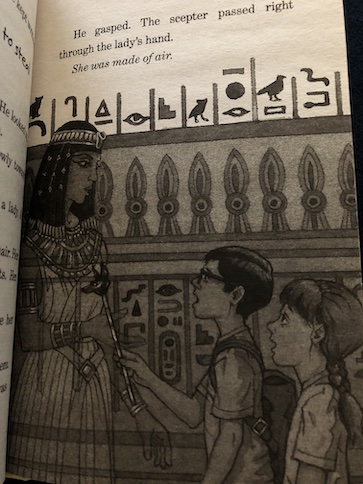
Revolutionary War on Wednesday

Magic Tree House

Revolutionary War on Wednesday by Mary Pope Osborne, 2000.

The story begins with a prologue that explains things that have happened in the series up to this point, saying that Jack and Annie are currently undertaking a series of missions to four special types of writing for the library at Camelot. These missions cover books #21-24 in the series, and in this book, Jack and Annie need to find a piece of writing that represents “something to send.” To find this piece of writing, they’re off to the time of the American Revolutionary War!

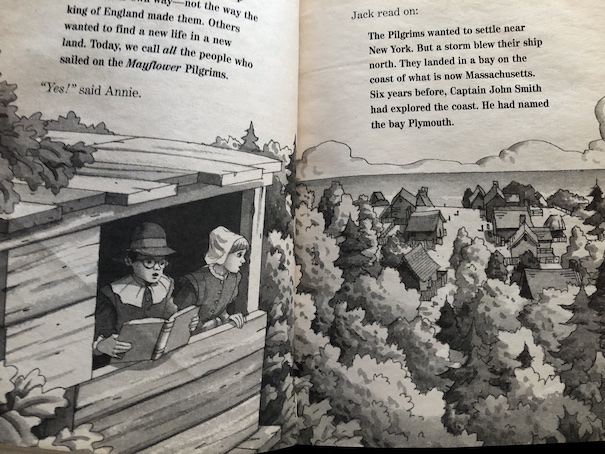
When they arrive, it’s winter, and they find a camp of soldiers nearby. At first, they’re not sure which side the soldiers are on, so they sneak up to the camp to get a look at them. The soldiers catch them spying on the camp, but it’s okay because they’re Patriots, not British Redcoats. The soldiers tell the children that they had better go home, thinking that they’re just ordinary children from their time.

After Jack reads a little further in their book about the Revolutionary War, he realizes that this is December 25, 1776, and that they are about to witness the famous crossing of the Delaware River in Pennsylvania. This was a mission carried out in secret by George Washington and his men. The children listen while George Washington delivers an inspirational speech to the soldiers (“These are the times that try men’s souls.”), but a captain tells them that they had better leave because they don’t want children getting in the way of the mission. However, he asks them to do one favor before they leave. He asks them to take a letter to his family back in Frog Creek. He says that it’s a farewell letter, and they should only deliver it if they hear that the mission has failed and many soldiers were lost. Jack accepts the letter, realizing that this letter represents “something to send.”

Since the children know from their book that the mission will be successful, they can safely keep the letter. Jack thinks that their mission is over, but Annie has other thoughts. She climbs into one of the soldiers’ boats because she wants to spend more time with George Washington. George Washington tries to send the children back, but when the snow gets worse and he considers canceling the mission, the children have to persuade him to continue.

At first, the soldiers think that the children might be enemy spies because they seem to know too much about their mission, and one of them saw Jack writing something down earlier. However, Jack convinces them otherwise when he shows that he copied George Washington’s inspirational speech. He reminds George Washington about what he told his men about perseverance. Jack’s words inspire George Washington to take his own advice.

There is a section in the back of the book with more information about the Revolutionary War and places and people mentioned in the story.

The book is available to borrow and read for free online through Internet Archive.

My Reaction

I didn’t often read prologues to books when I was a kid, and I remember skipping over sections that explained the story background and past events in series that I followed regularly, but in this case, I was glad that the prologue explained the children’s mission. I’ve read books in this series out of order, although I don’t really recommend doing that. The books in the Magic Tree House series are very linear, and there are story arcs that extend over multiple books. If you skip around too much, it can spoil some surprises or disrupt the thread of the story.

I liked how this book introduced children both to the historical event of Washington crossing the Delaware and to the famous speech that he made. The lesson about perseverance was good.

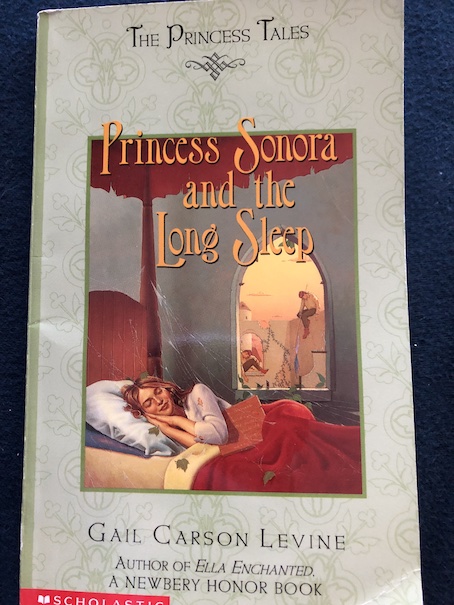
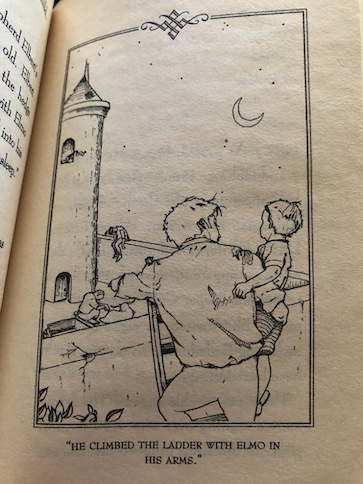
Princess Sonora and the Long Sleep

Princess Sonora and the Long Sleep by Gail Carson Levine, 1999.

This story is a retelling of the classic fairy tale, Sleeping Beauty. It’s part of a series of other retellings and re-imaginings of classic fairy tales called The Princess Tales.

When Princess Sonora was born, her parents invited the usual fairies to give her gifts. They do this because it can be dangerous to anger fairies, although fairies’ gifts are a risky proposition at the best of times. Unfortunately, there are two complications with the fairies who give Princess Sonora gifts. First, one of the fairies decides to top a previous fairy’s gift of intelligence by making Princess Sonora ten times as intelligent as any other human on earth. As a result, Princess Sonora is an unnaturally intelligent baby who begins to talk almost immediately and is smart enough to understand the second problem that arises.

Her parents neglected to invite a particular fairy because they’d heard a rumor that she was dead. Of course, the fairy shows up anyway, angry at the lack of invitation, and immediately curses Princess Sonora. As in the original Sleeping Beauty story, the curse is that, someday, Princess Sonora will prick her finger and die. Also, as in the original story, the last fairy who hadn’t yet given a gift uses her gift to soften the curse so that, instead of dying, Princess Sonora and everyone else in and around her castle will fall asleep for 100 years. She can’t completely remove another fairy’s spell because that might provoke a fairy war, but this change to the curse gives the family hope. She promises that Princess Sonora will meet an eligible prince when she wakes up. Princess Sonora, being an unnaturally intelligent baby who can talk, also gives her own feedback and suggestions on the situation, to her parents’ amazement. Her parents decide to try to prevent the curse from coming true by hiding anything that can prick Princess Sonora, but baby Princess Sonora has already realized that this will be impossible. She knows that the curse will come true someday, and as she lies in her cradle, she begins to make plans to prick herself on purpose, someday when she can choose just the right moment.

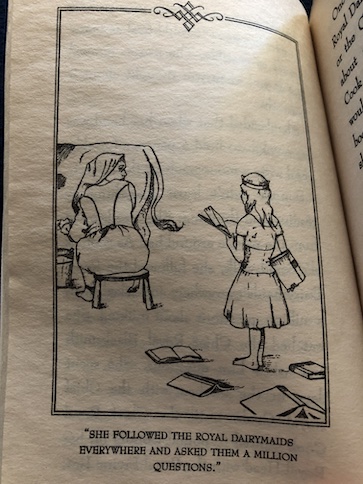
Being smart is generally a good thing, but Princess Sonora’s unnatural intelligence makes her a very peculiar girl in a number of ways. For one thing, she loves books and is always reading, even as a baby. She grows up to be a very studious girl. That’s not so bad, but Princess Sonora carries it to extremes. She also refuses to sleep. It’s partly because she knows that, at some point, she’s going to spend 100 years sleeping, so there’s no point in wasting more time asleep. She’s also afraid of sleep because she doesn’t know where her mind will go when she sleeps, and with her massive intelligence, she loves her mind and doesn’t want it to go away. Instead of sleeping, she just reads all night or thinks about things. Because of her intelligence, curiosity, and constant reading, Princess Sonora knows the answers to many questions, but people often find it irritating because they don’t want to hear her long explanations or all the ways she knows for people to do their jobs better. People start saying to each other, “Princess Sonora knows, but don’t ask her.” Princess Sonora wishes that other people would be more interested in what she has to say, but she knows better than to force the issue.

When Princess Sonora turns 14 years old, her parents begin looking for a prince she can marry, assuming that she doesn’t prick herself and fall asleep for 100 years first. They choose Prince Melvin, from a large and wealthy kingdom nearby. It seems like a smart match, but Princess Sonora knows it isn’t a good one. Prince Melvin has also received gifts from the fairies, and while they include positive qualities, like honesty and bravery, they don’t include intelligence. Prince Melvin isn’t very smart and wouldn’t appreciate any of the things Sonora knows or has to say. He would marry her anyway because he’s Honest and Traditional, but Sonora knows that she wouldn’t be happy. When she meets him, he’s very dull. The fairies made him a Man of Action, not of thought. He’s decided that thinking gets in the way, so he has few ideas and certainly no interesting ones. Sonora begins to think that the right time for pricking her finger might be coming soon. Pricking her finger doesn’t quite go as she had planned, but the curse works.

When Princess Sonora and everyone in the castle is put to sleep for 100 years, they are half-forgotten. Princess Sonora becomes a kind of legend, and the saying “Princess Sonora knows, but don’t ask her” becomes a common saying when someone doesn’t know the answer to something, with few people knowing who Sonora really is or why you’re not supposed to ask her what she knows. That is, until a prince with curiosity and a thirst for knowledge, someone who really needs Sonora’s knowledge to solve a problem, seeks her out for the answers he really needs. When Sonora wakes, she finally meets a prince needs a princess like her and is truly happy to hear what she has to say!

My Reaction

I liked this story when I first read it as part of a collection of other stories in the same series. Gail Carson Levine, who is also the author of Ella Enchanted, often writes stories themed on fairy tales but with her own twists. Princess Sonora’s extreme intelligence and fear of sleep weren’t part of the original fairy tale, although they fit this story nicely. I found the scene with the fairies giving Sonora gifts a little disturbing. When one of the fairies gives her the gift of beauty, the baby physically changes, and it is described as being painful. It is a theme in other stories by Gail Carson Levine that the magical gifts fairies give often have unfortunate side effects. Some of them really turn out almost like curses, but in this case, it turns out to be just what Sonora really needs and leads her to the person who really needs her. Even after people stop getting gifts from fairies when they’re babies, they still have quirks, and Sonora’s quirks fit with Prince Christopher’s quirk for curiosity!

House of Many Ways

House of Many Ways cover

House of Many Ways by Diana Wynne Jones, 2008.

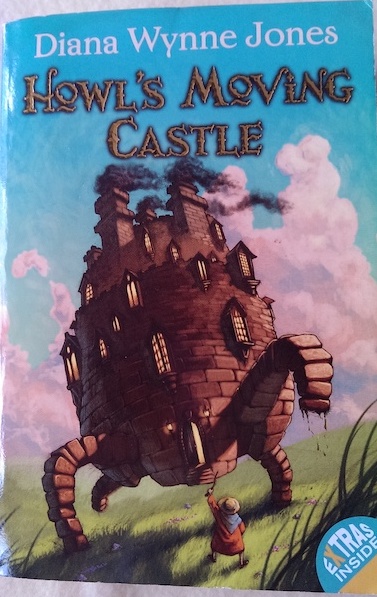
This is the third book in the Howl Trilogy. The Howl books are a loose series. Although the wizard Howl, his wife Sophie, and the fire demon Calcifer are the main characters in the first book and appear in all of the other stories, they are not the main characters in the other stories.

When her Great Uncle William, who is a wizard, has to go away for treatment for a health condition with the elves, Charmaine’s Aunt Sempronia volunteer her to house-sit for him. When Aunt Sempronia goes to tell Great Uncle William that Charmaine will be looking after his house, he asks whether Charmaine knows anything about magic. The aunt says that she doesn’t think so. Charmaine spends all of her time reading and doesn’t usually help much with the housework at home. Her aunt thinks this responsibility would do her good. Great Uncle William is a little concerned because his house is not an ordinary house, and he says that he had better take some precautions.

Although Charnaine could be annoyed at being volunteered for this chore without her permission, she is actually grateful for this opportunity to get away from her parents. Her parents are overprotective of her, and they never allow her to do anything that is remotely daring or doesn’t seem completely respectable. She feels stifled, and she wants the chance for a little independence. One of her first acts of independence is to write to the king, telling him that, more than anything, she would like to help catalog his library. She knows that the king is cataloging it himself with the help of his daughter, Princess Hilda (which was established in the previous book in the series), but Charmaine loves books more than anything and she has always dreamed of being an assistant librarian in the royal library. Her parents would think that she was being too cheeky by asking for this position.

In the meantime, Charmaine can prove herself capable and enjoy further independence in Great Uncle William’s house. When she arrives there, Aunt Sempronia tells her that living in a wizard’s house is serious business. Charmaine doesn’t know much about magic because her parents would never let her study it. They didn’t think magic was very respectable.

When Great Uncle William meets her, he seems pleased by her and starts to tell her that he has taken precautions for her stay in the house. Charmaine is about to tell him that she doesn’t know any magic, but they are interrupted by the elves, who come to take Great Uncle William away for his treatment. Charmaine asks the elves how long Great Uncle William will be gone, but they just say “as long as it takes.” Although Charmaine finds herself alone in the house, she hears Great Uncle William’s voice telling her that she will have to tidy the kitchen and apologizing for leaving so much laundry. His voice also says that there are more detailed instructions in the suitcase he left behind.

Before looking at the detailed instructions, Charmaine decides to take a look around the house and get herself unpacked. The kitchen is a horrible mess, and there are enormous bags of laundry. To her astonishment, there are no water taps in the kitchen sink, but there is a water pump outside. This is going to make her job harder. She is tempted to put her nose in a book and forget all her troubles and chores in the house, but she left the job of packing her own bag to her mother, and her mother didn’t include the books she had sitting out. Charmaine realizes that she should have packed her bag herself. This house-sitting job is going to be an education in responsibility as well as independence for Charmaine.

Charmaine also discovers that there’s a dog in the house that nobody told her about. Great Uncle William’s voice tells her that the dog is called Waif, that he used to be a stray, and that he’s afraid of everything. Charmaine was always afraid of dogs because of her mother’s worries about them, but Waif is so timid that she doesn’t worry about him and shares her food with him.

Charmaine realizes that she has led a very sheltered life, partly because of all of the things she was never required to do and also because of the things her parents wouldn’t let her do. It helps that anytime she asks a question out loud, Great Uncle William’s voice gives her the answer.

As Charmaine starts learning her away around the house, she discovers both that she has her work cut out for her and that it’s incredibly easy to get lost in the house. She also discovers that Great Uncle William’s study has many books in it. A note that her uncle left for her in the study says that he could be gone for about two weeks to a month and explaining more about the spoken instructions he left for her as well as the instructions in the suitcase. The note says that she can use the books in the study, but it warns her to be careful of the difficult spells. Charmaine is very appreciative for the books, although she finds them difficult to understand because they are all about magic. There are also many letters in the study written to her uncle by other wizards, including one from the wizard Howl. Many of the letters are from people asking Great Uncle William to take them on as apprentices. Charmaine thinks that her letter to the king probably sounded as pathetic as some of those letters to her great uncle.

Because Charmaine has never been allowed to try any magic before, she can’t resist trying one of the spells from one of her uncle’s books. She chooses one that looks pretty easy, but because the book’s pages turn every time she leaves to get more ingredients, she ends up putting bits and pieces of different spells together. Her spells does what she intends it to do, but the full results take some time.

Things get complicated when Charmaine has a terrifying encounter with a creature called a Lubbock while picking flowers in the mountains near the house. The Lubbock claims that it owns all the land around and everyone in it … including Charmaine. She has a narrow escape, getting away from the creature!

After she returns to the house, she meets a new arrival: Peter, Great Uncle William’s new apprentice. This unexpected guest gives Charmaine an extra responsibility. Peter is still pretty inexperienced with magic and often gets left and right mixed up, but even though he’s almost as inexperienced with everything as Charmaine, he is still company for her in this strange house. He recognizes that the reason why the house is so confusing and rooms seem to move around is that Great Uncle William has cast a spell on the house to bend space and include extra rooms in the house.

When Charmaine tells Peter about her encounter with the Lubbock, he is alarmed. The two of them research Lubbocks in Great Uncle William’s books, and what they learn is horrifying. Lubbocks need human hosts to reproduce, and those hosts die. The Lubbock offspring are also evil. While a full Lubbock looks like a purple insect, a human and Lubbock hybrid will have purple eyes. Charmaine and Peter reassure themselves that neither of them shows any sign of being part Lubbock. However, even with her aunt and mother coming to check on her, Charmaine isn’t prepared to let her fear of the Lubbock ruin her first experience with independence.

To her surprise, the king also accepts her application to work in the royal library! The cataloging work in the library isn’t quite as much fun as she had imagined it would be because much of it is routine documents, but Charmaine learns that the king and his daughter are searching for some very important documents. Before he went away, Great Uncle William was also helping them. Now, the princess has called in an old friend of hers, Sophie Pendragon, wife of the Royal Wizard Howl of Ingary. There is a plot against the royal family which has kept them poor. Not all of the royal family is what they seem to be, and some of the secrets of the past are hidden in Great Uncle William’s unusual house.

The book is available to borrow and read for free online through Internet Archive (multiple copies).

My Reaction

Some of the characters in this book other than Sophie, Howl, and Calcifer were introduced in the previous book in the series. The elderly princess was one of the princesses kidnapped by the djinn, which is how she met Sophie. The king’s cook, Jamal, and his dog were also introduced in Castle in the Air. However, Charmaine is definitely the main character of the story, along with Peter as her sidekick and main helper. The other characters are there for support. Howl and Sophie help Charmaine by providing her with information that she wouldn’t have had otherwise, and Calcifer destroys some of the threats because only a fire demon is powerful enough to do it. Howl is in the castle in disguise because, as one of the royal wizards of another country, it wouldn’t be right for him to seem to be working for the royal family of another country. Unlike in Castle in the Air, though, readers know right away what Howl’s disguise is, and it’s played for comedy. The villains of the story aren’t too difficult to spot once they appear. What is more mysterious is what the king is searching before and what happened to it.

Charmaine’s self-discovery is a major part of the story. Charmaine knows from the beginning that she has lived a very sheltered life because of her mother’s standards for what is “respectable” and proper for a young girl like her. She has already decided that she doesn’t agree with all of her mother’s ideas and that she wants some independence. To her credit, although she does resent some of the routine chores she has to do while taking care of Great Uncle William’s house, she is determined to learn what what she has to learn to achieve some independence and do some of the things she really wants to do. Peter knows more about some things than Charmaine does, like how to do dishes and laundry, so he is some help to her, but he has only recently left home to take up his apprenticeship, so there are things that he doesn’t know, either. Neither one of them knows how to cook, so they turn to Charmaine’s father for advice and recipes. Charmaine’s father is more broad-minded than her mother, so he is willing to help. Charmaine also gradually learns to get along with Peter, and they learn how to consider each other’s feelings and allow each other their own learning opportunities. At one point, Peter tidies up Charmaine’s room as a favor to her, but she is annoyed and tells him not to do that anymore because she wants to take care of her own things for herself.

From her own experimentation and from what her father tells her, Charmaine discovers that she has a natural talent for magic. She inherited her magical talent from her father, who admits to her that he has secretly been using his talent for making things in his bakery. He never tells his wife about his magic because she wouldn’t approve.

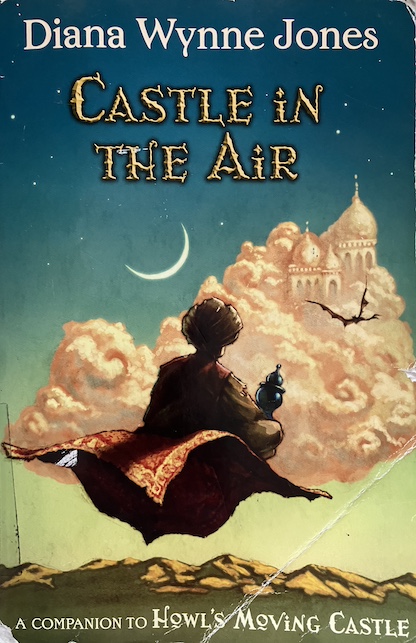
Castle in the Air

This is the sequel to Howl’s Moving Castle, the second book in the Howl Trilogy, although the characters from the first book only appear in secondary roles in this one. The series is somewhat loose, sort of like the Chrestomanci series by the same author. Characters from earlier books appear in later ones, but the main characters change in each book. This story is set in a country to the south of Ingary, where the first book took place, in a sort of Arabian Nights type setting.

Abdullah is a carpet merchant, operating a modest booth in the bazaar. He did not receive much inheritance from his father, having disappointed him in some way before he died. Apparently, there had been some sort of prophecy about Abdullah when he was born, and Abdullah has not lived up to it. He doesn’t know what the prophecy was, and mostly, it doesn’t bother him much, although he sometimes likes to imagine what it could have been, building “castles in the air” in his daydreams, where he is the kidnapped son of a king. Abdullah is mostly content with his life, doing enough business to get by, slowly building his business to have better stock, and using his free time for his daydreams. The only part of his life that he doesn’t like is when his father’s first wife’s relatives stop by his booth and nitpick him, telling him what a disappointment he is, how he should be more prosperous, how his business should be better than it is, how he should already be married, everything they can think of to make him feel bad about himself.

Then, one day, a stranger comes by Abdullah’s booth to sell him a carpet. The stranger is rude and disparaging of Abdullah’s shop, and Abdullah is dubious about the quality of the carpet he is trying to sell. The carpet seems rather old and worn. The stranger tells him that it’s a magic carpet and can fly. At first, Abdullah thinks that’s just a story to make him pay more for the carpet than it’s worth, but the stranger shows him that the carpet can fly by making it hover in Abdullah’s shop. Abdullah checks the carpet over and tries it out himself to assure himself that it’s not some kind of trick, but the carpet can really fly! Abdullah wonders why someone would be selling a perfectly useful and valuable flying carpet, even if it is a bit worn, but he decides to buy it anyway. Since he doesn’t like the stranger and suspects that there is some kind of trick involved, he drives a hard bargain, but eventually purchases the carpet. That night, Abdullah decides to sleep on top of the carpet, just in case the stranger’s trick is to call the carpet back to him in the middle of the night after having made the sale.

When Abdullah wakes up in a beautiful garden, like the one he imagines in his daydreams where he is secretly a prince, he assumes that he is dreaming. When a beautiful princess comes to him in the garden, he is sure that this must be a dream, although she doesn’t look exactly like the princess he always imagined himself in his daydreams. He decides to alter his daydreams to suit the girl. Since he thinks this is just a dream, he introduces himself to the girl as his imaginary alter-ego, the long-lost prince of a distant kingdom.

To Abdullah’s astonishment, the princess is astonished when he says that he is a man. For one thing, Abdullah is still wearing his nightgown, which the princess thinks resembles a dress, and for another, Abdullah doesn’t resemble any man she’s ever seen before. The truth is that the princess has not seen many men before. In fact, the only man she’s ever seen in her life is her father, who is a much older man than Abdullah. She thinks that all men are older men, like her father. Abdullah has heard that royal girls are kept practically prisoners, hidden away from other people. The princess, who is called Flower-in-the-Night, says that her father has kept her away from other men because he has already chosen her husband for her and doesn’t want any other man to fall in love with her and carry her off first, ruining his plans. Even though she knows that she has lived a relatively sheltered life, she still suspects that maybe Abdullah is still not a man, although she admits that it could just be because he is from a different country. She says that she wants to know all about him and his country. Abdullah, still thinking this is a dream, tells her about his daydreams of being a prince as if they were true. Then, in spite of thinking that this encounter is all a dream, he offers to come again and bring the princess as many pictures of other men as he can find, both to prove that he really is a man and also so that the princess will have a more realistic idea of what men are, so she will know whether or not she really loves the man he father has chosen for her.

After he lays back down on his carpet again, he wakes up in his own booth in the bazaar, and the carpet is still there, underneath him. The only thing he can’t find is his nightcap. After his dream, which is the most realistic dream he’s ever had, Abdullah’s ordinary life suddenly seems incredibly drab. The more he thinks about his dream, the more Abdullah remembers that he took off his nightcap in his dream. It makes him realize that the dream was actually real, and he left the nightcap behind in a real garden he visited during the night!

Abdullah comes to the conclusion that, thinking about his daydreams while he went to sleep, he must have said something in his sleep that caused the carpet to take him to the garden of a real princess. Now that he knows that the princess is real, he goes to a local artist and asks him to draw portraits of all different types of men, young and old. It’s a strange request, so he explains that it’s for a friend who is an invalid and cannot go out and see people. The artist is intrigued (and also thinks that Abdullah may be crazy), so he agrees to do it for a low price. When other people learn that Abdullah is collecting portraits now, many people try to sell him their portraits, too. It just sounds that much crazier when Abdullah refuses to buy any female portraits. Abdullah tells people that he’s think of expanding his business to selling art as well as rugs.

Abdullah realizes that the magic carpet seems to require a kind of code word to work, something that the man who sold it to him didn’t tell him but which he’s been saying in his sleep. He tries all kinds of words when he’s awake, but he can’t figure it out. Fortunately, the carpet works again when he’s asleep. He once again finds himself in the garden with Flower-in-the-Night. After he shows her all of the pictures of different men he’s collected, Flower-in-the-Night admits that she was wrong and that he’s definitely a man. She now realizes that her father is not a typical example of what all men are like, and to Abdullah’s delight, she says that she likes him better than any of the other men in the pictures. She says that she wants to marry him! Although that’s what he wants, too, it’s awkward because, when he saw her before, he was acting out his daydream with her, and he’s not really a prince. Breaking it to her gently, Abdullah says that, even if he was once a prince, he is now a carpet merchant and not a wealthy man, like her father would want to marry. Flower-in-the-Night insists that she doesn’t care.

Abdullah explains to her how he comes to her on the magic carpet but that he can apparently only use it to travel when he says the right word when he’s asleep. Flower-in-the-Night is an educated and intelligent young woman, something that Abdullah admires in her besides her beauty, and she deduces from what’s she’s read about magic carpets that the secret word is some common word that is pronounced in an old-fashioned way. Unfortunately, Abdullah accidentally sends himself back home too quickly, without Flower-in-the-Night!

He consoles himself by thinking that he will just have to make some arrangements that day and visit her again the next night to elope with her. However, his father’s first wife’s relatives have also been making arrangements for him. Although Abdullah has not known what kind of prophecy was made about him when he was a baby, they have known for years. That day, they reveal to him that the prophecy was that he would not follow his father in his business (the thing that had always disappointed his father) but that he would be raised above everyone else in the land two years after his father’s death. They’re not exactly sure what being raised above others in the land means, but they think it must mean that he is destined for some kind of honor or high social rank or wealth. Now, two years after his father’s death, the news that Abdullah has started dealing in art and not just carpets, like his father did, signals to them that Abdullah’s fortunes are changing and that his destiny for some kind of greatness must be close at hand.

His father’s first wife’s relatives try to force him to marry a couple of nieces of theirs to keep that greatness or whatever wealth might be coming to Abdullah in their family. Abdullah is appalled, and to get out of the marriages they are trying to arrange, he lies and tells them that his father made him take a solemn vow not to marry until he has achieved the goal of the prophecy and been raised above all others in the land. This gets him a temporary reprieve, but he knows that the relatives will check all of the officially recognized vows to verify whether he’s telling the truth.

His only hope is to return to Flower-in-the-Night and elope with her, taking her as far away as they can go to start over beyond her father’s reach. Unfortunately, when he returns to her garden, he is just in time to see her abducted by a djinn! Horrified, he tries to chase after the djinn on his magic carpet to rescue Flower-in-the-Night, but he isn’t able to follow the djinn. Not knowing where the djinn has taken Flower-in-the-Night, Abdullah returns home without her. The next morning, he is arrested by the Sultan’s men for kidnapping the princess! The Sultan knows that he has been visiting Flower-in-the-Night because he left behind his nightcap, with his name on it.

Under the Sultan’s questioning, Abdullah admits to visiting the princess and bringing her all the portraits of men that the Sultan has found among the princess’s belongings, although really, the Sultan has found less than half of the pictures that Abdullah brought. Abdullah points out that the Sultan has a strange way of caring for his daughter, by raising her to be so isolated that she can’t even recognize a man when she sees one. The Sultan admits that he had to raise her that way because a prophecy when she was a baby said that she would marry the first man she saw, apart from her own father. He planned to introduce her to the man he picked for her before she could see anyone else, and Abdullah’s sudden appearance has ruined his plans. Abdullah is sure that the Sultan will execute him for what he’s done. To Abdullah’s relief, the Sultan knows that he can’t cheat the prophecy, so the Sultan plans to find his daughter and make her marry Abdullah. Unfortunately, that doesn’t rule out executing Abdullah after the wedding. The Sultan also doesn’t believe Abdullah’s story about the djinn kidnapping the princess. He’s convinced that Abdullah is hiding the princess somewhere, so he has Abdullah locked in the dungeon until he can find her.

Abdullah despairs in the dungeon, knowing that the Sultan and his men won’t find Flower-in-the-Night and that he can’t tell them where she is. Then, his friend Jamal’s dog accidentally brings him the magic carpet. From there, Abdullah sets off on a wild journey, fleeing from the Sultan’s men, becoming the captive of bandits, and finding a bottle with a genie in it who must grant his wishes. With the help of a genie, finding Flower-in-the-Night seems like it should be easier, but that doesn’t mean that’s going to be easy. Even if the prophecy guarantees that Abdullah will somehow be successful in finding and marrying Flower-in-the-Night, there are no guarantees for what will happen to him afterward. Even the djinn is a pawn in someone else’s game.

The book is available to borrow and read for free online through Internet Archive (multiple copies).

I first read this book not long after I read Howl’s Moving Castle in high school. At the time, I knew it was a sequel to Howl’s Moving Castle, and I was confused by the change in location and because it took a long time before Howl and Sophie appeared in the story. At first, it seems like this is a completely unrelated story to the first book, but actually, Howl and Sophie are very involved in Abdullah’s situation. It just isn’t obvious because neither of them are recognizable when they first appear in the story. About halfway through the book, Abdullah learns what has happened to Howl’s moving castle, but what has happened to Howl and Sophie isn’t clear until later. Howl’s moving castle has been commandeered by the true villain of the story, and the people of Ingary think that Howl is missing. By the end of the book, it is established that Howl is a royal wizard as well as Suliman, and he and Sophie are not only married, but they have a child of their own. Their son’s name is Morgan. Since the last book, Sophie’s sister Lettie has married Suliman and also has a baby.

Prophecies play important roles in the story, and I like how the characters realize that prophecies can be literal or figurative, and there are situation that the prophecies don’t cover. The Sultan accepts that his daughter must marry the first man she sees other than himself because of the prophecy about her, and while he’s disappointed that this man turns out to be Abdullah the carpet merchant, there’s nothing in the prophecy that says that he can’t execute Abdullah immediately after the wedding and marry his daughter to someone else. The prophecy that Abdullah will be “raised above” everyone else can also have many possible meanings. It could mean that Abdullah will come to some high status in life, or it could mean that the Sultan will follow through on his threat to have Abdullah impaled in the air on a 40-foot pole.

Of course, the story has a happy ending. I was concerned that Flower-in-the-Night would be upset that Abdullah wasn’t telling her the truth about being a kidnapped prince, but she actually realizes the truth before Abdullah admits it to her. She understands how Abdullah feels because she used to have a daydream of her own about being an ordinary girl with a father who sold carpets in the marketplace.

Howl’s Moving Castle

Howl’s Moving Castle by Diana Wynne Jones, 1986.

The kingdom of Ingary is the land of fairy tales. There is magic, and in a family of three children, it’s always expected that the youngest of the three will be most successful. Sophie Hatter, as the oldest of three, is disappointed when she first realizes that, but she reconciles herself to her rather dull fate. She is devoted to her younger sister and half-sister, and she does her best to look after them and help prepare them for their futures.

When Sophie Hatter’s father dies, her stepmother Fanny has to decide what arrangements to make for the family’s hat shop and the three girls in the family: Sophie, her younger sister Lettie, and her half-sister Martha.  Because Martha is very bright and expected to one day seek her fortune in the world, as third children generally do, Fanny arranges for her to become an apprentice to a respected witch.  Lettie becomes an apprentice in a pastry shop, where she will learn a good trade and possibly meet a nice young man to marry.  Sophie, as she had always expected, continues to work in the hat shop.  None of the three girls are particularly excited about the arrangements, but they make the most of it.  Sophie does have a talent for hat-making.  In fact, she has a very unusual talent because, as she talks to the hats while she makes them, the things she predicts for the buyers come true. People become increasingly attracted to the hat shop because it seems like good things happen to people who buy hats there.

Sophie is good at working in the hat shop, but she has to admit that her life there is dull. She doesn’t really know what else she would want instead, but she feels isolated, hearing gossip from other people but not really talking to anybody herself. A visit to her sister Lettie on May Day puts Sophie’s life in perspective and calls the things that are expected of older and younger siblings into question. Sophie learns that her sisters, dissatisfied with the arrangements Fanny made for them and having ambitions other than the ones that are expected of them, have secretly switched places with each other. Lettie craves learning and adventure, so she has taken Martha’s place as the witch’s apprentice to learn magic. Martha doesn’t actually care about going out to seek her fortune at all. She doesn’t want adventure or riches. What she really wants, although she’s never admitted it before, is to marry, settle down, and have ten children. Working in the pastry shop, she has already attracted quite a following of young men, and she’s sure that she’ll find one who will love her and make her happy. Neither of them cares about fitting the tradition mold of three siblings, and they’re both concerned about Sophie’s future. Sophie has never had any particular ambitions of her own, but her sisters know that being shut up in the hat shop all the time isn’t good for her. They think Fanny is taking advantage of her because it’s Sophie’s work that’s attracting all the customers these days, and Fanny isn’t even paying her an apprentice’s wage! Apprentices like Lettie and Martha get wages at other businesses, but Sophie’s been working for free while Fanny takes all the profits. It gives Sophie a lot to think about, and she becomes convinced that she’s being exploited when she asks Fanny about wages, and Fanny puts her off. Sophie is so angry that she thinks maybe she should run away to seek her fortune, but she can’t shake the idea that eldest children can’t do that. Soon, circumstances intervene to force Sophie to be the one to go out and seek her fortune anyway.

Dangerous and mysterious things are happening in the kingdom. Rumor has it that the evil Witch of the Waste has threatened the king’s daughter and that the king’s personal wizard, Suliman, has vanished after going to deal with her. People think that the Witch of the Waste probably killed him. The king’ brother, Prince Justin, also went in search of Suliman and disappeared.

One day, the Witch of the Waste pays a visit to Sophie’s hat shop.  Mistaking Sophie for one of her sisters, the witch curses Sophie, turning her into an old woman.  Unable to explain to anyone what has happened (which is part of the curse), Sophie makes the decision to leave the hat shop, finding a new job as housekeeper to the mysterious wizard Howl, a sinister figure himself.  Little is known about Howl, although he is known to live in a strange castle that moves from place to place, apparently of its own accord, and he has a reputation for breaking women’s hearts.

Howl is even stranger although somewhat less sinister when Sophie gets to know him.  He allows Sophie to stay in his castle, not so much by requesting her to stay but by not telling her to leave, much like he did with his apprentice Michael, an orphan who came to live with him and gradually became his apprentice when Howl decided not to send him away.  Howl is vain (using makeup and hair dye to make himself more handsome), immature, and somewhat cowardly, but he is still a powerful wizard and can accomplish great things when he makes up his mind that he wants to (or finds himself unable to refuse).  He doesn’t real steal girl’s souls, as some of the rumors about him say, but he is definitely a flirt and a womanizer, who drops girls as soon as they fall in love with him because he likes pursuing them but is afraid of commitment. In fact, he even has Michael spread scandalous rumors about him in the towns where they do business so people will be more reluctant to try to get him to commit to anything or anybody.

Howl has other problems aside from his immaturity and fear of commitment.  Calcifer, the mysterious fire demon that powers the moving castle, hints as much to Sophie.  He hopes that Sophie will be able to help, although he, too, is unable to explain the reason why for magical reasons.  Howl is not an ordinary person, but a traveler from another dimension, from a strange country called Wales, the same place where the king’s wizard, Suliman, was from. In Suliman’s absence and against Howl’s will, the king recruits Howl to be the new royal wizard, to find the missing Suliman and Prince Justin, and to deal with the Witch of the Waste.

Sophie struggles to convince/cajole/force/help Howl to save the kingdom and to learn the secret curse that Howl himself is living under even while suffering from her own curse.  Surprisingly, it seems that Sophie is the key to breaking not only Howl’s curse but her own.

The book is available to borrow and read for free online through Internet Archive (multiple copies). It’s the first book in a loose series. Many people these days are familiar with the story because it was made into a Miyazaki movie, although the movie was very different from the book in a number of ways.

My Reaction and Spoilers

I first read this book when I was in high school, years before the movie version was made. In a way, the book is party mystery or puzzle as well as fantasy. Calcifer and Howl have a problem that they can’t talk about because of the magic around it. Only one rumor about Howl is true: Howl is literally heartless. But, Calcifer has a heart. It takes a long time for Sophie to make the connection and to realize what Calcifer actually is and what Howl did. Howl made a sacrifice years before that has left both Howl and Calcifer in a precarious position. The clues to Howl’s past and the arrangement between him and Calcifer are in a poem by John Donne that turns out to be part of Howl’s nephew’s school assignment. The Witch of the Waste, who turns out to be one of Howl’s former, discarded conquests, knows Howl’s secret and is trying to use it to get revenge on Howl.

Although the movie version is very good, and I enjoyed watching it, it is very different from the original book. The beginning part of the movie, where Sophie is working in the hat shop and cursed by the Witch of the Waste before going to work for Howl is very similar to the original book. However, the major problem of the war in the movie never happened in the book. War is a common theme in Miyazaki movies, but there’s nothing in the book about wizards making themselves into weapons of war. Instead, the main problems of the book are about lifting Sophie’s curse, figuring out what the secret contract between Howl and Calcifer is, evading the wrath of the Witch of the Waste, and finding the missing Suliman and Price Justin. The movie addresses the arrangement between Howl and Calicifer, but it doesn’t fully cover any of the rest of it. There are some characters and plot lines from the book which were combined or reduced in the movie in favor of the war plot, which I found less interesting because it has less intrigue. In the movie, the Witch of the Waste is tamed and redeemed as a character, but in the book, she really is evil and is never redeemed.

There’s also nothing in the movie about Howl being from Wales in our world and the land where he lives being a different dimension, but that’s a major part of Howl’s character in the book. In the book, Sophie even visits Wales with Howl and meets his family. His sister thinks that Howl, known as Howell Jenkins in his native Wales, is a wastrel, who hasn’t made anything of himself in spite of his college education. She’s only partly right. What she doesn’t know is that Howl started learning about magic at university, which is how he found out how to travel to other dimensions and make himself into a wizard. In spite of his immaturity and attempts to avoid certain types of service, he is actually very skilled and powerful. Howl can’t tell his sister the truth, so he just lets her think that he’s a wastrel.

Sophie finds Wales strange and mysterious. She is terrified when Howl takes her and Michael for a ride in his car. One of my favorite parts is when Howl needs to talk to his nephew about the poem he was assigned at school, but he doesn’t want to talk to Howl because he’s playing a computer game with a friend. Sophie and Michael don’t understand computers or that the boys are playing a game, so when the friend says that he can’t stop to talk or he’ll lose his life, they think that the boy’s life is really in danger. They almost panic when Howl pulls the plug on the computer to get his nephew’s attention, totally unworried about his nephew possibly dying. That’s one of the reasons why I prefer the book to the movie. Many of the humorous little moments like this are lost in the movie, although the movie did keep the episode where Howl has a temper tantrum and fills the house with green slime.

There are also intricacies of the plot that aren’t explained in the movie. The one I mind the most is that the movie doesn’t fully explain how the curse on Sophie works or how it gets broken, either. The book provided more information, which helps Sophie fully appreciate who she really is. As Calcifer realized soon after meeting Sophie, removing the curse on Sophie is complicated because it has two layers. Howl even admits later that he’s been quietly trying to remove Sophie’s curse himself, but he was never successful because Sophie was actually maintaining the curse herself. The first layer was what the Witch of the Waste did to her, but Sophie herself has magical powers that she has been unconsciously using throughout the book. The reason why good things kept happening to the people who bought her hats was that she was unconsciously casting spells on the hats when she talked to them while making them. The second layer of the spell on Sophie herself was her unconsciously reinforcing her sense of being old through all of the negative things she’d been telling herself about being the eldest child in her family. Sophie’s power typically manifests in the things she tells to people and things, and she’s been telling herself all the wrong things.

Because of all of the tales about how the youngest children are the ones who successfully go out to seek their fortune, Sophie has felt relegated to just being the eldest, helping other people, and not really thinking about what she wants for herself. Even as a young woman, she acted and felt old before her time because she didn’t have any confidence in herself or anything to look forward to in her future. Her sisters even worried about her for not having enough self-respect, no ambitions or dreams of her own, or ability to stand up for herself. Because she never expected to do much of anything with her life or any belief that she might have talents of her own, she and everyone else completely overlooked all of the magic that she’s been instinctively doing. When Sophie discovers that her sisters have switched places and learns about their real life ambitions, she is stunned to realize that she has badly misunderstood both of them for most of their lives, also making assumptions about them based on their birth order. She has also misjudged or underestimated other people, but the person she’s misjudged and underestimated is herself. Howl is the one who tells her that there’s nothing wrong with her being the eldest sister; the times when she gets things wrong have been when she acts without fully thinking things through. Part of the key to breaking her curse is to get rid of the negative feelings she’s had about herself and her ability and to see herself for who she really is: a person with powerful talents and a right to want things and achieve things for herself and her future. Once she sheds her doubts about herself and her abilities and stops thinking of herself as just the eldest and doomed to fail, she realizes how she can use her powers to save Calcifer and Howl, and Calcifer lifts the rest of her curse.

Day of the Dragon King

Magic Tree House

Day of the Dragon King by Mary Pope Osborne, 1998.

Since Jack and Annie first found the magic tree house full of books, they have managed to solve the ancient riddles and become Master Librarians. The owner of the tree house, Morgan Le Fay, has sent them on missions to retrieve lost stories from ancient libraries. This time, Morgan is sending them to ancient China to retrieve a legendary tale before the Imperial Library is destroyed. They have a guide book about the first emperor, called the Dragon King, to help them, but Morgan tells them that they will need the legend they are retrieving to rescue themselves in the end.

When they arrive in the past, a man asks them to take a message to the silk weaver as a favor. They agree and ask him where they can find the Imperial Library. The man doesn’t answer them, but he acts scared and tells them to beware of the Dragon King. They take the message to the silk weaver, telling her to meet the man at twilight, and she thanks them by giving them some silk thread. They ask her about how silk is made, and she tells them a little about it, but she also says that the method of producing silk is supposed to be a secret. If the Dragon King finds out that they know, they might be put to death!

When someone spots them talking to the silk weaver and chases them, Jack and Annie hide in a cart, and they are taken into the emperor’s city. To their surprise, the driver of the cart turns out to be a scholar in disguise. Scholars have gone into hiding because the emperor fears them and their learning. He wants to control people’s knowledge, and to keep people dependent on him, he has decided to burn all the books in the Imperial Library! When the scholar sees their Master Librarian cards, he understands who they are and promises to help them save the legend from the library before it is burned.

Unfortunately, the burning of the library has already started. Annie grabs the book they’re looking for, and the children are forced to run away from the king’s soldiers, who chase them and shoot arrows at them! When they take refuge in a tomb, they are shocked to see something that neither of them expect.

The book is available to borrow and read for free online through Internet Archive (multiple copies).

My Reaction

The surprising discovery the children make is the collection of terracotta soldiers that the Dragon King has prepared to populate his tomb. Although there is no paint left on the statues now, the children describe seeing them with their original, life-like paint. The same is also true of Ancient Greek statues. People think of classical statues as being just plain marble, but when they were first made, they were also painted with life-like colors.

Jack and Annie are able to save the book they came to find, which is in an unusual format, made with bamboo strips. Before Morgan le Fay sends them on their mission, she tells them a little about the history of paper and books. The reason why the book they find is made with bamboo strips is that is what Chinese people used to make books before they invented paper.

Unfortunately, Jack and Annie can’t prevent the burning of the rest of the Imperial Library. I didn’t know before about the burning of the Imperial Library by the Dragon King, and I was fascinated to find out about this other side of the reign of the emperor who commissioned the creation of the terracotta soldiers.

The Knight at Dawn

The Magic Tree House

The Knight at Dawn by Mary Pope Osborne, 1993.

After the previous adventure that Jack and his sister Annie had in the Magic Tree House, Jack is still puzzled about how the tree house travels though time and who owns it and the books inside. He also wonders about the gold medallion with the letter ‘M’ on it. Both Jack and Annie are having trouble sleeping because they’re wondering about these things, so Annie suggests that they go to the tree house early in the morning to see if they can catch the owner there.

However, when the kids get there, nobody is there, and the books are still where they left them. Annie points out a book about knights and castles that she likes. Although Jack tries to warn her to be careful, Annie wishes that they could see the knight, and the tree house takes them back in time to the Middle Ages. They see a large castle outside the tree house and a knight on a black horse.

Jack thinks that they should use the book about their home town to go home immediately and make some plans before they do anything else in the past, but Annie wants to stay and look around before they leave. She climbs out of the tree house, and Jack has no choice but to follow her.

They discover that there is a feast at the castle, and Annie wants to see the feast for herself. As the children spy on the feast, a servant spots them and demands to know who they are. Jack and Annie run away and hide in the armory, but they are found by guards, who take them to the dungeon. Annie startles the guards with her flashlight, and they are able to escape.

They find their way out of the castle through a secret passage and encounter the knight on the black horse. But, is he a friend or an enemy?

My Reaction

The Magic Tree House series is meant to be educational as well as fun fantasy stories, and I enjoyed the pieces of Medieval trivia throughout the story. As the kids explore this new time period, Jack reads the book about knights and castles to learn more about where they are and what’s happening there.

However, not all the facts in the book are true. The part where Jack was reading about how heavy a knight’s armor was isn’t right. His book says that a knight’s helmet could weigh forty pounds by itself. Jack remembers that he weighed forty pounds when he was five years old, so he thinks wearing a knight’s helmet could be like having a five-year-old on someone’s head. However, according to The Metropolitan Museum of Art, entire suits of armor weighed roughly 45 to 55 pounds, with the helmet weighing about 4 to 8 pounds. That’s still a heavy amount for someone to carry on their head, but far more reasonable than 40 pounds.